Tag: BARC India

  • BARC India scales up drive against panel tampering

    BARC India scales up drive against panel tampering

    MUMBAI: Continuing with its mission to make audience measurement more robust in India, BARC India has upped its Vigilance drive with stronger counter-measures to protect the system from Panel Tampering and other unfair practices with respect to manipulation of television viewership.

    In March 2017, BARC India had set up an independent Disciplinary Committee (DisComm) to probe complaints of viewership malpractice. Over the course of last 28 months, 18 cases have been referred to the DisComm with evidence of such malpractices. 

    The highest number of instances have been reported from markets in South India: 6 from Tamil Nadu, 5 from AP/Telangana and 1 from Karnataka. Penal action has been taken against 12 channels in the country. It may be recalled that FIRs were filed in Telangana and arrests have been made in Karnataka and Gwalior.

    The DisComm is headed by Justice Mukul Mudgal, former Chief Justice of Punjab and Haryana High Court, and has representation of all three industry bodies Indian Broadcasting Federation (IBF), Indian Society of Advertisers (ISA) and Advertising Agencies Association of India (AAAI). The committee also comprises of D. Shivanandan, former Mumbai Police Commissioner and Maharashtra DGP, and Paritosh Joshi, independent technical expert.

    BARC India is also evangelizing initiatives like Sample Return Path Data (SRPD), which will not only make the viewership data more robust but will also help address the issue of panel home tampering. BARC India also has a strict code of conduct for redressing viewership malpractices that is undertaken by all entities subscribing to BARC India’s weekly service. 

    BARC India has also engaged with TRAI and Ministry of Information & Broadcasting to get regulatory support and legal provisions to make panel tampering a punishable offence. BARC India and several industry members have made the point in TRAI’s Consultation Paper on TV viewership measurement.

    “The functioning of the Disciplinary Committee has been extremely professional and effective since its inception in March 2017. Panel Home tampering has long plagued the industry and the giant strides that BARC India has taken to tackle this menace and the sanctions imposed have proved an effective deterrent. Along with my other committee members, we are firm in our resolve to eradicate such malpractices from the industry and shall impose appropriate sanctions as and when required.” added Justice Mudgal

  • BARC week 29: B4U Bhojpuri leads in Bihar/Jharkhand (U+R) HSM

    BARC week 29: B4U Bhojpuri leads in Bihar/Jharkhand (U+R) HSM

    MUMBAI: In regional GECs, B4U Bhojpuri jumped to the leading position in week 29 of BARC India ratings. The channel has jumped from third position last week to first position in week 29. Last week Bhojpuri cinema was at first position, this week the channel has moved to second position. 

    Bhojpuri

    Rank Channel Name Weekly Impressions (000s) sum
        Week 29
    1 B4U Bhojpuri 65061
    2 Bhojpuri Cinema 62589
    3 Big Ganga 59600
    4 Dabangg 16429
    5 Bhojpuri Dhamaka DISHUM 15485
    Bihar/Jharkhand (U+R) : NCCS All : 2+ Individuals,


    In Tamil segment, Star Vijay Super was the new entrant in the list of Tamil (U+R) segment. The channel replaced Star Sports 1 Tamil at fifth position.


    Tamil

    Rank Channel Name Weekly Impressions (000s) sum
        Week 29
    1 Sun TV 800111
    2 STAR Vijay 506334
    3 Zee Tamil 386563
    4 KTV 254132
    5 STAR Vijay Super 94683
    Tamil Nadu/ Puducherry (U+R) : NCCS All : 2+ Individuals, 

    Zee Telugu and ETV Telugu have exchanged their positions and are at second and third positions. Star Maa Movies has replaced Gemini Movies in week 29. 

    Telugu

    Rank Channel Name Weekly Impressions (000s) sum
        Week 29
    1 STAR Maa 645802
    2 Zee Telugu 441470
    3 ETV Telugu 438562
    4 Gemini TV 411539
    5 Star Maa Movies 196550
    AP/ Telangana (U+R) : NCCS All : 2+ Individuals, 

    There were no changes in the Marathi segment. The genre was led by Zee Marathi and was followed by Fakt Marathi, Colors Marathi, Zee Talkies and Star Pravah. 

    Marathi

    Rank Channel Name Weekly Impressions (000s) sum
        Week 29
    1 Zee Marathi 383723
    2 Fakt Marathi 226194
    3 Colors Marathi 177330
    4 Zee Talkies 136492
    5 STAR Pravah 109059
    Mah/ Goa (U+R) : NCCS All : 2+ Individuals, 

    Colors Gujarati Cinema was in the leading position in week 29. The channel was followed by Colors Gujarati, TV9 Gujarati, ABP Asmita and Sandesh News.

    Gujarati 

    Rank Channel Name Weekly Impressions (000s) sum
        Week 29
    1 Colors Gujarati Cinema 30314
    2 Colors Gujarati 22085
    3 TV9 Gujarati 13730
    4 ABP Asmita 12747
    5 Sandesh News 10162
    Guj / D&D / DNH (U+R): NCCS All: 2+ Individuals

    Sony Aath and Zee Bangla Cinema exchanged their place at fourth and fifth positions.

    Bangla

    Rank Channel Name Weekly Impressions (000s) sum
        Week 29
    1 Zee Bangla 305114
    2 STAR Jalsha 241085
    3 Jalsha Movies 86279
    4 Sony Aath 60207
    5 Zee Bangla Cinema 55278
    WB (U+R): NCCS All : 2+ Individuals, 

    There were no changes observed in the Kannada genre. 

    Kannada

    Rank Channel Name Weekly Impressions (000s) sum
        Week 29
    1 Zee Kannada 427263
    2 Colors Kannada 297329
    3 Udaya TV 209446
    4 Star Suvarna 156309
    5 Udaya Movies 140624
    Karnataka (U+R) : NCCS All : 2+ Individuals, 

    Surya TV and Asianet Movies have exchanged their places at fourth and fifth positions. 

    Malayalam

    Rank Channel Name Weekly Impressions (000s) sum
        Week 29
    1 Asianet 276397
    2 Flowers TV 111479
    3 Mazhavil Manorama 96391
    4 Surya TV 57650
    5 Asianet Movies 50346
    Kerala (U+R) : NCCS All : 2+ Individuals, 

    Tarang and Prarthana have exchanged their places at fourth and fifth positions in Oriya segment.

    Oriya

    Rank Channel Name Weekly Impressions (000s) sum
        Week 29
    1 Tarang 158029
    2 Zee Sarthak 130706
    3 Alankar 48263
    4 Tarang Music 25843
    5 Prarthana 25114
    Odisha (U+R) : NCCS All : 2+ Individuals, 

    In Punjabi genre, Manorajan Movies and T TV have exchanged their places at fourth and fifth positions.

    Punjabi

    Rank Channel Name Weekly Impressions (000s) sum
        Week 29
    1 PTC Punjabi 52076
    2 Pitaara TV 27215
    3 DD Punjabi 23063
    4 Manoranjan Movies 16792
    5 T TV 14713
    Pun / Cha (U+R): NCCS All: 2+ Individuals,


  • India vs New Zealand World Cup semi final garners 221 mn viewers: BARC India

    India vs New Zealand World Cup semi final garners 221 mn viewers: BARC India

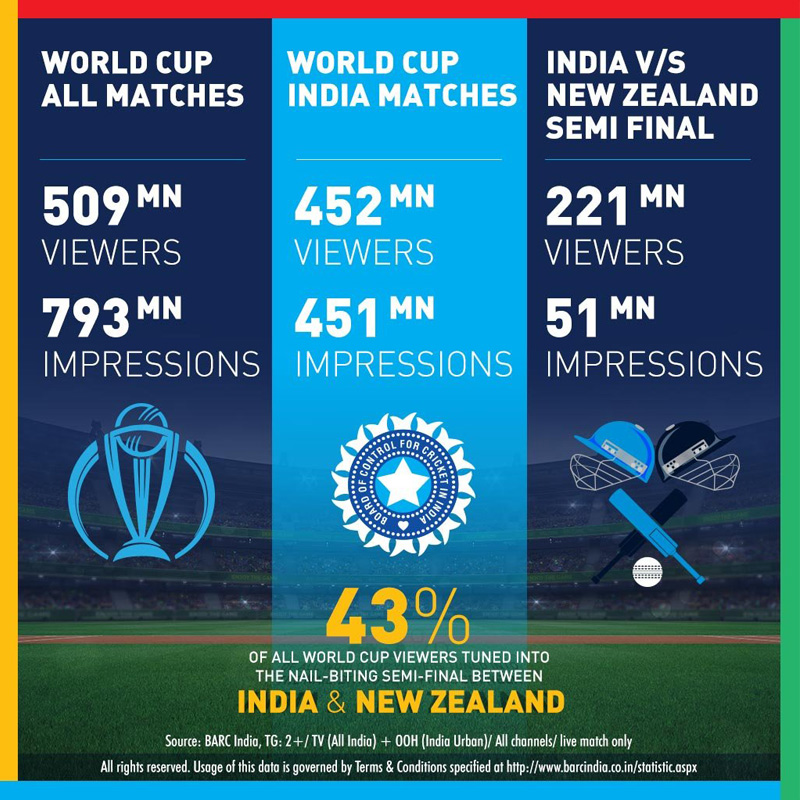
    MUMBAI: BARC India announced that the India vs New Zealand semi final in the ICC Cricket World Cup 2019 garnered 221 million viewers and 51 million impressions.

    Recently BARC India tweeted, “An exhilarating Semi-Final between India & New Zealand had the fans on the edge of their seats. Here's how it fared on Television #BARCInsight @ICC @cricketworldcup @imVkohli”

    According to the BARC India data, 43 per cent of world cup viewers tuned into the semi final between India and New Zealand. 

  • BARC India week 29: Sony Sab moves to 2nd position in urban HSM

    BARC India week 29: Sony Sab moves to 2nd position in urban HSM

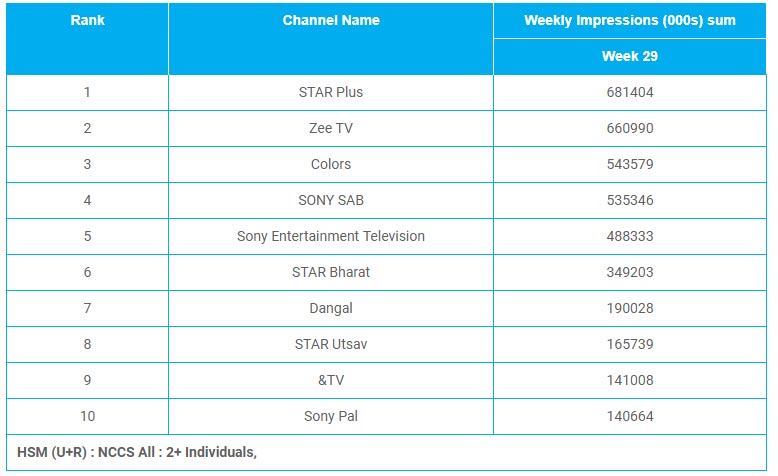
    MUMBAI: In the week 29 of BARC India ratings, Sony Sab became the second leading channel in urban HSM of Hindi GECs. The channel was seen at 4th position of the pay platform. Last week the channel was at third position in urban HSM. 

    Dangal continues to lead the rural HSM and was number one channel on the free platform of Hindi GECs. The channel was followed by Big Magic, DD National, DD Bharati, DD Arunprabha, DD Uttar Pradesh, DD Rajasthan and DD Madhya Pradesh on the pay table of BARC India ratings.

    Top 10 Hindi GECs on free platform 

    Star Plus continues to lead in urban HSM and pay platform of Hindi GECs. On the play platform the channel was followed by Zee TV, Colors, Sony Sab, Sony Entertainment Television, Star Bharat, Dangal, Star Utsav, &TV and Sony Pal

    Top 10 Hindi GECs on pay platform

    There were no changes in the pecking order of the Hindi GECs channels in rural HSM

    Hindi GEC Rural

    In urban HSM, Sony Sab moved to second position and Zee TV moved down to third position.

    Hindi GEC Urban

  • Industry gives mixed views on BARC India’s decision to separate pay and FTA viewership

    Industry gives mixed views on BARC India’s decision to separate pay and FTA viewership

    MUMBAI: BARC India’s decision to split its reportage of pay and FTA viewership has received mixed reviews from the industry. While some believe that this will be beneficial to both broadcasters and advertisers in channelising their resources, others believe that it has no meaningful objective.

    Welcoming the move by BARC India, Times Network president – strategy Vivek Srivastava said, “It aids both broadcaster and advertisers to better channelise their resources. Advertisers need audiences who can spend and there is no point paying for audiences who are on the free platform and don't have the propensity to consume. Advertisers wanting premium audiences, typically news and English, can now better optimise the price they pay to different platforms and not waste marketing monies on non-premium audience from free platforms. Consequently, broadcasters will also stop over-relying on one platform just to get numbers and premium content will get its due.”

    From week 27 of 2019, BARC India decided to report viewership from free and pay platform separately. The new variables are offered over and above the current urban and rural cuts that are reported by BARC India. It is made available to all the subscribers for planning and analysis through its proprietary BARC Media Workstation Software and is also published on the website for select genres.

    News Nation Network president – sales & marketing Abhay Ojha is of the view that the decision could be of benefit to all stakeholders. He said, “From a broadcaster’s perspective, we can better optimise our organisational resources towards strategising GRP requirements as per the revenue strategy of the network. Alternatively, a planner in an agency can further zero in on the quality of GRP required, depending upon their brand’s core competence and DPOs will get better clarity on ROI of paid and FTA channels. Therefore, holistically it’s a welcome move.”

    On the other hand, Ojha noted that for Hindi news channels, it hardly mattered which platform was giving viewership, because national Hindi news channels are most widely distributed and are very dynamic, depending on everyday events. He further pointed out, “Most of the news channels are now being taken for frequency builders rather than reach builders, therefore the pie of revenue is mostly leftover after consumption on GEC, movies, niche, vernacular channels, etc.”

    While announcing its move, BARC India CEO Partho Dasgupta had said, “There has been a strong demand from the market for separate reporting of viewership from homes with pay and free connection. We have taken the market feedback in consideration with the changes that have come about in the ecosystem post the implementation of the TRAI tariff order. We believe this move is a step in the right direction to empower the industry in understanding the distinct consumption patterns of this segment and plan more effectively.”

    BARC believes that reporting viewership from pay and free platform separately would enable focussed targeting. Advertisers can plan more effectively by placing insertions on the channels available on their platforms in the respective regions. It will also enable the broadcasters to make more informed decisions related to content and distribution.

    A broadcaster on the condition of anonymity said, “DD Free Dish has a presence across markets both in urban and rural and across demographics. Segregation of free and pay by a single platform will suit a few networks. It has no meaningful objective that will help the advertiser or broadcaster.”

    Dentsu Network, SVP Mayank Bhatnagar said, “From a media planner’s view my audiences are watching a certain set of channels whether they are in pay or FTA platform. This will help us to look at data in a slightly different manner and we will get one more cut now because earlier there was only urban and rural now there are pay and FTA platforms also. It will impact the media planner’s life because they will continue to chase TG which is targeted. From a broadcaster’s point of view, it will give one more dimension in the data cuts to see how they are performing.”

    He further said, “Lot of advertisers are looking at FTA channels and they are performing well. So if I have to do a relative comparison only on the pay platform, it will be easier for me to check which are performing well there and I can do a related shift. But otherwise, it’s not going to make any major changes.”

    With time, the industry will be able to make better estimations as to the effectiveness of this move.

  • Network18 writes to I&B ministry over BARC’s data validation and outlier policy

    Network18 writes to I&B ministry over BARC’s data validation and outlier policy

    MUMBAI: News broadcasting network Network18 India has shot off a letter to the Information and Broadcasting Ministry (MIB) raising concerns over Broadcast Audience Research Council (BARC) of India’s data validation and outlier policy, Indiantelevision.com has learnt.

    According to those in the know, the network has brought to the ministry’s attention the subjective nature of BARC’s implementation of outlier policy and its impact on TV ratings of channels with a relatively smaller viewership base.

    On its part, BARC has consistently maintained that it cannot identify landing pages. Hence, reliance on manual intervention in weeding out outliers makes the process susceptible to bias is a view held by a section within the industry.

    Indiantelevision.com reached out to Network18 for a comment, the network, however, did not confirm this development.

    BARC’s treatment of landing pages has raised a furore among broadcasters over its approach post TDSAT’s order on landing pages.

    Reacting to stakeholder concerns, the BARC board gave its nod to form a two-member committee to carry out an independent review of BARC’s data validation and outlier policy.

    With opinion divided within the industry, some broadcasters have also written letters, highlighting the negative impact of landing pages, to TRAI and BARC’s technical committee.

    On 28 May 2019, TDSAT set aside TRAI’s 3 December 2018 direction to rule in favour of landing page placement of channels.

    Data for week 22, first since the landing page ruling, saw CNN News 18 upset the English news apple cart to top the chart, followed by Republic TV, Times Now, DD India and India Today Television.

    BARC switched back to its previous methodology from week 23 onward claiming it had received multiple representations from stakeholders and the mandate of its board.

    BARC’s flip-flop with its outlier policy implementation further fuelled the landing page row.

    With the two-member committee now reviewing the policy, industry hopes for a speedy and acceptable resolution.

  • BARC to report viewership from free & pay platforms from week 27

    BARC to report viewership from free & pay platforms from week 27

    MUMBAI: BARC India on Monday announced that it would start reporting viewership from free & pay platforms separately starting week 27 (29th June – 5th July), confirming what Indiantelevision.com had reported first on 5 July.

    The systems at BARC India always evolve basis feedback from the industry. In the past 4 years BARC India has enabled granular reporting cuts basis feedback from various stakeholders to better understand viewership habits.

    The new Pay & Free platform variable will be offered over and above the current Urban & Rural cuts that are reported by BARC India. It will be made available to all the subscribers for planning & analysis through its proprietary BARC Media Workstation Software. It will also be published on the website for select genres.

    A Free Connection is one where the household incurs only a small one-time fee for installing the set top box. The major player in this area is DD Free Dish. The household does not pay any monthly subscription fee. Whereas a Pay connection is one where the subscriber invests an initial amount for installation and an on-going monthly subscription fee.

    In the Hindi Speaking Markets, 2 out of 10 homes are Free Homes, accounting for almost 140 Mn TV viewing Individuals. The Pay & Free viewer differs significantly not only in terms of demographics, but also their characteristics, values, lifestyle and psychographics. A study done in these homes by BARC India explicates the personas of these two audience types.

    Reporting viewership from Pay and Free platform separately would enable focussed targeting. Advertisers can plan more effectively by placing insertions on the channels available on these platforms in the respective regions. Broadcasters can also make more informed decisions pertaining to content and distribution. 

    “There has been a strong demand from the Market for separate reporting of viewership from homes with Pay & Free connection. We have taken the market feedback in consideration with the changes that have come about in the ecosystem post the implementation of the Tariff Order. We believe this move is a step in the right direction to empower the industry in understanding the distinct consumption patterns of this segment and plan more effectively” says BARC India CEO Partho Dasgupta.

  • BARC to now report viewership from pay, FTA platforms separately

    BARC to now report viewership from pay, FTA platforms separately

    MUMBAI: In what can be considered as a key new development, Broadcast Audience Research Council India (BARC) will now report viewership from pay and free-to-air (FTA) platforms separately. According to sources, the BARC board in its meeting on Thursday ratified the technical committee's proposal for the same.

    BARC provides several cuts for its urban viewership, which tends to be heterogeneous in nature. Reporting free platforms separately can be regarded as the first step in breaking up rural viewership, which is more homogeneous.

    BARC already provides separate urban and rural viewership of some key genres like Hindi GEC and news on its website. Now with pay/FTA reporting, the general public will get a more clear picture of leadership positions of channels in these two markets which have become more distinct after TRAI's tariff order implementation.

    With DD Free Dish flourishing, FTA viewership is now a sizable chunk. BARC's move to segregate pay and FTA channels is a positive one, and is bound to be welcomed by the industry, in particular, broadcasters.  

    The new pay/FTA reporting format for viewership on the BARC website and in its BMW software could be in the offing as early as week 27.

    Additionally, Indiantelevision.com has also been told by a broadcaster source that the much-debated landing page issue wasn't taken up for discussion by the board.

  • Crucial BARC India board meeting today under cloud of landing page issue

    Crucial BARC India board meeting today under cloud of landing page issue

    MUMBAI: The BARC India board is set to meet today in what can be considered as one of its more significant gatherings. The latest board meeting will be held in the backdrop of a series of controversial developments that have been triggered by TDSAT's order setting aside TRAI's directive on landing pages.

    The TV audience measurement body's approach post the TDSAT order has raised concerns from certain quarters of the industry. Indiatelevision.com has previously written about different perspectives from within the industry from a clarity and transparency standpoint.

    This is the first time the BARC India board will meet since it gave a nod to form a two-member committee to independently review its data validation and outlier policy that has drawn sharp opinions and observations from across the industry.

    The meeting comes a day after the Telecom Regulatory Authority of India (TRAI) hosted an open house discussion on review of television audience measurement and ratings in Mumbai on Wednesday where senior officials hoped the landing page issue would be addressed by the industry.

    Following TDSAT’s ruling, BARC had notified that it would include the ratings of channels placed on landing page in its weekly ratings data and while releasing the data of week 22, 2019 BARC correctly considered the channel available on landing pages.

    On 13 June BARC announced that it is reverting to its earlier method of filtering out outliers or abnormal reach from the landing page which BARC decided to do so, only after receiving some representations from industry players.

    With BARC again starting to exclude the outliers, several broadcasters have alleged that the data could be biased as the process of validating outliers for channels is manual.

    With several industry stakeholders keen to track the latest updates, this BARC board meeting is far from a routine affair.

  • TRAI’s SK Gupta on Independent TV troubles, BARC overhaul, landing page controversy & tariff order

    TRAI’s SK Gupta on Independent TV troubles, BARC overhaul, landing page controversy & tariff order

    MUMBAI: Top Telecom Regulatory Authority of India (TRAI) functionaries were in Mumbai on Wednesday for the second leg of the open house discussion (OHD) to review the television audience measurement and ratings system in India. In the audience were industry stakeholders spanning across broadcasters, advertisers, distribution platform operators (DPOs) and BARC representatives among others.

    “Ratings have to be unbiased, correct representation of the feelings of the people and should not be impacted by various methodologies being used to influence them,” said TRAI secretary Sunil K Gupta as he set the agenda.

    TRAI had received multiple comments and counter-comments from industry to its consultation paper, which featured a list of questions. In order to further deepen the engagement, Gupta recommended three additional topics be taken up for discussion.

    “What are the concerns and problems when it comes to return path data with set top boxes? Let us analyse and understand how we can increase the sample size of meters so that influencing data becomes difficult. Secondly, many broadcasters said in the Delhi OHD that data collected through such meters is filtered or manipulated to delete the outliers. They feel that the level of transparency in doing so is not there and in some cases they feel it is one of the tools to manipulate the TRP of a channel. Thirdly, is there any other alternative that can be adopted to make ratings more effective or more representative of viewership?” the secretary asked.

    However, despite the officials’ best efforts to initiate a conversation to highlight problems and suggest solutions, those present were rather conservative in their approach, side-stepping critical issues that continue to plague the broadcasting sector from a TV audience measurement standpoint. While regional broadcasters did argue in favour of a more representative sample to take into account multiple socio-cultural regions, major broadcasters failed to approach the discussion with their usual vigour.

    From BARC’s perspective, COO Romil Ramgarhia and chairman of its technical committee Shashi Sinha were rather frank and forthright, articulating their respective positions on all issues at hand quite candidly.

    In order to gain a better understanding of the regulator's viewpoint, Indiantelevision.com’s Dattaraj Thaly engaged the TRAI secretary in a quick chat on the sidelines of the OHD. 

    Edited excerpts follow.

    What compelled you to float a consultation paper on review of television audience measurement and ratings in India?

    We recommended the formation of an entity to rate the audience measurement for the TV sector and as per that recommendation, MIB came up with guidelines and then BARC was registered. Having said that, (BARC) working for the last three years, we just wanted to see how good the work is being done and there are different concerns of different stakeholders to improve the transparency of BARC rating. So, what are the concerns of stakeholders and how can we improve its functions was our objective.

    What are the specific functions you want improved? Is it credibility of the ratings, transparency of the system? What are the benchmarks for improvement?

    In fact it includes all the things. It is credibility, accuracy of the system and also to make it broad-based so that any attempt to tamper any information etc., should have minimum impact on rating given by the BARC.

    We know what the broadcasters’ concerns with BARC are. Can you tell us what the regulator’s view on the TV audience measurement body is?

    TRAI does not have any view of its own. We raise various issues to the stakeholders. We take oral as well as written comments of the stakeholders. We also analyse the international experiences, the issues raised by different people on what needs to be addressed and ultimately firmly take a view what should be done. So, one thing is very clear TRAI does not have its own view.

    You’ve now held two open house discussions (Delhi and Mumbai) to review our current TV audience measurement system. Have any key themes emerged from these consultations?

    One is that everybody wants BARC to give the ratings that are credible, transparent, not influenced by any of the stakeholders. They also want a broad-based rating pattern, so that chances of getting it influenced by few meters is reduced. Thirdly, they want to improve the transparency of the system.

    BARC’s data validation and outlier policy post the TDSAT order on landing pages has created quite a stir in the industry. What’s your view on this issue?

    You would have heard BARC clearly stating today that they do not have a method to identify landing page and therefore effectively address the issue.

    So, what is the way forward?

    You have yourself very clearly pointed out that there is a decision by TDSAT and we will look into it further and see what can be done. Also today you have heard that this is a call to be taken by the industry also.

    Are you satisfied with what you’ve accomplished in terms of the new tariff order roll-out?

    If you look at the preamble of the regulations and the tariff order issues, the objective raised over there were met to a great extent. So, we are satisfied.

    Two fundamental issues – consumer choice and transparency – were emphasised on by TRAI during the implementation of the new tariff order. Has the new regime addressed these two tenets?

    We have introduced giving the price of each channel in EPG, which has been appreciated by all of the stakeholders. As far as giving choice is concerned, we have checked different platforms and most of the platforms are complying and giving choice. What we have found is that there is a need to educate the consumers. Because consumers from the beginning have been given bouquets. Now awareness has been generated that options have been enabled to choose channels on a-la-carte basis. On this front, I think some more work is required.

    Has the broadcasting and cable services landscape settled down post the new tariff order implementation?

    The choice of customer is a dynamic situation and it will change from time to time and that is what we precisely feel like. The market will work once the consumer has got the options to exercise and it will depend on many things such as the type of programmes you are showing in your TV channel, the language, the awareness, etc. So, this is working very well on the ground and naturally it will take some time to settle. Saying that it has already settled may not be accurate, but yes it is going in the right direction.

    What’s your take on the Independent TV situation?

    Independent TV has been very recently given their license for DTH. The matter has been taken up with MIB and with the other enforcement arms of MIB, which is spread in the state and districts. We are looking into that.

    Is TRAI committed to light-touch regulation across the broadcasting and distribution sector?

    New tariff order is the right example of light-touch regulation (https://www.indiantelevision.com/regulators/trai/broadcasters-split-over-trai-s-directive-to-barc-on-tv-viewership-data-190226). We have given complete freedom to broadcasters to price their channels. We have given freedom to DPOs to carry out their business and get a certain committed revenue so that quality of the network can be upgraded and quality of the services can be given to the consumers. We are only prescribing the broad architecture and not micro-managing.