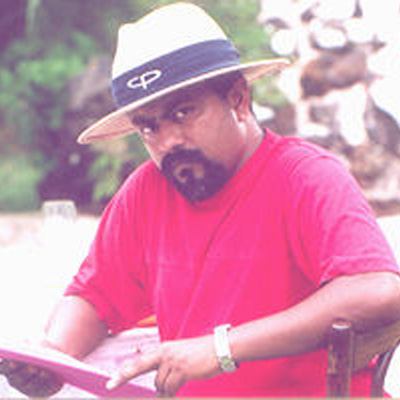
If popularity is the index of a director’s success, Partho Mitra should surely rank as one of the best directors on TV today.
Partho, who started his career on television with Shanti, Indian TV’s first daily soap, went on to direct Banegi Apni Baat, Ghar Ek Mandir and is now directing Sansaar. For someone whose passion was still photography, Partho has come a long way as director. Partho’s work is marked by his absolute commitment towards all aspects of filmmaking. He takes a personal interest in casting, oversees the development of the storyline and is particular about maintaining a high level of production values.
He comes across as a very frank person, at ease in speaking his heart out. We present excerpts of a no-holds-barred interview he gave to indiantelevision.com’s correspondent, Amar.
What brought you to direction?
In my college days, I was very passionate about still photography. After college, I assisted Deepak Roy, a documentary filmmaker for some time, before getting an opportunity to learn filmmaking at the Columbia School of Cinema, Los Angeles, in 1988. Two years later, I was on internship with the Jewish TV Network and covered the Gulf War. All this led to my coming home in 1991 and doing a couple of small budget films in Delhi. A couple of years later I moved to Mumbai and my first major project was the daily soap Shanti.
What factors do you keep in mind before starting a new project?
TV is essentially a writer’s medium, so I consider the script most important. Even in the script, I essentially look for powerful characterisations that can leave an impact. I took up Patang, mainly for the character of Niki Aneja who plays a woman shattered by marriage.
 |
A daily is more of a production exercise than a direction exercise. It’s more about how many scenes you can squeeze in a day, rather than the quality of the content.
__________
|
As a director, how involved are you with the storyline?
Tremendously. I won’t do a project if I don’t have a tab on the storyline. Even when I am shooting extensively, I insist that one-liners of the screenplay of future episodes are sent to me first, only after I have read and approved them does the writer go ahead and write the entire script.
Do you have any favourites among writers?
My favourite writer is Sutapa Sikdar. She does most of my writing.
Who are your favourite producers?
I have an excellent personal equation with Adib Contractor and enjoy working with him. I have also enjoyed working with Raman Kumar and Vinta Nanda. What I find best working with them is their level of faith in me and the freedom I get to execute my ideas.
What are the changes in temperament one has to make between shooting a daily and a weekly?
From a director’s point of view, I have found a daily to be more of a production exercise than a direction exercise. It’s more about how many scenes you can squeeze in a day, rather than the quality of the content. Dailies are more verbose – the thrust is more on the dialogues rather than on the screenplay. I would, in fact, equate the nature and feel of a daily with a radio programme.
But you’ve done well directing dailies too- Shanti and Ghar Ek Mandir?
Shanti was India’s first daily soap. It was truly a challenge to make the concept a success. Even with Ghar Ek Mandir and Bandhan, I was the director of the early episodes only. I was entrusted the responsibility of establishing these serials successfully, which I believe I did. Another reason I did these dailies was because all of them were shot with a multi-camera set-up which made work smoother. But beyond a point, a daily did not give me the freedom and initiative I look for, so I quit.
How much of an actor does a director have to be?
I don’t feel a director needs to be an actor himself. It is important that he understands the nuances of acting and the chemistry of the actor he is dealing with. Personally, I don’t believe in enacting scenes as a method of instructing the actors. What happens with this is that actors who are new and lacking in confidence become very conscious and start aping you without applying their minds.
Most directors feel that TV is a very limiting medium. Do you agree?
I believe TV is not quite a medium for fiction, it’s more conditioned for news and current affairs programming. I say this because, invariably it makes for passive viewing. Even the best made programs are not received so well because unlike in the cinema halls where your sole concentration is on the screen, at home you tend to do other things simultaneously- receive calls, prepare meals etc. This is one of the reasons that bring about disillusionment. Besides, budgetary constraints and the pressure of meeting deadlines also create some unpleasantness about the medium.
So are you also planning to join the movies bandwagon?
I am certainly working on the script of a movie. Hopefully in the next six months, the complete script will be ready.
|
A director needs to be an avid reader- one who has a wide point of view and one who is not bogged down by fixed notions.
_____________
|
 |
What are the natural instincts required of a successful director?
A director essentially needs to have the sensibility to understand varied emotions and situations. A director needs to be an avid reader- one who has a wide point of view and not one who is not bogged down by fixed notions. Being the captain of the ship, he has to be stern and authoritative, yet effective man-management also requires him to be a diplomat.
What are the qualities you would look for in a person before taking him under your wing?
Essentially it would be his keenness to learn in a very humble way. I would look for a basic level of technical expertise also. But that would be secondary. It’s the attitude that is more important.
Today, would you recommend a specialized course or training under somebody for a person who wants to be a director?
I would believe training hands-on is the best form of learning direction. A specialized course does endow you with better skills of film appreciation and helps you understand cinema better, but personally I feel there can be no substitute to training under somebody.
What are the factors you never compromise on as director?
I’ve already told you about the importance of the storyline in my scheme of things. That apart, I am also very particular about the technicality, maintaining high production values and the casting.
Who are your favourite actors?
Irfan Khan, Surekha Sikri and Niki Aneja.
Have you modelled yourself on any particular director?
Not consciously, though I have been inspired by the stylistic elements of a few renowned directors. I have been inspired by the script sense of Hrishikesh Mukherjee, the visual finesse of Guru Dutt and overall by the impeccable genius of Satyajit Ray.
What makes Partho Mitra different from the crowd? What is it about his work that makes him stand apart?
I believe I have evolved a style of working of my own wherein I can take important decisions very fast, without compromising on the quality and where I am at utmost ease with my actors. All this does lead to a certain feel about my creations, which is distinctive and essentially mine.
How do you unwind?
With music. When I am not shooting, I spend as much time as possible with my family. In fact, that is the reason we have shifted to Pune. When I am not shooting, I am in Pune.
Which has been the happiest moment of your career?
That’s difficult to answer. I would say it’s been all those occasions when I have started work on a project. I have felt extremely charged up, optimistic and full of energy on these occasions.