Tag: Balaji Telefilms

  • MIPCOM 2014: Best time to invest in India, say Indian media barons

    MIPCOM 2014: Best time to invest in India, say Indian media barons

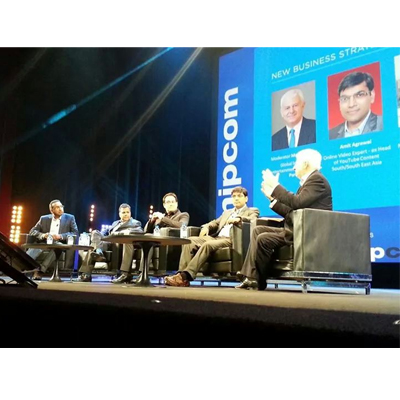
    CANNES: Indian content market is going through an exciting phase, and putting the scenario upfront to the world, through one of the biggest stages at the ongoing MIPCOM 2014 was the India panel which comprised of Colors CEO Raj Nayak, Balaji Telefilms group CEO Sameer Nair, Rajshri Entertainment managing director and CEO Rajjat Barjatya and online video expert and ex-head of YouTube content south/south east Asia Amit Agrawal. The session on ‘New business strategies from India’ was moderated by PwC global leader, entertainment and media Fenez Marcel.


    Setting the stage for some heated discussion was Nayak when he highlighted one of the biggest issues the country faces: lack of broadband. “Lack of connectivity is an issue. If the experience of watching becomes smooth, it will be a game changer,” he said.


    Comparing the online market in India with that of the world, Agrawal said that the Indian market has both traditional medium and online play “and both are very strong,” he informed adding that this meant huge opportunity to tap into.  


    Agrawal went on to say that while India consumes a lot of content online, almost 30-40 per cent of this content is not made in India. “That’s a huge chunk. I am seeing an emergence of micro-communities with technology. This will enable the content producer to tackle the right community. It will happen and very soon, may be in the next 12-18 months,” he stressed.


    There is too much of fragmentation in the country, currently. Mentioning the Telecom Regulatory Authority of India’s regulation about ad-cap for pay TV, Nayak said, “Once this happens, the supply and demand ratio will change. This will also help in the yield going up, because the demand will go up. We have to come at a point where the FTA channels will carry advertising with no limitations, pay channels which will have 10+2 advertising and very premium channels will have no advertising.”


    Barjatya who wears the hat of both traditional movie maker and digital feels that India is at a cusp of digital revolution. “For me the opportunity is to reach the global audience, especially through mobile. Traditional media rules cannot be applied on mobile,” he said.  


    The YouTube journey in India started with traditional media content that was distributed to audience which was moving away from traditional media. “But now, over the last one and a half years, I see so many online channels coming up on comedy, food, music, news, tech bloggers have all come up,” informed Agrawal.  


    With a contradicting viewpoint, Nayak said that YouTube is the biggest competitor to the broadcaster. And that it is due to this, that the broadcaster, since the last month, has taken its hit show Comedy Nights with Kapil off YouTube. “I am a big believer of digital media and I feel it is the future, but I also feel that it will co-exist with television and they will grow parallel.”


    Viacom itself is looking at a lot of short formats. “But the problem is that unless broadband issue is not addressed, monetisation will remain a huge problem. If you look at the money, YouTube does Rs 500-600 crore business from India, where television is a Rs 7000 crore business, so the numbers are small and that will not grow until and unless the bandwidth issues are addressed,” said Nayak.


    Nayak believes that no one in India has so far mastered the art of monetising content on the digital media, social media the way it should be, given its increasing reach and targeting abilities.. 


    “Monetisation will happen with broadband and hopefully this should be resolved with the rollout of 4G,” he added.


    The panel also put forth its wish list for the new government formed under Prime Minister Narendra Modi. According to Nair regulation for content already exists, which is beneficial to the whole industry. Highlighting PM Narendra Modi’s ‘come make in India’ campaign, he said that the government is giving open invitation for people to come to India. “As for Raj’s point that producers in India are not partnering with broadcasters and thus not sharing risks, we are looking at that very seriously and are encouraging everyone else to do it. If there is a risk-reward mechanism, everyone can benefit,” explained Nair.  

    As for Nayak, keeping in mind the dynamic & tech-savvy PM the country currently has, who understands the power of the Digital media, connectivity and broadband will get addressed in a much faster footing.  Given that electricity is still erratic in rural India, people will communicate and consume content through mobile phones. “I would ask him to release spectrum because that’s a big issue that’s coming in the way of growing business. Another thing that I would request  is complete implementation of the digitisation, process which is expected to be over by 2016 . He further added that broadcasters are not getting their fair share of subscription revenue and this can only happen once the digitisation process is complete and all stakeholders start seeing the benefits,” he said.


    Barjatya’s wish list consists of wiring up India and encouraging Indian entrepreneurs to have a global outlook rather than be restricted to Indian audiences alone. “We need to appeal to the audience outside of India,” he said.


    For Agrawal, the government should remove hurdles. “Out of all the YouTube content that we produce, more than 70 per cent of the viewership for programme comes from global audiences. We haven’t done a great job in marketing ourselves and make people aware of the country,” he added.


    Nayak is hoping for a dynamic change in the media industry, with the new PM.   


    The discussion also touched upon the consumer behaviour in the country.  “We see a lot of consumption happening on handheld devices. When we began, 10 per cent of our views were from handheld devices, today it is almost 50-50 and that number is higher in India than in the rest of the world. India’s next billion people will access internet on mobile, and will not know about PCs,” opined Barjatya.


    Agreeing to this, Nayak said that the reason it will happen is because for mobile, one doesn’t need electricity. “We have 160 million homes and 900 million handheld devices right now, which is expected to go up to 1.5 billion handsets. So the explosion is happening. Power will take a lot of time to be addressed, but if you have internet, you can consume content,” he informed.


    Nair classified the audiences and the programmes being made. He said, “The television industry currently is programming for newer audiences who are more into household dramas. Then there are also those who have already lived through all this and are now looking for more. The audience is evolving. There will be more niche channels.”  


    All the panelists felt that this is the best time to invest in India. “In India, people are ready to match dollar to dollar. And we are ready to put the money where our mouth is,” announced Nair.  


    Concluding the session with one advice to entrants in the market, Nair said, “It is important to be patient. We are still at the ground floor, but we can build.”

  • Sony Pal extends primetime with ‘Yeh Dil Sun Raha Hai’

    Sony Pal extends primetime with ‘Yeh Dil Sun Raha Hai’

    MUMBAI: Achieving a growth of 30-40 per cent key markets within a month of its launch, Sony Pal (the newest channel from Multi Screen Media slate) is definitely leaving no stone unturned to mark its position in the GEC space.


    But Sony Pal and Sab senior EVP and business head Anooj Kapoor believes that it still has a long way to go. “From the ratings perspective, we still have a long way to go. We don’t want to compare ourselves with any other channel within the space, but our main agenda is to showcase quality content that our TG can sample,” he says.


    The channel which went live on 1 September targets women, mostly housewives in the age group of 15-34 years, in SEC BCDE markets. With the tagline ‘Yeh Pal Hamara Hai’, it claims to have content which empowers and that showcases positive aspects of modern India, while presenting the traditional aspect.


    The channel currently has three hours of original content on-air which airs from Monday to Saturday between 7:30 pm-10:30 pm and two hours of original content on Sunday evening. In order to expand its prime time, it has joined hands with Balaji Telefilm’s Ekta Kapoor to present an intense love story ‘Yeh Dil Sun Raha Hai’ from 16 October onwards at 7 pm.


    This show is Ekta Kapoor’s first association with Anooj Kapoor and Sony Pal. Moreover Ekta Kapoor says that it was a challenge for her and the team as they have usually restricted themselves to urban set ups. “I don’t have any friends and relatives staying in non metro cities. It was a challenge for all of us, we did our own research, visited that place, observed the culture and modified the storyline accordingly,” she says.


    Set in the city of Patna, Anooj says that it wanted to break into the Hindi heartland and create something different.


    The show charts the journey of Poorvi (played by Aparna Dixit), the daughter of a senior government employee and Arjun (played by Navi Bhangu), the spoilt son of the local coal mafia. Initially, Poorvi and Arjun can’t see eye to eye, but steadily get drawn towards each other and eventually, go on to combat all odds and family antagonism for their love. Unfortunately, both are destined to be apart. It is thus the story of two star-crossed lovers, their journey of adoration and hatred.


    About the slot decision, Anooj revealed that mostly 80 per cent of housewives find it very convenient to watch shows at 7 pm. “This is because sometimes husbands haven’t arrived home yet and the kids are out playing and the dinner duty hasn’t started yet,” he says.


    He further goes on to say that in the north where winter sets in from next month, it becomes very late after 9:30 pm, so, in that case 7 pm slot is very ideal from all these points of views. “Moreover, at 7 pm in the current GEC space you don’t have too much of competition,” he adds.


    Anooj agrees to the fact that there are shows like Saathiya on Star Plus which is doing well and delivering good ratings. According to him there is lot of potential but not much competition.


    If the show does well, the audience will be propelled to the 7:30 pm and other slots because women will know what to expect from the channel and they would sample the promos of other shows in that half an hour.


    A 360 degree media campaign across TV, out of home, print and social media will be rolled out soon. TV is used to introduce the show concept, characters and premise. Other mediums like outdoors and print are used to reinforce the message and remind viewers to tune in.


    The campaign is led by intensive TV advertising on the network’s channels and other channels to cover the HSM, supported by extensive outdoor visibility in key markets across the Hindi heartland. The message is being reinforced by regular print ads in the run up to the launch across leading dailies.


    Media planners believe that though it is a good move doing a show at 7 pm slot, the channel will take some time to win the hearts of the audiences. “It all depends on content. If that manages to hold on to enough viewers to the show, the channel will automatically see growth in terms of viewership as well as reach.”

  • Life OK revamp: From being alternate to primary

    Life OK revamp: From being alternate to primary

    MUMBAI: It’s a channel that had promised to be different and has stayed true to its word till date. Exactly two and half years ago, on the launch day, it had organised an eight-hour-long Mahadev Rockathon at a Mumbai hotel, which could be viewed online, as numerous rock bands, including Parikrama, Agnee, Euphoria and Shaa’ir and Func, strummed songs.


    Done by none other earlier, Life OK, the sister channel of Star Plus, broke the conventional shackles to free the views of the usual saas-bahu dailies. Growing steadily in terms of viewership ever since its launch in December 2011, the channel has carved a distinct identity for itself on the back of its immensely popular shows like Mahadev, Saubhagyavati Bhava, Savdhaan India and now Laut Aao Trisha, all focusing on different social issues.


    Once known as a re-packaged replacement for Star One, which had failed to generate eyeballs, Life OK started off with 2 per cent market share, now enjoying a good 14 per cent market share.


    Taking a step further towards differentiation, the channel is set to give a new avatar to it by re-vamping. Come November, viewers will be introduced to a new look and feel of the channel.


    “Now we are confident of success,” says Life OK EVP and general manager Ajit Thakur. He states three reasons behind the channel’s continuous success.


    Number one, viewers have noticed the channel. “We are among that one success story which is very well entrenched. You go and talk to any community, viewers, trade, or advertisers.”


    Thakur feels that everybody needs numbers, and are important in terms of market share and the channel has done it at lower investment than others.


    Second point he highlights that it’s a matter of pride for the entire Star network  to have done it differently, as promised.


    Thakur recalls that when the channel started out, it had promised two differences. One, the channel will target the family – men and kids will also have as much to watch as the women in the family. Second, it would be built around a promise of no or a very few saas-bahu soaps. “Can we create a channel that the whole family can watch? Today there is one channel for women, one for men and one for youth. But in the house there is mostly one TV, so could we have created a destination for family where everybody has something to watch?”


    He says that confidently, no other channel has the kind of variety of programming which Life OK delivers. “One can switch any particular channel and expect the same genre from it year after year. For instance, one channel only focuses on comedy while other only on soaps. So, today we have a channel showing just one genre which is skewed towards one demographic in the house. We have changed the pattern.”


    Thakur states that the channel has had a very different viewing pattern focusing on genres like mythology, thriller, love story, social issues and crime.


    “It is of course risky,” reveals Thakur and adds, “Because what we are expecting is women to come in first, then the whole family to join in for mythology and men to keep glued on post 10 pm.”


    “We will not grow by being similar; we will grow by being different. One of the problems of not doing soaps is the longevity of the shows as our channel’s shelf life is smaller and we agree to it.”


    Similarly, the channel has different content during weekends. When other channels are filled with reality shows and extended soaps, Life OK has a different story to tell. “Who has a show on GEC targeting kids? Followed by a big ticket reality show and then crime,” asks Thakur.


    Thirdly, Thakur highlights that along with the viewers, it has managed to hold on to its advertisers and cable operators.  “We have a fare share of FMCG brands because they have all the big GECs, but we have a fair share of male centric clients because they don’t have that option.”


    The next big change…


    Thakur does not wish to be an alternative platform anymore. This Diwali, the channel aims to be a primary destination. “What is important is what we have built as an alternative proof, now in the next three months we want to tell them this is your primary destination, everything else is alternative. This Diwali, there is no bigger entertainment destination than Life OK.”


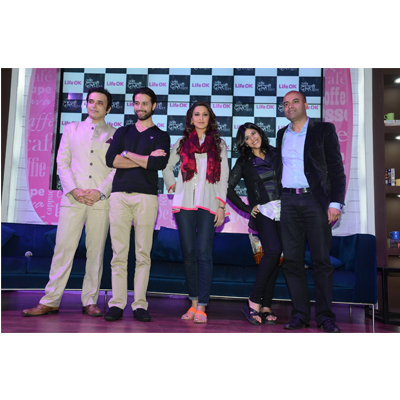
    The channel is adding seven properties to its kitty. Come 7 October, in the lines of Saubhagyavati Bhava, viewers will be introduced to a women’s journey towards independence by Ekta Kapoor’s Balaji Telefilms, titled  Ajeeb Dastan Hai Yeh at 9:30 pm.


    Planning to tap into the comedy genre for a very long time, it is set to review the definition of fun and laughter with Comedy Classes at 10 pm from 7 October. Breaking away from the usual practice of airing comedy on weekends, the channel is launching a daily sitcom with the popular TV comedy stars.


    Next up, for the first-time ever the channel will telecast the world television premier of the movie, 2 States. “I deeply believe that the film has a strong social topic. Divide on basis of caste, religion is just artificial and love prevails over it,” says Thakur.


    On the occasion of Diwali, viewers will be treated with a grand event with big Bollywood stars. This will be followed by Vipul Amrutlal Shah’s action-thriller show staring the youth icon Ranvijay Singh, which will hit the television screens in the first week of November replacing the on-going reality show Dare 2 Dance. One more big name to the channel’s stable is Sooraj Barjatya’s new love story.


    Taking mythology to the next level, it plans to launch a big mythology in the month of December.


    “From October to mid December, seven big properties all put together in the span of 10 weeks, which normally takes a year to do. We are establishing the channel’s identity of differentiated content,” says Thakur.


    To tell the world about its revamp, the channel is putting full marketing muscle behind it. Every week, one will see promotions on 50 TV channels along with live sports, outdoors, malls and buses. Moreover, the channel for the first-time ever has done cinema hall branding and promos, which will go on till December. Even digital, radio and print will not be spared.


    Not only TV advertising, but the channel is focusing strongly on cable advertising as well. “We have always dependent on the reach of television, but this time we are going beyond. We are doing cinema integrations and cable activations which is new.”


    “We want to be the foremost GEC”


    Ad rates have been rising steadily as has the number of advertisers, from 30, in the beginning, to 200 in the last quarter. Of the initial lot, Shakti Bhog, the lead sponsor for Mahadev, and Idea have stayed with the channel right through.


    For a show like Mahadev, last year a 10-sec slot was Rs 50,000 to Rs 70,000. Currently, it ranges anywhere between Rs 90,000 – Rs 1,10,000, sources from the industry estimate.


    Is the move in order to attract the advertising spends in this festive season? “The advertising for this season is already done and we are full. It is not about advertising revenue but telling the market our intent and ambition. We want to grow aggressively on the back of a strong platform that we have built over last two and half years. We haven’t talked too much, we have done it quietly, but now  we will let everyone know.”


    The channel has advertisers from all categories right from bikes to mobiles. “In terms of male targeting we have all the FMCGs. Compared to a GEC, we have a very different mix,” says Thakur and states the example of Kapoor’s show. “Usually a fiction show doesn’t get sponsors on-board before the telecast. But in this case, very different sponsors like Venus and Basmati Rice have come on-board,” he adds.


    Though advertisers are taking note of the channel, media planners unanimously believe that the channel’s growth is phenomenonal. However, they are apprehensive about it being counted in the top three as of now. “It will take some more time for the channel to become a ‘primary destination for the viewers,” says a media analyst.

  • Sonali Bendre’s fiction debut on Life OK

    Sonali Bendre’s fiction debut on Life OK

    MUMBAI: It was in late 2011 when viewers were introduced to a new Hindi general entertainment channel (GEC). And now, after almost three years, Star Network’s Life OK is ready to challenge the established ones in the genre.


    Reasons being the ‘differentiated content’, the channel prouds itself of, and shows like Saubhagyavati Bhava’, ‘Savdhaan India’ and ‘Devon Ke Dev…Mahadev’. And recently, with shows like ‘Laut Aao Trisha’ and its biggest dance property, ‘Dare 2 Dance’, it has set a benchmark for itself in the GEC space.


    With the channel focusing on social issues like domestic violence and crime in a big way, it is set to highlight the issue of infidelity in its upcoming show, ‘Ajeeb Daastaan Hain Ye’.


    In association with the queen of television, Balaji Telefilm’s Ekta Kapoor, the story highlights the tryst of a woman who is estranged by her husband and is made to break out of her inhibitions in quest of finding happiness for her loved ones. The show marks the debut of Sonali Bendre in the fictional genre. She will play the role of the female protagonist along with other stars like Apurva Agnihotri and Harsh Chhaya.


    It highlights the journey of a tenacious woman Shobha (Bendre) who fights against all odds for her family and their well-being, who was happy and content in her own little world until she was left devastated after her politician husband, Samarth (Chhaya) was put behind the bars for breach of information.


    Overnight, she was left holding the reigns of her family in the aftermath of her husband’s conducts. While trying to collect all pieces and settle, she ends up meeting Vikram (Agnihotri), a coffee shop owner who hires her as his assistant. Apart from dealing with difficulties at home, she also faces her galling boss at work.


    The channel wanted a high impact cast, Life OK EVP and general manager Ajit Thakur reasons of getting Bendre on-board. He says: “We needed a woman who is very elegant, strong and yet very homely. She is a mother and wife also in real life.”


    Thakur further goes on to say that the show talks about women’s journey towards independence. “It is a matured friendship that is shown between two characters.”


    It was Kapoor’s concept which the channel took forward. Set for a finite series, it will be aired for six-eight months (120-150 episodes).


    Kapoor believes that relatable characters and diverse concepts are two key ingredients of all her shows. “Ajeeb Daataan Hain Ye captures the story of Shobha who becomes a ‘hero’ for her family after she surmounts harsh realities of life. I am looking forward to my association with Life OK to bring forth this grand venture through an interesting storyline.”


    Bendre revealed that initially she was little sceptical about taking up a fiction show until Kapoor narrated the story to her and then there was no looking back. “The strength of the character and how she faces her life head on is what appealed to me .The fact that instead of being treated like a doormat she picks up her life and decides to have a fresh start is what resonated with me,” she points out.


    With a heavy 360 degree marketing campaign, the channel is not going to leave any stone unturned to create buzz around the show. Moreover, the promos of the show are already on air and will also be shown in theatres during the release of Bang Bang.


    It is set to hit television screens from 7 October every five days a week at 9.30 pm. About the slot, Thakur believes that all slots are competitive and 9.30 pm is the highest viewership slot. The show will replace ‘Tumhari Pakhi’ which will now air at 8.30 pm followed by ‘Laut Aao Trisha’ at 9 pm. It is going to face neck-neck competition with ‘Yeh Rishta Kya Kehlata Hai’ on Star Plus, ‘Qubool Hai’ on Zee TV, ‘Bigg Boss 8’ on Colors, ‘Hum Hain Na’ on Sony Entertainment Television and ‘Badi Door Se Aaye Hai’ on Sab.


    To get male audiences also on-board, the channel plans to launch a comedy show at 10 pm followed by ‘Savdhaan India’ at 10.30 pm.


    Normally in a fiction show, sponsors are locked once ratings are out, but in this case, it has already got a presenting sponsor and powered by sponsor on-board. 

  • Star Plus’ ‘Yeh Hai Mohabbatein’ gets dual time slot

    Star Plus’ ‘Yeh Hai Mohabbatein’ gets dual time slot

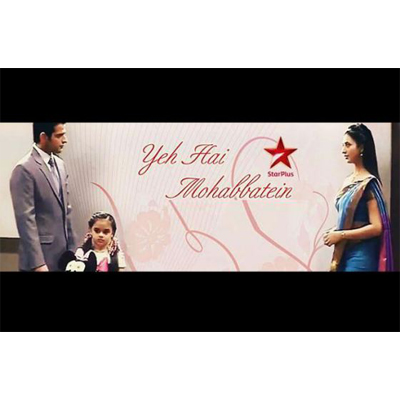
    MUMBAI: Star Plus and Balaji Telefilms relationship goes way back. The shows from the production house’s banner captured almost all the slots and made the channel flourish on the TAM TV ratings chart.


    Currently, Yeh Hai Mohabbatein (YHM), which was launched on 3 December 2013, had hit the television screens at a dead slot (11 pm) where no other broadcaster dared to experiment.  


    But the channel decided to take the bold move and was confident that one day the show will succeed. And today, if one goes as per the ratings, it ranks number four on Star Plus leaving behind even the older shows. In the week 37 of TAM TV ratings, it garnered 5,245 TVTs, down from 5,730 TVTs.


    From 22 September, the show will occupy a dual time slot and will air six days a week at both 7:30 pm and 11:00 pm. The series will replace Saraswatichandra which has been struggling with low numbers at the ratings chart.


    Star Plus SVP marketing Nikhil Madhok explains the reason behind the move. According to him, the move was made after audiences’ feedback that a certain section of viewers found the 11 pm slot too late in night.


    He adds, “It has a very loyal audience with the highest time spent on Hindi general entertainment channel (GEC). The show is really popular but a lot of people kept telling us, especially youngsters, that it was too late for them to stay awake and watch considering they have their schools and colleges the next day.”


    Madhok believes that prior to this, time slot movements were done by GECs usually when it wanted to shift a non-performing show to a competitive big show or early evenings or afternoons. But this is for the first time a top performer show is being shifted primarily to gain more viewership.


    The channel feels that the advantage of doing this is twofold. One, a lot of people who were not able to watch the show at 11 pm can now watch it at 7:30 pm. And secondly, audiences who love YHM get two opportunities to watch the show.


    “This was a show where repeat viewing the next day or viewing on online digital medium is very high. So the dual airing will not only help the existing viewers who love the show to watch it twice but also add a whole new set of viewers,” states Madhok.


    The channel underwent a research where it stated that at 11:00 pm, the number of people available is far lesser than 7:30 pm and contributes only 60 per cent of the overall audience in the community.


    Madhok and the makers are confident that since the content will remain same at both the slots, it will garner good ratings at both time slots. YHM has got India Gate Basmati Rice as its title sponsor.

  • Channel V’s ‘Gumrah’ aims to make 1 pm a destination slot

    Channel V’s ‘Gumrah’ aims to make 1 pm a destination slot

    MUMBAI: What if your kid desires to be a murderer or a rapist when he/she grows up? Bringing home uncomfortable realities of teen crimes, Channel V is back with its fourth season of its crime-based property – Gumrah – End Of Innocence.


    Though television serials showcasing prevalent evils in society are not uncommon, the 13 episode series through its multiple seasons has always given a new outlook to how crime is perceived by viewers.


    The show tackles issues like peer pressure, the need to fit in, materialism and the dilution of morals, thus initiating a dialogue for the youth to express and address their problems. Taking a step ahead from the earlier versions, season four will focus on what actually makes the person a criminal, because nobody is born one!


    Come 31 August, the one-hour episode will showcase 13 episodes every Sunday at 1pm.


    Talking about the show Channel V vice president marketing Nipa Asharam believes that for it, Gumrah is more a brand than just a TV show. “Our realisation came after Gumrah season three that people are actually concerned about safety, so this season we thought about what new can we offer?”


    Staying true to its philosophy -‘to be politically incorrect and emotionally correct’, the channel has penned the series on the same line. According to Asharam, young kids talking about becoming a rapist or a drug dealer is unusual and hard hitting. “We are trying to make people see that criminal qualities have their roots in childhood so it is important to identify them,” she says.


    Produced by Balaji Telefilms, season four will be hosted by Abhay Deol with real life stories involving first hand research. Then, second hand research is done by talking to people who fit into those stories. With four episodes in the bank, the show has got on-board a few celebrities who will share any teen crime story that they have experienced or witnessed in the course of their lives.


    Channel V EVP and business head Ajit Thakur believes that the show is about the youth’s tryst with crime and the circumstances which led to the incident, rather than sensationalising the crime or the criminal himself. “Over the years, the show has gained popularity with its exceptional content and execution and we are upping the ante this time around, hoping to really get the message across,” he says.


    According to Asharam, the USP of the show is honesty. “In every way, we have tried to maintain the honesty of the initiative right from the first time we conceptualised Gumrah. Honesty is the big reason I think the series has been successful,” she quips.


    The channel is leaving no stone unturned to promote the series. It was created into a strong digital campaign along with TV. On the digital campaign front, it had an interactive banner ‘when I grow up I want to be a ————‘ and when people put in various positive career options, what comes up is only murderer, rapist etc just to let them know that no one is born a criminal and there are kids who are becoming that.


    At present, the show enjoys huge fan following on Facebook with 24 lakh likes at the time of penning this article.


    Asharam believes that the response of advertisers has been very encouraging season after season. They have started to view the show as a brand and want to endorse the message that Gumrah sends out. It has also opened up whole new categories as well like education, mobile and technology. She further goes on to say that in the first season, there were a lot of apprehensions, but this season, advertisers were open to it.


    The idea to air it at 1 pm was because it is a virgin slot when others usually show only repeats and movies. It aims to make it a destination slot.


    A highly placed media planner believes that though the channel took a bold move of airing at 1 pm, it won’t attract much younger people on-board. “Though the channel targets the youth, in the end it is the content that is king. If the content is the same as shown before, it will lose its charm and audiences,” he says.

  • Balaji Telefilms Q1-2015 PAT triples

    Balaji Telefilms Q1-2015 PAT triples

    MUMBAI: Balaji Telefilms Limited (Balaji) reported triple the (2.9 times) consolidated PAT at Rs 10.56 crore in the quarter ended June 2014 (Q1-2015) as compared to Rs 3.62 crore during the previous quarter ended June 2013 (Q1-2014) and versus loss of Rs 27.36 crore in the preceding quarter ending March 2014 (Q4-2014).


    Consolidated PAT expanded on the steep increase in revenue from operations which rose 61 per cent to Rs 135.34 crore against Rs 84.03 crore in Q1-2014, and was almost same as revenue from operations in the preceding quarter Q4-2014.


    Three major segments contribute to Balaji’s revenue – Commissioned Programmes, Sponsored Programmes and Films. While the revenue from films for the company stood at Rs 89.33 crore, 44 per cent more than Rs 61.65 crore in Q1-2014, the revenue from commissioned programmes was Rs 46 crore in Q1-2015 as against Rs 22.77 crore in Q1-2014 and Rs 39.86 crore in Q4-2014. The profit made by the film segment was 23 per cent down to Rs 26.06 crores y-o-y.


    Revenue from Sponsored Programs in Q1-2015 was nil.


    EBITDA for the company was in positive at Rs 14.71 crore as against negative in the preceding quarter (Q4-2014) at Rs 5.01 crore.


     Let us look at the other numbers reported by the company.


    The company’s total expenditure rose 35 per cent in Q1-2015 to Rs 123.49 crore as compared to Rs 91.33 crore in Q1-2014 and 13 per cent as against Rs 109 crore in Q4-2014.


    Cost of production/acquisition and telecast fees contribute 44 per cent to the Balaji’s total expense, while marketing and distribution expense was 14 per cent of the total expenditure. The Cost of production/acquisition and telecast fees fell 19 per cent to Rs 55.49 crore in Q1-2015 versus Rs 69.26 crore in Q1-2014 and Rs 52.73 in Q4-2014.


    Balaji’s expenditure for marketing and distribution fell 27 per cent in Q1-2015 to Rs 18.07 crore as against Rs 24.96 crore in Q1-2014 and Rs 20.30 crore in Q4-2014


    Finance costs for Q1-2015 have been drastically reduced by the company to Rs 0.02 cr as compared to Rs 1.37 crore last quarter (Q4-2014)

     
    Let us look at Balaji’s subsidiary companies.


    Balaji Motion Pictures Limited (BMPL), a subsidiary of Balaji posted a profit growth of 147 per cent at Rs 8.84 crore versus Rs 3.57 crore in Q1-2014. Revenue for BMPL stood at Rs 89.39 crore, 44 per cent more than Rs 61.66 crore


    BMPL released three movies in the current quarter, among which ‘Ek Villain’ crossed the 100 crore mark.


    Bolt Media Limited (BML), another subsidiary of Balaji, reported a loss of Rs 0.25 crore versus loss of Rs 0.22 crore in Q1-2014. Revenue of the company increased to Rs 2.5 crore from Rs 0.83 crore in Q1-2015.


    Cost of Production/Acquisition and Telecast Fees for BMPL and BML was at Rs 74.88 crore and Rs 2.45 crore respectively in Q1-2015.


    BML is commissioning serials such as “Dharma-Kshetra” (26 episodes) and “Rakht” (10 episodes) for EPIC Television Networks Private Limited (Expected launch by Q2 of FY15).


    Click for financial release

    Click for investors report

  • Zee TV’s ‘Kumkum Bhagya’ gives tough fight at 9 pm slot

    Zee TV’s ‘Kumkum Bhagya’ gives tough fight at 9 pm slot

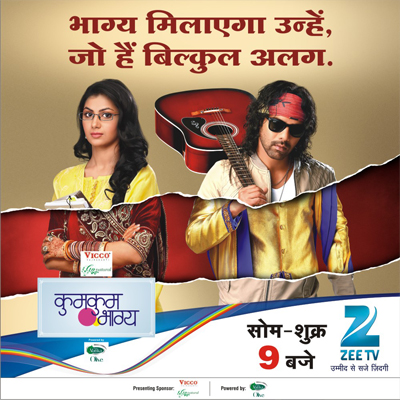
    MUMBAI: Zee TV, the channel that enjoys a steady second place on the TAM TV ratings chart is riding high on success and all thanks to its properties which have seen remarkable rise in viewership. But this week, what caught attention was Balaji Telefilms’- Kumkum Bhagya.


    It has seen a distinct spike in viewership ever since its protagonists Pragya and rockstar Abhi tied the knot clocking in 7,405 TVTs. The episodes from pre-wedding till the two tied the knot has seen a gradual rise in viewership.


    According to TAM data provided by the channel, while a four-week average for the pre-wedding period (starting week 21’14 to week 24’14) stood at 3,263 TVTs, the show has seen a 127 per cent increase in viewership in the last six weeks.


    So what has caught the attention of the viewers? Zee TV business head Pradeep Hejmadi believes that the ‘wedding track’ was a very important inflection point for people to gravitate to the series. He believes it is growing in terms of interest in all parameters.


    “The focus was on how fate can sometimes bring two very dissimilar individuals together. Then it is about how the relationship will take form and how they will conform to the institution of marriage as per our culture.”


    Kumkum Bhagya saw a surge in audience interest during the rather unlikely marriage of its protagonists – the flamboyant rockstar Abhi and the shy, serious girl-next door Pragya. The channel feels that due to its engrossing storyline coupled with believable performances, the show has been on a steady ascent, despite stiff competition at its time slot across GECs.


    Aired at 9 pm it picked a fight with slot leader Diya Aur Baati Hum (Star Plus) across Hindi GECs and has managed to grow exponentially. As per TAM, the show’s viewership has dropped by 22 per cent since week 16, when Kumkum Bhagya was launched. In the week 30, Diya Aur Baati Hum garnered 10,379 TVTs, down from 10,488 TVTs.


    Hejmadi believes that research forms an integral part during such competitive slots. Each show goes through a development process on how one would want to deal with a plot or the character.


    “Each story has its own promise and people who tune in are people who are bought into those promises or are keen to explore the relationships or the characters that stand out speaking to them. We concentrated on bringing out the key inflection points for the show and it was important because it is the core promise of KumKum Bhagya,” he says.


    At the marketing front, Hejmadi said that for any channel, marketing is the mix of two things – the on-air promotion on the network as well as promotion on other networks as additional activation.


    The show was heavily promoted through an aggressive 360 degree marketing campaign by the channel from the launch to the wedding highpoint to ensure traction kept growing week on week.


    Zee TV’s approach was one of sustained character building in all its communication across print, on-air and digital media. A judicious mix of mediums including high impact outdoors, print and innovatively crafted, personalised invites shared through social media on the day of the wedding created high visibility.


    The streamlined promotional strategy not only attracted eyeballs but also garnered a lot of word- of-mouth publicity, thereby creating an enormous buzz around the much touted wedding sequence.


    Hejmadi is confident that the series will continue to have the same kind of engagement level with the audiences. He goes on to say that in the fiction genre there are key points which mark the opportunity for an audience to start engagement. The channel has identified those key engagement points and will continue to focus on its other offerings as well.


    He believes that the ratings game is like running a marathon. But, with robust properties such as Kumkum Bhagya, Jodha Akbar and Qubool Hai ruling the roost, Zee TV is the only channel that has seen a 30 per cent increase in its weekday primetime viewership in the last six weeks.

  • We will look for international, local collaborations and diversifications: Sameer Nair

    We will look for international, local collaborations and diversifications: Sameer Nair

    I had never gone away”, says the man who is credited with bringing KBC and K shows to the Indian television screens. Sameer Nair, after a hiatus of three years, is back at doing what he does best. He has been busy exploring opportunities in online video, e-commerce, film & television production, education, hospitality and of course, helped the newest entrant, AAP, into Indian politics.


    A maverick as many call him goes by the philosophy – communicate clearly, be polite, be persuasive, sweat the detail, seize the moment and create not compete for what is already created.


    As the new group CEO at the country’s biggest production house, Balaji Telefilms, he will work closely with Shobha and Ekta Kapoor to take it to the next level.


    Indiantelevision.com’s Meghna Sharma caught up with him to know about his views on today’s audiences, their taste, Balaji’s success in gripping the viewers’ pulse and its future plans.


    Excerpts…


    You had the genius to select the content which caught the pulse of the viewers. How has that evolved? How do you keep abreast with the change in taste?


    Television is dynamic. When we did ‘KBC’ and ‘Kyunki saas bhi kabhi bahu thi’ which went on air on the same night, quickly followed by ‘Kahani ghar ghar kii’ and ‘Kasauti zindagi kay’, it used to be half an hour weekly programming on three main channels – Star Plus, Zee and Sony. This gave viewers 90 choices to pick from. At Star our big strategy was to channel this to daily and changed the whole schedule, reducing the primetime viewing choice to five. Which others followed and continues to be even done today. It was a new concept then and people liked it. With Imagine, we got mythology into primetime which can be seen today as well.


    In the last 22 years of Indian television, we have had a full generation of television – executive, creatives. When I started of in 1993, we were the pioneers then, and had only the legacy of Doordarshan (DD) to look back at whereas today’s generation has 22 years of television to study. So, in the last 20 years, there has been a lot of process especially in consumer taste because the country has progressed. Today we have 150 million television homes, 800 million mobile phones, internet, disposable income has increased and content has kept in pace with it because of the new talent entering the space. For instance, Colors has had wonderful success, Sab has created a special niche for itself and done remarkably well, production houses are doing well and coming up with shows like ‘24’ and ‘Yudh’.


    Content has evolved and so have the people.


    Channels do a lot of research, but what I feel is that research can only prevent you from doing a mistake. It can tell you what not to do and not what to do. Finally, what has to be done is done with meticulous details, creativity and the way a story is told. For instance, ‘kyunki…’ as a daily show was a good idea strategically, but people remember the story of Tulsi in the big Virani family. It is all about great stories, well told.


    What is your role as group CEO?


    Balaji is in a very good place and we have had a successful run of films as well as shows. I was doing a count and Balaji has 15 of the top 50 shows currently on the Indian television screens. There are a very few listed industries in this space and it is one of them.


    And in the past six months we have been discussing the growth plans and one of the main take outs of those meetings has been that we should scale up the company. So, now Balaji will do more movies, more television, we will look for international as well as local collaborations and look for diversifications.


    I have really come here to work with Shobha and Ekta Kapoor to do that.


    Which verticals are you looking at for collaborations?


    Could be movies, shows, formats or just partnering with an international company on specific projects. If there is a format company looking to set up a shop here in India or wants to do catalogue shows here then that could be an opportunity we would be looking at.


    Between Ekta, Shobha and you, how are the roles divided?


    Ekta is creative and she is great at that. Mrs Kapoor has been the operational backbone of the company, so I will work closely with her. And also with Ekta. The main aim here is to work together and look for growth opportunities.  


    What in your assessment are Balaji’s strengths and weaknesses? And what are its opportunities?


    Balaji has a very good team and they have produced some incredible work. So, if there has to be a weakness then it is to have craft a strategic plan and then execute it. At its current stage, the Indian television industry is at its best and has no weaknesses. But of course, one can always do better and look at different genres, show etc. But, I wouldn’t say that these are weaknesses but are opportunities.


    As for the strengths, they are very strong on creative, production and have the ability to deliver. The talent in Balaji is phenomenal and there is a lot of ambition.  


    What is Balaji’s USP- is it talent, creativity or the ability to know what viewers want?


    The USP is the storytelling. Ekta’s way of telling a story is what sets her apart from the others. The market is crowded and a lot of others are also doing a great job. It is not a monopolistic market. But Balaji is special.


    A lot of famous faces have come from Balaji’s house. How is the talent management arm, Spark, doing?


    I haven’t taken a look at it yet, but will soon do. I want to do some reorganisation with that arm. We at Balaji want to manage the talent in the country and look at growing more talent.


    Lately, we have seen channels experimenting with finite shows. According to you, what is its future in India?


    The market is already segmenting. There is a segment which will continue to watch the dailies and then there is another who will consume mythology and historical shows. But there is and will grow into a bigger section of audience which is interested in finite shows. So, there will be two distinctive audiences – you and your mother.


    Niche is always more valuable. And with digitisation it will benefit the industry and the viewer as one can choose to pay for a channel showcasing only hi-end products. As this group grows, it becomes a business model.


    The market is moving that ways and we are the market leaders.


    Globally, there are firms like Shine, BBC, Fremantle who have spread their wings internationally. Do you think Balaji can be India’s Shine?


    A lot of global companies which have come to India and come with their format catalogue which they are selling in India tend to be in reality and game show space. But we haven’t seen any international firm making any head way in the fiction space. The same thing applies on reverse basis. The west has been more advanced than India when it comes to television. The formats have done well there and since they are universal, they can travel across the globe.


    What Balaji will look to do is to partner with them. The future of this business is creative collaboration rather than destructive competition. We are looking at more people to work for.


    And we have already had a few offers to co-produce international movies into Hindi with a foreign partner. Maybe, later we could do shows as well and who knows set up a collaborated company in the future.


    Earlier there was Balaji and Balaji alone, apart from UTV. But today we have Beyond Dreams, Director’s Kut, Swastik which are producing big ticket shows. Did Balaji let go of opportunities? Or was it the content demand that helped them crop?


    It’s an expanding market and there is a limit to what a production house can do and should do. So, it’s just a dynamic market. There are too many channels and we need more shows so therefore more producers are needed to produce these shows.


    It is a nice competitive space with good creativity energy.


    Balaji did produce regional content for TV, will we see that happening again? What about venturing into regional films?


    I have heard that regional market is going through a bit of turmoil and price points have really crashed there. So, we are looking at the regional market to work with the right partners. So, again the big focus in on collaboration.


    Balaji has a lot of inherent strength and a lot of reverse so we have to see if we can collaborate with creative people there. We have an open door policy and anybody with a great idea can approach us. We are always looking for people to work with whether in television or films or new media.


    As far as films are concerned, what is the strategy?


    We have had a good run this year and the plan is to settle towards eight to 12 movie slates per year. So we will have to work really hard to achieve this because it will have to be across genre and across budgets. We have always done it that way and that’s why we have had films like ‘Ragini MMS 2’, ‘Mein Tera Hero’ and ‘Ek Villian’. So there is a lot of variety and we will be looking at scaling it up.


    What will be Tanuj Garg’s role now?


    The film arm is strong and has churned out fabulous work in the past. And will continue do so. Tanuj will be reporting to me.


    Balaji doesn’t own IP. Is that what has kept its price at the level it is?


    There is too much hype given to Intellectual Property (IP). The value of IP is when it has the ability to monetise the content. Movies have IP because after the theatrical release you can sell the broadcast rights to a channel and then re-syndicate it through DVDs.  In television, the kind of shows that are being made there is not much beyond what is in the first run. The channels are anyway syndicating it aboard.


    The US has so much of IP because of the content available there. For instance, they can have a great run of a show like ‘Big Bang theory’ and then sell it in India because we watch it too. But the reverse doesn’t work for us. For example, we can’t sell a ‘CID’ there for the Americans to watch, but we will watch ‘CSI’. So, IP makes sense when your content can cross boundaries and still be consumed.


    What is on the agenda for the next couple for years?


    We are looking a long term strategy of growing the business. In the next three to five years, we should double or triple in size. That means more shows, films and some good co-productions.


    The big agenda is that we are looking for creative people and companies to partner with and grow in inorganic manner as well.


  • Sameer Nair joins Balaji Telefilms as Group CEO

    Sameer Nair joins Balaji Telefilms as Group CEO

    MUMBAI: He has donned numerous hats. From selling space in Yellow Pages to being a member of a political party, Sameer Nair has had a volatile career.


    The former Star India CEO is now all set to join Ekta Kapoor’s Balaji Telefilms as Group CEO.


    On 15 July, Nair attended the board of directors meet and will take full -charge from today.


    Nair said, “I have enjoyed a wonderful association with the Kapoor family since 2000 following the launch of the hugely successful ‘K-series’ on Star Plus and later with their shows on Imagine. Undoubtedly the team has done a remarkable job of creating one of the most vibrant entities in content generation. The M&E industry is currently at a very dynamic stage and  will  continue  to  present  several  exciting  opportunities  across  all  segments, heralding significant change in times to come. I am delighted to have the opportunity of being a part of an extremely exciting business at one of India’s most pioneering, creative and talented media houses. Given BTL’s several strengths as a business, it is very well poised to capitalise on emerging growth prospects. I look forward to working together with Ekta, Shobhaji and the team, in driving strategic initiatives, furthering the Group’s vision of being regarded as an innovative entertainment powerhouse and enhancing value for all stakeholders.”


    Balaji Telefilms MD Shobha Kapoor added, “We are delighted to have Mr. Nair joining the Balaji family. Sameer brings with him immense and diverse experience in the media and entertainment industry and an acknowledged   record  of  content  innovation,  business  leadership  besides  being  an excellent  resource  unifier. Over  the  last  several  years  we  have  built  an  unparalleled franchise in creation of television content and have also developed  a very strong brand equity within the film production  segment. We are excited that Mr. Nair possesses  the same passion  for entertainment  as us and we look forward to him further reinforcing Balaji’s  inherent  strengths  in  both  segments  and  driving  the  Company’s  growth  & expansion strategies to help us scale greater heights.”


    Nair who was very vocal about his association with Aam Admi Party (AAP) started his TV career in 1994 where he began as a director-producer for Star Movies, Star’s English movie channel. In 2000, his career as well as Star reached higher peaks with Kaun Banega Crorepati which helped take Star Plus from number three position to number one.


    Soon, he was given the charge of the network as CEO. But it was short lived as he quit the company after 13 years of association in 2003.


    After that, he joined NDTV’s new joint venture with Karan Johar’s Dharma Productions as CEO. As part of the JV, he was involved in launching NDTV Imagine, the Hindi GEC in November 2007. However, the channel didn’t do well and was shut in 2012. 


    Since then, Nair has been busy as independent media entrepreneur and been making frequent trips to Delhi to support and contribute in AAP’s communication strategy.