Tag: Baidu

  • Digital ad investment will surpass TV in five more countries: GroupM’s Interaction 2017

    MUMBAI: GroupM has published Interaction 2017, a state of the union assessment of digital advertising worldwide with forecasts on technology developments, media marketplace trends and evolving consumer behaviors informed by experts from WPP’s worldwide network of communications, marketing and data companies. 

    The report offers in-depth insights underpinning digital advertising growth forecasts in 46 markets. Topics covered include ad fraud and marketplace integrity, fake news, privacy, ad blocking, artificial intelligence, augmented and virtual reality, video competition across platforms, live video, advanced television, streaming and on-demand audio, and much more.  In the report, GroupM’s global chief digital officer Rob Norman and Futures Director Adam Smith, also share views on media pricing, the consolidation of economic value in media among a small group of companies, and media consumption and ecommerce trends.

    As reported in its “This Year, Next Year,” worldwide media and marketing forecast, GroupM predicts that digital advertising will capture 77 cents of every new ad dollar in 2017; TV will capture 17 cents. Despite challenges around standards, measurement and supply chain integrity, digital advertising continues to grow rapidly as marketers follow consumers to the media destinations where they spend their time, and increasingly transact for goods and services. Digital investment has already surpassed TV in ten markets* and another five will cross this bar in 2017 (France, Germany, Ireland, Hong Kong and Taiwan), GroupM predicts.

    As the competition for consumer attention and advertiser investment escalates, people worldwide are spending more time with media. On a population-weighted average, the overall time spent with media (the ‘media day’) grew by nine minutes to eight hours in 2016, but time spent with online media grew by 14 minutes. This is attributable to the greater access to media that mobile technologies provide. Mobile similarly contributed to the growth of adult internet users to 2.34B in 2016.

    However, GroupM’s data shows that for now, TV is still king with advertisers when global data is aggregated. TV’s share of advertising investment was largely stable at 42% in 2016; GroupM predicts a share decline to 41% in 2017. TV rode a five-year peak share at 44% from 2010-2014, with only minimal share shedding since then.

    Still, linear TV demographics continued shifting in 2016, with the loss of the 16-24 year-old demographic remaining one of its biggest challenges. Though the global population of 16-24 year-olds only decreased 1% 2014-2016, the average “tonnage” of the 16-24 linear TV audience shrank 16%, with some markets reaching numbers closer to 30%. GroupM clarifies that some of this loss is exacerbated by TV’s other big challenge – the inadequate measurement of TV’s total audience across platforms. GroupM continues to advocate measurement improvements to better evaluate television across all devices in markets across the globe. The absence of close substitutes means that for now, those advertisers seeking this young adult TV audience can be willing to bear price inflation in proportion to its rising scarcity.

    In the report, GroupM also examines the coalescing of economic value among six global companies who hold the lion’s share of digital ad spending, with Google and Facebook at the forefront. GroupM notes that these companies have very different business models than the owners of linear TV, and they also attract different advertisers. Advertisers accounting for 90% of TV advertising revenue represent between 30% and 40% of the revenue earned by the digital giants. The other 70% of their revenue comes from a combination of small and local businesses, often ones that trade in digital products or services. This bifurcation among classes of advertisers is subject to change as television becomes more data-fueled and targeted (more like digital) and as video content on digital platforms continues to be enhanced with greater quality (more like TV).

    “Google and Facebook attracted the vast majority of incremental digital ad investment growth in 2016,” said Smith. “In 2017, the industry will be watching closely to see how Snapchat or Amazon may creep into Facebook’s and Google’s value chain, and if the stronghold that ‘BAT’ (Baidu, Alibaba, Tencent) has in China can expand to international markets.”

    Interaction 2017 also looks at consumer purchase behaviors. In 2016, ecommerce totaled USD 1.874 trillion, globally, fully 20% more than the USD 1.558 trillion logged in 2015. GroupM forecasts 18% growth for ecommerce in 2017, surpassing the two-trillion mark to USD 2.205 trillion.  On average, online shopping per user is projected at USD 869 in 2017. The U.K. remains home to the most active online shoppers, predicted to average USD 4,000 per user in 2017. Combined, Amazon and Alibaba represent more than half of all e-commerce (excluding the travel category).

    “Last year, we were cautious in our estimation of the rate of change, but this year we are less so in the face developments in hardware and software technologies that are advancing us from the information age to the intelligence age,” said Norman. “To help shape our thinking and speculation in this year’s Interaction, we invited more than 20 partners** to discuss AI, augmented and virtual reality, video competition, advanced and data-driven TV, streaming and on-demand audio, the Google/Facebook digital duopoly, live video, ecommerce, marketplace integrity and fake news. The result is both one of the most comprehensive pieces on the state of digital we’ve ever written and also a springboard for marketers to think long and hard about their future. We invite debate that will undoubtedly ensue.”

    (* Australia, Canada, China, Denmark, Finland, the Netherlands, New Zealand, Norway, Sweden, United Kingdom.)

    {** Amazon, AppNexus, comScore, DoubleClick, eMarketer, ESPN, Facebook, Google, Hulu, IAB, IBM, LinkedIn, NBCU, Pandora, Pinterest, The New York Times, Snapchat, Turner, Twitter, Vox Media, YouTube.}

    public://global-002.jpg

  • Baidu India launches a social campaign ‘The Last Conversation’

    Baidu India launches a social campaign ‘The Last Conversation’

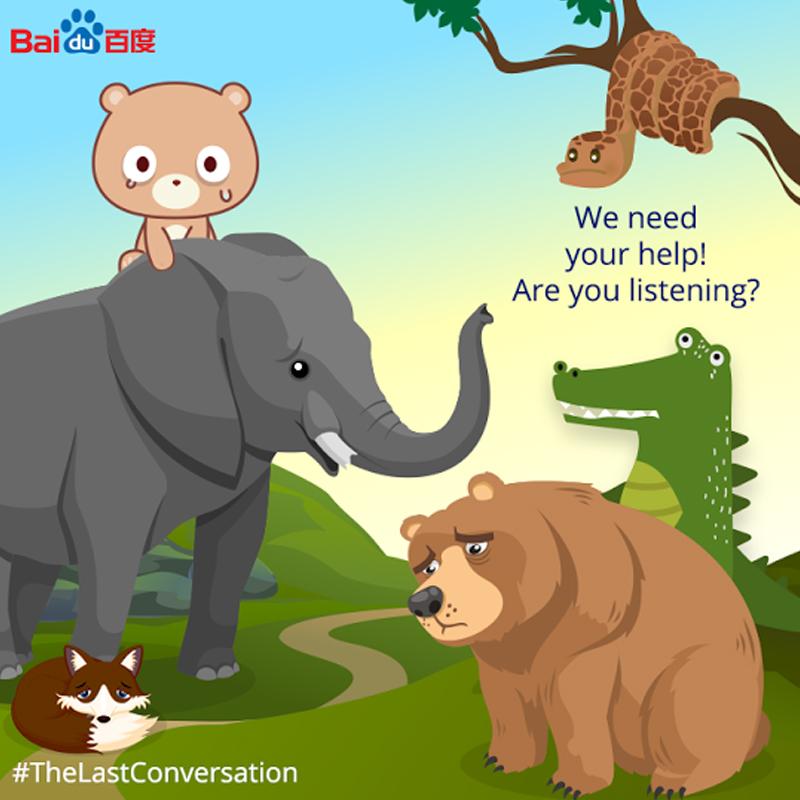
    MUMBAI: On World Environment Day (WED) 2016, Baidu’s India office will launch a new social campaign named “The Last Conversation” to raise awareness of wildlife depletion. The campaign will feature Baidu’s mascot, the “DU bear”, having a final conversation with different endangered animals through a series of posts on Facebook and Twitter, with the goal of urging people to avoid products that cause harm to wildlife.

    According to a 2014 report issued by the International Union for Conservation of Nature (IUCN), India is home to 6.5 percent of the world’s total wildlife species, which includes 7.6 percent of all mammals and 12.6 percent of all bird species. Out of these, 15 species of birds, 12 species of mammals, and 18 species of reptiles and amphibians in India are recognized as critically endangered.

    Baidu India will hold its campaign on Twitter and Facebook from June 1st to June 5th, 2016, with the hash tag #TheLastConversation. The animals featured in the conversations will speak their last words to the DU bear before they are turned into consumer products, in a strong message of the harmful impact of our purchases on wildlife.

    Baidu has previously advocated other environmental causes in India and worldwide. Since 2014, Baidu’s Android apps DU Battery Saver and DU Speed Booster have partnered with the World Wide Fund for Nature (WWF) on a yearly basis to raise awareness of Earth Hour, the world’s largest grassroots environmental movement organized by WWF.

    WED is a yearly awareness campaign run by the United Nations Environment Programme (UNEP). The theme of WED 2016 is illegal trade in wildlife, with the slogan ‘Go Wild for Life’.

  • Baidu India launches a social campaign ‘The Last Conversation’

    Baidu India launches a social campaign ‘The Last Conversation’

    MUMBAI: On World Environment Day (WED) 2016, Baidu’s India office will launch a new social campaign named “The Last Conversation” to raise awareness of wildlife depletion. The campaign will feature Baidu’s mascot, the “DU bear”, having a final conversation with different endangered animals through a series of posts on Facebook and Twitter, with the goal of urging people to avoid products that cause harm to wildlife.

    According to a 2014 report issued by the International Union for Conservation of Nature (IUCN), India is home to 6.5 percent of the world’s total wildlife species, which includes 7.6 percent of all mammals and 12.6 percent of all bird species. Out of these, 15 species of birds, 12 species of mammals, and 18 species of reptiles and amphibians in India are recognized as critically endangered.

    Baidu India will hold its campaign on Twitter and Facebook from June 1st to June 5th, 2016, with the hash tag #TheLastConversation. The animals featured in the conversations will speak their last words to the DU bear before they are turned into consumer products, in a strong message of the harmful impact of our purchases on wildlife.

    Baidu has previously advocated other environmental causes in India and worldwide. Since 2014, Baidu’s Android apps DU Battery Saver and DU Speed Booster have partnered with the World Wide Fund for Nature (WWF) on a yearly basis to raise awareness of Earth Hour, the world’s largest grassroots environmental movement organized by WWF.

    WED is a yearly awareness campaign run by the United Nations Environment Programme (UNEP). The theme of WED 2016 is illegal trade in wildlife, with the slogan ‘Go Wild for Life’.

  • Baidu India to hold International university marketing competition

    Baidu India to hold International university marketing competition

    MUMBAI: Baidu’s India office today announced its participation in Baidu Inc.’s first International University Marketing Competition. The competition, which aims to empower the next generation of marketers, will be open to university students in India, China and Indonesia.The Indiaportion of the campaign will encourage local university students tocreateshort marketing videosfor a chance to intern at Baidu’s New Delhi office, and visit the company headquarters in Beijing.

    The competition was formally announced at an opening ceremony in Beijing on 16 May. In addition to India, the competition willalso be open to students in China and Indonesia.“The Internet is changing the world quickly, and there’sa huge need for digital marketing talent,” said Baidu’s Educational Business Unit general manager Zhang Gao. “The International University Marketing Competition is a platform for all students to put their best foot forward and showcase their creative ideas”.

    To participate in the India campaign, university students will first need to create a video on Baidu’s new video app Talebox. Outstanding videos will then be shared on Baidu’s app store MoboMarket and held to a public vote to select the final winners. The India competition will be held from August 1st to September 30th, 2016.

    The Baidu India team plans to visitup to 100 universities across India duringAugust and September to raise awareness for the campaign and engage with local students. The planned visits will cover universities inmany major Indian cities, including New Delhi, Mumbai, Pune, Bangalore, Chennai, Kolkata, Kanpur, Ahmedabad and Hyderabad.

    For more information on how to take part in the competition, please follow the Baidu India Facebook page at: https://www.facebook.com/baiduindia/

  • Baidu India to hold International university marketing competition

    Baidu India to hold International university marketing competition

    MUMBAI: Baidu’s India office today announced its participation in Baidu Inc.’s first International University Marketing Competition. The competition, which aims to empower the next generation of marketers, will be open to university students in India, China and Indonesia.The Indiaportion of the campaign will encourage local university students tocreateshort marketing videosfor a chance to intern at Baidu’s New Delhi office, and visit the company headquarters in Beijing.

    The competition was formally announced at an opening ceremony in Beijing on 16 May. In addition to India, the competition willalso be open to students in China and Indonesia.“The Internet is changing the world quickly, and there’sa huge need for digital marketing talent,” said Baidu’s Educational Business Unit general manager Zhang Gao. “The International University Marketing Competition is a platform for all students to put their best foot forward and showcase their creative ideas”.

    To participate in the India campaign, university students will first need to create a video on Baidu’s new video app Talebox. Outstanding videos will then be shared on Baidu’s app store MoboMarket and held to a public vote to select the final winners. The India competition will be held from August 1st to September 30th, 2016.

    The Baidu India team plans to visitup to 100 universities across India duringAugust and September to raise awareness for the campaign and engage with local students. The planned visits will cover universities inmany major Indian cities, including New Delhi, Mumbai, Pune, Bangalore, Chennai, Kolkata, Kanpur, Ahmedabad and Hyderabad.

    For more information on how to take part in the competition, please follow the Baidu India Facebook page at: https://www.facebook.com/baiduindia/

  • Google, Baidu look to create online video solution in China

    Google, Baidu look to create online video solution in China

    MUMBAI: The world’s most valuable media firm Google is competing with rival Baidu.com to find China’s answer to global online video social site YouTube.

    Both the companies are looking to develop online video services in China.

    Media reports indicate that the two firms have independently had early discussions with some local video Web sites for potential business cooperation or possible acquisitions.

    However, neither Internet giant has secured a specific target yet.

    Google has two options. It could just translate its YouTube site into Chinese or build up a brand new ‘YouTube China’, possibly through the acquisition of a local video-sharing Web site.