Tag: Ayuna Badmaeva

  • Prasar Bharati & Digital TV Russia ink alliance to exchange programmes & technology, initiate co-productions

    Prasar Bharati & Digital TV Russia ink alliance to exchange programmes & technology, initiate co-productions

    NEW DELHI: Prasar Bharati and Russia’s top pay television broadcaster Digital TV Russia (DTR) have collaborated on high quality production, marketing and distribution of content related to art, culture, trade and science, research and technology.


    The memorandum of understanding on cooperation between the two broadcasters will also entail joint production and exchange of TV programmes and related services, which will give audiences in both countries an unprecedented access to a rich variety of thematic entertainment and factual content.


    The MoU was signed by Prasar Bharati CEO Jawhar Sircar and DTR representatives Dmitry Mednikov along with Ayuna Badmaeva. Prasar Bharati chairman Surya Prakash was also present.


    The joint productions will particularly be in the areas of music, opera, theatre, film-based programmes, cartoons and animation based on epics of both countries, literary classics, folk tales, science fiction, circus and so on. In addition children’s programmes, tourism promotion, sports and gymnastics will also be covered.


    The MoU will include re-packaging, re-purposing and dubbing popular or iconic TV programmes produced by one party for use by the other party.


    There will be unique exchange of programmes between the two broadcasters and cooperation in research and development for technical modernization and capacity building in the areas of TV programming.


    There will also be cooperation in manpower training by augmenting each other’s training facilities through mutual cooperation. 


    Marketing of each other’s programming will be another area, and this will include the rich archival programmes.


    Digitization of audio-visual materials of rich value for preserving them for posterity by sharing technical and scientific knowhow and best practices is another field of concentration.


    The two broadcasters will cooperate in promoting consumer products and ad sales of respective countries through their TV channels.


    Prakash said the MoU was a natural corollary of the ancient ties between the two countries. He also referred to the fact that Bollywood was the only answer to Hollywood, even though productions in India cost one-tenth of those in Hollywood.


    Jawhar said this partnership will cross-promote each nation’s unique culture and traditions through cooperation in all areas in the media arena. From adaptation of iconic TV programmes in each broadcaster’s library, right up to the sharing of best practices, this coming together will not only benefit viewers in India and Russia, but will also inspire media executives in both countries to explore new and exciting ways of communicating their stories.  


    He added that the tie-up had tremendous potential for developing synergies between the two broadcasters.


    He said, “A new vibrant India looks forward to a robust partnership with Russian Television and Radio, as represented by VGTRK and DTR. India and Russia have a long tradition of mutual respect and have enjoyed decades of meaningful partnership in many industrial, scientific and cultural domains. Through this new MoU, we look forward to a reassertion of our historic bonds and seek to know each other’s country, people and advancements even better. We intend to come even closer through better appreciation of our positions.”


    Russia TV and Radio Deputy CEO Dmitry Mednikov said DTR is committed to developing local content in India for distribution by local players, and will re-invest their revenues into local content. He said, “We are here to launch and build meaningful business in partnership with India’s programmers, content producers’, distribution platforms. Our key principle is to invest into local content production, state-of-the-art technologies and to develop local talents.”


    Answering questions, he said there was no problem about dubbing or sub-titling programmes in English. He also said DTR being a pay channel did not create any problems as it also had some FTA channels. 


    Doordarshan’s Lalrosanga said that this MoU was one of many new initiatives being taken by the public broadcaster.


    Russia’s leading journalists will be in India next month to produce TV programmes on Indian economy, technology and culture. This series will be aired in Russia’s highly rated FTA channels Russia 1 and Russia 24.


    DTR deputy CEO and GM of International Networks Ayuna Badmaeva said, “We provide smart and innovative programs that entertain, educate audiences across all demographics and on all platforms. Our philosophy in creating local brands and local formats ensures that these channels will resonate with the local viewers. Especially with a market like India where there are many regions and languages.” 


    Veena Jain who heads DD News said the channel would like to educate viewers about Russian arts and culture. DD ADG Deepa Chandra who is in charge of the national channel said music and dance always attracted viewers.
  • Indian pubcaster needs to re-invent in era of digital advancement

    Indian pubcaster needs to re-invent in era of digital advancement

    MUMBAI: While the general consensus on the role of a public service broadcaster (pubcaster) is that it provides not much “newsy” content, the BBC definitely remains a role model, even for private news channels.


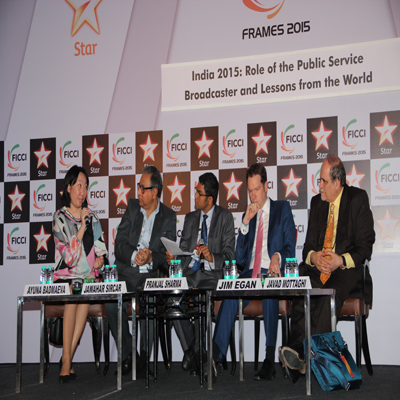
    This was the underlying theme that was discussed on a panel discussion titled ‘India 2015: Role of the Public Service Broadcaster and Lessons from the World’ at FICCI Frames 2015.


    The panel comprised Prasar Bharati CEO Jawhar Sircar, BBC Global News CEO Jim Egan, ABU secretary general Javad Mottaghi and VGTRK Digital Television Russia deputy CEO Ayuna Badmaeva. The session was moderated by Zee Network’s The Appointment host and FICCI advisor Pranjal Sharma.


    The session began with Sircar speaking on the role of Prasar Bharati in the country so far. According to him, the pubcaster had been able to streamline the entire country’s emotional unity together in a multi culture nation. It also played the heritage aspect role as it broadcast mythological shows like the Ramayana. “Show me a single broadcaster, who covers every island of the country across its geographical spectrum. India’s cultural unity was achieved because of a public service broadcaster,” he emphasised.


    Elaborating on how her network functions in Russia and on its role, Badmaeva informed that the network had 18 brands under its umbrella. “We started in 2009 with a factual entertainment channel. We work across Russia and our role is to fill the gap where other networks do not cover its citizens,” she said.


    Egan added, “What is most important for a public service broadcaster is to make the good popular and make the popular good. It is very important that a pubcaster reaches out to every citizen.”


    Posing a question, Sharma asked whether the government should decide what’s good for the public? Mottaghi replied saying that the first word “public” of Public Service Broadcaster referred to all groups of society. Hence its duty was to serve the public. “It has to be public oriented content versus commercial oriented content. We talk about issues such as health, culture, education and what society needs, which is not so much part of commercial news channels,” he opined.


    On being questioned by Sharma as to how Doordarshan ensures that it gets viewers to watch its content, Sircar conceded the fact that DD’s content was definitely not at par as compared to what the BBC was known for world over.


    For Sircar, the issue was related to both creativity and funding. “If the BBC could use 75 per cent of its funding on content, India could use only 10 per cent,” he said.


    Throwing an insightful statistic, which governed the theme of the discussion that followed, Sircar said, “While internationally, double digits dollars were spent per person for creating content. However, in India only 40 cents per person is spent on creating content. If you spend 40 cents, you get content worth 40 cents too.”


    Badmaeva then spoke on how the pubcaster tried remaining relevant in Russia in the ever-evolving digital age. She said, “While linear TV ratings are going down, people consumed content via smartphones and tablets. People also bought their content from cable operators. For us, our network is driven by both profit and reach.” She went on to add the Russian pubcaster has in recent time produced a documentary, which delivered the same rating as the Winter Olympics.


    Egan informed on how the BCC stayed relevant in a dynamic media space. “Every household is driven by a $20 subscription. The idea is about universality. While a part of it to remain relevant is about content, it is also about access, technology and reach. We innovate based on demand. In the digital age, it is how audiences engages with the content,” he said. He then added that around 270 million of the BBC’s audiences was out of the United Kingdom.


    Speaking on the now banned documentary India’s Daughter, which was a joint co-production between various production houses and the BBC, Egan said, “It had the highest values of journalism and the challenge is to avoid being ghettotised as just a pubcaster.”


    Sircar added that DD Sahayadri too had much of its content produced by private production houses. “Own it, don’t stone it,” he said. He also mentioned that when the pubcaster decided to air the Aamir Khan-helmed show Satyamev Jayate, he was questioned by ministers if a show where people washed their dirty linen in public was good for the channel. Sircar was of the opinion that because the show touched public issues, the pubcaster should air it.


    Touching upon the case of Star Sports, which went to court over the pubcaster airing the ICC Cricket World Cup, Sircar said that the pubcaster just followed a court order, which stated that in addition to profit making, the people of India are to be allowed to watch games via cable through terrestrial means. “Because of a very small cartel, which has a few channels, it will lead to monopolising of sports events,” he highlighted.


    Sircar informed that his goal was now focussed on two things. Firstly, increasing the number of channels on Free Dish from the current 50 to 112 and secondly, to use DD’s 1400 transmitters to create FM bands. “If FM has to reach mobiles, smaller circles of 50 kilometers will be created,” he said.


    He went on to add that a process was underway where 15 out of 20 channels could be auctioned. However, he refused to share details.


    Touching upon Sircar’s “40 cent” remark, Egan concluded the session saying, “In a country like India with a large population, 40 cents could add up to $500 million a year. It is a question about a national strategic choice. In some countries a pubcaster would weep tears of joy with this amount of money.”

  • FICCI FRAMES: Prasar Bharati CEO Jawhar Sircar to speak on pubcaster & revenue

    FICCI FRAMES: Prasar Bharati CEO Jawhar Sircar to speak on pubcaster & revenue

    NEW DELHI: Prasar Bharati chief executive officer Jawhar Sircar will be addressing the annual FICCI FRAMES convention commencing in Mumbai on how a public broadcaster can still earn revenue.


    Sircar’s talk is on “India 2015: Role of the Public Service Broadcaster and Lessons from the World.”


    The three day convention from 25 – 27 March will extensively cover discussions on various issues related to the media sector centred around the theme – how to make India a Global Entertainment Superpower.


    Sircar said, “There is no nation in the world that does not have a decent public broadcaster and some of them like BBC or NHK Japan or the Korean Broadcasting System are legends, mainly because their nations, people and their governments wanted them to be so and help them succeed. India cannot be an exception as it is the only public broadcaster, which operates from the icy peaks of Kargil to our lonely borders in Arunachal, right down to Andaman and every possible corner of India: without ever looking at short-term commercial gains.”


    This panel discussion is scheduled on the second day of the entertainment and media conclave and will be moderated by business journalist Pranjal Sharma featuring BBC Global News CEO Jim Egan and Russia’s largest media corporation and public broadcaster – VGTRK deputy CEO Ayuna Badmaeva.


    The other key participant is Asia Pacific Broadcasting Union (ABU) secretary general Javad Mottaghi, who is a special invitee at FICCI FRAMES 2015.


    FICCI secretary general Dr A Didar Singh said, “The discussion would provide greater clarity on how to maximise the efforts of public service broadcasting, and also how institutions like Prasar Bharati can balance their programming mandate with effective revenue generation, and remain relevant in the digital era.”


    The session will explore the relevance, importance and space for Public Service Broadcasting in today’s ‘always connected’ world which offers a multitude of choices by way of content, delivery platforms and engagement channels.