Tag: Axis My India

  • Digital is now second important source of brand awareness after TV: Axis My India survey

    Digital is now second important source of brand awareness after TV: Axis My India survey

    Mumbai: In a reflection of the changing media consumption habit and the surge both in digital consumption & advertising, 38 per cent of consumers shared that they have majorly seen ads on digital platforms in the latest Consumer Sentiment Index (CSI) survey by Axis My India. In terms of brand advertisement placements, 44 per cent said they had seen it on television, while only 11 per cent and seven per cent of the audience believe that they have seen ads on print or outdoor respectively. This digital growth is led by the 26-35 age group audience, as per the survey.

    Consumer data intelligence company Axis My India released its latest findings of the India CSI, a monthly analysis of consumer perception on a wide range of issues. The sentiment analysis delves into five relevant sub-indices – overall household spending, spending on essential and non-essential items, spending on healthcare, media consumption habits, and mobility trends. The surveys were carried out via computer-aided telephonic interviews with a sample size of 10430 people. 62 per cent belonged from Rural India while 38 per cent belonged from urban counterparts.

    Reflecting the view of the majority, the survey for the month of October reveals that media consumption remains the same for 48 per cent of the families while the same has increased by 25 per cent. In addition, a combined 82 per cent said that they had seen more ads on TV and digital platforms over others.

    Overall household spending has increased for 63 per cent of families which reflects a seven per cent increase from the last month. This increase is highest in Northern India.

    The increase in spending on essentials like personal care & household items stands at 50 per cent reflecting a surge by five per cent. The net score which was +20 last month has increased to +27 this month. The growth in rural India is slightly higher as compared to urban markets.

    Spending on non-essential & discretionary products like AC, car, refrigerator has increased for 18 per cent of families. For 73 per cent spends on non-essential purchases remain the same which reflects an uptick of three per cent from last month. The non-essentials November net score, therefore, lies at +9. The trend on spends on discretionary products reflects a fine balance between caution and indulgence.

    With more exposure to outside activities, the importance of health bounced back quickly. Consumption of health-related items increased for 47 per cent of families as compared to 44 per cent last month. The health score which has a negative connotation i.e. the lesser the spends on health items the better the sentiments, has a net score value of -27.

    Consumption of media remains the same for a majority of 48 per cent of families and increased for 25 per cent of the family, while mobility net score reflects a constant improvement over the last four months.

    88 per cent of families said that they are going out the same or more on getaways/staycations /malls/restaurants, with travel bans being lifted and double vaccination providing easier movement opportunities. The overall mobility score is at -4 which is an improvement over last month which was at -5. This reflects slow but consistent progress in people’s sentiments for engaging in out of home activities

    Gauging views around the Diwali festivities, Axis My India, further discovered that 36 per cent of the consumers are planning to go beyond small-ticket purchases this festive season. While 24 per cent are looking to spend on household or personal items like White Goods (AC, TV, Washing Machine, Refrigerator, etc.), furniture, electronics, and jewellery; Nine per cent are looking to buy a four-wheeler or a two-wheeler. Further from a purely sentimental outlook, 59 per cent of the consumers reflect the view of a more hopeful and cheerful Diwali this year!

    The November net CSI score, calculated by percentage increase minus percentage decrease in sentiment, was recorded at +9, up from +7 last month and rising at a constant pace over the last three months, indicative of a positive shift in consumer consumption metrics.

    “With the festivities at its peak, one can easily witness consumer’s excitement in terms of loosening their purse strings for varied expenses and experiences. While Diwali has triggered spending on products of personal indulgence (like 2-wheeler/4-wheelers or jewellery) and household items, the upcoming festivities and enthusiastic consumer sentiment will further set the momentum for the last half of this year,” said Axis My India CMD Pradeep Gupta, commenting on the October report.

    “In addition, one can also witness a transition in terms of preferences amongst consumers’ like opting for EVs or cheering for privatisation of loss-making companies. The growth of digital as a medium of advertising overtaking print & just after TV reflects the change in media consumption habits which was triggered by the pandemic. Lastly, our survey shows that a vast majority of India is still not investing in this age of cryptocurrencies, it would be interesting to see how financial players beyond traditional banks can capture and convert their interests for investments using varied instruments,” he added.

    This month, Axis My India’s Sentiment Index also delved deeper to understand consumers’ views on varied issues of national interest. These include privatisation of loss-making public-sector companies like that of Air India, views on economic recovery by 2022, alternatives to rising fuel prices, investment preferences, sentiments around Diwali, and on brand advertisement placements.

    While the long-awaited sale of Air India to the Tata group reflected a hopeful future for the airline. Axis My India further gauged consumer’s sentiment on whether or not the government should privatise other loss-making public sector companies. 46 per cent are in agreement with privatisation of such companies while 36 per cent disagreed with this view.

    When asked if economy/livelihood and business is expected to bounce back by January 2022, 41 per cent believe that the same is possible and Southern India being more optimistic with 54 per cent agreeing to this. With rising fuel prices being a concern, 48 per cent are optimistic about shifting to electric vehicles wherein 33 per cent and 15 per cent said that they will consider buying a 2-wheeler and 4-wheeler respectively in this segment. The younger age group of 18-35 have a more likelihood, with 53 per cent in agreement to an EV shift.

    Sharing their views on financial planning, a majority of 23 per cent still prefers to park their money in savings accounts, while a combined 12 per cent prefers to invest in fixed deposits, shares/stock market, and mutual funds. Gold is still seen as a reliable investment option for four per cent of the consumers. 40 per cent of the audience still don’t invest and interestingly two per cent still save their money in post offices.

  • Consumers prefer small purchases over big ticket goods this festive season: Report

    Consumers prefer small purchases over big ticket goods this festive season: Report

    Mumbai: In a reflection of cautious optimism, consumers prefer small ticket purchases over white goods, cars, property and jewellery this festive season. The 46 per cent of families said they will shop for clothes, when asked on shopping plans for Dusshera/Diwali while only 11 per cent intend to buy a four-wheeler or a two-wheeler, as per the latest Consumer Sentiment Index (CSI) report by Axis My India for the month of September. 

    In terms of online shopping behaviours 33 per cent are buying electronics like laptop, mobile etc. online while high value items like jewellery and even groceries (fresh food, rice, oil and meat) are still bought physically, indicating the view of 90 per cent and 92 per cent of the consumers respectively. The 40 per cent of Indians have watched IPL at least once this season, nearly 31 per cent of whom viewed it on a digital platform (OTT), as per the survey. Interestingly, the percentage of the audience watching online is higher in rural India.

    The sentiment analysis delves into five relevant sub-indices – overall household spending, spending on essential and non-essential items, spending on healthcare, media consumption habits & mobility trends.

    This month, the report also delved deeper to understand perception around festival spends, pre and post Covid-19 behavioural changes in terms of online purchase and UPI/wallet payment and citizen’s interest in IPL.

    More than 88 per cent of the families denied any interest in buying white goods such as AC, TV, washing machine, and refrigerator, or jewellery this festive season. In addition, 92 per cent showcased negative sentiment towards buying home, plot, or a commercial property.

    The consumer sentiment for the month also reflects that 76 per cent of the families will use their personal savings for making these purchases while only 21 per cent would prefer taking a loan from the bank or financial companies. This gives an indication that while buying spirit is moderate this festive season, the ticket size for purchase still remains small reflecting a cautious spending behaviour without denting one’s personal savings. 

    Axis My India CMD Pradeep Gupta said as the pandemic retreats, there is a steady return to normalcy, but with a cautious control over spending considerations. “This is highlighted in the survey as 46 per cent of the respondents will prefer spending on small ticket items such as clothes, while only 11 per cent of the respondents will consider buying a two-wheeler or car. Expenditure on household essentials is more or less same since the last two months. However, expenditure on healthcare decreased compared to last month, suggesting people are being decreasingly affected by the pandemic,” he said.

    Reflecting a transformation in consumer payment behaviour in the post-covid period, 27 per cent have said that they have increased their usage of UPI/ wallet payments (Paytm/Phonepe/Google Pay) while 49 per cent still don’t use these online transaction mediums. Interestingly the increase in usage of UPI payments is gradually decreasing with increase in age of respondents. The increase is highest for the age group of 18-25 years which is at 36 per cent.  

    “While 27 per cent respondents reported an increase in UPI transactions, almost 49 per cent still don’t use UPI/wallets, suggesting a tremendous opportunity in digital payments. IPL has proved its unparalleled reach and what is emerging as a trend is that audiences are increasingly viewing it on digital especially in tier 3/rural markets which still have electricity cuts & are single TV households,” Gupta commented on the September report.

    Some of the other key findings of the report are that Health continues to be an important consideration, with consumption on health-related items being increased for 44 per cent of families and decreased only for 19 per cent families. Overall household spending has increased for 56 per cent of families which is the same as last month. The spends increase on essentials like personal & household care is at 45 per cent. The net score is almost the same as last month which is at +20, said the report.

    Spends on non-essential & discretionary products like AC, car, refrigerator increased for 19 per cent of families. This increase is highest in North & East whereas the increase in South is only eight per cent. This increase still reflects an overall decrease by two percentage points from the previous month which stood at 21 per cent. This can also be because, the period between 20 September and 6 October is considered the ‘Shradh period’ when high value purchases are postponed.  

    Consumption of media reflects an increase for 26 per cent families, while constant improvement in mobility net score has been recorded since the past three months which indicates a steady return to normalcy. In terms of mobility 88 per cent families are saying they are going out the same or more on short vacations/ malls/ restaurants, with the overall mobility score is at negative five, which is an improvement over last month which was at negative eight. This reflects a slight progress in people’s sentiments in terms of conducting outside activities.

    The surveys were carried out via computer aided telephonic interviews with a sample size of 10639 people, of which 59 per cent belonged from rural India while 41 per cent belonged from urban counterparts covering 28 states and eight union territories. The net CSI score, calculated by percentage increase minus percentage decrease in sentiment, was recorded at positive seven, rising at a constant pace over the last three months, indicative of a positive shift in consumer consumption metrics.

  • 56% of families report increase in overall household spending in Aug ‘21: Survey

    56% of families report increase in overall household spending in Aug ‘21: Survey

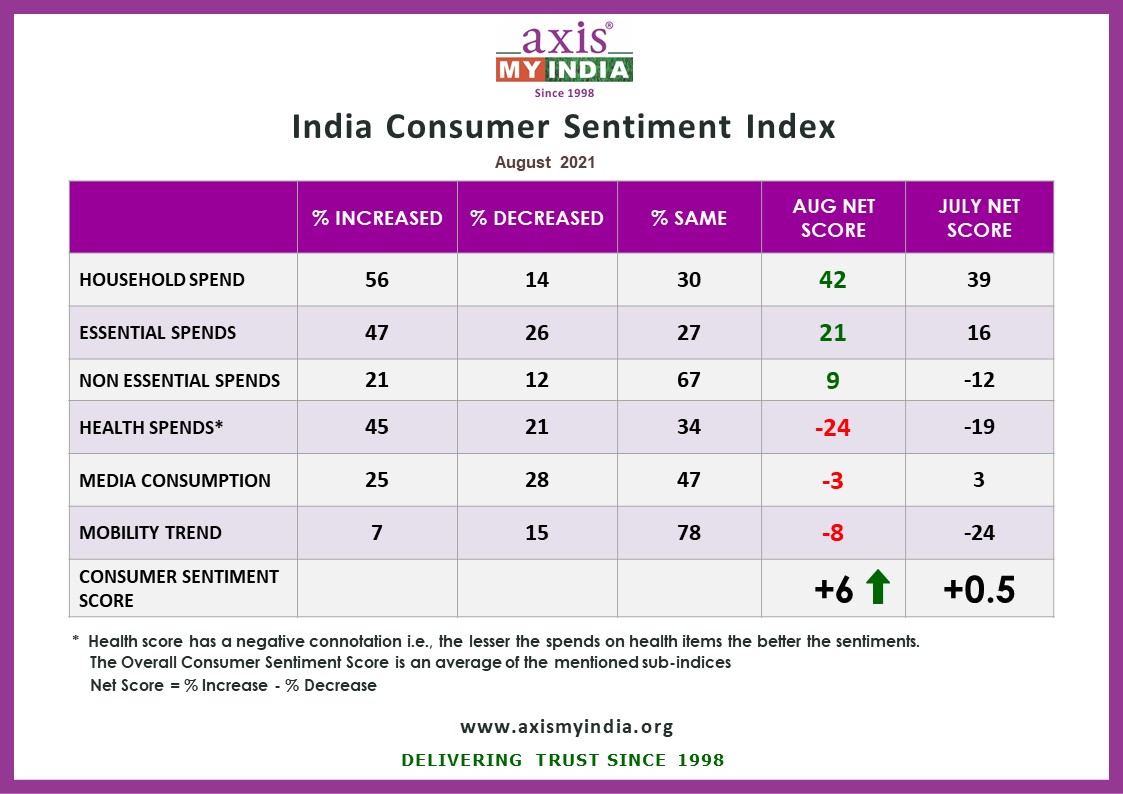
    Mumbai: Over 56 per cent of families across the country reported an increase in household spending in August, with North India leading the chart, according to consumer data intelligence company Axis My India’s latest monthly report. The ‘India Consumer Sentiment Index’ is a monthly analysis of consumer perception on a wide range of issues.

    The industry has pinned hopes on the upcoming festive season to push growth across sectors with rise in consumer spending. According to the survey done via Computer-Aided Telephonic Interviews, the consumers have reported an increase in spends on essentials like personal & household care. The spends on non-essential & discretionary products are still cautious with only 21 per cent of families reporting an increase. “This shows the festive spirit slowing building up with the net score having increased to +9 from -12 last month. Interestingly, the sentiment increase is highest in rural India,” said Axis My India.

    The survey covered as many as 10,482 respondents across the country of which 72 per cent were male and 28 per cent were female.

    Health still remains an important consideration and consumption of health-related items has increased or remained the same for 79 per cent of families and decreased only for 21 per cent of families. The health score which has a negative connotation i.e. the lesser the spends on health items the better the sentiments has a net score value of -24.

    When respondents were asked if they would shop more or less this festive season, 42 per cent of families said they would shop more or the same as compared to last year. “This gives an indication that there is a sense of cautious optimism and the pent-up demand or degree of revenge shopping which happened last year might not be the same this year. This expected increase in spends is higher among private & government service employees,” according to the survey.

    Among other findings, consumption of media has increased for 25 per cent families & remained same for 47 per cent. The corresponding increase figure was 28 per cent last month, net score being at -3. The media consumption increase was found to be highest in the 18-25-year age group at 32 per cent.

    Tourism, however, continues to be a concern as 83 per cent of the respondents are still averse to travelling, and 15 per cent mentioned they would only travel domestically. Showing a sign of self-maturity, 96 per cent of people said they will implement Covid appropriate behaviour this festive and hopefully this will reduce the level of cases in case the third wave strikes. 

    “As the festive season approaches, consumers are slowly stepping out – as proven by increased numbers for non-essential spending and mobility. This should have a positive effect on the hospitality industry which has been severely affected due to the pandemic,” said Axis My India CMD Pradeep Gupta said. “A positive score of an additional 5.5 points over the last month indicates steady progress towards social and economic normalcy, with this trend expected to improve further in the next few months. Overall, we hold a cautious but optimistic outlook on consumer sentiments.”