Tag: Axis My India

  • Axis My India appoints Vishal Kamath as business head for partnerships & consumer insights

    Axis My India appoints Vishal Kamath as business head for partnerships & consumer insights

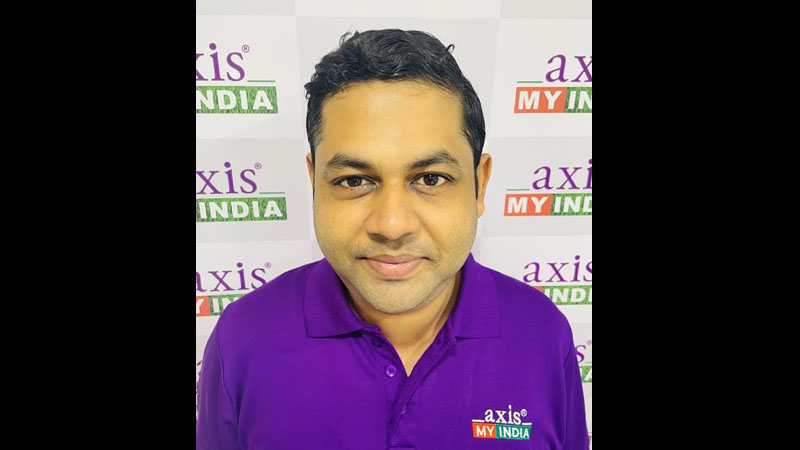
    Mumbai: India’s consumer data intelligence company Axis My India announced the appointment of Vishal Kamath as the business head for partnerships & consumer insights. Kamath brings over 18 years of extensive experience in the media industry making him a seasoned business leader.

    In his current role Vishal Kamath will be instrumental in leading the business and delivering invaluable insights to clients across diverse categories. With a dedicated focus on empowering clients through data-driven decisions using Axis My India’s extensive data coverage across India, Kamath will oversee growth strategy, new product development, and PNL management for both Government and Corporate clients. Concurrently he will be actively engaged in cultivating strategic B2B partnerships for ‘a’ the organization’s super app designed as a People Empowerment Platform (PEP). Kamath’s overarching mission is to establish Axis My India as the unparalleled source of trusted and authentic consumer data intelligence contributing daily to the positive transformation of a billion lives.

    Axis My India, super app ‘a,’ leverages Google technology to bring about a significant change in people’s awareness, accessibility, and utilization of various services benefitting up to Rs 250 million Indian households. The platform, utilizing Google Cloud’s generative AI (GenAI) technology aims to provide relevant information about government schemes and desired communication to citizens based on their needs. The app set to launch in early 2024 on both Android and iOS devices, aligns with Axis My India’s Mission Himalaya – Unchi Udaan roadmap initiative representing a transformative step towards a future where data-driven decisions positively impact lives.

    Before Axis My India Kamath spent 12 years at Nielsen ascending from manager to executive director & head – audience measurement. There he oversaw various solutions, including digital ad ratings, digital content ratings, mobile analytics, cross-media reach measurement, and digital ad effectiveness.Before joining Nielsen Kamath contributed significantly to Info Edge India online classifieds company where he worked for six years. Kamath holds a Master’s in Management Studies (Marketing) from the University of Mumbai.

    Sharing his thoughts on the appointment, Axis My India chairman and managing director Pradeep Gupta said, “We are excited to welcome Vishal Kamath to Axis My India. With his wealth of experience and strategic insights, we are confident that he will play a key role in driving our business forward. His expertise in partnerships and consumer insights aligns perfectly with our vision, and we look forward to achieving new milestones under his leadership”

    Commenting on the appointment, business head for partnerships & consumer insights Vishal Kamath stated, “Deeply immersed in the nuances of the consumer insights market, my vision for Axis My India is rooted in authenticity and trust. I see our role as more than just data providers—we’re on a mission to positively impact a billion lives. This journey involves forging meaningful B2B partnerships, especially through ‘a’ our super app—a genuine People Empowerment Platform (PEP). Together, we’re not just collecting data; we’re shaping a future where insights make a difference”

    A Harvard Business School case study, Axis My India has a robust physical presence across India, engaging over 250 million households immediately. The company, rooted in its belief of fuelling data-driven decision-making, annually publishes a Consumer Trust Index covering 45 consumer and product categories and surveying 1 million respondents.

  • Higher time spent per day on OTT (96 mins) compared to TV (60 mins) by Young India – Axis My India December CSI Survey

    Higher time spent per day on OTT (96 mins) compared to TV (60 mins) by Young India – Axis My India December CSI Survey

    Mumbai: Axis My India, a leading consumer data intelligence company, reveals the latest insights into shifting media consumption habits in India. The survey highlights a notable 23% families report media consumption, resulting in a 3% increase from last month. Focusing on the ICC World Cup 2023 viewership, the study exposes diverse preferences, with 31% opting for traditional television and a significant 22% choosing the mode of mobile phones. The analysis of daily time allocation on media presents a clear trend toward digital platforms, especially for shorter durations, indicating a dynamic transformation in media consumption patterns. Axis My India’s findings offer a comprehensive view of the evolving media landscape, influencing the future of consumer behavior in India.

    The December net CSI score, calculated by percentage increase minus percentage decrease in sentiment, is at +9.9, which is an increase of +0.9 from the last month.

    The sentiment analysis delves into five relevant sub-indices – Overall household spending, spending on essential and non-essential items, spending on healthcare, media consumption habits, entertainment & tourism trends.

    The survey used Computer-Aided Telephonic Interviews and included 5,143 participants from 35 states and UTs. Among them, 72% were from rural areas and 28% from urban areas. In terms of regions, 23% were from the North, 24% from the East, 28% from the West, and 25% from the South of India. Among the participants, 60% were male and 40% were female. Looking at the largest groups, 30% were aged between 36 and 50 years old, while 25% were aged between 26 and 35 years old

    Commenting on the CSI report, Axis My India chairman & MD Pradeep Gupta said, “The vibrant media landscape illuminates the ever-shifting preferences of our audience. A dynamic surge is witnessed in media consumption surrounding the excitement around the ICC World Cup 2023, showcasing the immense and diverse appeal of this global event. Delving deeper into the fabric of media consumption, our study also uncovers a decisive move towards digital platforms, with viewers now carving their own unique paths. The average daily time spent on TV and Video Streaming Platforms/OTT unveils a fascinating narrative, signaling a pronounced tilt towards the latter, notably among the vibrant youth spending 96 minutes daily on OTT compared to 60 minutes on TV. These insights serve as a compelling call to advertisers and marketers”

    Key findings

    1.   Overall household spending has increased for 58% of the families, which is a decrease by 2% from last month. Consumption remains the same for 33% of families. The net score, which was +51 last month, has dipped to +50 this month.

    2.   Spends on essentials like personal care & household items have increased for 49% of families, which marks an increase by 5% from last month. Consumption remains the same for 36% of families. The net score, which was at +27 last month, has surged to +34 this month.

    3.   Spends on non-essential & discretionary products like AC, Car, and Refrigerators have increased for 15% of families. Consumption remains the same for 79% of families. The net score, which was +3 last month, is at +9 this month.

    4.   Expenses towards health-related items such as vitamins, tests, and healthy food have surged for 44% of the families, which marks an increase by 7% from last month. Consumption remains the same for 41% of families. The health score which has a negative connotation i.e., the lesser the spends on health items the better the sentiments, has a net score value of -30 this month.  

    5.   Consumption of media (TV, Internet, Radio, etc.) has increased for 23% of families which is an increase by 3% from last month. The net score, which was -1 last month, is at +2 this month.

    6.   Mobility has increased for 8% of the families, which is a increase of 1% from last month. The net score, which was -4 last month, is at -5 this month. Mobility remains the same for 78% of the families.

    On topics of current national interest

    1.   The survey delved into identifying the top milestone missions for India in a year filled with significant events, including the ICC World Cup and the G20 Summit. A significant 54% of respondents identified the Chandrayaan-3 lunar mission as the most defining milestone of the year. This sentiment is underscored by the remarkable success of Chandrayaan-3, India’s ambitious lunar mission. The event not only garnered widespread acclaim and also set a new record with 8.06 million concurrent views during its live stream, highlighting the nation’s growing prowess and interest in space exploration and scientific achievements.

    2.   The survey unveiled that a significant 62% of respondents watched the ICC World Cup 2023, showcasing the event’s wide-reaching appeal. Delving deeper into the modes of viewership, it was found that 31% of the respondents followed the matches on television, while a notable 22% of the respondents opted to watch the games on their mobile phones, highlighting the diverse ways in which audiences are consuming sports content in the digital age.

    3.   The study delved into the average daily time spent on TV and Video Streaming Platforms/OTT across various time brackets. The overall time spent on TV is 65 minutes per day compared to 61 minutes on OTT. The younger age group spend significantly higher time spent on OTT (96 minutes per day) compared to TV (60 minutes per day)

    4.   For those allocating less than 30 minutes, 14% of respondents reported spending their time on TV, while 15% preferred Video Streaming Platforms/OTT

    5.   In the 30 minutes to 1-hour category, 16% indicated TV usage compared to 13% for Video Streaming Platforms/OTT

    6.   Moving on to the 1-2 hour bracket, 24% opted for TV, while 18% chose Video Streaming Platforms/OTT

    7.   The percentages decrease for longer durations, with 10% on TV and 9% on Video Streaming Platforms/OTT for 3-4 hours

    1.   2% on TV and 3% on Video Streaming Platforms/OTT for 5-8 hours, and

    2.   Merely 1% for both TV and Video Streaming Platforms/OTT for 9 or more hours

    This breakdown illustrates the varying preferences in media consumption habits, emphasizing a notable shift towards digital platforms, especially for shorter durations.

       Expanding on the findings regarding age-wise distribution, the data from Axis My India provides insights into the percentage of individuals within different age groups who spend ‘1-2 hours’ watching TV on a typical day:

    1       23% of 18-25 age group dedicate this time to TV

    2       21% of 26-35 age group dedicate this time to TV

    3       27% of 36-50 age group dedicate this time to TV

    4       26% of 51-60 age group dedicate this time to TV

    5       25% of above 60 age group dedicate this time to TV

    This suggests a fairly even distribution of TV watching habits across different age groups, with a slightly higher inclination in the 36-50 age category.

    1   Examining the data on a typical day’s OTT viewership, distinct patterns emerge across various age groups:

    2       Among individuals aged 18-25, a notable 25% engage with OTT platforms,

         Slightly lower yet significant 24% from the 26-35 age group do the same.

    4       The prevalence decreases in the 36-50 age group, with 17% of individuals choosing OTT for their media consumption.

           Further down the age spectrum, the 51-60 age group and those above 60 exhibit similar preferences, with 12% from both demographics tuning into OTT platforms

    These findings highlight the varying degrees of adoption of OTT platforms across different age brackets, indicating a higher affinity among younger individuals for on-demand streaming services. This suggests a fairly even distribution of TV watching habits across different age groups, with a slightly higher inclination in the 36-50 age category.

    1.   The survey provided insightful data on household income, spending, and consumption patterns bringing to light a spectrum of sentiments regarding the nation’s economic conditions this year. 46% of the participants expressed a sense of financial upliftment in 2023 compared to 2022 terms of financial well-being. Meanwhile, 36% still hold 2022 in higher regard, feeling that the previous year offered better financial stability. Additionally, 18% of the respondents viewed 2023 as being on par with the previous year, indicating a sense of consistency in their financial experiences.

    2.   The survey offered valuable insights into the spending patterns of consumers over the past and upcoming six months, highlighting shifts in purchase priorities. According to the findings, a significant 49% of respondent s are leaning towards investing in mobile phones, signalling a strong inclination towards technology and connectivity. Following closely, 37% of the respondents are focusing on financial prudence, with choosing a bank account being a top priority, reflecting an increased awareness and emphasis on financial management. Additionally, personal mobility emerges as a significant factor, with 30% of the respondents showing a preference for acquiring two-wheelers, underlining the growing importance of personal transportation in daily life.

    3.   In the wake of BJP’s notable victories in recent state elections, the survey tapped into the public’s perception of influence in India’s political sphere. Reflecting on this political landscape, 60% of the respondents identified Prime Minister Narendra Modi as the most influential figure of 2023. This perception has been further bolstered by the Prime Minister’s active international engagements, including his pivotal role in the G20 summit and efforts towards elevating India’s presence on the global stage. These events have clearly struck a chord with many people, contributing to the increased recognition of Narendra Modi as a significant influencer this year.

    4.   The survey shed light on public awareness and participation in the Ayushman Bharat – Jan Arogya Yojana, a pivotal health insurance scheme by the Government of India. It was revealed that 27% of respondents are aware of the scheme but have not taken the step to enroll. This indicates a significant level of awareness about the scheme, yet highlights a gap between awareness and action. On the other hand, 28% of respondents are aware of the scheme and have actively enrolled in the scheme, suggesting a proactive approach towards availing the health benefits offered.

    5.   The survey provided insights into the public’s awareness and adoption of the 14-digit Ayushman Bharat Health Account (ABHA) card, a key component of India’s health digitisation efforts. It revealed that 84% of respondents, are unaware of the ABHA card, indicating a significant knowledge gap in this critical health initiative. This suggests a considerable gap in public knowledge regarding the ABHA and its benefits. On the other hand, 9% of respondents have actively obtained the ABHA card, indicating some level of engagement and uptake among the populace. Meanwhile, 7% of respondents, although aware of the ABHA, do not possess the card.

    6.   With the five state elections seen as a prelude to the 2024 Lok Sabha elections the December CSI Report highlights the keen interest among the public in political trends. A significant 67% of respondents had expressed their intent to watch the exit polls of these crucial state elections, indicating a high level of engagement and curiosity about the potential outcomes and their implications. In contrast, 32% of the surveyed population are not planning to tune in for the exit polls, suggesting varying levels of political interest and engagement across the public. 

  • 57 per cent opt for mobile streaming for ICC ODI World Cup 2023 – Axis My India survey

    57 per cent opt for mobile streaming for ICC ODI World Cup 2023 – Axis My India survey

    Mumbai: Axis My India, a leading consumer data intelligence company, has unveiled the latest insights from the India Consumer Sentiment Index (CSI), shedding light on significant media consumption trends. With the ICC ODI Cricket World Cup 2023 in full throttle and India dominating, overall 67 per cent plan to watch the matches. A whopping 57 per cent are flocking to online mobile streaming platforms such as Hotstar for live action, while 49 per cent are hooked to their Linear Television sets, and eight per cent are watching it on Connected TVs.  Oppo, Thums Up, Mahindra, Havells, and Dream 11 are the top recalled brands in the ICC ODI World Cup. The report also notes that 20 per cent of families are broadening their media horizons, with platforms such as TV, Internet, and Radio. Interestingly, consumption across these platforms remains consistent, showing no change from last month’s figures.

    The November net CSI score, calculated by percentage increase minus percentage decrease in sentiment, is at +9, which is an increase of +1 from the last two months.

    The sentiment analysis delves into five relevant sub-indices – Overall household spending, spending on essential and non-essential items, spending on healthcare, media consumption habits, and entertainment & tourism trends.

    The survey used Computer-Aided Telephonic Interviews and included 4,980 participants from 35 states and UTs. Among them, 69 per cent were from rural areas and 31 per cent from urban areas. In terms of regions, 23 per cent were from the North, 25 per cent from the East, 28 per cent from the West and 23 per cent from the South of India. Among the participants, 65 per cent were male and 35 per cent were female. Looking at the largest groups, 34 per cent were aged between 36 and 50 years old, while 27 per cent were aged between 26 and 35 years old

    Axis My India Chairman & MD Pradeep Gupta said, ” As the pulse of the ICC ODI Cricket World Cup 2023 quickens, India’s enthusiasm resonates across both fields and screens. While a significant portion of fans eagerly tune in for the critical matches, we are seeing a blend of modern and traditional viewing preferences. Digital platforms are commanding attention, yet the charm of conventional cable/DTH remains unshaken. Interestingly, amidst the cricketing showdown, advertisements continue to play their own game of capturing viewer attention. This amalgamation of viewership patterns and advertising impact offers a compelling insight into a nation deeply invested in the sport, both on and off the pitch.”

    Key findings

    ●    Consumption of media (TV, Internet, Radio, etc.) has increased for 20 per cent of families which is the same as last month. The net score, which was -1 last month, also remains the same.

    ●    Overall household spending has increased for 60 per cent of the families, which is an increase of seven per cent from last month. Consumption remains the same for 31 per cent of families. The net score, which was +42 last month, has increased to +51 this month.

    ●    Spends on essentials like personal care & household items have increased for 44 per cent of families, which marks an increase of one per cent from last month. Consumption remains the same for 40 per cent of families. The net score, which was at +26 last month, has surged to +27 this month.

    ●    Spends on non-essential & discretionary products like AC, Car, and Refrigerators have increased for eight per cent of families. Consumption remains the same for 86 per cent of families. The net score, which was +1 last month, is at +3 this month.

    ●    Expenses towards health-related items such as vitamins, tests, and healthy food have surged for 37 per cent of families, which marks an increase of one per cent from last month. Consumption remains the same for 48 per cent of families. The health score which has a negative connotation i.e., the lesser the spends on health items the better the sentiments, has a net score value of -21 this month.  

    ●    Mobility has increased for seven per cent of the families, which is a decrease of one per cent from last month. The net score, which was -2 last month, is at -4 this month. Mobility remains the same for 82 per cent of the families.

    On topics of current national interest

    ●    In the ICC ODI Cricket World Cup 2023, with the Indian team leading the table over 67 per cent plan to watch the matches. Out of them, 26 per cent of the respondents intend to tune in for the crucial final games of the current season. Meanwhile, 22 per cent of respondents are following matches played by their preferred team, and 19 per cent of respondents are watching almost every game of the season.

    ●    During the ICC ODI Cricket World Cup 2023, various viewing platforms have gained traction among audiences. The survey reveals that a dominant 57 per cent of respondents are catching the action live online mobile streaming platforms such as Hotstar. Traditional cable/DTH television still holds its ground with 49 per cent of respondents tuning in through this medium. Notably, emerging technology isn’t left behind, with 8 per cent of enthusiasts streaming the matches on connected television sets using devices such as Fire Stick TV, Chromecast, and similar platforms.

    ●    During the ICC ODI Cricket World Cup 2023, advertisements played a pivotal role in capturing viewer attention amidst the on-field action. According to the survey, mobile phone brand Oppo made a significant impression, with 16 per cent of respondents recalling their advertisement the most. Close on its heels, 13% each have recognised advertisements from brands like MRF, Thums Up, Pepsi, Coca-Cola, and Havells. Additionally, Dream11, a fantasy sports platform, also managed to engage the audience effectively, with 12 per cent of respondents recalling their promotional content.

    ●    The survey delved into consumers’ intentions regarding their shopping preferences during the upcoming festive season. Notably, 25 per cent of the respondents are enthusiastic about shopping more as compared to last year while 23 per cent are committed to sustaining their purchase levels as last year.

    ●    The survey provided insights into household shopping budgets for the forthcoming festivities. A notable 56 per cent of respondents are set to shop on a budget of less than Rs 5000, while 24 per cent plan to shop in the range of Rs. 5,000 – Rs. 10,000. Furthermore, 11 per cent of the respondents are looking to spend between Rs. 10,000 – Rs. 20,000, while a combined segment of seven per cent is gearing up for shopping sprees ranging from Rs. 20,000 to a lavish Rs. 2,00,000. A significant one per cent of the overall population plans to spend more than Rs. 2,00,000.

    ●    During the auspicious festive occasions, the spectrum of consumer purchases is broad and varied. It encompasses customary clothing and apparel but also extends to high-value items. These items range from the latest electronic gadgets, such as mobile phones, to indispensable home appliances, and even luxury investments like vehicles, real estate, and jewellery. A significant majority of 67 per cent of respondents, indicated their intent to shop for clothes/apparel. Furthermore, 13 per cent of the respondents have their eyes on a new mobile phone, while a noteworthy 12 per cent of the respondents are aiming to enhance their homes with appliances such as ACs, TVs, washing machines, refrigerators, and more. Five per cent plan to buy a four-wheeler.

    ●    The survey explored the preferences of participants concerning various shopping channels they prefer when purchasing festive items. A significant 82 per cent of respondents voiced a preference for local physical retail stores near home indicating a potent sentiment towards bolstering local enterprises. On another note, 10 per cent of the respondents leaned towards online shopping platforms for their festive acquisitions. Meanwhile, eight per cent of respondents expressed favour for brand-specific physical stores, highlighting a range of diverse shopping inclinations among consumers.

    ●    Festive shopping popularised by e-commerce platforms has emerged as a significant favourite, especially with the advent of special promotions. These themes have become increasingly popular among consumers. According to the survey, a noteworthy 22% of respondents have expressed their intention to actively participate and make purchases during these e-commerce-led shopping festivals.

    ●    In the vibrant landscape of festive shopping, payment preferences reflected a blend of tradition and modernity. Amid the festive hustle and bustle, a substantial 79 per cent of respondents gravitate towards the timeless charm of cash for their transactions. In a modern twist, 16 per cent of respondents are inclined to embrace digital wallets to settle their festive purchases, while 5 per cent opt for the convenience of debit/credit cards and online banking for transactions.

    ●    Diwali, often hailed as the festival of prosperity and wealth, brings with it the added delight of financial bonuses for many. Employers often mark the occasion by distributing salary bonuses, allowing employees to indulge in the festive spirit with a little extra in their wallets. According to the survey, a notable 19 per cent of respondents have received /are anticipating receiving a salary bonus due to Diwali celebrations.

  • Over 80% of CXOs are building omnichannel & connected customer experience to soar high this festive season

    Over 80% of CXOs are building omnichannel & connected customer experience to soar high this festive season

    Mumbai: Exotel, the emerging market’s leading connected customer conversation platform, is excited to introduce its latest survey-driven report titled “Exotel’s CXO Festive Readiness Report.” This comprehensive report provides an in-depth exploration of the strategies and insights of CXOs as they prepare for the upcoming festive season, coupled with the exhilaration of the World Cup. The report offers invaluable perspectives on optimizing sales and prioritizing Customer Experience (CX). It throws light on the essential aspects of their preparations, highlighting the impact of cultural traditions, the significance of discounts, and the challenges they navigate. Additionally, it underscores the growing emphasis on personalization, CX, and the integration of AI in marketing strategies.

    With a resounding 80 per cent of CXOs honing their focus on building omnichannel experiences to soar high this festive season, it’s evident they are well-prepared to harness the incredible opportunities that lie ahead.

    As the festive season beckons, CXOs are orchestrating a diverse array of marketing strategies. These encompass influencer marketing, social media promotions, email and WhatsApp campaigns, alluring festive offers, and strategic brand collaborations. The common thread among these initiatives is the commitment to providing customers with a seamless journey from initial discovery to the final purchase.

    Cultural traditions wield a considerable influence, shaping consumer choices and impacting spending decisions for 39 per cent of survey respondents. In India, where culture and cricket fervor are intertwined, the World Cup isn’t merely a sporting event; it’s a cultural phenomenon dictating consumer behavior and preferences.

    For 37 per cent of CXOs, enticing offers and discounts serve as the driving force behind consumer spending. Discounts effectively leverage price sensitivity, creating a sense of urgency, enhancing perceived value, and providing a competitive edge.

    Personalization emerges as the star of the show, with 64.33 per cent of CXOs giving it a top spot in their marketing strategies. This personalized approach involves aligning marketing efforts with consumer preferences and harnessing data to craft tailored messages and offers, ultimately leading to heightened customer engagement.

    An impressive 86 per cent of businesses are making significant investments in creating a holistic customer journey, recognizing the pivotal role of delivering a positive customer experience during the festive season.

    Technology integration is another critical component, with 84 per cent of businesses seamlessly merging their customer platforms with Martech. This integration not only enhances operational efficiency but also fortifies marketing strategies.

    Furthermore, to foster connected customer conversations, 81.33 per cent of businesses are leveraging multiple communication channels. The overarching goal is to maintain a consistent brand presence across all customer touchpoints, ensuring a unified approach.

    Exotel VP & global head of marketing Udit Agarwal applauds the dynamic spirit of the Indian CXOs, stating, “It’s not merely about readiness; it’s about innovation and placing the customer at the core of strategies, especially in the lead-up to the festive fervor.” He added, “At Exotel, our ‘Like a Friend’ philosophy deeply resonates with the aspirations of CXOs. We’re not just a platform; we’re a trusted ally, guiding businesses to enhance their sales narratives through pioneering customer engagement blueprints. As we stand here, Exotel is not just ready but deeply committed to being that friend, leading CXOs to festive triumphs.”

    However, the path to festive success is not without its challenges. Intense competition, faced by 30.33 per cent of CXOs, underscores the need for innovative, standout strategies. Another substantial challenge takes the form of limited marketing budgets, voiced by 26.33 per cent. This necessitates the judicious allocation of resources, demonstrating a keen focus on efficiency.

    According to a report by Axis My India, a consumer data intelligence company’s India Consumer Sentiment Index (CSI) report, 23 per cent of shoppers plan to shop more during this year’s festive season compared to the previous year, indicating a boost in consumer spending during this period. This positive trend aligns with consumers’ expectations to spend higher amounts during the festive season. And it’s clear that CXOs are prepared to innovate, adapt, and prioritize customer-centric approaches, setting the stage for outstanding sales and memorable customer experiences.

    Methodology

    Exotel received responses from 300 marketers in an online survey conducted in September 2023. CXOs, VP Marketing, and Chief Customer Experience Officers from mid to large organizations across Tech, BFSI, E-commerce, Telecom, and Automotive verticals responded to this survey.


  • 47 per cent plan to watch 2023 ODI World Cup on TV – Axis My India CSI survey

    47 per cent plan to watch 2023 ODI World Cup on TV – Axis My India CSI survey

    Mumbai:  Axis My India, a pioneer in consumer data intelligence, has unveiled the latest insights from the India consumer sentiment index (CSI), shedding light on significant media consumption trends. The report highlights a one per cent decrease in media consumption from the previous month, with 19 per cent of families indicating increased media engagement. The survey also delves into consumer behaviour during festive sales, where 23 per cent of participants express continuity in their engagement with e-commerce platforms, with an additional 11 per cent intending to do first-time online shopping this year. Furthermore, the anticipation surrounding the 2023 ODI World Cup is reflected in the diverse choices of viewing platforms, with 47 per cent opting for traditional television and 27 per cent embracing digital channels.

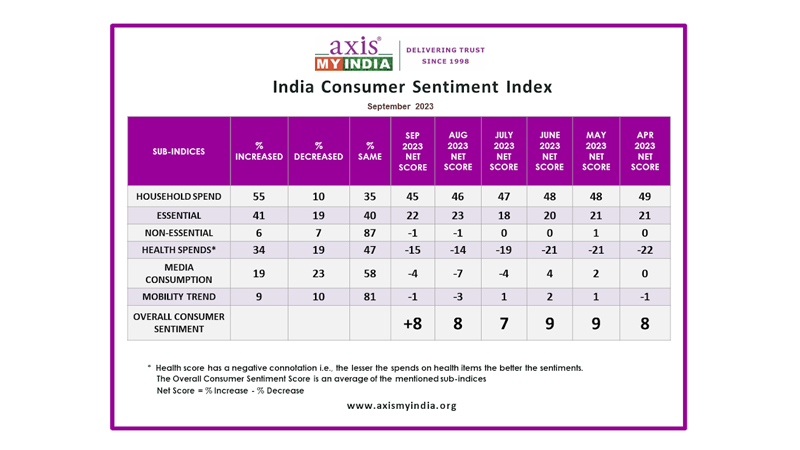
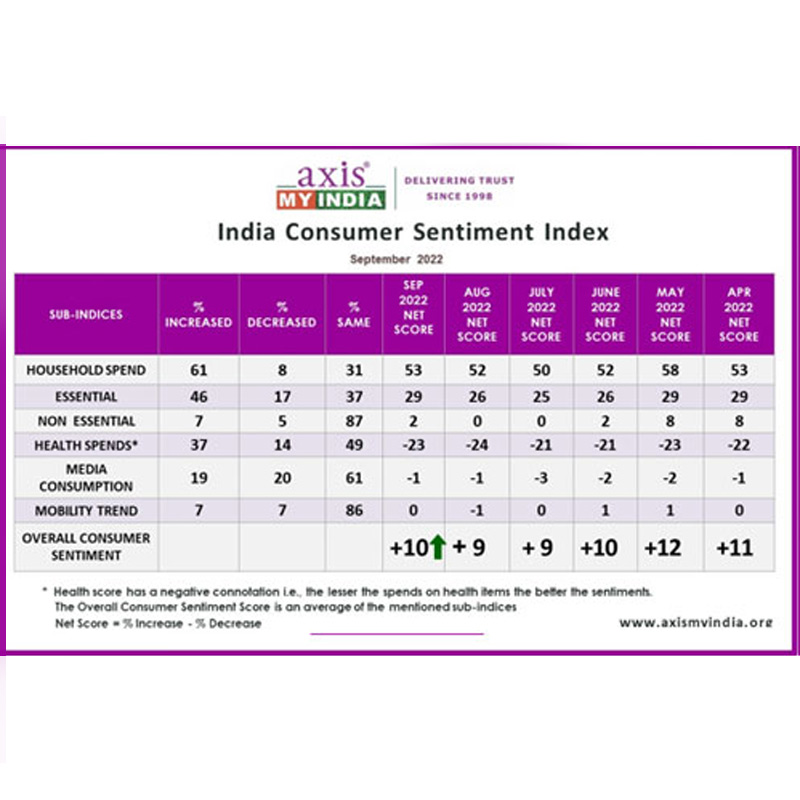
    The September net CSI score, calculated by percentage increase minus percentage decrease in sentiment, is at +8, which is the same as last month (+8).  However, the score reflects a dip of -2 from last year September 2022 (+10)

    The sentiment analysis delves into five relevant sub-indices – Overall household spending, spending on essential and non-essential items, spending on healthcare, media consumption habits, and entertainment & tourism trends.

    The survey used Computer-Aided Telephonic Interviews and included 5048 participants from 35 states and UTs. Among them, 68 per cent were from rural areas and 32 per cent from urban areas. In terms of regions, 22 per cent were from the North, 24 per cent from the East, 28 per cent from the West, and 26 per cent from the South of India. Among the participants, 62 per cent were male and 38 per cent were female. Looking at the largest groups, 29 per cent were aged between 36 and 50 years old, while 27 per cent were aged between 26 and 35 years old

    Commenting on the CSI report, Axis My India chairman & MD Pradeep Gupta said, “As we stand on the threshold of the much-anticipated 2023 ODI World Cup on our home turf, we are poised to witness how brands strategically align themselves with this grand event. The widespread recognition and enthusiasm surrounding the tournament offer an ideal backdrop for brands to forge impactful connections with diverse audiences. With media consumption trends diversifying across linear television, digital platforms, and live stadium experiences, this global spectacle will beckon marketers to seize the opportunity and become a part of the cricketing fervour, with this spectacle happening during the peak festive season it will be an added advantage for brands.”

    Key findings

    ●    Consumption of media (TV, Internet, Radio, etc.) has increased for 19 per cent of families, depicting a decrease in media consumption percentage by one per cent from last month. The net score, which was -7 last month is at -4 this month. Media consumption remains the same for 58 per cent of families

    ●    Overall household spending has increased for 55% of the families, which is a decrease of three per cent from last month. Consumption remains the same for 35 per cent of families. The net score, which was +46 last month is +45 this month.

    ●    Spends on essentials like personal care & household items have increased for 41 per cent of families, which marks a decrease of three per cent from last month. Consumption remains the same for 40 per cent of families. The net score, which was at +23 last month has dipped to +22 this month.

    ●    Spends on non-essential & discretionary products like AC, Car, and Refrigerators have increased for six per cent of families, which is the same as last month. Consumption remains the same for 87 per cent of families. The net score, which was zero last month is at -1 this month.

    ●    Expenses towards health-related items such as vitamins, tests, and healthy food have surged for 34 per cent of families. This reflects an increase in consumption by one per cent from last month.  Consumption remains the same for 47 per cent of families. The health score which has a negative connotation i.e., the lesser the spends on health items the better the sentiments, has a net score value of -15 this month.  

       Mobility has increased for nine per cent of the families, which is an increase of two per cent from last month. The net score, which was -2 last month has improved to -1 this month. Mobility remains the same for 81 per cent of the families.

    On topics of current national interest

    ●    The survey inquired about respondents’ awareness of the forthcoming 2023 ODI World Cup being hosted in India. Encouragingly, 70 per cent of participants confirmed their awareness of this prestigious sporting event taking place in the country. It highlights the fact that a substantial majority of respondents are cognizant of the global cricket event’s occurrence on Indian soil, reinforcing the event’s prominence and reach among the surveyed audience.

    ●    The survey sought to ascertain respondents’ preferences regarding their anticipated viewing platforms for the upcoming 2023 ODI World Cup set to unfold in India. The findings reflect a diverse array of choices. Notably, 47 per cent of respondents expressed their intention to tune in via traditional television, utilising DTH or cable services. Demonstrating the increasing influence of digital trends, 27 per cent indicated their inclination to follow the event on their mobile devices. A notable nine per cent exhibited enthusiasm to experience the tournament live by planning to attend matches at the stadium. These preferences underscore the multi-faceted avenues through which individuals are gearing up to engage with the international cricket spectacle, embracing both traditional and contemporary viewing modes.

    ●    The survey delved into consumers’ intentions regarding their shopping preferences for the upcoming festive season. Notably, 23 per cent of respondents plan to shop more during the festive period as compared to last year. Additionally, 28 per cent of participants revealed their intention to maintain their spending habits at the same level as before, hinting at a stable consumer sentiment. These responses highlight the potential shifts in consumer behaviour and their possible impact on the market.

    ●    The survey explored respondents’ prior and potential involvement in festive sales organized by e-commerce giants like Amazon and Flipkart. Significantly, a notable 23 per cent of participants confirmed their past participation in such events and expressed their intent to maintain this pattern this year as well.  Additionally, 11 per cent of those who had not engaged in festive online sales before expressed their interest in participating this year. Conversely, seven per cent acknowledged their previous engagement but revealed their decision not to partake this year.

    ●    Of 23 per cent of those who intend to maintain the pattern this year, 44 per cent said they will be shopping more through e-commerce mediums as compared to last year.  These insights provide a comprehensive understanding of consumers’ past and evolving attitudes towards e-commerce festive sales, shaping strategies for these platforms.

    ●    The survey explored participants’ inclinations towards investment in the Indian stock market or other financial assets in the upcoming months. Notably, a mere six per cent expressed an intention to invest more, while ten per cent indicated plans to invest less. Meanwhile, five per cent are projected to maintain their investment levels. These insights provide a snapshot of the current sentiment towards financial market investments, emphasizing the diverse attitudes among the surveyed individuals. Notably, a significant 79 per cent still don’t invest in stocks.

    ●    The survey inquired about participants’ perceptions regarding the potential movement of the stock exchange (SENSEX) beyond the threshold of 70,000 before the festive period of Dussherra/Diwali this year. Encouragingly, 46 per cent of respondents who invested expressed optimism that such a milestone could be achieved. Furthermore, eight per cent were uncertain about the market’s trajectory. These findings underscore the diverse range of opinions prevalent among respondents, reflecting the complex and multifaceted nature of stock market predictions.

    ●    The survey delved into participants’ perspectives on the government’s economic policies and their perceived influence on the nation’s growth. Impressively, 64 per cent of respondents expressed confidence in the effectiveness of policies such as Pradhan Mantri Jan Dhan Yojana and Pradhan Mantri Mudra Yojana. 

  • Axis My India releases India Consumer Sentiment Index

    Axis My India releases India Consumer Sentiment Index

    Mumbai: The leading consumer data intelligence company, Axis My India, has released its latest findings of the India Consumer Sentiment Index (CSI). It is a monthly analysis of consumer perceptions on a wide range of issues.

    The report from the month of November highlights that 61 per cent engages with the internet daily and 23 per cent use it for ‘chatting’ through WhatsApp, Messenger, Instagram, etc.

    The report finds that 52 per cent of respondents are aware of the recently launched 5G technology, and 24 per cent of them intend to switch to 5G phones.

    The sentiment analysis delves into five relevant sub-indices: overall household spending, spending on essential and non-essential items, spending on healthcare, media consumption habits, and mobility trends.

    The research also shows that 21 per cent of households have increased their media consumption (TV, Internet, radio, etc.), a rise of two per cent from the previous month. 55 per cent intend to watch the T20 World Cup; 69 per cent of them will prefer to watch it on television; 28 per cent will watch it on their phones.

    The survey was carried out via computer-assisted telephonic interviews with a sample size of 10,207 people across 32 states and UTs. 70 per cent belonged to rural India, while 30 per cent belonged to urban counterparts. In terms of regional spread, 26 per cent belong to the northern parts, while 24 per cent belong to the eastern parts of India. Moreover, 30 per cent and 20 per cent belonged to the western and southern parts of India, respectively. 56 per cent of the respondents were male, while 44 per cent were female. In terms of the two majority sample groups, 28 per cent each reflect the age groups of 26 to 35 and 36 to 50.

    Commenting on the CSI report findings, Axis My India chairman and managing director Pradeep Gupta said, “The growing dependency on the internet has impacted all spheres of the consumer’s life. From chatting to networking, expressing, and now watching, the internet has evolved to fulfil all consumer needs and will continue to do so in the future with the advent of 5G. While the dependency on online apps for grocery purchases is still at a nascent stage, we are more than confident that, like any other daily task, this too will become completely an online behaviour in the next few years. From adapting newer modes of media consumption like watching the World Cup on a phone to having varied other forms of empowered user experiences on the internet, 5G will only continue to shape consumer consumption behaviour”

    Further, the report also highlights that spending on essentials like personal care and household items has increased for 46 per cent of the families, which is an increase of two per cent from last month. The net score, which was at +25 last month, has increased by +2 to +27 this month. Spending on non-essential and discretionary products like an AC, car, and refrigerator has increased for 11 per cent of families, which reflects an increase of two per cent from last month and the highest increase in the last five months. The net score, which was at +3 last month, has improved to +4 this month, showcasing a steady upliftment in spending sentiment.

    Expenses for health-related items such as vitamins, tests, and healthy food have surged for 39 per cent of the families. This reflects an increase in consumption of two per cent from last month. The health score, which has a negative connotation, i.e., the less one spends on health items, the better the sentiment, and has a net score value of -23, which is the same as last month.

  • 30 per cent prefer OTT platforms to watch new movies:  Axis My India Survey

    30 per cent prefer OTT platforms to watch new movies: Axis My India Survey

    Mumbai: Axis My India, in a report on India’s Consumer Sentiment Index (CSI) published on Thursday, found that a significant 30 per cent of viewers prefer to watch the latest movies on over-the-top (OTT) platforms.

    The survey, conducted for monthly consumption on various issues, revealed that 24 per cent of viewers choose movie theatres to watch the latest movies, while 45 per cent wait for them to air on television.

    The study further stated that six per cent of respondents are looking forward to using the metaverse (augmented reality (AR) and virtual reality (VR)).

    Also, 12 per cent of individuals polled said the content produced by them for social media handles like Instagram or YouTube reflected the rising generation of content creators.

    Commenting on the CSI report, Axis My India MD and chairman Pradeep Gupta said, “The internet in general and social media in particular have shaped consumer experiences in all spheres of life. From creating content for Instagram/YouTube to using AR/VR for testing and buying products, consumers have found ways to express their individualities amongst their online and physical social networks. In addition, the internet has provided flexibility due to which, despite big screen launches, consumers are growing to prefer OTT for their viewing medium. The potential of the world-wide-web is huge and is only evolving, and one can only expect it to further enrich consumer experiences.”

    The October net CSI score, calculated by percentage increase minus percentage decrease in sentiment, is at +8, from +10 last month, reflecting a decrease by two points.

    The sentiment study examines five pertinent sub-indices, including total household expenditure; spending on necessities and wants; healthcare spending; media consumption patterns; and mobility trends.

    The survey was carried out via computer-aided telephonic interviews with a sample size of 10,058 people across 32 states and UTs. 67 per cent belonged to rural India, while 37 per cent belonged to urban counterparts. In terms of regional spread, 24 per cent belong to the northern parts while 23 per cent belong to the eastern parts of India. Moreover, 28 per cent and 25 per cent belonged to the western and southern parts of India, respectively. 61 per cent of the respondents were male, while 39 per cent were female. In terms of the two majority sample groups, 34 per cent reflect the age group of 36 to 50, while 30 per cent reflect the age group of 26 to 35.

    Check out the key findings of the reports here:

    •  In comparison to last year, 21 per cent of consumers plan to spend more this holiday season. This sentiment has improved by one per cent since last month.
    • This festive season, a majority of 78 per cent plan to shop from local physical retail stores, while 14 per cent plan to shop from e-commerce majors like Amazon & Flipkart
    • Overall household spending has increased for 58 per cent of families, which reflects a decrease of three per cent from last month. The net score, which increased by 53 per cent last month, has now decreased by four percent to 49 per cent this month.
    • Families’ spending on necessities like personal care and household items has increased by 44 per cent, a two-percent decrease from the previous month. The net score, which was at 29 per cent last month, has decreased by three per cent to 26 per cent this month.
    • Families’ spending on non-essential and discretionary items such as air conditioning, cars, and refrigerators has increased by nine per cent, an additional two per cent from the previous month. The net score, which increased by two per cent last month, has improved by an additional three per cent this month. This marks heightened consumer sentiment towards the festivities.
    • Health and fitness continue to remain important for consumers amidst the festive season, wherein expenses towards health-related items have increased for 37 per cent of families. The health score, which has a negative connotation i.e., the less spent on health items, the better the sentiments, has a net score value decreased by 22 per cent, an increase of one per cent as compared to last month.
    • Media consumption remains the same as the last two months at 19 per cent. The overall net score, which decreased by one per cent last month, increased by three per cent this time.
    • Mobility has increased for six per cent of the families, which reflects a decrease of one per cent from last month. The overall mobility net indicator score, which was nil last month, has been reported to increase three per cent this month.
  • 61% consumers watch online video content like YouTube/OTT on their mobile/home TV: Axis My India Sep CSI Survey

    61% consumers watch online video content like YouTube/OTT on their mobile/home TV: Axis My India Sep CSI Survey

    Mumbai: Axis My India, a leading consumer data intelligence company, released its latest findings of the India Consumer Sentiment Index (CSI), a monthly analysis of consumer perception on a wide range of issues.

    According to reports, 20 per cent of consumers are planning to shop more this festive season. On media consumption, 61 per cent mentioned that they watch online video content either on their mobiles or connected TV. 32 per cent mentioned that they notice advertising on TV, followed by digital (26 per cent). An interesting observation was on app usage. On average, nine apps are used by a smartphone user.

    The net CSI score for September, calculated by percentage increase minus percentage decrease in sentiment, is at +10, from +9 last month, reflecting an increase of one point. The sentiment analysis delves into five relevant sub-indices: overall household spending; spending on essential and non-essential items; spending on healthcare; media consumption habits; and mobility trends.

    Key Findings:

    •     Overall, household spending has increased for 61 per cent of families, which is the same as in August. The net score, which was +52 last month, has increased by +1 to +53 in September.
    •     Consumption of media remains the same as the previous month, i.e., 19 per cent. The overall net score, which is -1 in September, also remains the same.
    •     Mobility has increased for seven per cent of families, representing a one per cent increase over the previous month.
    •     Spending on essentials like personal care and household items has increased for 46 per cent of the families, which is an increase of one per cent from last month. The net score, which was at +26 this month, has increased by +3 to +29.
    •     Spending on non-essential and discretionary products like air conditioners, cars, and refrigerators has increased for seven per cent of families, which reflects an increase of one per cent from last month. The net score, which was at nil last month, has improved to +2 this month. This could reflect the spirit of the festive season approaching.
    •      Consumption of health-related items has increased for 37 per cent of the families, which reflects a decrease of one per cent from last month. The health score, which has a negative connotation i.e., the less spent on health items, the better the sentiments, has a net score value of -23 for September, as compared to -24 last month.

    On topics of current national interest:

    •      In an attempt to understand consumers’ engagement with mobile apps, the survey discovered that, on average, consumers have nine apps on their smartphones. 16 per cent use a minimum of 4–8 apps on their smartphone, and 22 per cent have more than eight apps. A significant 24 per cent mentioned that they use a feature phone.
    •     In order to determine which medium advertisements are more likely to be noticed, the survey discovered that a majority of 32 per cent notice ads on TV, while 26 per cent notice them on online media. It was also discovered that only 17 per cent notice ads on social media platforms, 15 per cent in print, six per cent in outdoor and two per cent on radio.
    •      The survey further revealed that a majority of 61 per cent watch online video content like YouTube or OTT on their mobile/home TV.
    •     Digging deeper into the festive spirit, the survey shows that 20 per cent plan to shop more this festive season compared to last year. However, 32 per cent plan to shop the same as last year.
    •     According to the Axis My India Consumer Sentiment Index Survey, 48 per cent of consumers shop/purchase more products during the festive season as compared to the rest of the year.
    •      Exploring farmers’ sentiments towards new tractors, the survey found out that 10 per cent are planning to purchase new tractors in the coming year, while three per cent and two per cent plan to do so within six months and three months, respectively. For reasons like smaller land size, renting, or affordability, a significant 86 per cent of farmers don’t own a tractor.

    The survey was carried out via computer-aided telephonic interviews with a sample size of 10014 people across 32 states and UTs. 68 per cent belonged to rural India, while 32 per cent belonged to urban India. In terms of regional spread, 23 per cent belong to the northern parts while 24 per cent belong to the eastern parts of India. Moreover, 29 per cent and 23 per cent belonged to the western and southern parts of India, respectively. 59 per cent of the respondents were male, while 41 per cent were female. In terms of the two majority sample groups, 32 per cent reflect the age group of 36-year olds to 50-year olds, while 31 per cent reflect the age group of 26-year olds to 35-year olds.

    Axis My India chairman and MD Pradeep Gupta said, “After compromising the past two festive seasons because of the pandemic and its related constraints, this year consumers are expected to shop more during festivities. One can already witness a slight increase in expenses across essential and discretionary products. Further improvement in mobility sentiments highlights the fact that more and more people are enjoying the stores’ and malls’ experiences of discovering, shopping, and gifting.”

    He further added, “This sentiment is also extended among the Indian farmers, wherein a significant percentage of 15 per cent intend to buy a brand new tractor in the next one year. This is thus a crucial time for the Indian advertising business as spending is expected to bring a lot more returns than usual. As more and more people (61 per cent) are watching online video content (YouTube/OTT) on their mobile/home TV and thereby noticing ads across TV, online and social media platforms, it is of utmost importance for the media industry to tap the right medium for addressing differentiated consumer needs.”

  • 26% of people surf internet while watching TV: Axis My India Survey

    26% of people surf internet while watching TV: Axis My India Survey

    Mumbai: At least 26 per cent of people surf the internet while watching Television, revealed Axis My India CSI Survey for February, thus opening deeper conversations on rising multi-screen user behaviour and scope of competitive advertising among different platforms.

    The survey covered as many as 10, 525 people across different states via Computer-Aided Telephonic Interviews. While 70 per cent of them belonged to Rural India while 30 per cent belonged to urban areas. In addition, 59 per cent of the respondents were male while 41 per cent of the respondents were female.

    According to the survey, consumption of media like TV, Internet, and Radio has also increased for 24 per cent of the families.

    Axis My India further assessed if advertisement influences consumer’s purchase decisions, and found that at least 41 per cent agreed that ads are stimulants and thereby drive purchases. This reflects the view of 18-35 year olds from the northern part of India. However, a majority of 57 per cent disagree on the same. 

    The latest monthly analysis of consumer perception also showed that spends on essentials like personal care & household items have increased for 43 per cent of the families showcasing a surge in the northern and southern part of India, however, this is also the lowest surge in the last five months. Spends however remain the same for 33 per cent of the families. Spends on non-essential & discretionary products like AC, Car, Refrigerator has also increased for 10 per cent of families, indicating an even lower percentage than the last five months.

    “The survey captures consumers’ apprehensions yet preparedness and confidence in the advent of Omicron. While essential, non-essential, and health-related increased expenditures witnessed a dip, consumers at the same time have expressed their confidence of not being financially impacted by the 3rd Wave,” said Axis My India CMD Pradeep Gupta, commenting on the February report.

    “Moreover, in our attempt to discover consumer information consumption habits, we witnessed a growing possibility of shared space competitiveness between TV and online for influencing ad-based purchase decisions. However online space unlike TV is an interactive platform and thereby possesses the challenges of ensuring the security and safety of data shared by consumers. Overall with the nation’s sentiments resuming back to slow and steady normalcy and more opportunities opening up within the media space, advertisers and marketers are in a sweet spot and should thereby leave no space untouched,” he added.

    Some of the other key findings of the consumer sentiment index survey are:

    ·89 per cent families reported going out the same for short vacations, malls and restaurants as compared to 85 per cent of families last month, which has been the highest percentage in the last five months.

    ·Consumption of health-related items more or less remains the same for 44 per cent of the families, while a surge is witnessed among 38 per cent of the families.

    ·With regards to financial and personal security, 41 per cent is apprehensive that the information shared online is not secure.

    ·Over 67 per cent believe that women are better as compared to men when it comes to financial/ investment management.

    ·A bulk of 48 per cent believe that the new variant of the virus – Omicron won’t impact their financial well-being.

    ·In a positive, 50 per cent of respondents engage in sports/exercise and other health-related activities to remain fit and healthy.

  • Shashi Sinha, Vikram Sakhuja join Axis My India advisory board

    Shashi Sinha, Vikram Sakhuja join Axis My India advisory board

    Mumbai: Consumer data intelligence company Axis My India on Tuesday announced the constitution of a pioneering advisory board with IPG Mediabrands CEO Shashi Sinha and Madison Media Group CEO Vikram Sakhuja joining the board. Sakhuja is nominated as chairman of the board.

    “The company has embarked on an audacious mission of solving the problems of 25 crore Indian households and transforming a billion lives, and the advisory board will serve as the guiding ship to enable the success of these endeavours,” it said in a statement.

    “Our company is certainly at an inflection point, as we look to take to fruition some marquee ideas – India’s first offline-online people empowerment platform focused on listening and facilitating resolution of various issues of an everyday Indian, the country’s largest syndicated brand study, Consumer Trust Index, as well as aggressively expanding by engaging with all echelons of industry with our superior data and research offerings,” stated Axis My India CMD Pradeep Gupta. “Shashi and Vikram along with other advisory board members, with their deep understanding of India’s business landscape will be invaluable as guides and mentors as we navigate challenges in our trajectory towards rapid growth and disruption.”

    The board’s primary responsibility would be to keep track of the big picture of the organisation, anticipate challenges in the ambitious path and suggest mitigation tools to avoid the same.  Board members would also be expected to bring in diversity of thought and action, and help broaden the company’s horizons to engage with constituencies and stakeholders out of its conventional realm, said the statement.

    “Axis My India has over the years established itself to be the most accurate psephologist in India. Underlying that is one of the most innovative organisations I have encountered, in terms of their leadership, team and processes,” said Vikram Sakhuja. “As they now roll out more exciting products, they have the potential to provide not only authoritative insights about both Bharat and India, but also create a platform for meaningful dialogue with consumers that can be invaluable for marketers and policy makers. It is my privilege to be able to participate in this journey as an outside-in advisor.”

    “There is tremendous innovation and bustling activity coming out of India’s non-metros. India’s small towns and villages will power its rise to an economic powerhouse in the 21st century,” remarked Shashi Sinha. “It is my privilege to be able to engage with Axis My India on its larger vision to empower these communities and to be a part of this exercise underpinned in nation-building.”

    Axis My India, recently launched Consumer Trust Index (CTI) which is India’s largest syndicated consumption study measuring current product consumption and future purchase intent across 40 categories with yearly one million+ sample spread across 737 districts. The All-Media Measurement module (AMMS) of CTI will capture media consumption habits across touchpoints – TV, print, OTT, digital, social media, daily used apps, radio, cinema, OOH. As part of CTI, brands will also be able to do media and product consumption linkage analysis.