Tag: AVOD

  • India’s Avod spend to reach $2.4 billion by 2026: Research

    India’s Avod spend to reach $2.4 billion by 2026: Research

    MUMBAI: The revenues for ad-supported video-on-demand (Avod) in India for TV series and movies are expected to reach $2.4 billion by 2026. In 2022, the revenue will surge to $1 billion, up from $0.8 billion last year, according to a report from Digital TV Research released recently. 

    It is predicted by the research that Avod revenues for TV series and movies will reach $70 billion by 2027 globally, which will surge from $33 billion in 2021. 

    The report also highlights that out Of the 138 countries covered in the survey, a total of 13 will generate revenue of over $1 billion by 2027.

    The survey has revealed the data of five top countries in Avod’s revenue growth in future. It includes countries such as the US, China, UK, Japan, and India. 

    Pointing out his views, Digital TV Research principal analyst Simon Murray said, “US AVOD will grow by $19 billion to $31 billion by 2027 – remaining the largest country by far. The US has the world’s most sophisticated advertising industry by some distance, plus AVOD choice is greater in the US than anywhere else. The US will account for 46 per cent of the global total by 2027, up from 39 percent in 2021.”

    After the US, China’s revenue growth for Avod will increase by 2027. It will reach $8.3 billion from the current over $6 billion. 

  • NBCUniversal announces ad innovations for Peacock streaming service

    NBCUniversal announces ad innovations for Peacock streaming service

    Mumbai: US-based media conglomerate NBCUniversal held its first Peacock Newfronts presentation at the Highline Stages in New York City. During the presentation, the company unveiled two new ad innovations for the AVOD streaming service, extending the company’s One22 commitment to enhance the ad experience for consumers and marketers.

    The Peacock Frame Ad keeps users connected to the content they love while a brand frames the experience with contextually relevant messaging and offers for purchase. Brands can leverage our robust first-party data through NBCUnified and a full suite of commerce capabilities including our new partnership with GoPuff, the instant commerce platform that delivers everyday essentials to a customer’s doorstep within minutes.

    The streaming service is also exploring the Peacock In-Scene Ad, which would integrate a brand’s product and/or messaging during post-production. This prototype aims to find the right moments within top shows for more personalized messaging. This custom solution ensures maximum brand familiarity by showcasing the right product in the right content, at the right time, on the right screen.

    Peacock Streaming Council Members will be the first partners to test these new ad innovations.

    “At NBCUniversal, we are constantly developing new and impactful commercial innovations for our marketing partners,” said NBCUniversal president of advertising and partnerships Laura Molen. “With Peacock, we are testing and learning hand in hand with our partners by tapping into NBCU’s data, technology and creative capabilities combined with our iconic storytelling. Research shows that Peacock’s ad innovations deliver better results for our marketers than other CTV competitors all through the purchase funnel. No other media company out there can deliver the pristine ad environment we have already built as well as continue to evolve with our partners and viewers.”

    “NBCUniversal has always been a leader in delivering ad-supported entertainment across platforms and we are proud to be setting the bar for what brands and consumers have come to expect with Peacock’s best-in-class AVOD streaming platform,” commented Peacock senior VP of product and UX John Jelley. “The majority of Peacock customers are opting for our ad-supported experience and we remain focused on collaborating with our brand partners to develop innovative, personalised ad experiences that continue to enhance the customer experience.”

    “The Peacock Newfront is the next step in NBCUniversal’s series of partner events, designed to create a symphony of opportunity for our partners,” said NBCUniversal global CMO – advertising and partnerships Josh Feldman. “At One22, we unveiled the data-driven future of media and technology. Today, we put a spotlight on the future of streaming, and how we are furthering our commitment to Commercial Innovation with two new additions to the Peacock ad experience. As we look ahead to the Upfront later this month, we’ll continue to celebrate the content that informs, entertains and shapes our world.” 

  • VidNet 2022: ‘Over half of global online video services are subscription funded’

    VidNet 2022: ‘Over half of global online video services are subscription funded’

    Mumbai: Over half of the online video services worldwide were subscription funded at the end of 2021, according to a study. The key findings of the study pointed out that while there are more subscription funded over-the-top (OTT) services worldwide, advertising is a much larger revenue stream for video-on-demand platforms. Advertising revenue will also outpace subscription revenue over the next five years nudging many global OTT players including Netflix to introduce an ad-supported plan on their platforms. These insights and more were revealed in the session ‘Trends in Global OTT’ presented by Omdia senior principal analyst – digital content and channels Tim Wescott at IndianTelevision.com’s VidNet 2022 Summit on Thursday. 

    The two-day industry event was supported by technology partners Dell Technologies and Synamedia, summit partners Applause Entertainment and Viewlift, industry support partners Gupshup, Lionsgate Play and Pallycon, community partners Screenwriters Association and Indian Film and Television Producers Council and gifting partner The Ayurveda Co.

    Omdia is a research firm that focuses on technology, media and telecommunications sector and connects the dots in the global media ecosystem. 

    Wescott shared that there were 5671 online video services available at the end of 2021. This includes video sharing services like YouTube, subscription video-on-demand (SVOD) services like Amazon Prime Video, Netflix and transactional video services like Apple iTunes. “We have seen a plateau in terms of the number of online video services that peaked in 2019. New services are being launched all the time that are replacing old online video brands. Some services have been shuttered because they haven’t managed to turn a profit.”

    There were slightly more OTT services in 2021 as compared to 2020. There are 2222 subscription funded online video services followed by just over 2000 AVOD platforms and 1362 transactional video-on-demand services. There were just over 1000 dedicated sports streaming services, 600 virtual pay TV operators and 463 free video-on-demand services. Free VOD services are either promotional channels or are public broadcaster funded services.

    There are an estimated 127 online video services in Central and Southern Asia out of which 51 are AVOD services and 45 are SVOD services. “Despite the publicity of SVOD, advertising is the larger revenue stream and has been since 2010,” said Wescott. “It is going to outgrow subscription as a source of revenue for online video services over the next five years.”

    The online video world is dominated by YouTube and Facebook. A lot of OTT streaming services have started offering advertising including HBO Max, Peacock, Hulu, Disney+ (later this year) and Amazon Prime Video. “We heard recently that Netflix is considering adding an advertising tier,” noted Wescott. “It comes as no surprise as advertising supported plans are already being rolled out by other OTT players. We forecast that online video advertising is going to outstrip linear advertising in 2022. It is a very strong source of financing that will continue to grow.”

    The number of global online video subscriptions have seen dramatic growth since 2015 with the launch of more streaming platforms. Amazon Prime Video and Netflix launched globally in 2012 followed by Disney+ and Apple TV+ in 2019, HBOMax and Peacock in 2020 and Paramount+ in 2021. “We will continue to see subscription growth, especially with the advent of SVOD platforms of US studios. Earlier, these studios used to sell content directly to OTT players but now they view them as competitors.” 

    Omdia also conducted a consumer study in eight countries including India to understand consumer preferences when it comes to OTT services. They found that in most countries the arrival of SVOD services had decimated pay TV subscriptions. For example, SVOD services in the US have undercut existing pay TV in terms of pricing and have led to dramatic decline in pay TV subscriptions. The opportunity to watch on demand and binge watch content is something consumers have enthusiastically embraced, according to Wescott. The picture is similar in other countries where pay TV hasn’t declined as much as in the US but there are more SVOD subscriptions in most cases.

    India is slightly different from other markets because the pricing differential between SVOD and pay TV is not the same. In India, SVOD is a premium service whereas pay TV tends to be cheaper. There are also a lot more pay TV households than SVOD in India, though that is also because a lot of people get their television services via fraudulent operators.

    “While there is an increasing array of SVOD services being launched every year, clearly not every household is going to subscribe to all these services,” observed Wescott. “Our research shows that people use free ad funded services the most. So, YouTube is the number one choice in many countries including India. Before 2021, YouTube was the biggest online video service followed by Facebook Watch and then the free ad-supported tier of Disney+ Hotstar. Amazon Prime Video and Netflix are in the middle of the rankings among top ten OTT services. “Netflix has famously said that they’re competing with sleep for the consumer’s time but in reality, all online video services, whether they are AVOD or SVOD are competing for the consumer’s attention,” said Wescott.

    When Omdia asked consumers what they rated highly in a SVOD service, most respondents overwhelmingly said that original exclusive content i.e., content that is not available anywhere else was the most important aspect of any OTT. Consumers also wanted to watch the most talked about TV series that they had yet to catch up on. The depth of the content catalogue is rated as the next most important aspect for consumers of online video services. Advertising or lack of ad-supported content was also a big deal for some consumers but not as much as having original content.

    Omdia’s Wescott also shared some exclusive data at VidNet Summit 2022. The data showed that the number of original productions that were transmitted in 2021 by streaming services including Amazon Prime Video and Netflix were less than the previous year. There were also fewer hours of original content last year. Netflix produced the most original content coming up at 1767 hours. “The main reason for the decline in original productions is due to the production hiatus that began in 2020 due to the pandemic. We see that disruption working into the delivery pipeline for players such as Netflix and Amazon Prime Video. However, if you compare what Netflix is putting versus a typical US linear TV service then it is still a considerable amount of original content.”

    More global OTT platforms are commissioning originals locally. Netflix commissioned content in 47 countries in 2021 that were outside the US. Netflix’s most successful hits are being produced outside the US in languages other than English. In the last five years, Spain (Spanish shows) has been the biggest source of drama content for Netflix followed by India. “When Netflix came to India it wasn’t able to get as much local content as it would have liked and thus was obliged to originate content,” said Wescott. “Also, audiences in India prefer local content. While they will watch content from other countries, what they’re looking for is local content.”

    Similarly, India ranked as an important market for Amazon Prime Video, as most of its original drama productions outside the US, have been made in India in the last few years. Many direct-to-consumer services are offering a broader range of content and not just original content, even though they are increasing their original productions. US studios are expecting their new films to be a very important part of their SVOD service. Studios like Disney, Paramount, Universal and Warner Bros are planning to release their films exclusively on their SVOD services after the theatrical release. They also have deep libraries of film and TV content. Recently, Amazon completed the acquisition of legacy movie studio MGM and has access to 50 per cent of all James Bond titles.
  • ‘Lock Upp’ is ALTBalaji’s ‘KBC moment’ as it forays into AVOD: Divya Dixit

    ‘Lock Upp’ is ALTBalaji’s ‘KBC moment’ as it forays into AVOD: Divya Dixit

    Mumbai: With its maiden advertising-based video on demand (AVOD) project “Lock Upp” delivering a stellar performance, Balaji Telefilms’ video streaming service ALTBalaji is currently experiencing its “KBC moment,” as the platform’s SVP of marketing and revenue Divya Dixit tells IndianTelevision.com. Clocking 100 million views within 19 days, and crossing 200 million unique views in 32, it has become one of the most-watched OTT reality shows since launching on ALTBalaji and MX Player.

    “Lock Upp” marks a turning point in ALTBalaji’s journey, as the popular subscription video-on-demand (SVOD) service opens up to the world of AVOD. The platform boasts 35 million subscribers, over 10 million MAUs, an engagement metric of 83 minutes per day, and a library of over 91 original shows. Up to 80 per cent of ALTBalaji’s audience is under 35 years of age.

    ALSO READ | Understanding ALTBalaji’s ‘under 35 viewers’ with Divya Dixit

    Having achieved these milestones, AVOD was a natural progression aimed at expanding the audience base, including via cross-sell and up-sell for ALTBalaji. Furthermore, “it adds a layer of advertising revenue over a successful SVOD business,” says Dixit.

    To this end, “Lock Upp” was designed to have an international appeal. Fronted by a controversial host Kangana Ranaut, and featuring equally controversial contestants, the show’s sets, costumes, tasks, and dares, were all planned to keep these objectives and audiences in mind. It will be exported globally from the next season.

    “After achieving tremendous success locally, the objective of creating a format that caters to the international audience is to expand our audience base as well as establish a homegrown exported-to-world IP, and have the freedom to implement new ideas,” states Dixit, adding that, “The strategy worked as the responses that we received have all been quite positive and exceeded the expectations.”

    The platform has registered equal male and female viewership in the 18-34 age group and a high Average Time Spent (ATS) for “Lock Upp.” International traffic on the app has also shot since it started streaming.

    Commenting on the idea behind launching AVOD with a captive reality show instead of other formats which ALTBalaji has seen success with, Dixit tells us that through AVOD the platform wants to ensure that its content also reaches the audiences that are currently still fence-sitters and buy-in OTT as a mainstream entertainment platform. “There had to be momentous propulsion and a valid reach thrust that would launch AVOD for us, and LockUpp with millions of views gave us that thrust,” she remarks.

    ALSO READ | ALTBalaji’s ‘Lock Upp’ garners 15 million views in 48 hours

    Going ahead, ALTBalaji will explore all different formats of entertainment through AVOD to have a prominent presence in the segment as well as to gain further reach. “Much like how we partnered with MX Player for ‘LockUpp,’ we are open to the ideas of other partnerships that will help us market our platform to the masses,” she asserts.

    The ALTBalaji IP “Lock Upp” was created in partnership with MX Player. Owned by MX Media, MX Player is an ad-supported OTT service with over one billion downloads and 280 million monthly active users globally. The reality show is its first attempt at unscripted content.

    “MX Player and ALTBalaji have always had a great business relationship, therefore we collaborated further on the show,” Dixit shares. “With the reach that MX Player enjoys, and with ALTBalaji emerging as a leader when it comes to unique content and marketing strategies, this is a win-win partnership for both platforms.”

    As ALTBalaji gears up for a long-term AVOD play, it has established separate, dedicated teams and plans for both its AVOD and SVOD offerings to ensure that they do not end up competing with each other. “We have had synergies with several platforms and our history shows that we have managed all those ventures very well and very efficiently. Be it SVOD or AVOD, our main focus has always been to provide world-class entertainment for our fans,” concludes Dixit.

  • Content discovery is overwhelming nearly half of American audiences: Nielsen report

    Content discovery is overwhelming nearly half of American audiences: Nielsen report

    Mumbai: A nearly 20 per cent increase in unique programme titles over the past three years has almost half of the American audiences (46 per cent) feeling overwhelmed by the growing number of services and platforms that makes it more difficult to find the content they’re looking for, revealed audience measurement firm Nielsen’s inaugural ‘State of Play’ report.

    According to the report, consumers now have over 817,000 unique programme titles as of February 2022 vs more than 646,000 as recently as December 2019. The increase in content also comes with an increase in consumption, as 18 per cent of Americans are now paying for four streaming services vs the seven per cent who did so in 2019.

    In February of this year, content from streaming platforms accounted for just under 29 per cent of consumers’ total time with TV, ahead of broadcast programming (26.4 per cent) for the fourth straight month, according to Nielsen’s The Gauge, its monthly total TV and streaming snapshot. In total, Americans watched nearly 15 million years’ worth of streaming video content last year.

    When asked about whether bundled streaming services might make it easier for consumers to find the content they are seeking, 64 per cent of respondents indicated they wish there was a bundled video streaming service that would allow them o choose as few or as many video streaming services that they wanted.

    “The inaugural State of Play really underscores the fact that we’ve entered the next phase of streaming, based on the trends we have been detailing about streaming over the past few years,” said Nielsen SVP product strategy Brian Fuhrer. “We’ve moved from infancy into adolescence and all the complexities that one would expect at that point. It’s not just that streaming is increasing year over year. Now consumers want access simplified and the explosion of services has renewed discussions around bundling and aggregation. Ultimately, these challenges signal an opportunity as the industry harnesses streaming for long-term business growth.”

    ‘State of Play’ highlights the increasing boom of video content in both linear and streaming in recent years. Overall, Americans increased their average weekly time streaming video by 18 per cent, with a year-over-year increase from 143.2 billion streamed minutes to 169.4 billion between February 2021 and February 2022.

    The report reveals two other key takeaways: streaming service consumption is expected to grow, with 93 per cent of Americans reporting they will increase their paid streaming services or make no changes to their existing plans over the next year, and over the last three years there was an 18 per cent increase in all available video content.

    However, due to a nearly 20 per cent increase in unique program titles over the past three years, nearly half of audiences (46 per cent) feel overwhelmed by the growing number of services and platforms that makes it more difficult to find the content they’re looking for.

    Amid the seemingly overwhelming choices provided by new streaming platforms, subscription video on demand (SVOD) now accounts for 53 per cent of minutes streamed. Of the four hours, 49 minutes per day that the average American spends watching content, 1:22 of that is through connected TV (CTV).

    In addition to providing streaming consumption trends and consumer sentiment, ‘State of Play’ details how the streaming landscape has broadened beyond traditional SVOD services. Ad-supported VOD, multichannel video programming distributors (MVPDs) and virtual MVPDs (vMVPDs) have grown to account for 35 per cent. The percentage of homes with YouTube TV—the vMVPD with the highest household penetration—has grown by over 160 per cent since 2020.

    The ‘State of Play’ report leverages Nielsen TV measurement and streaming data, insights from Gracenote a Nielsen company, and findings from an online custom survey of the US video streamers.

  • Here’s how ALTBalaji disrupted AVOD world with new show ‘Lock Upp’

    Here’s how ALTBalaji disrupted AVOD world with new show ‘Lock Upp’

    Mumbai: Streaming platform ALTBalaji recently launched its first reality show “Lock Upp” through an advertising-based video on demand (AVOD) model. The AVOD system allows viewers to access the free original content. This strategic move by ALTBalaji is on its way to set a new benchmark in the Indian entertainment industry.

    The Kangana Ranaut-fronted show turned out to be a great success for the streaming service platform. On the subscription video-on-demand side (SVOD), ALTBalaji has witnessed 36 per cent quarter-on-quarter growth in FY21. In addition, the platform saw a 75 per cent increase in active subscriber base to 2.1 million from 1.2 million last year, compared to the same period the previous quarter in 2020. As a result, the platform has more than 35 million subscribers with nine million monthly active users, according to the streaming service. 

    With over 80 per cent of ALTBalaji’s audience under 35 years of age; an exciting library boasting 91+ original shows and many in the pipeline; a flourishing SVOD business; AVOD is the next step in building the business further.

    For the first time, a platform with no network support has attempted to build an AVOD business, as it garners a record number of views based on the strength of the path-breaking content that it delivers regularly. According to the platform, the goal is to reach out to an even wider audience base, penetrating further into the hinterlands.  

    Speaking on this success, ALTBalaji spokesperson said the introduction of AVOD will not only be an added layer of advertising revenue to existing revenue streams but will also help them drive further subscriber base via cross-sell and up-sell. “We are excited about providing a further simplified and seamless experience with thousands of hours of free content for mass India,” added the spokesperson.

    ALTBalaji has a history of creating ventures and opportunities that are very well received by the audience. Currently catering to an MAU base of 10+million, it has sold 2.9 million subscriptions in H1 alone. The platform sees an audience engagement metric of 83 minutes per day, with different genres catering to varied audiences. According to a recent report by global technology research powerhouse Omdia, AVOD streamers will flourish over the next three years and will hit revenues of almost $260 billion by 2025.

    ​​​​​​

  • After edtech & fintech, now is time for media-tech: Anuj Gandhi at VBS 2022

    After edtech & fintech, now is time for media-tech: Anuj Gandhi at VBS 2022

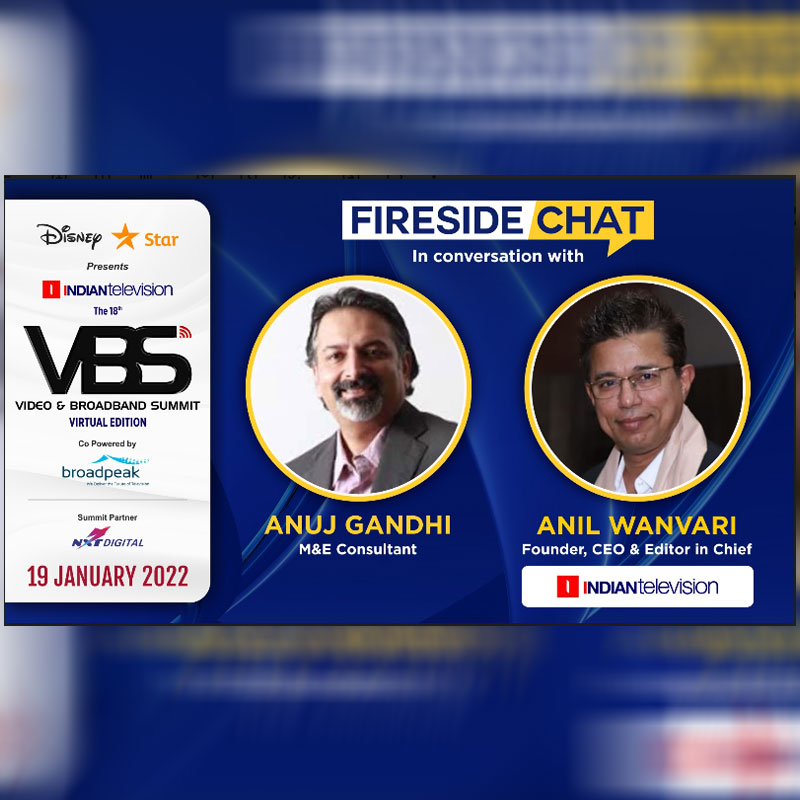
    Mumbai: After the edtech and fintech, it’s time for India to now witness the rise of media-tech, said M&E consultant and industry veteran Anuj Gandhi while decoding the post-pandemic future of the industry at the 18th edition of the Video & Broadband Summit 2022 (VBS) organised by Indiantelevision.com on Wednesday.

    The day-long virtual summit was co-powered by broadpeak, with Disney Star as the presenting partner, and NxtDigital as the summit partner.

    In a fireside chat with Indiantelevision.com founder CEO and editor-in-chief Anil Wanvari, the media distribution veteran discussed the six major trends which, according to him, will determine the course of the media and entertainment industry over the next couple of years.

    Video Trends: Unlike the days of DD and bundled offerings, the modern consumer wants more freedom to choose. With the burgeoning delivery platforms, it’s no longer that case where everyone has to be on PayTV. Moreover, in the present scenario where people are spending hours on social media, even Instagram Reels are ‘content’. Clearly, going forward, the definition of video, as well as trends in the space, will depend on the demand-supply equation. The rise of Free Dish and OTTs during the pandemic is a classic example, and even as their growth accelerates, PayTV will also continue to exist in some form or the other.

    Broadband Growth: Broadband has evolved into becoming a utility today; it is no longer limited to video. Considering the amount of consumption that’s happening over work-from-home, education, and other services, video is just a small fraction of it. The Trai’s figure for wired broadband that was stagnant at around 10-12 mn for many years, suddenly shot up to 25 mn, and this does not even include the huge undeclared market run by cable companies. The hybrid ecosystem fostered by the pandemic will continue to push this number further in the coming days.

    The fate of linear TV: It is a cause for worry and excitement at the same time. Both in India and globally there’s no denying the trend of people consuming less pay/linear TV as a result of the availability of alternatives as well as the failure of linear TV to innovate in terms of content. The Free Dish market has largely been insulated so far, but it will also experience disruption in the near future as broadband penetration in the hinterland grows.

    B2C focus and consolidation: The changes that were effected and necessitated by the growth in digital, especially in the last decade or so, have shifted the focus of the entire M&E industry from B2B to B2C. As the ecosystem opens up more and more to consumers directly, the need for consolidation will also increase, whether it is to meet the entertainment demands of viewers or to simplify content discovery for them.

    Rise of FAST: The popularity of Free Ad-Supported TV (FAST) services in the US and Europe, clearly shows that the west is moving towards AVOD. In the case of Asian markets including India, even though SVOD is picking up, the growth of Free Dish, YouTube, and OTT players like MX, is a strong indication of the potential for FAST.

    Crumbling walls: Changes in windowing norms that existed thus far will have a far-reaching impact on pricing, quality, and consumption of content as well as the actual segmentation of consumers in a multi-screen environment.

    The former group CEO of IndiaCast Media Distribution, who was also instrumental in setting up IndiaCast in March 2012 said he is hopeful about a future where all forms of video delivery – Free Dish, PayTV, VOD -will coexist. However, considering the current regulatory environment, competition, and the pace at which viewers are evolving, he recommended that the industry players must adopt an approach that gives more freedom and power to consumers rather than trying to resist the inevitable change in order to survive in the long run.

  • Madison Digital wins AVoD mandate for Zee5

    Madison Digital wins AVoD mandate for Zee5

    Mumbai: Madison Digital, a unit of Madison World has won the advertising-based video on demand (AVoD) mandate for home-grown video streaming platform Zee5. 

    The agency will handle media planning, social media, and creative development for Zee5’s B2B marketing function, said the statement.

    Zee Entertainment Enterprises Ltd chief operations officer of revenue Rajiv Bakshi said AVoD is a fast-growing OTT category and through its strong adtech and martech stack, Zee5 has paved the way for marketers and advertisers to engage with viewers through creative and innovative ways. “As a consumer-first brand, built on the back of our profound consumer understanding, the aim has always been towards providing customised and effective campaigns across multiple cohorts and segments. We have partnered with majority of brands across all industries, for multi-scale advertising, branded solutions and influencer-based marketing campaigns. We look forward to a successful partnership with Madison to further communicate our success story, distinct product offerings and fuel our growth in India,” Bakshi added.

    “Zee5 has seen a tremendous amount of growth over the last few years. The brand has been coming up with impressive originals suited for the Indian market. We are extremely happy to partner with Zee5 in growing the AVoD business for the platform,” said Madison Digital & Madison Media Ultra CEO Vishal Chinchankar.

  • Eros Now expands existing partnership with Xfinite’s Mzaalo

    Eros Now expands existing partnership with Xfinite’s Mzaalo

    Mumbai: South Asian OTT platform Eros Now owned by Eros STX Global Corporation announced details of its amended partnership with Mzaalo, a gamified video streaming service owned by Xfinite Global Plc (“Xfinite”).

    Aimed at bolstering Eros Now’s footprint in the emerging segment of advertising video-on-demand (AVOD), the partnership will allow Eros Now to continue building its core subscription video-on-demand (SVOD) service. The agreement also provides ErosSTX with positive optionality on the potential growth in digital assets and blockchain technology, said the company on Wednesday.

    One of the company’s strategic imperatives is to fully monetize the Eros Now platform and expand into ad-supported streaming and this partnership with Mzaalo does just that, highlighted Eros Now, CEO Ali Hussein.

    “We have an opportunity to monetize more the 224 million Eros Now registered users who are fans of our content offering but are also price-conscious. Mzaalo joins our already-substantial ecosystem of Eros Now distribution partners, including Bharti Airtel, BSNL, Tata Sky, Apple, Amazon and Roku. The Mzaalo agreement is purposefully structured to provide ErosSTX with an appropriate mix of fixed and guaranteed cash payments and variable revenue participation as Mzaalo scales,” he elaborated.

    ErosSTX is licensing majority of the existing Eros Now content library to Xfinite on an exclusive basis for global AVOD monetization. However, this agreement does not preclude Eros Now from launching its planned English-language service, Eros Now Prime, or from licensing content to other SVOD services.

    The AVOD platform is also expected to play a key role in Eros Now’s future content strategy and facilitate innovative windowing options. The current plans are to offer premium original titles and movies in the first window to Eros Now paying subscribers.

    Under the amended and restated agreement with Mzaalo, ErosSTX is entitled to a minimum guaranteed cash payment of $42 million over the remaining four-year license term, ending December 2024. ErosSTX has already received $18 million in minimum guaranteed payments under the original contract that started in 2018. 

    Additionally, ErosSTX will receive a 50 per cent share of any Mzaalo revenue generated above the minimum guarantee. Lastly, ErosSTX will receive 400 million XET Digital Tokens in exchange for access to Eros Now’s database of registered users,which totalled 224.0 million as of 31 March, 2021.

    Mzaalo, Xfinite’s first entertainment application, provides consumers with free access to premium content including films, original series, short-form content from Eros Now, and other media platforms, as well as a range of interactive features.

  • ‘Cruising Legends’ rides again on MX Player, top brands hop on

    ‘Cruising Legends’ rides again on MX Player, top brands hop on

    KOLKATA: MX Player is bringing back an award-winning travel show for another ride – Cruising Legends: Dawn Patrol will see four biking legends quench their thirst for wanderlust and undertake a journey to the easternmost part of India, Arunachal Pradesh, to witness the country’s first break of dawn. Top notch brands like BMW, Gopro, and Castrol 1 Ultimate have already come onboards as sponsors.

    Produced by The Vibe Studio, all four episodes of this travel series are now available to binge on MX Player.

    “In 2020, TheVibe had embarked on expanding its original IP catalogue which was AVoD-based into a SVoD play, and with this an interesting opportunity presented itself from MXPlayer to reboot Cruising Legends, a branded content series produced in 2017 under TheVibe Originals for AVoD, to be converted into a long-format episodic narrative as an MX Original Series. We felt that the property could grow. MX Player’s intervention has scaled up the project and turned it around as a multi proposition, ” TheVibe co-founder Kartik Rao said.

    The thing that makes this series special is that all of the chosen riders have distinct personalities and motivations; their reasons for travelling vary, how they travel and what they do while they travel vary. With each episode, a different rider takes the lead and sets the agenda of that leg of the journey.

    The four riders include Helmet Stories co-founder Harsh Man Rai, biker Candida Louis who’s on a mission to educate the world about the importance of travel, adventurer/biker Ouseph Chacko, and Vir Nakai, who is known all over the globe as the face of Indian motorcycling.

    “We are delighted to be a part of this series,” said BMW Motorrad India director Shivapada Ray. “The BMW G 310 GS is the perfect companion for such an escapade. The bike takes the excitement a step further into the typical GS territory that stands for robust adventures on two wheels.”

    GoPro India head of marketing Mayuri Pitale added, “Cruising Legends raises the bar of unique travel and adventure content in India and there were no better cameras to capture this incredible trip than the GoPro Hero9 Black and Hero8 Black. GoPro cameras are rugged, waterproof and built to withstand dirt, dust, bumps and spills – perfect for the incredible action content in MX Player’s adventure-fueled series. We are proud and excited to have GoPro Advocate, Vir Nakai, participate in the series and amazed by the exotic and treacherous terrain Arunachal Pradesh has to offer.”