Tag: Auction

  • IPL2025 Auction: The action heats up on day two

    IPL2025 Auction: The action heats up on day two

    MUMBAI: With limited purses at their disposal, some of the team managements moved cautiously while making their purchases on day two of the IPL2025 mega auction at the Abadi Al Johar Arena in Jeddah, Saudi Arabia.  Royal Challengers Bengaluru  had a piggy bank with Rs 30.65 crore; Mumbai Indians, Rs 26.1 crore; Punjab Kings, Rs 22.5 crore; Gujarat Titans, Rs 17.5 crore; Rajasthan Royals, Rs 17.35 crore; Chennai Super Kings; Lucknow Super Giants, Rs 14.85 crore; Delhi Capitals, Rs 13.8 crore; Kolkata Knight Riders, Rs 10.5 crore and Sunrisers Hyderabad, Rs 5.5 crore.

    The day was a bit of a shocker with some rather good players not finding any takers in the first round of the auction, but getting picked up in the first or second round of the accelerated auction later in the day. Among the cricketers who were left out figured: Kane Williamson,  Glenn Phillips, Ajinkya Rahane, Mayank Agrawal, Prithvi Shaw, Shardul Thakur, Daryl Mitchell,Shai Hope, K.S. Bharat, Alex Carey, Akeal Hosein, Adil Rashid, Keshav Maharaj, Fin Allen, Moen Ali, Umran Malik, Mustafizur Rahman, Umesh Yadav, Steve Smith, Sikandar Raza, Sarfaraz Khan, Kyle Mayers, Navdeep Saini, Lungi Ngidi Kwena Maphaka and Shivam Mavi. Some of these were once celebrated as stars and sure shots  who were paid big bucks in previous IPLs.

    The auction gets on the road

    It’s almost as if some of the teams were looking to take major risks and take on new talent, instead of recruiting players who have put up mixed performances. While others went about putting in big bucks to retain their squads of yesteryear. 

    Kolkata Knight Riders got the train moving by offering Rs 1.5 crore for West Indies skipper Rovman Powell, which was his base price. Delhi Capitals then got into the act by acquiring Faf du Plessis for Rs 2 crore, his base price.  But the big story of the day was the Rs 1.1 crore which Rajasthan Royals shelled out for the 13 year old tyro and hard-hitter Vaibhav Suryavanshi, making him the youngest ever player to be picked up for the IPL. 

    Among the players who were picked up  during the day included:  Akash Deep (Lucknow Super Giants, Rs 8 crore);  Lockie Ferguson (Punjab Kings, Rs 2 crore);   Deepak Chahar (Mumbai Indians,  Rs 9.25 crore);  Bhuvneshwar Kumar (Royal Challengers Bengaluru, Rs 10.75 crore);  Gerald Coetzee (Gujarat Titans, Rs 2.40 crore);  Tushar Deshpande (Rajasthan Royals,  Rs 6.50 crore);  Josh Inglis (Punjab Kings, Rs 2.60 crore);  Nitish Rana (Rajasthan Royals, Rs 4.20 crore);  Ryan Rickelton (Mumbai Indians, Rs 1 crore);  Washington Sundar (Gujarat Titans, Rs 3.20 crore);  Krunal Pandya (Royal Challengers Bengaluru, Rs 5.75 crore);  Marco Jansen (Punjab Kings,  Rs 7 crore);  Sam Curran (Chennai Super Kings, Rs 2.40 crore);  Allah Ghazanfar (Mumbai Indians, Rs 4.80 crore); Xavier Bartlett (Punjab Kings, Rs 80 lakh), Yuvraj Chaudhary (Lucknow Super Giants, Rs 30 lakh); Pyla Avinash (Punjab Kings Rs 30 lakh); Eshan Malinga (Sunrisers Hyderabad, Rs 1.2 crore); Devdutt Padikkal (Royal Challengers Bengaluru,  Rs 2 crore) ; Luvnith Sisodia (Kolkata Knight Riders, Rs 30 lakh); Shreyas Gopal (Chennai Super Kings; Rs 30 lakh); Ajinkya Rahane (Kolkata Knight Riders, Rs 2 crore); Glenn Phillips (Gujarat Titans,  Rs 2 crore); Donovan Ferreira (Delhi Capitals, Rs 75 lakh); Anukul Roy (Kolkata Knight Riders, Rs 40 lakh); Vansh Bedi (Chennai Super Kings, Rs 55 lakh); Moeen Ali (Kolkata Knight Riders, Rs 2 crore); Umran Malik (Kolkata Knight Riders, Rs 75 lakh); Sachin Baby (Sunrisers Hyderabad, Rs  30 lakh); Arshin Kulkarni (Lucknow Super Giants, Rs 30 lakh); Matthew Breetzke (Lucknow Super Giants, Rs 75 lakh); Kwena Maphaka  (Rajasthan Royals, Rs 1.5 crore); Praveen Dubey (Punjab Kings, Rs 30 lakh); Manvanth Kumar (Delhi Capitals, Rs 30 lakh); Karim Janat (Gujarat Titans, Rs 75 lakh); Bevon Jacobs (Mumbai Indians, Rs 30 lakh); Tripurana Vijay (Delhi Capitals, Rs 30 lakh); Madhav Tiwari (Delhi Capitals, Rs 40 lakh); Kunal Rathore (Rajasthan Royals, Rs 30 lakh); Arjun Tendulkar (Mumbai Indians, Rs 30 lakh); Lizaad Williams (Mumbai Indians, Rs 75 lakh); Abhinandan Singh (Royal Challengers Bengaluru, Rs 30 lakh); Kulwant Khejroliya, (Gujarat Titans,  Rs 30 lakh); Ashok Sharma (Rajasthan Royals,  Rs 30 lakh); Vignesh Puthur, (Mumbai Indians,  Rs 30 lakh); Mohit Rathee (Royal Challengers Bengaluru, Rs 30 lakh).

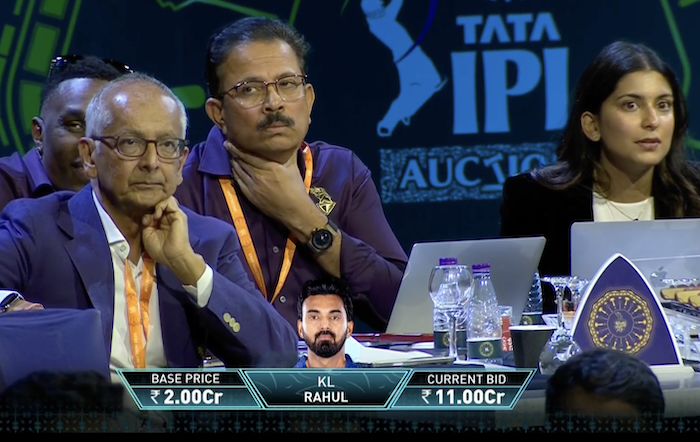
    Below are some moments from the auction interspersed with the final squads of each of the teams and the prices that were paid for them. Happy reading and viewing! (pix courtesy screen grabs from JioCinema’s stream of the auction)


    The auction place!

                    
                    The price mentioned in the second column is the amount paid to the player to acquire him for 
                     the  team.

    The Delhi capitals quad


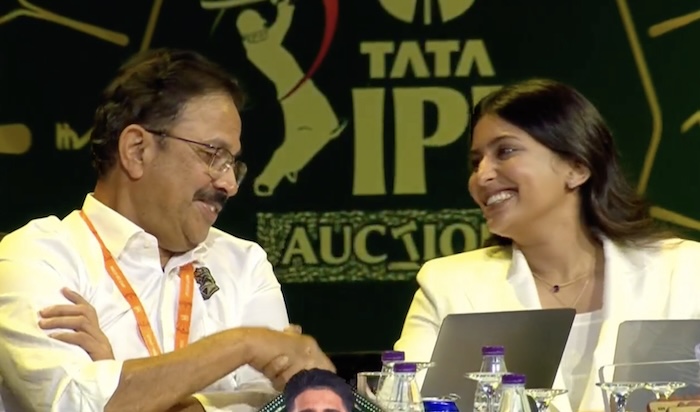
    Sanjeev Goenka


    Gujarat Titans Squad


    Delhi Capitals


    The Kolkata Knigh Riders


    Sunrisers Hyderabad


    Lucknow Super Giants


    Mumbai Indians


    The team


    Chennai Super Kings


    Nail biting


    Punjab Kings


    Akash Ambani


    Sunrisers hyderabad


    Sanjeev Goenkasmiling


    Royal Challengers Bengaluru


    Wait a minute, Ms Auctioneer!


    Rajasthan Royals


  • IPL 2025 auction: A day of big spending

    IPL 2025 auction: A day of big spending

    MUMBAI: Surprises galore! That’s what the day one of Tata IPL 2025 Mega Auction/player draft in Jeddah, Saudi Arabia threw up yesterday with some players being bought for astounding prices and some going unsold. Overall, the managements of the 10 teams spent Rs 467.5 crore, purchasing 72 players, of which 24 players were international players.

    Amongst the biggest eyeopeners was the Rs 27 crore sticker price that Lucknow Super Giants paid to acquire the swashbuckling Rishabh Pant, making him the most expensive cricketer in the league’s history. Earlier, Punjab Kings coughed up Rs 26.75 crore for Shreyas Iyer  breaking the Rs 24.75 crore record set for Mitchell Starc by Kolkata Knight Riders in 2024.

    Kolkata Knight Riders also almost broke the bank by shoveling Rs 23.75 crore for  all arounder Venkatesh Iyer. Leggie Yuzvendra Chahal became the most expensive Indian spinner ever in IPL as Punjab Kings  picked him for Rs 18 crore. Pacer Arshdeep Singh who was the first player to be put on the blocks during the auction was also purchased by Punjab Kings for an astounding Rs 18 crore, using the right to match card, beating out Sunrisers Hyderabad in the process. Amongst the players who went shockingly unsold included: Devdutt Padikkal, David Warner and Piyush Chawla.

    When the day began, a total of 574 players were  shortlisted from an initial pool of 1,574 names. This included 208 overseas players, 12 uncapped overseas talents, and 318 uncapped Indian players. Mallika Sagar stood up as the auctioneer for the whole period of the auction.

    IPL Auction 2025 Rajiv Shukla

    Chennai Super Kings had held on to  Ruturaj Gaikwad, MS Dhoni; Ravindra Jadeja, Shivam Dube and Matheesha Pathirana while Mumbai Indians had retained Hardik Pandya. Rohit Sharma, Suryakumar Yadav, Jasprit Bumrah and Tilak Varma. On the other hand Royal Challengers Bengaluru retained Virat Kohli, Rajat Patidar and Yash Dayal and Sunrisers Hyderabad retained Heinrich Klaasen, Pat Cummins, Travis Head, Abhishek Sharma, Nitish Kumar Reddy.

    While Delhi Capitals players retained Axar Patel, Kuldeep Yadav, Tristan Stubbs, Abhishek Porel. Punjab Kings had decided to continue with only Shashank Singh and Prabhsimran Singh. Gujarat Titans retained Rashid Khan, Shubman Gill, Sai Sudharsan, Rahul Tewatia, Shahrukh Khan  even as Lucknow Super Giants retained Nicholas Pooran, Ravi Bishnoi, Mayank Yadav , Ayush Badoni and Mohsin Khan. Rajasthan Royals held on to Sanju Samson, Yashasvi Jaiswal, Riyan Parag, Dhruv Jurel, Shimron Hetmyer and Sandeep Sharma even as Kolkata Knight Riders retained Rinku Singh, Varun Chakravarthy, Sunil Narine, Andre Russell, Harshit Rana and Ramandeep Singh.

    This gave Punjab Kings  a purse of Rs 110.5 crore when the auction commenced,; Rajasthan Royals, Rs 41 crore; Royal Challengers Bengaluru, Rs 83 crore, Delhi Capitals, Rs 73 crore;  Lucknow Super Giants, Rs 69 crore;  Gujarat Titans, Rs 69 crore; Chennai Super Kings,  Rs 55 crore; Kolkata Knight Riders, Rs 51 crore; Mumbai Indians, Rs 45 crore and Sunrisers Hyderabad,  Rs 45 crore.

    Sanjeev Goenka Lucknow Super Giants


    The players who were bought today included:  

    Kagiso Rabada (by  Gujarat Titans for Rs 10.75 crore); Jos Buttler (Gujarat Titans, Rs 15.75 crore); 
    Mitchell Starc (Delhi Capitals, Rs 11.75 crore); Mohammed Shami (Sunrisers Hyderabad, Rs 10 crore); David Miller (Lucknow Super Giants, Rs 7.50 crore);  Mohammed Siraj (Gujarat Titans, 12.25 crore); Liam Livingstone (Royal Challengers Bangalore, Rs 8.75 crore); K.L. Rahul (Delhi Capitals, Rs 14 crore); Harry Brook (Delhi Capitals, Rs 6.25 crore); Aiden Markram (Lucknow Super Giants, Rs 2 crore);  Devon Conway (Chennai Super Kings, Rs 6.25 crore); Rahul Tripathi (Chennai Super Kings, Rs 3.40 crore); Jake Fraser-McGurk (Delhi Capitals, Rs 9 crore); Harshal Patel (Sunrisers Hyderabad, Rs 8 crore); Rachin Ravindra (Chennai Super Kings, Rs 4 crore); Ravichandran Ashwin  (Chennai Super Kings,  Rs 9.75 crore); Marcus Stoinis (Punjab Kings; Rs 11 crore);  Mitchell Marsh (Lucknow Super Giants; Rs 3.40 crore); Glenn Maxwell goes (Punjab  Kings, Rs 4.20 crore); Quinton de Kock (Kolkata Knight Riders, Rs 3.60 crore); Phil Salt (Royal Challengers Bangalore, Rs 11.5 crore); Rahmanullah Gurbaz (Kolkata Knight Riders, Rs 2 crore);  Ishan Kishen (Sunrisers Hyderabad, Rs 11.25 crore);  Jitesh  Sharma (Royal Challengers Bangalore, Rs 11 crore); Josh Hazlewood (Royal Challengers Bangalore, Rs 12.50 crore); Prasidh Krishna (Gujarat Titans, Rs 9.5 crore); Avesh Khan (Lucknow Super Giants,  Rs 9.75 crore); Anrich Nortje (Kolkata Knight Riders, Rs 6.5 crore); Jofra Archer (Rajasthan Royals, Rs 12.5 crore); Khaleel Ahmed (Chennai Super Kings, Rs 4.80 crore); T. Natarajan (Delhi Capitals, Rs 10.75 crore); Trent Boult (Mumbai Indians, Rs 12.5 crore); Maheesh Theekshana (Rajasthan Royals, Rs 4.40 crore);  Rahul Chahar (Sunrisers Hyderabad,Rs 3.20 crore); Adam Zampa (Sunrisers Hyderabad, Rs 2.40 crore); Wanindu Hasaranga (Rajasthan Royals, Rs 5.25 crore); Noor Ahmad (Chennai Super Kings, Rs 10 crore); Atharva Taide (Sunrisers Hyderabad, Rs 30 lakh); Nehal Wadhera (Punjab Kings, Rs 4.20 crore); Karun Nair (Delhi Capitals; Rs 50 lakh), Angkrish Raghuvanshi (Chennai Super Kings, Rs 3 crore); Abhinav Manohar (Kolkata Knight Riders, Rs 3.20 crore); buy Nishant Sindhu (Gujarat Titans, Rs 30 lakh); Naman Dhir (Mumbai Indians, Rs 5.25 crore); Sameer Rizvi (Delhi Capitals, Rs 95 lakh); Abdul Samad (Lucknow Super Giants, Rs 4.20 crore); Harpreet Brar (Punjab Kings, Rs 1.50 crore); Vijay Shankar (Chennai Super Kings, Rs 1.20 crore); Mahipal Lomror (Gujarat Titans, Rs 1.70 crore); Ashutosh Sharma (Delhi Capitals, Rs 3.80 crore); Vishnu Vinod (Punjab Kings, Rs 95 lakh); Aryan Juyal (Lucknow Super Giants, Rs 30 lakh); Anuj Rawat (Gujarat Titans, Rs 30 lakh); Robin Minz (Mumbai Indians, Rs 65 lakh); Kumar Kushagra (Gujarat Titans, Rs 65 lakh); Akash Madhwal (Rajasthan Royals, Rs 1.20 crore); Mohit Sharma (Delhi Capitals, Rs 2.20 crore); Vyshak Vijaykumar (Punjab Kings, Rs 1.80 crore). Vaibhav Arora (Kolkata Knight Riders , Rs 1.80 crore); Yash Thakur (Punjab Kings, Rs 1.60 crore); Simarjeet Singh (Sunrisers Hyderabad, Rs 1.5 crore); Suyash Sharma (Royal Challengers Bangalore, Rs 2.6 crore); Manav Suthar (Gujarat Titans, Rs 30 lakh); Kumar Kartikeya Singh (Rajasthan Royals, Rs 30 lakh); Mayank Markande (Kolkata Knight Riders, Rs 30 lakh); Karn Sharma (Mumbai Indians, Rs 50 lakh) and Rasikh Dhar (Royal Challengers Bangalore, Rs 6 crore). 
     

  • IPL auctions set to kick off 2019 cricket bonanza for brands, marketers

    IPL auctions set to kick off 2019 cricket bonanza for brands, marketers

    MUMBAI: Indian fans are in for a rollercoaster ride in 2019 thanks to an action-packed cricket calendar. Virat Kohli’s men have major challenges – tough and exciting in equal measure – lined up right through the year. The Indian side is set to play 12 Tests, 22 ODIs, 17 T20Is and the all-important World Cup in June. That’s in addition to the two-month-long cricket party – the Indian Premier League (IPL).

    The mouth-watering prospect of the star-studded Indian cricket team taking on some of the most formidable cricketing nations offers an exciting proposition for fans, marketers, and brands. From a broadcast perspective, it obviously is a golden opportunity for ensuring maximum viewership and revenue. While Indian broadcasters are now investing in emerging sports along with a growing interest from audiences, nothing captures the hearts and minds of India’s public like a hotly contested cricket match.

    Dentsu Aegis Network South Asia chairman and CEO Ashish Bhasin says cricket always commands premium price purely because of the consistency of viewership that it ensures.

    “I think cricket is always a good opportunity for brands particularly those who want to reach a wide range of audience because it is one of those properties that reaches to each and every corner of the country and has got the universal appeal. If you look at the last few years, cricket hasn’t let any advertisers down because the interest has only gone on increasing. So I do think it’s a good opportunity and every opportunity comes at a price. Advertisers pay for eyeballs and cricket gets you consistent eyeballs. So it will always command a good price,” he feels.

    According to the 2018 KPMG media and entertainment report, television is expected to grow at a CAGR of 12.6 per cent owing to growing TV penetration, strong advertising demand on the back of domestic consumption and major events (two cricket world cups and a general elections on the next five years) supported by better distribution realisations due to operationalisation of TV digitisation.

    Season 11 of the IPL saw a spike of 15 per cent in viewership from 1.2 billion impressions in 2017 to 1.4 billion impressions in 2018. On the other hand, Star India’s OTT platform Hotstar hit a world record for concurrent online viewing with 10.7 million viewers for the final. The 2015 ICC World Cup garnered 635 million viewers till the India versus Australia semi-final. A total of 309 million Indians (TAM Panel CS4+ extrapolated to the universe using a standard conversion factor) tuned in to watch India’s semi-final clash against the Aussies on their television sets.

    Syska Group marketing head Amit Sethiya is looking forward to all the opportunities the upcoming year is likely to throw up to his brand.

    “Definitely there are a lot of opportunities that are going to come because of a whole range of experiences in 2019. But I think the main concern is that advertisers and brands need to check what kind of integration they are going ahead with. Three things that we are fundamentally repeating that it’s Bollywood, politics and cricket and these things still stand true,” he adds.

    Sports advertising expenditure is largely driven by cricket with other sports contributing a minor share. According to India Sports Sponsorship report 2018 by ESP properties and SportzPower, media spending in sports as a whole grew 15.8 per cent from Rs 3511 crore ($ 516 million) to Rs 4065 crore ($ 616 million), driven even more strongly in 2017 by Television On Air, which grew an incredible 42.7 per cent from Rs 2376 crore ($ 348 million) to Rs 3379 crore ($ 512 million). The other reason for sports adex increase is the annual increase in ad rates, especially on IPL.

    Broadcasters have started investing heavily in regional feeds, the likes of which were witnessed in the last IPL season. Star India leveraged 17 of its channels, including Star Plus and Star Gold to make the finals a runaway success. It was aired in eight languages including Hindi, English, Tamil, Telugu, Bengali, Kannada, Marathi and Malayalam.

    At the time, Star India aired all the regional feeds apart from Hindi and Tamil on GEC and movies channels, but in the recent past, it has launched a new channel for Telugu feed called Star Sports 1 Telugu. The network is also ready to launch its fourth regional channel on 30 December for the Kannada audience named Star Sports 1 Kannada.

    Fashion brand fbb’s marketing head Prachi Mohapatra said that cricket now reaches more demographic segments than before and therein lies its true power.

    “Our association with IPL has been positive from a view of fbb’s brand visibility and subsequent in-store traction. We were confident about the partnership and believed in the strength of the association. Cricket stays a superior property and now has a wider consumption that cuts across demographic segments than what it had earlier. Hence, association with the same will remain high on the agenda for many participating brands,” she adds.

    The ad expenditure on IPL increased from Rs 228 crore in 2008 to Rs 1204 crore in 2017. Sports advertising across all media accounted for Rs 4065 crore, 6.6 per cent of the total ad spends in the country. While the bulk of this advertising is on cricket though, other sports like kabaddi, football and badminton are now gaining traction from both the viewers and advertising.

    Eros Digital COO Ali Hussein highlights how his platform’s partnership with Kohli’s IPL franchise helped him drive their subscriber numbers.

    “It has been an interesting collaboration with Royal Challengers Bangalore as it was an industry first. No other OTT player in India has sponsored an IPL team. This association helped us reach a larger audience for Eros Now and we were able to leverage great synergies with content that we created for the platform and value that we were able to drive to our subscribers via match tickets and exclusive merchandise,” he said.

    While cricket has been the country’s most loved sport for a while, the explosion of the IPL has added another dimension to the sport. Apart from helping the Board of Control for Cricket in India (BCCI) to further propagate the game, the cash-rich league has aided brands in unlocking new markets and tapping more consumers.

    “Consumer-focussed brands are always seeking for various mediums & opportunities to reach out to their target audience. Given the kind of viewership these cricketing events enjoy in India, they would always serve as potential platforms for partnerships. Cricket and Bollywood are the two most followed headlines in the country and hence provide for a great association for a brand like Eros Now,” Hussein adds.

    Earlier this in January, IPL teams spent a mind-boggling Rs 431.7 crore in a two-day auction in Bengaluru, with pacer Jaydev Unadkat bagging a Rs 11.5 crore contract to earn the top Indian grosser’s tag.  The salary cap of Rs. 80 crore then was 33 per cent higher than the Rs 60 crore available in the 2014 auctions.

    Franchises have witnessed a windfall due to the renegotiated broadcast rights (won by Star India for Rs 3270 crore per year, four times higher than what Sony Pictures Network India paid per year during from 2008 to 2017) and title sponsorship rights (acquired by Vivo for Rs 440 crore per year).

    Indian cricket has set global benchmarks in the past couple of years, with the IPL rights being awarded for a record Rs 16347 crore to Star India for the period 2018 to 2022 and Oppo snapping up the Indian cricket team’s sponsorship rights for Rs 1079 crore till 2022.

    As the IPL money-spinner returns for its 12th edition, the auction on 18 December is where all the action commences before the players battle it out on the field.

    While 1003 players had initially registered but the final auction list is out with a total pool of 346 cricketers set to undergo the hammer in Jaipur. In a sense, the IPL auction is likely to end 2018 with a big and set the agenda for a thrilling season of cricket in 2019.

  • Telcos may skip 5G spectrum auction due to high prices: Fitch Ratings

    Telcos may skip 5G spectrum auction due to high prices: Fitch Ratings

    MUMBAI: Credit rating agency, Fitch Ratings, stated that India’s new National Digital Communication Policy (NDCP) could manage to benefit the telecom sector by making it easier to meet continuous rising data demand and focusing on tax and fee duty on the manufactory.
    5G spectrum auctions could be skipped by the Indian telcos if prices are too high. The Indian telecommunication companies are likely to raise investment in 5G spectrum which directly depends on the 5G spectrum principal price. This can overextend the liabilities on balance sheets of these companies.
    Furthermore, Fitch also explained how private telcos are going to benefit and enlarge their broadband coverage funded by the universal service obligation fund.
    By initiating and creating two million Wi-Fi hotspots in rural areas and another one million in urban areas, the NDCP plans on connecting almost more than 600,000 villages to the digital network. Although, according to Fitch, there are going to be a few execution challenges but it will only lead to broadband adoption rate increasing and going higher.
    The research report also stated that telco costs and red tape could be cut by the NDCP’s plans to review and rationalise the sector’s tax structure and optimise future spectrum asset pricing.
    A Fitch statement read, “Indian telcos face heavy and multiple taxes – including licence fees, spectrum usage charges, and universal service fees on top of expensive spectrum assets. Meanwhile, intense competition has limited telcos’ pricing power. Overall, these pressures have stretched balance sheets”.

  • DD Free Dish looks at  advertising for monetisation

    DD Free Dish looks at advertising for monetisation

    MUMBAI: The government’s own direct-to-home (DTH) platform DD Free Dish has had a good run since launch because of its wide acceptance, especially in the rural areas where the reach of cable is limited and pay TV is expensive. Now, the government is drawing up plans to make money from the platform.

    Last year, the government sanctioned a scheme to extend the number of channels to up to 250. In a reply in the Lok Sabha recently, Minister of State in the Ministry of Information and Broadcasting (MIB) Rajyavardhan Rathore said that this would enable Free Dish to generate revenue via advertisements. Quoting a private newspaper, the response mentions that private channels easily garner Rs 500-700 crore as revenue a year while a channel slot on Free Dish is as low as Rs 6-8 crore. He admitted that there were limitations to the revenue models that could be adapted into the free service if it wanted to ensure quality and reach.

    Another means of making money is via auction of channel slots on the DTH platform, which turned into a legal case when the auctions were arbitrarily called off mid last year by Smriti Irani, the information and broadcasting minister. Auctions have been kept in abeyance till a settlement is reached between Prasar Bharati and the networks that have reached out to the Telecom Disputes Settlement Appellate Tribunal. The tribunal has asked the government to conduct a comprehensive review on the auctioning policy for Free Dish before any stand is taken.

    At present, there are 72 free channels and 39 radio stations available on Free Dish.

    Updating the parliament on its growth, Rathore added that about 66,000 DTH set-top boxes have been given out in tribal, remote and border areas. According to estimates, Free Dish’s total subscriber base is 22 million.

    Also Read :

    TDSAT interim order ensures continuity for private channels on FreeDish

    TDSAT gives Prasar Bharati 2 days to respond to FreeDish auction suspension

    FreeDish auction on 4 July, different reserve prices for GEC and news


  • BCCI invites bids for e-auction of India rights

    BCCI invites bids for e-auction of India rights

    MUMBAI: The Board of Control for Cricket in India (BCCI) has invited bids for media rights of international and domestic cricket matches in India for a five year period from 1 April 2018 to 31 March 2023. This time, the rights will be decided via an online auction on 27 March which will start at 2 pm.

    The BCCI has three media rights package. This includes global TV rights plus rest of the world digital rights package, Indian sub-continent digital rights package and global consolidated rights package.

    Star India in 2012 had won the media rights for Rs 3,851 crore. The invitation inviting tender (IIT) document can be bought for Rs 680,000 or $10,000 (non-refundable and non-adjustable) by demand draft or pay order (both payable in Mumbai).

    The interested broadcasters or companies can also make a consolidated bid for all the three packages. A bidders workshop has been scheduled on 7 March at 11 am to educate the interested bidders on the online bid process.

    The IIT documents are available for collection from the BCCI office from 10 am to 5 pm from 20 February to 5 March. The parties may submit their bids latest by 10 am on 27 March, which means up to five hours before the start of the online auction process.

  • DD to auction prime time slots: Rathore – viewership & revenue dropping

    DD to auction prime time slots: Rathore – viewership & revenue dropping

    NEW DELHI: Doordarshan is to auction some of its prime time slots on DD National instead of commissioning them or taking them on self-financed commission basis. Minister of State for Information and Broadcasting Rajyavardhan Rathore admitted in parliament today that the current acquisition of programmes through commissioning and self finance commissioning (SFC) route had resulted in dipping of viewership of DD National and consequently decreasing revenue.
     
    Prasar Bharati has therefore considered the option of sale of time slot /time bands on DD National channel as a strategy to source high quality content at no cost. The SFC scheme was launched in 2005 and it worked well for DD in the initial years but SFC serials did not deliver either on increasing viewership or revenue in recent years.
    Rathore said the Prasar Bharati Board had advised DD to proceed with an alternative policy by opening-up prime time slots for sale. DD is coming up with a slot sale policy so that genuine external and creative professionals can mount their programmes on DD Channels through slot purchase, the minister said.
     
    In this scheme, DD would stop financing production through ‘Pay Out’ modes and instead have revenue assurance in the form of a slot fee. The policy envisages that producers are made stakeholders in the scheme. They would invest in the content and recover the same from the market through sale of associated commercial time. In such a situation, the minister added, market forces would ensure that high quality standards are maintained for the content mounted, while assuring revenue for Doordarshan.

    In reply to another question, the minister said Television Rating Points (TRP) and viewership details of DD National according to the Broadcast Audience Research Council (BARC) data including rural viewership initiated in October 2015 fluctuates on weekly basis. He admitted that Doordarshan has suffered a setback because of sharp drop in number of terrestrial TV viewers. He said the Prasar Bharati Board had also decided to invite good external programmes to be telecast on all its channels in different phases.

  • DD to auction prime time slots: Rathore – viewership & revenue dropping

    DD to auction prime time slots: Rathore – viewership & revenue dropping

    NEW DELHI: Doordarshan is to auction some of its prime time slots on DD National instead of commissioning them or taking them on self-financed commission basis. Minister of State for Information and Broadcasting Rajyavardhan Rathore admitted in parliament today that the current acquisition of programmes through commissioning and self finance commissioning (SFC) route had resulted in dipping of viewership of DD National and consequently decreasing revenue.
     
    Prasar Bharati has therefore considered the option of sale of time slot /time bands on DD National channel as a strategy to source high quality content at no cost. The SFC scheme was launched in 2005 and it worked well for DD in the initial years but SFC serials did not deliver either on increasing viewership or revenue in recent years.
    Rathore said the Prasar Bharati Board had advised DD to proceed with an alternative policy by opening-up prime time slots for sale. DD is coming up with a slot sale policy so that genuine external and creative professionals can mount their programmes on DD Channels through slot purchase, the minister said.
     
    In this scheme, DD would stop financing production through ‘Pay Out’ modes and instead have revenue assurance in the form of a slot fee. The policy envisages that producers are made stakeholders in the scheme. They would invest in the content and recover the same from the market through sale of associated commercial time. In such a situation, the minister added, market forces would ensure that high quality standards are maintained for the content mounted, while assuring revenue for Doordarshan.

    In reply to another question, the minister said Television Rating Points (TRP) and viewership details of DD National according to the Broadcast Audience Research Council (BARC) data including rural viewership initiated in October 2015 fluctuates on weekly basis. He admitted that Doordarshan has suffered a setback because of sharp drop in number of terrestrial TV viewers. He said the Prasar Bharati Board had also decided to invite good external programmes to be telecast on all its channels in different phases.

  • TRAI recommends high reserve prices for spectrum auction; TSPs unhappy

    TRAI recommends high reserve prices for spectrum auction; TSPs unhappy

    NEW DELHI: The Telecom Regulatory Authority of India (TRAI) today recommended rates for auction of spectrum in the 700 Mhz, 800 Mhz, 900 Mhz, 1800 Mhz, 2100 Mhz, 2300 Mhz and 2500 Mhz bands.


    Earlier, TRAI chairman R S Sharma had said that the auction may be conducted in May or June this year.


    The base spectrum price per MHz for Delhi metro will be Rs 1,595 crore for 700 MHz, Rs 848 crore for 800 MHz, Rs 399 crore for 1800 MHz, Rs 554 crore for 2100 MHz, Rs 143 crore for 2300 MHz and Rs 143 crore for 2500 MHz band.


    TRAI said the base spectrum price per MHz for Karnataka (including Bangalore) will be Rs 740 crore for 700 MHz, Rs 303 crore for 800 MHz, Rs 558 crore for 900 MHz, Rs 185 crore for 1800 MHz, Rs 328 crore for 2100 MHz, Rs 98 crore for 2300 MHz and Rs 98 crore for 2500 MHz band.


    One TSP, who did not want to be named, told Indiantelevision.com that the prices were prohibitive and the government may be asked to reconsider the recommendations.


    The Authority reiterated its earlier recommendation that APT700 band plan should be adopted for the 700 MHz (698-806 MHz) spectrum band with FDD based 2×45 MHz frequency arrangement.


    TRAI has also recommended that entire available spectrum (2x35MHz) in the 700 MHz band should be put to auction in the upcoming auction.


    The Authority said test schedule for the roll-out obligations testing for 700 MHz should be released within a period of one year from the date of completion of auction in this band.


    The same roll-out obligations, which were imposed on the successful bidder of spectrum in 800 MHz, 900 MHz, 1800 and 2100 MHz band in the auctions held in 2015, should be prescribed for these spectrum bands in the upcoming auctions for new entrants. The Authority also said no fresh roll-out obligation should be imposed on existing service providers who are already operating their services in 800, 900, 1800 or 2100 MHz band, in case they acquire additional block of spectrum in the same band.


    The Authority recommended that the same eligibility criteria that have been made applicable for other bands viz. 800 MHz, 900 MHz, 1800 MHz and 2100 MHz band in January 2015 NIA should be made applicable for 2300 MHz and 2500 MHz bands. The same eligibility criteria should also be made applicable for 700 MHz band also.


    Partial spectrum available in Bihar, Rajasthan and North-East LSAs should not be put to auction till such time it becomes available at least in 75 per cent of total number of districts of the LSA including the State capital(s).


    The Authority recommended that DoT, in coordination with Defence and the TSPs, should complete the harmonisation process in the 1800 MHz band before upcoming auctions so that the entire spectrum that is made available due to this exercise is placed for bidding. The available spectrum must be put to auction in contiguous blocks, preferably in the block of 5 MHz.


    It recommended that the 1800 MHz band administratively assigned spectrum to Aircel in Haryana and MP, and Tata in HP should be taken back. The Authority also recommended that the 800 MHz band be administratively assigned spectrum to Tata in WB and Quadrant in Punjab should be taken back. This spectrum should also be put to upcoming auction.


    The Authority recommended that DoT, in coordination with Defence and the TSPs, should complete the harmonisation process in the 1800 MHz band before upcoming auctions so that the entire spectrum that is made available due to this exercise is placed for bidding. The available spectrum must be put to auction in contiguous blocks, preferably in the block of 5 MHz.


    The Authority recommended that DoT should ensure that the spectrum surrendered by TTSL is not kept idle and takes appropriate legal remedies to put it in the upcoming auction.  


    Additionally, the entire available spectrum in 2100 MHz band, including spectrum taken back from STEL, should be put to auction.


    Spectrum in 700 MHz band should be offered in the block size of 5 MHz (paired). In case a TSP is able to win more than one block of spectrum in the upcoming auctions, it should be allocated spectrum in contiguous blocks.


    In case a TSP is able to win more than one block of spectrum in 2100 MHz band, it should be allocated spectrum in contiguous blocks. Similarly, if the TSP already having spectrum in the 2100 MHz band, acquires additional carrier, it should be ensured that all its carriers are contiguous.  


    Spectrum in the 2300 MHz and 2500 MHz bands should be put to auction in the block size of 10 MHz (unpaired). Currently, spectrum trading in 2300/2500 MHz band is permitted in the block size of 20 MHz. The Authority also recommended that after network synchronisation of all the TDD networks, spectrum trading in 2300/2500 MHz band should be permitted in the blocks of 10 MHz.


    Existing provision of a cap of 25 per cent of the ‘total spectrum assigned’ in 700/800/900/1800/ 2100/2300/2500 MHz bands and 50 per cent within a given band in each of the access service area shall apply for total spectrum holding by each TSP.


    The roll-out obligations to be imposed for licensees who acquire access spectrum in 700 MHz band should be: all towns/villages having population of 15,000 or more but less than 50,000 to be covered within five years of effective date of allocation of spectrum for access services and all villages having population of 10,000 or more but less than 15,000 to be covered within seven years of effective date of allocation of spectrum; to prevent, duplication of infrastructure, a TSP should also be permitted to fulfil the obligations by sharing network of other operator to the extent permissible as per guidelines/instructions applicable from time to time.


    The Authority recommended that the quantum of test fee for the purpose of roll-out testing requirements may be reduced to 20 per cent of the existing rates for testing in the block headquarters (for phase 3, 4 and 5 of the rollout obligations) and similarly for testing of coverage in rural SDCAs.

  • TRAI recommends high reserve prices for spectrum auction; TSPs unhappy

    TRAI recommends high reserve prices for spectrum auction; TSPs unhappy

    NEW DELHI: The Telecom Regulatory Authority of India (TRAI) today recommended rates for auction of spectrum in the 700 Mhz, 800 Mhz, 900 Mhz, 1800 Mhz, 2100 Mhz, 2300 Mhz and 2500 Mhz bands.


    Earlier, TRAI chairman R S Sharma had said that the auction may be conducted in May or June this year.


    The base spectrum price per MHz for Delhi metro will be Rs 1,595 crore for 700 MHz, Rs 848 crore for 800 MHz, Rs 399 crore for 1800 MHz, Rs 554 crore for 2100 MHz, Rs 143 crore for 2300 MHz and Rs 143 crore for 2500 MHz band.


    TRAI said the base spectrum price per MHz for Karnataka (including Bangalore) will be Rs 740 crore for 700 MHz, Rs 303 crore for 800 MHz, Rs 558 crore for 900 MHz, Rs 185 crore for 1800 MHz, Rs 328 crore for 2100 MHz, Rs 98 crore for 2300 MHz and Rs 98 crore for 2500 MHz band.


    One TSP, who did not want to be named, told Indiantelevision.com that the prices were prohibitive and the government may be asked to reconsider the recommendations.


    The Authority reiterated its earlier recommendation that APT700 band plan should be adopted for the 700 MHz (698-806 MHz) spectrum band with FDD based 2×45 MHz frequency arrangement.


    TRAI has also recommended that entire available spectrum (2x35MHz) in the 700 MHz band should be put to auction in the upcoming auction.


    The Authority said test schedule for the roll-out obligations testing for 700 MHz should be released within a period of one year from the date of completion of auction in this band.


    The same roll-out obligations, which were imposed on the successful bidder of spectrum in 800 MHz, 900 MHz, 1800 and 2100 MHz band in the auctions held in 2015, should be prescribed for these spectrum bands in the upcoming auctions for new entrants. The Authority also said no fresh roll-out obligation should be imposed on existing service providers who are already operating their services in 800, 900, 1800 or 2100 MHz band, in case they acquire additional block of spectrum in the same band.


    The Authority recommended that the same eligibility criteria that have been made applicable for other bands viz. 800 MHz, 900 MHz, 1800 MHz and 2100 MHz band in January 2015 NIA should be made applicable for 2300 MHz and 2500 MHz bands. The same eligibility criteria should also be made applicable for 700 MHz band also.


    Partial spectrum available in Bihar, Rajasthan and North-East LSAs should not be put to auction till such time it becomes available at least in 75 per cent of total number of districts of the LSA including the State capital(s).


    The Authority recommended that DoT, in coordination with Defence and the TSPs, should complete the harmonisation process in the 1800 MHz band before upcoming auctions so that the entire spectrum that is made available due to this exercise is placed for bidding. The available spectrum must be put to auction in contiguous blocks, preferably in the block of 5 MHz.


    It recommended that the 1800 MHz band administratively assigned spectrum to Aircel in Haryana and MP, and Tata in HP should be taken back. The Authority also recommended that the 800 MHz band be administratively assigned spectrum to Tata in WB and Quadrant in Punjab should be taken back. This spectrum should also be put to upcoming auction.


    The Authority recommended that DoT, in coordination with Defence and the TSPs, should complete the harmonisation process in the 1800 MHz band before upcoming auctions so that the entire spectrum that is made available due to this exercise is placed for bidding. The available spectrum must be put to auction in contiguous blocks, preferably in the block of 5 MHz.


    The Authority recommended that DoT should ensure that the spectrum surrendered by TTSL is not kept idle and takes appropriate legal remedies to put it in the upcoming auction.  


    Additionally, the entire available spectrum in 2100 MHz band, including spectrum taken back from STEL, should be put to auction.


    Spectrum in 700 MHz band should be offered in the block size of 5 MHz (paired). In case a TSP is able to win more than one block of spectrum in the upcoming auctions, it should be allocated spectrum in contiguous blocks.


    In case a TSP is able to win more than one block of spectrum in 2100 MHz band, it should be allocated spectrum in contiguous blocks. Similarly, if the TSP already having spectrum in the 2100 MHz band, acquires additional carrier, it should be ensured that all its carriers are contiguous.  


    Spectrum in the 2300 MHz and 2500 MHz bands should be put to auction in the block size of 10 MHz (unpaired). Currently, spectrum trading in 2300/2500 MHz band is permitted in the block size of 20 MHz. The Authority also recommended that after network synchronisation of all the TDD networks, spectrum trading in 2300/2500 MHz band should be permitted in the blocks of 10 MHz.


    Existing provision of a cap of 25 per cent of the ‘total spectrum assigned’ in 700/800/900/1800/ 2100/2300/2500 MHz bands and 50 per cent within a given band in each of the access service area shall apply for total spectrum holding by each TSP.


    The roll-out obligations to be imposed for licensees who acquire access spectrum in 700 MHz band should be: all towns/villages having population of 15,000 or more but less than 50,000 to be covered within five years of effective date of allocation of spectrum for access services and all villages having population of 10,000 or more but less than 15,000 to be covered within seven years of effective date of allocation of spectrum; to prevent, duplication of infrastructure, a TSP should also be permitted to fulfil the obligations by sharing network of other operator to the extent permissible as per guidelines/instructions applicable from time to time.


    The Authority recommended that the quantum of test fee for the purpose of roll-out testing requirements may be reduced to 20 per cent of the existing rates for testing in the block headquarters (for phase 3, 4 and 5 of the rollout obligations) and similarly for testing of coverage in rural SDCAs.