Tag: Atul Kumar Tiwari

  • I&B special secretary Neerja Sekhar promoted as DG of  National Productivity Council

    I&B special secretary Neerja Sekhar promoted as DG of National Productivity Council

    MUMBAI: Special secretary in the ministry of information and broadcasting (MIB) Neerja Sekhar has finally got the rank of secretary in the  Indian government. Excepting she has been moved to the National Productivity Council (NPC) as director general with the secretary rank, according to whispersinthecorridors.

    The NPC falls under the department for promotion of industry and internal trade which in turn comes under the ministry of commerce.

    Sekhar, from the 1993 IAS batch of the Haryana cadre, had been appointed additional secretary at the MIB in November 2020, replacing Atul Kumar Tiwari.

    The current MIB secretary is Sanjay Jaju  (from the 1992 IAS batch) who took over the role on 5 February 2024. 

  • Role of skilling, education in media and entertainment sector critical in realizing vision of Viksit Bharat: Secretary, Skill Development & Entrepreneurship, GoI

    Role of skilling, education in media and entertainment sector critical in realizing vision of Viksit Bharat: Secretary, Skill Development & Entrepreneurship, GoI

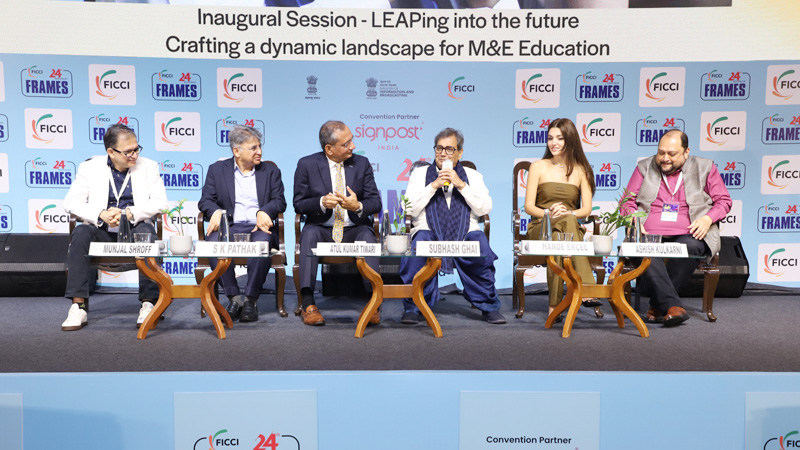
    MUMBAI: Govt of India, secretary, ministry of skill development & Entrepreneurship Atul Kumar Tiwari said that the Indian media and entertainment sector is growing rapidly and there is immense potential for skilling in this sector. This sector has been growing with a CAGR of over 13 per cent in the last few years and employes 30 lakh people directly and 55 lakh indirectly. Skilling combined with education and scaling can help India achieve the vision of Viksit Bharat 2047, there by supporting the GDP as well as establishing the prowess in India’s soft power, he added.

    Addressing the session on ‘LEAPing into the Future’, at FICCI FRAMES 2024, Tiwari said that in order for India to prosper, there is a need for creating a mass awareness about skilling. The New Education Policy (NEP) along with all government policies focuses on skilling. All sectors of the economy are recognizing that skilling is going to be a game-changer for India. With our country’s demographic advantage, having the youngest and the world’s largest number of working-age individuals, skilling will lead to a significant enhancement in productivity and employment. We have the youngest population in the world, largest number of working population and skilling them will lead to a great deal of enhancement in productivity and employment along with competitiveness, he noted.

    Tiwari also emphasized spreading awareness on ‘LEAP – Leveraging Education to Accelerate Progress’, which is the need of the hour. That nothing is more creative than making a film. The government, he said, is working to identify and bridge the skilling gap through policy initiatives along with industry and academia collaboration. “There is a need for us to identify the opportunities and create awareness among people, especially in tier 2,3 cities to attract more talent,” he emphasized.

    He further stated that the M&E sector has experienced a remarkable transformation with the advent of the internet, revolutionizing entertainment consumption. The dynamics of content creation have shifted, leading to a buzzing M&E landscape that not only entertains but also promotes and preserves cultural heritage, added Tiwari.

    He also stated that the Indian media and entertainment sector not only provides support to nation’s GDP but also promotes tourism, increase in cultural exchanges and strengthens India’s soft power.

    Whistling Woods International (WWI) filmmaker & founder and chairman Subhash Ghai highlighted the role of education and skilling in media and entertainment sector. He added that we are currently relying on memory-based education rather than skill-based education. It is crucial to develop skill-based education in the country, noted Ghai.

    FICCI, secretary general SK Pathak said, “In the 25 edition of FICCI FRAMES in 2025, we will identify the transformational changes required in the media and entertainment industry, focusing on the initiatives needed for India in 2030.”

    Ashish Kulkarni, chair, FICCI AVGC-XR Forum and Founder, Punnaryug delivered the vote of thanks.

    Hande Ercel, Turkish actress was also present during the inaugural session.

  • Difficult to balance consumer interest with stakeholder objectives: TRAI’s RS Sharma

    Difficult to balance consumer interest with stakeholder objectives: TRAI’s RS Sharma

    NEW DELHI: Telecom Regulatory Authority of India chief RS Sharma, on Thursday, demystified myths and impressions about the regulation of the sector in a panel discussion at FICCI FRAMES 2020.

    He said that it is immensely difficult for regulators to strike a balance between consumer interest and objectives of other stakeholders. Sharma commented when Media Partner Asia executive director and co-founder Vivek Couto asked about heavy-handed TV regulations.

    "The objective of TRAI is to ensure the interest of consumers, stakeholders, distributors and creators and ensure there is a growth of the sector. Since 2004 to 2017, there were price caps. If you put these price caps, it disincentivises the producers. Why should I keep any control on pricing? The industry thinks the regulator is heavy-handed and the regulator thinks they are light touch. The basic approach TRAI has had in regulating this sector is that we have adopted a light-touch approach and allowed market forces to operate in this space. We believe that the market is the best determinant and accelerator for the adoption of new technologies and satisfying consumers, so long as there is fair play, transparency, non-discrimination. Then, we don’t need to intervene.”

    Sharma emphasised that for regulators consumers’ choice will always have major importance.

    Speaking about the evolution of the sector and change in consumption patterns of viewers, he pointed out that proliferation of cheap data that will drive OTT services.

    According to the new tariff order (NTO), consumers could choose the TV channels they want to watch and pay only for them at maximum retail prices (MRPs) set by broadcasters, instead of the pre-set bouquets offered earlier. It was said that the NTO will make channels cheaper but it seems prices of like-to-like option went up. Sharma argued that the amendments to NTO and the TRAI channel selector app were introduced to make things transparent for consumers.

    “As technology moves forward, with 5G, there will be more disruption and change in watching habits. Emerging trends will necessitate a new framework. Regulation should ensure that technological developments are not throttled or scuttled. They should be allowed to grow and take place," he said.

    Meanwhile, the ministry of information & broadcasting additional secretary Atul Kumar Tiwari spoke on the contentious subject of regulatory structure for OTT platforms. He said, "We invited them to come back to us with some kind of self-regulatory mechanism. We would like to have a light-touch regulation but there has to be some kind of regulation on the streaming content."