Tag: Atal Bihari Vajpayee

  • HistoryTV18 to air making-of documentary ‘Modern Marvel: Atal Tunnel’

    HistoryTV18 to air making-of documentary ‘Modern Marvel: Atal Tunnel’

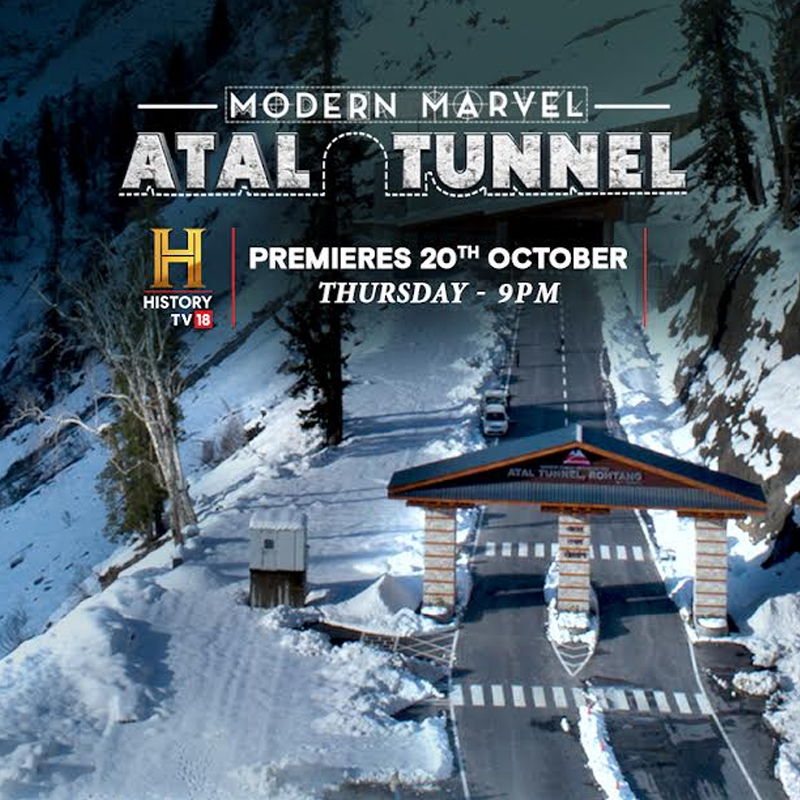
    Mumbai: The most recent documentary on HistoryTV18, Modern Marvel: Atal Tunnel, tells the amazing tale of the resilient human spirit and the marvels of contemporary engineering. A never-before-seen account of a record-breaking achievement that was accomplished under extremely difficult circumstances. HistoryTV18 is premiering the making of a documentary on 20 October at 9 p.m.

    Speaking about the programme, Network18 Broadcast CEO and A+E Networks managing director Avinash Kaul said, “With Modern Marvel: Atal Tunnel the team at HistoryTV18 continues to deliver riveting originals, with top-notch production values and exemplary storytelling that bring to life India’s stories that are as important historically as they are entertaining and engaging. The Atal Tunnel is undoubtedly one of the great modern marvels of 21st-century India, in its making we have witnessed the making of history. We’re proud to have had the opportunity to tell its remarkable story.”

    The action-packed half-hour documentary on HistoryTV18 reveals little-known information, sheds light on the scope and complexity of the undertaking, and provides a step-by-step explanation of the difficulties and what it takes to complete the mission. The performance vividly depicts how the never-say-die attitude triumphed on this amazing Himalayan trip.

    The documentary was partially shot throughout the winter to show the harsh weather that prevails then. The story highlights the difficulties and failures that the project’s 750 officers, engineers, geologists, seismologists, drilling specialists, and more than 3,000 labourers overcome to make the idea a reality.

    Speaking about the importance of the tunnel, Defence Minister Rajnath Singh said, “Strategically and for its national importance, the tunnel is a blessing for our country. Along with its economic benefits, the tunnel also has great importance from a social perspective.”

    The documentary also features Defence Secretary, Ajay Kumar, and BRO Director General, Lt. Gen. Rajeev Chaudhry, who provide valuable insights. The Atal Tunnel project’s chief engineer, KP Purushothaman, shares a first-person account of what transpired hundreds of metres inside the mountain.

    Archival images and footage from the construction site enrich the storytelling, while aerial shots of the mesmerising snow peaks, filmed in 4K and high definition, provide the daunting backdrop against which the story unfolds.

    India’s newest man-made wonder, which pierces through the Pir Panjal range in the Western Himalayas, was dedicated to the country on 3 October 2020. It is the world’s longest high-altitude highway tunnel. The 9.02 kilometre long tunnel and road link, which connects Leh, in the strategically important region of Ladakh, with Manali via Keylong in Himachal Pradesh, is located at an altitude of more than 10,000 feet. Access to areas beyond the perilous Rohtang Pass was restricted for about seven months of the year due to severe snowfall. The residents of Himachal’s Lahaul and Spiti now have much-needed connectivity thanks to the all-weather route made possible by tunnelling through the pass.

    A meeting between Atal Bihari Vajpayee, the prime minister at the time, and his childhood friend, Arjun Gopal, a resident of Lahaul, led to the conception of the tunnel. But it would be many years before the project began, only picking up steam under the Modi government, which gave it a much-needed boost by speeding up construction by five times what it had been under prior administrations.

    Speaking at the inauguration of the tunnel, prime minister Narendra Modi underlined his commitment to fast-tracking projects of national interest, “When one wants to move on the path of development at a rapid pace and there is a strong desire for the development of the people of the country, then the speed has to be increased.”

    It was not only ambitious but had never been done before, anywhere in the world, to tunnel 10,000 feet below in the Himalayas while enduring blizzards, avalanches, and nature’s great fury. But the Border Roads Organisation (BRO), a specialist branch of the Indian Armed Forces, was established to carry out precisely that kind of task. The BRO has been in charge of linking India’s farthest frontiers and remote areas since 1960. Its role is essential given India’s expanding national security concerns and defence requirements.

  • Analysis: Top South Indian news channels in 2018

    Analysis: Top South Indian news channels in 2018

    BENGALURU: South Indians consumed more news  of the top 5 channels in their local languages than their Hindi speaking brethren of top 5 Hindi News channels  in their respective markets in 2018. Amongst the four south Indian languages spoken in six states, Malayalis’ (Denizens of Kerala, language Malayalam) consumed more news per household (HH) and per capita on the top 5 Malayama News channels than their South Indian brethren in 2018.  Overall, Kannadigas’ (People from Karnataka, language Kannada) consumed more volume of news in terms of average weekly impressions during the 52 weeks of 2018 on the top 5 Kannada News channels than the consumers of news on top 5 channels in the other three South Indian languages. The four South Indian languages are (in alphabetical order) Kannada, Malayalam, Tamil and Telugu.

    It may be noted that this analysis is based on Broadcast Audience Research Council of India (BARC) weekly data of top 5 News channels for each of the four South Indian languages and Hindi News as per the following demographics:

    Kannada News: Karnataka  Urban and Rural or (U+R): NCCS All: 2+ Individuals
    Malayalam News: Kerala (U+R): NCCS All: 2+ Individuals
    Tamil News: Tamil Nadu/Puducherry (U+R): NCCS All: 2+ Individuals
    Telugu News: Andhra Pradesh or AP/Telangana (U+R): NCCS All: 2+ Individuals
    Hindi News in HSM Markets (U+R): NCCS All 15+ Individuals

    To arrive at the per capita viewership or consumption, the author has considered the 52 week average number divided by the respective population of the respective market as per BARC India, Households and Individuals Universe Estimate – 2018 (BARC Population Estimates 2018). BARC considers HSM or Hindi Speaking Market as All India without the four South Indian markets. Hence, the author has subtracted the NCCS 15+ population of the four South Indian markets from the All India NCCS 15+ population to arrive at the HSM 15+ population numbers. In the case of per capita consumption for South India, the author has taken the sum of average weekly impressions of the top 5 channels for each language and then added the four sums to arrive at the total average weekly impressions for South India, this total average has then been divided by the 2+ population figures for each of the four languages/six states as per BARC Population Estimates 2018.

    Overall, across their four languages South Indians averaged 2.32 impressions per person per week of news  on the top 5 News channels in their respective language and territories in 2018 as compared to just 0.99 impressions per person per week of Hindi news on the top 5 Hindi News channels consumed in the HSM (U+R).  The combined average weekly news consumption of the top 5 news channels in each of the four South Indian languages was 6,00,473.88 thousand (000s) weekly impressions in their respective markets as compared to 4,92,359.25 (000s) weekly impressions viewership of the top 5 Hindi News in the HSM (U+R) market.

    Please refer to the figure below:

    Across the 52 weeks of 2018, viewership ratings of South Indian News channels was different when compared to viewership of Hindi News Channels. Even within the four South Indian languages, viewership ratings across weeks trended differently. South Indian news viewership in the respective South Indian markets peaked during weeks 32 and 33 of 2018 . In week 32, floods in Kerala and the death of the Tamil leader K Karunanidhi on 8 August 2018 spiked viewership in Kerala and Tamil Nadu. Like the HSM, Television news viewership peaked in week 33 in the South Indian markets also, and was relatively higher than HSM news viewership of top News channels in the respective markets.  Week 33 of 2018 was the week when Indians celebrated Independence day on 15 August and the former Indian premier Atal Bihari Vajpayee passed away the next day of 16 August. Please refer to the figure below

    South Indian News channels Trends

    As mentioned above, per capita local television Malayalam news consumption in Kerala is the highest amongst the four languages, while in terms of absolute viewership Kannada News in Karnataka scores the most average weekly impressions. The figure below is a scaled part of the figure above.

    Kannada News channels in Karnataka

    There were four news channels that appeared in BARC’s list of top 5 Kannada News channels during all the 52 weeks of 2018 – they were TV9 Kannada, Public TV, Suvarna News 24×7 and News18 Kananda. TV9 Kannada was by far the most watched Kannada News channel in Karnataka with average weekly impressions of 78,059.65 (000s), about 64 percent more than the next most watched Kannada News channel in Karnataka – Public TV which scored an average of 47,622.5 (000s) weekly impressions during the 52 weeks of 2018. Suvarna News 24×7 was next with an average of 30,951.44 (000s) weekly impressions followed by News18 Kannada with a weekly average of 21,724.06 (000s) weekly impressions during the 52 weeks of 2018. Two other channels appeared in BARC’s weekly list of top 5 Kannada News channels during the 52 weeks of 2018 – they were Dighvijay 24×7 News (45 weeks) and BTV (7 weeks). Please refer to the figure below.

    As is obvious, Kannada News channels viewership in Karnataka peaked during the announcement of the drama laced results of the Karnataka State Assembly Elections in week 20 of 2018.

    Malayalam News channels in Kerala

    There were three Malayalam News channels that appeared in BARC’s weekly lists of top 5 Malayalam News channels during all the 52 weeks of 2018 – they were – Asianet News, Manorama News and Mathrubhumi News. Asianet News was by far the most watched Malayalam News channel in Kerala during all the 52 weeks of 2018 with average weekly ratings of 44,453 (000s) weekly impressions. Manorana News was next with an average of 23,157.13 (000s) weekly impressions, or about 52 percent of the ratings of Asianet News. Mathrubhumi News was next with average weekly impressions of 18,168.36 (000s) weekly impressions. Four other channels also appeared in BARC’s weekly lists of top 5 Malayalam News channels during the 52 weeks of 2108 – In no particular order, they were – News18 Kerala (43 weeks), Media One TV (42 weeks), Janam TV (12 weeks) and People TV (7 weeks).

    As in the case of Kannada News, Malayalam News viewership in Kerala also peaked in the face of local events – on 8 August 2018 ( during week 32 of 2018) Kerala was hit by some of the worst floods in its history due to excessive rainfall. In its neighbouring state of Tamil Nadu, one of India’s senior most politicians – K Karunanidi had passed away the previous day.  These events led to the surge in Malayalam News television ratings during the week. Please refer to the figure below.

    Tami News channels in Tamil Nadu and Puducherry

    Two channels appeared in BARC’s weekly lists of top 5 Tamil channels during all the 52 weeks of 2018. They were Poliimer News with average weekly impressions of 42,361.37 (000s) followed by Thanthi TV with 24,498.6 (000s) average weekly impressions during the 52 weeks of 2018.

    Four other channels – Puthiya Thalaimurai (50 weeks), Sun News (41 weeks), News18 Tamil Nadu (27 weeks) and Seithigal (1 week) also appeared in BARC’s weekly lists of Top 5 Tamil News channels during the 52 weeks of 2018.

    Like its Kannada and Malayalam news counterparts, Tamil News ratings peaked in Tamil Nadu/Puducherry in week 32 of 2018. On 7 August 2018 (week 32 of 2018) one of India’s senior most politicians and a former chief minister of the state – K Karunanidi had passed away. Also, floods in the neighbouring state of Kerala could have added to the viewership during week 32 of 2018. Please refer to the figure below.

    Telugu News channels in Andhra Pradesh and Telangana

    Like all the other South Indian counterparts, Telugu News channels viewership in Andhra Pradesh/Telangana spiked upwards for local events – the biggest spike coming in week 50 of 2018, the week in which results of the assembly elections in Telangana were announced.

    Four channels appeared in BARC’s weekly lists of top 5 Telugu News channels during all the 52 weeks of 2018. They were: TV9 Telugu with average weekly impressions of 49,830.42 (000s) followed by NTV Teleugu with an average of  36,230.21 (000s) weekly impressions or about 72.7 percent of the viewership of TV9 Telugu. TV5 News was next with average 30,915.17 (000s) weekly impressions followed closely by V6 News with an average of 29,752.38 (000s) weekly impressions during the 52 weeks of 2018.  Four other Telugu News channels also appeared in BARC’s weekly list of Top 5 Telugu News channels during 2018. They were  T News (24 weeks), Sakshi TV (16 weeks), 10 TV (8 weeks) and ABN Andhra Jyothi (4 weeks). Please refer to the figure below.

    Conclusions

    South Indians watch more local news on the top 5 channels of their respective languages than their Hindi speaking counterparts do in the case of Top 5 Hindi News channels in Hindi speaking markets.

    Per capita local news consumption of top 5 News channels in Kerala is highest among the four South Indian languages. Overall, in terms of impressions, more Kannada news on the top 5 News channels in Karnataka is consumed than any of the other three South Indian languages.

    Viewership of South Indian languages news channels spikes when local events occur. The highest spikes in viewership of the Top 5 News channels in Karnataka and Andhra Pradesh/Telagana happened in the weeks when state assembly elections were announced in their respective markets. The highest spikes in viewership of Malayalam News and Tamil News channels happened during a calamity and death of a great political leader respectively.

    Viewership in respective markets of South Indian News channels also spikes in the case of a national event – such as Independence Day celebrations and the death of a national figure such as the former prime minister happen.

  • Most watched Hindi news channels in 2018

    Most watched Hindi news channels in 2018

    BENGALURU: News is event driven – that is a fact that is known and repeated a dozen times and more by all publications, newsletters, and whatnots.  As per a Broadcast Audience Research Council of India (BARC) report presented at FICCI-Frames 2018, Hindi content still rules the Indian television landscape in terms of viewership. After Hindi GEC, Hindi movies and Hindi music, Hindi news is the most watched genre in the country. The report also says that contrary to popular perception, TV viewership is highest amongst youth (15-30 years) even in the digital age.
    The BARC report says that news events cannot escape the lure of drama. And drama includes elections and election results, deaths of celebrities, high court and supreme court verdicts on celebrities and sensitive issues, major changes such as demonetisation announced by the central government, major public holidays such as Independence and Republic days and events that pertain to terrorist attacks and counter-attacks, etc.

    Data from the past few days have not been announced due to the migration to the new TRAI tariff regime from 1 February. BARC is giving the industry time to settle.

    So how did Hindi television news fare in 2018?

    Until recently, BARC had been releasing three sets of weekly viewership data for Hindi news in the Hindi speaking markets (HSM). The first was the combined viewership of the 5 top Hindi news channels in urban and rural Hindi speaking market – HSM (U+R). Besides, BARC also provided weekly viewership data of the 5 top Hindi news channels in the Hindi Speaking rural market – HSM (R) and the Hindi speaking urban market – HSM (U). The demographics for the three sets of data were: HSM (U+R) NCCS All : 15+ individuals; HSM (R) NCCS All : 15+ individuals and HSM (U) NCCS All : 15+ individuals.

    Like English news, Hindi news also peaked during elections that happened in central and the eastern part of India in calendar year 2018. Comparatively, the elections and elections results week in Karnataka managed just a small upward blip in overall Hindi viewership ratings in HSM (U+R), HSM (R) and HSM (U) as compared to English news channels.

    The most watched Hindi news channel in the Hindi speaking market (HSM) – be it urban (U), rural (R) or combined (U+R) was India Today TV Network’s Aaj Tak during the 52 weeks of 2018. The channel was present during all the 52 weeks of 2018 according to Broadcast Audience Research Council of India (BARC) data for weeks 1 to 52 of 2018 (Saturday, 30 December 2017 to Friday, 28 December 2018) in all the three weekly lists for HSM (U+R), HSM (U) and HSM (R).

    Viewership of the top 5 Hindi news channels in HSM (U+R) peaked in week 49 of 2018 – election results week of five states in the Hindi heartland and the north eastern part of the country – the top 5 channels scored a massive 931.068 million weekly impressions – 89 percent more than the 52 week weekly average of 492.539 million weekly impressions. The nadir was in week 19 of 2018 – a 34 percent dip at 324.188 million weekly impressions from the above mentioned 52 week average. Like their English counterparts, Hindi news channels also peaked during Independence Day week – the major events in these weeks being Independence day celebrations on 15 August 2018 and the demise of former Indian premier Atal Bihari Vajpayee the very next day -16 August 2018.

    Aaj Tak topped BARC’s weekly lists for HSM (U+R) during the 52 weeks of 2018 in terms of overall viewership. In HSM (U+R), Zee News was the second most watched Hindi news channel during the 52 weeks of 2018, followed by India TV. Only three channels appeared in BARC’s weekly list of top 5 Hindi news channels in HSM (U+R) during all the 52 weeks of 2018. Aaj Tak was ranked first for 50 of the 52 weeks of 2018, followed by Zee News and India TV which were ranked first for one week each in BARC’s weekly lists of top 5 Hindi news channels in HSM (U+R). Please refer to the figure below.

    In the HSM (R) market also, Aaj Tak topped ratings – it was ranked first for 51 of the 52 weeks of 2018. The one week where it was ranked third in terms of viewership was week 18 of 2018. Aaj Tak was the only channel that was present in BARC’s weekly list of top 5 Hindi news channels in HSM (R) during all the 52 weeks of 2018.
    Rural audiences also reacted like the overall Hindi speaking market – viewership peaked during the election results week of north-eastern India, Independence Day/Vajpayee week and the elections in the eastern part and Hindi heartlands towards the closing month of 2018. The elections and election results weeks for Karnataka did not mar the charts too much. 
    In HSM (R), the combined weekly ratings of the top 5 Hindi news channels were highest in week 50 of 2018 at 418.124 million weekly impressions, 94 percent more than the 52 week average of 215.162 million weekly impressions in 2018. The lowest combined impressions of the top 5 Hindi news channels in HSM (R) in 2018 were in week 2 of 2018 at 190.280 million weekly impressions.  Please refer to the graph below.

    HSM (U) also behaved in practically the same way that HSM (U+R) did in terms of viewership peaks and dips. Election results in the beginning of year and towards the fag end of the year in north-eastern and the Hindi heartland as well as Independence Day week saw viewership peaks. HSM (U) viewership ratings peaked in week13 of 2018 with combined weekly impressions of the top 5 Hindi news channels at 541.398 million weekly impressions, which were 93 percent more than the 52 week combined weekly impressions average of 280.285 million. The lowest combined weekly impressions happened in week 2 of 2019, at 264.155 million weekly impressions, 5.8 percent lower than the combined 52 week average for HSM (U).

    Aaj Tak, ABP News, India TV and Zee News were present in BARC’s weekly lists of top 5 Hindi News channels in HSM (U) during all the 52 weeks of 2018. Aaj Tak was the most watched Hindi News channel in HSM urban also. Please refer to the figure below.


  • Fresh attempt underway to study convergence of communications & broadcasting

    Fresh attempt underway to study convergence of communications & broadcasting

    NEW DELHI: More than a decade after the then Union government, headed by Atal Bihari Vajpayee, failed to agree on a Convergence Commission of India, a new attempt is being finalized to establish a single regulatory framework for communications, IT and broadcasting sectors.


    The Department of Telecom is likely to make a presentation on the proposed Communications Convergence Bill to the Prime Minister’s Office on 15 February.


    A Group of Ministers headed by then Finance Minister Yashwant Singh had held several meetings on the possibility of a Convergence Commission of India but failed to reach consensus. Members included Arun Jaitley (then Law Minister), the late Pramod Mahajan (then Telecom and IT Minister) and Sushma Swaraj (then Information and Broadcasting Minister). A draft had in fact been prepared in 2000 but it was then learnt to have been shelved because of differences between the then Telecom and I&B Ministers.


    According to Department of Telecom sources, the presentation being prepared by it will be made before Principal Secretary Nripendra Misra on 15 February and those expected to be present will include Telecom Secretary Rakesh Garg, Telecom Regulatory Authority of India chairman Rahul Khullar, and I&B secretary Bimal Julka.


    The new Bill proposes a super regulator – Communications Commission – with defined powers, procedures and functions for regulatory and licensing functions, and an Appellate Tribunal.


    The aim is to replace all old and redundant legislations, which include the Telegraph Act of 1885, as well as Indian Wireless Telegraphy Act 1933, Cable TV Networks (Regulation) Act 1995, and IT Act 2000.


    The super regulator is proposed to be a six-member body with a chairman who will have a five-year tenure. Members will include one each from sectors like telecom, broadcasting, finance, management, accountancy and either law or consumer affairs.

  • Major initiatives of the I&B Ministry in 2014

    Major initiatives of the I&B Ministry in 2014

    The Ministry of Information & Broadcasting (I&B) has undertaken key initiatives in the different sectors aimed at enhancing the outreach of policies and programmes across platforms. Some of the initiatives undertaken have been innovative, involving people’s participation, enhancing government’s presence on the social media platforms and strengthening communication at the grassroots. Some of the key initiatives are as under:


    Initiatives under Swachh Bharat Mission

    As part of the Swachh Bharat Mission, the Ministry initiated a 360 degree multimedia campaign to enhance the outreach and impact of the Mission. All media units were involved in outlining audience specific content, tools and action plan. Intensive discussions were held with key stakeholders of the mission and innovative strategies were incorporated across media platforms for greater visibility and impact. Some of the key initiatives undertaken by the Ministry are as follows:
     

    Three Day Rashtriya Bal Film Mela on the theme “Swachhta”

    Organized by the Children’s Film Society of India (CSFI) on the occasion of National Children’s Day celebrations, the three day festival provided an opportunity for children to appreciate high-quality film content, experience value-based entertainment, and to trigger their imagination about environment conservation and cleanliness. The festival showcased a bunch of internationally acclaimed children’s films on the theme of cleanliness.

    The Festival featured interactive workshops on film-making, film appreciation, animation, Charlie Chaplin’s Mimes and storytelling. Live dance performances, magic act, sand act, and puppetry along with various competitions such as painting on the theme, ‘Swachhta’, and digital collage on the theme ‘Clean India’ and the craft of making utility items from waste materials, were being organized on the sidelines of the festival.


    1. Creation of Audio-Visual Spots on Swachh Bharat Mission.
    2. Animation / short video competition (less than three minute duration) organized on the digital volunteer platform of the Ministry with 15 October as deadline.
    3. Launch of Photo-Competition depicting “before and after pictures of cleanliness” on the digital volunteer platform with 15 October as deadline.
    4. Creation of an animation film by New Media Wing
    5. Crowd sourcing for the design of print advertisements
    6. Developing platform specific content on social media
    7. Creation of banners, logos and e-mailers for spreading of the message through social media
    8. Jingles on All India Radio
    9. Community Radio Mobilization to effectively reach the grass root communities
    10. Advisory to private TV & FM channels to become part of the campaign so as to enhance impact and outreach of the mission
    11. Anchor based and in-house serials on DD & AIR
    12. News bulletins through special success stories on DD & AIR
    13. Interactive programmes on DD & AIR
    14. Public Information Campaigns to focus on the core issues of the mission.
    15. Interpersonal communication strategies through field units of the Ministry.


    Launch of the DAVP Calendar, “Clean India, Green India”: The year 2015 calendar has been developed on the theme of “Clean India Green India” with focus on “Swachhta” and environment issues. The January page of the Calendar displayed the launch of the “Swachh Bharat Mission by Hon’ble Prime Minister Shri Narendra Modi. While the February page carried the message of ‘Swachh Vidyalaya’ and ‘Bal Swachhta Abhiyan’, the March page was designed on the theme, ‘Rejuvenating Rivers.’ The April Page of the Calendar portrayed “Clean Hospitals: A Healthy India,” May depicted the cleanliness drive of Railways, June focused on Rejuvenation of the River Ganges, ‘Namami Gange’, and July on people’s participation in Swachh Bharat Movement. The August page was on the theme of Clean Villages; the month of September highlighted Solar Energy as clean and renewable source of energy; October depicted Wind Power as pollution free source of energy and November emphasized the need to preserve Himalayan Ranges. Wildlife conservation was the theme for December.


    For the first time ever, a mobile app of the calendar has been developed. The mobile App would provide access to the latest tweets from the PMO, the YouTube channel of the Ministry of Information and Broadcasting, and the press releases on the PIB website. In addition to being a window for all websites of Government of India, this informative application would serve as a planner to the users bringing news updates from AIR and DD News. The mobile app was developed for Android platforms initially, which would be made available on other mobile platforms also in due course of time.


    Organising Press Conferences to highlight achievements and initiatives of the Government:The strategy adopted has been extremely successful in positioning the visibility of Government’s initiatives across media platforms.


    Multimedia Exhibition on Former Prime Minister Shri Atal Bihari Vajpayee:The Ministry of I&B has mounted a multimedia exhibition under the aegis of DAVP on the former Prime Minister Shri Atal Bihari Vajpayee. The exhibition would serve as an inspiration and learning to the people in understanding the life and contributions of Shri Vajpayee as a politician, statesman, and poet. The exhibition was inaugurated by Union Minister of Finance, Corporate Affairs, and Information & Broadcasting Shri Arun Jaitley on 20 December, 2014.


    The exhibition portrays the life of Shri Vajpayee, through a display of around 250 photographs, which reflect his vibrant personality. These rare pictures not only take the visitors through the political journey of this visionary leader, but also provide a glimpse into the diverse phases of his life – as a poet and a great thinker. At this event, different facets of his life will be showcased through photo and electronic exhibition. Scrollers, translites, LED walls, large fascia and title boards are the major attractions of the exhibition. The exhibition was open to public from 20 – 25 December, 2014.


    Establishment of Social Media Presence of Government of India: In order to facilitate Ministries/Departments in registering their presence on social media by utilizing the services of the Communications Hub established by the Ministry of Information & Broadcasting, the ministry organized a half day training workshop on 11 July, 2014 at the National Media Centre. The response was very encouraging as about 150 officers representing 59 Ministries/Departments attended the workshop. An interactive Q&A session was also held before concluding the workshop and induction material including a handbook on social media was also distributed to all the participants.


    Third and fourth phase of digitization: A Task Force has been constituted with the approval of MIB to steer the remaining two phases i.e., Phase III and Phase IV of digitization in India. The Task Force is headed by the Additional Secretary of the Ministry and comprises stakeholders from various ministries, departments and industry representatives. The constitution of the Task Force paves the way for implementation of digitization initiative in India, which will see digitization of about 8 crores cable TV homes in India. This will bring India in the league of developed nations. It is also a step towards the Prime Minister’s dream of a Digital India, as digitization will enable quick penetration of broadband connectivity in India.


    Government of India vide Notification dated 11 September, 2014 has revised the timeframe for digitization for Phase-III and IV of the Cable TV. As per revised guidelines, Phase-III and IV of Cable TV would be completed by December 2015 and December 2016 respectively.


    Third phase of FM radio auction: The Cabinet Note on third phase of FM has been moved for cabinet approval. This decision of the Ministry of I&B will pave the way for e-auction of FM Phase-III channels.


    Goa declared the permanent destination for International Films Festival of India: In order to develop the “Brand IFFI” on the lines of other international film festivals, Goa has been declared as the permanent destination for International Films Festival of India (IFFI). The IFFI platform propagated the theme “Green India, Clean India” at all the major events organized under its banner.


    North East Film Festival: For the first time, a three-day North East Film Festival was held in Delhi (Siri Fort Complex) on a grand scale. It will henceforth be an annual feature, a prominent event in the film festival calendar of the Directorate of Film Festivals. The Festival concluded on 24 August, 2014.


    FTII, SRFTII to be institutes of national importance: In order to provide statutory backing through an act of Parliament to declare both the institutes as Institutes of National Importance the government has proposed a Bill. The proposed Bill would enable both the institutes to award its own degrees and diplomas and start new activities on the lines of IITs and IIMs. Cabinet Note has been moved.


    Meeting with stakeholders related to Set-Top-Boxes to promote indigenization of digitization: Efforts were taken to fulfill the long pending demand of domestic manufacturers of Set-Top-Boxes (STBs) to get tax concession (C Form benefit) in order to compete with imported STBs. A letter was written by Hon’ble MIB to Hon’ble Finance Minister to resolve the issue of C-Form concession to domestic manufacturers. This was followed by a meeting by Hon’ble MIB with senior officials from Ministry of Finance, Ministry of Commerce, Ministry of Micro, Small and Medium Enterprises, Department of Electronics and Information Technology, Department of Telecom, Bureau of Indian Standards etc., and other industry stakeholders like indigenous STB manufacturers, DTH Association and MSO Associations etc. As a result of continuous follow up, Department of Telecom has confirmed Set Top Box as “Telecom Network Equipment”. The proposal has also been approved by the Ministry of Finance and a letter has already been issued to all the State Governments, Commissioners of Taxes and other concerned that STB will get the facility of ‘Form C’.


    e-initiatives: The Office of Registrar of Newspapers for India, M/o I&B has streamlined its Single Window Public dealing mechanism at its office. The RNI has achieved 100% success in online e-filing of Annual statements by publishers for 2013-14. The software module has been finalized for online filing of title verification application. It has also started sending automatic SMS intimation about status of title and registration application to publishers.


    Boost to Community Radio movement in the Country:Hon’ble MIB has been given a lot of emphasis on reaching out to the people especially in rural and marginalized areas with effective development communication. Community Radios are one of the best tools to touch the lives of millions of people as it is the platform, which provides an opportunity to community to not only receive messages from Government but also provide its feedback, which ensures two-way communication. An announcement has been made by Hon’ble Finance Minister in his budget speech allocating an amount of Rs 100 crores for “Supporting Community Radio Movement in India.” This would enable setting up of 600 community radio stations across the country in the 12th Five Year Plan. The resources would also be utilized for enhancing awareness, building capacities of community radio operators and promoting innovations in the sector. Funds would also be provided to various CR operators as a matching grant for setting up /upgrading community radio stations. At present 170 community radios are operating in various parts of India and about 200 are in the pipeline. This major initiative of the new government will strengthen the connect with the population living in rural and marginalized areas.


    A monitoring mechanism is also being set up to monitor community radio stations live at Electronic Media Monitoring Centre.


    Simplification of Procedures for granting Television licenses for starting additional television channels: Ministry of I&B grants permission to private television channels in India. At present about 800 TV channels have already been permitted by the Ministry of I&B. India has a huge broadcasting industry, thanks to the large number of television channels providing news and entertainment in various languages both at the national and regional level. Many companies desirous of starting new television channels have been approaching the Ministry to simplify procedures for launch of additional television channels. The issue of grant of additional television channels had become complicated as previously it was decided that for starting every additional TV channel security clearance would be required even for the same company and same set of Directors, who had been security cleared earlier, within the period of validity of such security clearance.


    Proposal cleared for Rs 600 crore National Film Heritage Mission (NFHM) to preserve India’s film legacy: The revised EFC proposal for a Rs 600 crore National Film Heritage Mission project to preserve India’s filmic legacy was cleared by the Expenditure Finance Committee in the Ministry of Finance on 3 July, 2014. The modalities are being worked out to launch it at the earliest.


    Peoples’ participation in Government Advertising through Crowd-Sourcing of Advertisements: The advertisement for the important events being designed on the crowd-sourcing model. Independence Day advertisement designed on these lines and DAVP has invited suggestions for the proposed advertisement to be brought out on 5 September to observe “Teachers Day”.


    Adopting 360 degree approach to information dissemination: Designing integrated campaigns based on the 360 degree approach, the core theme touching all tools including the contemporary as well as new media. For Independence Day, the advertisements were crowd-sourced for the first time and coverage was extended to all media platforms.


    Transparency Steps have also been taken by the Ministry to enhance transparency and expedite approvals for which Open House Meetings have been started for Community Radio applicants on the first of every month. For Multi System Operators (MSOs), Open House meetings are held every week on Tuesday. For television applicants, Open House meetings are held every fortnight i.e., on 5th and 20th of every month. This provides an opportunity to applicants to have a direct interaction with the Ministry officials and clarify their doubts as well as to get the status of their pending applications. This has enhanced transparency and accountability in the grant of various permissions to applicants of Community Radios, television channels, MSO permissions etc.


    Screening of rare archival footage: A half an hour film, “Road To Freedom,” was produced by the Ministry of Information & Broadcasting, based solely on rare archival footage. It was screened on DD (National) on 15 August, 2014. More such films will be produced and screened on days like 2nd October, 26th January and such like.


    Organisation of One Day Workshop on ‘Crisis Communication’:  In pursuance of the decision taken in Committee of Secretaries (CoS) meeting held on 1 July 2014 to consider measures to upgrade the efficacy of control and response system of Government in crisis situation, Ministry of Information organized a one day training session for senior officers of various Ministries/ Departments on ‘Communicating with Media’ through Indian Institute of Mass Communication (IIMC) on 22 September, 2014 at National Media Centre.


    (These are purely personal views of I&B Ministry secretary Bimal Julka and indiantelevision.com does not necessarily subscribe to these views.)

  • Vajpayee multi-media exhibit opens in Delhi

    Vajpayee multi-media exhibit opens in Delhi

    NEW DELHI: Information and Broadcasting Minister Arun Jaitley has said the Multimedia Exhibition mounted by DAVP on former Prime Minister Atal Bihari Vajpayee would serve as an inspiration and learning to the people in understanding Vajpayee as a politician, statesman, and poet.


    Jaitley stated this while inaugurating the Multimedia Exhibition being organised on the occasion of the 90th birthday of former Prime Minister at IGNCA complex.

    The exhibition will portray the life of Vajpayee through a display of around 250 photographs which reflects his vibrant personality. These rare pictures not only take the visitors through the political journey of this visionary leader, but also provide a glimpse into the diverse phases of his life – as a poet and a great thinker. At this event, different facets of Vajpayee’s life will be showcased through photo and electronic exhibition. Scrollers, Translites, LED walls, Large Fascia and Title Boards will be the major attractions of the exhibition.

    Apart from this, a drawing and quiz competition will also be organised on the occasion.


    The Films Division of the Ministry will screen three films based on the life of the former Prime Minister. The Photo Division has provided the photos being mounted at the Exhibition. The Song and Drama Division of the Ministry will be giving cultural performances during the Exhibition. The Publication Division has organised a Book Exhibition at the venue.


    Doordarshan has provided short films to highlight the achievements of the former Prime Minister. Minister of State for Information & Broadcasting R S Rathore, Secretary Bimal Julka, and other senior officials of the Ministry were also present on the occasion.

    The exhibition will be open to public from 20 December to 25 December daily from 11am to 6pm.

  • Narendra Modi gets chatty with ETV

    Narendra Modi gets chatty with ETV

    JAIPUR: BJP’s Prime Ministerial candidate Narendra Modi, while for the first time giving a long interview to ETV, during the electioneering environment, has expressed that in the Indian politics this will be an election of hope. Because, the people have lost faith not only on Congress Party and its Prime Minister, but also on the system named government. That is why the first priority should be to get back the faith of the people.

    The interview of Narendra Modi has been telecast on all ETV channels. It will be re-telecast at 8.30 pm during Central Hall Programme. Head of ETV News Network, Jagdish Chandra on this occasion said that during the Lok Sabha Elections, the channel has started a series of programmes for bringing national issues and opinions of national leaders on those issues to the common people. This series has started with the interview with Narendra Modi. Narendra Modi is believed to be very near to be the next Prime Minister. Nearly 240 channels’ applications are pending with Narendra Modi for getting his interview. But, to make reach his voice to 35 crore viewers, he chose first ETV.

    For ETV’s programme “Central Hall”, Senior Journalist Harishankar Vyas took interview of  Narendra Modi. In reply to his question on “Congress Free India”, Modi said that it means Corruption free India, Dynasty free India, Free from Undemocratic methods, Free from misuse of constitutional agencies of India, Free from price rise and free from threat to India. Because, Congress has become a medium for all these. Hence Congress Free India call has been given. When, he is saying Congress free India, that means he is calling to free from the work culture that has been developed in India over sixty years by Congress. And also for the free from vote bank policy adopted by Congress.

    On a question that previously some non-Congress governments also functioned similar to Congress during their tenure, Modi replied that except Atal Bihari Vajpayee, all others heading non-Congress governments, were having Congress Gotra (lineage). They had been groomed in Congress. Only due to personal differences or for any other political reasons they had been separated from Congress.

    Narendra Modi also said that he has a clear picture in mind on what will be his priorities after forming government. Administrative system has to be revived to uplift the poor. Modi asserted that he doesn’t consider himself as Hero. His commitment is for the poor, farmer, youth, women and jawans.

    Narendra Modi during his 66 minutes interview openly discussed on National and International issues, safety and army related issues and also on economic reforms issues. In between, the interview, ETV News Network Head Jagdish Chandra presenting the reviews said that Modi wants to implement the Gujarat Model across the nation, which will be a big challenge before him. In addition to this, Modi tried to refute the allegations labeled against him by highlighting economic issues. Assuring to spread Atal Bihari Vajpayee’s ambitious project of inter linking rivers, Modi hinted of bringing a new turn in economic system. Modi during the discussion also hinted that RSS life vision can be seen in his work style.

    Commenting on UPA government, Narendra Modi said that their policies are of vote bank policies. They run the government to win  the elections and we want to run the government to empower the people. For them, grabbing power is everything, and we want to empower the people. Vote bank based policies empty the government treasury and term these as economic reforms. There is a need to weed out huge obsolete laws. Even after the files complete 40 Dhams (holy places), it never completes the journey. Modi also expressed his views on development of agriculture, Shipping Industry and tourism. On replying to a question, Modi said that his think tank will be 125 crore public.

    Narendra Modi, showed interest in Mahatma Gandhi and Lal Bahadur Sashtri. Replying a question on Health issues, Modi said that Gandhiji had always talked about hygiene, but we couldn’t teach our children about those culture. We will present a Clean India on Gandhiji’s 150th anniversary. We should think on being healthier than suffer from diseases. We want to set up one medical colleges in each district. Modi cleverly avoided the reservation issue and said that he raised the number of seats in Engineering and Medical Colleges to such an extent that everyone can get opportunity to study. He gave priority to increase job opportunities for youths.

    Narendra Modi, during his interaction with ETV, for the first time spoke about his personal life and interests. He said that he likes to listen music, especially instrumental music. He also likes to trek in mountains and Himalaya is his favorite place. He used to read lot of books in his village library during childhood. But, now he doesn’t get time to read. He also said that he never dreamed of being something, and never told young people to dream to become someone. But, yes, he dreams to do something and advises the young to dream of doing something. And he left home, left family, and left village, only to do something for Mother India. Not to be something.