Tag: Atal B. Vajpayee

  • ‘The attempt and game plan is to have anchor-led shows and an anchor-driven channel’ : Rajat Sharma – India TV chairman

    ‘The attempt and game plan is to have anchor-led shows and an anchor-driven channel’ : Rajat Sharma – India TV chairman

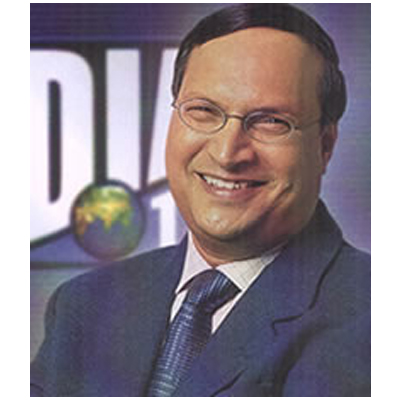
    He has seen the downside of life. Portrayed himself in a Hindi potboiler film after becoming a successful media personality. At one time, he had even announced a proposal to pen a biography of former Prime Minister Atal B. Vajpayee. But today, Rajat Sharma doesn’t have time to think of those things; he’s too busy putting in place, along with his team, the plans to take India TV, a Hindi language news channel, forward.

    Six months after the launch of India TV, Sharma discusses the ups and downs of running and managing a news channel in a conversation with Indiantelevision.com’s Anjan Mitra. The Sunday tete-a-tete was peppered with some frank admission on carriage fee, how market leaders had messed up the cable distribution market and why India TV chooses to be different.

    Excerpts:

    It has been over six months that India TV went on air. How would you assess this time?
    It’s over seven months to be frank. But these months have been exciting and part of a learning curve where not only I, but my team also has learnt a lot of things about the business of broadcasting. When you run your own venture, the logistics look different. Even a seemingly small expense would need to be scrutinized and has to be justified. Still, the joy of producing a decent product, if not a brilliant one, is there. It would also be our continuous endeavour to better ourselves and actually serve the needs of the people and not only our ours. I have said it in the past that this is like a mission to me and I’ll reiterate it again today.

    During the time that India TV has been on air, it has faced resistance from the cable operators and distributors, unlike some other news channels, which hampered its visibility. What’s your take on this issue now?
    If you are talking about distribution, then it’s true that there were initial problems. And, that problem, we quickly realised, could have a lasting impact on our growth prospect. Distribution became a problem that we had not envisaged. Especially when more than (investments in) content, other issues dictate the rules of the game. We have managed to address the problem to a large extent and we are also happy that whatever initiative we undertook in this regard has been bearing fruit. We are on prime band in almost all major networks in the country and our reach too has phenomenally increased over the last few months.

    Did India TV actually give in to the demands of the cable industry and pay a fee to cable ops for carrying and positioning the channel favourable?
    We had no option, but to pay carriage fee. At a time when the market leaders (in the news segment space) have been paying carriage fees, the cable ops don’t shy away from asking the same from all of us too. We initially thought good content would drive demand for the channel, but it was not happening. We too paid carriage fee, which are in the form of annual contracts I am told.

    Subsequent to this game plan, our visibility has definitely increased, which is indicative from the type and number of responses that we are getting for our programmes. It’s not a healthy practise, but in this cut-throat world we have to play the game according to the rules already set. But, I think somebody — either the government or the regulator — should look into this aspect seriously.

    Now that partly the distribution problem has been solved, what’s the strategy forward?
    We have introduced a change in programming line up in the evenings, which is basically aimed at providing viewers with fare that they would like to see at a time when other channels are not showing them. Take, for example, a late evening slot of 11 pm. Around this time, most news channels have crime shows going on, on India TV we have Speed News. This is aimed at corporate executives and people of the upper class who have come in late home and want to watch news and not some current affairs show. The speed news segment gives the news without any frills and packing in as much as possible. Fast and zippy when there’s no time to blink

    Similarly, at 22 hours India Live with Sudhir Chaudhary looks at the big news of the day, analyzing them with the sector-specific editor and correspondents across the country. For example, if the Sensex has touched dizzy heights, then after the Mumbai correspondent has filled in with his day’s reports detailing the nittie-gritties, the business editor discusses with the anchor the issue and its various aspects. If it’s a sports item, then the sports editor of India TV comes in with his expert views. At 21.30, when other news channels are getting onto their band of prime time bulletins, we have Showtime India, India TV’s party go-around show.

    This half-hourly programming line up has really helped us gain viewership from various segments.

    It seems the attempt is to play up anchor driven shows on India TV. Is this a conscious decision?
    If people are noticing that there are known faces on India TV hosting shows, then it’s a good sign. The attempt and game plan is to have anchor-led shows and an anchor-driven channel. Worldwide, the trend is that news channels are anchor driven. A majority of people come on to CNBC, for example, to see a Jay Leno. It’s only in India that the trend is to be news driven and most channels, except NDTV 24×7, don’t believe in propping up their anchors, hosts or known faces.

    ‘At a time when the market leaders have been paying carriage fees, the cable ops don’t shy away from asking the same from all of us too’

    Do you feel that news channel managers are afraid of investing in people who will become too big for their boots?
    Only a secure person can nurture and try build sub-brands. I can bet that the name and fame that some of the anchors of NDTV 24×7 have today, would not have been possible if Prannoy Roy had not been benevolent and secure enough to nurture them.

    At India TV, it is a conscious decision to build sub-brands, apart from the likes of Sudhir, Maneka Gandhi (host of an environment based show), Suhaib Ilyasi and Rajat Sharma. We want to be anchor-driven, rather than news driven. That’s why our shows too have been designed in a way to suit this plan.

    How does India TV go about nurturing and building talents?
    From the time a youngster joins us, he/she is made to go through a routine to spot the talent. Then there are stylists, speech and diction trainers and senior media professionals who put the youngsters through their paces. Ritu (Rajat’s wife and business partner) and I too some time chip in with advise. After this, the effort is to give youngsters full chance to blossom. I am quite proud in saying that we have a bunch of youngsters who can be stars of tomorrow. People like Faraz Shere, host of Kal Ka India on Sundays, Speed News co-anchor Ranjini and even the Box Office India host are young people who have the verve and zest to make it successful and they will be.

    What about your earlier stated plans to take India TV to foreign shores?
    Negotiations are underway at the moment for the US market. We are also available in the Middle East where the feedback shows us we are not doing very badly.

    A sizeable viewership for India TV comes from Muslim-dominated areas in India and that’s because of the popularity of Al Jazeera. Would there be any change in the relationship if the owners of the Arabic channel sell off their shareholding?
    I don’t think so anything of that sort would happen and even if there is some change in the ownership pattern, our relationship is that of content exchange. That can certainly continue. But Al Jazeera certainly has perked up our viewership in smaller Muslim-dominated towns.

    What about going pay?
    Not at least for two years.

    Is the company looking at raising more money from the market through an initial public offer?
    In principle the decision has been taken that we would tap the capital market. In principle, yes an IPO is in the offing. But if you ask me for a time frame, I’d be unable to say. These are things that have been left to our financial advisors.

    Does the company need money for expansion?
    Actually, we don’t need funds at the moment. We had envisaged a total expenditure of Rs. 100 crore and raised Rs. 700 million initially. We are comfortable as advertising has started generating some revenue.


  • Court ruling on political ads may be contested

    Court ruling on political ads may be contested

    NEW DELHI: The Indian government is contemplating contensting the Andhra Pradesh high court order quashing a ban on political advertisements on the electronic medium. Reason: to douse the fire that has engulfed not only Congress chief Sonia Gandhi, but also Prime Minister Atal B. Vajpayee.

    According to political sources in the Capital, the govermnent is mulling, as one of the options, to go in for a Special Leave Petition (SLP) petitoning the Supreme Court to look into the issue of politcal advertisments, surrogate or otherwise, on television channels.

    A The sources said that a high-level meeting in this regard was held at the Prime Ministers residence yesterday where this matter was debated.

    It is also learnt that Vajpayee, while expressing his unhappiness at being target of a surrogate advertisment questioning his antecendents during the pre-Independence days, would want the issue to be buried. An ideal scenario would be to have the Supreme Court stay the order of the Andhra high court, which removes the ban on political ads to be carried o TV channels under the Cable TV Network (Regulation) Act.

    Amongst the several options discussed, the most plausible looked like the one where the government or an organisation contested the Andhra HC order.

    Those who attended the meeting with the PM included his advisor Brajesh Misra, information and broadcasting minister Ravi Shankar Prasad, Solicitor-General Soli Sorabjee and Bharatiya Janata Party president Venkaiah Naidu.

    On 23 March, the Andhra HC, based on a petition filed by Gemini Television Network, ETV and Maa TV which challenged rule 7 (3) of the Act invoked by the Information and Broadcasting Ministry and Election Commission to ban telecast of political advertisements, quashed the ban.

    The court also observed that the ban order amounted to discrimination between the two media (print and electronic) and was also violative of the right to freedom of trade and business.

    Since the order was passed, the issue has snowballed into a controversy with the Election Commissiona nd the government lobbing the ball into each others court.

    The issue of surrogate political advertisements is echoing not in the Election Commission or on TV channels, but somewhere else. The reverberations of personal attacks can be heard in the Prime Ministers residence. Apparently, according to political sources, PM Atal B Vajpayee is very upset that an ad allegedly showing him in bad light did a round of TV channels before broadcasters decided to take all such ads off air.

    Stung by a surrogate ad put out by a Bharatiya Janata Party front organization questioning party chief Sonia Gandhis foreign origin, a seemingly front organization of the Congress hit back by issuing an ad that dwelt on Vajpayees antecedents and that he was allegedly involved as an informant for the British during the pre-Independence days of India.

  • BJP’s optimistic election agenda

    BJP’s optimistic election agenda

    Soon after Virender Sehwag, aka as Najafgarh (a Delhi locality)‘s Nawab, completed his triple ton against Pakistan in the first Test at Multan on Monday, a text message started doing the rounds of Delhi and then spread further. It said: "Sehwag ke 309 run ki tarah, hum bhi 300 seat payenge (like Sehwag‘s 309 runs, we will also bag 300 Parliamentary seats in the forthcoming elections)."

    Though a bit optimistic, there‘s no doubt that the political SMS message was sent out by supporters of the Bharatiya Janata Party (BJP)-led coalition government in India. Realising that cricket is the mantra of the day, the media managers of the BJP were quick to cash in on the cricket fervour too.

    This is an indicator to the body language, to use a sporting lingo, of the BJP and its allies, in sharp contrast to its main rival, the Congress Party, which has been more reactive than pro-active in its media and communication strategy. As an aide of senior BJP leader Pramod Mahajan, one of the media managers and spin doctors of the party, puts it, "We don‘t know about the Congress, but our media strategy has been in planning for quite some time now. Even before the elections were announced."

    No wonder, people in the party have been busy coining catchy one-liners for leaders and advertising campaigns for months now in anticipation of the elections.

    Sample some: Lakshya Atal, vote kamal (the target is PM Atal B Vajpayee and vote lotus, the party symbol) and Atal aur vikas, bharat ka vishwas (Atal and development are the beliefs of India).

    Sample this…

    And it is not just catchy headlines that is a part of the strategy, which, like a giant tree, has been etched out to hog space in almost all conceivable areas. From the traditional to the modern, for the techno-savvy to the technologically-challenged, from the upper crust of the populace to the lowest, BJP‘s media strategy spares none and, almost, nothing.

    Points out Mukhtar Abbas Naqvi, one of the general secretaries in the BJP and a party spokesperson, "The whole idea is to communicate our messages more efficiently and effectively to the maximum number of people through a variety of platforms."

    On its part, BJP is planning to reach out to 150 million voters through e-campaign, comprising e-mails, telephones (both fixed and mobile), new web site Mission2004, apart from TV and radio and cinema halls.

    That is why apart from the print medium and outdoor, where a government-sponsored India Shining campaign has already has its run, television is also a possible target with some meticulous planning going in to as what the campaigns should be and highlight – PM‘s meetings, achievements of the government, the angle about prosperity (economy booming as also the stock market), success in foreign affairs with Pakistan being a cornerstone. The Indian cricket team‘s performance, till now, has certainly helped the party too.

    Though some campaigns for the TV medium have been shot, reportedly by Lintas in association with Team Mahajan, a full-fledged onslaught is yet to be seen on the electronic medium for the simple reason that the guidelines on this are still not clear. Surrogate ads on some TV channels have not helped the matter much, but only vitiated the atmosphere further.

    But despite the uncertainty, BJP believes in keeping its act ready to unveil at the first opportunity. That‘s why some TV channels, including entertainment and music channels, have been sounded out without the actual release orders for ads being released. Even the South Indian channels not have been overlooked totally.

    Since the elections are being held in phases, the TV campaigns especially too had been planned in several phases with the first one scheduled to get off the block sometime in April. But that would depend on the outcome of a controversy relating to surrogate ads making direct attacks on Congress chief Sonia Gandhi and Prime Minister Vajpayee. As part of the first phase, some films on leadership and one the national highway project (one of the dream projects of PM) have been kept ready.

    A typical film, which would also be shown on various video vans that would tour the interiors of the country where the presence of cable TV is not very strong, goes something like this: The clips would show Indian ministers of the 1980s (when Congress ruled the country) going abroad and then asking for help in the form of foodgrains. Cut to 2002 when foreign countries‘ representatives are shown coming to India seeking help. The message: Sound and booming economy under the BJP-led coalition government.

    "We had plans of going on air on news channels, mass channels, apart from different films for youth on channels such as MTV and Channel [V]. We also had planned cosmetic presence on southern channels," says Sudhanshu Mittal, a member of Team Mahajan.

    But here too some inputs from various people have gone in. The BJP feels that using just the satellite channels would not serve the purpose as they would "cover only between 30-35 per cent of the total population." Explains Naqvi, "This time cinema halls would also be used as a delivery mechanism and some 200-odd halls have been identified for screening of party campaigns. If Doordarshan is allowed to accept political ads, it would only add to the reach of the TV."

    ‘Yuva Shakti‘ – Says who???

    The catchy slogans, target platforms and themes like ‘Stree Shakti‘ (depicting party‘s women power in the form of Sushma Swaraj and chief ministers like Vasundhara Raje Scindia and Uma Bharti), ‘Yuva Shakti‘ (the Young Turks of the party like Arun Jaitley, Naqvi and ministers in the outgoing government like Pratap Singh Rudy and Shahnawaz Khan) all point to the fact that BJP is making a conscious effort to keep pace with time and acquire new followers and supporters, especially the youth.

    As a senior advertising professionals feels that BJP is focusing on the ‘choice of the new generation‘ image, drifting away from ‘the party of the business class‘ image. Film and TV stars, past and present, being just props for the mega-star and brand of the party – PM Vajpayee.

    Pointing out that film stars, who have joined the party are committed, information and broadcasting minister Ravi Shankar Prasad said, "The real star is Atalji, followed by the likes of Advaniji." Prasad has been instrumental in bringing to the party fold singers like Kumar Shanu.

    Though the party media managers would like to take most of the credit for the savvy and sometime, catchy one-liners, definitely there is professional help at hand. Agencies like Graphic Ads, Crayons and a Mumbai-based video film and publicity company are lending their services to the party where some mega bucks are to be made. There are talks about Lintas too being involved, but talked about in a hush-hush manner.

    So, what are the media budgets? With a straight face Naqvi would have us believe that it‘s sufficient without being extravagant. Is it around one billion rupees as reported in the media? "I must point out that media speculations on the BJP‘s advertising and media budget have put figures on the higher side," he says, adding, more helpfully, the total budget is still to be finalised as the party‘s state units have separate budgets for such activities and "the state figures have not come in yet."

    Still, a source in Team Mahajan points out that the NDA-alliance has deliberately marked limited budgets for areas where its partner had been traditionally strong. For example, in Andhra Pradesh, BJP does not have to spend much as its ally, the Telugu Desam Party of Chandrababu Naidu, is strong and is spending a huge amount on election-related publicity activities.

    But media professionals are a bit skeptical about the usage of interactive and Internet mediums, considering the danger of junk emails and flurry of messages on mobiles. Considering the fact that such strategy might result in intrusion, there is a feeling that cellular operators might go in for such deals only if "coerced" as there is danger of crossing the ‘permission marketing‘ approach. Something that has come to the fore with cellular customers getting taped messages – and protesting too – from the PM greeting them by saying, "Namaskar, mein Atal Behari Vajpayee bol rahan hoon.. (Greetings, I am Atal Behari Vajpayee speaking)."

    However, that has not stopped the BJP from pulling out almost all the stops. As Naqvi aptly sums up: "This time we‘d fight the elections from the sky (through satellite channels) as also on the ground."

    (Additional reporting by RITESH GUPTA)

    (This is the second installment in our series on media and communication strategy of political parties for the forthcoming elections.)

  • TV commentator Siddhu joins BJP

    TV commentator Siddhu joins BJP

    NEW DELHI: After India’s finance minister unleashed the sop opera in the run-up to the general elections, now comes the soap opera.

    Not content with film actors and television stars joining the party, the king of one-liners, former cricketer and TV commentator Navojot Singh Siddhu, is the latest arsenal in the war-chest of Bharatiya Janata Party (BJP), which is seeking another term at the Centre during the elections.

    With BJP’s ace strategist Pramod Mahajan, another one very good with one-liners, beside him, Siddhu today announced his decision to join politics and immediately let go of some bouncers.

    ”A true leader like Atal is one who turns weakness into strength and obstacles into opportunities,” Siddhu quipped today when asked to describe the leadership of Prime Minister Atal B. Vajpayee.

    According to United News of India (UNI), Siddhu went on to praise the ideology of the BJP and the leadership of Vajpayee as “Kushboo to hawa ke sath jati hai, lekin insani khusboo har disha mein jati hai (fragrance goes in the wind’s direction but human fragrance spreads in all directions).”

    Siddhu equated BJP as a party like a rock. ”BJP chattan ki taraah Atal hai,” he mouthed, while expressing regard and respect towards the leadership of the BJP, UNI reports.

    Siddhu is part of the cricket commentary team of Ten Sports that would go to Pakistan for the forthcoming Indo-Pak cricket series.

    Meanwhile, small time TV and film actor Gajendra Chauhan — his claim to fame is playing Yudhistir in Doordarshan’s famous Mahabharata serial in the late 1980s and early 1990s — too has decided to join the political fray and the BJP. Film star Suresh Oberoi has already announced his decision to join the BJP.

    Not to be left behind, the Congress Party is also contemplating roping in some TV and film stars like Raza Murad and Govinda. The Delhi unit of the Congress has even suggested to the party leadership that it should consider cricket legend and occasional TV show host, Kapil Dev, as a potential candidate for a Lower House seat in the forthcoming elections.

    In the coming days, there would be many more film and TV artistes who are likely to join some political parties.