Tag: ASSOCHAM

  • Government to link rural areas by optic fibre network for broadband growth

    Government to link rural areas by optic fibre network for broadband growth

    NEW DELHI: In a bid to promote broadband growth in the country, the government is planning to link all the gram panchayats and rural areas through optical fibre cable network.


    Addressing the 11th National Summit e-governance and Digital India inclusive growth through digital empowerment by ASSOCHAM, Bharat Net chairman & MD Aruna Sundarajan said that the country was entering into a new era of digital empowerment. “Our digital project is a giant leap to bridge the digital divide between urban and the rural India by linking all the gram panchayats in the country through the common platform of optical fibre cable. Our vision is to transform our country into a knowledge economy.”


    She said optical fibre is the most economical means of communication as it can carry higher bandwidth applications. “We will ensure high-speed broadband connectivity to all the gram panchayats. This is to be achieved by utilising the existing optical fibre network of public sector companies and extending it to village panchayats,” she added.


    The vision of Digital India aims to transform the country into a digitally empowered society and knowledge economy. The programme is implemented in phases from the current year till 2018. Digital India is transformational in nature and would ensure that Government services are available to citizens electronically. It would also bring in public accountability through mandated delivery of government’s services electronically, a Unique ID and e-Pramaan based on authentic and standard based interoperable and integrated government applications and data basis.


    Telecom Regulatory Authority of India (TRAI) chairman RS Sharma a second warning will be issued to telecom operators about call drops next month. He added opposition to setting up telecom towers in residential areas was based on apprehensions that were baseless. He said the TRAI, telecom operators and government together should promote an awareness campaign on this if service quality has to improve.


    Pointing out that quality was a two-way street, Bharti Enterprises vice chairman Akhil Gupta said that Telecom Minister Ravi Shankar Prasad had written to state chief ministers to provide sites for setting up telecom infrastructure. However, he wanted the State Electricity Boards to take up the electricity supply to telecom towers on a priority basis.


    Deloitte India senior director Santosh Anoo said, “Focused execution using innovative partnership models will expedite the realisation of the Digital India vision. The best of breed localised solutions with focus on total cost of ownership will build on the great start and deliver viable business models.”
  • Female artists should be groomed to take up non-conventional roles: M&E experts

    Female artists should be groomed to take up non-conventional roles: M&E experts

    NEW DELHI: The advancement in technology has made it possible to essay any kind of role in the media and entertainment industry but there is need for proper grooming and training of females in various non-conventional roles in the industry.


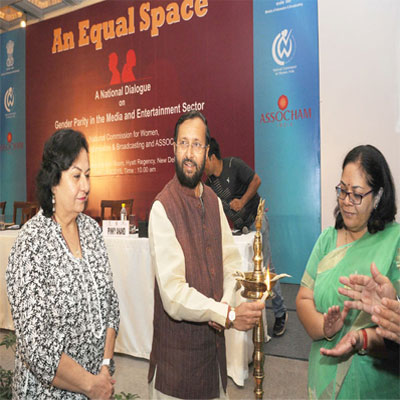
    This was the general view at a discussion on “An equal space: Gender parity in media and entertainment sector” held here by the National Commission for Women (NCW) in partnership with the Information and Broadcasting Ministry and ASSOCHAM.


    The participants felt that technology and digitisation has changed the scenario – for example, equipments were now lightweight as compared to the earlier times and women are entering into various roles like make-up artists, stuntwomen etc.


    In his inaugural address, Environment Minister Prakash Javadekar said that the world had lost a lot by not giving women equal opportunities and not recognising their talent.


    The Minister emphasised that women have qualities like compassion, conviction, consistency and courage which are their unique strengths. There is no difference between men and women in terms of capabilities and men need to be sensitised regarding their attitude towards women, he added. 


    NCW chairperson Lalitha Kumara Mangalam said even today, an invisible barrier exists in the media and entertainment industry where women do not get equal opportunities. She said various factors like lack of training and lack of family support are responsible for this situation. “The percentage of women working in this sector is also very low. Even today people do not find this sector as a good place to work,” she added. 


    Filmmaker Ramesh Sippy opined that women should be portrayed as empowered characters in the films to send the right message to society. “Female artistes should be encouraged to participate in non-conventional roles in films, which help to eliminate misconception of the entertainment industry being projected as biased,” he added. 


    The inaugural session was followed by technical sessions. Deliberations were held on various issues such as equal opportunity for women in media and entertainment, enabling and empowering women at M&E workplace and skill and capacity building.


    It was noted that the news industry has much more presence of women as compared to their male counterparts, the participants opined but a lot needs to be done to encourage women to join this sector and establish themselves into the system. 


    Personalities related to the M&E industry like actor and director Rajat Kapoor, actresses Divya Dutta and Rajeshwari Sachdev also participated in the seminar. Senior Advocate and Additional Solicitor General of India Pinky Anand, Indian Institute of Mass Communications DG Sunit Tandon, former I&B Ministry director (Films) Nirupama Kotru, National Film Development Corporation (NFDC) MD Nina Lath Gupta, and senior journalist Rahul Kanwal, amongst others were panelists in the discussion. 

  • Telecom Ministry sets up committee to study net neutrality

    Telecom Ministry sets up committee to study net neutrality

    NEW DELHI: Even as the Telecom Regulatory Authority of India (TRAI) recently issued a Consultation Paper on over-the-top (OTT) services, the Telecom Ministry has set up a committee of its own to examine the whole issue of Internet usage in the country including the newly-highlighted debate on net neutrality.


    Telecom Ministry director (security) R Shakiya said that the committee was expected to finalise its recommendations towards the latter half of next month.


    Although there was no plan for the committee to give a hearing to stakeholders before finalising its report, he assured stakeholders present at a meet organised by ASSOCHAM that he would forward its request to the Minister in this regard.


    Meanwhile, he made it clear that OTT meant communication services like WhatsApp or WebChat and not sites related to e-governance. Similarly, internet governance is independent of net neutrality.


    He also said that Digital India was a delivery-oriented scheme and it would be erroneous to confuse it with Internet growth.


    Meanwhile, he added that India had asked the International Telegraphic Union (ITU) to conduct a study into how the traceability of the user can be brought in the present regulations.


    ASSOCHAM itself is also expected to form a paper on net neutrality.


    ASSOCHAM chairman for the National Council on Telecommunications T V Ramachandran, while holding that he was all for net neutrality and there was no reason for consumers to pay extra for services foisted on them, said telecom corporations have been discriminated against and wanted them to find ways to avoid this as far as net neutrality is concerned. 


    He cited a US Federal Communication Commission (FCC) statement, which said that these “…new service offerings, depending on how they are structured, could benefit consumers and competition.” The FCC, however, has ruled against a move that violated net neutrality principles.


    The net neutrality debate has arisen after Airtel launched a platform called Zero on which Internet companies could sign up to allow its users free-of-cost access.


    Other speakers included Pradeep Kumar Verma, who is a Scientist with the Department of Information Technology, and ASSOCHAM senior director Ajay Sharma among others.


    A representative of Asia Pacific Telecommunity (APT) wondered if TRAI, which sought views by 24 April, should interfere as net neutrality was more a matter of content than carriage and the regulator only dealt with carriage issues. He felt that the best body to deal with the issue was the Competition Commission of India (CCI).


    Meanwhile, in its paper on OTT, TRAI devoted one full chapter on net neutrality. It suggested that to ensure a thriving and neutral Internet, the issues that needed to be addressed are:


    i. The Internet must be kept open and neutral. Reachability between all endpoints connected to the Internet, without any form of restriction, must be maintained.


    ii. All data traffic should be treated on an equitable basis no matter its sender, recipient, type, or content. All forms of discriminatory traffic management, such as blocking or throttling should be prohibited.


    iii. Network service providers should refrain from any interference with internet users’ freedom to access content (including applications of their choice).


    iv. There should be restricted use of packet inspection software (including storage and re-use of associated data) to control traffic.


    v. Complete information on reasonable traffic management practices and justifications for the same must be accessible and available to the public. TSPs should be transparent and accountable to any changes in practices.


    vi. Non-neutral treatment of traffic for “voluntary” law enforcement purposes must be prohibited unless there is a legal basis for it.


    In view of this, TRAI sought to ask the stakeholders about their views on net-neutrality in the Indian context; what forms of discrimination or traffic management practices are reasonable and consistent with a pragmatic approach; what should or can be permitted; should the TSPs be mandated to publish various traffic management techniques used for different OTT applications; and how should the conducive and balanced environment be created such that TSPs are able to invest in network infrastructure and CAPs are able to innovate and grow. 


  • DAS task force to meet on 8 October amidst protests

    DAS task force to meet on 8 October amidst protests

    NEW DELHI: Almost a month after its constitution, the task force set up for the implementation of digitisation in the country and particularly overseeing the execution of the last two phases of Digital Addressable System (DAS) is expected to meet on 8 October at 10:30 in Delhi.


    However, local cable operators who have already expressed their protest at not being given a voice in the Task Force have not been invited to the meeting.


    Talking about the meeting, Information and Broadcasting Ministry secretary Bimal Julka told indiantelevision.com that all the stakeholders named in the task force order of 12 September had been nominated and are expected to be at the meeting. Although an official of the Information and Broadcasting Ministry denied this.


    LCOs who form the backbone of the cable television system in the country said no organisation of LCOs had been included in the task force or invited in the meeting.


    Meanwhile, ASSOCHAM Media and Entertainment Committee co-chairman Sujatha Dev informed the industry body that she is unaware of how a representative of ASSOCHAM was nominated to the task force.  


    National Cable & Telecommunication Association president Vikki Choudhry has in a letter to the I&B Minister Prakash Javadekar alleged that “In spite of all your endeavours taken to clean up the mess that had been created on account of DAS by the previous UPA government, few officials still attached to the MIB are bent on misleading and misguiding you on this much controversial DAS issue.”


    He has also pointed out that certain categories had not been invited to the task force meeting despite them being directly involved in implementation of DAS which included five Independent MSOs one each from North, South, East, West and North East region, five registered LCO associations one each from North, South, East, West and North East regions, a representative of the Association of Regional Television Broadcasters of India/ Regional News Broadcasters Association, five prominent consumers organisations, one each from North, South, East, West and North East regions, a representative of ASSOCHAM and a representative of Telecom Equipment Manufacturers Association of India (TEMA).


    Choudhry added that while there had been mention of these in the order of 12 September constituting the task force, no persons had been nominated for these categories.


    Additionally, he also revealed that there was no representation / invitation sent to Conditional Access System Vendors (an integral part of the entire DAS) and Subscriber Management System (SMS) that controls the entire DAS ecosystem after integration with the CAS.


    According to the 12 September order, the new task force was to be headed by I&B additional secretary as chairperson, with Telecom Regulatory Authority of India (TRAI) principal advisor for broadcast and cable satellite, I&B Ministry joint secretary broadcasting, representatives from the MSO Alliance, five independent MSOs one each from north, south, east, west and north east regions, five registered LCO associations one each from north, south, east, west and north east regions, representatives from the Indian Broadcasting Foundation, News Broadcasters Association, Association of Regional Television Broadcasters of India, DTH Association, FICCI, CII, ASSOCHAM, CEAMA, Department of Telecommunications, Department of Electronics and Information Technology, DG: Doordarshan, DG: All India Radio, BECIL, BIS, five prominent consumer organisations one each from north, south, east, west and north east regions and 33 state level nodal officers one each from the states/union territories governments.

    The task force was to act as an interface between the government and the industry in matters related to implementation of DAS in the cable TV sector and monitor the execution of DAS. It also will have to analyse the roadblocks that may come in the way of digitisation and suggest measures.


    While NBA and IBF will be participating in the meeting, representatives of cable operators associations from different states are protesting against the exclusion of LCOs and MSOs from the meeting. 


  • Tangerine Digital launches content solution for e-commerce brands

    Tangerine Digital launches content solution for e-commerce brands

    MUMBAI: Tangerine Digital, a digital content solutions provider and part of To The New group has launched a customised content solution for brands in the budding e-commerce sector.


    Tangerine Digital chief operating officer Seeraj Katoch said, “As digital increasingly drives every aspect of the consumer’s life, we have observed that the digital consumer today prefers purchasing online after evaluating the product. With this unique solution, we are confident we will create content that is engaging, trend based, informative, visually attractive and well packaged that will help drive engagement this festive season. This could be in form of top quality videos, classic photo-shoots, engaging descriptions and so on!”


    Cashing on the festive season in India, e-commerce players have increased their marketing budget to persuade consumers to buy everything online. The Associated Chambers of Commerce and Industry of India (ASSOCHAM) 2014 report states that the corporates are planning to spend about 25-30 per cent on advertising in this festive season as compared to the last year in consumer durables, electronics and auto taking the lead, but this change is expected in the e-commerce space ranging from higher sales in mobile telephones, shoes, apparel, gifts and electronic gadgets. 


    The e-commerce content solution by Tangerine Digital will enable brands to provide their customers with customized content, aggregated content and crowd sourced content that can help brands to communicate with their audiences’ at all possible digital touch points. The content solution is supported by analytics that can help brands monitor the effectiveness of their content. The solution can help brands serve the right content at the right time.

  • TRAI paper on broadband next month

    TRAI paper on broadband next month

    MUMBAI: The Telecom Regulatory Authority of India (TRAI) will come out with a comprehensive consultation paper on broadband next month. It will invite views of public on issues related to roll out of broadband in the country.


    Inaugurating the “Eighth Mobile India Summit: Broadband Highway-Driving India’s Growth” organised by Assocham, TRAI chairman Rahul Khullar said, “The authority has been working on broadband issues, and hopefully, we will come out with a paper on broadband, may be by the end of next month.” He also admitted that India’s progress in terms of broadband has been very limited and disappointing.


    “Of 1.8 lakh kilometres (kms) cable that has been ordered 15,000 has been delivered which is just about eight per cent, of six lakh kms for ducting actual achievement is about 2,000 kms which is about 0.3 per cent, the optical fibre cable pulled is about 250 kms which is less than 0.05 per cent of the target and all this has been achieved in past two years,” he added.


    He further stressed the need for targeted approach to achieve broadband policy objectives. He also focused on the scope to use available private infrastructure in conjunction with already existing public infrastructure


    TRAI is also planning to issue a consultation paper soon to discuss regulatory framework around Over-the-top (OTT) players like WhatsApp, Skype, Viber, WeChat etc.


    The OTT players facilitate free calls and messaging services, making it affordable for consumers to use them. Telecom subscribers are required to pay only internet charges to their operators for using OTT services.


    The authority had recently organised a seminar on ‘Regulatory Framework for OTT Services’ with the aim to provide a platform for exchanging views on key issues related to OTT and also rejected the proposal put forward by telcos to charge popular apps.

  • Digitisation has failed to show increase in ARPUs: Deloitte

    Digitisation has failed to show increase in ARPUs: Deloitte

    NEW DELHI: Although carriage fees saw a reduction of 15-20 per cent after the first two phases of digitisation, the delay in implementation of the various phases of digitisation means the promised jump in subscription revenues and average revenue per user (ARPU) has not materialized.


    The recently launched Digitization and Mobility: Next frontier of growth for M&E, report by Deloitte states, “One year into the implementation of digitisation, the cable and broadcast sector is still trying to iron out creases and get systems in place. The key goal of digitisation was addressability, which was expected to plug leakages in the system. While cable subscribers have been increasing, rampant under-declaration meant, Multi-System Operators (MSOs) that transmitted the signals to cable operators earned little from the large subscriber base.”


    In 2014, Deloitte predicts that the digital TV distribution space – both digital cable and Direct-to-Home (DTH) would find ample room for growth given the catalysing effect of digitisation and the headroom for growth provided by non-TV households in the country.


    The report prepared for the ASSOCHAM annual M&E meet says about 12 million set-top boxes have been seeded and 80 per cent consumer application forms have been received as of December 2013. The Telecom Regulatory Authority of India (TRAI) claims 100 per cent digitisation in DAS phase II.


    TRAI has also said recommendations on the new DTH licences would be brought out very soon.


    HITS licenses which have been issued to two players, is expected to enable digitisation in phase III and phase IV markets.


    Meanwhile, the report notes, “Complaints have poured in against set-top boxes. People in the city are complaining about digital set-top boxes installed in their houses and offices. Visual and sound disturbances coupled with channels going off air from time to time have left viewers unhappy.”


    It also notes that “in the haste to install set-top boxes in the city, cable operators have overlooked a crucial step – that of filling in the Cable Access Form (CAF) before installation of the device. The purpose behind mandating DAS was to identify the actual number of cable viewers in the country. But with most customers not filling in the form, the purpose still remains defeated.”


    “With penetration of TV in India standing at approximately 65 per cent, at present, the country has close to 80 million non-TV households, which presents a key opportunity for the television distribution players. This low level of penetration holds a great potential for players to increase their subscribers and revenues. Drivers such as rising incomes, decreasing household size, multi TV phenomenon and rising urbanisation would only provide a further fillip.”


    Noting that the government’s digitisation mandate is “slowly but steadily progressing towards its target,” the report says the television distribution space is abuzz with prospects, albeit it would call for investments and improvements, especially from the digital cable players. All metros except Chennai have been largely digitised and the phase II of digitisation, which covers 38 cities, is also nearing completion. Phase III and IV of digitisation targets December 2014 for their completion. This would mean digitisation of additional 40 to 50 million households in the balance towns.”


    The report also says that phase III aims to focus on digitisation of all urban areas (municipal areas). Given the extensive coverage of MSOs and LCOs in such areas, digital cable is expected to make the most in the relatively densely populated areas, notwithstanding the churn of subscribers to DTH. In the first phase of digitisation, DTH operators were able to grab 20 per cent of subscribers converting them from analog to digital.


    Phase IV aims to focus on digitisation for the rest of India, which predominantly aims at rural areas and tier II cities. DTH is expected to gain the most in areas with sparse population and inadequate cable infrastructure.


    Digitisation phases, scope and affected subscribers

    Digitisation phase               Scope                                        Subscribers affected (million)

    Phase I                            Delhi, Mumbai, Kolkata, Chennai        8-10

    Phase II                           All cities with population > 1 million   12-14

    Phase III                          All urban areas (Municipal areas)        30-35

    Phase IV                         Rest of India                                               22-25

    Source: Industry discussions


    DTH, as a sector, had started off by concentrating on rural areas, which were deprived of cable infrastructure and gradually also entered the urban markets. However, they are still strong in rural markets.


    Given the complexity of the exercise across the country and the rate at which television penetration is growing (MPA expects India to have 183 million pay-TV homes by 2020); the scale of undertaking of digitisation will be a big challenge.  


    But it says analysts and sector professionals agree the future looks promising with the lessons learnt from phases I and II.

  • Government keen to resolve issues facing M&E industry

    Government keen to resolve issues facing M&E industry

    NEW DELHI: While exuding confidence in the Media and Entertainment industry in the country, Information and Broadcasting Minister Prakash Javadekar today said it was important for the stakeholders to keep the welfare of the citizens in mind.


    He said he knew the sector had immense opportunities and the world “is fascinated by our culture and Indian cinema is becoming very popular.”

     
    “Education and entertainment are the primary needs after roti, kapda and makaan (food, cloth and shelter),” Javadekar added.


    The Minister said that his attempt in keeping with the mandate of the new government would be to take decisions on pending issues as soon as possible as “delay is out, decision is in.”  The work of the government is not to create roadblocks but to give impetus to entrepreneurship and industry. 

    Addressing the ASSOCHAM meet on media and entertainment, SCREENS 2014, the Minister, said the path-breaking initiatives on digitisation were bound to improve the quality of television broadcasting in the country. Both the government and the industry should work together for the welfare of the consumers. “There are issues of distribution, there are issues of taxation,” he added.

    “We, both the industry and the government, have to think about the final consumer. Government and industry have to think about the welfare of common citizen and to that end we are partners, we are the facilitators,” he said. 


    Later, Additional Secretary (Films) Raghvendra Singh said that the government was in the process of revamping the Cinematograph Act 1952 which had been drafted when there was no television or other media,


    Realising that media and entertainment was the biggest market in terms of consumer needs; the government is also on the threshold of announcing a major initiative for curbing piracy.


    He was conscious that entertainment tax being a state subject was not uniform, and that there was a grievance about service tax. He hoped all these issues would be subsumed in the proposed Goods and Sales Tax, which the government hopes to bring forward soon.


    He said that the government was very keen to upgrade the Film and Television Institute of India and the Satyajit Ray Film and Television Institute, also to set up a centre of excellence for animation and special effects as soon as possible.


    He also informed that the government was finalising its work on the National Film Heritage Mission for assessment of preservation and restoration of film material.


    “Funds have already been provided in the Ministry’s allocations for anti-piracy measures but this was not possible without collaboration from the industry itself,” said Singh.


    Telecom Regulatory Authority of India member Vijayalakshmy K Gupta stressed that addressability has led to better television and online video viewership has grown 13 per cent between December 2012 and December 2013.


    It has also led to reduction of carriage fee, she claimed on the basis of the first two phases of digital access system.


    She said that TRAI was firm on its decision not to permit state or central government units in private radio or television broadcasting.


    She felt that as far as cinema was concerned, there was need for a Film Commission for dealing with various issues.


    TRAI advisor N Parameshwaran said, “One major problem is that all multi-system operators are ‘pulling in different directions’ and therefore it is difficult to resolve their problems.”  


    He agreed that there was need for rationalisation of taxes in the country as far as media and entertainment were concerned.


    He said TRAI was already working on the issue of increasing bandwidth in view of 4G technologies coming in after HD.


    He denied charges by cable operators that broadcasters or MSOs were being protected as he said they had also been prosecuted for violating rules.