Tag: Asia-Pacific

  • Conrad Clifford to lead IATA in Asia-Pacific

    Conrad Clifford to lead IATA in Asia-Pacific

    NEW DELHI: The International Air Transport Association has appointed Conrad Clifford as Regional Vice President for Asia Pacific.  Clifford joins IATA on 1 February 2014 and will be based in its Asia Pacific Regional Office in Singapore.  He succeeds Maunu von Lueders, who is retiring from IATA.


    Clifford’s career in aviation spans over 30 years. Most recently he served as Acting Managing Director of Antrak Air Ghana (2012 to 2013), and was formerly CEO of Monarch Travel Group (2010 to 2012) and of Virgin Nigeria (2005 to 2009).  His career has also included work for Cathay Pacific Airways, Virgin Atlantic Airways, Menzies Aviation Group and Emirates.


    “Conradbrings to IATA a unique perspective. He has broad and deep experience in both airlines and suppliers; and has lived and worked in many countries in Asia and around the world. I am confident that he will provide strong leadership to IATA’s activities as we serve our airline members and industry stakeholders in the dynamic and exciting Asia-Pacific region,” said Tony Tyler, IATA’s Director General and CEO.


    “I look forward to leading IATAin Asia Pacific as we embark on the 2nd century of commercial aviation. The region offers tremendous opportunities. Many of the region’s governments are using aviation as a critical element of their economic strategies. Some, however, are struggling to provide the foundation for the industry’s success. In both cases IATA has an important role to play. I, personally, will place a key priority on further developing IATA’s partnerships across the region. These will enable IATA’s global standards and global perspective to deliver maximum value to the safe, sustainable and profitable development of aviation,” said Clifford.


    “I want to thank Maunu for his service and contributions to IATA and to our members in Asia-Pacific over the last three years. I wish him a long and happy retirement,” said Tyler.  Von Lueders will retire from IATA on 14 March 2014.

  • SES, SpeedCast and AsiaSat come together to help Typhoon Haiyan survivors

    SES, SpeedCast and AsiaSat come together to help Typhoon Haiyan survivors

    MUMBAI: SES S.A. (NYSE Euronext Paris and Luxembourg Stock Exchange: SESG), SpeedCast, a leading satellite telecommunications service provider in Asia-Pacific, and AsiaSat, a commercial operator of communication spacecraft, have donated satellite and service capacity to enable NetHope, a consortium of 41 non-governmental organisations around the globe, to re-establish communication links to survivors of Typhoon Haiyan that killed at least 6,069 people in that country alone earlier in November 2013.

    Typhoon Haiyan in the Philippines was an exceptionally powerful tropical cyclone that devastated portions of Southeast Asia, particularly the Philippines. It is said to be the deadliest Philippine typhoon on record.

    By utilising the satellite capacity donated by SES and the uplink services and ground infrastructure provided by SpeedCast and AsiaSat, NetHope will be able to provide Typhoon Haiyan survivors access to information directly. The services and infrastructure will also support a number of other relief agencies and NGOs working in-country. 

    “Damage to critical telecommunications infrastructure has made disaster relief and rapid assessment of the situation difficult. Given that it may be weeks or months before terrestrial infrastructure is up and running, satellite connectivity is vital in providing immediate communication needs. SES is pleased to donate satellite capacity to support the people of the Philippines during their recovery from this terrible disaster,” said senior vice president, Commercial Americas at SES Elias Zaccack.

    SES is the world’s leading satellite operator with a fleet of 55 geostationary satellites. The company provides satellite communications services to broadcasters, content and internet service providers, mobile and fixed network operators and business and governmental organisations worldwide.

    “SpeedCast, SES and AsiaSat are providing vital aid directly to the areas that need it most with the help of NetHope. Since the Typhoon hit and we activated our response services, NetHope is now able to assist the relief efforts with communication services that can reach the most remote parts of the country,” said CEO of SpeedCast Pierre-Jean Beylier.

    “AsiaSat is pleased to take part in this initiative by offering uplink services from our Tai Po Earth Station. This effort in cooperation with our partners, will establish communication links needed to assist Typhoon Haiyan relief efforts in the Philippines,” remarked AsiaSat president and chief executive officer William Wade.

    The GVF’s Humanitarian Assistance & Disaster Response Programs helped to facilitate this combined industry response to Typhoon Haiyan in the Philippines. For more information, please refer to the press release attached. If you would like to speak to an SES spokesperson, please let me know.

  • Hui Keng Ang becomes the senior VP and GM for SPT Asia

    Hui Keng Ang becomes the senior VP and GM for SPT Asia

    MUMBAI: Sony Pictures Television (SPT) has promoted Hui Keng Ang to the position of senior vice president and general manager, networks, Asia. He would continue to report to SPT executive vice president, networks, Asia-Pacific George Chien.


    Ang will oversee the networks’ robust portfolio of channels across Southeast Asia, including AXN, Sony Entertainment Television, beTV, ONE, Animax and the recently-announced GEM. Ang would be based in Singapore and would also continue to manage the company’s interest in joint-venture networks AXN and Animax in Korea, as well as Televiva in Indonesia.


    Prior to this, Ang was the senior vice president, business operations, where he managed SPT Networks Asia’s channel operations, finance, technology and human resources. However, he had joined SPT Networks, Asia as the financial controller in 1997.


    He has also served as the networks’ growing Asian content portfolio, including Animax, which is currently available in 46 million homes across 17 markets; as well as ONE, which launched in 2010 and under his guidance has grown to be one of the top-rated pay-TV channels in Malaysia and Singapore.

  • Global media economy set to accelerate in 2014: Study

    Global media economy set to accelerate in 2014: Study

    MUMBAI: The year is coming to an end, and it’s time to introspect. Various studies will be done to review how the years went by. Was it good, bad or ugly?

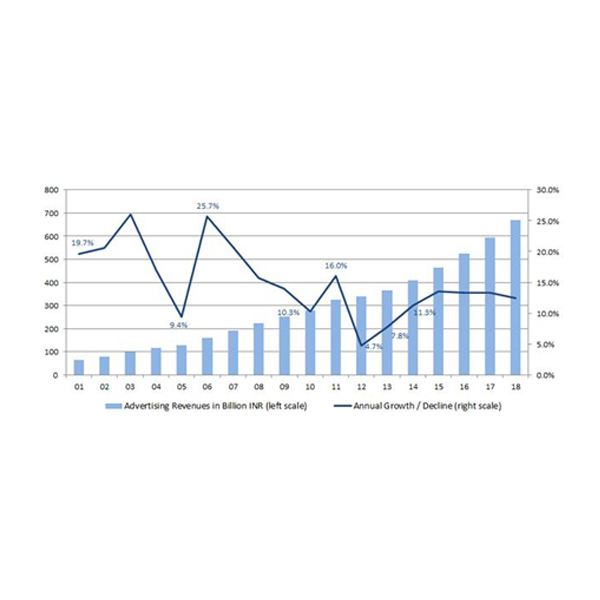
    As far as media owner advertising is concerned, the revenue grew by 3.2 per cent in 2013 to $ 489.6 billion at a global level, even though the economic environment remained weak throughout 2013, according to the study by Magna Global.

    Around the global average growth of +3.3 per cent for advertising revenues in 2013, Latin America once again showed the strongest growth (+9.5 per cent), followed by Eastern Europe (+7.9 per cent) and Asia Pacific (+6.3 per cent). On the other end, developed markets showed little or no growth: North America +1.5 per cent, Western Europe -0.8 per cent.

    “That level of economic activity is not particularly impressive by historical standards but confidence indices keep improving and we believe advertising spending will reflect and amplify that economic trend,” said Magna Global India director intelligence EVP Venkatesh S in the report.

    Asia Pacific advertising revenue grew by an average of +6.3% in 2013 to $148.7bn. Television continues to remain the largest media category in APAC, and will grow by +5.1% in 2013, up from +4.3% in 2012 to reach market share of 42.3% of total spend in the region. However, it will gradually fall below 40 per cent share in the next five years.

    Digital is the fastest growing category and will grow by +22.4% in 2013 to reach $33.6bn, as per the study. Newspaper and magazines continue to lose ground at -1.4% and -3.1% CAGR through 2018, respectively, and together print will only represent 21.8 per cent of total spend in 2013, down from 32.2 per cent of total spend as recently as 2008. As a whole, the APAC region now represents approximately 30 per cent of total global spend.

    Within APAC, China and Japan represent nearly two thirds of the total APAC advertising revenues. However, China is growing quickly and will surpass Japan for the top spot in APAC as soon as 2015. But the development of the markets within APAC varies significantly with some very advanced markets such as Australia and some much underdeveloped markets like India. This disparity can also be seen in the share of digital spend, with India’s digital market share at 7.4 per cent of total spend in 2013 vs. Australia’s at 32.7 per cent of total spend.


    Rise of social media

    The biggest game changer, this year, has been the rise of social media and, more specifically mobile social media. In the last 18 months, social media usage has migrated towards portable devices and platforms at a faster rate than most anticipated.

    The impressive success of tablets in the Western world and the rapid penetration of feature phones and smartphones in the developing world have contributed to this rapid shift in consumer usage. At the same time, social media owners (Facebook and Twitter most significantly) have introduced ad formats specifically matched to those portable devices that have met with instant success among marketers without alienating users.

    Globally, the social media advertising grew by 58 per cent this year, to $9.1bn, of which $2.9bn came from mobile social (+ 300 per cent), the forecast company said in the report.

    Looking forward

    The company predicts the economic conditions to improve for good in 2014. It expects the global advertising revenue to grow by +6.5 per cent (previously: +6.1 per cent) to reach $521.6bn, which will be the strongest year-on-year growth since 2010 (+8.4 per cent, following the 2009 recession).

    Said Magna Global’s director of global forecasting EVP Vincent Letang in the report, “The combination of an improved economic environment and stronger-than-usual cyclical drivers is bound to unlock marketing and branding budgets in 2014. This will primarily benefit television and digital media where new formats and opportunities are being explored for activation and branding campaigns”.

  • Cartoon Network to distribute Asia-Pacific developed series globally

    Cartoon Network to distribute Asia-Pacific developed series globally

    MUMBAI: Cartoon Network that has started production on a new Asia Pacific-made series that is being developed for global distribution.


    Exchange Student Zero, a series where fantasy becomes reality when the dark forces from a tactical anime card game are unleashed on our world, will be ready to air in 2015. The series would be the first one to be developed in the Asia-Pacific region and telecast across the world. However, the Network’s movies develop in the region has been released on a global level earlier.


    Another new project in the pipeline for the leading kids’ network is Monster Beach, an original TV special that will also be available internationally.


    “Since the very early days at Cartoon Network in Asia Pacific we have produced local content,” says Cartoon Network Chief Content Officer Mark Eyers. “Exchange Student Zero confirms our continued commitment to producing exclusive and compelling creator-driven local content with export potential.”


    The show’s director, Patrick Crawley from Bogan Entertainment Solutions (BES) in Australia, adds, “It’s fantastic that we’ll be able to turn this character-driven, inter-dimensional story into a complete Cartoon Network series. Our Australian animation creative team is a formidable talent and we’re thrilled to have the chance to work with an international broadcaster to bring Exchange Student Zero to a global audience.”

  • Digital Asia Festival 2013 announces shortlist

    Digital Asia Festival 2013 announces shortlist

    MUMBAI: The Digital Asia Festival Awards, honouring the best digital marketing communications across Asia Pacific, has announced this year’s shortlist.


    Chaired by Jason Kuperman, vice president of Omnicom Digital Asia Pacific, India, Middle East and Africa, the jury consists of 40 industry professionals with a mix of leading client marketers, digital media practitioners and agency strategists, judged 506 pieces of work based on strategy, creativity and innovation, execution and results with a total of 80 entries making it onto the shortlist. Japan leads with the most shortlisted entries (14), followed by Australia (13), New Zealand (10), China (9), Hong Kong (9), India (7), Singapore (7), The Philippines (5), Malaysia (4) and Thailand (2).


    Commenting on the judging process so far and the quality of the work, some jury members had the following to say in a release:  


    “I found this year’s entries seamlessly integrating technology into the creative leap turning the communication into truly refreshing and engaging consumer experiences. Several of the shortlists had started with a fabulous consumer insight and market/media opportunity that had never been explored before. We saw a lot of first-of-its-kind innovations and we could see technology playing along beautifully with the big idea. That’s a very encouraging sign,” said Tigress Tigress founder, CEO and CCO Meera Sharath Chandra.


    “Judging the DAF awards this year demonstrates that the region is thinking big and acting big in digital.  It’s no longer just an add-on to a TV campaign, but brands and agencies are genuinely looking at how they can build participation throughout their initiatives.  In a world where we often seem to be obsessed with daily posts on Facebook, it’s brilliant to see how much scale and impact can be really achieved with digital innovation,” said Iris Worldwide planning director, APAC regional Paul Gage.


    “The work that stood out for me was based on a single sharp insight and a strong idea – simply presented and well executed. Several entries made me go, Aha, wish I had thought of it,” said Infosys global head – digital marketing Ashok Lalla.
    The winners of the 2013 awards will be announced online through www.digitalasiafestival.com on 18 November.

  • Indian businesses leading Asia Pacific on cyber risk

    Indian businesses leading Asia Pacific on cyber risk

    MUMBAI: Business leaders in India are increasingly waking up to the threat of cyber-crime according to the third Lloyd’s Risk Index conducted by Ipsos.

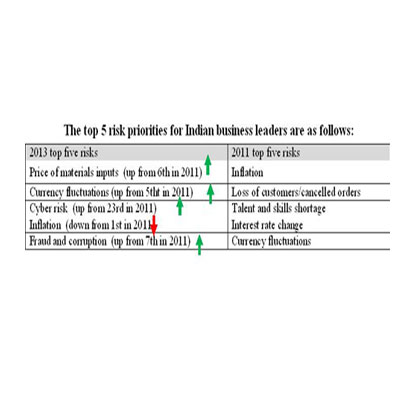
    Ipsos surveyed over 500 of the world’s most senior business leaders for the Risk Index, which shows that cyber risk has become a key concern among Indian businesses, soaring up the Index from the 23rd highest priority in 2011 to 3rd this year.

    The findings show that Indian businesses are taking cyber security more seriously than their Asia-Pac counterparts; prioritising cyber risk five places higher than the Asia-Pac average of eighth place.

    While prioritisation of cyber risk is high, business leaders feel less prepared to cope with the threat of an incident, rating cyber just 14th in terms of the risks they are most prepared to deal with.

    The increased awareness of cyber risk comes at a time when research has shown the average annualised cost of cyber breaches has sharply increased. For 56 benchmarked organisations the average cost was $ 8.9 million a year, up from $ 8.4 million in 2011, and ranging from $ 1.4 million to $ 46 million per year, per company.

    Lloyd’s head of Asia-Pacific Kent Chaplin said: “It’s encouraging to see Indian businesses increasingly leading the way when it comes to recognising the threat of cyber incidents. As recent high profile events have shown, cyber-breaches are only getting more sophisticated and it seems business leaders are beginning to acknowledge that.”

    “However, the risks faced by Indian businesses go far beyond cyber and leaders must ensure they are responding to the challenges they face today and evolving to meet the emerging risks of tomorrow. With the timetable for global economic recovery likely to be much longer than we hoped, effective risk management should be a priority for boards across the world,” added Chaplin.

  • Turner International hires Ricky Ow as Marcopoto’s replacement

    Turner International hires Ricky Ow as Marcopoto’s replacement

    MUMBAI: Turner International’s Turner Broadcasting System Asia Pacific has been beset with some bad news or the other emerging from it over the past couple of years. Restructuring, layoffs and the sudden stepping down of its long serving boss Steve Marcopoto earlier this year all caught the headlines.


    A hunt for his successor was on, the company had stated at the time of Marcopoto’s announcement.


    The good news now is that the company has announced his replacement. And it is international television executive Ricky Ow who will be joining Turner International as President of Turner Broadcasting System Asia Pacific effective January 2014. The announcement was made by Gerhard Zeiler, President of Turner Broadcasting System International.


    Most recently Executive Vice President & General Manager for Sony Pictures Television (SPT) Networks Asia, Ow will lead Turner International’s portfolio in the Asia Pacific region, based in Hong Kong.


    As President of Turner APAC, Ow will have executive oversight for all entertainment and kids networks, the digital and media services offered, the distribution of CNN’s services in that region, and all licensing and merchandising activity in APAC.


    “We are delighted that Ricky is joining us and look forward to the leadership and wealth of international media experience he will bring to one of the most strategically important areas of Turner International,” said Zeiler in a press release. He continued: “His vast experience in the region, his successes in launching and establishing channel brands both locally and regionally, his experience in local content production, as well as his deep understanding of sales and marketing, make him the ideal choice to lead our business in the Asia Pacific region into the next stage of growth. Looking with fresh eyes at our business as a true leader, he will be a strong addition to Turner International. We all look forward to working with him to extend our core brands and build international scale.”


    “I am very excited to join Turner and it is an honour to work with Gerhard and the team that has built some of the most valuable media brands in the world including CNN, TNT, Cartoon Network, Pogo and Turner Classic Movies,” said Ow. “This is an opportunity to leverage on our incredible heritage of creativity and innovation to grow a dynamic portfolio of iconic brands, to develop new ventures and to strengthen relevance and value for our viewers, partners and the business community.”


    Ow joins Turner after a 14-year career at Sony Pictures, most recently as Executive Vice President & General Manager for Sony Pictures Television (SPT) Networks Asia. In that role, Ow was responsible for overseeing the networks business across Asia as well as developing new channel opportunities in the region. He also had oversight of SPT’s two Korean joint ventures, AXN Korea and Animax Korea. Prior, Ow was the Senior Vice President & General Manager, Networks Asia, overseeing the company’s channel brands, including AXN India and Animax India. He joined SPT in 1999 as Head of Sales and Marketing. Under his leadership, AXN became the leading English language general entertainment channel in Asia while SPT Networks Asia grew into a bouquet of entertainment brands including “One”, the leading Asian language channel in Southeast Asia. Additionally, Ow has led SPT’s networks in Asia to pioneer various award-winning pan-regional entertainment productions. Prior to joining SPT, Ow held positions at SBC Enterprises (now Mediacorp TV), Asia Business News, and CNBC.

  • Close Arvind Sharma steps down from Leo Burnett, Saurabh Varma to take chargea

    Close Arvind Sharma steps down from Leo Burnett, Saurabh Varma to take chargea

    MUMBAI: Tom Bernardin, Chairman and CEO, Leo Burnett Worldwide announced today the new leadership of the India operations. Chairman and CEO of Indian subcontinent Arvind Sharma will be leaving the agency to pursue other business interests outside the industry after a successful stint of 30 years.

    The currently regional chief strategy officer of Leo Burnett Asia Pacific Saurabh Varma has now been appointed as the CEO Leo Burnett Group India.

    The appointment will be effective from 1November, 2013. In his new role as CEO for the India operations across Mumbai, New Delhi and Bangalore, Varma will report directly to Leo Burnett Asia Pacific President Jarek Ziebinski.

    As chief strategy officer of Leo Burnett Asia Pacific, Varma oversees all heads of strategy and planning directors in the region. His role also sees him playing a key role in the management of regional and global accounts. A post graduate in Communications from Mudra Institute of Communications Ahmedabad (MICA), Varma has 16 years of experience in the business. He has spent seven years with Leo Burnett based at Singapore. Some of the brands he has worked on include Indian Oil, Lakme (Unilever), Vicks (P&G), NIVEA, Fosters, Philips, HP, Blackberry, Samsung, Friesland Campina Asia Pacific (Dutch Lady/ Foremost/ Frisian Flag), MCYS and UOB Bank.

    Varma has spent the first nine years of his career in advertising in India. He began his career with DDB India and within four years of being in the business, he was made head of account management at TBWA India. In the last three years, Varma has won more than 50 awards including the Effie Gold, the Appies Gold, the Grand Prix for Direct Marketing, the most effective media campaign at Hall of Fame, 2 Gold Lions at Cannes, the Grand Prix at the ADFEST, the Viewers’ Choice Award (Mediacorp) and many more. In 2010, Varma was awarded the ‘Strategic Planner of the Year’ at the Hall of Fame Awards.

    His strength lies in being able to bring life into a strategic process, unearthing societal contexts and creating out of the box briefs.

    Commenting on his new role, Varma said, “India is home to me. This new role is coming full circle to where it all began. Over the years, I have always kept a keen eye on the developments in India and in some ways, I felt like I have never left. I look forward to coming back with a fresh perspective gained from my time away and bring the best learnings of Leo Burnett network to India. Being a part of the regional team for Asia Pacific has given me a unique perspective and experience of diverse markets across the region and I look forward to bringing this understanding to my new role. Together with the management team, most of whom I already know and have the privilege of working with, we will be focused on driving a positive change for the agency to take it to the next level.”

    Varma’s strength lies in being able to bring life into a strategic process, unearthing societal contexts and creating out of the box briefs

    Bernardin, who is in Mumbai today with the regional management team for the announcement said, “We would like to take this opportunity to express our deep gratitude and appreciation to Arvind Sharma. He has worked tirelessly over the past 30 years to build Leo Burnett into one of India’s leading creative agencies and laid down a solid foundation for the agency to progress to the next level. During his tenure, Arvind built a stellar client base that includes blue chip multinational and local clients and nurtured some of the brightest stars within the Indian advertising industry today. Though he remains available for his advice and counsel, we bid farewell to Arvind today, in his official capacity, with our very best wishes and as a dear friend.”

    Ziebinski added, “I’d like to thank Arvind for his contribution to our success and close collaboration over the past four years since I arrived in the region. I wish Arvind nothing but the best for his new future.”

    While bidding adieu, Sharma had some fond memories, as he said, “I had a very long and fruitful run as the leader of Leo Burnett in India Subcontinent. As I approached the company-defined age of 58, I would like to start something totally new. I look back at my 30 years at the agency and 21 years of leading it with a great deal of satisfaction.”

    The agency was awarded Global Agency of the Year by Leo Burnett Worldwide for 2003 and 2008. In partnerships with its clients, the agency has been recognised creatively across leading award shows globally including Cannes, Clios, D&AD, One Show and London International Awards. Work produced by Leo Burnett India has also run in multiple countries worldwide. Last year, the agency successfully completed the acquisition of digital agency, Indigo Consulting and integrated it into the Leo Burnett Group.

    Continued Bernardin, “We are fortunate to have a strong management team on ground in India and equally fortunate in having the bench strength in the region in naming Saurabh to this role. Saurabh’s talent and track record is well-recognised within the network. His combined experience and knowledge of having worked across creative, media and digital agencies is invaluable as we look to elevate the agency to its next stage of development in India, a key market for the network globally. He will have the full support of the global and regional management in his new role.”


  • Cisco increases its reach to 100 million digital TV homes in Asia Pacific

    Cisco increases its reach to 100 million digital TV homes in Asia Pacific

    MUMBAI:  In the rapidly-growing digital television industry in Asia Pacific, Cisco, a provider of conditional access (CA) and digital rights management (DRM) solutions, has secured content that is delivered to more than 100 million digital homes in the region.

     Using an industry-estimated average of 3.3 people per household, Cisco’s VideoGuard conditional access and digital rights management technology now provides the critical protection of premium content to over 340 million viewers.
    Cisco has also developed a research and development (R&D) center in Bengaluru that is dedicated to the development of video technology. According to the MPA report of May 2013, the company currently enjoys the largest market share of the estimated 257 million digital TV homes in Asia Pacific.

    Service Provider Video Software Solutions vice president sales, Asia Pacific Sue Taylor said, “Achieving the milestone of over 100 million digital homes in this region is a testament to our commitment to Asia Pacific over the past 20 years, and our partnerships with some of the most successful cable TV and DTH satellite platforms in the region. This industry in Asia Pacific is one of the fastest growing and most dynamic in the world. We look forward to serving million more households that can benefit from Cisco’s enhanced TV-viewing experiences, as the demand for advanced services and applications surges.”

    BOX

    • Cisco® VideoGuard conditional access and digital rights management solutions make Cisco the leading CA provider in Asia Pacific with a market share of 31 per cent (Source: Screen Digest Report 2013 and Cisco’s internal subscriber data).
    • Cisco is a trusted pay-TV technology partner for over 150 Pay-TV operators as well as media and entertainment companies worldwide, including leading Direct-to-home (DTH) and cable operator customers in Asia Pacific like Airtel Digital TV, Astro, Foxtel, Hathway, Oriental Cable Network, Sichuan Cable TV, Tata Sky and DEN Networks.

    Cisco recently announced the key milestone of over 30 million digital TV homes in India with an estimated 150 million viewers.