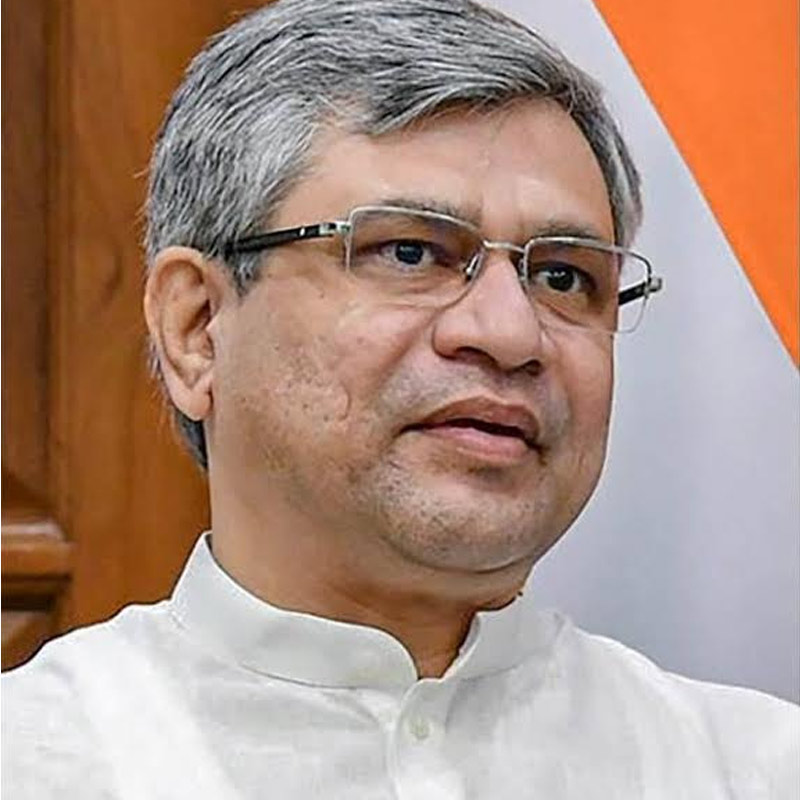
Tag: Ashwini Vaishnaw

  • L. Murugan joins I&B as minister of state

    L. Murugan joins I&B as minister of state

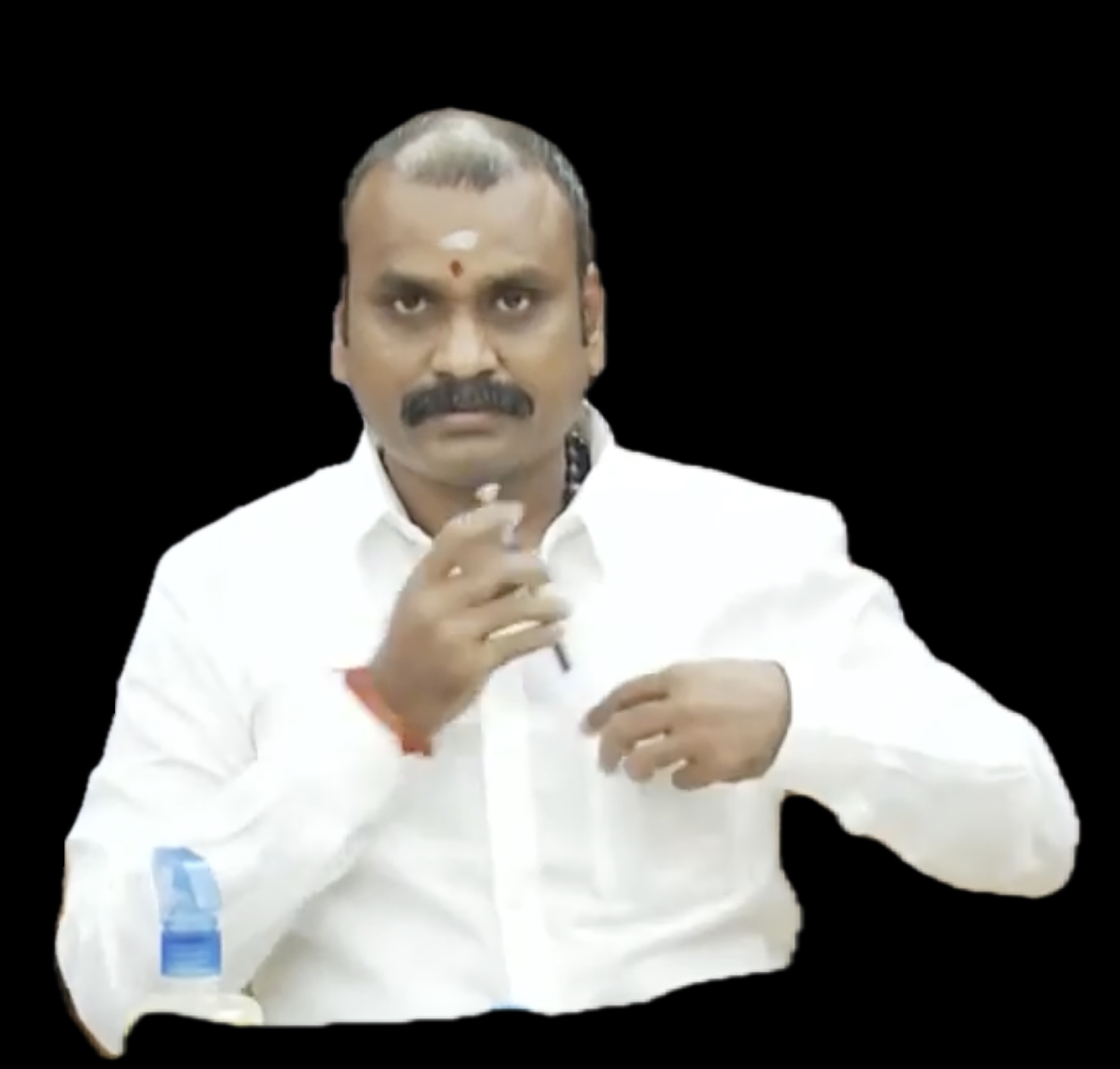
    MUMBI: Even as all attention has been  focused on MeITy and railways minister Ashwini Vasihnaw getting additional oversight of the ministry of information & broadcasting (MIB),  what has been under-reported is the   handing over  of the minister of state  position to L. Murugan in the same ministry. Murugan was earlier appointed as minister of state in 2021, prior to which he was the state president of the BJP IN Tamil Nadu.

    The 47 year old is a law graduate and a doctorate holder from the University of Madras who has been practising law for more than 15 years. He has been associated with the RSS since 1997, having served as the standing counsel to the Indian government at the Madras high court

    Murugan’s appointment should work well in favour of both the industry and Vaishnaw as a whole lot of regulations and decisions are pending with the ministry. 

  • MeiTY & Railways minister Ashwini Vaishnaw gets I&B additionally

    MeiTY & Railways minister Ashwini Vaishnaw gets I&B additionally

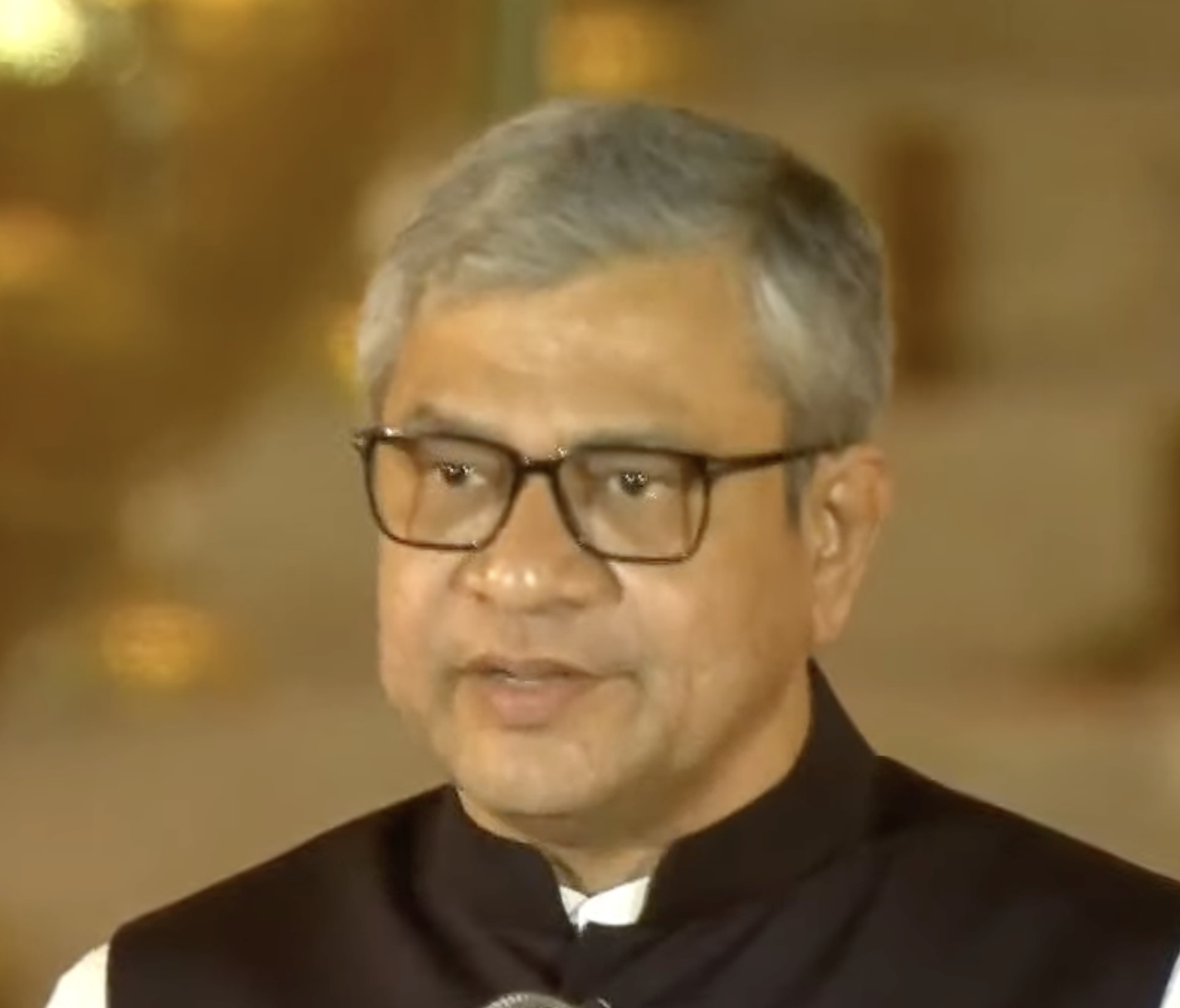
    MUMBAI: Ashwini Vaishnaw made his mark in the Modi 2.0 government by holding two portfolios –  the minister of electronics and information technology as well as that of the railways. Now a third one has been added to his list of responsibilities: in Modi 3.0  that of the ministry of information and broadcasting in Modi 3.0. He replaces  Anurag Thakur who ran the ministry during Modi 2.0, and was kept out of the cabinet, despite winning from his constituency. 

    Vaishnaw will have his hands full with the various ministries. But there is some overlap between the MeITY and I&B ministry, especially considering that both are concerned with the ballooning video streaming business with around 60-70 apps in operation.

    Public pressure has forced the government to regulate the video entertainment streamers, something which MeiTY has done effectively. With the content ecosystem – which is the preserve of the I&B ministry- coming under his supervision, it could well make things easier for him. 


    The minister will have his work cut out for him: on the one hand, Vaishnaw will have  to put in his best efforts to somehow ameliorate the popular perception that the Modi government has been manipulating the media to its own ends, through a carrot and stick approach.  Then Prasar Bharti needs some amount of direction going forward, even as Doordarshan needs to be reinvented and modernised in keeping with the needs of modern viewers who are today spoilt for choice. Decisions on viewership monitoring too have to be taken. 


  • ABP News ‘Shikhar Sammelan’ on India’s democratic landscape

    ABP News ‘Shikhar Sammelan’ on India’s democratic landscape

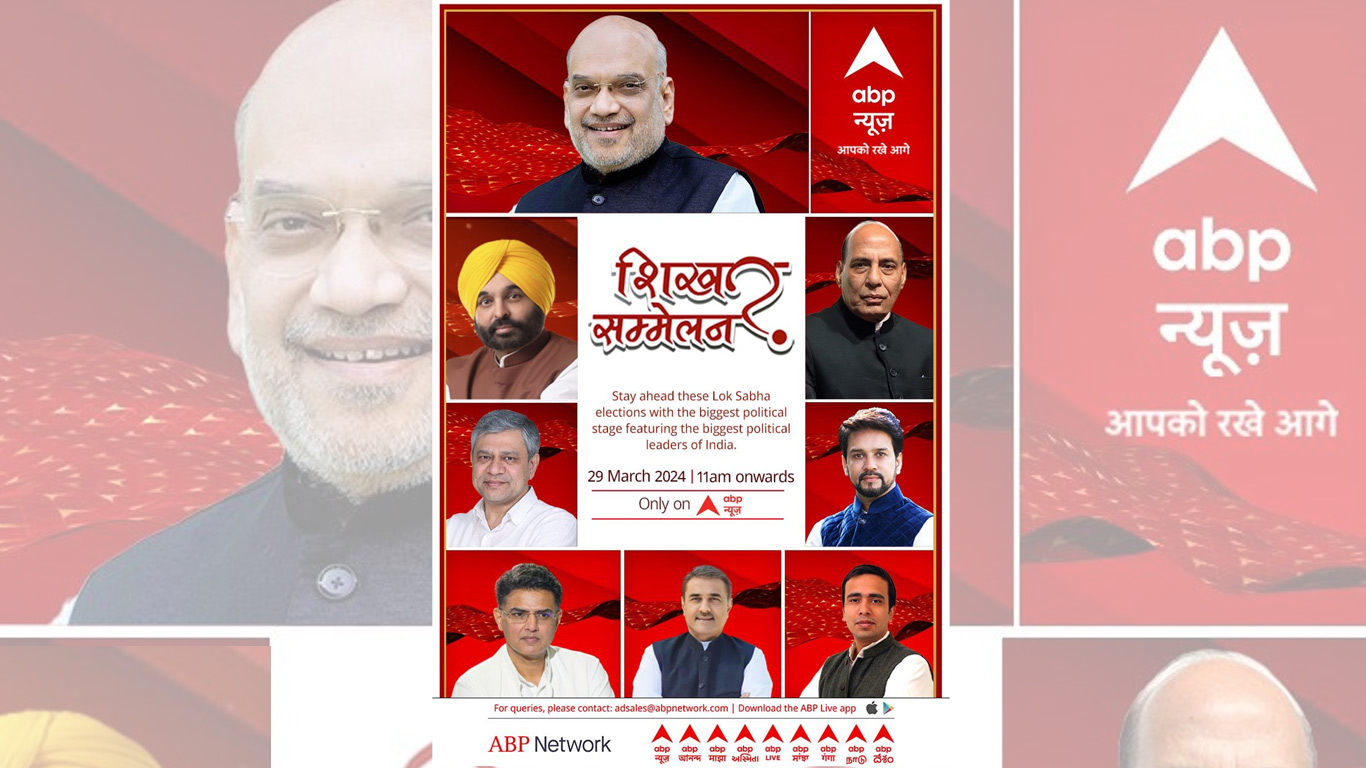
    Mumbai: ABP News, one of India’s leading Hindi news channels, is all set to host a ‘Shikhar Sammelan’ – a day of high table thought-provoking sessions delving into the realities of the current political landscape of India. Scheduled for 29 March at Hyatt Regency Delhi, this is a day-long conference that will provide a platform for insightful analyses and fervent debates, a very necessary exercise as a nation gears up for the world’s biggest polls ever, India’s Lok Sabha Elections 2024.

    ABP News Shikhar Sammelans in the past have been renowned for their thorough assessment of a government’s performance and the same standards are to be expected of this upcoming event in 2024. Multiple panels made up of distinguished experts, notable initiators and powerful political personalities from across the polity will engage in meaningful dialogue, delineating the challenges as well as the opportunities facing the nation.

    Minister of defence of India Rajnath Singh; minister of home affairs of India Amit Shah; Indian National Congress (INC) president Mallikarjun Kharge, minister of Information and Broadcasting of India Anurag Thakur; member of Rajya Sabha Jayant Chaudhary; union minister of railways of India Ashwini Vaishnaw; union minister of urban development Hardeep Singh Puri, Indian National Congress (INC) general secretary Sachin Pilot; member of Rajya Sabha Praful Patel; are some of the esteemed personalities, amongst a host of others, who are expected to participate at this ABP News ‘Shikhar Sammelan’.

    The ‘Shikhar Sammelan’ is set to showcase ABP News’ commitment to creating a platform where important leaders can engage in in-depth discussions and analyses of issues that are political and governance related, from deliberations on administrative challenges to opportunities for progress the day-long conference will facilitate an exchange of ideas and varied viewpoints that will be shaping India’s political landscape for the years to come.

    With this upcoming event, ABP News continues its tradition of fostering transparent and accountable dialogue through events like ‘Shikhar Sammelan,’ reinforcing its devotion to informed journalism and responsible governance.

  • News9 Global Summit unites global leaders for insight and inspiration

    News9 Global Summit unites global leaders for insight and inspiration

    Mumbai: The much-anticipated News9 Global Summit commenced on 26 February 2024, hosting a gathering of eminent personalities, thought leaders, and industry experts from over 20 countries across the globe. The summit, part of the prestigious TV9 What India Thinks Today (WITT) summit, kicked off with a series of insightful discussions and keynote addresses, setting the stage for robust dialogues on critical issues facing India and the world.

    The day began with a warm welcome address by TV9 Network MD and CEO Barun Das who extended his greetings to all attendees, emphasising the significance of the decadal momentum and geopolitical moment that seem to be in India’s favour.

    The day’s first keynote address, titled ‘From Asia-Pacific to Indo-Pacific: Reframing Regional Relations’, delivered by former prime minister of Australia, Tony Abbott, captivated the audience’s attention, shedding light on the evolving dynamics of regional geopolitics and the need for strategic partnerships in the Indo-Pacific region.

    Praising India as a leader of the global south, Tony Abbott said, “After several decades of ‘License Raj’, India is now roaring down the runway to economic take-off”.

    The first-panel discussion, ‘Not an Era of War: India as a Global Peace Catalyst’, featured distinguished speakers including Velina Tchakarova, Mariya Ahmed Didi, and Syed Akbaruddin, exploring India’s role as a harbinger of peace and stability in the global arena.

    Also conducted was a panel on ‘AI: The Promise and Pitfalls’, featuring experts like Samsung research director Alok Shukla, Stanford Prof. Anurag Mairal, Reliance Jio AI/ML chief data scientist Shailesh Kumar, Microsoft executive director Samik Roy and entrepreneur and film producer Jonathan Bronfman, discussing the promise and pitfalls of AI technology. The panel examined the transformative potential of AI in various sectors while addressing concerns related to ethics, privacy, and job displacement.

    This was followed by a panel discussion on ‘Startup, India: Scale up and Sustain’, which saw 108 capital founding partner Sushma Kaushik, Mamaearth co-founder Ghazal Alagh, NoBroker co-founder Akhil Gupta and Amul MD Jayen Mehta discuss the startup boom in India, and the many challenges that lie ahead for these young firms in their bid to stand on their own two feet.

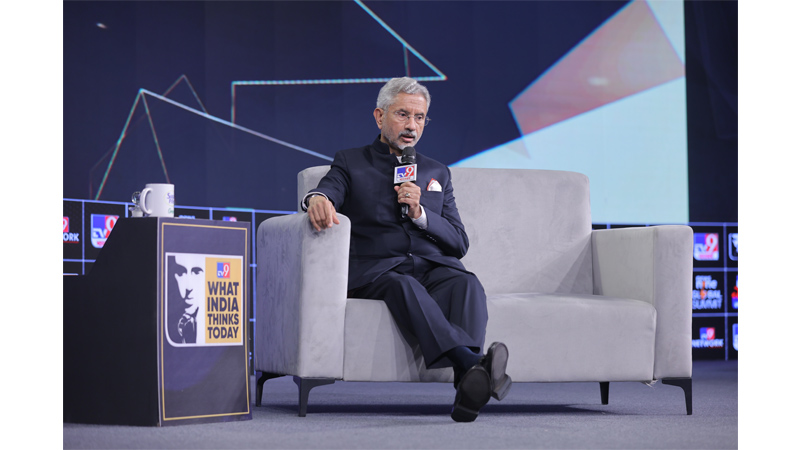
    Subsequent sessions included keynote interviews with Union Ministers like Smt. Smriti Irani on ‘Naari Shakti’, Ashwini Vaishnaw on ‘Infra, Investment and IT’ in India, and Dr S. Jaishankar on ‘Rise of the Global South’.

    Praising the ground India has managed to cover in terms of women’s emancipation across the last decade, union minister Smriti Irani said, “What India does today, the world does tomorrow. What India has done significantly for gender is make a case for women who are emancipated across all walks of life”.

    Union minister Ashwini Vaishnaw was also confident about the trajectory the nation is taking, and talked about the need to make technology available to the masses, saying, “Technology has to be democratised. It should be available to every Indian citizen”.

    Speaking about the leadership of the global south that India has displayed, external affairs minister Dr S Jaishankar said, “When we spoke to the G20, we were not only speaking on behalf of India … we also had 125 countries who said ‘speak for us’. ”

    Interspersed among these interviews were fireside chats with eminent personalities, including youth icon Ayushmann Khurrana, BharatPe chairman Rajnish Kumar, Zydus Wellness CEO Tarun G. Arora, Maruti Suzuki chairman R. C. Bhargava, Mahindra and Mahindra MD Dr Anish Shah, actress Kangana Ranaut and with Dr Vivek Lall, chief executive of General Atomics Global Corporation.

    Discussing the untapped potential of corporate India in a panel on ‘Creating an Equitable Boardroom’ were supreme court advocate Menaka Guruswamy, Shardul Amarchand Mangaldas managing partner Pallavi Shroff, TeamLease co-founder Rituparna Chakraborty and policy researcher and corporate advisor Dr Srinath Sridharan.

    Shortly after, American sociologist Salvatore Babones, author Vikram Sampath, former minister of external affairs Salman Khurshid and Penguin Random House Sr VP Milee Ashwarya engaged in a round table discussion on the narratives about the new India and India of the past, in ‘Setting the Record Straight’.

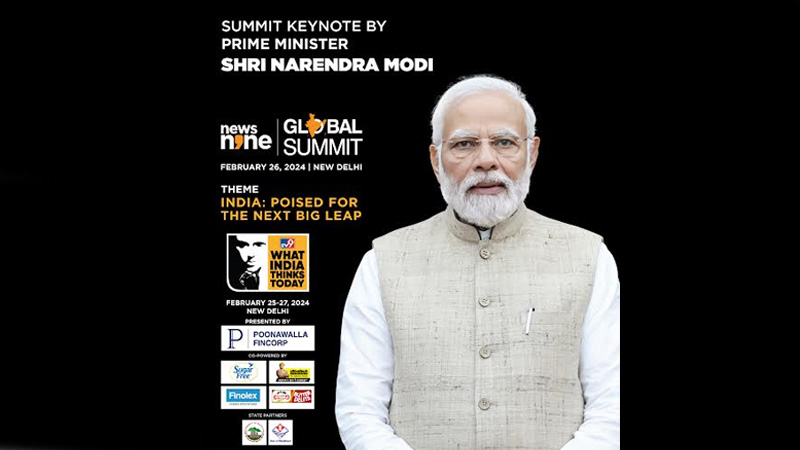
    Delivering the summit keynote address on the theme of ‘India: Poised for the Next Big Leap’ was prime minister Narendra Modi, who graced the occasion and spoke about the strides India has taken in the decade gone by, and those he hopes India will take in the run-up to its centennial anniversary of independence.
  • PM Narendra Modi to deliver keynote address at News9 Global Summit 2024

    PM Narendra Modi to deliver keynote address at News9 Global Summit 2024

    Mumbai: News9 Global Summit, part of TV9 What India Thinks Today (WITT), is set to take place between 25 and 26 February 2024. An unequalled gathering of visionaries, policymakers, and influencers from around the globe, the summit takes on a grand theme ‘India: Poised for the Next Big Leap’. The Hon. Prime Minister of India Shri Narendra Modi will deliver the summit keynote address.

    Among the dignitaries who will be speaking at the 2024 edition of News9 Global Summit are stalwarts such as former prime minister of Australia, Tony Abbott; Union Ministers S. Jaishankar, Smriti Irani, Ashwini Vaishnaw, and Anurag Thakur; American sociologist Salvatore Babones, Indian film actresses Kangana Ranaut and Raveena Tandon , Grammy-award winner Ricky Kej and author Vivek Sampath, among others.
    The two-day summit has distinct focus areas for each day.

    On 25 February, the summit kicks off with The Inaugural, setting the stage for thought-provoking discussions on India’s soft power in cinema and sports to burnish Brand India, and will witness interesting fireside chats and panel discussions with top Union ministers and celebrities, including the likes of Anurag Thakur, India’s G20 Sherpa Amitabh Kant, Grammy Award winners V Selvaganesh and Rakesh Chaurasia, and Sinclair Broadcast Group CEO Christopher Ripley.

    The Inaugural will also feature TV9 Network’s Nakshatra Samman Awards, bestowed upon the brightest stars of India’s sports and entertainment landscape.

    On 26 February, the summit transitions into its flagship event: the Global Summit, which will serve as a melting pot of ideas and perspectives on pressing geopolitical and geo-economic issues. While the Inaugural sets the stage, the Global Summit will witness the arrival of distinguished guests from around the world, including political leaders, industry experts, and renowned intellectuals.

    Union Ministers S. Jaishankar, Smriti Irani, and Ashwini Vaishnaw; Vivek Lall (Chief Executive, General Atomics Global Corporation), Jodi McKay (former Leader of Opposition, Australia), R. C. Bhargava (Chairman, Maruti Suzuki), Anish Shah (President-FICCI), American Sociologist Salvatore Babones and author-politician Salman Khurshid are among the dignitaries that will be speaking on a variety of topics. The highlight of the Global Summit will be the eagerly anticipated Summit Keynote Address, delivered by the Honourable Prime Minister of India, Shri Narendra Modi.

    “We are thrilled to launch the second edition of TV9 What India Thinks Today Global Summit 2024 and to have thought leaders from around the world join us for two days of inspiring discussions and collaborative initiatives,” said TV9 Network managing director and CEO Barun Das. “TV9 WITT is a manifestation of our belief in the power of ideas to drive positive change, and we are confident that this year’s event will serve as a catalyst for fuelling the narrative that the new India wishes to create in the decade to come. Hence, the bold theme: “India: Poised for the Next Big Leap”.

  • PM Modi launches 5G services in India

    PM Modi launches 5G services in India

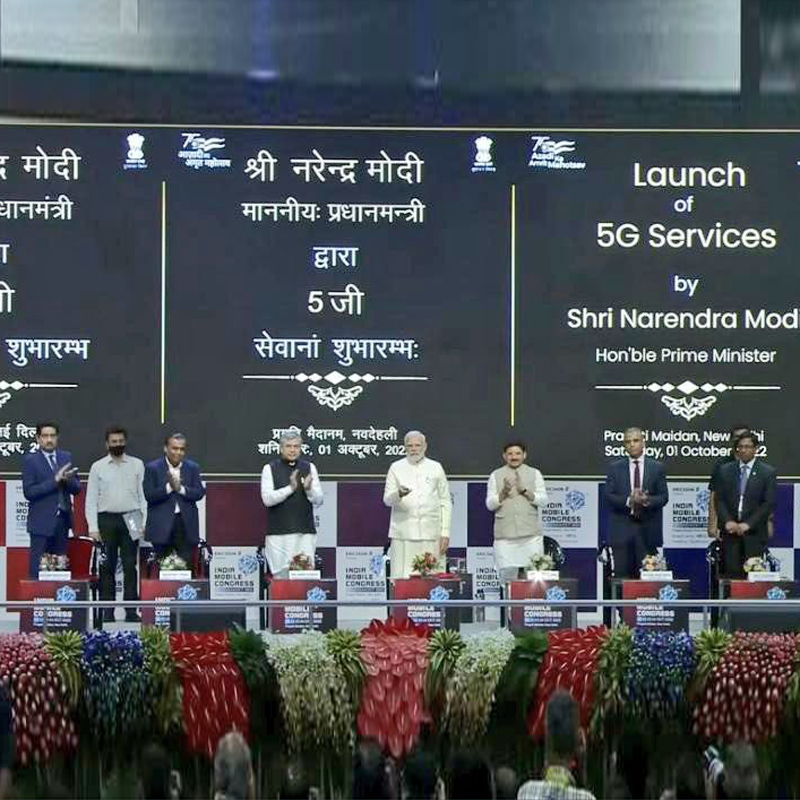
    Mumbai: On Saturday, prime minister Narendra Modi launched 5G services in India at the India Mobile Congress in New Delhi.

    At the launch, while addressing the nation, Modi said that 5G technology will revolutionise the telecom sector and that it is a historic day for India in the twenty-first century. “The launch of 5G is a gift from the telecom industry to 130 crore Indians. It is a step toward a new era in the country, and is the beginning of infinite opportunities.”

    He emphasised how digital India’s success is based on four pillars, including the cost of a device, digital connectivity, data costs, and the digital first approach.

    Over the next few years, the services will gradually expand to cover the entire country. The fifth generation (5G) service, capable of supporting ultra-high-speed internet, is expected to open up new economic opportunities and societal benefits, serving as a transformative force in Indian society.

    Also read: Reliance Jio to roll out 5G services in major cities by Diwali

    “Earlier, the cost of one GB of data was about Rs 300. It has come down to about Rs 10 per GB now. On average, a person in India consumes 14 GB per month. This would have cost about Rs 4,200 per month but costs Rs 125-150. It’s the efforts of the government that led to this,” he added.

    Speaking further, Modi said, “With developments in technology and telecom, India will lead the industry’s 4.0 revolution. This is not the decade of India, but the century of India.”

    At the event, Modi was accompanied by telecom minister Ashwini Vaishnaw, junior telecom minister Devusinh Chauhan, and Reliance Industries chairman Mukesh Ambani, Bharti Enterprises founder & chairman Sunil Bharti Mittal, and Aditya Birla Group chairman Kumar Manglam Birla.

    After officially opening the show, Modi visited pavilions set up by several telecom carriers and technology providers to get a first-hand look at what 5G is capable of. He began at the Reliance Jio booths.

    Reliance chairman Mukesh Ambani thanked the prime minister for inspiring the vision of a developed nation by 2047. “Every action and policy of the government is skillfully crafted to propel India towards that goal. Steps taken to fast-track India’s march into the 5G era provide compelling proof of our prime minister’s determination.”

    He narrated the possibilities of 5G in key areas like education, education, and climate change, etc. “Your leadership has raised India’s prestige, profile, and power globally like never before. In today’s fast-changing world, there will be no stopping a resurgent India from soaring to the top,” Ambani concluded.

    Bharti Enterprise chairman Sunil Bharti Mittal remarked that the launch of 5G is the beginning of a new era and since it is happening during “Azadi Ka Amrit Mahotsav,” it makes it even more special. “With the efforts of the prime minister, this will usher in new energy in the country. We are fortunate to have a leader in the prime minister who understands technology very well and has deployed it to the development of the country in an unmatched manner,” he noted.

    Mittal further said that it will open up a sea of opportunities for people, especially in our rural areas. He recalled the PM’s initiatives in the fields of infrastructure and technology from his Gujarat CM days. He said that during the pandemic, traffic shifted to villages and homes and the country’s heartbeat did not stop even for a second. Credit for that goes to the digital vision. He also praised the audacity and achievement of the vision of “Make in India.” “Along with “Digital India,” the prime minister also took forward the “Start-up India” campaign and, soon enough, India started producing unicorns,” Shri Mittal added. “With the advent of 5G, I’m sure that the country will add many more unicorns to the world.”

    Aditya Birla Group Chairman Kumar Mangalam Birla called the advent of 5G a transformational event that proves India’s prowess on the global stage and reiterates the role of telecom technology as the bedrock of India’s growth. He thanked Modi for his vision and leadership for a generational leap in technology that has resulted in India’s making a mark on the global stage. He also thanked the PM for his inspirational role in supporting the telecom industry during the ongoing pandemic and for the path-breaking telecom reforms in the industry.

    Birla said that the launch of 5G marks the beginning of an exciting journey for India. “We will see limitless potential for 5G development and use cases in the years to come,” he added.

    Reliance Jio connected a teacher from a school in Mumbai with students in three different locations in Maharashtra, Gujarat, and Odisha.

    The Vodafone Idea test case demonstrated the safety of workers in an under-construction tunnel of the Delhi Metro through the creation of a ‘Digital-Twin’ of the tunnel on the dias.

    In the Airtel demo, students from Dankaur, Uttar Pradesh, witnessed a lively and immersive educational experience to learn about the solar system with the help of virtual reality (VR) and augmented reality (AR).

  • Why did government retract Data Protection Bill

    Why did government retract Data Protection Bill

    Mumbai: Union IT Minister Ashwini Vaishnaw has withdrawn the Data Protection Bill from Lok Sabha on 3 August 2022. The centre will review the policy and come up with a ‘comprehensive legal framework’ for regulating online data privacy. The new regulation on data protection will help the overall internet ecosystem, safeguard against cybercrime, and secure non-personal data.

    The Data Protection Bill was first introduced on 11 December 2019. The bill was referred to the Joint Committee of the Houses for examination on 16 December 2021 & later, the committee presented the report in the Lok Sabha. The joint parliamentary committee raised concerns and provided 93 recommendations that explain why the government cannot invade one’s privacy. The government will introduce the new regulation during the winter session of the parliament this year.

    Why did political parties oppose the bill?

    In 2019, the opposition parties such as Congress and Trinamool Congress vehemently protested against this bill as it violated the fundamental rights of the citizens. The opposition believed that the bill provided power to the government to access the personal data of individuals, and it lacked transparency and was opaque.

    It is imperative to provide adequate protection to people on their privacy rights. Currently, India is the fastest growing data-generation nation in the world with over 700 million Internet users and more than 400 million smartphone users.

    Which data can the government have access to?

    Data is usually generated through four sources such as personal data, bank accounts data, medical records and employment data. Other data is generated from web searches and visits to any web portals. The data helps to understand and identify people’s choices, preferences and histories.

    It is also generated through a cache that comes from social media posts, tweets, phone calls, emails and videos. It is also generated through coordinates from the real-time location. Stacks of data are also collected from one’s spending patterns when an individual purchases online, via modes of payment used, and transactions made through payment gateways.

    It is that personal data many individuals would like to keep private and the government exercising control on accessing it- is a serious matter of concern. There needs to be a mechanism and policy in place to process such data without breaching people’s trust and protecting its safety & security.

  • UN agency ITU to set up area office for South Asia in New Delhi

    UN agency ITU to set up area office for South Asia in New Delhi

    Mumbai: The International Telecommunication Union (ITU) – United Nations specialised agency for information and communication technologies (ICTs), is set to open in New Delhi by mid-2022. The planned area office, funded by the government of India, will enhance regional initiatives for sustainable and inclusive digital transformation in South Asia.

    The ITU area office and innovation centre aims to strengthen technology cooperation and boost regional telecommunications development. Through a closer presence, ITU hopes to advance shared regional priorities, such as reducing disparities between developing and developed countries in terms of Internet access, digital skills, and other socio-economic indicators after the Covid-19 pandemic.

    From India’s national capital, the new office will implement ITU initiatives and provide technical assistance and policy guidance on information and communication technologies (ICTs) in South Asia.

    “Today’s agreement is an important step in the enduring partnership between ITU and the Republic of India, and between ITU and the South Asia sub-region,” said ITU secretary-general Houlin Zhao. “I’m confident that the establishment of an ITU area office for South Asia in New Delhi will help to push the boundaries of innovation and accelerate digital transformation for all people and communities across India, the region and beyond.”

    India’s minister of communications Ashwini Vaishnaw welcomed the opportunity for closer regional and international engagement through the signing of a host-country agreement for the office.

    “India is proud to partner with ITU on this progressive initiative for the region, which will advance shared regional priorities, help reduce disparities with developed countries, and strengthen South Asia’s post-Covid recovery. India is determined to bridge the digital divide and help address the ensuing inequalities in digital access affecting the entire region,” he said.

    ITU promotes inclusive connectivity for all as a key part of global sustainable development. Governments, companies, research institutes, and civil society organisations from around the world, gathered at the last ITU Plenipotentiary Conference in Dubai in 2018, noted the need for an upgraded regional presence to conduct programmes and projects harnessing technologies for sustainable development.

    ITU regional and area offices report to the director of ITU’s telecommunication development bureau, currently Doreen Bogdan-Martin, who said she was excited about the opening of the South Asia area office in New Delhi.

    “This new office will allow ITU to broaden partnerships, building upon current work and facilitating digital innovation,” she said. “ITU will work, together with the Government of India, to ensure that the new office strengthens ITU’s regional presence, by bringing ITU closer to member countries, and further enhances ITU’s capability to help them recover from the Covid-19 pandemic, accelerate the achievement of sustainable development, and at the same time advance digital transformation.”

    ITU’s South Asia team will focus specifically on setting up an innovation centre for exchanges of ideas, success stories, innovative solutions, and global endeavours, promoting the introduction of advanced technologies, contributing to the development of ICT/telecommunication networks and services in South Asia, providing technical assistance in relation to infrastructure, e-governance, and cross-sectoral ICT applications, assisting with human resources and capacity development and conducting other activities related to ITU’s mandate to connect the world and support the UN sustainable development goals.

  • New IT rules will empower and protect social media users: Ashwini Vaishnaw

    New IT rules will empower and protect social media users: Ashwini Vaishnaw

    New Delhi: The new IT rules will empower and protect users and ensure a safer social media ecosystem, said the union IT and communications minister Ashwini Vaishnaw who recently took charge of the ministry post the cabinet reshuffle.

    “Reviewed the implementation and compliance of Information Technology Rules, 2021 along with my colleague Rajeev Chandrasekhar ji. These guidelines are empowering and protecting users and will ensure a safer and responsible social media ecosystem in India,” Vaishnaw said in a post shared on Koo, which is considered a competitor to Twitter in India.

    Vaishnaw’s statement comes amid a continued standoff between the government and some social media platforms over the new rules. Twitter, which had been in the eye of the storm over its alleged failure to comply with the new IT rules in India, on Sunday named Vinay Prakash as its resident grievance officer for India, according to the company’s website.

    The new rules notified on 25 February, came into effect on 26 May recommend a three-tier mechanism for the regulation of all online media portals and publishers, over-the-top (OTT) platforms, and social media intermediaries. Under the new rules, each significant social media company with over 50 lakh users is required to appoint a chief compliance officer, a nodal contact person for 24×7 coordination with law enforcement agencies, and a resident grievance officer. All three should be resident Indians and their details be put on the company’s website.