Tag: Ashish Bhasin

  • Dentsu Aegis Network announces rebranding of Dentsu Branded Agencies

    Dentsu Aegis Network announces rebranding of Dentsu Branded Agencies

    MUMBAI: Transformation is in the air at Dentsu Aegis Network’s Dentsu Branded Agencies.

    One of the key advantages that Dentsu Aegis Network has as a network is, to create collaborations that keep clients’ business at heart. In a key move to help clients better leverage the capabilities of a global network, Dentsu Aegis Network has realigned agencies across several countries under three groupings.

    In India, this is now being manifested in three of its creative agencies being rebranded to better reflect this alignment.

    As a consequence, Dentsu Communications will now be known as Dentsu India, Dentsu Marcom will now be known as Dentsu One and Dentsu Creative Impact will now be known as Dentsu Impact. Meanwhile, Taproot Dentsu and Dentsu Webchutney remain unchanged.

    Said Dentsu Aegis Network India & south Asia chairman & CEO Ashish Bhasin: “This new nomenclature is a first step towards expanding and reinforcing the global and regional services we provide our clients in India. It will help us serve our global clients better as well as acquire more new business.”

    Commenting further on the change, Ashish Bhasin added, “We are consolidating our capabilities under a global agency network, with a uniform identity across markets, in order to strengthen the coordination across our network and expand the high quality service we consistently provide. The most important ingredient in creating innovation in an ever-changing environment is collaboration. This realignment will fuel, just that in newer, more efficient ways. This will help us further accelerate the tremendous success that Dentsu Branded Agencies have experienced in India over the last year, including the spectacular performance at Goafest awards and in the area of new business.”

    There is no change in the leadership or staff of each of the individual units, Dentsu announced. Simi Sabhaney will continue as CEO and Vipul Thakkar as NCD of Dentsu India, Harjot Narang as President and Titus Upputuru as NCD of Dentsu One, and Amit Wadhwa as president and Soumitra Karnik as NCD of Dentsu Impact. Meanwhile, Narayan Devanathan continues as the group executive & strategy officer of Dentsu Branded Agencies, India.

  • “TV ad rates will continue to be under pressure” – Ashish Bhasin

    “TV ad rates will continue to be under pressure” – Ashish Bhasin

    MUMBAI: From leading brands discussing the advertising fraternity’s readiness to deal with the digital onslaught to panel discussions after panel discussions dedicated to cracking the content code of the digital world in reputed conferences; the Indian media world is truly enamored with the word ‘digital.’ And rightly so, as the media has completely changed how the trade works in the sector.

    But little is being discussed on the specifics of digital media’s effect on television and its business. To put this into perspective and shed light upon the current realities of the television industry from a media executive’s point of view, indiantelevision.com reached out to Dentsu Aegis Network chairman and South Asia CEO Ashish Bhasin.

    In a free flowing conversation, Bhasin opens up on sophistication employed in a new age television plan with the help of data analysis, ad-rates discrepancies in India,  future of TV media from advertising perspective, and more.

    Excerpts:

    Does Big Data and interpreting it play a role in today’s TV plans?

    It is important to pay attention to Big Data and analyse it right. At Dentsu Aegis Network we have set up our own data stack, which is driving through econometric modelling. That team is using it…it is composed of a young team of statisticians and senior data analysts, economists, and technicians who are analysing and decoding the available data on behalf of our clients.

    For example, you can get 44 percent reach for a particular plan on television.  Now if you spend 10 percent extra on your budget, you probably can get 46 percent reach on the same plan. This 10 percent of budget spends for 2 percent of incremental reach isn’t viable for the client. Thats where the data team comes in, who have developed a software who figures out where is that wastage happening. They combine the television exposure and digital exposure and tells us here is the sweet spot for advertisers to spend that 10 percent on.

    The age old problem of advertising is that advertisers know 50 percent of their advertising works but don’t know which half. Our approach helps the advertisers to know to some extent which half works.

    Many fear that digital will eat into television’s ad revenues even as TV continues to grow. What are your thoughts on this?

    Well in the distant future, in theory, digital will eat into television’s market share because everything will become digital. It is already happening in the more mature western markets but in India that has a long way go because television penetration has some way to go. We are all seeing it still from a Mumbai-Delhi point of view but the growth is not going to come from these two metros, there is already 100 per cent penetration there. The growth will come from tier III tier IV rural towns.

    There it is a long way to go. Therefore for the next five to 10 years there is enough space for all media to grow. Even print, which is collapsing everywhere else in the world is still still growing in India because literary levels are growing. But we don’t doubt that digital will grow faster – at least we believe – than any other medium.

    Will the per unit realisation (valuation) of television go up?

    Per unit realisation is the function of the audiences you get. More your distribution, more your audience, more is the realisation. I don’t think it will go because there are contradictory factors acting. On the one side you are getting more audiences, on the other side, the time of these audiences is getting more fragmented. It is getting fragmented — within television, and also between television and digital.

    So, there will be a balancing factor. It won’t collapse like it has in many other parts of the world. It may go up but gradually because there will be the other factor of the fragmentation which will come into play. There will be the two paradoxical forces acting together.

    Compared to markets like US, Indian television ad rates are very low even after adjusting the purchasing power parity. Your comments?

    I think it is unfair to compare US national rates with Indian semi regional rates because they are operating on completely different bases. There are 300 million people in the US. Out of that the TV audience is about 150 million. Per person per secondage average if you compare the two, you will understand, there are two different bases you are operating from. It’s unfair to compare US national rates with Indian semi-national or regional programs. Because then what you should compare is the 0800 ads in Minnesota, Iowa. You see their rates, their rates are less than or equal to the rates in India, even though the ones there are in dollars. The Super Bowl, one refers to, is a dense packed audience nationally – it is a unique phenomenon.

    Could the IPL be that property in India?

    It probably could be, But the IPL has already peaked; it will not go beyond this. That’s why IPL is commanding the premium; one spot on IPL is so expensive. It is anywhere between Rs three to five lakh for a 10 second spot.  

    What trend do you notice in the current television advertising rates per spot?

    I feel that the pricing on television will further go down. Today, we are looking at 0.1 rated programs. There are hundreds of programs that rated 0.1 by BARC. Tomorrow, you will be having programs with e rated 0.05, hypothetically. An advertiser is ultimately paying for the eyeballs the show is getting. If that number will go down, suddenly the prices can’t go up right?

    It is true that some premier shows will command higher ratings, such as a cricket match etc. But I don’t see the ratings going up in general.

    An advertiser is only paying more money to get more audience. To an advertiser it does not matter whether the viewer is watching it on Zee, Sony, Star or Colors, he is interested in that my target audience, say a million people, where do I reach them? So, if the reach or number of people is going to get more and more fragmented, then the per spot rate is headed south. Overall the advertiser may end up spending more because he has to take that many more spots to reach the audience he wants, but the per spot rate realisation will not go up, it will come down.

    The problem with television is also that there is too much supply, too many channels, too much inventory. The TV industry had one chance to limit the supply when the TRAI asked them to limit ad time on TV to 12 minutes an hour. Limiting supply could have had to benefit of taking rates up. But the industry did not comply with this. Hence, now there has been a commodisation of television air time.

    Do you think we will need  TV broadcaster going forward?

    The reduction of dependency on a broadcaster is at least five to 10 years away in India, which is what I keep reminding people. We are at that sweet spot where everything is going to grow. While there will be a lot of digital pressure and digital will grow fast, actually if there were no other contradictory pressures, TV should have started collapsing. That will not happen because TV is growing.

    Doordarshan has started giving away its Free Dishes in the south now. They started this in the north earlier. With this the penetration of free to air channels is going to really rise. Hence the distribution increase is going to keep an inward positive upward pressure for TV coming up. Digital is going to put pressure on it to push it down. Therefore it will remain in balance for four to five years. Finally, digital will prevail. Once you more or less have penetrated India. You have more or less got everyone in. That stage, that will be tipping point when digital will take over.

    What will happen when Jio launches?

    Globally, if you see, smart phone penetration when it goes over one third, it’s the rule of thumb. That’s the inflection point in digital anywhere. In India we are probably at around 18-20 per cent. We are about 12-18 months away from that point. The moment smartphone penetration crosses 33 per cent, bandwidth gets available cheaper and cheaper. And you get good quality bandwidth. That inflection point is going to happen.

    How will that impact the advertising agency?

    Lines are blurring. There is no difference between media  or technology or content. There is only one solution. And the advertiser is looking at a comprehensive digital solution from his communications partner.

    What does a traditional client looking for digital solutions want from an agency these days?

    The client today doesn’t want generalists. He wants super specialists. If it is digital, he doesn’t want a normally media guy to handle it, he wants a digital specialist to handle its social media, a search specialist and then a display specialist.

    The clients today want the benefits of specialization but he does not want the hassles of silos. Fortunately or unfortunately, all the legacy agencies are constructed in silos. For a guy in a creative agency, it does not matter if the media goes to any other agency. Because they are all separate companies. Because of this they have not been able to provide a single solution under one umbrella.

    The reason we have been successful is that we are structured as one P&L. Everything from media in India reports into me – whether it is Carat or Isobar or iProspect or  Dentsu Creative or whatever. And that is our biggest strength because you can bring talent in, think around the client in one seamless way.  And almost all of the others have not focused on this.

    Your take on ad blockers?

    Ad blocking is a very tricky subject. As a consumer when I look at it, ad blockers are damn good because audiences don’t want an intrusion when they consume content. I think advertising businesses are to be blamed for getting the pushback from the consumers because people just went berserk with displays online. Consumers are not paying to see your advertising, they are paying for content. So if advertisers start intruding so much, there will be push back. And it will only go up unless we figure out some standardisation. The future of digital advertising is going to be opted.

    We see ad blocking in conjunction with bot fraud and click fraud, it will lead to a scenario where the media will collapse unless the cleaning up doesn’t happen.

    We have a large programmatic buying division. The biggest challenge they face is how do you that it’s a human being consuming the content on the other end. So ad blocking will continue to happen unless you have incentivized the consumer to opt it. Either by choice or by incentives. Privacy laws will get stronger, they are much stronger abroad than they are here.

     

  • “TV ad rates will continue to be under pressure” – Ashish Bhasin

    “TV ad rates will continue to be under pressure” – Ashish Bhasin

    MUMBAI: From leading brands discussing the advertising fraternity’s readiness to deal with the digital onslaught to panel discussions after panel discussions dedicated to cracking the content code of the digital world in reputed conferences; the Indian media world is truly enamored with the word ‘digital.’ And rightly so, as the media has completely changed how the trade works in the sector.

    But little is being discussed on the specifics of digital media’s effect on television and its business. To put this into perspective and shed light upon the current realities of the television industry from a media executive’s point of view, indiantelevision.com reached out to Dentsu Aegis Network chairman and South Asia CEO Ashish Bhasin.

    In a free flowing conversation, Bhasin opens up on sophistication employed in a new age television plan with the help of data analysis, ad-rates discrepancies in India,  future of TV media from advertising perspective, and more.

    Excerpts:

    Does Big Data and interpreting it play a role in today’s TV plans?

    It is important to pay attention to Big Data and analyse it right. At Dentsu Aegis Network we have set up our own data stack, which is driving through econometric modelling. That team is using it…it is composed of a young team of statisticians and senior data analysts, economists, and technicians who are analysing and decoding the available data on behalf of our clients.

    For example, you can get 44 percent reach for a particular plan on television.  Now if you spend 10 percent extra on your budget, you probably can get 46 percent reach on the same plan. This 10 percent of budget spends for 2 percent of incremental reach isn’t viable for the client. Thats where the data team comes in, who have developed a software who figures out where is that wastage happening. They combine the television exposure and digital exposure and tells us here is the sweet spot for advertisers to spend that 10 percent on.

    The age old problem of advertising is that advertisers know 50 percent of their advertising works but don’t know which half. Our approach helps the advertisers to know to some extent which half works.

    Many fear that digital will eat into television’s ad revenues even as TV continues to grow. What are your thoughts on this?

    Well in the distant future, in theory, digital will eat into television’s market share because everything will become digital. It is already happening in the more mature western markets but in India that has a long way go because television penetration has some way to go. We are all seeing it still from a Mumbai-Delhi point of view but the growth is not going to come from these two metros, there is already 100 per cent penetration there. The growth will come from tier III tier IV rural towns.

    There it is a long way to go. Therefore for the next five to 10 years there is enough space for all media to grow. Even print, which is collapsing everywhere else in the world is still still growing in India because literary levels are growing. But we don’t doubt that digital will grow faster – at least we believe – than any other medium.

    Will the per unit realisation (valuation) of television go up?

    Per unit realisation is the function of the audiences you get. More your distribution, more your audience, more is the realisation. I don’t think it will go because there are contradictory factors acting. On the one side you are getting more audiences, on the other side, the time of these audiences is getting more fragmented. It is getting fragmented — within television, and also between television and digital.

    So, there will be a balancing factor. It won’t collapse like it has in many other parts of the world. It may go up but gradually because there will be the other factor of the fragmentation which will come into play. There will be the two paradoxical forces acting together.

    Compared to markets like US, Indian television ad rates are very low even after adjusting the purchasing power parity. Your comments?

    I think it is unfair to compare US national rates with Indian semi regional rates because they are operating on completely different bases. There are 300 million people in the US. Out of that the TV audience is about 150 million. Per person per secondage average if you compare the two, you will understand, there are two different bases you are operating from. It’s unfair to compare US national rates with Indian semi-national or regional programs. Because then what you should compare is the 0800 ads in Minnesota, Iowa. You see their rates, their rates are less than or equal to the rates in India, even though the ones there are in dollars. The Super Bowl, one refers to, is a dense packed audience nationally – it is a unique phenomenon.

    Could the IPL be that property in India?

    It probably could be, But the IPL has already peaked; it will not go beyond this. That’s why IPL is commanding the premium; one spot on IPL is so expensive. It is anywhere between Rs three to five lakh for a 10 second spot.  

    What trend do you notice in the current television advertising rates per spot?

    I feel that the pricing on television will further go down. Today, we are looking at 0.1 rated programs. There are hundreds of programs that rated 0.1 by BARC. Tomorrow, you will be having programs with e rated 0.05, hypothetically. An advertiser is ultimately paying for the eyeballs the show is getting. If that number will go down, suddenly the prices can’t go up right?

    It is true that some premier shows will command higher ratings, such as a cricket match etc. But I don’t see the ratings going up in general.

    An advertiser is only paying more money to get more audience. To an advertiser it does not matter whether the viewer is watching it on Zee, Sony, Star or Colors, he is interested in that my target audience, say a million people, where do I reach them? So, if the reach or number of people is going to get more and more fragmented, then the per spot rate is headed south. Overall the advertiser may end up spending more because he has to take that many more spots to reach the audience he wants, but the per spot rate realisation will not go up, it will come down.

    The problem with television is also that there is too much supply, too many channels, too much inventory. The TV industry had one chance to limit the supply when the TRAI asked them to limit ad time on TV to 12 minutes an hour. Limiting supply could have had to benefit of taking rates up. But the industry did not comply with this. Hence, now there has been a commodisation of television air time.

    Do you think we will need  TV broadcaster going forward?

    The reduction of dependency on a broadcaster is at least five to 10 years away in India, which is what I keep reminding people. We are at that sweet spot where everything is going to grow. While there will be a lot of digital pressure and digital will grow fast, actually if there were no other contradictory pressures, TV should have started collapsing. That will not happen because TV is growing.

    Doordarshan has started giving away its Free Dishes in the south now. They started this in the north earlier. With this the penetration of free to air channels is going to really rise. Hence the distribution increase is going to keep an inward positive upward pressure for TV coming up. Digital is going to put pressure on it to push it down. Therefore it will remain in balance for four to five years. Finally, digital will prevail. Once you more or less have penetrated India. You have more or less got everyone in. That stage, that will be tipping point when digital will take over.

    What will happen when Jio launches?

    Globally, if you see, smart phone penetration when it goes over one third, it’s the rule of thumb. That’s the inflection point in digital anywhere. In India we are probably at around 18-20 per cent. We are about 12-18 months away from that point. The moment smartphone penetration crosses 33 per cent, bandwidth gets available cheaper and cheaper. And you get good quality bandwidth. That inflection point is going to happen.

    How will that impact the advertising agency?

    Lines are blurring. There is no difference between media  or technology or content. There is only one solution. And the advertiser is looking at a comprehensive digital solution from his communications partner.

    What does a traditional client looking for digital solutions want from an agency these days?

    The client today doesn’t want generalists. He wants super specialists. If it is digital, he doesn’t want a normally media guy to handle it, he wants a digital specialist to handle its social media, a search specialist and then a display specialist.

    The clients today want the benefits of specialization but he does not want the hassles of silos. Fortunately or unfortunately, all the legacy agencies are constructed in silos. For a guy in a creative agency, it does not matter if the media goes to any other agency. Because they are all separate companies. Because of this they have not been able to provide a single solution under one umbrella.

    The reason we have been successful is that we are structured as one P&L. Everything from media in India reports into me – whether it is Carat or Isobar or iProspect or  Dentsu Creative or whatever. And that is our biggest strength because you can bring talent in, think around the client in one seamless way.  And almost all of the others have not focused on this.

    Your take on ad blockers?

    Ad blocking is a very tricky subject. As a consumer when I look at it, ad blockers are damn good because audiences don’t want an intrusion when they consume content. I think advertising businesses are to be blamed for getting the pushback from the consumers because people just went berserk with displays online. Consumers are not paying to see your advertising, they are paying for content. So if advertisers start intruding so much, there will be push back. And it will only go up unless we figure out some standardisation. The future of digital advertising is going to be opted.

    We see ad blocking in conjunction with bot fraud and click fraud, it will lead to a scenario where the media will collapse unless the cleaning up doesn’t happen.

    We have a large programmatic buying division. The biggest challenge they face is how do you that it’s a human being consuming the content on the other end. So ad blocking will continue to happen unless you have incentivized the consumer to opt it. Either by choice or by incentives. Privacy laws will get stronger, they are much stronger abroad than they are here.

     

  • GST: How concerned should the advertising world be?

    GST: How concerned should the advertising world be?

    MUMBAI: The Finance Act of India 1994 (defines ‘advertising’ as the sale of space or time services, and any such facility offered by an advertising agency or person is considered a taxable service. Why the need to put such a dry perspective to an otherwise vibrant and creative business?

    The answer is closely related the top trending topic among both netizens and citizens : Goods and Services Tax AKA GST.

    This very definition highlights that the advertising fraternity, much like any service sector industry functions in compliance with ‘Service Tax’ that is levied by the central government, whether it is on the advertiser, the seller or the agency facilitating. Therefore any major rehaul of the service tax system makes an impact on the sector — be it good or bad.

    So far industry observers and stakeholders have identified two key areas where GST has direct or indirect implication on the advertising industry of India — first is the incidence of tax or tax burden levied on the service sector, and secondly, cost of adapting new processes to deal with new tax regime.

    “In compliance with the general commentary on the issue, industry is predicting that the tax on services is likely to go up due to GST. Clearly, from our perspective, that will not be a welcome piece of news. Especially at a time when India is looking to speed up the process of economic growth, in which this industry has a very vital role to play. It would be in the country’s interest, our industry’s interest and that of our many clients’ that this activity is incentive-ised rather than the other way round,” the newly elected AAAI president and Publicis south Asia CEO Nakul Chopra observes.

    “We hope that the government in its wisdom, will hopefully keep the taxes at the current level or minimise any hikes,” Chopra adds.

    Elaborating on his second point of concern, Chopra says: ”The government has been working for some time on the IT backbone which is required to handle the immense change in the process in transitioning from Service Tax era to GST. This can also have a lot of implications for our industry and our members. Manufacturing industry, to which excise and sales tax, are already on similar processes that is projected to implement GST. It won’t be a large shift for them. Whereas service tax is administered in a completely different way and has been a central levy. Hence, for the advertising industry it is a totally different story.“

    Currently it is being taxed at 15 per cent after progressively going up over the years.

    When it comes to the advertiser – media owner equation, barring radio and television media, most other print and digital forms of advertising enjoyed tax exemption under special provisions from the government, until finance minister Arun Jaitley removed digital advertisement from ‘Negative list of Services,’ in Budget 2014, and brought digital ads under the purview of service tax. This, observers, believe has already made the ecosystem more challenging for digital media to compete with the rest, being the late entrant in it. Although, it is true that analysts have also projected that GST will facilitate a larger digital penetration in the country as it would ease up the logistics in the tech industry.

    Echoing Chopra’s concern, Dentsu Aegis Network chairman and South Asia CEO Ashish Bhasin opines: “As of now the advice from noted consultants seems to be that GST will actually make taxation much more complicated, particularly for advertising agencies, who operate in multiple states because there will be a Central GST and State GST, which will increase the complexity contrary to the government’s intent.”

    Bhasin hopes the government will be able to focus on this area and address this issue urgently so that the bill achieves its intent of simplification and ease of business, even for the service industry.

    Much of which will depend on the exact rate that is yet to be decided. Till now the discussions were mostly on whether the amendment will be made in the first place, is what most industry stalwarts had to say. But now there will be a more focused debate on the taxation rate and the method of administration.

    The concerns over the bill haven’t completely overshadowed the promise of an economic growth that the new tax regime is expected to bring with itself. Bhasin feels that GST willl be brilliant for business in general, once it settles down. “Some industries will gain significantly, not just by the adjustment of rates but by the simplification of the process,” he says.

    “If GST has a lot of positive impact on our clients, that eventually would benefit us as well. The onus is upon us as an industry body to address the concerns so that the advertising industry can make the most of the positives that come with GST,” Chopra states.

    Most industry observers believe that some sectors that were heavily taxed like the automobile category will now see government levies being more than halved. That will lead to a reduction in costs for the end consumer, which is likely to lead to a surge in sales, that will then lead to more spends on advertising and marketing, and that could then lead to a spurt in business for the advertising industry – both in terms of creative and media planning and buying.

    “Now the industry can look at it as a glass half empty or half-full,” says an advertising veteran. “The bullet had to be bit sometime, the best time is now. Yes, the administration and paper work of what appears to be a complicated exercise involving Central GST, State GST and an IGST,, but in the long run we will learn to live with it. So I guess we will have to go with both the positive and negative impacts and reap the benefits when everything settles down.”

    Bhasin is willing to look at GST beyond its short-term impact on the sector. “There may be some interim inflationary effect because of the potential increase in rate from 15 per cent service tax to say 18 per cent of GST but I think since the set off is going to be available, other benefits will far outweigh this disadvantages,” he adds on an optimistic note.

  • GST: How concerned should the advertising world be?

    GST: How concerned should the advertising world be?

    MUMBAI: The Finance Act of India 1994 (defines ‘advertising’ as the sale of space or time services, and any such facility offered by an advertising agency or person is considered a taxable service. Why the need to put such a dry perspective to an otherwise vibrant and creative business?

    The answer is closely related the top trending topic among both netizens and citizens : Goods and Services Tax AKA GST.

    This very definition highlights that the advertising fraternity, much like any service sector industry functions in compliance with ‘Service Tax’ that is levied by the central government, whether it is on the advertiser, the seller or the agency facilitating. Therefore any major rehaul of the service tax system makes an impact on the sector — be it good or bad.

    So far industry observers and stakeholders have identified two key areas where GST has direct or indirect implication on the advertising industry of India — first is the incidence of tax or tax burden levied on the service sector, and secondly, cost of adapting new processes to deal with new tax regime.

    “In compliance with the general commentary on the issue, industry is predicting that the tax on services is likely to go up due to GST. Clearly, from our perspective, that will not be a welcome piece of news. Especially at a time when India is looking to speed up the process of economic growth, in which this industry has a very vital role to play. It would be in the country’s interest, our industry’s interest and that of our many clients’ that this activity is incentive-ised rather than the other way round,” the newly elected AAAI president and Publicis south Asia CEO Nakul Chopra observes.

    “We hope that the government in its wisdom, will hopefully keep the taxes at the current level or minimise any hikes,” Chopra adds.

    Elaborating on his second point of concern, Chopra says: ”The government has been working for some time on the IT backbone which is required to handle the immense change in the process in transitioning from Service Tax era to GST. This can also have a lot of implications for our industry and our members. Manufacturing industry, to which excise and sales tax, are already on similar processes that is projected to implement GST. It won’t be a large shift for them. Whereas service tax is administered in a completely different way and has been a central levy. Hence, for the advertising industry it is a totally different story.“

    Currently it is being taxed at 15 per cent after progressively going up over the years.

    When it comes to the advertiser – media owner equation, barring radio and television media, most other print and digital forms of advertising enjoyed tax exemption under special provisions from the government, until finance minister Arun Jaitley removed digital advertisement from ‘Negative list of Services,’ in Budget 2014, and brought digital ads under the purview of service tax. This, observers, believe has already made the ecosystem more challenging for digital media to compete with the rest, being the late entrant in it. Although, it is true that analysts have also projected that GST will facilitate a larger digital penetration in the country as it would ease up the logistics in the tech industry.

    Echoing Chopra’s concern, Dentsu Aegis Network chairman and South Asia CEO Ashish Bhasin opines: “As of now the advice from noted consultants seems to be that GST will actually make taxation much more complicated, particularly for advertising agencies, who operate in multiple states because there will be a Central GST and State GST, which will increase the complexity contrary to the government’s intent.”

    Bhasin hopes the government will be able to focus on this area and address this issue urgently so that the bill achieves its intent of simplification and ease of business, even for the service industry.

    Much of which will depend on the exact rate that is yet to be decided. Till now the discussions were mostly on whether the amendment will be made in the first place, is what most industry stalwarts had to say. But now there will be a more focused debate on the taxation rate and the method of administration.

    The concerns over the bill haven’t completely overshadowed the promise of an economic growth that the new tax regime is expected to bring with itself. Bhasin feels that GST willl be brilliant for business in general, once it settles down. “Some industries will gain significantly, not just by the adjustment of rates but by the simplification of the process,” he says.

    “If GST has a lot of positive impact on our clients, that eventually would benefit us as well. The onus is upon us as an industry body to address the concerns so that the advertising industry can make the most of the positives that come with GST,” Chopra states.

    Most industry observers believe that some sectors that were heavily taxed like the automobile category will now see government levies being more than halved. That will lead to a reduction in costs for the end consumer, which is likely to lead to a surge in sales, that will then lead to more spends on advertising and marketing, and that could then lead to a spurt in business for the advertising industry – both in terms of creative and media planning and buying.

    “Now the industry can look at it as a glass half empty or half-full,” says an advertising veteran. “The bullet had to be bit sometime, the best time is now. Yes, the administration and paper work of what appears to be a complicated exercise involving Central GST, State GST and an IGST,, but in the long run we will learn to live with it. So I guess we will have to go with both the positive and negative impacts and reap the benefits when everything settles down.”

    Bhasin is willing to look at GST beyond its short-term impact on the sector. “There may be some interim inflationary effect because of the potential increase in rate from 15 per cent service tax to say 18 per cent of GST but I think since the set off is going to be available, other benefits will far outweigh this disadvantages,” he adds on an optimistic note.

  • Dentsu Aegis Network reaches out to 2500 children on ‘One Day For Change’

    Dentsu Aegis Network reaches out to 2500 children on ‘One Day For Change’

    MUMBAI: Dentsu Aegis Network organised the third edition of its corporate social responsibility programme, ‘One Day For Change’, on June 3, 2016.

    With children playing the central role in the programme this year, the India chapter of this global initiative successfully reached out to as many as 2500 children across the country. An estimated 1,500 Dentsu Aegis Network employees across offices in Mumbai, New Delhi, Bangalore, Kolkata, Chennai, and Kochi were engaged to execute the project, “Champions For Children”.

    In India, the key focus of the ‘One Day For Change’ (ODFC) programme was held across four categories – digital, education, health and entertainment.

    As part of the digital push, the network’s Delhi office visited Kushi Rainbow Girls Home to donate laptops and conduct sessions on excel & IT skills. Meanwhile, the employees also visited the Earth Saviours Foundation and interacted with more than 300 mentally challenged children.

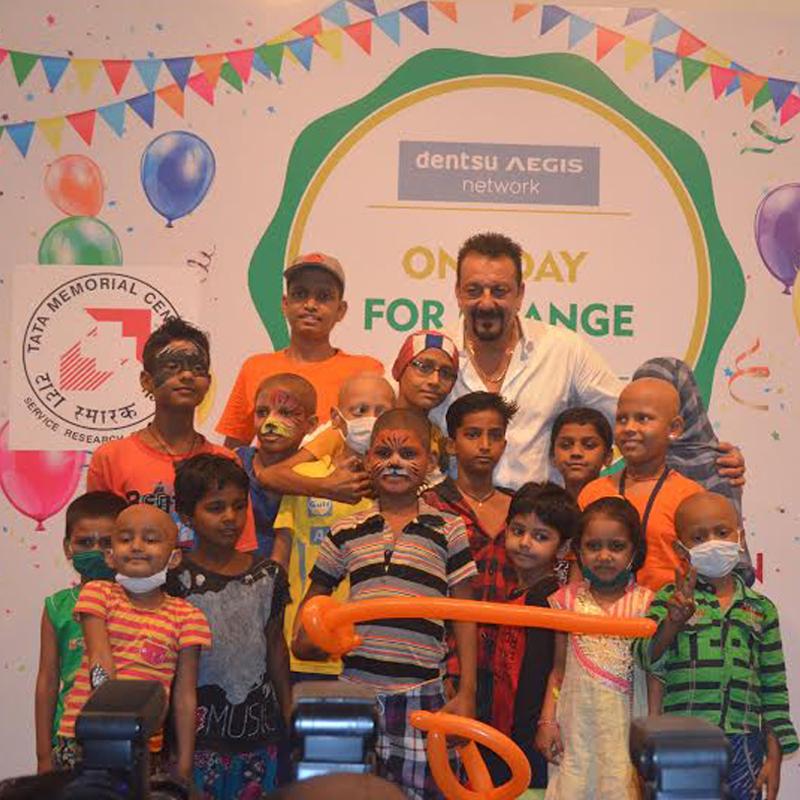
    In Mumbai, Dentsu Aegis Network touched the lives of 1100 kids across nine child welfare organisations. It is pertinent to note here that the Dentsu Aegis Network employees also created a Fun Fair for more than 200 children suffering from various forms of cancer to entertain them all through the day. The event was attended by none other than Bollywood actor Sanjay Dutt, the chief guest for the day at the Tata Memorial Hospital, Parel.

    The company also arranged an educational excursion for 100 underprivileged children, supported by Umang Foundation, to Nehru Science Centre, Worli. Additionally, the group set-up a dental health check-up camp at Madras Wadi, a slum area near Worli, where 300 children turned up for the event.

    The network was sub-divided into teams of 20-50 in Kolkata, Chennai, Bangalore and Kochi. Each team visited a particular child welfare shelter to execute a variety of creative workshops.
    Delhi, Bangalore and Mumbai also tied up with various hospitals and NGOs to organise a blood donation drive for kids with Thalassemia and Cancer. Over 250 bottles of blood were donated by Dentsu Aegis Network staff across all regions.

    Ashish Bhasin, Chairman & CEO South Asia Dentsu Aegis Network said, “One Day For Change is extremely important to us at Dentsu Aegis Network. It gives all our employees an opportunity to give back to the society, as a team. More important than what we volunteer in kind and cash is the time we all volunteer together. We hope to continue many of these activities throughout the year. It really feels good, as a team, to be able to do our bit.”

    One Day For Change is an annual social commitment by the Dentsu Aegis Network, where employees from each of the countries are encouraged to go out and volunteer on the same day.

    Last year, over 800 employees volunteered in India contributing 2,200 staff hours. While the final numbers are still trickling in, it is estimated that in 2016 in India 1,500 employees volunteered over 6000 staff hours for the One Day for Change initiative.

  • Dentsu Aegis Network reaches out to 2500 children on ‘One Day For Change’

    Dentsu Aegis Network reaches out to 2500 children on ‘One Day For Change’

    MUMBAI: Dentsu Aegis Network organised the third edition of its corporate social responsibility programme, ‘One Day For Change’, on June 3, 2016.

    With children playing the central role in the programme this year, the India chapter of this global initiative successfully reached out to as many as 2500 children across the country. An estimated 1,500 Dentsu Aegis Network employees across offices in Mumbai, New Delhi, Bangalore, Kolkata, Chennai, and Kochi were engaged to execute the project, “Champions For Children”.

    In India, the key focus of the ‘One Day For Change’ (ODFC) programme was held across four categories – digital, education, health and entertainment.

    As part of the digital push, the network’s Delhi office visited Kushi Rainbow Girls Home to donate laptops and conduct sessions on excel & IT skills. Meanwhile, the employees also visited the Earth Saviours Foundation and interacted with more than 300 mentally challenged children.

    In Mumbai, Dentsu Aegis Network touched the lives of 1100 kids across nine child welfare organisations. It is pertinent to note here that the Dentsu Aegis Network employees also created a Fun Fair for more than 200 children suffering from various forms of cancer to entertain them all through the day. The event was attended by none other than Bollywood actor Sanjay Dutt, the chief guest for the day at the Tata Memorial Hospital, Parel.

    The company also arranged an educational excursion for 100 underprivileged children, supported by Umang Foundation, to Nehru Science Centre, Worli. Additionally, the group set-up a dental health check-up camp at Madras Wadi, a slum area near Worli, where 300 children turned up for the event.

    The network was sub-divided into teams of 20-50 in Kolkata, Chennai, Bangalore and Kochi. Each team visited a particular child welfare shelter to execute a variety of creative workshops.
    Delhi, Bangalore and Mumbai also tied up with various hospitals and NGOs to organise a blood donation drive for kids with Thalassemia and Cancer. Over 250 bottles of blood were donated by Dentsu Aegis Network staff across all regions.

    Ashish Bhasin, Chairman & CEO South Asia Dentsu Aegis Network said, “One Day For Change is extremely important to us at Dentsu Aegis Network. It gives all our employees an opportunity to give back to the society, as a team. More important than what we volunteer in kind and cash is the time we all volunteer together. We hope to continue many of these activities throughout the year. It really feels good, as a team, to be able to do our bit.”

    One Day For Change is an annual social commitment by the Dentsu Aegis Network, where employees from each of the countries are encouraged to go out and volunteer on the same day.

    Last year, over 800 employees volunteered in India contributing 2,200 staff hours. While the final numbers are still trickling in, it is estimated that in 2016 in India 1,500 employees volunteered over 6000 staff hours for the One Day for Change initiative.

  • Dentsu Aegis Network tops Goafest 2016 metal count as a group

    Dentsu Aegis Network tops Goafest 2016 metal count as a group

    On the road to its stated ambition of becoming #2 in the Indian ad industry by 2017, the Dentsu Aegis Network units quietly combined to bring in the highest tally of metals as a group at the Creative and Media Abbys at Goafest 2016.

    With 6 gold, 32 silver and 45 bronze for a total of 83 metals, Dentsu Aegis Network units in India showed that there was an equal momentum to the creative reputation as there was to its business growth.

    Taproot Dentsu (40 metals), Dentsu Creative Impact (23 metals), Dentsu Webchutney (13 metals), Isobar (3 metals) and Dentsu Marcom and Vizeum (2 metals each) put in their collective best to surpass all other groups at this year’s Goafest. With wins across the entire gamut of categories—from film to print, out of home to activation, design to digital and direct, media to craft—Dentsu Aegis Network showed itself to be a creative force to be reckoned with, even as its business growth has been ample evidence of clients’ faith in the group’s capabilities.

    Commenting on the performance, Ashish Bhasin, Chairman and CEO, Dentsu Aegis Network, South Asia said, “Business growth can only be sustained on the back of fantastic creative work, and our performance at Goafest 2016 is a demonstration of that. Having said that, this is only the beginning. Business stability and growth form a solid foundation upon which creative work can flourish, and that is precisely what you will see from us – in market, and in peer forums like Goafest.”

    “This is a very happy reflection not just of the range and depth of our talent but also of clients’ trust in our abilities. And this is happening because the business and planning heads at each unit are getting behind the creative 100%. The effort that each of our creative leaders has brought to bear is clearly visible here and I thank each of them for this outstanding performance. This is another big step forward in helping us achieve our mission of being the second largest agency group by end 2017 in India, overturning for the first time the existing ranking which has historically been in place for over 80 years in India,” he added.

  • Dentsu Aegis Network tops Goafest 2016 metal count as a group

    Dentsu Aegis Network tops Goafest 2016 metal count as a group

    On the road to its stated ambition of becoming #2 in the Indian ad industry by 2017, the Dentsu Aegis Network units quietly combined to bring in the highest tally of metals as a group at the Creative and Media Abbys at Goafest 2016.

    With 6 gold, 32 silver and 45 bronze for a total of 83 metals, Dentsu Aegis Network units in India showed that there was an equal momentum to the creative reputation as there was to its business growth.

    Taproot Dentsu (40 metals), Dentsu Creative Impact (23 metals), Dentsu Webchutney (13 metals), Isobar (3 metals) and Dentsu Marcom and Vizeum (2 metals each) put in their collective best to surpass all other groups at this year’s Goafest. With wins across the entire gamut of categories—from film to print, out of home to activation, design to digital and direct, media to craft—Dentsu Aegis Network showed itself to be a creative force to be reckoned with, even as its business growth has been ample evidence of clients’ faith in the group’s capabilities.

    Commenting on the performance, Ashish Bhasin, Chairman and CEO, Dentsu Aegis Network, South Asia said, “Business growth can only be sustained on the back of fantastic creative work, and our performance at Goafest 2016 is a demonstration of that. Having said that, this is only the beginning. Business stability and growth form a solid foundation upon which creative work can flourish, and that is precisely what you will see from us – in market, and in peer forums like Goafest.”

    “This is a very happy reflection not just of the range and depth of our talent but also of clients’ trust in our abilities. And this is happening because the business and planning heads at each unit are getting behind the creative 100%. The effort that each of our creative leaders has brought to bear is clearly visible here and I thank each of them for this outstanding performance. This is another big step forward in helping us achieve our mission of being the second largest agency group by end 2017 in India, overturning for the first time the existing ranking which has historically been in place for over 80 years in India,” he added.

  • Viacom18’s Sudhanshu Vats appointed as chairman of IBF Credit and Collections Committee

    Viacom18’s Sudhanshu Vats appointed as chairman of IBF Credit and Collections Committee

    MUMBAI:  The Indian Broadcasting Foundation (IBF) announced the appointment of Viacom18 group CEO Sudhanshu Vats as the chairman of the IBF Credit and Collections Committee & co-chairman of the joint IBF- AAAI sub-committee.

    IBF, in association with AAAI (Advertising Agencies Association of India), had formed a joint credit collections committee which scrutinizes, regulates and evaluates the credit worthiness of the advertiser’s active through AAAI member advertising agencies on IBF member channels. It plays a pivotal role in dispute resolution between channels and agencies vis-a-vis advertisers.
    Vats, also an IBF Board member stated, “I am delighted to have been entrusted with this responsibility. Strengthening our relationship with the advertisers would be our goal and I look forward to introducing newer mechanisms in line with the global standards, to normalize the revenue mechanisms for all parties.”

    The outgoing chairman I Venkat said, “I know Sudhanshu would bring his ethos and greater clarity in the functioning of the committee. I am thankful to all the members for their support and  their valuable contribution and also to Ashish Bhasin , the co- chairman of the committee,  AAAI  who helped me conduct these meetings in a more organised and transparent manner”.

     Speaking on Vats appointment, IBF President Uday Shankar said, ”Both Mr Vats and Mr Venkat have been valuable colleagues in the IBF board and both deserve admiration and appreciation for taking up the task of revamping the broadcaster’s ad revenue flow. I am sure Sudhanshu will bring greater efficacy and democracy to the functioning of the committee.”