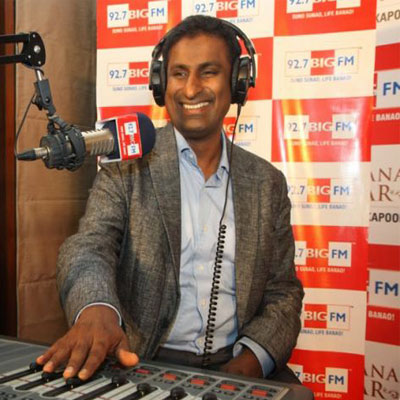
Tag: Asheesh Chatterjee

  • RBNL’s chief financial officer Asheesh Chatterjee takes on the additional role of the company’s chief business officer

    RBNL’s chief financial officer Asheesh Chatterjee takes on the additional role of the company’s chief business officer

    MUMBAI: Reliance Broadcast Network Limited (RBNL) announces the appointment of Asheesh Chatterjee in the role of ‘Chief Business Officer,’ in addition to his current responsibility of serving as ‘Chief Financial Officer’ of the company. During the last year, Asheesh has been instrumental in bringing together his rich experience and understanding of the media industry to guide the Revenue and Business support teams across the company apart from his usual role of managing Finance, Legal, IT & Digital Transformation.  With his deep knowledge of the business since the past 8 years, Asheesh has been contributing in developing practices to help both the radio network’s external as well as internal stakeholders to increase business efficiency, manage costs effectively and deliver great services to clients.

    Commenting on taking on an additional role, Asheesh Chatterjee said, “It’s a pleasure to be taking on the additional position of Chief Business Officer at the company with which I have been associated for 8 years. In keeping with BIG FM’s core ethos, I intend to give it my best in taking the company into its next phase of development.”

    Speaking about Asheesh’s appointment in his new role, Abraham Thomas – RBNL CEO said, “Since his appointment in 2011, Asheesh has been an asset to the company, significantly contributing towards developing practices that enhances business efficiency, manage costs effectively and deliver great value to clients. Over the last year, he has driven the Revenue, Finance and Business support teams to meet the company’s objectives.”

  • GST benefits come with ‘daunting’ compliance & increased paperwork, say sector stakeholders

    MUMBAI: Even as the government has been attempting to convince the industry and the average tax-paper that the goods and services tax (GST) being implemented from 1 July 2017 will help not only in curbing price rise and simplifying taxation procedures, the broadcast and entertainment industry has shown mixed reaction and fears that it may, in fact, lead to more problems and paperwork — at least in the short to medium term.

    In a survey conducted by indiantelevision.com , industry pundits have questioned the increased paperwork and complex compliance that is opposed to the ease of doing business.

    Multi-system Operator GTPL COO Shaji Mathews, admitting that overall taxes related to the media and broadcast industry will come down under GST, said, “The paper work (to become GST-compliant) has increased because you need to register in every state you are operating in.” In the cable industry, the service tax has been 15 per cent. The set-top box (STB) and other equipment related to cable were in a higher tax bracket, 28 per cent earlier, which has now been reduced to 18 per cent.

    Mathews added: “The industry has a very positive approach to the government, but a similar approach is needed from the other side. As far as the consumers are concerned, GST will apparently make their payouts a little higher because the tax rate is up from 15 to 18 per cent.”

    He further said: “With GST coming, it was widely accepted that all other taxes, including entertainment tax, will get subsumed in GST. The implementation of GST was expected to give the industry a uniform pricing and clarity to all stakeholders regarding taxation. There are states where the entertainment tax is not levied by the states but by the local bodies. In these states, there is neither uniformity nor clarity.”

    However, he hoped that as long as everything was system-driven it will ultimately help better compliance and better settlement of tax returns for the cable and broadcast industry. “In the long run, we all are bought by the GST concept. However, there may be problems in the beginning. So we are being patient and are hoping that over a period of time this will definitely be beneficial and everything will fall into place,” Mathews added.

    He concluded: “All the paperwork will not lead to loss of revenue but we think that these investments are worth doing and as an industry we need to contribute to the implementation of the concept.”

    Echoing similar sentiments, Reliance Broadcast Network Limited CFO Asheesh Chatterjee said “the billing software and the entire radio industry are grappling with how the billing is supposed to emanate” because most radio stations operate across multiple states and , hence, compliance is a “challenge.”

    “From our perspective the entire compliance mechanism requires rigorous exercise from all the registrations done across the multiple states and vendors who also need to be GST registered across the space. The radio industry is much smaller, but the compliance load for the industry is much bigger. GST is for the highly automated streams where you have big teams, which are already in place because of the larger scale. But mid size firms do not have that type of automation level and suddenly you are grappling with the time driven agenda of compliance where there is no way out of it,” Chatterjee highlighted the pains of mid-size companies.

    When asked how the GST will benefit broadcasters, he commented, “It will be initially negative for the broadcasters, but may become beneficial later.” But, Chatterjee maintained that it was not easy to be GST-compliant and added, “It is not simple at all. All software, from your billing software to your traffic software, needs higher degree of customization to be ready.”

    Questioned whether the paperwork and filings with the government agencies would increase as compared to the previous set up of multiple taxes, he responded by saying though in the long run the GST regime may be beneficial, smaller organizations, which do not have a high level of automation, will find it “more difficult” to be ready in the short term.

    As to whether the sector will benefit from GST, he explained that if the country’s economy does well, it would benefit everybody, maintaining “in the short term it has pains.”

    Responding to whether getting GST-compliant will lead to loss of man-hours and revenue, Chatterjee admitted that it will lead to “lot of man-hour loss,” but added that compliance, in the long term, would have a cascading effect on the revenues that would increase as systems are properly put in place.

    Republic TV group chief financial officer S Sundaram was more candid when he said, “There is no option. We will know whether we can address all key compliances as and when the process comes into operation.”

    Still, he admitted getting GST-compliant is “not simple” and companies will have to see whether the multiple and online process is helpful.

    While making a point on the impact of GST on broadcasters, he said it was “too early” to judge whether this will benefit the broadcasters or not.

    When asked if paperwork has increased to be GST-ready, Sundaram replied that “numerically it looks daunting” but the actual difficulty can only be fathomed when the filing process begins, adding that GST is a new initiative that has its positives and negatives — while multiple taxes have got subsumed in the new structure, the GST rates have the “potential to confuse” and the robustness of the underlying IT process needs to pass scrutiny.

    However, DDB Mudra Group ED and DDB Mudra West managing partner Rajiv Sabnis was more optimistic saying “most advertisers GST touches are going to have a favourable impact.” According to him, major beneficiaries of the new tax regime would be sectors of retail and FMCG, while e-commerce may get negatively impacted.

    Still, Sabnis also admitted that prima facie GST “looks very simple, but is highly complex” as far as compliance goes. Reason? Vendors have to be registered prior to the 30 June 2017 deadline and many clients do not want to be registered as vendors as they will not get the benefit of the input credit (a technical jargon for offsetting payment of extra taxes). “So there is a complex mechanism of registering vendors,” he explained.

    As to whether GST has increased the paperwork and the filing processes, Sabnis said, “Paperwork has definitely increased for national clients. For example, the Tourism Ministry suggests that all 29 states be charged separately, which means 29 different invoices will have to be raised for one 30-second spot (of advertisement). In that sense, compliance is complex. I think it is a learning curve and if some new complexities arise in future, I am sure the government will find solutions to ease the GST pains.”

    According to Sabnis, in the long run GST would prove to be beneficial to advertising setups as his as it has a high degree of exposure to retail and retail will be benefitting the most from the GST.

    But, that is in the long run. In the short term, broadcasters are bracing for a revenue hit courtesy the GST imposition. A leading GEC CEO was recently heard telling another rival, that his network was girding up its loins for the impact of the new tax.

    “First there was demonetisation which hit our revenues, because advertisers immediately slammed the brakes on spends,” he says. “Now there is GST. While large advertisers such as Levers, Procter & Gamble may continue to spend despite the plethora of paperwork and confusion, smaller ones which do not have their systems in place, may not be that eager. They would want to understand how things will move going forward – paperwork, compliance etc – while observing for a couple of months. I expect July-mid-August to be lean months, especially for the news and smaller TV channels which are dependent on smaller advertisers. Things should ease up after that.”

    That’s a view echoed by the CEO of an advertising network. He expects an advertising flood to hit television channels by end-August. That should provide them with some relief.

    Clearly, 2017 has been a bit of a bumpy ride.

  • Reliance Broadcast Network ups Ashwin Padmanabhan as COO

    Reliance Broadcast Network ups Ashwin Padmanabhan as COO

    MUMBAI: For the second time in a year, Reliance Broadcast Network Limited (RBNL) has promoted executive vice president Ashwin Padmanabhan.


    In his new role as COO, Padmanabhan has stepped into the shoes of former COO Lavneesh Gupta, who quit earlier this year. He will continue to report to Reliance Broadcast Network CEO Tarun Katial.


    In May 2015, Padmanabhan was promoted as EVP, while he continued to handle his existing role as Big FM business head.


    Padmanabhan will now not only look after the radio business of RBNL’s Big FM, but also oversee the company’s television channels Big Magic and Big Magic Ganga.


    It may be recalled that after Gupta quit in May, RBNL went through a re-shuffle wherein the company’s chief financial officer Asheesh Chatterjee was appointed as executive vice president and was given the additional responsibility of COO.


    Padmanabhan, who was Big FM’s national business head since 2013, has been with the company since its inception, starting his tenure as cluster director at Andhra Pradesh. Since then, he has held various designations in the company.


    He holds an Engineering degree along with Masters in Business Administration from BIM, Trichy. He has worked in diverse business sectors including petrochemical, media and other services. Prior to joining Big FM, he was with Visage Media Services as founder and director of content development.

  • Reliance Broadcast Network ups executive leadership; Lavneesh Gupta quits

    Reliance Broadcast Network ups executive leadership; Lavneesh Gupta quits

    MUMBAI: Reliance Broadcast Network Ltd (RBNL) has made a series of promotions in its top-level management. The newly appointed executive leadership team will work seamlessly across RBNL’s radio (92.7 Big FM) and television (Big Magic and Big Magic Ganga) businesses.


    The leadership team with Reliance Broadcast Network CEO Tarun Katial at the helm, will comprise Asheesh Chatterjee as the executive vice president and chief financial officer, who will be looking at new opportunities and expansion plans in addition to the finance and regulatory portfolios.


    On the other hand, Ashwin Padmanabhan as executive vice president and business head will oversee the television channels, in addition to his existing role as business head for 92.7 Big FM.


    RBNL chief strategy officer Sunil Kumaran will across handle revenue and product as well as marketing for both the radio and television businesses. The network’s creative director Paritosh Painter will also work across both the mediums.


    Meanwhile, after a stint of almost two years with the organization, RBNL chief operating officer Lavneesh Gupta has decided to move on.


    Katial said, “In order to build a future ready organisation, we want to build a team of lateral leaders. Their focus will be on developing skills of the team in the areas of innovation, creativity, risk taking and adopting an entrepreneurial approach. I am certain that the team will deliver and continue to successfully drive the growth story for the Group.”

  • RBNL’s radio business continues profitable run in Q1-2014

    RBNL’s radio business continues profitable run in Q1-2014

    BENGALURU: Note: The profit/loss figures mentioned collectively or for each segment in this report are profits before tax and interest (PBIT), unless stated otherwise.


    Reliance Broadcast Network Limited (RBNL) radio business which first returned a profit in Q3-2013 of Rs 3.36 crore, followed by a profit of Rs 8.06 crore in Q4-2013 continued its profitable run with positive figures of Rs 8.71 crore for Q1-2014.


    On a consolidated basis, RBNL reported a loss of Rs 15.76 crore for Q1-2014, about 55 per cent of the loss of Rs 28.705 crore loss during Q1-2013 and about 65.25 per cent of the Rs 24.154 crore loss reported for Q4-2013. RBNL reported a loss of Rs 91.73 crore for FY-2013.


    RBNL CFO Asheesh Chatterjee informed www.indiantelevision.com, “RBNL achieved cash break-even at consolidated level and remains PAT positive at standalone basis in Q1-2014.

    Radio business reported 31 per cent y-o-y growth in revenue and EBITDA of Rs 17.4 crore. TV business sustained leadership reporting 37 per cent y-o-y revenue growth.”


    Overall


    Q1-2014 consolidated total income of Rs 61.1 crore; increase of 26 per cent y-o-y
    Q1-2014 consolidated EBITDA at Rs 0.9 crore – achieves break even.
    Q1-2014 consolidated EBIT was Rs (9.8 crore)
    Q1-2014 standalone total income of Rs 58.5 crore; increase of 18 per cent y-o-y
    Q1-2014 standalone EBITDA at Rs 19 crore; increase of 382 per cent y-o-y.
    Q1-2014 standalone EBIT at Rs 8.8 crore; increase of 264 per cent y-o-y
    Q1-2014 standalone PAT at Rs 2.1 crore; increase of 112 per cent y-o-y.


    Let us look at RBNL’s figures from various segments in Q1-2014


    Radio


    Revenue from radio contributed a major chunk – Rs 47.27 crore or about 73.26 per cent of RBNL’s total revenue of Rs 64.53 crore and 76 per cent of Income from operations at Rs 62.19 crore during Q4-2014.


    Revenue from radio in Q1-2014 at Rs 47.27 crore grew 31.3 per cent as compared to the Rs 36.01 crore for Q1-2013 and grew 2.6 per cent as compared to the revenue of Rs 46.09 crore for Q4-2013.


    Q1-2014 radio standalone EBITDA at Rs 17.4 crore as against EBITDA of Rs 7.8 crore in Q1-2013; increase of 122 per cent y-o-y


    Q1-2014 radio standalone EBIT at Rs 8.7 crore as against EBIT of Rs (-1.0) crore in Q1-2013.


    TV Production


    TV Production, with a standalone revenue of Rs 5.90 crore, contributed 9.5 per cent to Income from operations during Q4-2014. Revenue from production in Q1-2014 grew by 11.8 per cent as compared to the revenue of Rs 5.28 crore in Q1-2013 and 29.24 per cent as compared to the revenue of Rs 4.57 crore in Q4-2013. Production suffered a loss in Q4-2014 of Rs 0.423 crore as compared to a profit of Rs 0.1059 crore in Q1-2013, but 16.11 per cent lower than the loss of Rs 0.504 crore reported for Q4-2013.


    Standalone EBDITA for Q1-2014 from this segment was Rs (-0.3) crore in Q1-2014 as compared to the EBDITA of Rs0.2 crore in Q1-2013 and Rs (-0.3) crore in Q4-2014.


    OOH


    Revenue from outdoor at Rs 1.995 crore in Q1-2014 was almost one third (34.5 per cent) of the revenue of Rs 5.99 crore in Q1-2013 and just 30.6 per cent of the Rs 6.303 crore in Q4-2013. Loss from this revenue segment in Q1-2014 was significantly lower (by 12.4 times) at Rs 0.1758 crore as compared to the loss of Rs 2.182 crore in Q1-2013. Outdoor returned a profit of Rs 0.1407 crore for Q4-2013.

    Standalone EBITDA from this segment was a positive Rs 1.2 crore during Q1-2014 as compared to a loss of Rs 1.8 crore in Q1-2013 and Rs 0.7 crore during Q4-2013
    Televison.


    Consolidated revenue of Rs 8.44 crore from television contributed 13.6 per cent of total revenue for Q1-2014. Revenue from this segment grew at 36.9 per ecent as compared to the Rs 6.16 crore reported for Q1-2013 and just half a per cent as compared to the Rs 8.39 crore for Q4-2013. Consolidated loss from television in Q1-2014 at Rs 18.06 crore was 54.4 per cent higher than the loss of 11.69 crore for Q1-2013, but was significantly lower by 32 per cent as compared to the Rs 26.54 crore loss for Q4-2013.


    RBNL CEO Tarun Katial said, “Reliance Broadcast Network has delivered a robust performance, breaking even at the operating level. Radio has delivered the highest ever Q1 performance, fortifying its position as the leading national network and both key businesses of radio and television are primed to benefit from government reforms.”


    RBNL says that its flagship general entertainment channel Big Magic which emerged a leader in the Hindi heartland, has steadily expanded distribution across the Hindi speaking markets of India, benefiting from phase II of television digitisation. Its ays that TRAI’s mandate to regulate advertisement inventory to 10 minutes per clock hour will translate into more equitable distribution of advertisement inventory across channels, resulting in increased advertisement flow to both radio and emerging channels like Big Magic, Big CBS and Big RTL Thrill.

  • Asheesh Chatterjee is RBNL CFO

    Asheesh Chatterjee is RBNL CFO

    MUMBAI: Reliance Broadcast Network Ltd. (RBNL) has appointed Asheesh Chatterjee as its chief financial officer.

    Chatterjee will lead the finance and legal side of the business and will also spearhead key initiatives like fund raising, M&A and JVs.

    Speaking on Chatterjee’s appointment, Reliance Broadcast Network Ltd. CEO Tarun Katial said, “Asheesh’s varied finance background across critical financial and legal portfolios, will add tremendous value to Reliance Broadcast Network Ltd., which is a young company at a critical growth juncture. We welcome Asheesh on board and look forward to his expertise in taking this Company through its next growth leap.”

    A chartered accountant and cost accountant by qualification, Chatterjee brings with him over 15 years of post qualification experience across varied sectors will – assurance and consulting, financial services, manufacturing and media and entertainment.

    Having held senior finance positions with leading companies like Moser Baer, Sony Entertainment Television (Multi Screen Media), ICICI Prudential Asset Management and Ernst & Young, Chatterjee has worked on a diverse portfolio covering strategic finance, corporate structuring, operational finance, tax planning, audit, treasury and investor/analyst relations.

    On his appointment, Chatterjee said, “The brand Big has successfully created a robust and diversified business model ranging from radio broadcast, television, out of home and live events. I am excited to join the Company and work with a young and dynamic team, to achieve the full potential of Reliance Broadcast Network’s growth strategy.”

    In his last assignment, as the CFO of the entertainment business with Moser Baer, Chatterjee was involved in setting up of the home entertainment & film divisions and leading the company to become the largest home video company in the country within a year from launch.

    He was also spearheading the strategic process at the company to formulate its entry into newer verticals in the M&E space and also manage key strategic initiatives at the group level.