Tag: ASCI

  • MIB issues advisory to curb surrogate advertising

    MIB issues advisory to curb surrogate advertising

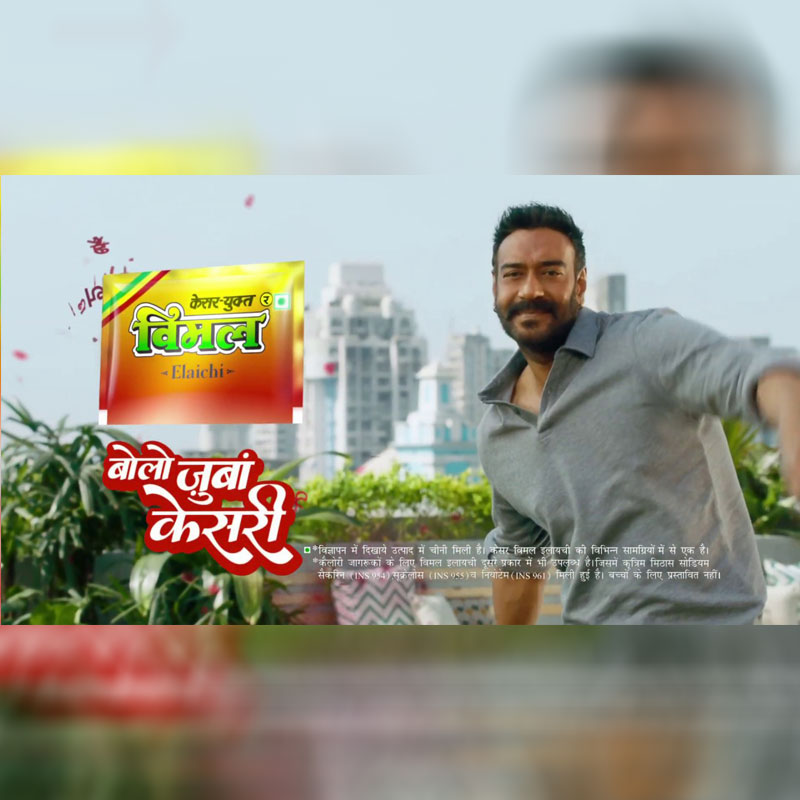
    NEW DELHI: Surrogate Advertising has been a very old debate in the India’s advertising industry. An alcohol brand can advertise in the garb of music CD or a gutka brand can talk about the great taste of saffron and circumvent the advertising code. The rule thus aims at prohibiting surrogate advertisements while at the same time allowing advertisements of genuine brand extensions subject to specified conditions. 

    Rule 7(2)(vih)(A) of the Advertising Code enshrined under Cable Television Networks Rules, 1994 prohibits direct or indirect advertisements of cigarettes, tobacco products, wine, alcohol, liquor or other intoxicants. However, advertisements of genuine products sharing a brand name or logo of such products are permissible subject to specified conditions prescribed therein.

    Time and again, industry people and government institutions have debated the matter on various industry platforms but not much output has come. Several activists and common citizens have also complained about surrogate ads from various categories running on national television but not much could have been done about it.

    Over the years, brands have circumvented the rule to create a massive reach of their products via their brand extensions.

    The latest advisory issued by the Ministry of Information and Broadcast states that such ads have to be first previewed by Central Board of Film Certification before telecast and deemed to be fit for consumption.

    “Second proviso of Rule 7(2)(vhi)(A) provides that such advertisement has to be previewed and certified by Central Board of Film Certification as suitable for unrestricted public exhibition and are in accordance with stipulated conditions,” stated the advisory.

    The focus of this advisory was mostly on brands related to the cigarettes, tobacco products, wine, alcohol, liquor or other intoxicants. The advisory clearly stated that “It is accordingly advised that all advertisements of the nature referred to at para 2 above strictly follow the stipulations contained in the Rules and are previewed and certified by Central Board of Film certification (CBFC) before being telecast on Television.”

    The decision is expected to create a strong impact on the brands for this industry because many of these players have emerged as the top advertisers of the country. 

  • Subhash Kamat: “We are looking for government collabs for ASCI”

    Subhash Kamat: “We are looking for government collabs for ASCI”

    NEW DELHI: Last week, BBH & Publicis Worldwide India CEO Subhash Kamat was unanimously elected as chairman of the board of governors of the Advertising Standards Council of India (ASCI), an independent industry body that works towards protecting the consumers' interests by containing the menace of misleading ads. The veteran ad man replaced the outgoing chairman Rohit Gupta who served in that the position for a year. Kamath has been an active member of The Ad Club in the past and has been serving on the board of governors of Asci since 2010.

    Kamat has his work cut out for him: ASCI is not the only body which can crack the whip on advertising: there’s the Central  Consumer Protection Authority which apparently has powers to penalise errant advertisers. There’s a huge surge in political advertising, which does not come under its remit. Then there’s the continuing explosion in digital advertising, online and on OTT platforms.

    Indiantelevision.com’s Dolly Mahayan got into a conversation with Kamat on the challenges before Asci, how it is dealing with them, what is he going to immediately focus on, and what kind of a legacy he would like to leave behind. He also spoke about the industry watchdog's guidelines on big and small brands to curb misleading advertisements and what lies in the future around the celebrity influencer guidelines. Excerpts from the interview:

    Read more news on ASCI

    What will be your immediate role and responsibilities? What are your top priorities? 

    We must continue to build on our past milestones, as well as work hard to take our work to the next level. Collaborations across different stakeholders, making ourselves technologically savvier, will be some key objectives so that we are able to address the opportunities of the future stronger and better. In terms of the regulatory context, we have a new consumer protection law and the Central Consumer Protection Authority. Therefore, the context in which ASCI functions has also been transformed. All this makes it imperative for us to think hard about codes, guidelines, regulations, etc. We will build on our past work. The question is what should we do to take this work to the next level? I’d love to see the Consumer Complaints Council and board members working more closely together. The intellectual debate that would follow would raise the quality of decisions and the standards of internal working.

    How do you plan to further strengthen the teeth of ASCI?

    With the digital revolution influencing brand messaging and engagement with consumers, advertising is evolving rapidly. And with the recent formation of the Central Consumer Protection Authority constituted by the government, self-regulation will be even more crucial in promoting consumer confidence and trust. Our industry today is at a crucial stage.In addition to the above, we will look for more close collaborations with government departments.

    How do you plan to regulate the brands and agencies to stop coming up with misleading ads?

    We already have a clear code in place that is continuously evolving. Our processes have kept pace too. For instance, we now monitor 3,000 digital platforms in addition to print and TV through the national advertising monitoring service. We now cover 80 per cent of India’s ad spend. We have a transparent and easy complaints redressal process and we offer fast-tracking of it too. Because we’re self-regulated, we have consistently had a compliance rate of well over 90 per cent.

    What is the way forward on celebrity influencer guidelines?

    The world over, people follow celebrities and get influenced by them. The ASCI code clearly states that celebrities must do due diligence to ensure that the advertisements they appear in do not violate ASCI codes so that they don’t land up misleading consumers. It’s reasonable to expect that celebrities be mindful of what they attach their name to because they have the trust of millions of consumers.

    A lot of small agencies across different pockets of the country are less aware of the role and functionality of ASCI. How do you intend to aware of them? 

    We already have a robust awareness creation mechanism. We do this through regular interaction with the media and also through very active social media channels. That is why consumers know and agencies know about us and approach us in such large numbers.

    Read more stories on Subhash Kamath

    While we see big and small brands coming up with misleading ads across categories, which are the top five  categories with the most misleading ads?

    Last year, the food and beverage, healthcare, and education sectors accounted for 79 per cent of the complaints processed by ASCI. These are sectors we’re looking at closely, especially given the claims about Covid2019 preventions and cures.

    What will be the key milestone that you would want to achieve in this position?

    To be completely in sync with the new digital reality.

  • ASCI appoints Manisha Kapoor as its new secretary-general

    ASCI appoints Manisha Kapoor as its new secretary-general

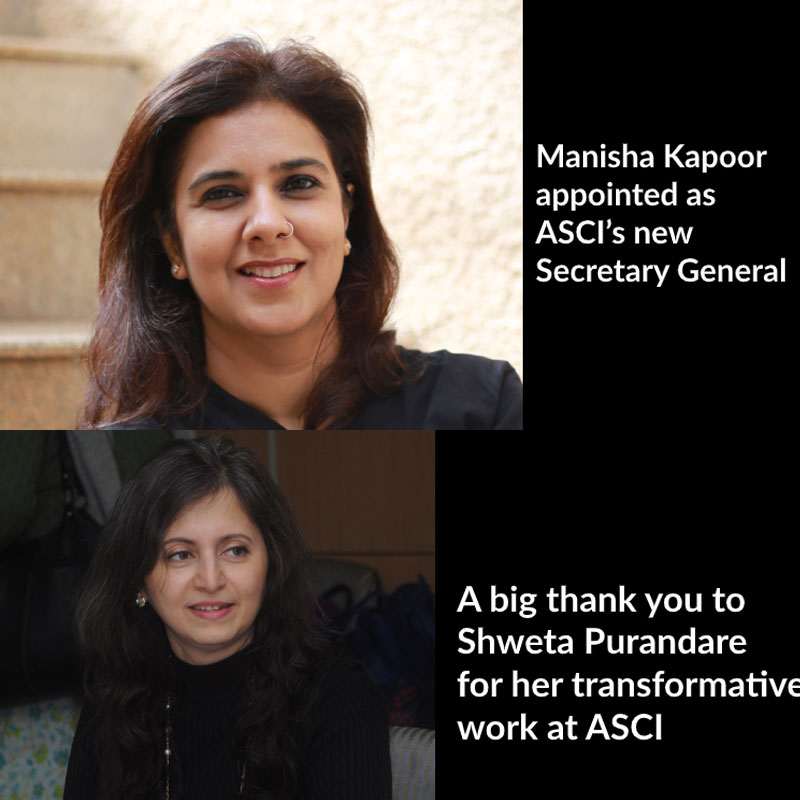
    MUMBAI: The Advertising Standards Council of India (ASCI) has named Manisha Kapoor as its new Secretary-General. From September 1, Kapoor will take over ASCI’s secretariat responsibilities, including the consumer complaints redressal process as well as the marketing, public relations, and social media initiatives.

    Kapoor has been part of ASCI’s consumer complaints council for the past five years and is, therefore, closely associated with the advertising industry’s self-regulatory body. She will take over from Shweta Purandare.

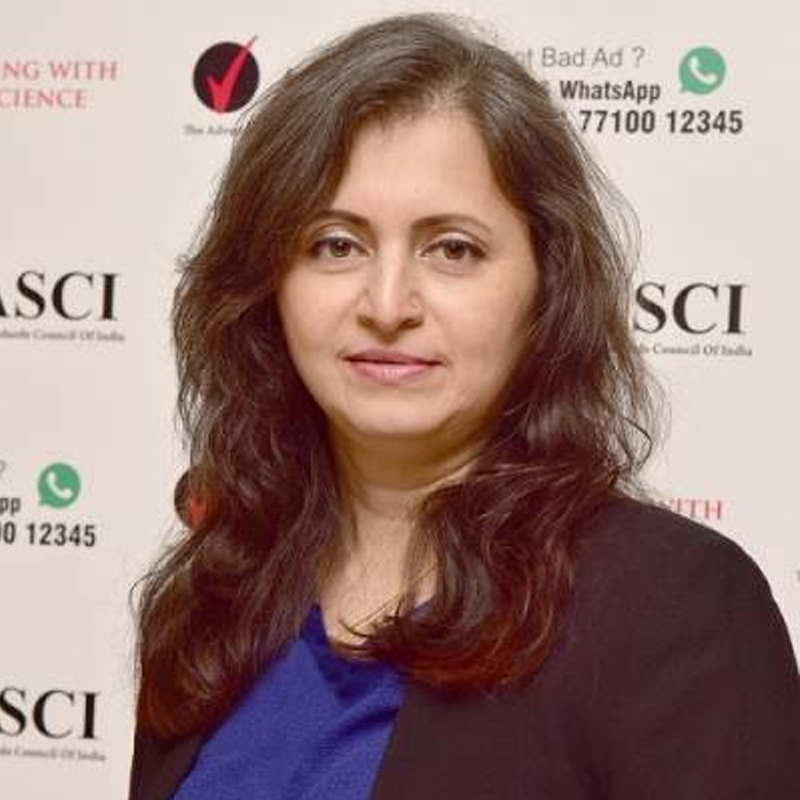
    Purandare joined ASCI eight years ago as chief complaints officer and took over in 2014 as the Secretary-General.  During her tenure, ASCI became bigger and better. It launched its WhatsApp number and set up new complaint redressal and review processes. She also was instrumental in increasing ASCI’s vibrant presence on social media. Over the years, she became the public face of ASCI with various stakeholders and represented it with distinction in various fora.

    ASCI chairman Rohit Gupta said: “We thank Purandare for her work in achieving our vision and her belief in our goals and motto. She was instrumental in enabling ASCI’s closer engagement with the regulators resulting in ASCI signing MoUs with the Department of Consumer Affairs, the Food Safety and Standards Authority of India, and the Ministry of AYUSH. As she embarks on the next phase of her career, we wish her the very best. We are delighted that Kapoor will take on the role now. We look forward to her valuable inputs and leadership.”

    Purandare said: “It has been an extremely enriching experience professionally through which I could contribute to ASCI’s transformation in terms of capacity, capabilities, and stature. As I move on to undertake a new journey, I wish Kapoor the very best.”

    Kapoor has more than 25 years of experience in building brands and businesses. Having worked with companies like Hindustan Unilever and J&J India, she has also consulted with corporations on brand development and strategy for the past 15 years – first with MarketGate Consulting and more recently with Futurebrands Consulting. She has also worked with several non-profits and the government on development sector projects.

  • OTT platform runs commercials for liquor brand, report says

    OTT platform runs commercials for liquor brand, report says

    KOLKATA: Sparking a new controversy, the streaming service SonyLIV runs commercials for liquor brands between breaks. It appears the liquor brands which can’t use television or print, are utilising OTT platforms in the absence of advertising codes. The OTT platforms don’t have any advertising code yet for their original content.

    According to a Mint report, the liquor brand Diageo India promoted its 180 ml pocket-size flasks called 'Hipsters' which launched last year for scotch whiskey brands Black Dog, Black & White, and Vat 69.

    However, it displayed the ad with a disclaimer that it should not be shared with people below the legal drinking age. The brand has shown on-screen during the cricket tournament that young consumers are pouring whiskey from a flask to make a chilled drink on multiple occasions when the drink can be enjoyed.

    "It is in accordance with the Diageo Marketing Code and Diageo Digital Guidelines, that guide for all communications that go out across any platform," a company spokesperson said as quoted by Mint.

    Advertising Standards Council of India (ASCI) secretary-general Shweta Purandare said these matters are beyond the scope of ASCI. According to ASCI, such matters are best examined and dealt with by the concerned regulators.

  • Brands boost sales with SARS Cov2 virus-killing fabrics; ASCI warns against advertising without proof

    Brands boost sales with SARS Cov2 virus-killing fabrics; ASCI warns against advertising without proof

    NEW DELHI: The race to create Covid2019-protective products is on. Indian fashion retail brands such as Donear, Arvind, and Siyarams have launched anti- Covid2019 fabric products in the market, claiming that it kills the deadly virus when comes in contact with the product.

    Textile manufacturer RSWM Ltd has announced its latest innovation with the launch of the anti-viral fabric range ‘ViroSecure.’ The new range has been launched through a strategic technology partnership with HeiQ that lends its antiviral Viroblock technology to formulate a protective coating on the fabric to offer 99.99 per cent protection against SARS-CoV-2 in just 30 minutes. With ViroSecure, RSWM is targeting 20 per cent of sales in FY 2020-21.

    Mayur Suiting and LNJ Denim CEO and business head Suketu Shah says, “As the world reels under COVID2019 impact, we, as a company have the responsibility towards our consumers and are committed to equipping them with the resources to adapt to this new normal. There is a significant uptake in the demand for the anti-viral fabric technology and with this; we are targeting 20 per cent of the sales from the ViroSecure fabric in this fiscal.”

    Siyaram’s has also launched its anti-corona range of fabric tested by the WHO (World Health Organisation) approved labs to fight against the spread of the pandemic. The brand claims that the anti-corona fabric provides a 24/7 silent sentinel protection from the deadly virus and is developed in association with HealthGuard, and guarantees 99.94 per cent effectiveness against the virus.

    As revenues dry up, marketers are finding novel ways to push up sales. Scenario Consulting CEO Rajesh Lalwani says, “Unless backed with unambiguous medical research any health benefit claims by brands are to be taken with a pinch of salt but to do this around an unprecedented, global pandemic like Covid2019 appears highly irresponsible. We don’t know enough about the virus itself yet and to claim that we have found fabrics that won’t let Covid2019 survive seems suspect at best and frivolous at worst. I am not sure if customers are likely to be fooled so easily and would be surprised if take these messages on face value.”

    However, people have also trolled the brands asking for the evidence which led the Advertising Standards Council of India (ASCI) to enter into the scene. The council has raised objections about telecasting such ads on social media platforms.

    ASCI wrote on Twitter, “Dear advertiser, do not make any claims implying benefits that are not substantiated. Avoid misleading claims such as products that can mitigate or prevent from COVID2019 virus.”

    Donear Group claims that it has collaborated with ZODIAC and has supplied a significant volume of the fabric treated with the unique HEIQ Viroblock technology that has tested successfully against the virus that causes COVID2019. ASCI has asked Zodiac to prove its facts or withdraw the ads.

    TRA Research CEO N Chandramouli explains, “It is natural for a product to capitalise on the current demand and come up with products that suit the customer’s needs. However, when it comes to making claims, brands must be backed by scientific evidence or else unsuspecting consumers may end up buying products that are non-efficacious in their immunity or Covid2019 protection properties. ASCI has done the correct thing by taking action on such unsupported ad claims.”

    Samsika Marketing Consultants founder, chairman and MD Jagdeep Kapoor opines that fabric brands promoting special products during these troubled times are following a relevant emerging need strategy. “This is a protective opportunity for consumers and retailers and a timely business opportunity for brands. The most critical element in this brand strategy will be credible efficacy.”

    Last month, Patanjali had a massive launch for its Covid2019 cure but later took a U-turn on the claim. This created a massive furore for misleading people.

    Chandramouli asserts that most often, the time lag between the claim made by the brand and the action taken against the ad is enough to give momentum to the brand’s Covid2019-related product. “Even if they change their claim afterwards, as did Patanjali, the original residual message of the brand stays in the consumers’ minds. Rather than impact credibility, some brands cleverly use this time-lag to their advantage.”

    According to Lalwani, brands get away with cheap penalties but manage to get eyeballs in the interim. “Typically, top tier brands do not do this but brands that cater to masses tend to try such gimmicks and get away most time. People have short memories in today’s times unless the damage suffered by such claims was serious,” he adds.

    In the last few months, at least four textile brands have come out with such kinds of technology-infused fabrics that claim it kills the virus shortly after it lands on the surface. As buyers are highly cautious these days and look for protection in everything, it has created a new opportunity for brands to come out with new products. However, it will be interesting to observe how effectively these brands will advertise for this new range.

  • ASCI looks into  533 objectionable ads in March-April

    ASCI looks into 533 objectionable ads in March-April

    MUMBAI: During the months of March and April 2020, ASCI investigated complaints against 533 advertisements, of which 115 advertisements were promptly withdrawn by the advertisers on receipt of communication from ASCI. The Consumer Complaints Council (CCC) evaluated the remaining 418 advertisements, of which complaints against 377 advertisements were upheld. Of these 377 advertisements, 187 belonged to the healthcare sector, 132 belonged to the education sector, 15 to the food & beverages sector, nine belonged to the real estate sector, five to the personal care and the immigration sector each and 24 were from the ‘others’ category.

    The ministry of AYUSH sought help from the ASCI team to alert them about such advertisements. The ASCI team picked over 50 such COVID cure advertisements in April, notifying the advertisers to withdraw them forthwith within a week.  ASCI closely monitored digital media, social media handles and web-sites of the advertisers. Over 90 cases of potential violation of the drugs and magic remedies regulations were also flagged to the regulator. During this period, the CCC continued their meetings over video conferencing.

    According to ASCI chairman Rohit Gupta, “I am very proud of our ASCI team that has remained accessible and responsive to all stakeholders during this pandemic situation. Our Consumer Complaints Council has been very efficient as we continue to deliberate via video conferencing. We appreciate the cooperation being extended by the complainants as well as the advertisers to ensure self-regulation of advertising content by ensuring time bound compliance.”

    Follow Tellychakkar for the consumer facing news & entertainment

  • 171 misleading ads withdrawn at the behest of ASCI

    171 misleading ads withdrawn at the behest of ASCI

    MUMBAI: In the month of February the Advertising Standards Council of India (ASCI) investigated complaints against 279 advertisements, of which 101 advertisements were promptly withdrawn by the advertisers on receipt of communication from ASCI. The independent Consumer Complaints Council (CCC) of ASCI evaluated the remaining 178 advertisements, of which complaints against 171 advertisements were upheld.

    Of these 171 advertisements, 77 belonged to the education sector, 59 belonged to the healthcare sector, six to real estate, five to visa/immigration services, five to personal care, four to the food & beverages sector, and 15 were from the ‘others’ category.

    ASCI continues to see advertisements featuring celebrities falling short of adhering to “Guidelines for Celebrities in advertising”.
     
    ASCI secretary general Shweta Purandare said, “Our guidelines for Usage of Awards/ Rankings in Advertisements that were introduced in January 2020, are proving to be a timely step in the right direction. We are educating the advertisers that self-sponsored awards and ranking are on thin ice and will not hold any more. They need to know the rigor expected in claim substantiation when referring to awards and rankings in their advertisements”.

    Amongst the various advertisements that were scrutinized, CCC pulled up a misleading advertisement of a “gamified school education” app claiming it to be the biggest scholarship exam, and promising prize money worth up to Rs one crore, featuring one of Bollywood’s legendary actors. An advertisement of herbal drops endorsed by a Bollywood celebrity made a misleading claim that it can save or protect from diseases by immunity enhancement.

    ASCI also saw several real estate companies making superlative / leadership claims. A few of them were specially focused on providing communities and townships for elderly people. One well-known brand while promoting their township project for seniors, made an unsubstantiated claim of being “India’s Largest Senior-Living Community”.

     A popular auto company, in a TV advertisement, depicted a pillion riding barber shaving the rider on a running motorcycle.  It showed a dangerous act with disregard for safety and challenged safe driving requirements. The advertisement contravened ASCI’s guidelines for advertisements depicting automotive vehicles.

    ASCI also processed complaints against several advertisements which guaranteed “100 per cent Visa”, “100 per cent Visa Success Ratio”, “No.1 Visa Company '' either for work or education in countries which had stringent documentation mandates. Such misleading claims were likely to lead to widespread disappointment in the minds of students and job seekers.

  • ASCI calls Kissan Ketchup, Oxylife ads misleading

    ASCI calls Kissan Ketchup, Oxylife ads misleading

    MUMBAI: The Advertising Standards Council of India (ASCI) has called out popular brands like Kissan Ketchup (HUL), Bajaj Pulsar (Bajaj Auto Ltd) and Oxylife (Dabur) for misleading advertising.

    ASCI investigated complaints against 342 advertisements in January this year, of which 110 advertisements were promptly withdrawn by the advertisers on receipt of the communication from the council. The remaining 232 advertisements were evaluated by the independent Consumer Complaints Council (CCC) of ASCI that upheld complaints against 208 advertisers, out of which 83 belonged to the education sector, 64 belonged to the healthcare sector, eight to personal care, seven to real estate sector, five to the food & beverages sector, and 41 were from the ‘others’ category.

    ASCI revealed in a press note that it exercised the “Suspension Pending Investigation” (SPI) option to fast track a complaint against an extremely offensive advertisement of an online content app. The advertisement shown as a user-uploaded content involving the use of expletive and swear words as well as the use of obscene language. The advertiser was instructed to pull down the objectionable advertisement within 48 hours.

    Kissan Ketchup’s claim to "boring roti-sabji ko banaiye yummy kissan roll" was found to be misleading. It was observed that while the CCC agreed with the advertiser’s submission that ketchup, like a condiment, enhances the specific tastes of the dish, thereby making it appealing to the children. However, calling out regular “roti-subji” as boring was considered to be discrediting home-cooked food and also disparaging good food practises. The advertisement also contravened the ASCI guidelines on advertising of food and beverages.

    Bajaj Pulsar was called out for portraying dangerous acts and manifesting a disregard for safety as ‘the visuals were likely to encourage minors to emulate such acts which could cause harm or injury.’

    “PharmEasy’s television advertisement’s claim “Trusted by 50 Lac + Customers” was not substantiated. The advertiser did not provide any verifiable data or market/consumer survey data to support the claim nor was the claim backed by any audited report or independent third-party validation,” noted ASCI's press statement.

    In the cosmetic and personal care category, Dabur was found to fall foul by contravening the ASCI guidelines for advertising of skin lightening or fairness improvement products. These were two separate advertisements of their cosmetic bleach brands. Another FMCG company misled consumers by claiming that its soap was recommended by doctors and is capable of reducing the risk of skin problems by up to 95 per cent.

    For the month of January, the CCC saw misleading advertisements of several IVF hospitals and fertility clinics guaranteeing success and claiming to be the best. There were also a number of real estate advertisements making leadership claims which were unsubstantiated.

    Follow Tellychakkar for the consumer facing news & entertainment

  • ASCI welcomes health ministry’s move to update healthcare ad regulations

    ASCI welcomes health ministry’s move to update healthcare ad regulations

    MUMBAI: Quacks, fake doctors and illegal mobile dispensaries had better watch out. The Indian ministry of health & family welfare (MHFW) is taking steps to take you out of business.

    Under the draft Drugs and Magic Remedies (Objectionable Advertisements) (DMR) (Amendment) Bill, 2020, it is seeking to levy fines of Rs 5 lakh and  imprisonment of two years on violators for the first offence, going up to as much as five years in gaol and a fine of Rs 50 lakh for subsequent violations. The various disorders and illnesses have also been clearly defined, while what constitutes an ad in modern times has also been spelt out. The MHFW is seeking the public’s feedback on the DMR Amendment Bill 2020.

    The effort by the ministry to update the older act has met with the approval of the advertising industry’s watchman the Advertising Standards Council of India (Asci). Its secretary Shweta Purandare got into a tele-conversation with indiantelevision.com and said that the amendment will help it police the healthcare sector better.  "The proposed DMR bill 2020 is an important development and would lend strong support to ASCI's efforts of suo motu monitoring of misleading advertisements in the healthcare sector,” she said. “Consequences of advertisements in violation of DMR regulations are serious and this would result in better compliance from advertisers as well as media concerned, be it an advertisement of allopathic products or Ayush products.”

    The draft bill has listed the diseases and conditions which will come under its  umbrella. These include: AIDS, blindness, blood poisoning, bronchial asthma, cancer benign tumour, cataract, change in colour of hair and growth of new hair, change of foetal sex by drugs, congenital malformations, deafness, diabetes, diseases and disorders of the uterus, obesity, fairness of the skin, form and structure of the breast, genetic disorders, improvement in size and shape of the sexual organ and in duration of sexual performance, improvement in height of children or adults, mental retardation, sub normalities, and growth.

    Purandare further stated, “Apart from print and TV, it will be interesting to see the impact of advertisements on social media as well as on the advertisers' websites. We would expect this effect to trickle to advertisements by Ayush doctors and clinics propagating ‘guaranteed cure’ as the Central Council of Indian Medicine has taken cognizance of DMR violations in the past and had issued an advisory to state councils for their action."

  • ASCI releases guidelines on award referencing in ads

    ASCI releases guidelines on award referencing in ads

    MUMBAI: The Advertisement Standards Council of India (ASCI) has introduced guidelines for usage of awards/rankings in advertisements effective 1 February 2020.

    According to a press release, “Consumers are sometimes misled into believing that an award or ranking which is given to a brand, product, institute or service makes it superior and /or more authentic.”

    To ensure that their claims are not misleading, the guidelines will lend assistance to advertisers for the appropriate usage of reference to awards or rankings in advertising, the release said.

    It will also assist the advertiser to understand the rigour required for claim substantiation and pitfalls to avoid so that their claims pass the muster with ASCI’s Consumer Complaints Council (CCC).

    The council urged brands and services to ensure that the accrediting bodies involved in disseminating or presenting awards or rankings are authentic and credible to validate their claims in advertisements.

    Moreover, the guidelines are also applicable to all advertisers and would particularly be relevant for healthcare services and the educational sector which tends to use such superiority or leadership claims.

    In this regard, ASCI chairman Rohit Gupta said, “Claims such as ranking first in the state or in India, receiving an award for being the most trusted or award of excellence, listed in some book of world records etc. makes consumers believe that the product/service is recognized and trustworthy, whereas in some cases this may not be true.”

    He added, “The guidelines are a step towards ensuring that advertisers are cognizant of the serious impact of deceptive advertising and hence make responsible claims when referring to awards and rankings in their advertisements.”

    The council said, prospective students and parents easily fall prey to awards/ranking claims by institutes and coaching classes as they rely blindly on such claims. It added that a wrong choice directly impacts the quality of education and the future of children and has a financial implication.

    Citing an example of the health services sector, the council said, misleading claims about rankings and awards lure patients in choosing the service provider and could hamper patient health, quality of care received and result in financial losses.