Tag: ASCI

  • How do Influencers perceive the ASCI code on Influencer advertising

    Mumbai:  The 14 June deadline for the Advertising Standards Council of India (ASCI) code on influencer advertising to be implemented is just around the corner, even as we reach out to some of the primary stakeholders- the social media influencers themselves. We share their take on the rules that will govern all their future branded collaborations (and already too), with creative content creators being popular and credible voices of society.

    While most agree that the Influencer advertising guidelines released last month has transparency at its core to help customers discriminate between a paid content and an organic post, the underlying concern that emerged was whether the new code proposes to shift the onus (of falling foul of the law) on the content creators more than the brand.

    To fully understand the implications of the guidelines on the fledgling Influencer marketing industry, it is only fair that we listen in to the influencer’s side- especially now that the deadline to implement the code looms large.

    Indiantelevision.com spoke to some of the leading influencers from disparate genres like Fashion, Tech & Social satire to understand their thoughts on how they perceive the guidelines, whether they have started implementing them, and if they have noticed any changes in their traction or engagement.

    Fashion & Beauty content creator Sakshi Sindwani, owner of the Instagram handle @stylemeupwithsakshi with over four lakh followers believes the guidelines will enable content creators to make an informed decision on the ‘what’ and ‘how’ of branded content, and relevance of collaborations. “However, there is a rider in terms of engagement,” she says, “It impacts the numbers. So, content creators and brands will have to go the extra mile to ensure that content is creative and integrated, rather than exclusive. Furthermore, creators will need to identify what makes their audience remain loyal.”

    Comedy content creator & popular Social satirist Saloni Gaur @salonayyy aka Naazma Aapi aka ‘pados wali aunty’ and a plethora of other satirical characters, with 5.5 lakhs followers on Instagram says: “A few brands don’t like to put labels like paid promotion on your content, it reduces engagement and people don’t like to consume branded content.”

    Known for her biting, humorous take on everyday issues and for calling a spade a spade, Saloni agrees that it makes sense from a consumer point of view as it is important to maintain transparency and authenticity. “While the labels might impact the viewership/ engagement, creators need to believe that at the core of creation lies relevant and organic content. And content is king! Creators hold the power in their hands to make it engaging and entertaining for the audience,” she adds.

    According to Tech Blogger Shlok Srivastava aka Techburner, with 4.78 lakh followers on Instagram it is a step in the right direction, however, “the nuances of guidelines are not thought through for different platforms or genres.”

    The guidelines define ‘influencers’ as those having access to an audience with the power to affect the purchasing opinion and decisions of the consumers. “Social media is a vast pool with so many creators. Some of them are sceptical about the implementation of these guidelines for the kind of content that they create. For instance, in a space like Tech or Auto, 90 per cent of the products are given by the brands for reviews owing to the credibility that we hold. So, if we label such content as paid or branded, it’ll create confusion amongst the audience and they’ll doubt our authenticity which will destroy the whole purpose of establishing regulations,” says Srivasatava.

    Pulp Strategy founder & MD Ambika Sharma says, the reception to the reining in by ASCI has been a mixed bucket. While most Influencers understand that the move is a positive one, they have concerns around the impact it would have.

    “We are currently working with over three dozen influencers for different campaigns, the sentiment is mostly positive. There is a lack of awareness and we are building compliance alongside campaign execution,” she says.

    IPLIX Media co-founder Neel Gogia states that as with every new initiative a debate is necessary to create a sustainable solution.

    “The lines are a little blurred. For instance, a non-monetary association under which an influencer shares an unbiased product review will be labelled as an Ad, leaving consumers in a tough spot. This will be difficult to implement for a tech or an auto influencer as they cannot buy every product for review as they are of high monetary value, and in fact, not all the reviews are positive as well so they cannot be labelled as an Ad,” he says.

    Furthermore, Gogia says that the current recommendations might not be aligned with the objective of organic and value-added content creation with genuine product integration. “For a YouTube content creator with long-format vlogs labeling the entire integration section as an Ad will lead the audience to ignore the content even if it is adding value to them”, he adds, saying that we will just have to wait and watch how this unfolds.

    In recent times, a significant portion of the marketing budget of brands or businesses is allocated to social media advertising. Influencer marketing has witnessed a surge in India, especially in the pandemic period. Nielsen studies have shown that home-bound consumers during the pandemic have led to a 60 per cent spike in the amount of video content watched globally.
  • Amul & PETA India engage in a Twitter war

    Amul & PETA India engage in a Twitter war

    Mumbai: Just days after Amul claimed vindication on its ad that purportedly unravels the facts and myths behind vegan milk as opposed to cow’s milk, the debate seems to have spilled all over the social media, triggering a tweetstorm between Amul MD Sodhi and PETA India. The ad released in March this year by Amul was challenged by three animal rights organisations, one of them being PETA, for disparaging vegan milk as “impersonating or masquerading as a dairy product”, while extolling the virtues of cow’s milk. The petitioners alleged that the contentions made in the advertisement were false.

    The ‘Myths vs. Facts’ print campaign, according to Amul, was to “expose the falsity behind myths that were being circulated regarding milk and to call out plant-based beverages terming itself as ‘milk’.

    The Advertising Standards Council of India (Asci) dismissed the three complaints filed by the organisations — Beauty Without Cruelty, PETA and Sharan India, who had complained against the homegrown dairy giant’s ‘Myths vs. Facts advert which said that plant-based “milk” is not milk. The petitions were filed on 24 March.

    Based on the response and evidence provided by Amul, as well as FSSAI guidelines that specifically defined milk as a vegetarian product, the consumer complaints council (CCC) of ASCI examined the issue and concluded that the advertiser had not made any misleading claims in the advertisement. 

    Following this, Amul India MD Sodhi tweeted the news with his strongly-worded statement, where he is quoted as saying, “Plant-based food companies are encashing the equity of milk. These products are nothing but genetically-modified lab foods that are made out of chemicals and synthetic materials by big corporations and MNCSs, with the only objective of profit making and not livelihood.”


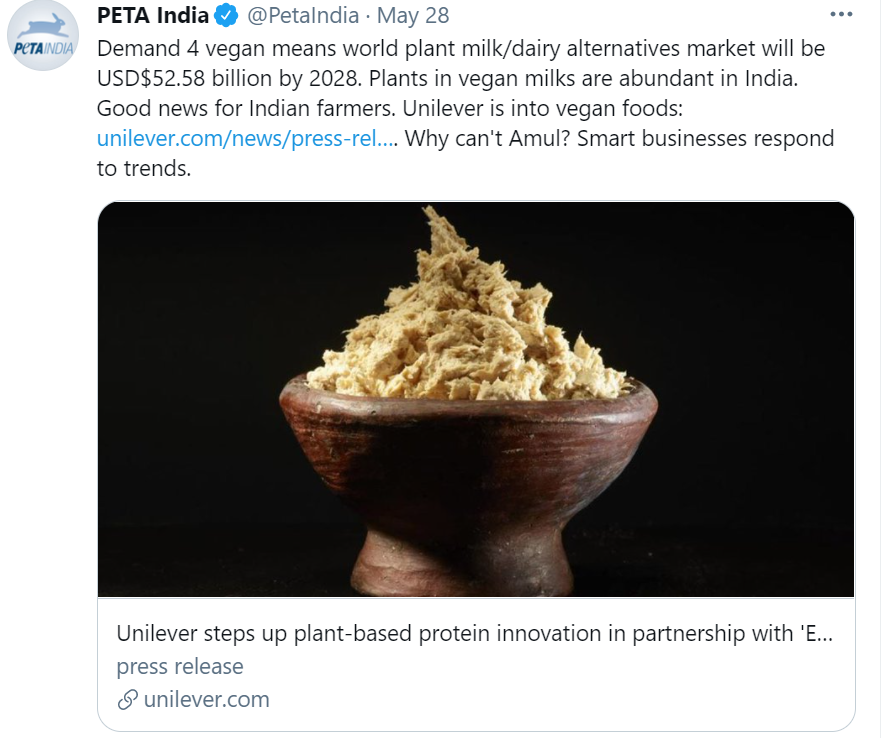
     In response, PETA India tweeted “Indian farmers stand to greatly benefit from vegan (which simply means made from plants) foods. Instead of fighting the inevitable vegan national/global trend, @Amul_Coop can start making plant-milk itself like so many dairy & former dairy companies now do.”

    It also shared a Forbes article stating how India can lead the Vegan economy against the future pandemics. Vegan milk is an umbrella term referring to various kinds of non-dairy, plant-based ‘milks’ such as soy, coconut and almond.

    However, the country’s largest producer of dairy products was not amused by the suggestion.

    “Peta wants Amul to snatch livelihood of 100 mill poor farmers and handover all resources built in 75 years with farmers’ money to market genetically modified Soya of rich MNCs at exorbitant prices, which (the) average lower middle class can’t afford,” Sodhi tweeted in his rejoinder to the NGO.


    PETA India, countered citing another FMCG brand’s name which had made the shift, “Unilever is into vegan foods. Why can’t Amul?” with a gentle jibe that “Smart businesses respond to trends”.

    While both parties continued to stick to their respective stands, several netizens clambered onto the tweet-war, expanding the scale of the debate – with each giving their take on it while taking sides.

    Some accused PETA of selectively singling out issues, while ignoring other cases where animal abuse is rampant- advising it to focus on saving animals.

    Many others criticised Amul for labelling all plant-based beverages as bad. One twitterati tweeted in favour of veganism, accusing the dairy giant of providing employment and making money at the cost of cows and their calves. “Needs & technology continue to evolve for the better all the time. Jobs evolve with it. You are setting your company up for failure by fighting against what is right. #veganism.”

    As of now, there seems to be no end in sight to the debate around cow’s milk vs. vegan milk. What’s your take on it?

  • “Need of the hour”- industry hails ASCI’s new guidelines

    “Need of the hour”- industry hails ASCI’s new guidelines

    MUMBAI: Is the party over for influencer marketing in India? Or does it get bigger hereon? These are some of the questions playing in the minds of industry players and consumers as the Advertising regulatory body (ASCI) unveiled its long-overdue guidelines for influencer advertising, here on Thursday. The new rules come into effect on 14 June.

    The Influencer advertising market in India is booming across social media platforms and is estimated to be worth $75-100 million, as per digital marketing agency AdLift. And, it’s only getting bigger. With people unable to indulge in retail therapy and check products & services in person, watching an influencer talk about the product or following the social media talk seems like the next best option for many.

    Brands too have recognised its burgeoning potential and allocated a significant share of their digital ad spend on the segment. Needless to say, Influencer marketing does help a brand in multiple ways. Apart from product trials and reflections, it helps them bring out their brand’s story organically and establish trust with their target audience. In fact, as per Forbes 54 per cent of people have visited a website to purchase after seeing a product or service mentioned on Instagram.

    However, there was no way for consumers to make a distinction between promotional content for a brand and genuine user-generated content- unless the influencer chose to make the disclosure. Well, all that is going to change now.

    The new ASCI guidelines make it mandatory for social media influencers to label the promotional content they post: “All advertisements published by them on their accounts must carry a disclosure label that clearly identifies it as an advertisement.” And it is not limited to “monetary compensation”, but “anything of value given to mention or talk about the Advertiser’s product or service, like free or discounted products or service or other perks.”

    So what does the industry have to say about these regulations in what was so far a free-for-all market?

    “It is a step forward in the right direction,” says branded content marketplace Do Your Thng founder Ankit Agarwal. “The blurring of the line between ads and simple user-generated content needed to be corrected. Users not only have the right to know the difference between the two, but it was also their demand. Besides helping bolster the trust audiences were increasingly haemorrhaging in content creators, the guidelines will hold brands and marketers more accountable. I am gratified ASCI has moved the needle in organizing a niche where entropy was just about beginning to reign supreme.”

    According to ClanConnect co-founder & COO Kunal Kishore Sinha, the guidelines will shape the future of sponsored posts and influencer-brand collaborations in India. “Going forth, consumers can expect much more transparency as they navigate through the social media universe. On our part, we are geared up to guide influencers through the intricacies of the newly-launched guidelines, helping them meet all the requirements so they can focus on what they do best – create impactful content,” he says.

    Whoppl managing partner Jennifer Mulchandani says agencies now need to make sure brands & influencers still stand out by staying relevant and engaging their audience through content that resonates with them. “It’s important to pick the right influencer mix that caters to the specific TG that would benefit from the product in question, and not just result in a sale for the brand but also greatly positively impact the consumer, thereby using their power of influencer responsibly,” she adds.

    According to SoCheers director Rajni Daswani, many brands are still averse to the whole #Ad & #Sponsored and may now start drawing parallel compared to paid media, which might see the investment in influencer marketing take a slight hit, after the phenomenal growth year that it had in last few years. “The guidelines could be like a double-edged sword for creators as influencers/creators who are doing a lot of branded content might see a hit in their engagement & reach numbers, but quality content will continue to win nonetheless,” adds Daswani.

    Terming it as the need of the hour, OpraahFx founder Pranav Panpalia says it will also help elevate creators’ reputation and help brands to connect to their exact audience set while aiding consumers to make informed decisions. “Giving a disclaimer of a brand being promoted (prior to the content), helps viewers make an upfront choice about whether they want to continue to consume the said promotional content. Continuing to consume such content simply implies that s/he indeed is interested to listen to the brand’s promotional pitch,” he says.

    However, industry experts also believe that there may be some teething issues during the initial days and the content creator also has to know in detail what they are marketing to their audience and exercise a sense of responsibility, says Divo founder and director Shahir Muneer.

    Influencers, on their part, have also welcomed the move, albeit a tad cautiously. According to some influencers, the guidelines put more onus on the creator than on the brand and could lead to a disengagement of a section of their audience, once they realise its paid content. Some voiced their concern on social media, that even when they organically endorse a product or service, it could be misconstrued by their followers as a mere sponsored promotion.

    Some like Nikunj Lotia, popularly known as BeYouNick told a publication that brands are often involved in specific parts of the content, instead of the entire, and labelling it may confuse the audience.

    Allaying fears that it might restrict creativity, Grapes Digital founder & CEO Himanshu Arya says, consumers are smart enough to make a distinction between a material connection and an organic post. “It is the first step towards making transparency and trust the ethos of influencer marketing,” says Arya.

  • ASCI unveils final guidelines for influencer advertising on digital media

    ASCI unveils final guidelines for influencer advertising on digital media

    Mumbai: Advertisers now have a clear set of guidelines on which they can base their influencer driven ads/commercials. Industry watchdog – the Advertising Standards Council of India (Asci)  –  unveiled the final guidelines for influencer advertising on digital media today. The ombudsman had initially released some draft guidelines  in February and sought feedback from all stakeholders – advertisers, agencies, influencers and consumers. Asci then incorporated the responses before drawing up the final framework.    To ensure a collaborative process and expert inputs, ASCI tied up with Big Bang Social, a leading marketplace for social storytelling, to get India’s leading digital influencers’ views on board.

    The new rules will become applicable to commercial messages or advertisements published on or after 14 June 2021. The guidelines clearly lay out the definitions for the terms influencer, virtual influencer, material connection and digital media. Asci has introduced  Asci.social platform- a digital platform that will house information about the rules applicable to the  community of influencers, marketers, agencies and consumers. Additionally, all promotional content in which they feature will have to mandatory  be labelled as such by the influencers. Asci has roped in Reech, a French technology provider to monitor potential violations of the guidelines.

    GUIDELINES:

    Disclosure: All advertisements published by social media influencers or their representatives, on such influencers’ accounts must carry a disclosure label that clearly identifies it as an advertisement.

    Criteria for disclosure :

    a. Disclosure is required if there is any material connection between the advertiser and the influencer.

    b. Material connection isn’t limited to monetary compensation. And includes anything of value given to mention or talk about the Advertiser’s product or service, like free or discounted products or service or other perks

    c. a disclosure is needed even if they weren’t specifically asked to talk about that product or service.

    d. Disclosures are required even if the evaluations are unbiased or fully originated by Influencer, so long as there is a material connection between Advertiser and Influencer.

    e. If there is no material connection and the influencer is telling people about a product or service they bought and happen to like, that is not considered to be an advertisement and no disclosure is required on such posts.

    · Disclosure must be upfront and prominent so that it is not missed by an average consumer

    · Any one or more disclosure labels can be used: advertisement, ad, sponsored, collaboration, partnership, employee, free gift

    · If the advertisement is only a picture or video post without accompanying text (such as Instagram stories or Snapchat), the disclosure label needs to be superimposed over the picture/video

    I. For videos that last 15 seconds or less, the disclosure label must stay for a minimum of 3 seconds.

    II. For videos which are 2 minutes or longer, the disclosure label must stay for the entire duration of the section in which the promoted brand is mentioned.

    · In live streams, the disclosure label should be announced at the beginning and the end of the broadcast.

    · In the case of audio media, the disclosure must be clearly announced at the beginning and at the end of the audio, and before and after every break that is taken in between.

    · The disclosure should be in English OR in the language as the advertisement itself in a way that is easy for an average consumer to understand.

    Responsibility of disclosure of material connection and also of the content of advertisement is upon the advertiser for whose product or service the advertisement is, and also upon the Influencer.

  • Dabur dons Kovirakshak kit, as ASCI doffs Chyawanprash ad

    Dabur dons Kovirakshak kit, as ASCI doffs Chyawanprash ad

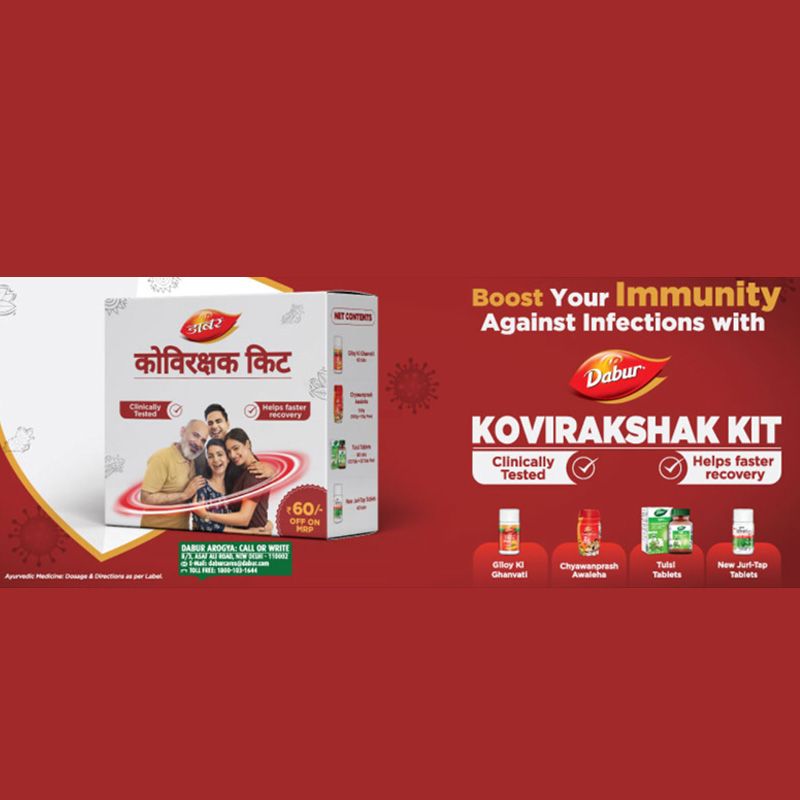
    Mumbai: India’s leading FMCG major Dabur India Limited Tuesday announced the launch of Dabur Kovirakshak Kit that includes Chyawanprash, Giloy, Tulsi and Juri-Tap products.

    A company message said the product is “A combination of time-trusted ayurvedic medicines to help in faster recovery from ongoing respiratory infections. Dabur KoviRakshak Kit was developed and launched based on (the) Indian Council of Medical Research (ICMR) guidelines and after (a) thorough study on infected patients”, the company has claimed.

    The company’s website also prominently claims: “Get your Dabur Kovirakshak kit – As part of our commitment to fight the COVID-19 pandemic, Dabur is distributing free Kovirakshak kits to the first 200 people who register with us. Sign up to get your immunity shield.”

    The new audience interactive advertisement comes only a day after the Advertising Standards Council of India (ASCI) pulled up the brand for making misleading claims through its advertisement for Dabur Chyawanprash. ASCI had asked the ayurveda major to modify or withdraw the Chyawanprash ad that claimed to offer protection against the Corona virus. The print ad published in March this year claimed that taking two spoons of the product daily provided protection against COVID-19.

    ASCI secretary general Manisha Kapoor told IndianTelevision that while she’s yet to see the new Dabur Kovirakshak ad, “Each product and advertisement will have to be examined on its own merit, if they are able to prove what they are claiming then its fine.” She added that they have not received any complaint about the newer advertisement so far. 

    The ad featuring actor Akshay Kumar stated that the claim is backed by “clinical studies conducted in 5 centres”.

    The advertisement ran into controversy on social media after several people tagged ASCI to look into the matter. Brand consultant & strategist, Ambi Parameswaran had also tweeted and alerted ASCI about a possible violation:

    ASCI launched an investigation after a formal complaint was lodged and noted, “Dabur Chyawanprash has immunity building properties, however, it is not established whether the product could protect one against (the) Corona virus.”

    In its report to Dabur, as reported by online media afaqs, ASCI stated that the claim made in the advertisement “could be construed literally by an ordinary consumer, that consuming the product would protect one from COVID-19”. Following the investigation of reports and data provided by Dabur, the Consumer Complaints Council (CCC) of ASCI in turn maintained that the “claim is misleading by ambiguity and exaggeration and is likely to lead to widespread disappointment in the minds of consumers.”

    ASCI has advised Dabur to suitably modify or withdraw the advertisement by June 4, 2021.

    The ad had attracted major trolling on social media after its brand ambassador Akshay Kumar announced that he has tested positive for covid-19.

    The irony of the situation was not lost on net users who trolled the brand as well as the actor over the apparently false COVID-19-protection claims.

    A section of the online community had also red flagged the actor and the company for being reckless while promoting products through incorrect claims.

    While the Covid-19 outbreak has brought some businesses to a grinding halt, it has also served as a business opportunity for others. Several FMCG giants cashed in on the health-related fear induced into the general public by the pandemic by launching a plethora of immunity-boosting products ranging from beverages comprising of juice, tea, coffee to probiotic shots and supplements in capsule form, mixes and powder, even food items.

    The Indian Immunity Boosting Packaged Products Market is projected to reach $ 347 million by FY 2026, as per a report, owing to increasing consciousness and focus among Indian consumers towards sickness preventing health foods.

    Major players operating in the immunity boosting packaged products market include The Himalaya Drug Company, Dabur India Ltd., Patanjali Ayurved, among others, which have capitalised on their ayurvedic lineage. Dabur India is a remarkable case in point, with the home-grown FMCG major overhauling its go-to-market strategy.  

    While Brand strategist Ambi Parameshwaran believes the brand has played it safe this time by avoiding any blatant mention of COVID-19 protection in the ad copy, he still feels the product name may get it into trouble once again. He said, “Just on the basis of the name Kovirakshak Kit they can be taken to ASCI again. Rakshak in Hindi means protector, which again implies COVID-19 protection, not just immunity. So, while the copy is correct, I still have an issue with the brand name. They could be hauled up once again.”  

    In either case, the controversy has meant piqued audience interest inadvertently for a second time, not necessarily in the interest of public health. Bad publicity is also good for publicity.

  • ASCI secretary-general Manisha Kapoor named VP, ICAS executive committee

    ASCI secretary-general Manisha Kapoor named VP, ICAS executive committee

    Mumbai: Advertising Standards Council of India (ASCI) general secretary Manisha Kapoor has been appointed to the executive committee of the International Council for Advertising Self-Regulation (ICAS). She will be one of the four vice-presidents on the executive committee. Set up by the European Advertising Standards Alliance in 2008, ICAS is a global platform of self-regulatory organisations (SROs).

    Until April this year, ASCI served on the executive committee as a member for a two-year term. Now, Kapoor will play a leadership role  on the committee till 2023.

    In her role as part of the ICAS leadership team, she will take forward the agenda of self-regulation globally. Some priority areas of ICAS for the next couple of years are:

    ●        To promote advertising self-regulation as an optimal mechanism for consumer protection

    ●        To strengthen ICAS as a global alliance

    ●        To facilitate knowledge sharing among SROs to establish best practices

    ●        To support emerging SROs across the globe

    ●        To monitor global trends in the advertising ecosystem that impact self-regulation

    ●        Work closely with established and emerging digital platforms to make the online space more transparent and fairer for consumers

    Kapoor said, “This appointment is  a recognition of ASCI’s growing global standing  and influence in the narrative of responsible advertising, as well as the importance of Indian advertising industry itself at a global level. This offers us a chance to  exchange learnings and best practices. With the Indian advertising industry evolving fast and  digitalisation boosting growth, ASCI’s leadership of  the ICAS executive committee will add  new perspectives to the agenda of responsible advertising.”

    ICAS is a globally established organisation with members comprising national and regional SROs, associations and international industry associations representing advertisers, the media and creative agencies, all working to ensure that advertising and marketing communication is legal, honest and decent.

    The three other vice-presidents are one each from Canada, the USA and the World Federation of Advertisers. The ICAS president is from the United Kingdom.

  • How Broadcoasters’ LED screens are lighting up the Mumbai coastline

    How Broadcoasters’ LED screens are lighting up the Mumbai coastline

    MUMBAI: What started as a seed of an idea to explore India’s vast coastline as a marketing medium led to a whole new and unique concept of having LED hoardings over water. Launched in 2017, Zen Digital Media is an Indian start-up co-founded by Sanjay Raval and Payal Raval and Broadcoasters is one of its first products to go live this month.

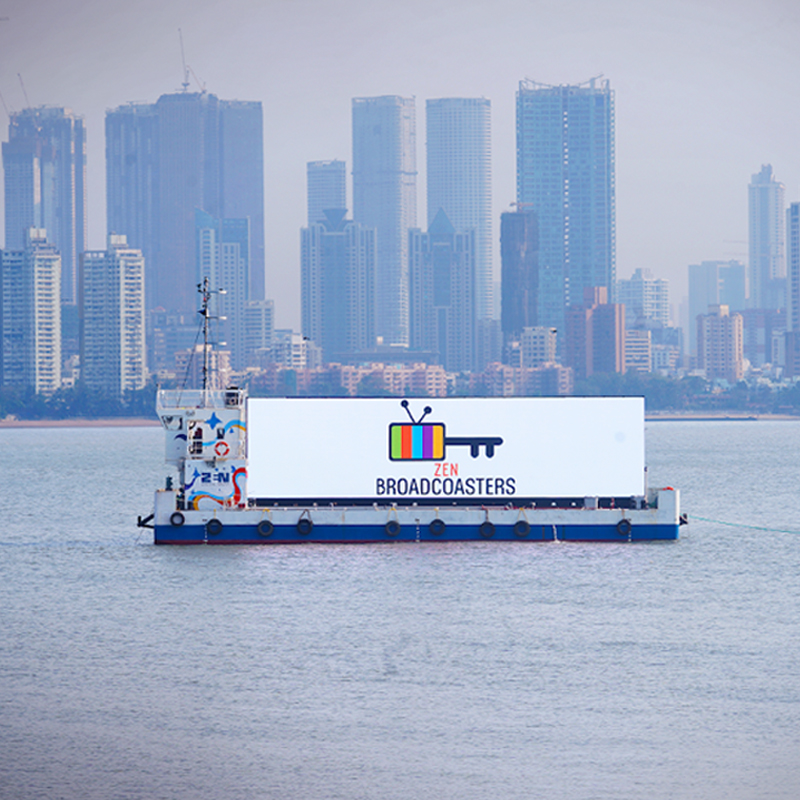
    The novel OOH set-up uses a customised, self-propelled vessel to carry high resolution LED screens with auto-brightness sensors along India’s coastal areas as an advertising platform, showcasing various formats of eye-catching static and video content. 

    While the start-up had the first-mover advantage in the segment, it did bring its fair share of challenges too. Right from designing the vessel according to the specifications mandated by the Indian Register of Shipping and customising it to support the weight of huge LED screens, combining high-tech tools with mobility while taking into account the wind pressure – the team had the whole thing planned down to a tee.

    “A lot of effort has gone into creating this kind of infrastructure. What we have done is make a platform that is very future tech-ready in terms of new technologies like VR, AR at our back end and infrastructure. So tomorrow if any gaming or tech companies want to take over the platform to screen gaming finales or have people interact with the screen, we will be ready for that too,” Zen Digital Media head of marketing Varun Ramrakhyani told Indiantelevision.com.

    Though capital-intensive and cost-heavy, Ramrakhyani believes the platform is different enough to warrant a new category in itself, and not be compared to other out-of-home (OOH) advertising media. “We are essentially broadcasters who can relay anything we want on our space, in addition to operating on the coast, hence the name Broadcoasters,” he quipped.

    The first Broadcoaster vessel was launched and anchored at Mumbai’s Bandra Worli Sealink promenade on 15 March. The next launch is scheduled across the beautiful coastline of Juhu-Versova Beach this month. It is a cyclical industry which can only operate in the ocean for eight months – between October and May – in a year, as they have to be out of the waters during the monsoon.

     “While there have been a few global precedents of having LEDs on water, we have opened up the platform to a lot of participants in a lot of different ways,” said Ramrakhyani. “It is new-age storytelling where brands can flex their creative muscles, play around with light, animation, VFX special effects, and long-form videos. The Brihanmumbai Municipal Corporation (BMC), Mumbai police and ASCI (Advertising Standards Council of India) are already participating and using the platform to educate people and relay their messages very creatively.”

    For the Juhu launch, the team has selected a five-kilometre stretch wherein the vessel will keep plying to and fro. The second vessel is accordingly designed to carry dual screens while moving from point A to point B and back, all while using heavy animation, VFX, and full-length videos.

    Zen Digital also plans to use the screens to highlight important events and achievements, such as an Olympics victory for India or an ISRO launch. “So, the entire idea is to engage, entice, educate and excite the audience in a way that has never been done before,” he remarked.

    Several brands such as Amul, MG Hector, Skoda, Tata Motors, Volvo, Mercedes, Kotak, HSBC, Amazon Prime, and non-government bodies such as ASCI are already on board. The start-up has also tied up with five-star properties along Juhu beach to conduct full-scale events.

    Its second initiative, ‘Beach and You’ is modelled along the lines of “Equal Streets” of Bombay, wherein it will showcase content which people coming to the beach can make use of, like Zumba or yoga. This will be executed with the help of tie-ups with health and fitness companies to air fitness sessions.

    But what of the profitability and feasibility aspects of this hitherto unexplored segment in India?

    “No capital-intensive business can be profitable from day one. We believe it will take its own sweet time to give returns. The traditional industry is very RoI-centric, and everything has to be measured. But creativity is very subjective and cannot be measured. Brands that want to test the market with creativity come to us,” summed up Ramrakhyani.

  • ASCI joins UN Women’s gender programme Unstereotype Alliance

    ASCI joins UN Women’s gender programme Unstereotype Alliance

    MUMBAI: Advertising industry watchdog Advertising Standards Council of India (ASCI) on Monday announced that it has become a founding ally of the UN Women’s gender-based programme called Unstereotype Alliance. UN Women is a United Nations entity for gender equality and women's empowerment.

    "After announcing a nationwide GenderNext study, ASCI is pleased to announce that we are now a founding ally of the UN women’s programme, the UNstereotype Alliance," ASCI said in a tweet.

    A thought and action platform, Unstereotype Alliance aims to remove negative stereotypes around women in the media and advertising content. The programme unites industry leaders, decision-makers and creatives globally to end harmful gender-based stereotyping in advertising. The alliance contributes to empowering women in all their diversity (race, class, age, ability, ethnicity, religion, sexuality, language, education, etc.) and addressing harmful masculinities to help create a gender equal world. The launch of the India chapter of the programme is scheduled for 30 March.

    ASCI has shifted its focus to gender portrayal after recently preparing guidelines on influencer marketing, online gaming and covid-related advertising in India. Just last week, the ad industry regulator had, in association with Futurebrands, launched its first ever deep, immersive dive into gender depiction in Indian advertising. The study titled ‘GenderNext’ aims to provide actionable insights that can shape the gender narratives in advertising positively, ASCI said. The study is the first of several initiatives ASCI aims to undertake in 2021 as part of a year-long focus on gender, the regulator said.

    The report, which is set to be released in September, will study more than 200 national and regional advertisements published in the past few years. ASCI said it plans to expand its existing advertising code using the study findings. To unravel gender narratives in advertising, to evolve and enrich gender understanding in the context of cultural change and to provide insights to navigate and embrace positive narratives for women in advertising content were listed as some of the main objectives behind the exercise. With this new found alliance, the advertising regulator hopes to further expand its gender agenda.

  • Depiction of women in ads matters, but their absence also tells a story: ASCI’s Manisha Kapoor

    Depiction of women in ads matters, but their absence also tells a story: ASCI’s Manisha Kapoor

    MUMBAI: The Advertising Standards Council of India (ASCI) and Futurebrands have announced the launch of their first-ever deep, immersive dive into gender depiction in Indian advertising. The study titled ‘GenderNext’ aims to provide actionable insights that can positively shape the gender narratives in advertising. It is the first of several initiatives that ASCI will undertake this year. The full report is expected to be out by September.

    In a free-wheeling discussion with indiantelevision.com’s Anupama Sajeet, ASCI secretary-general Manisha Kapoor talked about the skewed portrayal of women, gender roles in Indian advertising and the idea behind the initiative.

    Edited excerpts:

    On the objective of the study.

    We wanted to examine the portrayal and the narratives around women in advertisements and their roles, the vocabulary that is used – whether they are shown to be with family, friends, or alone, at home or at work. Then, use this information to bring about a much more positive depiction of the narrative. We felt that advertisers need to be given a different starting point to explore gender narratives in advertising, in a more relatable way that’s also inspirational and progressive. It is not just for advertisers, but policymakers, for academia, the government, and civil society. The study is not an audit. We are not trying to audit advertising, we are trying to learn through observations of what could be a better way of saying things and open up newer ways this conversation could be taken ahead.

    On whether the ad industry is losing connect with consumers with changing times.

    Advertisers and brands do realise that consumers have changed. However, the change is complex, it is not simple to understand. To illustrate my point, why is it that every time we need to show something traditional we resort to showing a homemaker – a homemaker today may not necessarily see herself as traditional. This points to an indirect manner in which advertising has thought of women. Some brands have tried to break the mould and succeeded.  There is a larger shift that’s happening globally and the idea is to bring that larger shift into focus. Society and ads- both influence each other. Ads will show the truths that they pick up from societal changes and vice-versa. So, there is a need to be more responsible as well as progressive. 

    On plans to deal with the continued objectification of women in ads.

    ASCII already has guidelines that say that ads cannot be derogatory or demeaning to women. So in cases where it is quite evident, we process complaints against these ads. Depending on what has been said or depicted we could uphold the complaint against such an advertisement. Now the challenge lies in what is permissible and what’s not outright derogatory.  So within that, what are the positive narratives that we can pick up?; it's not just about correcting a wrong, we are trying to move the needle in terms of more aspirational, relatable, positive depiction. We want advertisers to make better ads.

    On tackling ingrained, stereotypical gender roles in Indian ads.

    There are five enquiry frameworks that we are using in the study. First, we will culturally decode advertisements. We will look at ads from different regions and different categories over some time and try to understand what is the gender dynamics that are being depicted in the ad. This involves decoding advertisements that are already out there in the public domain. Second, we will talk to consumers about how they perceive certain ads. We’ll do in-depth qualitative research across 10 centres with groups of consumers to this effect. Next, we’ll talk to the creators of the ads- to the brands, advertisers, leading creative voices in the industry, to understand their perspective. The fourth part will be to talk to the policymakers, social activists and those who have worked in the gender space.

    Finally, we will look at what our partner in this initiative – Futurebrands – brings to the table. Futurebrands has an ongoing primary study for 11 years now, which has covered more than 200 small and large towns in India. It’s called Bharat Darshan and it maps the changes in Indian society. This will provide the foundation on which we will review some of the information which we assimilate now.

    On guidelines for the ad industry post the study.

    We may draft certain guidelines in future which could be helpful to advertisers to navigate this space. Our code already provides for the fact that advertising should not be derogatory to women, but we may offer more by way of explanation, examples and illustrations and certain more specifics. We are looking at a broad spectrum of categories, it includes categories that have traditionally spoken to women, as well as, those which have not. Thus, even the absence of women in certain categories of ads is something to be noted. While the presence of women and their depiction matters, the absence also tells a story. Hence with GenderNext, we hope to provide an insight that will help advertisers navigate these conventional tropes.

    On ASCI’s plan to focus on gender initiatives.

    Gender is the big focus and our flagship initiative this year. To further this agenda, we are looking at the formation of more alliances and collaborative efforts with other organisations, like the kind we have done with Futurebrands, which will be revealed in time. This is only a beginning. We will have much more coming up as the year goes by. Companies have stepped forward to fund the study. Nobel Hygiene is one of our principal sponsors. GenderNext is a first-of-its-kind study and expected to be of significant value to advertisers and creative agencies, as well as academia, policymakers and advocacy bodies.

  • Education, healthcare topped list of misleading ads in 2020: ASCI

    Education, healthcare topped list of misleading ads in 2020: ASCI

    MUMBAI: Advertising Standards Council of India (ASCI) has said that the third quarter of 2020 witnessed a surge in number of consumer complaints after an initiative driven quarter by the Ad industry regulator to increase consumer awareness.

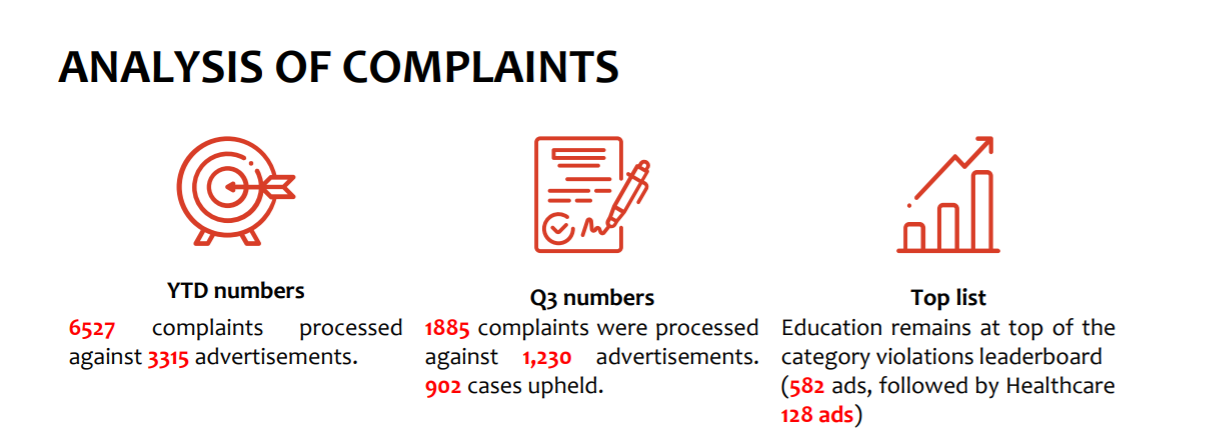
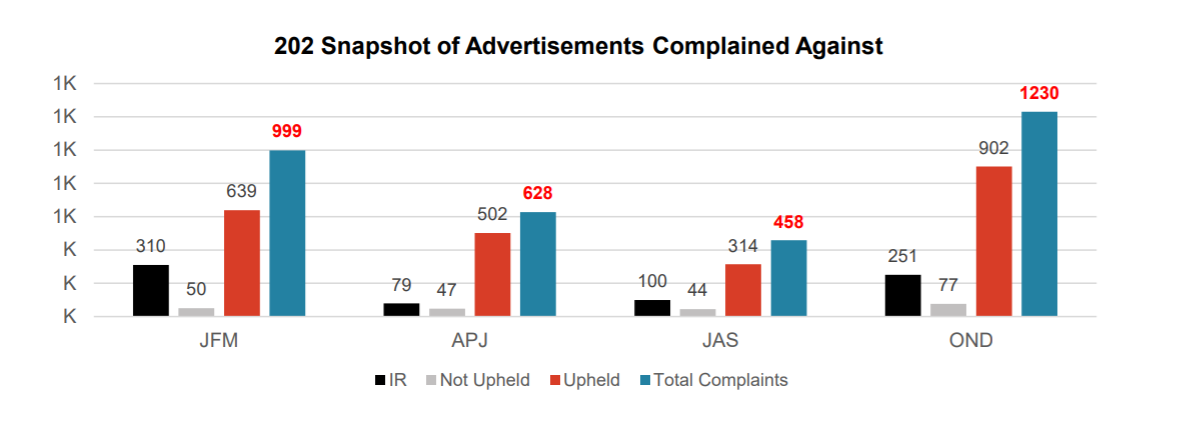
    Between October and December, the ASCI team received 1,885 complaints originating from 1,230 advertisements, the regulatory body said in its Complaints Analysis Report – Q3 FY (2020-21). It noted that the Industry focused initiatives it led for consumer protection and streamlining of processes for effective self-regulatory practices had had a high impact.

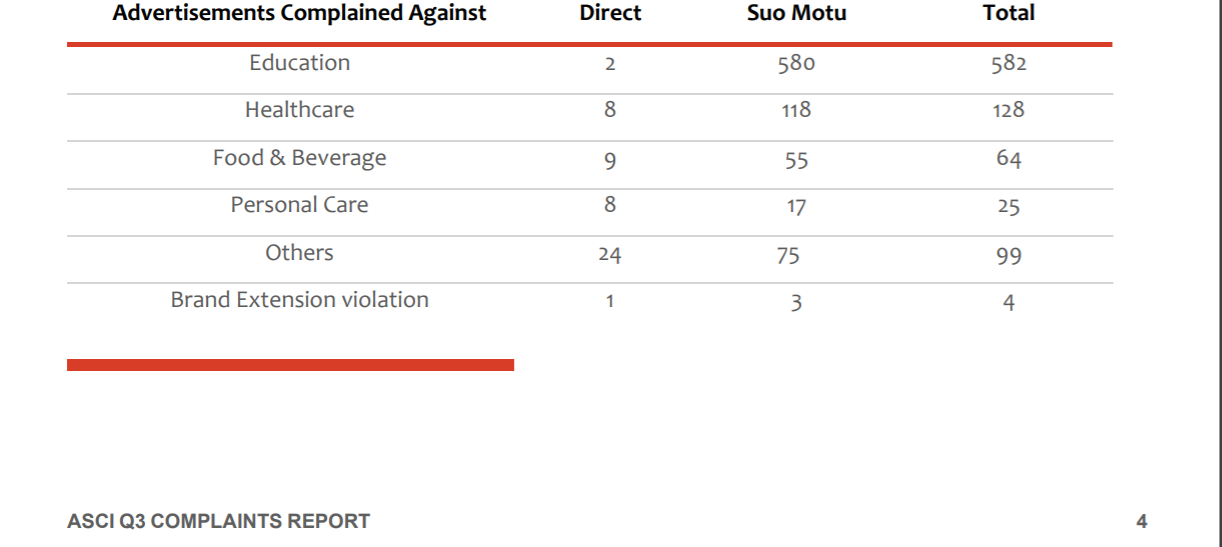
    251 of the 1,230 advertisements were either withdrawn or amended by the advertisers on receipt of communication from ASCI. From the remaining advertisements, ASCI’s independent Consumer Complaints Council (CCC) upheld complaints against 902 advertisements. Of these, a whopping 582 or almost 65 per cent ads belonged to the education sector and 128 from healthcare, 64 from food and beverages, 25 from personal care, 99 from other categories. Complaints against 77 advertisements were not upheld as these advertisements were not found to be in violation of the ASCI code.

    Some of the key themes of false claims or code violations that emerged during the quarter October-December were:

    – Education ads with false claims of job guarantees, placements, etc.

    -Healthcare ads with false claims about Covid2019 cures and preventions advertising.

    Other complaints included those against brands issuing comparative advertisements while prominent cases against honey brands were also in the spotlight. During the third quarter, complaints regarding surrogate advertising also picked up post the IPL.

    In October 2020, ASCI introduced the Covid2019 advisory for advertisers, to protect consumers from being misled during the pandemic. Soon after, in November 2020, ASCI introduced guidelines for online gaming for “real-money winnings”, to protect audiences from risks associated with games involving real money. The guidelines received much appreciation and backing from the ministry of information and broadcasting. Earlier in 2020, the council had also introduced guidelines for usage of awards/rankings in advertisements by brands. Early September, it expanded its national Advertising Monitoring Service (NAMS) to add digital advertising to its suo motu screening. More than 3,000 digital platforms are being currently tracked by the regulatory body.

    The initiatives sparked conversations in the media, on social media and various other forums, which further helped drive consumer education and awareness. Additional impact of the constant buzz on various channels was the spike in the number of complaints processed by ASCI for the quarter.

    Overall in 2020, ASCI looked into 6,527 complaints that were registered against 3,315 advertisements, of which 2,357 were upheld. Education (1,062) and healthcare (827) topped the list for the year as well. Some of the numbers for other categories, 117 food and beverage advertisements were complained, 63 against personal care, 17 violations of guidelines for brand extension, 22 against real estate, 10 against visa and immigration services and 239 against ads from other categories.

    ASCI secretary general Manisha Kapoor said: “The third quarter of the financial year involved initiatives leading to positive impact on the industry and stakeholders. The quarter recorded the highest numbers in terms of complaints processing, compared to the previous two quarters which were a direct outcome of the pandemic. We hope to continue this momentum in the year ahead.”