Tag: AS Kiran Kumar

  • ISRO’s PSLV-C35 takes off successfully, Scatsat1 launched

    ISRO’s PSLV-C35 takes off successfully, Scatsat1 launched

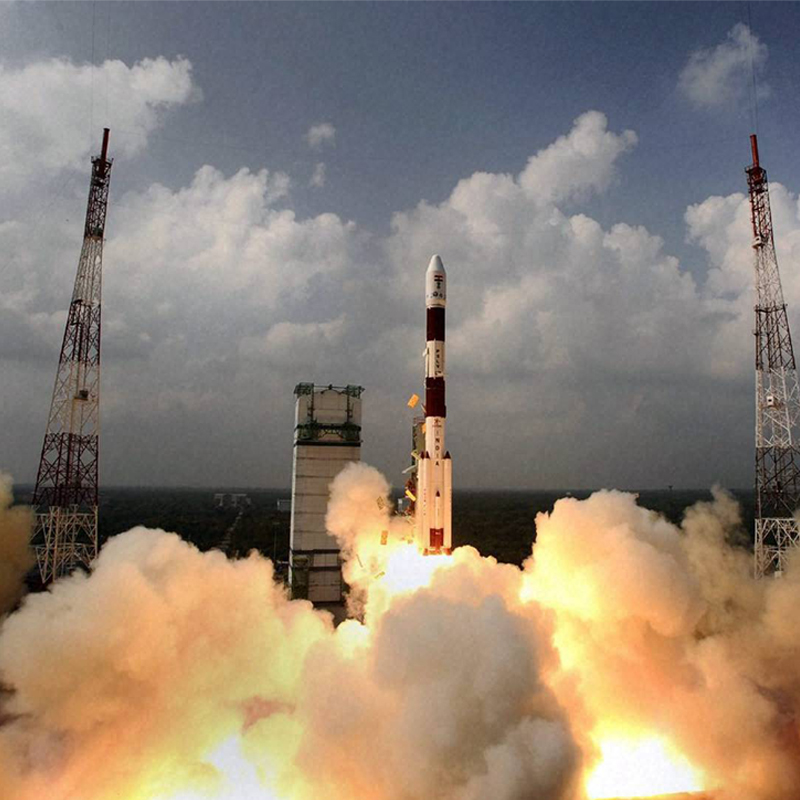
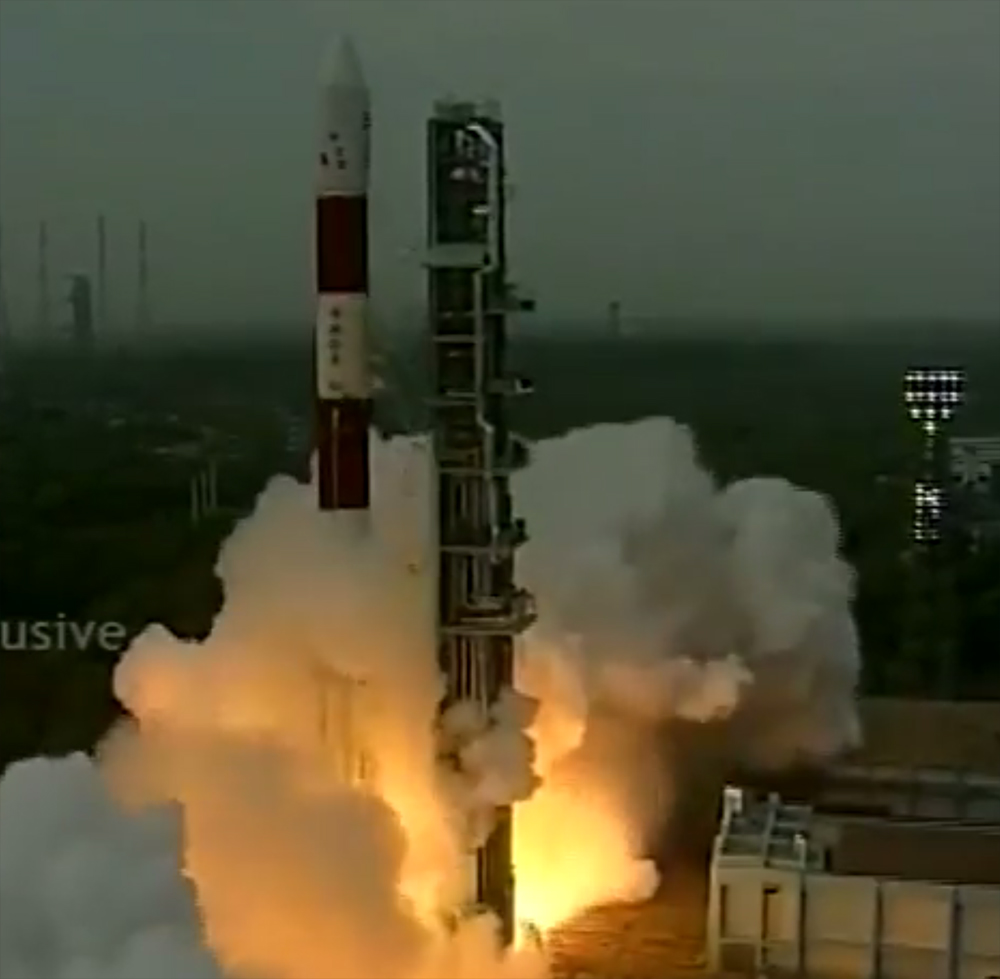
    MUMBAI: It’s another feather in ISRO’s cap. The Indian space outfit seems to be going from success to success. Earlier this morning at 9:12 am, its latest mission the PSLV-C35 lifted off immaculately from the Satish Dhawan Space Centre in Sriharikota. Around 17 minutes later, its fourth stage rocket engine was shut off and it launched one of its passengers, the ScatSat 1 satellite, into its orbit at height of 720 km., to the delight of ISRO scientists.

    Currently, the organization is waiting to fire the fourth stage engine again to send the remainder of its seven satellite payload into their orbit at a height of 670 km, between 11:25 and 11:28 am, according to ISRO updates.

    “This is a challenging two-in-one mission which puts India in a unique league of nations having the capability to achieve two different orbits in a single mission,” ISRO chairman AS Kiran Kumar was quoted as saying.

    Tweeted Prime minister Narendra Modi: “Moment of immense joy and pride for India. Congratulations to isro on successful launch of PSLV-C35/ScatSat1 & 7 co-passenger satellites. Our space scientists keep scripting history. Their innovative zeal has touched the lives of 125 crore Indians & made India proud worldwide.”

  • ISRO’s PSLV-C35 takes off successfully, Scatsat1 launched

    ISRO’s PSLV-C35 takes off successfully, Scatsat1 launched

    MUMBAI: It’s another feather in ISRO’s cap. The Indian space outfit seems to be going from success to success. Earlier this morning at 9:12 am, its latest mission the PSLV-C35 lifted off immaculately from the Satish Dhawan Space Centre in Sriharikota. Around 17 minutes later, its fourth stage rocket engine was shut off and it launched one of its passengers, the ScatSat 1 satellite, into its orbit at height of 720 km., to the delight of ISRO scientists.

    Currently, the organization is waiting to fire the fourth stage engine again to send the remainder of its seven satellite payload into their orbit at a height of 670 km, between 11:25 and 11:28 am, according to ISRO updates.

    “This is a challenging two-in-one mission which puts India in a unique league of nations having the capability to achieve two different orbits in a single mission,” ISRO chairman AS Kiran Kumar was quoted as saying.

    Tweeted Prime minister Narendra Modi: “Moment of immense joy and pride for India. Congratulations to isro on successful launch of PSLV-C35/ScatSat1 & 7 co-passenger satellites. Our space scientists keep scripting history. Their innovative zeal has touched the lives of 125 crore Indians & made India proud worldwide.”

  • ISRO seeks industry co-operation for space-based services

    ISRO seeks industry co-operation for space-based services

    NEW DELHI: India’s space agency, ISRO, has sought industry’s help and co-operation to realize India’s growing need for space-based services.

    ISRO Chairman and Department of Space (DoS) Secretary AS Kiran Kumar yesterday said in Bengalaru that to meet the increased demand for space-based services, it was imperative that ISRO joined hands with industries in an effort towards enhancing capacity.

    Kumar was speaking at a “Make in India” Conference on Enabling Spacecraft Systems Realisation through Industries (ESSRI- 2016) organised on June 23, 2016 at ISRO Satellite Centre, Bengaluru.

    An official government statement quoted Kumar as telling delegates that almost all the government departments and ministries had evinced keen interest in applying space technology for carrying out their mandates.

    He also emphasized on India’s great potential to capture a sizeable portion of the business in the international space market.

    ISRO earlier in the week put in space 20 satellites that included many belonging to foreign countries, including the US.

    The conference was organised to elicit industry support for spacecraft realisation on an end-to-end basis to meet the rapidly increasing national demand for space based services and the realisation of Prime Minister’s objective of “Make in India”.

    The government statement further added that over the years, a number of Indian industries have been actively participating in realising various sub-systems of spacecraft. A variety of models have been adopted by ISRO in outsourcing jobs to these vendors, but end-to-end realisation of spacecraft has not yet been realised. The Conference aimed to fill this gap.

    ISRO has announced that the Expression of Interest (EoI) for realising spacecraft on an end-to-end basis has been hosted on ISRO/ISAC websites and invited the industry to respond to it.

    During the conference, senior executives of ISRO gave an insight into the requirements of ISRO with respect to hardware, technologies, quality and delivery schedule and what was essential for them to be qualified vendors of ISRO.

    About 110 industries in aerospace business participated in the conference.

    However, as far as leasing out satellite capacity to Indian customers go, ISRO has been lagging behind in meeting the demands for KU-band transponders, while restricting foreign satellite companies’ access to the Indian market.

    In a report on satellite capacity over Indian skies versus demand, released in March 2016, Hong Kong-based Asian industry organization CASBAA had noted that over the last three years, for example, the number of transponders contracted by DTH operators have gone up from 73 to 78 with the share of transponders supplied by foreign operators going up to 75% as ISRO/Antrix has not been able to meet the need through domestic launches.

  • ISRO seeks industry co-operation for space-based services

    ISRO seeks industry co-operation for space-based services

    NEW DELHI: India’s space agency, ISRO, has sought industry’s help and co-operation to realize India’s growing need for space-based services.

    ISRO Chairman and Department of Space (DoS) Secretary AS Kiran Kumar yesterday said in Bengalaru that to meet the increased demand for space-based services, it was imperative that ISRO joined hands with industries in an effort towards enhancing capacity.

    Kumar was speaking at a “Make in India” Conference on Enabling Spacecraft Systems Realisation through Industries (ESSRI- 2016) organised on June 23, 2016 at ISRO Satellite Centre, Bengaluru.

    An official government statement quoted Kumar as telling delegates that almost all the government departments and ministries had evinced keen interest in applying space technology for carrying out their mandates.

    He also emphasized on India’s great potential to capture a sizeable portion of the business in the international space market.

    ISRO earlier in the week put in space 20 satellites that included many belonging to foreign countries, including the US.

    The conference was organised to elicit industry support for spacecraft realisation on an end-to-end basis to meet the rapidly increasing national demand for space based services and the realisation of Prime Minister’s objective of “Make in India”.

    The government statement further added that over the years, a number of Indian industries have been actively participating in realising various sub-systems of spacecraft. A variety of models have been adopted by ISRO in outsourcing jobs to these vendors, but end-to-end realisation of spacecraft has not yet been realised. The Conference aimed to fill this gap.

    ISRO has announced that the Expression of Interest (EoI) for realising spacecraft on an end-to-end basis has been hosted on ISRO/ISAC websites and invited the industry to respond to it.

    During the conference, senior executives of ISRO gave an insight into the requirements of ISRO with respect to hardware, technologies, quality and delivery schedule and what was essential for them to be qualified vendors of ISRO.

    About 110 industries in aerospace business participated in the conference.

    However, as far as leasing out satellite capacity to Indian customers go, ISRO has been lagging behind in meeting the demands for KU-band transponders, while restricting foreign satellite companies’ access to the Indian market.

    In a report on satellite capacity over Indian skies versus demand, released in March 2016, Hong Kong-based Asian industry organization CASBAA had noted that over the last three years, for example, the number of transponders contracted by DTH operators have gone up from 73 to 78 with the share of transponders supplied by foreign operators going up to 75% as ISRO/Antrix has not been able to meet the need through domestic launches.