Tag: Arvind

  • Brands boost sales with SARS Cov2 virus-killing fabrics; ASCI warns against advertising without proof

    Brands boost sales with SARS Cov2 virus-killing fabrics; ASCI warns against advertising without proof

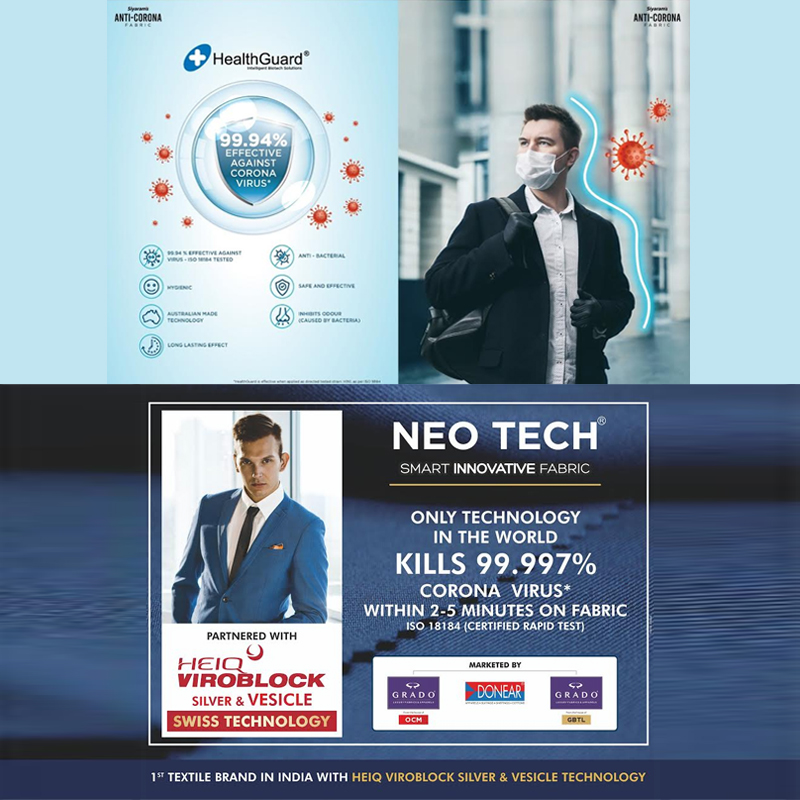
    NEW DELHI: The race to create Covid2019-protective products is on. Indian fashion retail brands such as Donear, Arvind, and Siyarams have launched anti- Covid2019 fabric products in the market, claiming that it kills the deadly virus when comes in contact with the product.

    Textile manufacturer RSWM Ltd has announced its latest innovation with the launch of the anti-viral fabric range ‘ViroSecure.’ The new range has been launched through a strategic technology partnership with HeiQ that lends its antiviral Viroblock technology to formulate a protective coating on the fabric to offer 99.99 per cent protection against SARS-CoV-2 in just 30 minutes. With ViroSecure, RSWM is targeting 20 per cent of sales in FY 2020-21.

    Mayur Suiting and LNJ Denim CEO and business head Suketu Shah says, “As the world reels under COVID2019 impact, we, as a company have the responsibility towards our consumers and are committed to equipping them with the resources to adapt to this new normal. There is a significant uptake in the demand for the anti-viral fabric technology and with this; we are targeting 20 per cent of the sales from the ViroSecure fabric in this fiscal.”

    Siyaram’s has also launched its anti-corona range of fabric tested by the WHO (World Health Organisation) approved labs to fight against the spread of the pandemic. The brand claims that the anti-corona fabric provides a 24/7 silent sentinel protection from the deadly virus and is developed in association with HealthGuard, and guarantees 99.94 per cent effectiveness against the virus.

    As revenues dry up, marketers are finding novel ways to push up sales. Scenario Consulting CEO Rajesh Lalwani says, “Unless backed with unambiguous medical research any health benefit claims by brands are to be taken with a pinch of salt but to do this around an unprecedented, global pandemic like Covid2019 appears highly irresponsible. We don’t know enough about the virus itself yet and to claim that we have found fabrics that won’t let Covid2019 survive seems suspect at best and frivolous at worst. I am not sure if customers are likely to be fooled so easily and would be surprised if take these messages on face value.”

    However, people have also trolled the brands asking for the evidence which led the Advertising Standards Council of India (ASCI) to enter into the scene. The council has raised objections about telecasting such ads on social media platforms.

    ASCI wrote on Twitter, “Dear advertiser, do not make any claims implying benefits that are not substantiated. Avoid misleading claims such as products that can mitigate or prevent from COVID2019 virus.”

    Donear Group claims that it has collaborated with ZODIAC and has supplied a significant volume of the fabric treated with the unique HEIQ Viroblock technology that has tested successfully against the virus that causes COVID2019. ASCI has asked Zodiac to prove its facts or withdraw the ads.

    TRA Research CEO N Chandramouli explains, “It is natural for a product to capitalise on the current demand and come up with products that suit the customer’s needs. However, when it comes to making claims, brands must be backed by scientific evidence or else unsuspecting consumers may end up buying products that are non-efficacious in their immunity or Covid2019 protection properties. ASCI has done the correct thing by taking action on such unsupported ad claims.”

    Samsika Marketing Consultants founder, chairman and MD Jagdeep Kapoor opines that fabric brands promoting special products during these troubled times are following a relevant emerging need strategy. “This is a protective opportunity for consumers and retailers and a timely business opportunity for brands. The most critical element in this brand strategy will be credible efficacy.”

    Last month, Patanjali had a massive launch for its Covid2019 cure but later took a U-turn on the claim. This created a massive furore for misleading people.

    Chandramouli asserts that most often, the time lag between the claim made by the brand and the action taken against the ad is enough to give momentum to the brand’s Covid2019-related product. “Even if they change their claim afterwards, as did Patanjali, the original residual message of the brand stays in the consumers’ minds. Rather than impact credibility, some brands cleverly use this time-lag to their advantage.”

    According to Lalwani, brands get away with cheap penalties but manage to get eyeballs in the interim. “Typically, top tier brands do not do this but brands that cater to masses tend to try such gimmicks and get away most time. People have short memories in today’s times unless the damage suffered by such claims was serious,” he adds.

    In the last few months, at least four textile brands have come out with such kinds of technology-infused fabrics that claim it kills the virus shortly after it lands on the surface. As buyers are highly cautious these days and look for protection in everything, it has created a new opportunity for brands to come out with new products. However, it will be interesting to observe how effectively these brands will advertise for this new range.

  • Hari Krishnan is new Lowe Lintas president – South

    Hari Krishnan is new Lowe Lintas president – South

    MUMBAI: Lowe Lintas has announced that Hari Krishnan is the new president of its South operations. This appointment comes on the back of GV Krishnan’s recent exit.

    To be based out of Bengaluru, his remit includes the agency’s offices in Bengaluru, Chennai and Hyderabad. As the largest creative agency in South region, the portfolio includes over a 100 clients and brands such as Arvind, Britannia, Fastrack, Flipkart, Gold Drop, Hike, ITC Foods, MRF, Mobizz, Paperboat, Sonata, Tanishq, TI Cycles, TVS Motors and many other companies and brands.

    Krishnan, currently CEO of MullenLowe’s operations in Sri Lanka is in the process of transitioning into his new role.

    He had joined MullenLowe early 2015 from Grey India where he was heading their South operations.

    Hari has about 20 years of experience in the advertising and media industry; having spent most of it between Lowe Lintas, JWT, Star TV and Grey.

    Commenting on his move, MullenLowe Lintas Group, India Group CEO Joseph George said:“Hari has done an incredible job in Sri Lanka almost transforming our operations there overnight. Going by his track record across the agencies he has worked in, he is just the right person we need to build on the fantastic momentum that the South operations of Lowe Lintas have achieved over the past 3-4 years in terms of creative product and new business acquisition. Both of which, Hari is rabidly passionate about.”

    Hari Krishnan too added, “This is a homecoming of sorts for me since my association with Lowe Lintas almost 18 years ago started in the Bengaluru office. The India operations of Lowe Lintas has been on an unbelievable roll the past few years and my mandate is clear. The talent in our 3 offices in the South, especially the creative fire-power under Rajesh Ramaswamy’s leadership is just reassuringly and intimidatingly brilliant. Can’t wait to get started!”

    Speaking of succession for MullenLowe Sri Lanka, Joseph George said, “Our Sri Lanka operations are in a sweet spot thanks to all the efforts made in the past 18 months under Hari’s leadership and some fantastic clients. And we are perfectly poised to build on from here; which is why Hari’s replacement for the Sri Lanka CEO’s role is crucial; and so I am very pleased with whom we have found. The announcement will take place in a few days.”

  • Hari Krishnan is new Lowe Lintas president – South

    Hari Krishnan is new Lowe Lintas president – South

    MUMBAI: Lowe Lintas has announced that Hari Krishnan is the new president of its South operations. This appointment comes on the back of GV Krishnan’s recent exit.

    To be based out of Bengaluru, his remit includes the agency’s offices in Bengaluru, Chennai and Hyderabad. As the largest creative agency in South region, the portfolio includes over a 100 clients and brands such as Arvind, Britannia, Fastrack, Flipkart, Gold Drop, Hike, ITC Foods, MRF, Mobizz, Paperboat, Sonata, Tanishq, TI Cycles, TVS Motors and many other companies and brands.

    Krishnan, currently CEO of MullenLowe’s operations in Sri Lanka is in the process of transitioning into his new role.

    He had joined MullenLowe early 2015 from Grey India where he was heading their South operations.

    Hari has about 20 years of experience in the advertising and media industry; having spent most of it between Lowe Lintas, JWT, Star TV and Grey.

    Commenting on his move, MullenLowe Lintas Group, India Group CEO Joseph George said:“Hari has done an incredible job in Sri Lanka almost transforming our operations there overnight. Going by his track record across the agencies he has worked in, he is just the right person we need to build on the fantastic momentum that the South operations of Lowe Lintas have achieved over the past 3-4 years in terms of creative product and new business acquisition. Both of which, Hari is rabidly passionate about.”

    Hari Krishnan too added, “This is a homecoming of sorts for me since my association with Lowe Lintas almost 18 years ago started in the Bengaluru office. The India operations of Lowe Lintas has been on an unbelievable roll the past few years and my mandate is clear. The talent in our 3 offices in the South, especially the creative fire-power under Rajesh Ramaswamy’s leadership is just reassuringly and intimidatingly brilliant. Can’t wait to get started!”

    Speaking of succession for MullenLowe Sri Lanka, Joseph George said, “Our Sri Lanka operations are in a sweet spot thanks to all the efforts made in the past 18 months under Hari’s leadership and some fantastic clients. And we are perfectly poised to build on from here; which is why Hari’s replacement for the Sri Lanka CEO’s role is crucial; and so I am very pleased with whom we have found. The announcement will take place in a few days.”

  • Arvind forays into e-commerce with Creyate

    Arvind forays into e-commerce with Creyate

    MUMBAI: Keeping pace with the rising online sector, textile manufacturer Arvind group announced its entry into the e-commerce space with the launch of its online custom clothing brand, Creyate.


    Arvind Internet Limited (AIL), a subsidiary of Arvind group will anchor all the company’s e-commerce initiatives. Arvind group executive director Kulin Lalbhai will drive the e-commerce initiative at the company, which will be a major growth driver for Arvind moving forward.


    Elaborating AIL’s vision Lalbhai said, “Arvind Internet Ltd will be the vehicle that will enable Arvind’s e-commerce vision. As pioneers in bringing global fashion to India, Arvind now intends to extend innovative and best in class brand experiences to the online world. We are all set to be a leading consumer lifestyle player in the digital space by engaging in several business models that can scale globally.”


     “In an attempt to break away from norms, labels and quick-fixes, Creyate strives to bring to you a fashion identity that is uniquely you, created by you. You can create garments on a 3D visualisation engine, which would then be made for you – it’s like having a very own factory at your fingertips. With more than 100,000 unique products to create, this is the next generation of fashion retail,” added Lalbhai.


    Arvind has so far invested close to Rs 20 crore into building capacities for Creyate, Lalbhai said, adding that the company would scale up investment going forward. Creyate has plans of launching stores in 15 cities within the next year. It already has stores in Bengaluru, Ahmedabad and Delhi and offers home visits in major cities.


    Creyate intends to offer an alternative to ready-wear as well as traditional custom clothing and targets to be Rs 100 crore plus brand by next year and Rs 1000 crore revenue from e-commerce in three years.


     AIL COO Tejinder  Singh said, “Creyate can be experienced in our digitised retail stores or alternatively, one can visit our website (www.creyate.com)  to design garments online and then schedule a home visit by our ‘Style Stewards’. Style Stewards not only take a customer’s measurements, they also give them style advice and complete wardrobe solutions. And once measured, customers can ‘Creyate’ their own garments from anywhere and they will be delivered as per their exact fit at their door step.”

  • Marketing lessons a la AAP

    Marketing lessons a la AAP

    MUMBAI: The recent-concluded Delhi elections, took everyone by surprise when Aam Admi Party won 28 seats. We take a look at what one can learn from the new entrant.

    When it was formed less than a year ago on 26 November, 2012, little did the Aam Aadmi Party imagine it would make such a big splash at the polls.   

    Winning 28 out of 70 seats in the Delhi Assembly elections on 8 December, the AAP came a close second to the BJP which won 31 seats, pushing the ruling Congress to an irrelevant third position. What’s more, three-time Congress CM Sheila Dixit suffered defeat at the hands of AAP chief Arvind Kejriwal. Before the elections, the now ex-CM of the national capital, didn’t think before making statements like, “Arvind isn’t even on our radar.” Dixit probably forgot the legend of David Vs Goliath.

    For a fledgling party which emerged as an offshoot of the larger ‘India against Corruption’ movement launched by activist Anna Hazare -where people took to the streets to protest the many ills plaguing the current administration – this is no mean feat.

    And neither is the fact that AAP – registered as a political party with the Election Commission (EC) only in March this year – has successfully met the EC’s criteria to become a state party.

    So what did the AAP do right to banish all the scepticism its broom-wielding members met with from seasoned politicians who dismissed the party, at least initially, as ‘chillar’ or worse, a group that made a lot of noise but had no real impact.

    Looking at the AAP’s historic win from a marketing perspective, we at indiantelevision.com believe brands may do well to take a few lessons from the party’s promotional strategy:

    * Strong USP
    Each brand need to have a very strong USP which helps position it in the minds of the target audience. AAP’s USP is that it gives the common man a belief, a hope, that there is going to be a better tomorrow, and that it has been created by the common man who is fed up of the politics of politics, and will hence deliver on its promise.

    *Be consistent
    At the heart of the AAP’s party manifesto is its stand against corruption – which cuts through classes. And it has not deviated from that. It has refused to ally with either the Congress (I) or the BJP, despite there being a possibility of it occupying the seats of power in Delhi.

    Brands need to stick to their core premise and promise and not try to ride fads.
     
    * Marry your brand USP with the brand mnemonics
    The AAP has always had one agenda – the aam aadmi, and it has stayed true to it ever since inception. Party members are common people who have volunteered and are unpaid. They come across as common people; they dress up like common people; they move around like common people. Even though many of them are well educated.
    And during this election campaign there was none of the largesse distribution or ostentation that the general political parties generally resort.

    The choice of name and the symbol in the case of the AAP was also crucial. The name says it all -Aam  Aadmi Party. Then the symbol was the killer: what is the one thing that is still common across all homes in India, even in middle-class and upper class homes and hutments – it is the broom. Using the broom as the mnemonic meant many things: it will be used to sweep clean all the dirt in the political system, while it helped identify the common man with a tool that is used in his/her home every day.

    * Know your customer; make him your network and your ambassador
    The AAP needed to connect with its customer: the electorate of New Delhi. Almost 130,000 volunteers all over the world, some of whom descended on Delhi before the election campaign became both the best focus group and research agency anyone could ask for.

    Some executives even took leave from their high paying jobs in India and overseas, housewives found time from their day to day chores, young college students, technicians, labourers, cable TV operators – everyone pitched to connect with the consumer and pass on what troubled the common Delhi-ite – crucial information to the central headquarters of the AAP. And they then propagated that further themselves to the electorate.

    With millions of products overflowing on shop shelves and online, brands need to know what their customers really want, when they want it and how they want it, and in the process make them your ambassadors and messengers.

    * Choose the correct medium at the correct time
    AAP had little financial resources at its disposal; some say less than Rs 20 crore. That’s probably what’s spent by politicians on a couple of constituencies. Once again volunteers stepped in to build the buzz.

    Twitter, facebook, online, print, and television. AAP went the whole hog on all the mediums. But not to splurge; just to have its message heard. The media were relatively complying: did not the common man also work in media? It hooked the middle class and the upper middle class through social media.

    And what about the man on the street?  Well it used direct selling: volunteers went door to door to the electorate in Delhi, connected with the common man. In trains, in buses, on auto rickshaws, in jhuggis, in bastis – there was the huge poster campaign, and it was the educated folks who went where they normally would not.

    Brands have to be careful about the medium they choose and utilise it to maximise impact. Brands too have to keep themselves in people’s mind through various activations/campaigns especially in today’s market where the sharks are ready to rip apart any competition.