Tag: Arun Jaitley

  • CASBAA asks FM, I&B to roll back increased royalty on foreign satellite operators

    CASBAA asks FM, I&B to roll back increased royalty on foreign satellite operators

    NEW DELHI: The Cable and Satellite Broadcasters Association of Asia (CASBAA) has urged Finance Minister Arun Jaitley to withdraw the royalties imposed on foreign satellite operators (FSO) by the Finance Act 2012 and 2013 and let the matter be settled by the Supreme Court which is presently hearing a matter in this regard.


    The Delhi High Court had in January 2011 held in the case of Asia Satellite Telecommunications company Limited (AsiaSat) that the charges received by the Hong Kong based FSO from its customers for provision of transponder capacity cannot be characterised as ‘royalties’ under the Income Tax Act as it stood prior to the amendment in 20l2. It was held by the court that the equipment was used by the FSOs to provide a service to their customers and so the question of royalty taxation did not arise.


    The memorandum by CASBAA CEO Christopher Slaughter says that this view of the High Court was in conformity with the international jurisprudence and model commentaries issued by international tax bodies and renowned jurists / authors and was also followed in case of other FSOs by the High Court and Income Tax Appellate Tribunals.


    However, the memorandum sent to Jaitley with a copy to Information and Broadcasting (I&B) Minister Prakash Javadekar points out that the matter has become sub judice as Income Tax authorities have filed an appeal against this judgment in the Supreme Court.


    I&B Ministry sources told indiantelevision.com that CASBAA has also protested the rise in royalty under the Finance Act 2013 from 10 per cent to 25 per cent as it is not reasonable in view of the competitive margins earned by the industry players. The Association wants the Minister to roll back this increase so that the tax rates are made ‘friendlier’ and both the operators and consumers can benefit from a rational tax regime.


    It is stated that a majority of the Double Taxation Avoidance Agreements (DTAA) that India has entered into provide for a tax rate (on gross basis) on royalties and fees or technical services of 10 per cent.


    Thus, taking a holistic view from the point of alignment with the DTAAs and internationally accepted tax rates, the rate of 25 per cent is highly unjust and implies that FSOs are earning high revenues from India which is not the case.


    Furthermore, any such step to increase tax rates is not right as the matter is sub judice in the Supreme Court. It not only makes the services ‘cost ineffective’ but hits the ultimate Indian end consumers.


    Slaughter points out that India’s participation in the global network of satellite communication is growing and any such move by the Indian Government to tax FSOs may also drive policy-makers of other nations to adopt similar measures for taxing payments flowing into India from foreign jurisdictions. 

  • News channels reform before Modi’s big Budget 2014

    News channels reform before Modi’s big Budget 2014

    NEW DELHI: The presentation of the general budget on 10 July morning by Finance Minister Arun Jaitley will perhaps be the most keenly watched analysis of the financial shape of the nation since the early 90s when the then Finance Minister Manmohan Singh presented his budget.


    This is also perhaps the first time in recent years that the budget is being presented by a man from the legal profession.


    Although only Lok Sabha TV has the permission to cover the budget live from inside the portals of Lok Sabha, almost every channel in the country – and certainly every business channel – will be taking the beam from Lok Sabha TV and then adding its own analysis programmes.


    CNBC TV18, Doordarshan News, Times Now, and most other News channels plan to commence the discussion on the budget from around 8.00 am with experts talking about expectations, and then beaming the live presentation from 11.00 am onwards.


     The entry of websites like moneycontrol.com and economylead.com streaming the budget and by social media will be an added feature this year, as many websites have already announced plans in this regard.


    With the new dispensation in place, the aspirations of the common man are soaring high and many are wondering whether the ruling Bharatiya Janata Party will live up to its slogan of ‘Acche din aaney waley hain.’


    The presentation is expected to be followed soon after by the reaction of Prime Minister Narendra Modi on Doordarshan and Lok Sabha TV and an exhaustive interview of Jaitley about his budget on Doordarshan.


    In addition, channels will cover live the press meet by senior Finance Ministry officials in the afternoon about the various facets of the budget.


    The coverage on CNBC TV18 will be led by Shereen Bhan, on Times Now by Arnab Goswami, and on NDTV 24×7 by Prannoy Roy. Times Now has articulated its standpoint by saying ‘Everyone deserves a piece of this super budget. Get Yours.’ The channel though also warns that it may be a bitter pill.


    Other channels like CNN-IBN, Aaj Tak, ABP News, Sahara Samay, P-7, News X and others have also lined up experts who will analyse the budget. The channels will also have teams that will go to Parliament House premises to get the reactions of various political leaders.


     For the business channels, it will be a particularly exhaustive day as they will also have a link with the National Stock Exchange and Bombay Stock Exchange to get the latest ups and downs.


     Zee Business which is a Hindi business News channel will telecast the pre-Budget discussions and analysis from 7.00 am onwards and will bring in live and uninterrupted coverage of the Budget Speech. The channel will articulate, analyse and keep the common man abreast of all the impacts that Budget is going to have on their daily lives.


     Interestingly themed as the ‘Abki baar, sapne sakaar,’ Zee Business will have expert panels, business leaders and corporate captains throughout the day to give their expert advice. After the Finance Minister’s speech, Zee Business will undertake a series of power packed Budget Bulletins. Some of these bulletins will comprise high power panel discussions and will involve expert comments from the nation’s top business leaders and policy makers.  Some of the key Ministers holding important portfolios have already appeared and shared their views, and will also do so during post-Budget analysis programmes. They include Power, Coal, New & Renewable Energy Minister Piyush Goyal, Information & Broadcasting Minister Prakash Javadekar and Commerce & Industry Minister Nirmala Sitharaman.


    Special shows have been conceptualised with thorough research from the industry point of view without losing the ground reality and its impact on the common man. Expert opinions, industry perspective viz–a–viz market reaction and informative bulletins will be telecast.


    Zee Business will also organise a viewer’s engagement programme throughout the day from different parts of the country where commoners get a voice to air their reaction and feedback on the pertinent issues on budget.


     Zee Media CEO Samir Ahluwalia said, “With clear understanding of the expectations of the India Inc. as well as indications of the common man, Zee Business is poised to present a comprehensive Budget coverage. Through special programming and initiatives focusing on budget expectations, analysis and impact, Zee Business will once again ensure specialised coverage on Budget Day.”


    Added CNBC-TV18 managing editor Shereen Bhan, “The key question we will be asking is if the budget will be able to deliver. There will be a sharp focus on market reactions, the stance taken by other countries giving India a thumbs up and about investment in domestic capital. We will analyse the long term and short term ideas the government has as well as the reforms that will be taken up to revive the economy.”

  • Axe the tax, say DTH ops & MSOs

    Axe the tax, say DTH ops & MSOs

    MUMBAI: In the run up to Budget 2014, the DTH Operators Association and the MSO Alliance have joined hands with broadcasters to embark on an aggressive campaign (in the shape of a television promo or commercials)  to fight the heavy entertainment taxes levied on them by the various state governments.


    The TV commercial which stars Roopal Tyagi (Sapne Suhane Ladakpan Ke) and Surbhi Jyoti (Qubool Hai) has been running across all channels.  It makes an appeal to TV viewers to log on to http://entertainmenttaxappeal.com to pledge against rising entertainment taxes. It says that on an average a viewer spends approximately Rs 3000 on cable TV and DTH recharges annually. Almost half of this goes directly into the government’s kitty by way of taxes. Therefore, there is a need to put an end to it.


    “We will present the appeals from the people to the government and hope that they take note of it,” says newly-appointed DTH Operators Association of India president RC Venkateish. He added that the advertisement was timed to coincide with the upcoming budget session. 


    Entertainment tax is a state subject and hence, varies from state to state. In some, it is a fixed amount while in others the state exchequer carves it out as a percentage of the bill. 


     “The state of Maharashtra charges Rs 45 as entrainment tax. This is ridiculously high,” says an industry professional and adds, “High entertainment tax is one of the reasons why local operators don’t declare the number of viewers they have.”


    The campaign is expected to run for a month in order to build a ground swell of public opinion against the entertainment tax levies.  It seems to have got the Information & Broadcasting Minister Prakash Javadekar’s attention already. Speaking to PTI recently he assured industry that “the government is looking into the demands of the DTH operators and that the issue is with the Ministry of Finance.”


    “Industry has high hopes in the new Modi-led government. For several years, it has been appealing to the previous government to reduce the burden but to no avail.  High and multiple taxes have been crippling. Hopefully, the government will find a solution to this problems,” says a media observer. 


    It’s now over to Mr Arun Jaitley. 


    Click here to watch the commercial

  • Bloomberg TV India asks ‘Will The Government Walk the Talk’

    Bloomberg TV India asks ‘Will The Government Walk the Talk’

    MUMBAI: The year 2014 saw a landmark in the Indian political system with Bharatiya Janata Party (BJP) coming to power with a landslide majority.


    Since then, all eyes have been on the new government’s moves and with the budget just a couple of weeks away, news channels especially the ones which cover business have once again gone into a tizzy. It is time for them to decipher the next phase.


    A channel that prides itself in being a part of the biggest financial network in the world is setting a benchmark for the upcoming budget. ‘Will They Walk the Talk’, essentially Prime Minister Narendra Modi and finance minister Arun Jaitley, is the question that Bloomberg TV India will seek answers to through its three week long special budget programming. 


    Bloomberg TV India editor Vivek Law points out that the new BJP government is riding on high expectations from both Indian as well as global investors. “The budget is the first detailed statement that will be very closely watched. We have heard the government’s campaign and manifesto that clearly said that once in power, they will resurrect the economy. Stock market is all about the foreign institutional investors (FII) and this market is only standing on the legs of the money that FIIs are bringing in. It is very important how they perceive the performance of the government and what this budget will give them,” he says.


    Keeping this in mind, the channel has decided to begin its budget programming from 30 June, dedicating 60 to 70 per cent of time addressing the global audience.  In the run up to the budget which is fixed for 10 July, the various programmes will focus on India Inc, global view, youth and personal finance wherein discussion will be on what should be the government’s agenda and post the budget it will analyse what Jaitley has put forth for year 2014-15. “For the last few years, Indian investors have not been participating in the equity market much.  They are now keen to know if it is time to get back in the overall growth. Once the budget is announced we will discuss whether they have really managed to bring back the retail investor into the market,” adds Law.


    Shows will focus primarily on the global investor with Vivek Law, Harsha Subramaniam, Anupriya Nair and Priyank Lakhia leading the pack. Panel discussions both in and out of studio have been arranged in Mumbai/Delhi, youth discussions in campuses and market and corporate shows in public locations. On 10 July, Bloomberg TV India says it will have global investors and experts from Hong Kong, Dubai, Sydney, London, Tokyo, Singapore and the US on board stating whether the budget sticks to its word or not.


    The channel will also be leveraging its Bloomberg Terminal that has close to 350,000 subscribers world over and allows them to watch the channel live. “Given the fact that we are a JV, we have access to the entire network & content and that’s a huge advantage. If you are outside India and you want cutting edge live information, you can only get it from our terminal,” says Law.


    Even though focus is on global investors, sponsors will not be very different with the primary sponsors from BFSI, automobiles and the consumer durables sector who are being approached. A 360 degree marketing campaign created by Triton Communications has been designed including outdoor, TV, print, online, social media, radio, ground activations and PR to promote the budget programming with spends close to Rs 80 lakhs to Rs 90 lakhs, the channel says.


    Since 2012 the broadcaster has aimed at positioning the channel as an extension of its parent channel Bloomberg. Law is certain that it is not a day trader channel. “You will not get tips or any buy/sell calls on our channel. We reach out to the aspirational and influential audience, who are not necessarily rich. It could be the judiciary, political establishment, bureaucracy, top corporate professionals or global investors. This is in sync with the way our channel is world over,” he says. To add to this, changes have also been incorporated in the channel’s design and more are to be expected, soon.

  • Dish TV’s appeal to the Finance Minister

    Dish TV’s appeal to the Finance Minister

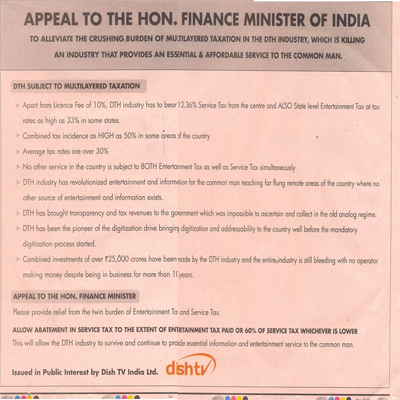
    MUMBAI: The Direct to Home (DTH) industry has been vehemently opposing the heavy taxation being levied on the various operators in the country. In view of the same, the country’s oldest DTH operator Dish TV has appealed to the new Finance Minister Arun Jaitley.


    The DTH operator in its appeal has requested the Minister to alleviate the crushing burden of multilayered taxation in the DTH industry which is in turn killing the industry. The operators are subject to several taxes such as 10 per cent licence fee, 12.36 per cent service tax from the centre and the state level entertainment tax which is as high as 33 per cent in some states. While the average tax rates in most states is 30 per cent, in some it is as high as 50 per cent.


    The appeal states that no other service in the country is subject to both service as well as entertainment tax at the same time. “DTH industry has revolutionised entertainment and information for the common man reaching far flung remote areas of the country where no other source of entertainment and information exists. It has brought transparency and tax revenues to the government which was impossible to ascertain and collect in the old analogue regime,” states the appeal.


    Dish TV says that the entire industry has made investments of over Rs 25,000 crore but is still bleeding with no operator making money despite being in business for more than 10 years.


    The request by the operator on behalf of the entire industry is to provide relief from the twin burden of entertainment tax and service tax. It requests to allow abatement of service tax to the extent of entertainment tax paid or 60 per cent of service tax whichever is lower.   

  • Google partners with Network18 on ‘In Conversation’

    Google partners with Network18 on ‘In Conversation’

    MUMBAI: Network18 and Google announced a joint initiative today to help connect prominent politicians with voters across the country. The partnership involves a series of Google Hangouts with politicians titled ‘In conversation”. First in the series will be Arun Jaitley, Leader of Opposition, Rajya Sabha, who will be addressing voters live via a hangout session on 25th March.

    The 2014 general elections have been acknowledged to be the first in the nation’s history that will be extensively discussed, debated and fought on social media platforms including Google Hangouts and YouTube. The hangout series will involve politicians such as West Bengal CM Mamta Banerjee, Jammu & Kashmir CM Omar Abdullah, Madhya Pradesh CM Shivraj Singh Chauhan, NCP President Sharad Pawar, noted economist Jairam Ramesh and social activist Anna Hazare – discussing key topics and issues on the voters minds.

    Announcing the partnership, Rajan Anandan, VP and Managing Director, Google India, said, “India is a politically vibrant country and the 2014 general elections promises to be a landmark in the history of this nation – it marks the beginning of political parties and candidates embracing Internet to reach out to an educated and digitally savvy group of young and potential voters. We are very excited to partner with Network18 to provide our users with all the information they need and engage the leaders of the country on Google products.”

     
    Commenting on this, Ajay Chacko, COO, Network18 added “At Network18, as a leading editorial voice in the country, we have always focused on ideas and initiatives that encourage our citizens to participate and engage. ‘In Conversation’ is another milestone in this direction and it assumes greater significance given the 200 million+ fast-growing, highly aware digital audience that is shaping the agenda during these elections. We are happy to partner with google in this pioneering effort and are confident that this will serve our audiences well.”

     
    Speaking on the partnership, Rajdeep Sardesai, Editor in Chief, IBN18 Network, said, “Perhaps more than any other election in the past, these elections are about capturing the imagination of millions of both first-time as well as experienced voters. And it is evident that the frontier of this battle is online. ‘In Conversation’ is a landmark because it meshes the power of digital with the impact of a town hall’.

    Making full use of the power of social media and understanding the importance of getting real time feedback from the citizens of the country, Indian politicians have increasingly started using social media platforms like Google+ to reach out to the netizens. In 2012, Gujarat Chief Minister, Narendra Modi, was the first Indian public figure to use Hangouts to reach out to his audience. A number of politicians including Arvind Kejriwal of Aam Aadmi Party (AAP), Union Finance Minister P Chidambaram, HRD Minister Shashi Tharoor and others have used Google+ Hangouts to connect with Indian citizens.

    Don’t miss this special series beginning Tuesday, March 25, 2014 at 10:00 PM on CNN-IBN and at 9:30 PM on IBN7.


  • Where goest the broadcast bill?

    Where goest the broadcast bill?

    The fate of the broadcast bill hangs on a razor’s edge, despite Braodcast Minister Arun Jaitley’s pledge to table it in the surrent budget session of parliament.

    Lobbying for the Broadcast bill is expected to reach fever pitch after March during the Budget session recess. The broadcasters lobby group, The Indian Broadcast Foundation has set up three committees for the purpose. Discovery India’s Kiran Karnik, News Television India’s Peter Mukherjee and Urmila Gupta, and Sony Entertainment Television’s Kunal Dasgupta are looking at convergence and spectrum allocation issues. ESPN’s Manu Sawney and Turner International’s Anshuman Misra are reviewing technology convergence, especially the last mile infrastructure.

    Content provider UTV’s Ronnie Screwvala and Khursheeda Mody, Nimbus Communications Harish Thawani and MTV India’s Alex Kuruvilla are looking at Internet regulatory issues. Three government committees are also reviewing critical areas in the bill.

    Jaitley expects to reach a consensus during the recess before tabling the bill in parliament. Some analysts believe that foreign equity in cross media holding and DTH may not form a part of the bill, plagued by opposing political viewpoints. Others indicate that the bill may be tabled, but will go into a sub committee for further review.

  • Former I&B minister Pramod Mahajan dead

    Former I&B minister Pramod Mahajan dead

    NEW DELHI: Senior BJP leader and former information & broadcasting (I&B) minister Pramod Mahajan passed away this afternoon at Mumbai’s Hinduja Hospital following multiple organ failure.
    Mahajan, who was shot and grievously wounded by his youngest brother Pravin on the morning of 22 April after an argument at the BJP leader’s apartment in Mumbai’s upscale Worli area, had remained in a critical condition ever since the attack 12 days ago.

    The 56-year-old former I&B minister had three bullets lodged in his body and suffered what ultimately proved fatal damage to his liver, pancreas and intestines. Mahajan is survived by his wife and a son and daughter.

    Hinduja Hospital has been virtually under media seige these past days with television crews stationed there 24/7. Mahajan’s condition, which has had blanket coverage across all news channels, began deteriorating rapidly since yesterday and officials anounced his demise at 4:10 pm this evening.

    It was on Mahajan’s watch that Star India in 1998-99 made its first concerted effort to get a direct-to-home (DTH) broadcast service going with its ISkyB venture. Mahajan had in end-1998 indicated that DTH clearances would come within two-and-a-half months.

    Doordarshan’s news channel is also a brain child of Mahajan, who floated the idea in 1999. The idea of starting such a channel was mooted immediately after the BJP came to power in March 1998. Mahajan gave the green signal for starting the channel after he became I&B minister in December.

    It was also Mahajan who got the idea to upgrade the facilities of Kashmir DD centre to counter Pakistani propaganda unleashed by Pakistan’s state broadcaster PTV in 1999-2000. Though a dedicated Kashmir channel was started with the help of private broadcasters when Arun Jaitley became the I&B minister after Mahajan in 2000, the former had sanctioned a $100m package for the upgradation of DD Kashmir’s centre.

    After Mahajan was shifted to the telecom ministry, holding also the infotec portfolio, he expressly scotched an idea of merging the telecom and I&B ministry to form an ICE ministry for the proposed convergence era.

    It is not wise to make one out of three important ministries of telecom, information and broadcasting and information technology, especially in view of the amount of work involved and number of employees associated, Mahajan had said in his capacity as information technology & communication and parliamentary affairs minister, while opposing a merger of the three ministries.

    The media savvy Mahajan was also the brain behind the “India Shining” campaign that his party, which was then ruling at the Centre, used unsuccessfully to fight the last general elections in 2004.

  • Former I&B minister Pramod Mahajan shot at by brother, remains critical

    Former I&B minister Pramod Mahajan shot at by brother, remains critical

    MUMBAI / NEW DELHI: Senior BJP leader and former information & broadcasting (I&B) minister Pramod Mahajan was shot this morning (Saturday) and remains in a critical condition.

    Mahajan was shot at by his youngest brother Pravin with a Brownie pistol after an argument at the BJP leader’s apartment in Mumbai’s upscale Worli area at around 8 am, news channels have reported.
    The 56-year-old former I&B minister reportedly has four bullets lodged in his body and has suffered grievous injury to his liver, pancreas and intestines. He underwent a nearly four-hour operation at Mumbai’s Hinduja Hospital where he was administered nearly 25 bottles of blood due to the heavy internal bleeding he suffered in the attack. Doctors have not removed the bullets yet and will take a call on that only after keeping him under observation for the next 48 hours.

    It was on Mahajan’s watch that Star India in 1998-99 made its first concerted effort to get a direct-to-home (DTH) broadcast service going with its ISkyB venture. Mahajan had in end-1998 indicated that DTH clearances would come within two-and-a-half months.

    Doordarshan’s news channel is also a brain child of Mahajan, who floated the idea in 1999. The idea of starting such a channel was mooted immediately after the BJP came to power in March 1998. Mahajan gave the green signal for starting the channel after he became I&B minister in December.

    It was also Mahajan who got the idea to upgrade the facilities of Kashmir DD centre to counter Pakistani propaganda unleashed by Pakistan’s state broadcaster PTV in 1999-2000. Though a dedicated Kashmir channel was started with the help of private broadcasters when Arun Jaitley became the I&B minister after Mahajan in 2000, the former had sanctioned a $100m package for the upgradation of DD Kashmir’s centre.

    After Mahajan was shifted to the telecom ministry, holding also the infotec portfolio, he expressly scotched an idea of merging the telecom and I&B ministry to form an ICE ministry for the proposed convergence era.

    It is not wise to make one out of three important ministries of telecom, information and broadcasting and information technology, especially in view of the amount of work involved and number of employees associated, Mahajan had said while opposing a merger of the three ministries.