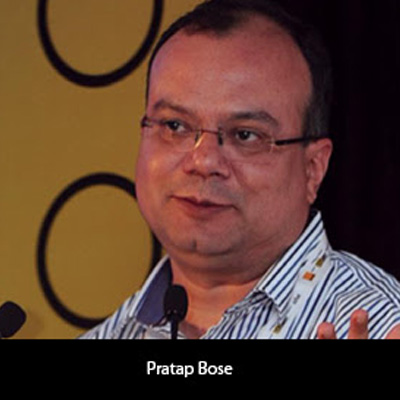
Seven months back ad man and former Ad Club president Pratap Bose embarked on his entrepreneurial journey with The Social Street, a digitally driven agency that looks at advertising as part of the many marketing solutions that an advertiser seeks. Joining him in the initiative were partners Mandeep Malhotra, Arjun Reddy and Pradeep Uppalapati — all pioneers in different fields.
After his exit from DDB Mudra as the chief operating officer, it was natural that The Social Street’s launch would make headlines with all industry’s eyes trained on its proceedings. Now, seven months later, with the buzz receding, we find the workings of this new fledgling agency becoming more and more shrouded in mystery. “It is a conscious decision to not reveal our account wins, as we don’t want to be in that game,” Bose simply answers when queried about the same.
Currently operating through 10 satellite offices with 160 employees who handle over 50 clients to boot, The Social Street credits its quick growth to its unique positioning in the market. In a candid chat with Indiantelevision.com’s Papri Das, Bose speaks on the advertising philosophy the start-up agency holds, their game plan for 2016, his thoughts on retail and shopper marketing and why their focus is not advertising.
Excerpts:
How has life been as an entrepreneur? What are the biggest changes that you have observed from your past role?
Not much honestly. I am not someone who has worked in 10 agencies in the last 25 years of my career. In terms of work hours, the pressure and handling people, it comes very naturally to me. The only thing that has changed is that it’s my business and I am not answerable to any chain of superiors or hierarchy. I am the one accountable. There is no reporting to New York or Hong Kong, for example. It certainly brings a fresh perspective now that I am on the other side. Now I can see things far more realistically from a client’s point of view.
When you work for a large agency, I think fundamentally you are chasing revenue rather than cultivating good strategic work. I am not saying that has always been so but in the last five years or so, the pressure on margins and revenues from an agency’s point of view is getting more acute than ever before. And performance, no matter what the industry says, is evaluated on a quarter by quarter basis on revenue target achievements.
How does The Social Street differ from that mindset? What is its advertising philosophy?
In any business numbers are very important, especially so for start-ups, though I prefer not to call us one. Because if you are not profitable as an agency, whether you operate with 20 people or 200 people, there is always going to be a strain on the business. But you are not accountable to every person in the organisation who wants to know what the numbers are. If your fundamentals in the strategy is bang on then we believe the numbers will happen in any which way. We have an offering and range of services that really sets us apart from most agencies. I am not competing with any creative agency as the market I want to penetrate, is world apart.
If I have to round up, we have seven buckets of businesses, which includes out of home, traditional media like television, print and radio, experiential, branded content, shopper and retail, rural, youth and sports marketing and cause marketing. Then there are specialisations that come with each.
How was year 2015 for The Social Street? Did you set any benchmarks when it comes to the work and mandates? How was it in terms of new business?
It takes time to build an organisation. Nothing happens in six months’ time. Having said that, have we done well? I think so, yes. The fact that we have opened 10 satellite offices and three main offices, hired around 160 people, and managed to get over 50 clients onboard is great progress, I feel. It was a conscious decision to not publicise about the account wins. We prefer to put all the investments upfront so in that regard I feel we have broken traditions in the business as well. And the experiment has paid off for us. Clients are happy with us. For seven months, I feel that is a pretty large amount of progress.
Your expertise is legendary in the industry and now you have Deepak Singh onboard. Tell us how this appointment helps the agency reach its advertising philosophy?
The creative process and approach we take to a client is one of our differentiating aspects. So therefore, the kind of people we are looking for are new age thinkers who are willing to look beyond TV commercials and newspaper ads.
Today the market needs creatives to think like clients who are seeking accountability. So I am looking for creatives who are not afraid to talk about how we are delivering incremental sales through the most creative process, of course. So Deepak fit the bill perfectly and hence he is onboard with us. He shares the same advertising philosophy as we do.
The Social Street was recently making headlines for its partnership with Rediffusion. Please tell us the thought behind this partnership and how it will play out?
The Social Street and Rediffusion have worked together twice in the past during our initial days. It worked well for both the companies and the vibes were just right. The clients were happy too. That led to the idea of taking our partnership on a bigger scale. We decided to offer the entire gamut of our services to the entire group. We are having a separate unit of about 35 – 40 people, for that who will closely work with Rediffusion on all their clients. We will cater to their Out of Home needs, experiential, digital and other requirements, rather than core media. We won’t be making TV commercials for them, Rediffusion will cater to their creative needs instead.
Being a fairly new company, was it difficult to penetrate the market?
Though we deal in core media, I am not really focusing in the advertising part of it. I am not looking forward to making TVCs and newspaper ads. There will be some as they are bread and butter and I need to pay the bills as well. But at the end of the day my focus is to deliver business solutions in a way that delivers ROI for the client. Therefore I don’t see creative agencies as competition. For us, it’s more about solving business problems or finding innovation business solutions with data consulting and analytics. We have a unique positioning in the market thanks to the various and distinct services we can offer, all under the same umbrella. Clients see value in going to one agency and getting all their requirements fulfilled than knocking at 10 different doors.
Though several forecasts predict that digital ad spends are growing by leaps and bounds, television still remains the most preferred medium for advertisers to invest in. What do you have to say to that?
I am not looking into advertising budgets of brands, I am looking into marketing budgets. The advertising spends are a fraction of what brands and clients have put together for their marketing. For example’s sake, if there is a large retailer owning 500 stores in india, those 500 stores are the most important part of his business. He puts in way more effort and money into those stores, which could be easily ten times of what he spends on advertising them. If I have the ability to measure every customer who is walking in his store and profiling and understanding them, to help him create a marketing strategy for them in a creative way, they will see far more value in it. It is very important to understand the distinction between marketing and advertising. Advertising is only a sliver of marketing.
What are your thoughts on the current landscape of marketing?
I feel that shopper marketing, which is one of the most important tools in the western world, should be paid more heed to. If a shampoo brand spends Rs 50 crore in advertising but doesn’t get picked up by the shopper in the mall, what use is that? So at the moment of truth, whether you go to the roadside kirana store or a mall, you go from being a consumer to a shopper. That science, research and understanding is massive and we need young professionals to understand that.
What is interesting is that the same shopper market is now turning to digital marketing as well, as more and more consumers choose to shop online, which calls for completely different game plans. There are studies done in western markets on ways to influence customers even in their online shopping experience.
Where do you see most of your business coming in from?
From clients who are seeking solutions in anything that is process and tech driven, because that’s where there is a huge amount of incremental value to the clients. That is where the growth will happen for us.
If I were to break it down, I see the entire experiential marketing space coming back in the business. Obviously digital will grow, there’s no doubt about it. I also see some clients looking for content based solutions, which may even be viral videos etc. I also see a huge scope in the rural marketing category as there are hardly any players in the business who have a strategy in place, but that’s where brands are spending. And last but not the least, retail and shopper marketing, as I said, holds a lot of promise for us.

 Abhijit Avasthi: The media had a field day when Ogilvy & Mather chief creative officer Abhjit Avasthi put in his papers out of the blue last year. The mystery was unravelled six months later, when Avasthi announced his new creative solutions start-up Sideways, of which he is a co-founder. Aimed to be a multi-dimensional creative solutions provider, Avasthi even gave an open invitation to professionals from different industries to join his new venture.
 Ajay Chacko and B Saikumar: Industry veterans and Network18 associates, who severed ties with company almost at the same time, came together after a long time to team up with media and broadcasting veteran Ronnie Screwvala to form a new digital media company called Arré. The venture aims at establishing a digital brand, which will offer multi-genre¬, multi-lingual content across video, audio, text and other traditional and new age art forms.
 Barkha Dutt: Media professional or not, there is hardly anyone unfamiliar with this veteran journalist, who anchors NDTV’s prime time shows. Therefore, her announcement to quit the news network as an editor to start her own digital multi-media company has saddened several fans of Dutt – the reporter. As she firmed up plans for her new venture, she moved to the role of consulting editor for the news channel, while remaining closely associated as the anchor for The Buck Stops Here on weeknights and We The People on weekends.
 Cyrus Oshidar: Former MTV man, who is known for his involvement with iconic shows such as MTV Bakra, Roadies, et al, made a comeback this year with what he does best – telling stories about young urban India. Through videos, photos and tongue-in cheek style of articles, branded content start-up 101 India is designed to be the window to open-minded listless and creative millennials and what they find interesting.
 Gaurav Seth: Those who have known Gaurav Seth as the senior vice president of Sony Entertainment Television did a double take when he ended his relationship of over six years with the broadcast network to co-found Purple Canvas. Fresh in the picture, this new content creating start-up already has its first television series underway.
 Nitin Suri and Chraneeta Mann: When two highly creative individuals get together, the combination always leads to creation and that’s exactly what happened when former Dentsu national creative director Suri and Rediffusion Y&R national creative director Mann joined hands to form The Mob. Funded by the wholly owned subsidiary of Mogae Media, the venture aimed to marry television commercials and content with mobile phones.
 Prakash Nathan: This former UTV Disney India operations head and UTV Motion Pictures vice president too recently rolled out India’s first ever digital media market titled CineMArkets Digital Solutions along with partners Girish Kumar and Inkswipe Consulting LLP. Backed by his experience of two decades, Nathan is already leading this CineMArket into new avenues.
 Prashant Bhatt: Colors fiction head Prashant Bhatt, best known for shows likeMadhubala and Udaan, surprised one and all in the first half of the year by venturing into production. Bhatt launched the new production house – Studio B&M – along with his business partner and cinematographer Sanjay Memane. The one year old production house is already slated to produce Mastaangi for Channel V.
 Pratap Bose: As the DDB Mudra Group chief operating officer, Bose helmed several path breaking projects and even donned the hat of the Ad Club president. Therefore his decision to take on the role of an entrepreneur and start his own creative agency – The Social Street came as a surprise to the industry at large. His former colleagues and associates Mandeep Malhotra, Arjun Reddy and Pradeep Uppalapati were quick at his heel, and joined his new venture as partners.
 S Yesudas: The most recent executive to join the start-up bandwagon is former managing director of Vizeum India and media expert S Yesudas. Along with partners Ajit Nair of MX Advertising and Amit Tripathi from IdeateLabs, Yesudas plans to disrupt the current industry with their ‘unagancy,’ which is christened triggerbridge. From the way the agency is spelled to its operational objectives, triggerbridge comes across as having an innovative and modern outlook towards the current advertising space.