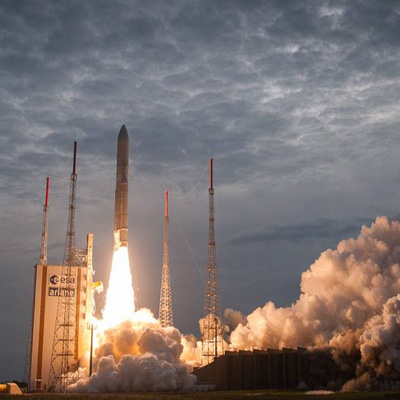
Tag: Ariane 5

  • Arianespace appoints David Cavaillolès as CEO replacing Stéphane Israël

    Arianespace appoints David Cavaillolès as CEO replacing Stéphane Israël

    MUMBAI: Arianespace has gone in for 36  year old David Cavaillolès to become CEO of the European space rocket launch firm from January 2025.

    David has been a rising young  star, starting out in insurance at ACPR as a financial supervision expert after acquiring two masters  degrees, one in sciences, economic, and mathematics followed by another in finance which included actuarial finance. 

    He stayed there for a couple of years following which he joined the public sector, first as an inspector of finances for a couple of years for the French government, then as a senior ministerial adviser in the office of  the minister of  education, research and innovation where he was given  charge of space David advised the ministry on its  industrial strategy for launchers and satellites, Newspace, among many other areas.

    He held this position for two and a half years before being lured back to the private sector by Capgemini Financial Services where he stayed for five years and theee months, rising from head of ADM Paris  practice to chief sales officer of the French office of Capgemini.

    His growth has been rapid throughout his career, especially considering that he was headhunted to lead Arianespace at the young age of 36.

    David replaces Stéphane Israël the outgoing  CEO of Arianespace, who has been at the company’s helm since April 2013 and is currently pursuing new opportunities.  As CEO, Stéphane Israël  played a key role in developing the Ariane industrial cluster with the Ariane 6 launcher, and in transforming Arianespace, which became a subsidiary of ArianeGroup in 2017. 

    After consolidating the Ariane 5, Vega and Soyuz launcher families and supporting the development of Ariane 6 and Vega C next-generation launchers, Stéphane Israël gave Arianespace’s offering a new direction, transitioning from dual GEO satellite launches to solutions designed for large constellations in low-Earth orbit and the growing diversity of satellites. 

    Thanks to these initiatives, Arianespace reached a record rate of 15 launches in 2021 while taking orders for 30 Ariane 6 launches and 15 Vega C launches. Since April 2013, Stephane Israël has supervised 108 launches, including, recently, the emblematic James Webb Telescope (JWST) mission for Nasa and the Juice probe launch for the European Space Agency (ESA).

    “Every day I have spent since April 2013 writing this chapter in the history of Arianespace has been a great honor and an extraordinary human adventure,” said Stéphane Israël. “I am pleased to entrust my successor with a company boasting a solid order book to ramp up the launch rate as of 2025. With Ariane 6, Arianespace will be able to capture the opportunities arising in a dynamic and fast-changing market.”

    ArianeGroup CEO Martin Sion said: “Stéphane has supported Arianespace through major milestones, from the height of Ariane 5’s success to the first flight of Ariane 6. He also worked hard to transform Arianespace in line with ArianeGroup.”
     

  • India’s GSAT-17 communication satellite launched successfully

    India’s GSAT-17 communication satellite launched successfully

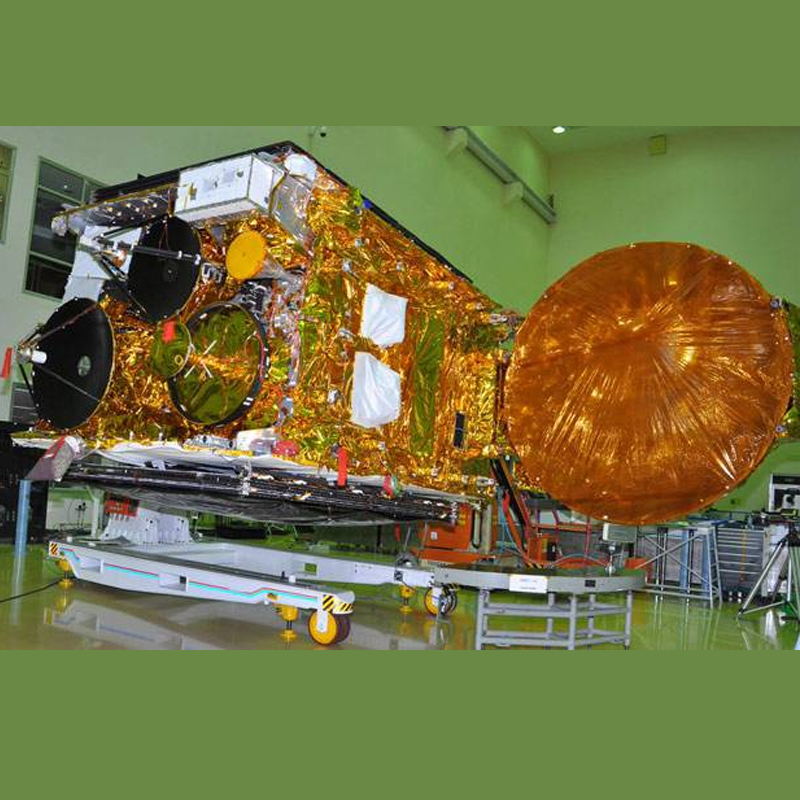
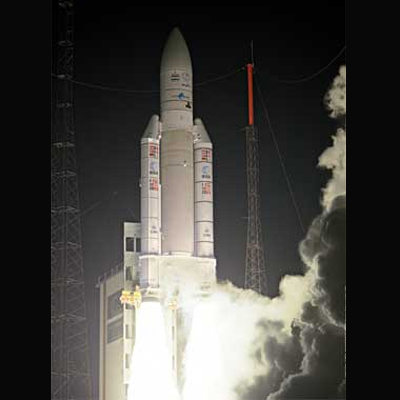
    MUMBAI: GSAT-17 became India’s third communication satellite to successfully reach orbit in the past two months. GSAT-17 was launched in the early morning hours using the European Ariane 5 Launch Vehicle from Kourou, French Guiana. The 3477 kg GSAT-17 carries communication payloads in C-band, Extended C-band and S-band for providing various services to the country.

    The satellite also carries equipment for meteorological data relay and satellite based search and rescue services. After its lift-off at 0245 hrs (2:45 am) IST and a flight lasting about 39 minutes, GSAT-17 separated from the Ariane 5 upper stage in an elliptical Geosynchronous Transfer Orbit (GTO) with a perigee (nearest point to Earth) of 249 km and an apogee (farthest point to Earth) of 35,920 km, inclined at an angle of 3 degrees to the equator.

    ISRO’s Master Control Facility (MCF) at Hassan in Karnataka took over the command and control of GSAT-17 immediately after its separation from the launch vehicle. Preliminary health checks of the satellite revealed its normal functioning.

    In the coming days, orbit raising manoeuvres will be performed to place GSAT-17 satellite in the Geostationary Orbit (36,000 km above the equator) by using the satellite’s propulsion system in steps.

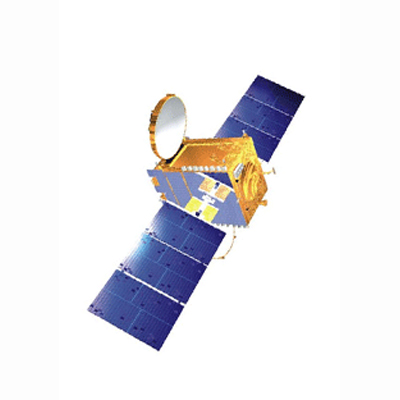
    During the final stages of its orbit raising operations, the two solar arrays and both the antenna reflectors of GSAT-17 will be deployed. Following this, the satellite will be put in its final orbital configuration. GSAT-17 will be positioned at its designated orbital slot in the geostationary orbit and will be co-located with some of the Indian operational geostationary satellites. Later, it is planned to turn on the communication payloads of the satellite. After the successful completion of all the in-orbit tests, GSAT-17 will be ready for operational use.

  • Intelsat launches Epic next-gen satellite system in orbit

    Intelsat launches Epic next-gen satellite system in orbit

    MUMBAI: Satellite services provider Intelsat S.A. has launched the first of the Intelsat EpicNG high throughput satellites – Intelsat 29e successfully from French Guiana aboard an Ariane 5 vehicle.


    The Intelsat 29e satellite separated from the rocket’s upper stage 38 minutes after launch and signal acquisition has been confirmed.


    Manufactured by Boeing and equipped with the most advanced digital payload on a commercial spacecraft, Intelsat 29e will bring high throughput capacity in both C- and Ku-band to North and Latin America and the North Atlantic region. Intelsat 29e will be placed into service at 310° East, where it replaces Intelsat 1R.


    Intelsat 29e is the first satellite of Intelsat’s next generation, all digital EpicNG satellite platform, which combines wide beams and spot beams with frequency reuse technology and the sector’s most advanced digital payload. The digital payload will provide customers with unprecedented security and flexibility, enabling customers to seamlessly access and shift capacity to match their usage needs in a particular region or timeframe. Intelsat EpicNG is optimized to provide satellite connectivity for applications including the Internet of Things, enterprise, wireless infrastructure, aeronautical and maritime mobility, and government, which are expected to provide a combined $3 billion incremental opportunity by the year 2020.


    “Today’s launch represents a truly ‘epic’ moment in communication’s history, as we begin a new era of high throughput satellite services for our customers. This is a testament to the innovation and creativity of the Intelsat team who envisioned the Intelsat EpicNG platform nearly four years ago. Through design expertise and a deep understanding of our customers’ requirements, the Intelsat EpicNG platform will deliver high performance, improved economics and simplified access that will expand the addressable market for our solutions,” said Intelsat CEO Stephen Spengler.


    The Intelsat EpicNG platform design reflects the company’s innovative approach to introducing high throughput technology into the world’s largest community of enterprise-grade satellite networks which operate on the Intelsat fleet. Intelsat EpicNG is backwards compatible and fully interoperable with Intelsat’s existing satellite fleet and terrestrial infrastructure, allowing customers to use currently deployed network hardware to access the high performance connectivity. The platform’s open architecture allows customers to have control over service offerings and hardware selection, providing differentiation of service offerings.


    The payload will deliver carrier-grade services to fixed and mobile network operators, and broadband for applications such as enterprise, aeronautical and maritime mobility, and government throughout the Americas. The satellite also features spot beams for mobility customers serving the heavily trafficked North Atlantic region. Companies such as Harris CapRock, Panasonic, EMC (formerly MTN), Axesat and leading national telecom operators in Latin America will be among the first to deploy services on the platform.


    Intelsat 29e is the 56th Intelsat satellite launched by Arianespace.  Intelsat expects to launch the second Intelsat EpicNG satellite, Intelsat 33e, which will serve Europe, Africa, the Middle East, and Asia, in the third quarter of 2016, also aboard an Arianespace launcher.

  • Intelsat launches Epic next-gen satellite system in orbit

    Intelsat launches Epic next-gen satellite system in orbit

    MUMBAI: Satellite services provider Intelsat S.A. has launched the first of the Intelsat EpicNG high throughput satellites – Intelsat 29e successfully from French Guiana aboard an Ariane 5 vehicle.


    The Intelsat 29e satellite separated from the rocket’s upper stage 38 minutes after launch and signal acquisition has been confirmed.


    Manufactured by Boeing and equipped with the most advanced digital payload on a commercial spacecraft, Intelsat 29e will bring high throughput capacity in both C- and Ku-band to North and Latin America and the North Atlantic region. Intelsat 29e will be placed into service at 310° East, where it replaces Intelsat 1R.


    Intelsat 29e is the first satellite of Intelsat’s next generation, all digital EpicNG satellite platform, which combines wide beams and spot beams with frequency reuse technology and the sector’s most advanced digital payload. The digital payload will provide customers with unprecedented security and flexibility, enabling customers to seamlessly access and shift capacity to match their usage needs in a particular region or timeframe. Intelsat EpicNG is optimized to provide satellite connectivity for applications including the Internet of Things, enterprise, wireless infrastructure, aeronautical and maritime mobility, and government, which are expected to provide a combined $3 billion incremental opportunity by the year 2020.


    “Today’s launch represents a truly ‘epic’ moment in communication’s history, as we begin a new era of high throughput satellite services for our customers. This is a testament to the innovation and creativity of the Intelsat team who envisioned the Intelsat EpicNG platform nearly four years ago. Through design expertise and a deep understanding of our customers’ requirements, the Intelsat EpicNG platform will deliver high performance, improved economics and simplified access that will expand the addressable market for our solutions,” said Intelsat CEO Stephen Spengler.


    The Intelsat EpicNG platform design reflects the company’s innovative approach to introducing high throughput technology into the world’s largest community of enterprise-grade satellite networks which operate on the Intelsat fleet. Intelsat EpicNG is backwards compatible and fully interoperable with Intelsat’s existing satellite fleet and terrestrial infrastructure, allowing customers to use currently deployed network hardware to access the high performance connectivity. The platform’s open architecture allows customers to have control over service offerings and hardware selection, providing differentiation of service offerings.


    The payload will deliver carrier-grade services to fixed and mobile network operators, and broadband for applications such as enterprise, aeronautical and maritime mobility, and government throughout the Americas. The satellite also features spot beams for mobility customers serving the heavily trafficked North Atlantic region. Companies such as Harris CapRock, Panasonic, EMC (formerly MTN), Axesat and leading national telecom operators in Latin America will be among the first to deploy services on the platform.


    Intelsat 29e is the 56th Intelsat satellite launched by Arianespace.  Intelsat expects to launch the second Intelsat EpicNG satellite, Intelsat 33e, which will serve Europe, Africa, the Middle East, and Asia, in the third quarter of 2016, also aboard an Arianespace launcher.

  • SES entrusts Arianespace with SES-12 launch

    SES entrusts Arianespace with SES-12 launch

    MUMBAI: SES has selected Arianespace to launch the powerful new hybrid communications satellite, SES-12, on board an Ariane 5 booster from the European Space Center in Kourou, French Guiana, during Q4 2017. This will be the 40th launch of an SES spacecraft on board an European Ariane launch vehicle.


    The new satellite will expand SES’s capabilities to provide direct-to-home (DTH) broadcasting, VSAT, Mobility and High Throughput Satellite (HTS) data connectivity services in the fast growing Asia-Pacific region, including rapidly growing markets such as India and Indonesia.


    The spacecraft will be positioned at the well-established SES orbital slot of 95 degrees East, providing incremental as well as replacement capacity with excellent view angles across the Asia-Pacific region. SES-12 will replace SES’s existing NSS-6 satellite and will be co-located with SES-8. Today, SES serves close to 20 million DTH households in India and Indo-China from this orbital slot.


    SES-12 is being built by Airbus Defence and Space based on the highly reliable Eurostar E3000 platform. The satellite is designed to operate for 15 years, with a payload comprising 68 high-power physical Ku-band transponders and eight physical Ka-band transponders. The spacecraft will be equipped with an electric plasma propulsion system for orbit raising and on-orbit manoeuvres.


    The payload of the hybrid SES-12 satellite consists of two distinct but complementary missions: first, traditional wide beam coverage, and second, a high-powered Ku-band multi spot beam payload (HTS).


    The traditional wide-beam mission consists of 54 (36 MHz equivalent) transponders that will provide state-of-the-art replacement and growth capacity for SES’s existing DTH, government and VSAT customers, allowing for a seamless transition from NSS-6 to SES-12. In addition, the design provides incremental growth capacity to support new DTH platforms and other services targeting the Asia-Pacific region.


    The second mission consists of 70 Ku-band spot beams and 11 Ka-band spot beams delivering over 14 GHz for VSAT, Enterprise, Mobility and Government applications. This mission also includes a Digital Transparent Processor (DTP), which provides anti-jamming capabilities as well as increased payload flexibility in order to provide customized bandwidth solutions to SES customers.