Tag: apps

  • Indiantelevision.com, mFilterIt co-host Bengaluru roundtable on AI-led app marketing

    Indiantelevision.com, mFilterIt co-host Bengaluru roundtable on AI-led app marketing

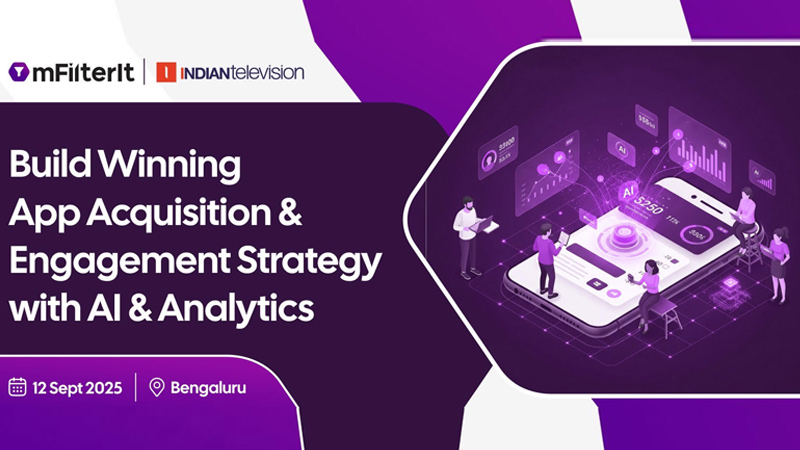
    BENGALURU: With India’s app economy mushrooming and companies locked in a race for clicks and engagement in an era of attention deficit, the question is no longer just about investing in app marketing, it’s about making every install count. To address this challenge, Indiantelevision.com Group and mFilterIt co-hosted a closed-door roundtable in Bengaluru on September 12, themed Build Winning App Acquisition & Engagement Strategy Using AI & Analytics.”

    “In an ecosystem, where installs alone no longer define success, it is critical to focus on cleaner traffic, sharper strategies, and genuine engagement. That’s why we are delighted to co-host this forum with mFilterIt—a partner whose expertise in AI and analytics has been pivotal in redefining transparency and trust in the digital ecosystem. By co-hosting this forum with mFilterIt, we aim to equip marketers with insights that go beyond the numbers and help shape sustainable, growth-focused approaches for the industry,” noted Indiantelevision.com, chief business officer, Soumitra Sahu.

    The invite-only forum brought together senior voices from leading brands to discuss sharper strategies for app marketers. The focus was not only on driving installs but also on ensuring genuine user engagement, maintaining cleaner traffic, and improving key efficiency measures such as cost per install (CPI) and cost per engagement (CPE). 

    The shifting ground of app acquisition

    With user acquisition campaigns increasingly driven by affiliates, India’s top brands are beginning to face blind spots in their frameworks. Attribution platforms may be able to measure installs, but optimisation and bot detection often fall outside their scope. This is where independent validators such as mfilterit have entered the picture, deploying AI-powered algorithms and layered checks that uncover wasted ad spend and fraud patterns usually missed by traditional systems. 

    A powerhouse panel

    The discussion was moderated by WPP Media, national head – performance marketing, Satheesh Kumar and featured senior leaders including Rohit Utmani of Phonepe’s Indus app store, Manas Prakash of Ajio, Pawandip Singh of Rapido, Akansha Kumari of Pocket FM, Utkarsh Garg of Jar, Satheesh Chinnappan of redbus, Saravanan G of Payrupik, Kirtiman Phadke of Stable Money, Rajat Srivastava of My Growth Club, Durgesh Rathore of mfilterit, and Jagmeet Singh of mfilterit. Together, they brought perspectives from diverse verticals of India’s booming app economy.

    Cracking the code

    The agenda stressed on some of the toughest questions in app marketing today. Among them was how brands can detect wasted ad spend and improve ROI, what critical metrics validate app ad traffic and highlight potential risks, and how incent walls distort campaign outcomes. A key theme: why marketers must challenge the data they receive from platforms and affiliates instead of taking it at face value. Fraud samples, like unusual CTIT patterns, installs from invalid OS versions, click hijacking, incent traffic, and even fake orders, further demonstrated how affiliate monitoring and real-time validation can uncover non-compliant activities and wasted spend. By highlighting these real-world patterns, the session demonstrated how independent checks bring more rigour, transparency, and efficiency to app marketing campaigns. 

    Why it matters

    By the end of the session, participants gained a clearer view of the blind spots in user acquisition and a sharper understanding of how AI and big data can improve campaign outcomes. They also walked away with a roadmap to elevate their strategies with real-time insights, helping ensure that every install delivers value rather than vanity. For Indiantelevision.com group, co-hosting the event reinforces its role as a knowledge partner to the industry. Together with mfilterit, it aims to provide marketers with a forward-looking agenda at a time when the quality of engagement, rather than sheer quantity, defines sustainable growth.

  • RunnTV crosses 50 thousands app downloads

    RunnTV crosses 50 thousands app downloads

    Mumbai: RunnTV, the Indian FAST (Free Ad-Supported Streaming Television) based content streaming platform targeting only Indian audiences, has achieved a benchmark by surpassing 50,000 downloads in a short timeframe while targeting only selective Indian cities. This response underscores RunnTV’s relevance and experience for OTT users in India.

    Since its launch in November 2023, RunnTV has built and captivated audiences with its curated content and experience delivered with user-friendly interface, and innovative features. The app’s instant appeal to a broad audience can be attributed to RunnTV’s aim to deliver high-quality entertainment experience that caters to the evolving preferences of today’s digital audience.

    RunnTV is targeting the emerging and high growth FAST market in India. This initial response to RunnTV clearly highlights the void and a need for a free TV platform with great user experience and good content without any clutter created with a dump of available free content. RunnTV will soon be available on Smart TVs and other aggregator platforms.  

    OTT App Name stands out with its features, such as mentioning any unique features which have garnered positive feedback from users and contributed to the app’s rapid growth.

    Runn TV founder & CEO Manish Sinha said, “We are thrilled to have reached the milestone of 50,000 downloads in such a short span. This achievement is a testament to our RunnTV team’s dedication to delivering exceptional entertainment and streaming experience. We are grateful to our users for their support and trust in our platform, this is definitely a great start to our vision to make RunnTV the Entertainment Experience Destination for Indians across the globe.”  

    As RunnTV continues to evolve and expand its channels and content offerings, the company is optimistic to provide an entertainment experience that brings many firsts to the Indian OTT audience.

  • Tata Play Binge becomes a standalone OTT offering for Rs 59

    Tata Play Binge becomes a standalone OTT offering for Rs 59

    Mumbai: Content distribution platform, Tata Play (formerly known as Tata Sky), has announced the expansion of its OTT entertainment app, Tata Play Binge, to all smartphone users, with no pre-requisite of needing a DTH subscription. Tata Play Binge, the application that aggregates content from across OTT platforms in India and presents it on a single screen, offers subscribers one of the largest collections of movies, TV series, web originals, and live sports from 17 streaming apps, along with gaming, under one roof. In an endeavour to ease the process of content discovery and reduce the hassle of multiple subscriptions, Tata Play Binge is introducing plans starting at Rs 59 per month and providing access to premium content across popular national, international, and regional apps as per subscribed plans. The platform will soon host 25 apps as eight more apps are slated to be added in the coming months.

    The all-new Tata Play Binge offers content in 12 languages from popular OTT apps such as Disney+ Hotstar, ZEE5, Voot Select, SonyLIV, MX Player, hoichoi, Namma flix, Chaupal, Planet Marathi, Sun NXT, Voot Kids, Eros Now, Hungama Play, ShemarooMe, EPICON, DocuBay & Curiosity Stream. Upcoming integrations include Apple TV+, Lionsgate Play, Travelxp, Shorts TV, Reeldrama, Manorama Max, Tarang Plus, Koode, and more. Tata Play DTH subscribers can access Netflix combo plans, and Amazon Prime Video can be accessed with an add-on subscription on Binge.

    Tata Play MD & CEO Harit Nagpal said, “Today, in India, approximately 70+ OTT services cater to 450 million plus consumers with just 90 million paid subscriptions. The penetration at a subscriber level drops further as each consumer needs to subscribe to multiple OTT services. The biggest bottlenecks to the growth of OTT subscriptions are accessibility, availability, and affordability. With our aggregated OTT platform, Binge, we endeavour to address these pain points. Content from across 17 OTT providers plus gaming is available today to all subscribers, accessible through a unified interface with a single subscription package starting at Rs 59 a month. Tata Play Binge makes entertainment easy for consumers while increasing the subscription footprint for our OTTpartners.

    “India is a value-conscious market and value is a derivative of both time and money. Just as Tata Play DTH has connected television viewers across the country to channels from multiple broadcasters, so will Tata Play Binge aggregate content from across OTTs for digital viewers across the country.”

    Tata Play Binge app presents a freemium model, wherein anyone can install the Binge app and view and browse free content across partner OTT apps; and can also watch premium content behind paywalls by choosing subscription plans starting from Rs 59 per month. A single subscription will allow simultaneous viewing on two or more devices. Options such as “Universal Search,” “Language Preference,” and “Create Your Own Binge List” have been made prominent features of the app to create personalised experiences for consumers that reduce time spent navigating multiple platforms.

    Tata Play continues its association with actors Kareena Kapoor Khan, Saif Ali Khan, R. Madhavan, and Priyamani, who have played relatable, everyday characters to bring out the essence of Tata Play Binge to larger audiences through the campaign, to make entertainment more jingalala. Covering multiple touchpoints, Tata Play Binge’s marketing campaign aims to reach out to potential customers across the country this festive season.

    Tata Play chief communication officer Anurag Kumar said, “Through our campaign, “Bachcha Bachcha janta hai” we have created relatable, slice-of-life characters to bring out the essence of the Tata Play Binge offering, which is – access to all the content from 17 OTT apps covering movies, shows, live sports and more, under a unified platform-  making entertainment consumption easy and simple.”

    Rooted in its mission of providing entertainment on any budget, any screen, anytime and anywhere, Tata Play, through Binge, gives easy and simple access to a variety of OTT content, personalised for the consumer.

  • 61% consumers watch online video content like YouTube/OTT on their mobile/home TV: Axis My India Sep CSI Survey

    61% consumers watch online video content like YouTube/OTT on their mobile/home TV: Axis My India Sep CSI Survey

    Mumbai: Axis My India, a leading consumer data intelligence company, released its latest findings of the India Consumer Sentiment Index (CSI), a monthly analysis of consumer perception on a wide range of issues.

    According to reports, 20 per cent of consumers are planning to shop more this festive season. On media consumption, 61 per cent mentioned that they watch online video content either on their mobiles or connected TV. 32 per cent mentioned that they notice advertising on TV, followed by digital (26 per cent). An interesting observation was on app usage. On average, nine apps are used by a smartphone user.

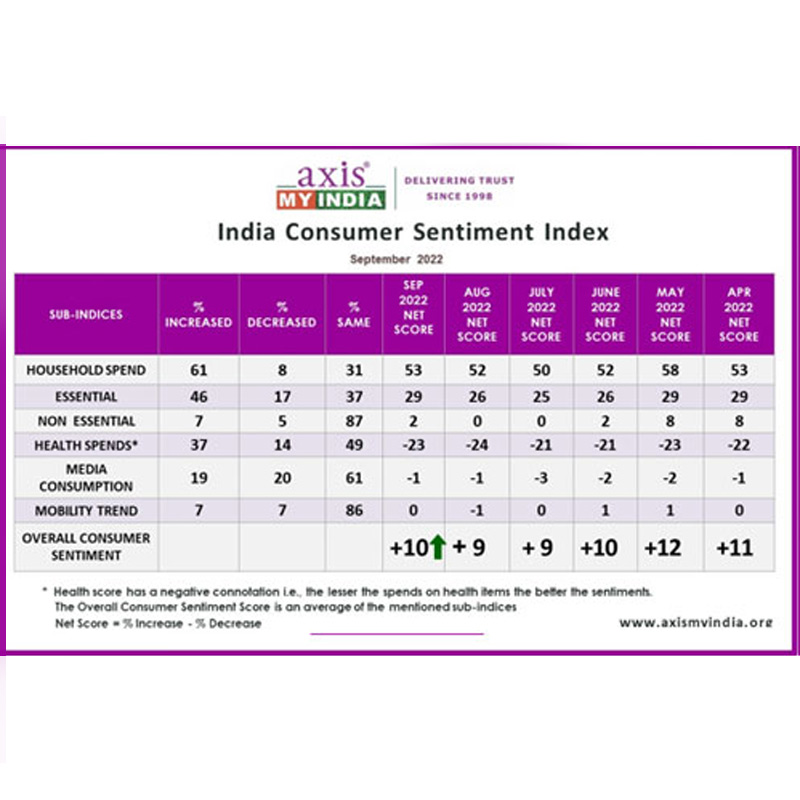
    The net CSI score for September, calculated by percentage increase minus percentage decrease in sentiment, is at +10, from +9 last month, reflecting an increase of one point. The sentiment analysis delves into five relevant sub-indices: overall household spending; spending on essential and non-essential items; spending on healthcare; media consumption habits; and mobility trends.

    Key Findings:

    •     Overall, household spending has increased for 61 per cent of families, which is the same as in August. The net score, which was +52 last month, has increased by +1 to +53 in September.
    •     Consumption of media remains the same as the previous month, i.e., 19 per cent. The overall net score, which is -1 in September, also remains the same.
    •     Mobility has increased for seven per cent of families, representing a one per cent increase over the previous month.
    •     Spending on essentials like personal care and household items has increased for 46 per cent of the families, which is an increase of one per cent from last month. The net score, which was at +26 this month, has increased by +3 to +29.
    •     Spending on non-essential and discretionary products like air conditioners, cars, and refrigerators has increased for seven per cent of families, which reflects an increase of one per cent from last month. The net score, which was at nil last month, has improved to +2 this month. This could reflect the spirit of the festive season approaching.
    •      Consumption of health-related items has increased for 37 per cent of the families, which reflects a decrease of one per cent from last month. The health score, which has a negative connotation i.e., the less spent on health items, the better the sentiments, has a net score value of -23 for September, as compared to -24 last month.

    On topics of current national interest:

    •      In an attempt to understand consumers’ engagement with mobile apps, the survey discovered that, on average, consumers have nine apps on their smartphones. 16 per cent use a minimum of 4–8 apps on their smartphone, and 22 per cent have more than eight apps. A significant 24 per cent mentioned that they use a feature phone.
    •     In order to determine which medium advertisements are more likely to be noticed, the survey discovered that a majority of 32 per cent notice ads on TV, while 26 per cent notice them on online media. It was also discovered that only 17 per cent notice ads on social media platforms, 15 per cent in print, six per cent in outdoor and two per cent on radio.
    •      The survey further revealed that a majority of 61 per cent watch online video content like YouTube or OTT on their mobile/home TV.
    •     Digging deeper into the festive spirit, the survey shows that 20 per cent plan to shop more this festive season compared to last year. However, 32 per cent plan to shop the same as last year.
    •     According to the Axis My India Consumer Sentiment Index Survey, 48 per cent of consumers shop/purchase more products during the festive season as compared to the rest of the year.
    •      Exploring farmers’ sentiments towards new tractors, the survey found out that 10 per cent are planning to purchase new tractors in the coming year, while three per cent and two per cent plan to do so within six months and three months, respectively. For reasons like smaller land size, renting, or affordability, a significant 86 per cent of farmers don’t own a tractor.

    The survey was carried out via computer-aided telephonic interviews with a sample size of 10014 people across 32 states and UTs. 68 per cent belonged to rural India, while 32 per cent belonged to urban India. In terms of regional spread, 23 per cent belong to the northern parts while 24 per cent belong to the eastern parts of India. Moreover, 29 per cent and 23 per cent belonged to the western and southern parts of India, respectively. 59 per cent of the respondents were male, while 41 per cent were female. In terms of the two majority sample groups, 32 per cent reflect the age group of 36-year olds to 50-year olds, while 31 per cent reflect the age group of 26-year olds to 35-year olds.

    Axis My India chairman and MD Pradeep Gupta said, “After compromising the past two festive seasons because of the pandemic and its related constraints, this year consumers are expected to shop more during festivities. One can already witness a slight increase in expenses across essential and discretionary products. Further improvement in mobility sentiments highlights the fact that more and more people are enjoying the stores’ and malls’ experiences of discovering, shopping, and gifting.”

    He further added, “This sentiment is also extended among the Indian farmers, wherein a significant percentage of 15 per cent intend to buy a brand new tractor in the next one year. This is thus a crucial time for the Indian advertising business as spending is expected to bring a lot more returns than usual. As more and more people (61 per cent) are watching online video content (YouTube/OTT) on their mobile/home TV and thereby noticing ads across TV, online and social media platforms, it is of utmost importance for the media industry to tap the right medium for addressing differentiated consumer needs.”

  • Meesho becomes most downloaded e-commerce app globally

    Meesho becomes most downloaded e-commerce app globally

    Mumbai: Homegrown internet commerce platform Meesho has become the most downloaded e-commerce app globally in October, according to a recent SensorTower blog. During this period, it also became the only Indian company and e-commerce platform to feature amongst the top-ten most downloaded non-gaming apps across the world.

    Meesho also saw over 57 million downloads across the App Store and the Google Play Store from August to October, as per App Annie, making it the most downloaded app across all categories in India. The company has seen installations in India grow by over 120 per cent quarter-on-quarter in Q3 2021, outranking all other e-commerce platforms in the country for quarterly downloads.

    “We have always kept our users at the heart of our innovations. Whether it is our industry-first zero per cent commission model for sellers or building a nimbly-sized application, we are ensuring Meesho is easy to use for users even from the farthest corners of our country,” stated Meesho founder & CEO Vidit Aatrey. “Our success comes from a laser-sharp focus on building for India’s Tier 2+ markets. With an aim to democratize internet commerce for everyone, we will continue to digitize India’s unorganized retail industry with more Bharat-first initiatives.”

    The e-commerce platform has reduced entry barriers, improved logistical infrastructure for tier 2+ markets, and fuelled the discoverability of hyperlocal businesses and products. The company’s five-day festive sale event in October cut deeper into India’s underserved markets with ~60 per cent orders coming from tier 4+ regions, including remote locations like Khawzhwal and Sopore. Today, five per cent of all Indian households shop on Meesho every day, said the statement.

    With an aim to enable 100 million monthly transacting users by December 2022 and in its bid to fuel Bharat’s e-commerce dreams, Meesho has instituted multiple measures to bring new digital users online.

    To facilitate a seamless shopping experience, the company built an app compatible with low-end smartphones and low-internet bandwidth to address internet latency challenges even in the farthest corners of India.

  • Flipkart collaborates with Moj for video and live commerce

    Flipkart collaborates with Moj for video and live commerce

    Mumbai: Home grown e-commerce marketplace Flipkart has collaborated with short video platform Moj to enable video and live commerce experiences at scale. The collaboration will help Flipkart to scale video commerce in the country and engage the next 200 million e-commerce customers.

    Moj currently has over 160 million monthly active users. Besides making e-commerce accessible to millions of first-time users, this collaboration also incentivises content creators in the Moj ecosystem by enabling new commerce-led revenue streams to deepen socio-economic impact.


    “The strategic collaboration between Flipkart and Moj will play a key role in onboarding the next 200 million e-commerce users while creating an ecosystem that benefits all stakeholders involved – from brands and sellers to content creators,” Flipkart senior VP and head corporate development Ravi Iyer said. “Given the diverse cultural fabric of our country and with the intention to offer an inclusive e-commerce experience to every consumer, we continue to bridge the gap between audiences through our regional language interface experience which has played a key role in onboarding first-time consumers. Moj’s wide reach through the Indic languages it operates in is another step in this direction.”

    Mohalla Tech Pvt Ltd (parent company of Moj) chief financial officer Manohar Singh Charan said, “The creator economy led revenue streams are globally seeing a massive upsurge and this collaboration with Flipkart is a step towards developing a concrete revenue stream for creators in India, while also enhancing the social experience of our users on the platform. This also opens the universe for creative in-app integrations towards personalized marketing. The seamless amalgamation of content and commerce will push brands to reimagine how they connect with their consumers and ignite the digital social commerce revolution in India.”

  • GUEST COLUMN: FMCG companies took to apps, bet big on direct-to-consumer reach

    GUEST COLUMN: FMCG companies took to apps, bet big on direct-to-consumer reach

    Mumbai: The eruption of COVID-19 has left millions and millions of businesses scurrying for survival. Although somewhat less affected than some categories, the FMCG companies also faced headwinds for some time. And to counter these headwinds, technology has been the single most important intervention that they have employed during these trying times. And of the technologies, applications enabling a direct route to the consumer as well as other businesses in the value chain have been most prominent.

    While placing their faith in these applications, FMCG companies have also recast their value chains weeding out unnecessary elements at various levels allowing themselves greater leverage vis-à-vis their vendor partners and establishing a more direct connect with their end-consumers. And among FMCG firms, food companies, or those with prominent food product portfolios have been particularly noteworthy for taking the app route.  A step ahead of general trade, modern trade, or even traditional e-commerce channels, these apps have been popular yet necessary go-to modes for these companies.

    The big B2C advantage

    How does B2C prove to be advantageous for FMCG companies? Until now, customer-relationship building and acquiring customer insights were largely the preserve of the retailer community. However, what B2C apps do is that they facilitate a direct and one-on-one company-to-consumer relationship, with the former no more having to make efforts to establish bonding with a faceless consumer. On top of allowing deeper end-consumer insights for companies and brands, they can catalyse more relevant and individualised product and service propositions by the brand to the consumer thus leading to a more enriching customer experience which in turn would drive increased customer acquisition, conversion, and retention for the brand. And needless to say, the power balance between the brand and the retailer is further shifted in favour of the brand and away from the retailer.

    B2B applications not too far away

    However, this taking to applications has not been limited to B2C channels. FMCG companies have also incorporated apps in their business processes directly targeting retailers and kirana stores who offload their products and serve as a last-mile seller/supplier to end-consumers. Identifying and prioritising retailers who delivered top volume businesses, the companies made sure that the retailers continued to place orders for their products, and even more efficiently using these applications than they did before. In fact, thanks to Covid, the earlier forecasts projecting a contribution of around 10 per cent digital channels in the total FMCG market in the next ten years in the country has been advanced to next three to four years now. And at the same time, cutting out or minimising the role of distributors especially in terms of selection of retail outlets, the brands have reclaimed their power vis-à-vis the latter while effecting greater streamlining and consolidation of their distribution systems.

    Proliferation of new products

    While pivoting to digital technologies, B2C and B2B apps, the FMCG companies have also realigned their product portfolios in a major way capitalising on the shifting consumer preferences and behavior in times of the pandemic. And as part of this realignment, there has been a proliferation of new and innovative products which have been introduced to the market in the last few months. With health and hygiene being a predominant consumer focus, as many as 3,000 products in the health and hygiene category have been estimated to be launched in the September quarter alone last year. Earlier, in the April-September quarter, as many as 9,700 new products were launched by FMCG companies. Mindful of and in response to the country-wide lockdowns in place and customers being confined to their homes, 125 products were introduced in-home cooking segment alone during March-August 2020 in categories including ketchup, jams, cheese, and milk powders.

    Exploring alternative channels of distribution too

    Even as D2C apps gain traction, the FMCG companies are also exploring tie-ups with new-age delivery startups, food-tech service players, food aggregators, hyper-local apps, and courier firms to have their products delivered to the doorsteps of the end-consumer. In fact, some FMCG companies are also making product-specific tie-ups with delivery platforms and micro delivery platforms.

    Digitisation not limited to distribution: Influencer marketing gets a boost

    Rising uptake in apps and the broader digitisation has not only been confined to retail and distribution but also advertising and marketing. And riding on the increasingly entrenched position of social media and its consumption, influencer marketing has become a big part of FMCG’s digital marketing strategy in recent years. According to a report, globally, nearly a fifth (19 per cent) of FMCG companies have raised their influencer spending significantly as compared to pre-COVID-19 levels. And within India, during the festive season campaign alone, influencer marketing saw a 20 per cent jump in campaigns. A digital marketing agency has estimated India’s influencer market at $75-150 million a year, as compared to the global market of $1.75 billion, which is only set to get bigger in the coming months and years.

    Other technologies that could aid the B2C momentum

    At the same time, apart from apps, there are several related B2C technologies and platforms that could add teeth to the ongoing B2C drive. They could range from customer data platforms to data management platforms to marketing automation tools to business intelligence and data visualization tools to social listening tools, among others.

    So, in the future, there is no doubt that the B2C apps as part of an FMCG company’s digitisation program will acquire a more permanent dimension. Notwithstanding a resurgence of Covid in certain states, now with vaccination underway and revival of consumer sentiment in urban India, FMCG businesses including food companies are set to see greater activity and growth.  

    (Manish Aggarwal is director, Bikano, Bikanervala Foods Pvt Ltd. The views expressed in the column are personal and Indiantelevision.com may not subscribe to them.)

  • PallyCon adds App Security to its digital arsenal

    PallyCon adds App Security to its digital arsenal

    New Delhi: PallyCon, a global leader in Multi DRM, forensic watermarking services, and anti-piracy technology on Monday launched its state-of-the-art app security service.

    A simple plug-n-play solution, it is dedicated to helping content developers and publishers protect their content from manipulation and theft. The solution is conceptualized with no single line of code and offers robust security that’s affordable, said the company.

    INKA Entworks Inc, CEO and founder, James Sungim Ahn said, “With the increasing popularity and rise in viewership of OTT apps, the chances of theft and leakages have increased multiple times. It takes a lot of effort and money to produce content, and illegal access and copying are causing significant revenue losses. Hence, data security should be considered mandatory, and all content creators should adopt a 360-degree security along with DRM service for OTT apps to protect their investment”.

    The solution offers a real-time threat analytics dashboard for content creators to trace the source of piracy and hacking of streaming content in real-time. It works in tandem with a high-performing DRM video protection service to identify leakages right to the last user who leaks or consumes the content illegally, thus offering endless scalable security.

    Discussing the potential of the service, INKA Entworks Inc, head of global business, Govindraj Basatwar said, “Cyber-attacks against OTT apps and content creators are on the rise. Without adequate security, apps can be easily hacked, which poses a threat to the privacy of data, revenue and puts the brand image at risk too. With this launch, we aim to create a fearless and thriving environment for all content creators and protect their data from potential threats,” he added.

    With new security standards set by Hollywood studios, it becomes critical for OTT platforms to protect their apps in runtime. The solution supports Android, iOS, and other hybrid apps.

  • Tik Tok appoints Shouzi Chew as CEO

    Tik Tok appoints Shouzi Chew as CEO

    New Delhi: Chinese short-video sharing platform TikTok has tapped Shouzi Chew as the company’s new chief executive officer.

    TikTok’s interim head Vanessa Pappas, based in Los Angeles, will be the new chief operating officer.

    Chew is based in Singapore and was named chief financial officer of TikTok parent company ByteDance in March this year, and will continue in that role, the company said.

    The decision was taken after TikTok CEO Kevin Mayer quit the company in August 2020 amid India’s decision to ban the app.

    Chew has served as Xiaomi’s chief financial officer from 2015 to 2020, and ran its international business for a year, and took the company in one of the largest ever Chinese tech listings on the Hong Kong Stock Exchange.

    “The leadership team of Shou and Vanessa sets the stage for sustained growth,” said ByteDance CEO Yiming Zhang. “Shou brings deep knowledge of the industry, having led a team that was among our earliest investors and having worked in the technology sector for a decade.”

    TikTok became the most downloaded non-gaming app worldwide, with more than 58 million installs in March. Over 11 per cent of these installs were from China followed by the US at 10 per cent. The second most popular app was Facebook, with more than 56 million installs in March, according to data shared by app analytics firm Sensor Tower.

  • ESPN bets big on apps for India

    ESPN bets big on apps for India

    MUMBAI: With increasing preference for sports on digital platforms, ESPN is working towards tapping this demand with more content.

    The broadcaster, which has been present here for over quarter of a century, owns two digital properties — ESPNcricinfo, a cricket content platform, and a co-branded multi-sport content offering ESPN.in, with its joint venture partner Sony Pictures Networks India that was launched 15 months earlier.

    For ESPN, digital video consumption has been growing at 150 per cent, while mobile video demand has been growing even more dramatically, at a rate as high as 350 per cent.

    “We believe that India is a mobile-first market and data confirms that. Almost 78 per cent of all our traffic is either on the mobile web or the app. We also believe that, over time, people are shifting from mobile web towards apps,” ESPN International executive vice-president and managing director Russell Wolff has said.

    He said the company has been producing more videos for mobile and digital platforms, given the growing interest in digital content.