Tag: APOS 2021

  • Negligible content investment for the urban viewer segment: Tata Sky’s Harit Nagpal

    Negligible content investment for the urban viewer segment: Tata Sky’s Harit Nagpal

    KOLKATA: The pay-TV industry in India has been highlighting the regulatory overburden in the industry for some time now. The players have been battling several legal issues, the amended new tariff order (NTO 2.0) being the most discussed one. According to Tata Sky CEO Harit Nagpal, it has not only impacted the growth of the industry, but put a halt on broadcasters’ plans to bring any change in pricing since January 2020, despite rising industry costs.

    Speaking at the recently concluded APOS 2021, the Tata Sky CEO said broadcasters will not be able to make up for this period, even if they are allowed to alter prices tomorrow. “A hole has already been created in the ability to generate revenue for the industry. There is a logjam between broadcasters and regulators via legal cases, which we are hoping settles down soon, so that broadcasters can raise prices,” he explained.

    According to Nagpal, the price hike will enable broadcasters to invest in creating more differentiated content and help them cater to increasing needs of viewers from various segments. “There has been a negligible investment for the urban viewer segment, even though it is one of the growing segments,” he pointed out, during a virtual session with Media Partners Asia executive director and co-founder Vivek Couto.

    But the Tata Sky CEO highlighted that he still remained optimistic about the growth of linear TV in India. “Both will survive; both will grow but not at the cost of each other. The people who can afford a broadband connection at home, and can subscribe to SVoD, can also afford TV because TV is much cheaper than that,” he added. “And viewers who cannot OTT subscriptions will watch content that comes only through cable and satellite. TV viewing remains a habit for Indians.”

    Recalling the days he spent days walking in and out of 1,200 customer homes in the rural area, Nagpal said there was rarely a home without a television set in India. “It’s like background noise. A family collectively consumes six to 10 hours of TV content per day. It is one segment that leaves a high opportunity for the growth of traditional TV,” he shared.

    Despite that, there are still around 100 million homes that don’t have a TV in India. The data shows that TV sales have picked up in the last few years. But there is still a gap in TV penetration this year due to the ongoing crisis, which will be filled in the next few years, he noted.

    “We have not seen signs of on-demand content or even broadband penetrating the kind of numbers that we have been hearing for the last few years. Despite the best efforts of most of the broadband operators, we have not seen numbers reaching the level that we are talking about,” said Nagpal.

    Tata Sky has embraced the change in the industry with the launch of Binge products – its smart boxes which offer both TV and OT content. The DTH operator has also marketed the product aggressively last year. 

    “We never expected these services to reach the level of DTH. We said both will grow. Maybe Binge will grow faster in terms of percentage because we have got a small base. But there is enough headroom for the satellite TV market to grow. We are pretty happy with the numbers of both sides,” Nagpal stated. 
  • Consumer spending on video grew 9% in APAC in 2020

    Consumer spending on video grew 9% in APAC in 2020

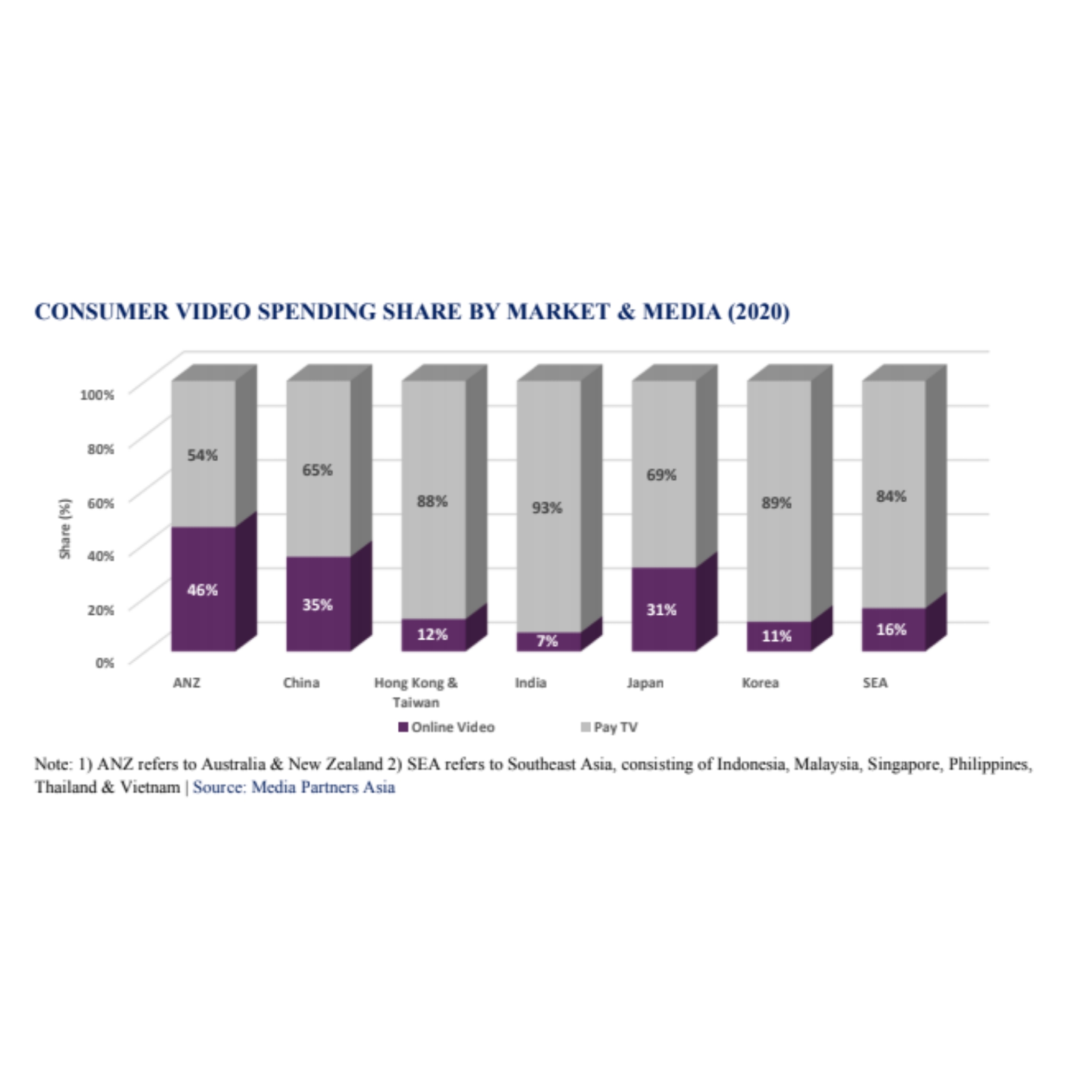
    New Delhi: Consumer spending on video in the Asia Pacific (APAC) region grew nine per cent in 2020 to reach $58.3 billion in aggregate, according to a new analysis and research released by Media Partners Asia.

    The report projects growth to rise a further six per cent CAGR to $79.3 billion, led by the fast-expanding online SVoD sector. MPA forecasts that the online SVoD consumer spending revenue is likely to grow at 15 per cent CAGR over 2020-25 to reach $31.6 billion by 2025. This will represent a 40 per cent market share while consumer spends on pay-TV will grow at two per cent CAGR to reach $47.8 billion, representing a 60 per cent market share.

    The findings were released on the first day of MPA’s APOS Summit which was held virtually this year.

    All the markets increased spending on SVoD services with strong activity in peak pandemic periods during the first half of 2020, and robust spending in the second half of 2020 due to new launches from major players.

    China remains the largest market in APAC for consumer spending on video with $27.6 billion in revenue, led by SVoD and IPTV services. Japan comes in second with $9.2 billion with SVoD representing more than a third of consumer spend, while India is third with $6.5 billion with pay-TV contributing having greater than 90 per cent market share, it stated.

    Korea with $5.7 billion in revenue in 2020 and Australia with $2.9 billion remain formidable markets; Malaysia led southeast Asia with $962 million in revenue with pay-TV contributing more than 90 per cent of market share.

    “Consumer spending on entertainment and sports through video platforms was robust in 2020 due to growth of SVoD in a peak pandemic year along with new competition and consumer choice in many Asian markets,” said MPA executive director Vivek Couto. “

    While SVoD growth will decelerate in 2021, MPA sees "a bright future for the SVoD sector and the stacking of various services across sports, entertainment and deeply integrated local services.”

    According to Couto, China, Japan, India, and Korea will lead the way as the market for SVoD slowly deepens in the key markets across southeast Asia, led by Indonesia, the Philippines, and Thailand. Pay-TV will remain vital in Korea (led by IPTV), India, Malaysia, and the Philippines, he added.

  • Netflix global TV head Bela Bajaria dishes on ‘local impact strategy’

    Netflix global TV head Bela Bajaria dishes on ‘local impact strategy’

    KOLKATA: Among a host of over-the-top (OTT) platforms in India, Netflix has always been considered as the “premium” one in terms of pricing and content. To break the stereotype, the streaming giant has taken several measures like launching a mobile-only plan. Netflix global TV head Bela Bajaria said the platform wants to “please many more members” with its diverse content offering as well.

    Speaking on day one of APOS 2021, Bajaria, who smilingly disclosed her “personal bias” for the market because of her ethic roots, remarked that the platform wants to have a wider breadth of offerings for the country. She pointed to the much-hyped slate of more than 40 originals which consist of different categories of originals.

    “I think sometimes when we’re in a country, we make the first couple shows people externally and even sometimes [viewers] internally perceive us as just a platform having premium or edgy dramas… We want to please many more members than that,” she said during the discussion with Media Partners Asia executive director & co-founder Vivek Couto.

    Of all its Indian originals, Masaba Masaba really struck a chord with audiences. She also spoke of the recently launched women centric Bombay Begums, and the upcoming season of the highly acclaimed web series Delhi Crime that she believes will be compelling for viewers. She went on to reveal that more exciting shows would be launched in Q3 & Q4.

    Considerably, she noted the presence of family drama in Netflix’s upcoming slate. “I think it was important because we still want to have everybody’s favourite show. We want to have a show you could co-view with your family,” Bajaria commented.

    While Netflix is highly focusing on staying true to local stories, having a strong local team is really important, as is being part of the local ecosystem. For any local market the focus is always on “massive local impact”, not on making shows popular across markets. Netflix India took its localisation a step ahead with Monika Shergill’s appointment.

    “People sometimes think we want to make a show global or international. The most important thing is we make it the most authentic and specific vision in that country and it has the most local impact and people love it in that country. If people love it in that country, other people will love it too,” she stated.

    However, local shows like La Casa De Papel, Barbarians, Lupin, Who Killed Sara? and Space Sweepers have seen global success. In its home market, non-English viewership has grown by 50 per cent as the viewership of anime has increased by 100 per cent, while Korean drama consumption has tripled.

    “Traditionally, Hollywood has exported stories. Now what we are doing is we are exporting local authentic stories and shows everywhere around the world. All of these stories are different in point of views, from different lenses and very specific to the cultural lens,” she stated.

    Netflix has grown exponentially in other Asian countries too. South Korea has been the most prominent market for the streamer. It has a mix of licensed, regional, the original film in the market. While some of the licensed shows like K-Dramas have performed well, Korean shows in other categories also travelled. More importantly, Netflix could continue its production in Korea the whole time during the pandemic. Hence, the OTT platform has a “pretty solid” slate in Korea for 2021.

    The streamer is gearing up its efforts in Japan by building studios and partnering with local talent. Along with investing in anime which is very successful for the platform, it is also betting big on live-action and non-fiction in the Japan market.

    “The strategy is always going to be, we want to have the best shows. If the best shows are original shows, that’s great. If the best shows are a combination of acquisitions and partnerships and co-productions and originals, then that’s what we do,” Bajaria contended.

    To build a solid global footprint of Netflix, the other goal is it wants to be a part of the creative community in each country. There will be new places the platform starts making more original content in, she added. For instance, it was only a year and a half ago it started doing originals in Africa.

    “We’ve barely scratched the surface. There are so many great storytellers in so many parts of the world. There are great stories that can be told on a global scale in so many places,” she said.

    The media executive has worked across mediums, starting her career with millennial TV, spending a chunk of it at Studios. She has seen the growth and progression of the M&E business, especially the rapid change in the last three to five years. It has always been very important to create a supportive environment for creators and for executives to do the work.

    “I think what has been interesting about working at Netflix is typically the speed. The speed of decision making. There are not many layers like other traditional media companies I worked in. What I had to learn is to move very quickly,” she signed off.