Tag: Anushree Bhattacharyya

  • The third edition of IAA’s ‘Voice of Change’ summit inspires industry to ‘Break the Bias, Together!’

    The third edition of IAA’s ‘Voice of Change’ summit inspires industry to ‘Break the Bias, Together!’

    Mumbai: The International Advertising Association (IAA) India Chapter hosted the third edition of its ‘Voice of Change’ summit, themed ‘Gender Portrayal from 30 Seconds to 3 Hours’, aiming to champion gender-sensitive and equitable content across media.

    This impactful event featured an impressive lineup, including chief guest Smt. Smriti Irani, guest of honour Taapsee Pannu and prominent industry leaders such as Srinivasan K. Swamy, Neha Barjatya, Eashwari Deshpande, Anushree Bhattacharyya, Mitrajit Bhatacharya, Neena Dasgupta Anurag Agnihotri, Karthik Nagarajan, Zairus Master, Gautami Kawale, Janaki Amrite and Shreya Jain. The summit highlighted the critical role of the stakeholders of the industry in shaping gender representation and addressed the need to challenge biases.

    Lamp-lighting ceremony

    The day began with a formal lamp-lighting ceremony graced by the chief guest followed by a welcome address by Srinivasan K. Swamy, IAA Mancom Member & Executive Group Chairperson at R.K. SWAMY Ltd.

    Welcome address from Srinivasan K. Swamy

    The summit’s opening session, led by Nina Elavia Jaipuria and Megha Tata, Chairperson and Co-Chairperson of the IAA India Women Empowerment Committee, discussed the evolution of the ‘IAA: Voice of Change’ movement since its inception in 2021.

    Nina Elavia Jaipuria and Megha Tata

    Reflecting on the initiative, Megha Tata shared: “This journey began four years ago, and it has become a powerful movement in our industry. When I was President of IAA, we launched ‘Voice of Change’ with the objective that, as communication professionals, we must be the change we want to see.” She emphasized the significance of their partnership with UNICEF and Google, which has provided critical data on gender portrayal in media, underscoring persistent stereotypes and the need for progress.

    Nina Elavia Jaipuria added: “In the previous editions of IAA: Voice of Change, we covered advertising, television and OTT content, while this edition focuses on gender representation in Digital. Over the years, we have created awareness and sensitized stakeholders of the industry in shaping their perspectives and challenging stereotypes for a more equitable gender portrayal in content. Thus, having a positive influence on consumers and shaping the social narrative. We are delighted to have Google India continue to partner with us in this movement.”

    The chief guest of the day, Smt. Smriti Irani, former cabinet minister, engaged in a lively and insightful conversation with Neha Barjatya, IAA Mancom Member and Marketing Director at Google India. Together, they discussed the transformative role content creators play in reshaping the portrayal of women in media and society.

    Neha-Barjatiya--Smriti-Irani

    Smt. Smriti Irani delivered a compelling keynote address, stating the lack of visibility and acknowledgement women face despite their contributions. She remarked: “Women do not have a problem speaking or showing up; what we lack is recognition for our contributions. It’s crucial to continue these conversations and support women who strive for their rightful place.” She also powerfully emphasized YouTube’s societal impact and remarked the platform does not just provide access but by giving women in Tier 2 and 3 cities a platform and an audience, we “democratize dreams”.

    She spoke passionately about how women have always been present and impactful, yet their contributions are often overlooked, challenging audiences to not only see women but truly hear their voices. Addressing the pressure many women feel to downplay their achievements to avoid labels of arrogance or ambition, she urged women to own their successes openly. Irani noted a generational shift, celebrating young women today who express themselves boldly without apology, contrasting this with the constraints her own generation often faced. She underscored the responsibility that comes with content creation in the digital era, highlighting the need to dismantle stereotypes rather than reinforce them. Irani also reminded listeners that each woman’s journey is unique and deserves respect, calling for collective action to build a legacy where female voices are valued and celebrated, creating a world where all women can take pride in their contributions without reservation.

    Neha Barjatya emphasized “At Google and YouTube, we are deeply committed to empowering women in the digital age. We have always fostered inclusivity across our platforms and as we’ve entered the AI era, our commitment continues. We are dedicated to building AI that unlocks creative possibilities and promotes economic opportunity for everyone. We are focused on developing AI responsibly, ensuring it is used to create a safe and equitable platform for all women. We believe that when women succeed, India succeeds.”

    In a special address, UNICEF’s Geetanjali Master, Partnerships Specialist in Public & Private Sector Engagement at the UNICEF Delhi office, highlighted the pervasive impact of gender socialization on opportunities for girls in India, emphasizing the role of media and community engagement. She stated: “Gender socialization creates visible and invisible barriers—manifesting as limited educational opportunities, early marriages, and fewer job prospects for girls. As UNICEF engages across India, we see the profound impact media can have. It has the power to reinforce stereotypes or to challenge them. That’s why we’re working with organizations like the Geena Davis Institute to generate real-time insights on gender portrayals, and we recognize the importance of connecting with content creators not only in metros but also in smaller towns and communities. By doing so, we aim to inspire inclusive storytelling that can shift perceptions and unlock opportunities for young girls across India with our continued partnership with IAA: Voice of Change.”

    Geetanjali

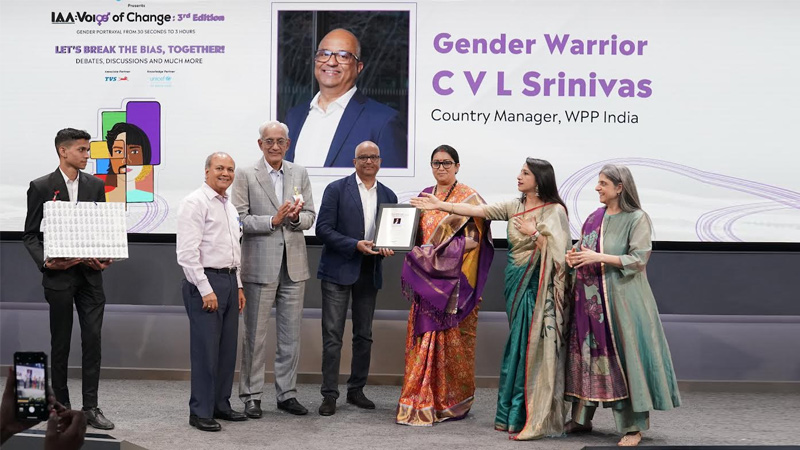
    Celebrating gender warriors: The event honored remarkable industry stalwarts who have tirelessly championed gender equity and led by example as protagonists of change. The first recipient of the Gender Warrior award was C.V.L. Srinivas, Country Manager of WPP India, recognized for driving transformative change in the industry. The second Gender Warrior, Smita Sharma, an acclaimed photojournalist and visual storyteller, was celebrated for her impactful work in human rights and gender issues. Through her powerful images featured in National Geographic, TIME and other publications, Smita has brought dignity to marginalized communities while challenging societal norms.

    CVL SrinivasSmita

    The day’s events were marked by thought-provoking insights, particularly during the first panel, “Conscious Creativity in Digital Content,” moderated by Eashwari Deshpande, Head of YouTube Ads Marketing & Industry Advocacy. Esteemed panelists included content creators Gautami Kawale and Shreya Jain, alongside Janaki Amrite, Associate VP of Content Syndication and OTT Partnerships at Pocket Aces.

    IAA

    The discussion emphasized the transformative role of technology in democratizing both access to content and aspirations, creating a space where everyone has a voice. Deshpande shared YouTube’s commitment to enabling creators to build sustainable careers, transcending barriers of language, literacy, and background.

    Slayy Point & The Crash Pad founder Gautami Kawale highlighted the responsibility content creators hold when engaging with Gen Z audiences. Janaki Amrite spoke about Pocket Aces’ commitment to positive representation through channels like Dice Media and Filter Copy. Beauty influencer Shreya Jain discussed navigating stereotypes in the beauty and makeup industry, sharing her journey of maintaining authenticity while shedding light on makeup’s role as both an art form and a major industry.

    The session underscored the importance of responsible creation and inclusion, inspiring attendees to reflect on their own creative roles and the potential of digital platforms to promote positive, diverse voices.

    The second panel discussion at our event, titled “Digital Advertising through the Gender Lens,” was wonderfully moderated by Anushree Bhattacharyya, Editor, Education and Brand and Marketing, Financialexpress.com. This engaging panel featured industry leaders: Anurag Agnihotri (Managing Partner- Creative, Ogilvy West), Karthik Nagarajan (CEO, Hogarth), Neena Dasgupta (Founder & CEO, The Salt Inc.), and Zairus Master (Chief Business Officer, Honasa Consumer Ltd- Mamaearth).

    IAA

    Anushree kicked off the session by delving into how digital advertising is evolving with gender inclusivity in mind. Anurag Agnihotri discussed his approach to portraying women as strong, independent figures in advertising, especially in campaigns where the aim is to break away from traditional stereotypes. Zairus Master shared insights on Mamaearth’s consumer-centric branding, which places an emphasis on progressive storytelling that resonates with modern, urban audiences. Karthik Nagarajan tackled the topic of stereotypes in product marketing, especially within categories like beauty and personal care. Neena Dasgupta discussed how content creation on platforms like OTT and YouTube is contributing to a more nuanced portrayal of women. She noted that women-centric content often performs well on OTT platforms, reflecting a shift in audience preferences.

    The panel closed with a shared sentiment on the importance of creating content that is aspirational, breaking stereotypes, and representing both men and women in roles that reflect today’s society. The discussion provided valuable insights on how advertising can be a powerful tool in reshaping gender perceptions and promoting inclusivity in brand storytelling.

    The event was infused with energy and laughter, thanks to a special performance by renowned comedian Neeti Palta. Her sharp wit and relatable humor based on gender portrayals, biases and stereotypes brought a fresh, lively vibe, engaging the audience and drawing waves of laughter from the guests. With her unique perspective on everyday life and her natural ability to connect with diverse audiences, Neeti turned the event into a memorable experience, leaving everyone in high spirits.

    The event wrapped up with an engaging and deeply inspiring fireside chat featuring acclaimed actor Taapsee Pannu, moderated by Mitrajit Bhattacharya, IAA Mancom Member and Founder of The Horologists. The session celebrated Taapsee’s fearless spirit, impressive body of work, and commitment to impactful storytelling. Reflecting on her career from her Telugu film debut to her success in Hindi cinema, Taapsee shared insights into her journey, the challenges of taking on complex, women-centric roles, and her drive to explore diverse characters. She spoke about her memorable roles in films like Pink, Mulk, and Saand Ki Aankh, which echo her commitment to challenging societal norms and advocating for women’s empowerment. In addition to her acting, Taapsee discussed her entrepreneurial ventures and her passion for breaking stereotypes.

    Taapsee-Pannu-Mitrajit-Bhayyacharya

    Google India & Youtube were the presenting partners, while UNICEF the knowledge partner and TVS the associate partner for this event.

    Republic Digital was the digital news partner & Crome Talkies, AdGully, Indian Television, Manifest, Mediabrief, MxM India were web media partners whereas Free Press Journal & Hindustan Times were the print partners for this event.

    This edition of IAA: Voice of Change summit included powerful voices that engaged in meaningful and inspiring discussions making it another milestone in the journey of the movement, reinforcing our commitment to a more positive and inclusive gender portrayal in media.

  • ‘We will get an opportunity to build our brand in the international arena of cricket’ : Amrit Mathur – GMR Sports CEO

    ‘We will get an opportunity to build our brand in the international arena of cricket’ : Amrit Mathur – GMR Sports CEO

    The drama over, it is back to business. As the Indian Premier League (IPL) takes refuge in South Africa to play out its second edition, the team owners are readying their new plans to size up their revenues.


    GMR Sports, the owner of Delhi Daredevils, is trying to figure out how to make up for the revenue loss from ticketing sales. The spotlight is on sponsorship revenues.


    In an interview with Indiantelevision.com’s Anushree Bhattacharyya, GMR Sports CEO Amrit Mathur talks about the opportunity that South Africa throws up in establishing the Delhi team franchise as a brand in the international arena of cricket.


    Excerpts:

    GMR Sports was aiming at a 20 per cent revenue growth from sponsorship and ticketing. Now with IPL being shifted to South Africa, will that be achievable?
    No, very unlikely. With ticketing revenues under pressure, it will be difficult to reach the target. Sponsorship will be the only avenue open for us to actually earn. Also, with the tournament moving out of the country, the business model in terms of cost and revenue sharing changes.

    How does the revenue pattern shift dramatically?
    Till last year, IPL was a tournament organised by the eight franchises. Out of the total 59 matches, 56 matches were run by the franchises while IPL organised the two semi-finals and the final. But for this year, all the matches will be organised by IPL and the BCCI. So unlike last year where each franchise was clear about the cost model, (for example, the franchise knew it was to organise seven matches and could size up the costs of organising them), it is all uncertain now of how much we as franchises have to bear.


    We also don’t know how the revenue will be shared this time. Till last year, we knew that the central pool contributes revenues of about Rs 320 million. Now it is possible that the IPL may add the ticket revenue to the central pool to share it with the franchises. So the revenue from central pool might increase this time. It will, thus, depend on the revenue share model the IPL finally decides upon.

    Which are the areas where you feel the costs will increase for the franchises?
    Since the franchises have been told that it would be a centrally managed tournament, the IPL is expected to bear all the costs. But the main cost will depend on the financial structure of the facilities being made available – including the ground, the infrastructure, availability of ground for practice, etc. Now IPL will have to discuss these arrangements with the South Africa cricket board and figure out the expenses. As owners of teams, we have an idea of what the games would have cost in India. But we have no idea of what it would be like outside. The cost of travel and the hotels will be relatively minor.

    What if the IPL asks the franchises to bear a certain portion of the costs?
    We will go by the consensus approach. We understand that it’s an extraordinary situation. So if there is a cost attached to the tournament, I am sure everybody will sit together and find out a way.

    On the sponsorship front, GMR Sports has roped in Coca-Cola, UB, Hero Honda, Religare, adidas and Kingfisher. What has been the progress on the two slots that are still lying vacant?
    We are trying to close the last two sponsorship deals as soon as possible. However, the last couple of weeks had been uncertain and there were doubts about the tournament being played. Due to this, we had put on hold our talks with the sponsors. Now that the dates and venue have been announced, we are hoping that the interest for the property will revive.

    We are unlikely to reach our target of 20 per cent revenue growth this year. Ticketing revenues will be under pressure

    With the game shifting outside India, are sponsors looking at renegotiating their old deals?
    No, not so far. We had signed sponsors for three years and there is further scope for extension. But at the same time, we are supposed to give them certain benefits. We are in constant negotiations with our sponsors and are open for any sort of dialogue.

    With the broadcast partner yet to be finalised, how much of damage will that do to the business?
    The audience is not really bothered about who the broadcast partner is. The main concern is whether the tournament is on or out. Now that we all know that it is in, things would start moving again.

    Now that the IPL will be played in foreign land, does your marketing strategy go through a complete overhaul?
    Well, it will change to a large extent. What we could do in terms of promoting our team in Delhi, we can definitely not carry out those activities outside India. So our marketing plans will change. We will now try to build our fan base even stronger with ticketing being handled by IPL. Moreover, we will promote our team through our media partners which include BigAdda.com, SMS GupShup, Hindustan Times, Times of India and CNN-IBN.

    Do you think the IPL will manage to gather enough loyalty in South Africa?
    This year it is true that the character of the tournament has changed because it’s no more a domestic league. The nature of loyalty will change. For example, Delhi Daredevils will miss its loyal Delhi fans. The team will play in venues like Durham or Johannesburg which might see an inflow of neutral crowd only interested in cricket as a sport. But then this is only for this year, as the schedule clashed with the Lok Sabha polls.

    What would have been a better decision – no IPL or IPL in South Africa?
    The most important thing is to have the IPL running. About hosting it in South Africa, the benefit is that the tournament and teams will get an international exposure. As team owners, we would get an opportunity to build our brand in the international arena of cricket.

  • ‘Sponsorship rates have reduced by 20 per cent’ : Mohit Burman – Kings XI Punjab co-owner

    ‘Sponsorship rates have reduced by 20 per cent’ : Mohit Burman – Kings XI Punjab co-owner

    Kings XI Punjab, the Mohali team for Indian Premier League (IPL), was bought for $76 million by Bombay Dyeing deputy MD Ness Wadia, actress Preity Zinta, Dabur India director Mohit Burman and Apeejay Surrendra Group chairman Karan Paul.


    The four shareholders together formed KPH Dream Cricket Private Limited, the holding company of Kings XI Punjab.


    Kings XI Punjab is eyeing sponsorship revenues while cutting down on marketing expenses.


    In an interview with Anushree Bhattacharyya, Burman talks about how the economic downturn is going to upset the revenue targets of the team franchisees.


    Excerpts:

    Since Kings XI Punjab did not go for three-year sponsorship deals, how difficult has it been to retain them for the second IPL edition?
    Spice Telecom is very much on board as our title sponsor. We are in the final stage of negotiations with Coca-Cola as our pouring partner. Kotak, Provogue and 9X, however, are not there this time.


    As for new deals this year, we have signed up with United Spirits while Reebok is our apparel sponsor. We will be closing two more deals in the next four to five days. Overall, we are looking at signing eight to nine sponsors this year.

    Has the downturn in the economy forced sponsorship rates to fall?
    The whole world has changed and overall sponsorship rates have reduced by 20 per cent. We thought we were better off than those team franchisees who had gone in for three-year sponsorship deals. We felt we would be able to command higher sponsorship rates after the build-up from the first IPL tournament. But amid the economic downturn, the teams who signed three-year deals seem to be the smarter ones.

    Does this mean that the revenue targets have gone awry?
    Since the tournament went off on a high note last year, we were under the impression that we would break even this year. However, looking at the present situation, I don’t think that franchisees will be able to break even before 2012. Most franchisees will not be able to make a profit this year, although the tournament will continue to be a success.


    The fact that the IPL is held after a long gap doesn’t help matters. Globally, leagues are played for eight to nine months with a short break, providing sponsors a continuous flow of events.

    Where do you see most of your revenues coming from?
    We hope to make more from our sponsorships, ticket sales and merchandising. This should account for over 60 per cent of our total revenues this year, unlike in the inaugural edition where the maximum came from the central pool. We also hope to get our act right on the ticketing sales front this year.

    Do you plan to decrease the ticket prices to pack more audiences into the stadium?
    We already have a pricing strategy. The ticket prices range between Rs 150 to Rs 6000, addressing different segments of audiences. But this year we are going to be very strict in terms of ensuring that people who wish to watch the matches do pay for the tickets.

    Have you lined up your licensing and merchandising strategies?
    For apparel licensing, we have already tied up with Reebok. We will be soon announcing our partner for making accessories like key chain, mugs, etc.

    Have you trimmed your marketing expense this year?
    We are bringing down our marketing cost to Rs 35 million, from Rs 50 million last year. The initial costs in building up a brand are obviously higher. For example, we made a video with Daler Mehndi last year – and that obviously increased our marketing budget. We don’t see such a requirement for making another video this year.

    Since the tournament went off on a high note last year, we were under the impression that we would break even this year. However, looking at the present situation, I don’t think that franchisees will be able to break even before 2012

    What role will Preity Zinta play to promote the franchisee this year?
    We have already started our marketing initiatives through the King XI Punjab Cup. We had also sponsored the Manali winter festival in Punjab. This year we will be concentrating more on ground level activities in our catchment areas.


    Preity Zinta is one of the owners and she is welcome to play whatever role she desires. She has already contributed a lot last year and as the tournament gets closer, I am sure she will help us in our marketing activities.

    What was the idea behind organising the Kings XI Punjab Cup?
    The idea is to reach out to the people of our catchment areas which include Himachal Pradesh, Punjab, Jammu and Kashmir, etc. At the same time, we want to promote the game of cricket at the grass root level. Since we have a coach and some of the best players from the world, we want to nurture young talent.

    A few franchises have partnered with TV channels in search of cheer leaders. What are your plans?
    We have got plans, but at this moment we are really concentrating on ground activities. Our idea is that instead of doing national hoity-toity shows on TV, we should concentrate on building the brand in our own locality. We believe that if we really want to make our franchise work, then we need to get closer to our fans and get them more involved with the team.

    Are you looking at beginning a cricket academy as Ness Wadia said that the franchisee job is to acquire and groom new players?
    We are setting up an academy and for that we have already got an academy coach. We should be able to roll out the academy a few weeks before the tournament.

    Will Brett Lee’s injury affect your team’s performance?
    I believe Lee will be fit to play for the tournament. We have, however, crafted a team keeping in mind the fact that Lee may not be able to play. Which is why we added West Indian pacer Jerome Taylor and Ravi Bopara.

    You got England’s Ravi Bopara for $450,000, three times his starting price of $150,000. Would you call this an intelligent investment, looking at the present market scenario?
    Kolkata Knight Riders bought Mortaza at a very high rate. So was that an intelligent investment? Every team has to decide on their player investments, keeping many things in mind. While it is true that Bopara was expensive, it is a fact that we needed an all-rounder. And there were two other franchisees who were bidding for him. I believe Bopara would have gone for higher if other franchisees had not run out of money.
    With the dates of the Lok Sabha polls coinciding with some of the IPL matches, how would franchisees be impacted if venues were changed?
    The IPL committee had asked the franchisees to create a back-up plan. Franchisees have an option to play in one or two grounds in the nearby areas. Rescheduling, thus, will not affect the plans of the franchisees.
  • ‘The Hindi GEC market can only grow between 10-15 per cent’ : Anita Nayyar- Havas Media CEO

    ‘The Hindi GEC market can only grow between 10-15 per cent’ : Anita Nayyar- Havas Media CEO

    The Indian advertising and television industry has started to feel the heat of the global economic slowdown. With advertisers trimming their ad budgets and postponing launches of products and services, the entire sector is beginning to feel the pinch.


    In an interview with Indiantelevision.com’s Anushree Bhattacharyya, Havas Media CEO Anita Nayyar speaks about how the Indian television and advertising industry is trying to cope with this financial crisis.


    Excerpts:

    How much has the global financial crisis affected the Indian advertising industry?
    The Indian advertising industry, pegged at Rs 160 billion, has been clearly affected by the global economic meltdown. The television segment, which accounts for Rs 72 billion, was growing at 18-20 per cent. Given the current situation, growth will slow down.


    Lots of big launches of products or services have been postponed. Advertisers are waiting till the first quarter of next year to see how the market is going to evolve. It is too early at this stage, thus, to quantify the pace at which the ad industry will grow.

    Looking at the current economic crisis, how deeply hurt will be the TV sector? Are the Hindi general entertainment channels (GECs) headed for further trouble due to the on-going dispute between the TV producers and workers?
    Out of the Rs 72 billion television ad industry, almost 50 per cent (Rs 36 billion) comes from the Hindi GECs. Looking at the current strike and the global financial crisis, the Hindi GEC market can only grow between 10–12 per cent. The strike between producers and Federation of Western India Cine Employees (FWICE) is, however, a temporary phase and would not continue for long. So the GEC market would pick up pace once again, after the strike in Mumbai gets over.


    FMCG is the category that advertises mostly on GECs. And presently it is one of the least impacted category. Hence advertising will gain momentum once the strike gets over.

    Will the TV news channels feel the pinch?
    It is true that the five to six categories that include banking, insurance, automobile, aviation and real estate are the worst hit by the global financial crisis. And so news channels would be affected. The news television market could see a 5-7 per cent growth. Interestingly, I think now is the time for the banking sector to advertise to regain the confidence of its clients. But it seems like banks are restraining from further advertising spends in a major way.

    What about the growth of sports and movie channels?
    Sports and movie channels are based on events and film titles. Channels like these will not get affected to a large extent and will grow between 5-10 per cent, each time they show events or big titles. Thus for sports channels, the more the sports events they have, the more they will get a chance to grow. In sports, cricket will keep bringing the advertisers in. However since the TV rights acquisition cost for live cricket is very high, it will be difficult for broadcasters to break even.

    Do you feel you have been able to bring Havas out of Euro RSG’s basket?
    I don’t think that we have ever tried to project that Havas Media works under the limelight of Euro RSCG; in fact we are trying to bring Havas Media out of the shadow of Euro RSCG. Today we have Havas Media as the umbrella brand which has various other brands like Euro RSCG, Havas Sports, Havas Entertainment, MPG, Media Contacts etc. Thus wherever there is an opportunity, we try to bring the Havas brand in front.


    Havas Media has clients like Reckitt Benckiser, which is our biggest client. It also has Voltas, Bank of Baroda, Air France, ibibo.com and Hindustan Motors as its clients.

    News channels will feel the heat as banking, insurance, automobile, aviation and real estate are the worst hit by the global financial crisis

    Interestingly, when you moved out of Starcom you were blamed for taking away both people and accounts?
    I don’t know how to answer these allegations. There were people who had shifted from Starcom even before I had joined Havas Media. Nevertheless for people who joined Havas after me, all I can say is that they were all intelligent people and no one has brainwashed them. So they were aware of their decision.


    As for the businesses that I got from Starcom, those moved based on pitches. But this also proves another point – that I share a very good relationship with the clients.

    Havas Group introduced Havas Sports in India. How has sports marketing picked up in India, especially after IPL?
    Sports marketing always existed in India. However thanks to the Indian Premiere League (IPL), it gained recognition. Sports marketing companies like Total Sports Asia and Globosports have been investing in sports like Golf tournament, Tennis matches, marathon etc. After the success of IPL, companies have openly accepted sports as an event to endorse their products or services. Cricket, however, continues to hog the limelight.


    We at Havas Sports have clients like Good Earth products, A1GP, etc. Havas Sports is also involved in celebrity endorsement.

    How are your clients reacting to this financial crunch?
    Fortunately for Havas Media, clients have not yet decreased their advertising budget or postponed launch of their products. So far, we have not seen our clients reducing their budgets.

    How is Havas Media tackling the situation, because sooner or later your clients will also reduce their ad budgets?
    We are looking at various cost efficient alternatives like internet, multiplex, radio and below the line activities.

  • ‘We are not a business model-oriented channel’ : Suneet Tandon – Lok Sabha TV CEO

    ‘We are not a business model-oriented channel’ : Suneet Tandon – Lok Sabha TV CEO

     ‘The no-confidence motion against the UPA government last month gave Lok Sabha TV’s ratings the much required boost as well as an opportunity to rake in money by sharing its feed with privately run satellite news channels.


    Indiantelevision.com’s Anushree Bhattacharyya caught up with Lok Sabha TV CEO Suneet Tandon to find out more on his plans for the channel. Interestingly, Tandon was elevated as CEO less than a week before the crucial vote. He was earlier the channel’s executive director-marketing.


    Excerpts:

    How has the channel fared in the two years of its existence? What are major changes that have taken place?
    The first year was devoted at consolidating the position of the channel. And in its second year, we established the channel’s presence. People now know who we are.


    There are channels that spend large amounts on advertising and marketing. We have not gone that route, yet we have carved out our very own position. All this has happened primarily due to the coverage of Lok Sabha sessions as well as other programmes like debates, discussion and documentaries.

    What is the composition of Lok Sabha TV? Apart from Somnath Chatterjee (whose brainchild the channel is), who are members of its governing body?
    The channel owes everything to the Speaker. But the channel is institutionalised under the overall power of the Lok Sabha. Under the Speaker, we are headed by the secretary general. In addition, there is also an advisory council to guide the functioning of the channel and is chaired by the Speaker. The vice chairman of the council is the deputy speaker of Lok Sabha. The council also consists of leaders from all the major parties in Parliament. So there is also that structure which has been set up to help offer the balance.

    How much investment has been made into Lok Sabha TV?
    Well, at this point of time, it is difficult to speak about the figures as I don’t have them with me right now.

    The channel has to depend on the audio-visual unit of the Lok Sabha secretariat for its expenses and infrastructure. Do you face any constraints in funding since you do not have a business model as such?
    We are not a business model-oriented channel. We are a public service channel for which funds are made available by the Parliament from Parliament’s own funds. Though there have been no constraints on our funds, it is our desire that we don’t want to become a burden on anyone. We need to do it in an economical and careful manner and are very conscious of that. We do not try to spend liberally just for the sake of spending.

    How many hours of feed were sold by Lok Sabha TV for the two days (during the Trust Vote)? How was the business on these two days for the channel?
    We did not sell any number of hours of feed as such. News channels picked up largely the important segments. We had earlier informed all the news channels about the rates. We had adopted Doordarshan’s practice of sharing feeds for important events in Parliament.


    We are using the same rates used by DD. Apart from charging Rs 1 mn beyond every five minutes of feed, there is also a provision for a one-time payment. For the one-time payment, a news channel has to pay Rs 3 mn in advance and can use the feed for any three important events, which makes it Rs 1 mn for every event.

    We also try to spread cultural awareness not in terms of entertainment but by spreading awareness for our classical heritage and folk heritage. We also air awardwinning films on our channel

    Since it’s all about garnering TRPs, how does a channel like Lok Sabha TV manage to catch the attention of viewers?
    By being a credible, sensible and balanced channel. We are not trying to attract the attention of viewers and TRPs by showing any sensational news. We like to deal with our viewers intelligently and try to reflect their concerns because this channel is meant for the thinking citizens of this country. We are very conscious that Lok Sabha TV has to reflect and balance all shades of political opinion. And I must say that there is a lot of feedback that we have got saying that people like watching our channel because we don’t sensationalise anything.

    Do you keep an eye on the ratings of Lok Sabha TV? Are the ratings satisfying enough?
    Yes, we do. We have subscribed to Tam (television audience measurement) every week. Considering the niche nature of the channel, it is very satisfying. Lok Sabha TV is neither a news channel and nor is it a GEC, yet our ratings have been consistently more than CNN and BBC. Also in metros like Delhi and Mumbai, our ratings have been better than many of the established news channels. It’s actually a good reason to be happy for a young channel which does not offer any traditional sensation to its viewers.

    The channel’s viewership soared on 21 and 22 July. Do you feel that Lok Sabha would have been able to garner more ratings if you had not shared the feeds?
    Of course. Those two days were extremely important for Indian democracy. And had we not shared the feed, we would have got as much viewership as that of all the channels put together… all those who took our feed and our viewership.

    Apart from covering the Lok Sabha, what else does the channel concentrate on?
    People have begun to look at us as in terms of quality discussions, debates and documentaries on socio-economic, constitutional and government issues. Moreover, we also try to spread cultural awareness not in terms of entertainment but by spreading awareness for our classical heritage and folk heritage. We also air awardwinning films on our channel.

    At any point of time, have any member of the Advisory Council or the Speaker shown an apprehension on maintaining balance while covering any session?
    No within the Parliament the balance is maintained by the Speaker himself or whosoever is in the chair at that time. And our duty is simply to cover what has happened. And as far as rest of the programmes are concerned, we have not yet faced any significant criticism. But if there are any observations, we take corrective actions.

    In terms of programming, what are the changes that you would like to bring about?
    Every television channel has constantly tweak its programming and look for new ideas to develop interesting programmes. I think we need to give a little more emphasis on fresh programming. And I would also like to see if we could have some more involvement from other states and cities. We also have phone-in programmes where we have toll-free numbers and people can call from anywhere in the country.

    Though there is a website dedicated to Lok Sabha, there is no online property for the channel. Any plans to develop a dedicated web portal for Lok Sabha TV?
    Well, that is something that we can certainly consider taking up. During the time of the debate, many people who had logged on to watch a simultaneous webcast had found that our server had reached its maximum capacity as people from all over the world had logged on it. The servers for loksabha.nic.in got jammed. So, yes, may be there is a need to set up a separate website and increase the bandwith.

    What lies ahead for Lok Sabha TV?
    Technically, we are already at power with any other channel. Our visual quality is as good as any other channel. Yes, we would definitely like to have more interesting programmes and would also like to increase our scope of operation.