Tag: Anurag Thakur

  • I&B minister Anurag Thakur meets Netflix chief Reed Hastings

    I&B minister Anurag Thakur meets Netflix chief Reed Hastings

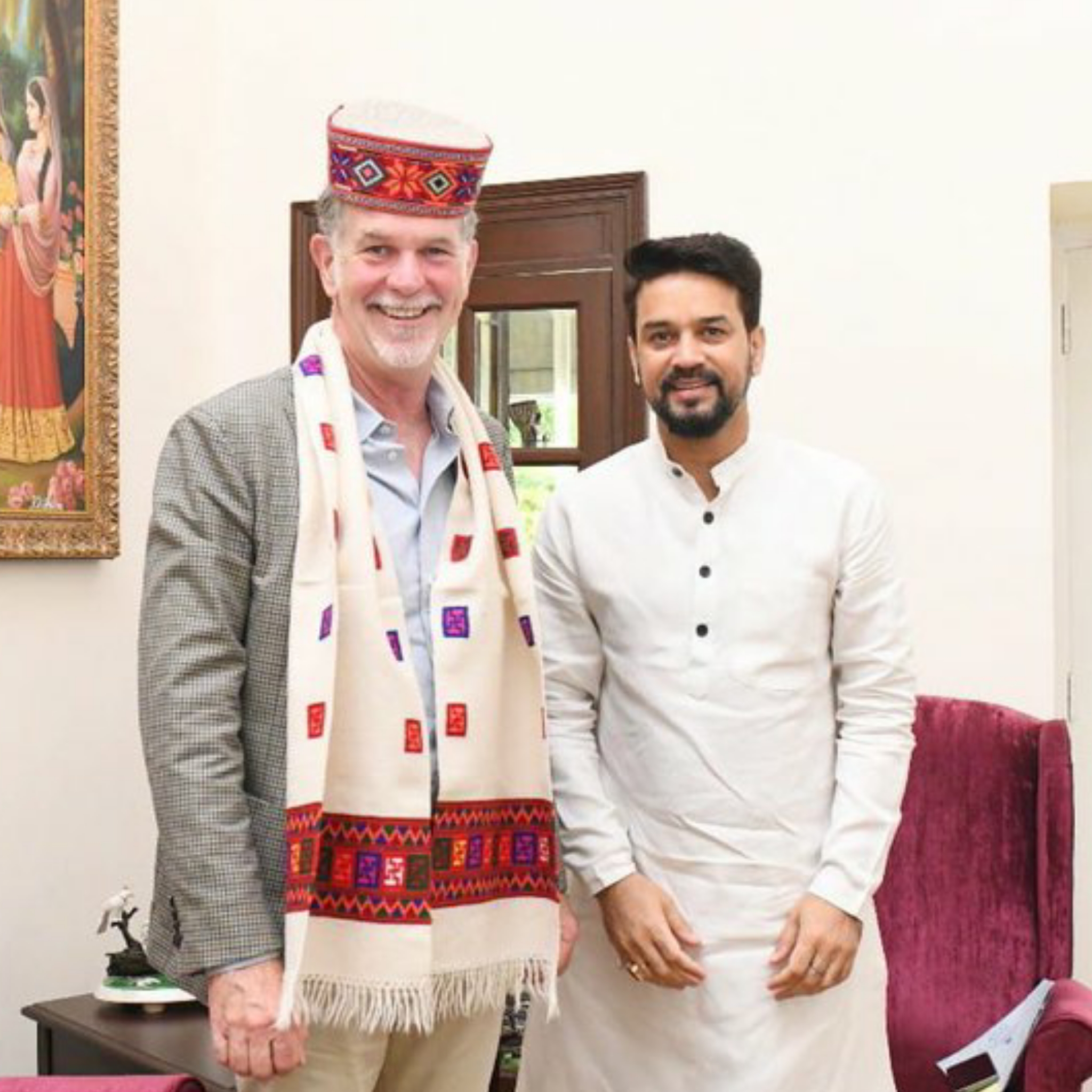
    Mumbai: Minister of information and broadcasting Anurag Thakur met with Netflix co-founder and chief executive officer Reed Hastings for a discussion on Tuesday. Thakur presented Hastings with a copy of the holy book Bhagvad Gita during the meeting. 

    The minister shared photos of the meeting via his personal handle on Twitter.

    “Good discussion with Mr Reed Hastings (Co-Founder & CEO Netflix),” said Thakur in a tweet. “Today consumers of content are traveling the world through stories; India offers a variety of opportunities and ideas – in multiple languages,” he wrote.

    Hastings recently announced that Netflix would invest more in India after already pumping Rs 3000 crore in the past two years. In an interview with Business Today, the Netflix chief had said that India is one of its “top priorities” and that the streaming company will continue its commitment to the Indian market by simply “investing more” in content.

    In February, the government framed the Information Technology (Intermediary Guidelines and Digital Media Ethics Code) Rules 2021 that introduced a grievance redressal mechanism for news publishers, OTT platforms and digital media and a Code of Ethics that prescribe the guidelines to be followed by OTT platforms and online news and digital media entities.

  • MCOF demands TRAI resolve pending grievances by 2 October

    MCOF demands TRAI resolve pending grievances by 2 October

    Mumbai: The Maharashtra Cable Operators’ Foundation (MCOF) has written to the chairman of the Telecom Regulatory Authority of India (TRAI) and minister of information and broadcasting (I&B) Anurag Thakur to resolve pending grievances of local cable operators (LCOs) before 2 October.

    According to the association, the inaction of TRAI has resulted in a loss of Rs 600 crore per year for LCOs. “The LCO fraternity will take steps to protect itself no matter the consequences on the rest of the value chain,” the letter reads.

    The LCOs had sought TRAI intervention in the matter of unilateral imposition of inter-connect agreement by multi-system operators. It alleged that MSOs leveraged their portals to impose prepaid terms on LCOs while offering post-paid services to subscribers, and called for redefining the shareable revenues between broadcasters and cable operators, and asked TRAI to clear ambiguity in set-top-box ownership.

    “Our subscribers and we are wondering as to why TRAI has not taken any step to implement the NTO 2.0 after the SC verdict refusing interim relief to broadcasters’ pleadings,” said MCOF. “The broadcasters and MSOs continue to milk the disempowered customers through packaging tricks and also deny a level playing field for standalone broadcasters. On a conservative basis, the forced excess payment towards content that subscribers do not want is Rs 50 per month.”

    Model interconnection agreement (MIA) and standard interconnection agreement (SIA) are signed between MSOs and LCOs for the retransmission of TV signals. MIA ensures that there is a mutual agreement in the terms set between LCOs and MSOs in line with the regulatory framework, to avoid disputes and ensure a level playing field. SIA provides for standard terms and conditions prescribed by regulation that may be adopted by MSOs and LCOs if they fail to mutually agree on an MIA.

    During NTO 2.0 litigation, LCOs claimed that TRAI has incorrectly portrayed them as a conduit between MSOs and subscribers undermining the role they have played as last-mile owners bringing connectivity to lakhs of homes. LCOs fear that subscriber ownership may be transferred to the MSOs and will lead to broadcasters and MSOs benefitting disproportionately at the cost of LCOs.

    LCOs have adopted a prepaid billing model for cable TV subscriptions to bring transparency and plug leakage of revenues. However, LCOs claim that while MSOs impose prepaid terms on the LCOs, they continue to offer post-paid services to TV subscribers by leveraging their portals. This has impacted their revenue collection.

    “The payout of pay-TV channels to cable operators for retransmission of TV signals is much lower than the amount billed to the customer,” said MCOF. “This fact is visible at a glance at the P&L statement of MSOs who disclose Netted Content Costs,”, said the letter.

    LCOs have asked TRAI to clear ambiguity on set-top-box ownership resulting in unilateral pricing without invoicing or service level agreement (SLA) to the subscribers.

    The LCOs service 10 crore homes and employ five lakh semi-skilled personnel. The letter states that the sector is at a make-or-break point with thousands of crores invested in fibre infrastructure at risk of disuse and economical infotainment to 40 crore viewers. It said that LCOs’ long list of grievances has been brushed aside by TRAI without any justification.  

  • Need to integrate the spirit of nation-building in each citizen: I&B minister

    Need to integrate the spirit of nation-building in each citizen: I&B minister

    New Delhi: “India is a pivotal power in Asia and as a member of the BRICS consortium, we would like to play a crucial role to strengthen ties between the member countries” said union minister of Information and broadcasting Anurag Singh Thakur.

    Thakur was addressing the virtual inaugural of ‘BRICS Film Technology Symposium’, being organised by FICCI, jointly with the ministry of I&B and FTII, here on Wednesday. “India takes pride in organising the first-ever BRICS Film Technology Symposium as a part of the special event planned in the run-up to the BRICS summit to be held in India,” he said.

    According to the minister, the focus of the BRICS Film Technology symposium is to acknowledge the service sector and technicians working for the film industry. “I am sure the symposium will create opportunities for the working professionals in the field of film technology of all BRICS nations to explore the world of cinema with a new perspective and vision,” said Thakur, highlighting the need to win the hearts and minds of the people from all BRICS nations. “A film symposium is an event which brings together one and all through the medium of cinema technology.”

    “Organising the first-ever BRICS Film Technology Symposium is a step in this direction to bring the people from all member states together. Through the medium of films, art and culture we have also opened avenues for cooperation which will be supporting development and growth in the film business,” he added.

    The two-day symposium intends to form partnerships and provide a platform for technological companies and organisations promoting films and bring the film community together for better communication, cooperation and collaboration.

    “BRICS countries are significant players in the field of VFX animation, computer-generated imagery, and media outsourcing. There is a great potential for collaborating with each other to enhance the technology in film production and cinematic experiences for the world of entertainment. The BRICS Film Festival which we will be organising along with the 52nd International Film Festival of India will provide us another opportunity to interact and share the best of our Cinemas,” said MIB secretary, Apurva Chandra.

    The event is spread over two days with sessions conducted by eminent speakers from all the BRICS countries. A virtual exhibition is being held as well.

  • Azadi Ka Amrit Mahotsav: Anurag Thakur to kick-off ‘Iconic Week’ celebrations

    Azadi Ka Amrit Mahotsav: Anurag Thakur to kick-off ‘Iconic Week’ celebrations

    Mumbai: Union minister for information and broadcasting Anurag Thakur will kick off a gamut of activities to celebrate the ‘Azadi ka Amrit Mahotsav’ from 23-29 August. Thakur will kick off the ‘Iconic Week’ which will attract participation from across the country under the overall spirit of ‘Jan Bhagidari and Jan Andolan’, the I&B ministry said.

    According to the press statement released by the ministry, the objective is to showcase the journey of New India and celebrate the contribution of freedom fighters including the ‘unsung heroes’ of the freedom struggle through massive outreach activities. “The celebrations will be a 360-degree outreach via traditional means such as cultural programmes, nukkad natak and TV programmes along with innovative means of digital and social media,” it added.

    The AIR will launch a series of special programmes called ‘Dharohar’ which are speeches of freedom fighters; ‘Nishaan’ which will showcase 75 landmark sites and ‘Aparajita’, a show on women leaders. 

    The Doordarshan network will telecast programmes covering themes such as diplomacy, Digital India and legislative reforms through sectoral programmes like ‘Naye Bharat Ka Naya Safar’ and ‘Journey of New India’. Daily news capsules on ‘Unsung heroes and Freedom Struggle’ will also be shown, the ministry said.

    The National Film Development Corporation of India (NFDC) is also organising a film festival on its OTT platform www.cinemasofindia.com screening a specially curated bouquet of films such as “Island City”, “Crossing Bridges” and many others, it added.

    DD Network will showcase a series of documentaries such as “Netaji”, “Merger of Princely States”, etc. Popular films like “Raazi” will also be broadcasted. 

    The Bureau of Outreach and Communication (BOC) will also reach out to the people through nukkad nataks, skits, magic shows, puppetry, folk recitals through more than 50 integrated communication and outreach programmes by ROBs and over 1,000 PRTs by Song and Drama Division across the country. BOC will also launch an eBook on ‘Making of the Constitution’ on its website.

  • Need immediate resumption of viewership ratings: NBF to Anurag Thakur

    Need immediate resumption of viewership ratings: NBF to Anurag Thakur

    Mumbai: Governing board members and senior member broadcasters of News Broadcasters Federation (NBF) met with the minister of information and broadcasting, Anurag Thakur, on Tuesday.

    During the meeting, members of NBF highlighted the need for the immediate resumption of viewership ratings for the news genre. The ratings “have been unilaterally paused and have severely impacted the sustainability of news channels”, they said. 

    The new broadcast body apprised the I&B minister of key issues facing the news industry, recent growth and trends in the broadcasting sector, and challenges faced by news broadcasters in recent times.

    “It was a pleasure to meet and exchange views with the NBF governing board led by Arnab Goswami,” said Anurag Thakur. “It was a productive exchange of views and I look forward to engaging with the NBF on issues regarding news broadcasting and the role of news broadcasting in strengthening our democracy,” he added.

    The NBF governing board informed the minister about key initiatives undertaken by the body to provide greater representation to channels broadcasting in various languages and on further steps to strengthen regulation among member channels.

    The NBF delegation included Republic Media Network, editor-in-chief, Arnab Goswami; TV9 News Network, CEO, Barun Das; Prag News, founder/MD, Sanjive Narain; Pride East Entertainment, chairperson/MD, Riniki Bhuyan Sarma; ITV Network founder/promoter, Kartikeya Sharma; Fourth Dimension, CEO, Shankar Bala; TV9 Bharatvarsh, news director, Hemant Sharma; News Nation, editor-in-chief, Manoj Gairola; MHOne, chairperson, Mahendra Bhatla; Newsfirst Kannada, business head, Divaakar S; NBF and Eshita, secretary-general, and associate for policy and regulations of NBF, R Jai Krishna.

    “The meeting of NBF members with the Minister was a wonderful opportunity to apprise him about the steps we have taken to build India’s largest federation of news broadcasters,” said NBF president Arnab Goswami. “The Minister has heard our views and concerns in detail and we look forward to working with the Ministry of Information and Broadcasting to make the news broadcasting sector even stronger.”

    Shankar Bala called the meeting “path-breaking” and said, “We have particularly stated that it is essential to release the viewership ratings for news channels, which were unilaterally stopped. The resumption of the publication of news ratings will ensure fair play and measurement-driven competitive news industry.”

    “The highly competitive news TV genre certainly needs a level-playing field for new promising players both in the national arena and regional markets. We felt extremely assured after our meeting today,” said Barun Das.

    “As a team, NBF put forth the problems we tend to face and the ways in which we want to raise and address our concerns. At least, we can go forward and help regional industries survive, like ours. The minister gave us a patient hearing and we are very grateful to the Ministry. We are now looking forward to the future and ways as to how we can progress together,” said Riniki Bhuyan Sarma.

    “The minister heard out all the matters raised by various members of the NBF. I would like to thank the minister for hearing the viewpoints of all news channels from across India and from regional channels as well,” said Kartikeya Sharma.
  • I&B ministry imposes additional penalties for violation of programme code

    I&B ministry imposes additional penalties for violation of programme code

    Mumbai: The minister of information and broadcasting, Anurag Thakur has informed the Rajya Sabha that there have been 37 instances between March 2005 and June 2021 where broadcasters were prohibited the transmission and re-transmission of a channel for a specified time period, or permission to downlink the channel was cancelled, due to violation of the programme code.

    The information and broadcasting minister was asked to give the status of Cable TV Networks Amendment (Regulation) Bill, 2020 which proposed to increase the penalties for violation of the Programme Code. He was also asked whether the government had imposed a monetary penalty or prohibited the transmission of a channel under the relevant provisions of the Cable TV Networks Amendment (Regulation) Act for violation of the Programme Code.

    “No monetary penalty has been imposed for the violation of Programme Code,” noted Thakur.

    The programme code comes under the Cable TV Networks (Regulation) Act, 1995 and Cable Television Networks Rules, 1994 contains broad guidelines related to content broadcast on private television channels.

    The matter of violation of the programme code and advertising code has been addressed by amending the rules vide government gazette notification number G.S.R. 416(E) on 17 June so as to include a complaint redressal mechanism by the broadcaster which prescribes the specific actions that can be taken by the central government for such violations.

    As per the amendments, if the government is satisfied that the programme of any channel is not in conformity with the programme code, it may, after giving an opportunity of hearing to the cable operator, and by an order in writing, prohibit the transmission or re-transmission of any such channel or programme in accordance with the provisions of section 20 of the Act.

    The rules provide for a three-tiered complaint redressal mechanism; Level I self-regulation by the broadcaster, level II self-regulation by self-regulating bodies of the broadcasters, and level III oversight mechanism by the central government.  

    The I&B minister had previously informed the Parliament on Friday that the government took action against 126 violations of the programme code between 2018 and 2021.

  • I&B Minister Anurag Thakur meets the NBA Board

    I&B Minister Anurag Thakur meets the NBA Board

    New Delhi : The newly appointed union minister for Information and Broadcasting  Anurag Thakur met the board members of the News Broadcasters Association (NBA) on Saturday to discuss various pertinent issues concerning news channels and the broadcast industry.

    Led by NBA president and chairman and editor-in-chief of India TV, Rajat Sharma, the delegation included ABP Network CEO  Avinash Pandey, Zee News, editor-in-chief and CEO, Sudhir Chaudhary, News24 chairperson and managing director Anuradha Prasad Shukla, India Today Group vice chairperson Kalli Purie, and NDTV editorial director Sonia Singh.

    The discussions delved into various issues including that of attaining a stable regulatory climate in the industry and other positive changes that can be introduced in the television ecosystem.

    Speaking about the meeting, spokesperson of NBA said, “Effective communication is extremely important for us to uplift the broadcast industry and implement positive changes. The discussion helped us provide direction to various issues within the industry. We are looking forward to working closely with the union minister of Information and Broadcasting Anurag Thakur to take the broadcast industry to greater heights.”

    Further, NBA members discussed the industry landscape in the post-COVID scenario and apprised the minister about their concerns. The meeting also threw light on creating a strong policy roadmap for growth in the post-Covid era for the broadcast industry. 

  • I&B ministry acted against 126 violations of Programme Code in last 3 years

    I&B ministry acted against 126 violations of Programme Code in last 3 years

    Mumbai: During 2018 to 2021, the Government took action against 126 cases of violation of Programme Code laid down in the Cable Television Networks (CTN) Rules, 1994 framed under Cable Television Networks Act, 1995. The action with respect to cases was taken by issuance of advisories, warnings, apology scroll orders, and off-air orders, said the ministry on Friday.

    “Government has an institutional mechanism for taking action in respect of private TV channels which are found to violate the Programme Code. The I&B ministry also issues advisories from time to time to private satellite TV channels for adhering to the Programme Code,” said the minister of information and broadcasting, Anurag Thakur in the ongoing monsoon session of the Parliament.

    The minister was responding to a query put forth in the Lok Sabha on whether the Government has taken cognizance of high decibel, sensationalist and slanderous news programmes/debates being hosted on Indian news channels. The Government was asked whether it has received complaints against news channels for violating the broadcasting guidelines and broadcasting fake news, hate and divisive agenda during the last three years.

    The Government was also asked whether it is planning to initiate any code of conduct or broad guidelines for the debates that happen on electronic media and the time by which final decision is likely to be taken in this regard.

    The Programme Code contains broad guidelines related to content broadcast on private television channels.

    The guidelines also provide that no programme should contain anything obscene, defamatory, deliberate, false and suggestive innuendos, and half-truths, and should not criticise malign or slander any individual in person or certain groups, segments of social, public and moral life of the country.

    The Rules provide for a three-level complaint redressal mechanism; Level I by the broadcaster, Level II by the self-regulating bodies of the broadcasters; and Level III by oversight mechanism of the Central Government.

  • Licences of 204 private TV channels revoked in last four years : I&B minister

    Licences of 204 private TV channels revoked in last four years : I&B minister

    New Delhi: The ministry of information and broadcasting has revoked licences of over 200 private TV channels during 2016-2020, union I&B minister Anurag Thakur told the Parliament on Monday.

    Responding to a query in Rajya Sabha during the ongoing monsoon session, Thakur said that as on date, there are 916 private satellite TV channels which have been granted permission by the government under the Up-linking and Downlinking Guidelines, 2011.

    “However, many channels failed to fulfil the guidelines and ceased to operate in the last five years,” he said. “TV channels cease operation due to various reasons, including for non-fulfilment of conditions under the guidelines. During the last five years, 204 TV channels have ceased to operate.”

    Thakur also told the Parliament that the government also takes action against private TV channels for violation of programme code laid down under the Cable Television Networks (Regulation) Act, 1995 by issuance of warnings, advisories, off-air orders, etc. “The government has issued warnings in 128 cases for violation of guidelines,” he said.

    The minister said 60 private satellite TV channels were given permission to operate in the country in 2016-17, 34 in 2017-18, 56 each in 2018-19 and 2019-20, and 22 in 2020-21.

  • Govt ad spend on print falls by 54 % in last 3 years

    Govt ad spend on print falls by 54 % in last 3 years

    New Delhi: The government’s expenditure on print advertisements has dropped by almost 54 per cent in the last three years.

    According to the latest data presented in the Parliament, the government had spent Rs 429.55 cr in print advertisements in 2018-19, which decreased to Rs 295.05 cr in 2019-20, and further plummeted down to Rs 197.49 cr during the pandemic in 2020-21. The data was shared by the union minister for information and broadcasting Anurag Thakur during the ongoing monsoon session of the Parliament.

    The ad-expenditure on electronic and digital media has also also recorded a significant drop over the last three years, said Thakur in a written response to a question raised by BJD MP Sasmit Patra. According to Thakur, the Centre spent Rs 514.29 crore on TV ads in 2018-19. In 2019-20, the allocation for ad expenditure on electronic media platforms was slashed to Rs 316.99 crore, which further came down to Rs 167.98 crore in 2020-21.

    All these expenditures refer to expenses incurred by the Bureau of Outreach and Communications (BOC), which acts as an advisory body to the government on its media strategy, and undertakes information, education, and communication (IEC) campaigns of the government through its empanelled media platforms as per the policy guidelines.

    The plummeting ad spends by the government come at a time when the print industry is struggling to survive the pandemic’s severe blow. The print media thrives on advertisement expenditure of industries including e-commerce, automobiles, and finance, which were also impacted by the lockdown. Many businesses ended up pulling out advertisements, as part of budget cuts and also due to a drastic fall in the circulation of newspapers and magazines. The prolonged lockdown restrictions forced several publications to limit the number of pages, shut their editions and resort to layoffs.

    Last year, the Indian Newspaper Society (INS) had also raised concerns over the rising newsprint and logistics costs and increasing preference for online content. It had also demanded a 50 per cent increase in government advertisement rates and a 200 per cent increase in the Centre’s spend on print media advertising and an immediate settlement of advertisement bills outstanding to both central and state governments.