Tag: Anupama Mandloi

  • TCH 2024: Need for sustainability & content creation

    TCH 2024: Need for sustainability & content creation

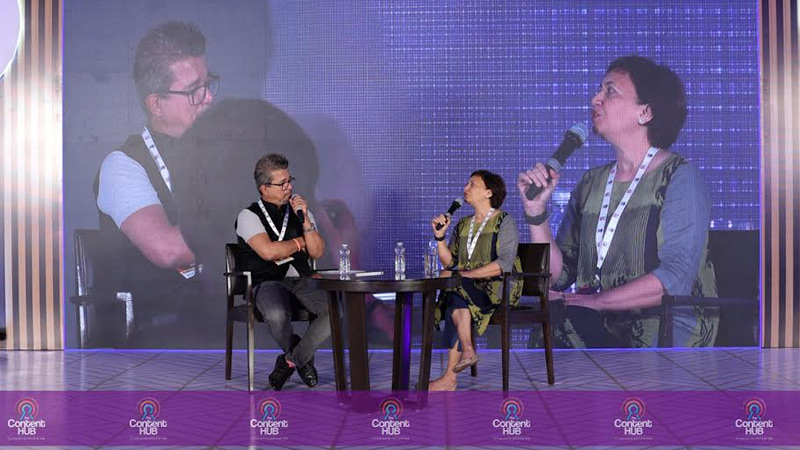
    Mumbai: The eighth edition of The Content Hub Summit delves into the ever-changing world of content creation. With the consolidation of platforms, creators face new hurdles in gaining visibility, maximizing revenue, and maintaining creative freedom. The event also explored the remarkable theatrical success of Indian cinema and unraveled the secrets behind its unprecedented profits, with a critical eye towards its sustainability.

    The fireside chat saw Indiantelevision.com group founder, chairman & editor-in-chief Anil NM Wanvari in conversation with India GreenSet CEO & co-founder Anupama Mandloi.

    They discussed the critical importance of sustainability in content creation, especially in India, which leads in volume. They highlighted the industry’s potential for influence and the necessity to adapt to climate change. Mandloi emphasized the need for sustainable practices, citing examples like the Mumbai floods’ impact on business.

    Wanvari proposed initiatives like eliminating single-use plastics at events and forming industry alliances for sustainable standards. They emphasized the shift toward sustainability as a cultural change, stressing the industry’s collective responsibility and the need for unity to overcome hurdles.

    Mandloi suggested practical steps individuals can take, urging a bottom-up approach to drive the sustainability revolution.

  • Anupama Mandloi resigns as Fremantlemedia India MD, to continue as consultant

    Anupama Mandloi resigns as Fremantlemedia India MD, to continue as consultant

    MUMBAI: Known for spearheading Fremantlemedia’s India operation and building it from scratch, Anupama Mandloi has resigned from the post of managing director.


    However, she will continue as a consultant at the company. 


    Speaking to Indiantelevision.com, Mandloi says, “I consider myself fortunate to have had the opportunity to set up and drive the company in India with a fabulous set of colleagues. It has been an enriching five years and I will always treasure this experience. I continue to work with Fremantlemedia as a consultant.”


    Mandloi joined Fremantlemedia as content head in 2010 armed with nine years experience at Sony Entertainment Television and over two years as creative director in Star India.


    She is best known for spearheading shows like Indian Idol and Savdhan India.


  • Fremantle concludes first season of its digital production ‘India’s Digital Superstar’

    Fremantle concludes first season of its digital production ‘India’s Digital Superstar’

    MUMBAI: A production house behind successful shows like Indian Idol and India’s Got Talent, FremantleMedia has concluded the biggest talent hunt show – India’s Digital Superstars.


    The show created around 800 minutes of original content and roped in 35 celebrities to mentor the participants in their journey which received entries from across 12 countries.


    The real success of the show lay in the fact that three contestants – Famous Crew, the dance group, Prerna and Apurva, the scintillating salsa dancers and Yogeshwari, an aerial dance performer who made it to the semi finals of India’s Got Talent- 6 were discovered through India’s Digital Superstars. The show was extended by six weeks on account of its rising popularity and public demand.


    The show redefined the digital space with its huge success that had got the nation in a frenzy. India’s Digital Superstar crossed the million mark with the views and likes from audiences who were the ultimate judge of the show. Feroz Khan was declared as the winner. Khan won prize of Rs 20 lakh and also a contract with FremantleMedia and One Digital. 


    “We are glad to celebrate the success of our first digital production. The format is already being considered for licensing and production in three other countries. As a production house we would be open to developing and creating shows for all platforms,” said FremantleMedia MD Anupama Mandloi.


    Talking about the show, judge Anu Malik added, “It was an immense pleasure to witness the massive talent from different walks of life at India’s Digital Superstar, a platform to show case talent before the whole world from the comfort of our homes. The unique concept of an online talent hunt show is going to reach newer heights because we are living in a digital era and the internet is here to stay.”


    The show’s host, Sahil Khattar who is an ace digital host stated, ‘’It was a ride of a lifetime for me’’. His association with FremantleMedia as India’s Digital Superstar’s host has been an exciting journey for him and he looks forward to more such exciting opportunities where he can witness the powerhouse of talents that India has.’’


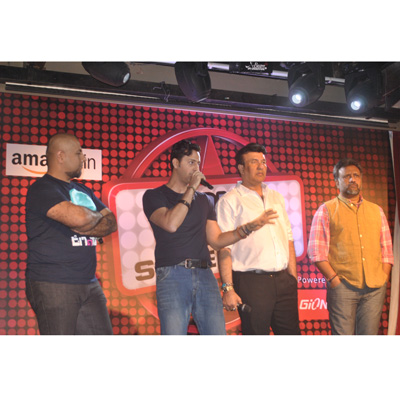
    The show was presented by Amazon.in, powered by Gionee in association with radio partner Red FM. India’s Digital Superstar platform encouraged participants to upload multiple videos of their talent, and was judged by the audience through the number of views and likes across Youtube, ZengaTV and Facebook. It was a power-packed digital show with non-stop auditions, non-stop opportunity, 24/7 content and non-stop fun.

  • The making of ‘Junior’ stars

    The making of ‘Junior’ stars

    It was a countdown that began in the year 2004. Armed with a huge promotional blitz, Sony Entertainment Television (SET) launched its ‘big one’: an ambitious project that threatened to challenge the viewing habits of the telly loyals.

    Be it a lack of hit since Bade Achhe Lagte Hain, or the obvious threat posed by the ‘youth or women oriented’ focus of several other general entertainment channels (GECs), SET has a huge stake with the desi version of FremantleMedia’s Pop Idol.

    The mega budget Indian Idol is SET’s bid to fortify its youth viewer base. Multi Screen Media (MSM) calls this talent hunt a power brand created by Sony in the past 15 years, which stands above a few other powerful brands created by the channel including CID, Aahat, Boogie Woogie among others.

    Indian Idol so far has produced six successful seasons. Worried of the show reaching a fatigue level, the channel introduced a sub-franchise targeting kids with Indian Idol Junior in 2013. On the back of a successful first season, Sony has come back with the second edition this year.

    Indian Idol Junior2 currently showcasing the audition round, will see the ‘juniors’ paying tribute to the maestros of Indian music at the season’s grand launch. What’s more, the talent quotient has gone a notch higher with the inclusion of actor Sonakshi Sinha as one of the judges.

    A look at the journey

    While all looks glamorous when one watches the show on TV, producing half an hour to one hour of reality show is no child’s play.

    At any given time, more than 100-200 people work to make a reality show. The production team and the crew are as important as the talent and really make the show happen. When a fiction show is penned, one has to simply write all the relevant beats to that week’s tale, but with reality programmes, things are a bit different.

    Let’s take a look at all the madness that goes backstage while making a show like Indian Idol Junior2.

    For FremantleMedia India managing director Anupama Mandloi the blueprint of these formats is simple, uncomplicated, clean and universally adaptable. A reality show like Indian Idol while is relevant to any culture across the globe, it also has the ability to absorb the local DNA, thus becoming a true representation of the region they are produced in.

    “The audience enjoys the predictability of the journey, the range of talent, as well as the fresh and exclusive energy each season brings. Characters and storytelling define any good show. These shows are all about creating strong, memorable, aspirational and yet relatable characters whose journey and endgame is contained within a finite number of weeks,” she explains.

    Considering the basic blueprint remains the same, making any new edition look fresh is the biggest challenge. “We look at various elements: right from the talent to choosing areas for getting fresh, new voices to the panel of judges depicting their camaraderie and journey through the show. We also look at scheduling, how to differentiate various phases of the show as well as the larger story that we want to convey through the programme. These shows are all representative of current times and there is a definite change in narrative that comes through the contestants on the show,” Mandloi explains.

    She believes that when they first started the journey of reality shows, it gave audiences a sense of opportunity, scale and transformation. Over the years, it has reflected the pathos of underprivileged lives, their acceptance of destiny and the rooted middle class values.

    But, the narrative now is of achievers, children wanting the best and working towards it as well as a growing sense of community through technology. “It is about expecting the best and taking destiny into their hands. These shows are fascinating in what they throw up as you gather stories from across India,” she adds.

    Content Creation

    For starters, broader and thematic links for hosts is written before hand after a lot of internal discussions. A large part of the script is written on the ground based on situations as they unfold. As per Mandloi, this year the show witnessed the turnout of an unprecedented number of twins.

    She further goes on to say that the writers do not write scripts for judges because that never works. “The judges are articulate and capable of phrasing their thoughts. Scripting for the judges or the kids would make the show fake and we have a fairly purist approach to this aspect of the show. The viewers can tell if a show is over produced,” she asserts.

    There is only one writer who works closely with the creative director, associate creative director and the anchor director. It is all about the brief and how the writer links it with existing social norms and then how he wants the show to resonate. “The idea is to give the show consistency and a sense of purpose. Be it celebration, search, revelation, wish fulfillment,” she explains.

    There was no extensive research for this season, says Mandloi.  But, with a successful first edition, the makers were keen to establish the junior brand with the second season.

    “This season is a celebration of talent rather than a discovery and that is probably what is showing up through all interactions. There was a reflection on elements that worked and those that could have been better and we moved forward with those learnings in place. The top 13 is a true reflection of India from north, south, east and west. The top 13 is a wide range of voices as well as personalities and the talent is fresh and memorable,” she reasons.

    Reality shows are exhausting & relentless

    According to Mandloi, Indian Idol Junior took almost nine intense months of work and the crew usually faces a vacuum once the show gets over. “These shows are exhausting as they are relentless and require dedicated commitment from the team. At FremantleMedia, we are very careful to work with the best in the industry. They take pride in their work and that is always reflected in the quality of the show.”

    For IIJ, the makers had a one year window to find the talent and according to Mandloi that is clearly coming across in the show.

    It was a three months journey for the talent hunt to finally complete the auditions. While a number of children are called through an established network of music schools, institutions and gharaanas, there is also an open audition for which people register and audition.

    Since the show deals with kids, the makers ensure that children come with guardians. Food and water is provided and while the wait can be long, it does not allow entries after 5 pm. Moreover, the crew has contestant managers and their teams as well as a large ground team that helps address any issues that may crop up.

    “We are very careful with children. As far as possible we do try and ensure that the children are treated gently and with care. The entire team is briefed and prepped before the unit hits the road,” she says.

    How do the makers ensure a good turnout for auditions? Says Mandloi, “We can’t really control this beyond a point. In some cities the turnout is fabulous and in some it is sometimes underwhelming but for us the focus is not on the volume as much as it is on the talent. We make sure that a fair opportunity is provided to all those who are present.”

    According to Mandloi, she has been very fortunate with her channel interactions. “There is great faith in the team as well as belief in the format. There is a lot of creative freedom for this reason and the show is eventually a collaboration of creative ideas and execution.”

    Live, Camera & Action

    The show began the actual shoot approximately three months before going on-air.

    The audition phase is an accumulation of shoot footage of over two months which is then sifted through and assembled into episodes. “It is a tough process though now we have very good teams that have understood the process and are very skilled at connecting the dots,” she opines.

    The theatre phase is shot over three days. The concert episodes are shot every Sunday with a live result episode.

    One single episode takes anywhere from three weeks to five hours depending on the nature of the episode. The audition episodes take the longest as there is hours and hours of footage that needs to be culled, assembled and structured into a narrative. The live result takes approximately five hours and the concert episodes take close to three days.

    For all these, the production house has a large set-up with multiple machines and large post teams. A very tight core team drives the show. It hires the technical, creative as well as production teams on project basis. For a show of this size it is usually around 200 people on ground.

    To manage the crowd and ensure enough eyeballs in the studio, a large part of the crowd is sourced through audience co-coordinators. Moreover, there is a floor manager and his team that takes care of audience management as well as all the ground show flow.

    Every season needs to focus on bringing together fresh, exquisite talent that people align themselves with. This alignment dictates how they feel about the judge panel and the judges’ personal graphs within the show.

    For IIJ season2, judges like Vishal Dadlani, Shalmali Kholgade and Salim Merchant were selected for their credibility, their ease with children, ability to connect with viewers, personality and a very strong sense of who they are as opposed to who they are trying to project.

    Host Hussain Kuwajerwala and co-host Asha Negi were selected for their ability to be spontaneous, charming as well as the ability to connect with kids and viewers.

    This season the makers have conceived a set that is unlike any so far in its true 360 degree design. It’s intimate, glamorous and yet very fresh. A wireless cam does a 360 degree revolution around the centre stage. The families, contestants, audience and judges are all seated around the circular stage so that the contestant feels connected to all.

    The contestant performs in a central arena surrounded by graphics and the live band fills the set with its magic. IIJ 2 is being shot with 15 cameras.

    Reality shows costs a bomb

    One cannot deny the fact that reality shows are expensive. The production house is allocated with a budget and it has to work under those tight budgets.

    A media planner believes that though they are high budget shows, it is not in the cost of content. “The focus is to make sets bigger and shiny with more lights.  But, that is not what attracts the audience anyways.”

    According to a planner, it is the celebrity quotient that increases the cost of production.  “If you are working on a budget, you usually have to figure out what level of celebrity you can afford and that decides the costing. While the scale of the show is controllable, it is the demand for a particular celebrity which takes the cost high,” adds the planner.

    The production cost per episode of IIJ season 2 is somewhere between Rs 30-35 lakh.

    Sony, which currently is at the sixth position at the television ratings chart, has high hopes from this season of Indian Idol Junior. While the stage is set for the star performers, whether it will open up the stars for the channel is yet to be seen.   

  • Sony re-jigs weekend programming for ‘Indian Idol Junior’

    Sony re-jigs weekend programming for ‘Indian Idol Junior’

    MUMBAI: While it may not have found favour with audiences on its fiction fare recently, Sony Entertainment Television is all set to enthrall audiences with the second season of its popular singing reality show format – Indian Idol Junior.

    The show, which will launch on 30 May, will be aired at 8.30 pm on weekends. With this, Adaalat, which was aired from 8 – 9 pm on Sony, will now get a new time slot and will be aired from 7.30 – 8.30 pm. Additionally, Bhanwar, which aired at 9 pm will be taken off air. The show’s last episode will be on 24 May.


    Indian Idol Junior, this time round, will see the juniors paying a tribute to the maestros of Indian music at the season’s grand launch. With the success of the first season, Sony Entertainment Television is upbeat about giving talented youngsters this platform to exhibit their talent yet again.


    What’s more, the talent quotient for this season has gone several notches higher with the inclusion of actor Sonakshi Sinha as one of the judges.


    Speaking to Indiantelevision.com at the launch of the show, Sony Entrainment Television senior executive vice president and business head Nachiket Pantvaidya said, “The unique thing about this show is that for the first time ever, we are using a celebrity i.e. Sonakshi Sinha as a representative of the common people. You normally find that the judges are experts in their own fields but with Sonakshi, we want to explore the connect further.”


    “With the second edition of Indian Idol Junior, we intend to bring the entire family together and recreate the entertainment quotient of this season substantially while gifting the music industry with some really outstanding talent,” Pantvaidya added.


    Sharing insights on her television debut, Sinha said, “Playback singing is unique to Indian cinema. For our films, music is as essential an entity as the story. With every era of movies, there has come a whole generation of musicians who have almost immortalized some movies through the music. I’m really excited and happy to be associated with Indian Idol Junior, a reality show that celebrates music and creates platform for young talent to follow their dreams and reach out to the stars.”


    Sony Entertainment Television chief creative officer Ajay Bhalwankar added, “The whole selection process, auditions, theatre took about a year. The gala rounds episodes will go on for fourteen weeks and will have the normal voting system like previous formats.”


    Fremantle Media India managing director Anupama Mandloi said, “It’s always been nice to work with this format. We have been doing it for years now and this time it’s special because we found talent across the country – north, south, east and west.  Also in time to come, you will see what surprises this season will bring.”


    Sony has brought on board three sponsors for the second season of Indian Idol Junior. While Horlicks is the ‘presenting’ sponsor, Lifebuoy and Aquaguard have associated with the show as ‘co-powered by’ sponsors.


    Apart from Sinha, the show will have judges like Vishal Dadlani, Salim Merchant and Shalmali Kholgade. It will be hosted by Hussain Kuwajerwala and Asha Negi.

  • FremantleMedia launches India’s first ‘Digital Talent Hunt’

    FremantleMedia launches India’s first ‘Digital Talent Hunt’

    MUMBAI: FremantleMedia has partnered with mobile video streaming service Zenga TV and YouTube MCN of India, OneDigital Entertainment to launch its first digital talent show ‘India’s Digital Superstars.’


    This will a first of its kind digital talent hunt, where the audience will judge the next ‘Big Digital Star.’ The show will be presented by Amazon.in, powered by Gionee in association with radio partner RedFM.


    The auditions for the show, which began from 19 January, will culminate with a finale in May. The winner will be given a contract worth Rs 20 lakh from FremantleMedia and One Digital. The auditions are open to all Indians across the world.


    Auditions will span across 13 weeks. The 14th week is the grand finale to be held in Mumbai. The Indiasdigitalsuperstar.com platform will encourage participants to upload multiple videos of the talent that they wish to showcase, and will be judged by the audience through the number of views and likes across Youtube, ZengaTV and Facebook.


    Fresh videos can be uploaded until a week before the ‘Finale Night’. The host will come online thrice a week – Mondays, Wednesdays and Fridays for 10 continuous weeks starting from the fifth week of audition.


    FremantleMedia India managing director Anupama Mandloi said, “After the super success of Indian Idol, India’s got Talent, we at Fremantle are delighted to launch a platform that will be accessible to everyone with internet access. Given that India is a priority market for FremantleMedia and a popular destination for many of our hit international brands, we want to continue driving our strategy of aggregating talent across media with India’s Digital Superstars. We have been instrumental in sourcing, discovering and unleashing talent across television and this is the obvious next step for us to take the talent hunt to the internet which is a world unto itself.”


    Amazon.in director integrated marketing Manish Kalra added, “The digital medium democratises opportunities and choices and enables easy access to them for everyone like no other medium. We are very excited to be part of India’s Digital Superstar and support this effort to celebrate the immense talent that is waiting to be discovered.”


    “The youth today is hungry for exciting and engaging content and ‘India’s Digital Superstar’ is an opportunity where every moment will count and adrenal will be on the high. This gives everyone a chance to showcase talent from anywhere in the world and be the next start in this world which has no boundaries,” informed ZengaTV & OneDigital MD & CTO Shabir Momin.


    “Digital as a a platform is connected to the youth of this country. IDS as a digital platform is the first in the country, which creates the opportunity for the youth to showcase the talent and get recognized. We at Gionee are proud to be associated with IDS as this allows the youth to follow their passions and this has got a great synergy with our brand as we also want our consumers to follow the passions and we help them as an enabler for it,” added Gionee Smartphones India head Arvind R Vohra.


    “With the unique format of the show specially created for the digital platform, India’s Digital Superstar will create opportunities for Indians globally to showcase their talent without having to stand in queues or reach specific locations at specific time. Moreover the show is not about highlighting only a couple of contestants but we want to showcase as many talented Indian creators, and that is why the call for entries never stops during the show. As long as the show is on, people can participate and stand a chance to win,” concluded One Digital Entertainment COO and co-founder Gurpreet Singh.


  • CEOs from north India to vie for ‘CEO’s Got Talent’ trophy

    CEOs from north India to vie for ‘CEO’s Got Talent’ trophy

    NEW DELHI: After the popular show comes another that seeks to judge the best chief executive officers (CEOs) in the country; CEOs Got Talent. FremantleMedia has announced the second edition of the event to be held in New Delhi on 15 November featuring CEOs from India Inc. who will pit their unique talents against each other.

    The first-of-its-kind event was created by FremantleMedia within its ‘Got Talent’ franchise to recognise the creativity and talent of CEOs and providing them with a platform to showcase a side to them that generally doesn’t come into view in their day-to-day business lives. And judging the CEOs will be Colors CEO Raj Nayak and Bollywood personalities Mahesh Bhatt and Neha Dhupia.

    Produced by FremantleMedia, ‘CEOs Got Talent’ is an initiative powered by Karmyog Foundation and lifestyle partner Victorinox and its beneficiary Genesis Foundation. This initiative will see top CEOs from north India competing on a common stage for the coveted CEOs Got Talent trophy.

    Proceeds from CEO’s Got Talent will go to Genesis Foundation, which provides financial support for life-saving and life-changing medical intervention for critically ill under-privileged children in the areas of cancer, cardiac disorder, post organ failure, thalassemia and extreme deformities.

    To encourage and support this cause, the event will be attended by over 400 industry players comprising of CEO’s and other partners.

    Speaking about the show Colors CEO Raj Nayak said, “I’m sure CEOs are bored of their board room presentations. This is a great platform for corporate head honchos to de-stress and show off the cool quotient in their personalities.”

    Acclaimed filmmaker Mahesh Bhatt commented, “Spotting talent is a heart-warming adventure for me. It’s even more exciting if you have to spot talent amongst CEOs – the head honchos of our corporate society. It was a hell of an experience judging the first event held in Mumbai and I look forward to an even better experience in Delhi.”

    Actor Neha Dhupia added “It’s not every day that one gets an opportunity to see corporate czars and czarinas step into my world (read entertainment) as they unleash their hidden passions. And who knows – my next co-star or playback singer could be discovered right here, right now.”

    FremantleMedia India MD Anupama Mandloi, “CNBC-TV18 returns as our broadcast partner, assisting us in showcasing the unique talent these corporate stalwarts have. We look forward to this year’s event receiving Delhi this time and continue to generously support Genesis Foundation.”

     
    Prema Sagar, Founding Trustee, Genesis Foundation, said, “CEO’s Got Talent’ is a platform for chief executives to come out of the closet, to do what they love, show their hidden talent – be it music, dance or any other performance, while raising funds to save lives of critically ill children.”

    Sourabh Sarkar, Founder Karmyog Foundation, said “CEO’s Got Talent is a unique concept that aims at bringing together some of the most successful people in the country together. It not only gives them a platform to enthrall the audiences by unveiling their ‘other side’ but also lets them contribute toward a larger cause. We are glad to be associated with CEO’s Got Talent.”


  • CNBC TV18 to exclusively air CEO’s Got Talent

    CNBC TV18 to exclusively air CEO’s Got Talent

    MUMBAI: The month of March has seen a unique property, CEO’s Got Talent emerge under the internationally acclaimed Got Talent franchise, bringing together mavericks of the corporate and entertainment industry on a common platform at a plush hotel in suburban Mumbai. Organized by FremantleMedia India, for the benefit of Genesis Foundation, the gala event witnessed twelve CEOs as they come in the spotlight while showcasing their creative and varied talents. Viewers will be able to get an exclusive glimpse into the fun-fun-filled evening on CNBC TV18 on Saturday, 29th March 2014 at 4:30 PM and Sunday, 30th March 2014 at 5:30 PM.


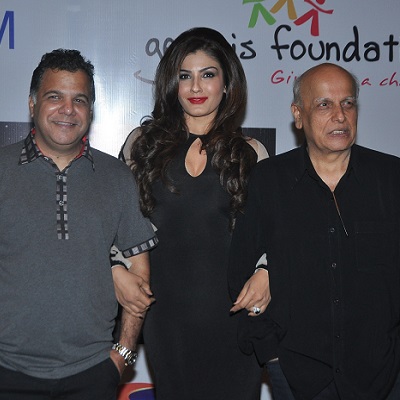
    CEO’s Got Talent was a unique property created by FremantleMedia India. The on-ground event comprised of several acts ranging from classical singing, jive dance moves to playing musical instruments and stand-up comedy. The event was filled with energy and vigor as the top management of India Inc. came together in support of Genesis Foundation. These acts were judged by a distinguished panel of jury members including renowned actor Raveena Tandon, celebrated director-producer Mahesh Bhatt and Raj Nayak, CEO – COLORS.


    Upon being declared the winner of CEO’s Got Talent, Atul Khatri, CEO of Kaytek Computer Services Pvt. Ltd. said, “Owing to our hectic routines, we often find it difficult to pursue our passions. CEO’s Got Talent has given us the experience that has been truly enriching and a welcome break from our busy schedules. This feels extremely special because we have come out of the board rooms to showcase our talent and give back to the society by supporting Genesis Foundation.”


    Talking about the event, Anupama Mandloi, Managing Director – FremantleMedia India said, “We were very excited to launch such a unique initiative adapted from our global ‘Got Talent’ Franchise.  We  wish to reach out to the core business leaders of the country with CNBC TV18 as our broadcast partner. This formed a great platform for senior management of the country to showcase their talent outside the corporate board rooms!”


    Mr. Krishnadeep Baruah, Senior Marketing Director – BBM (APAC) said, “Setting up BBM Channels through this initiative, we provided leaders of corporate India an opportunity to promote their talent. As part of this format, the CEOs set up their own BBM Channels and therefore had a number of fans following them through their channels page. The number of subscribers on their BBM channel contributed to their overall score. This tool has acted as a rich community-building tool.”


    CEO’s Got Talent showcased India Inc.’s leaders in a manner never seen before, even by their peers. Proceeds from the auctioned painting by well-known artist Subra went to Genesis Foundation.


    Genesis Foundation provides financial support for life-saving and life-changing medical intervention for critically ill under-privileged children in areas of cancer, cardiac disorder, organ failure, thalassemia and extreme deformities.


    Watch out for all this and much more exclusively on CNBC TV18 on Saturday, 29th March 2014 at 4:30 pm and Sunday, 30th March 2014 at 5:00 pm.

  • Regional audiences are not second class

    Regional audiences are not second class

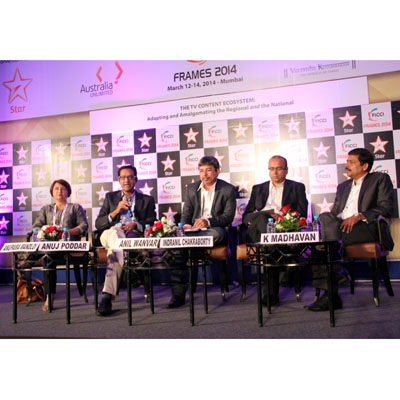
    MUMBAI: Two big regional broadcasters and two big production houses got together to discuss ‘TV content ecosystem: Adapting and amalgamating the regional and the national’ at FICCI Frames 2014. The session started with a keynote by Asianet Managing director K Madhavan and was followed by a discussion among panelists that included Viacom18 regional channels EVP Anuj Poddar, Fremantle India MD Anupama Mandloi and BIG Synergy COO Indranil Chakraborty on the opportunities in the regional entertainment space. The discussion was anchored by indiantelevision.com Founder, CEO and editor-in-chief Anil Wanvari.


    Madhavan started off by predicting that in three years, the ad revenue coming from regional channels will be equal to that of the national channels. He also highlighted that the biggest problem for regional broadcasters is carriage fees.


    “The regional market is about Rs 5,000 crore in terms of advertising revenue and we are the second largest in ad revenue as well as viewership after the Hindi GEC genre,” said Poddar. He also stated that there is a misconception that regional means language while it actually is a reflection of the culture. “Even Hindi television has its stories based on regions – for instance Ballika Vadhu was based in Rajasthan but adapted for national Hindi television.”


    Chakraborty said BIG Synergy entered the regional space five years ago and found that the regional audience was considered as second class as against the Hindi GEC audience. But that mindset is changing. “The word ‘adaptation’ is wrong. You need to redefine content to make it relevant to that audience,” he said. 


    He said he was happy that regional viewership that TV channels generate is getting its due in terms of ad rupees. “Earlier, regional TV channels had higher share of the overall  national viewership but the advertising expenditure on them was much less than that share. In 2013, ad expenditure on regional has gone up and and share of viewership is matching with share of advertising if you check out the latest Ficci report.”


    Added Poddar:  “This change clearly shows that advertisers and media agencies have understood the value of regional television and are willing to pay more for air time as they get targeted viewers. Even the coming elections are seeing a large amount of political advertising expenditure being shifted towards regional TV.”


    Regional channels seem to have taken the 12 minute ad cap very happily. “Sun raised its ad rates by 60 per cent and we (Asianet) raised it by about 20 per cent,” said Madhavan. He revealed that while earlier the ad rates of regional channels were one tenth of a national (read Hindi GEC) player, today they are up to about  25 per cent.


    The good part about regional television is that budgets for shows are rising, explained Chakraborty. An example of this is the regional adaptation of Kaun Banega Crorepati, which saw its budget going up 10 times as compared to what was being invested in other regional non-fiction shows.  This happened at a time when the Hindi version was being subject to budget cuts.


    As far as regional contributing to national and vice-versa in terms of show concepts, formats and storylines is concerned, Wanvari cited several instances where this has taken place in the Indian context.


    Said he: “Dance India Dance that super franchise from the Zee Entertainment stable began from Dance Bangla Dance produced for Bengali audiences. Today it has spawned several sub-franchises – Dance India Dance Lil Champs, Dance India Dance Super Moms, Dance Maharashtra Dance. Similarly with Big Boss which began on Colors and has since then been produced on its sister ETV channels in  Bengali and Kannda. KBC gave birth to editions on Tamil, Telugu, Malayalam on the Star network even as it aired in Hindi on Sony Entertainment TV and in Marathi on ETV Marathi. Ballika Vadhu was remade by the Network 18 group in Tamil, Telugu and Kannada, even as Uttaran has been remade in Marathi.”


    Wanvari pointed out that the reverse has also happened with shows from regional television being adapted to Hindi TV. “The Telugu soap Shravanti came on air as Dil Se Di Dua Saubhagayvati Bhava; Tami serial Kolangal was remade as Maayke Se Bandhi Dor; Tamil soap Thirumathi Selvam gave birth to the long running Pavitra Rishta; Idhayam turned into Dil Se Diya Vachan; Telugu show Ratha Samptamai  resurfaced as Rakht Sambandh; Bengali series Khela as Badalte Rishtey Ki Dastaan and then of course  the Ravi Ojha produced super successful show Sasural Genda Phool which emerged from the Bengali series Ogo Bodho Sundari,” highlighted Wanvari.


    He went on to further state that Star India has been working on reaching out its Hindi productions  to regional audiences, by dubbing shows such as Satyamev Jayate, Mahabharat and Mahadev in other languages such as Tamil, Telugu, Bengali, Marathi, and Malayalam and airing them on its regional language channels under the Asianet group and Star Pravah.


    “Taking a national product to regional is called revenue optimisation,” said Chakraborty talking about dubbing of national shows to regional languages.”For an adapted  show to work it needs to be locally adapted to suit the culture. “


    Poddar emphasised that it is not enough to dub regional shows, regional adaptations of Hindi national shows requires a lot of research and localisation to suit  cultural tastes and emotions. “When we had to remake Ballika Vadhu which is about a child bride for our Kannada channel, we looked around for a district in Karnataka where child marriage is prevalent and based our story there as the rest of the state does not have it as a practice as it is in Rajasthan. Also the pacing of the storyline in the Kannada version was faster.  Similarly, for the Marathi adaptation of KBC we went for a couple participant concept in the show and had Sachin Khedakar host it. “


    Chakraborty highlighted that there are benefits which accrue from Hindi show adaptations to regional languages and the other way around too. “Initially, we had to instill best practices and skillsets we had picked up while producing the Hindi version when we decided to go regional. Now the best practices and skillsets we got while producing the regional shows are being brought to Mumbai and  instilled in our crew while producing the Hindi version.”


    Fremantle Media India MD Anupama Mandloi confessed that her production house – which produces the successful formats Indian Idol and India’s Got Talent – has not yet taken the plunge into regional television but it is something which would be of great interest to her. “We have the experience of producing an international format and localising it in several countries, languages, cultures,” she said. “And we have done it successfully. We would like to  make some further inroads in regional television soon.”


    Madhavan added that Star Plus’ show Satyamev Jayate had realised the potential of regional which is why it was dubbed in so many languages and regional stars were roped in to promote it. He pointed out that Mahabharat dubbed in different languages has not proved as popular as Mahadev. But he revealed that even then the show has been a profit generator for his network. 


    “Simulcast is driven by commercial imperatives as a business model,” said Poddar.


    When prompted by Wanvari as to why don’t regional channels add subtitles to their shows, he said it is an option he is willing to consider.

  • India Inc. puts up a great show on ‘CEO’s Got Talent’

    India Inc. puts up a great show on ‘CEO’s Got Talent’

    MUMBAI: Mid-life crisis is nothing unusual. Whether it’s a middle-class executive or the chairman of a company, there comes a time when one just can’t ignore but go through the crisis that has struck. What could be the possible solution to overcome the phase? A vacation? Time off from work and family? Or something so differentiating that the meaning of your life changes?


    At the age of 40, the CEO of Kaytek Computers Pvt. Ltd Atul Khatri was going through this phase of his life when he decided that he would learn bartending. A fairly new talent for him. His bad luck: the bartending teacher didn’t appear for the first day’s class. He could have given up the idea of doing something exceptional but not so soon. He performed a stand-up act at an open mic venue. Surprisingly, he was liked and there has been no looking back.


    This is the story of Khatri, who in the last few years has discovered and only improved in the talent of being funny on stage. With his rib-tickling performance, he ended up winning the coveted trophy of CEO’s Got Talent on Friday night. The show by FremantleMedia India is a corporate initiative under the Got Talent franchise that brought together the mavericks of the corporate and entertainment industry on a common platform.


    The gala event witnessed twelve CEO’s of India Inc. battle it out in front of the judges – filmmaker Mahesh Bhatt, actor Raveena Tandon and Colors CEO Raj Nayak. The corporate executives, who are mostly seen discussing projects, negotiating deals and taking decisions for their companies presented a completely different face of theirs on this stage.


    The evening started with the performance of The Xlantic Group’s chairman David Fischer (the second runner-up), who with the band, The Other People, put up a nice solo performance of a song by Bruce Springsteeen. With his scintillating performance, he set the standard for the competition, leaving even the three judges surprised that in the “garb of a corporate lies such a good singer”.


    Fisher says music for him is an universal language that knows no boundaries and after a hard day’s work, it is music that relaxes him.


    Surprisingly, not just him, a lot of other corporate honchos find solace in music. And that was the reason that out of the 12 performers, eight sang, one played the accordion and one sang and played the guitar. With this, though the CEO’s Got Talent turned to CEO’s Got ‘Musical’ Talent, no one was complaining as everybody thought it’s a nice initiative to bring to the fore the unknown side of the corporate world.


    After the performance of Ajay Chopra, the executive chef of The Westin Mumbai Garden City who “married cooking and singing” as he prepared a palatable seafood platter and sang Dil Ye Mera Tumse Kuch Keh Raha Hai…, Mahesh Bhatt remarked, “It’s a hell of a speed to cook and sing at the same time. Since your hands already know how to cook, you sing and let the cooking happen on its own.”


    Raj Nayak, however, was highly surprised by the performance of the winner Khatri. He thought that coming out with something that you like doing without worrying about “others” is a commendable thing. “One of the things we don’t do is follow our passion. We shy and conform to what others would say,” he remarked as the stand-up act by Khatri got a standing ovation.


    The first runner-up trophy went to Rich Graviss Products Pvt Ltd executive director and CEO Pankaj Chaturvedi. A great Kishore Kumar fan, Chaturvedi brought back nostalgia as he performed on a classic number.


    While Rhythm House’s managing director Mehmood Curmally, the last performer of the evening, didn’t win a prize, but he got a huge applause as he came dressed as Elvis Presley and ended the evening with the famous pelvic thrust of the legendary musician. Even the judges couldn’t control but applaud. Raveena was amazed by the effort that he put in for the performance.  


    FremantleMedia India managing director Anupama Mandloi said that the team has got a huge response for creating something like the CEO’s Got Talent. “It has engaged Corporate India and brought forth their fun side for the world to behold.”


    Presented by Blackberry Messenger, the proceeds from CEO’s Got Talent will go to Genesis Foundation, which provides financial support for life-saving and life-changing medical intervention for critically ill under-privileged children in areas of cancer, cardiac disorder, organ failure, thalassemia and extreme deformities.


    The show will go on air on CNBC TV18 on 22 and 23 March, 2014.