Tag: Anjum Rajabali

  • Copyrights registrar grants copyright society status to Indian screenwriters rights body

    Copyrights registrar grants copyright society status to Indian screenwriters rights body

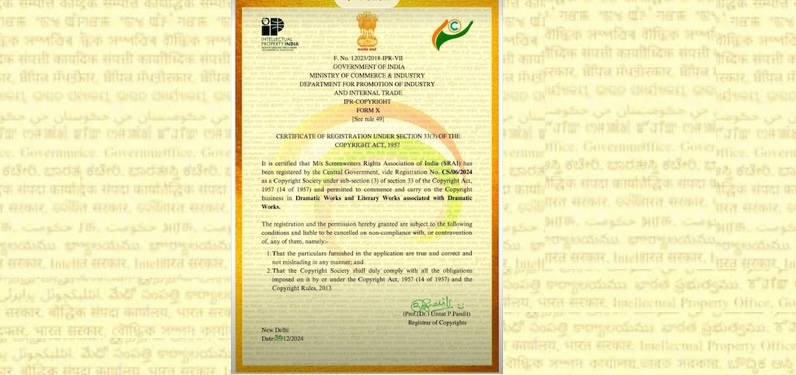
    MUMBAI: It took four years  and a little more to come through, but it finally has. The Screenwriters Rights Association of India (SRAI) has got the go-ahead from the registrar of copyrights Unnat P Pandit on 30 December to operate as a copyright society under the Copyright Act, 1957.  What that means is that it can collect royalties for dramatic works  and literary works associated with dramatic works.  

    This means good news for story writers, scriptwriters, dialogue writers of television shows , OTT shows and films. They  can now look forward to a future where they can get royalties for their works.

    In fact, the Screen Writers Association (SWA)  and its members were made aware  of this through minister of commerce Piyush Goyal’s office which posted the SRAI certificate on social media late in the evening of 30 December.

    The request for the registration was made to the  registrar of copyrights (which falls under the department for promotion of industry and internal trade  which in turn is a body under the commerce ministry) on 4 November 2020 by SRAI’s chairman Anjum Rajabali with Vinod Ranganathan as the CEO and veteran writers like Saket Chaudhary, Kamlesh Pandey, Rajesh Dubey, Vipul Shah, Mohammed Badiuzzaman (Zaman Habib), Javed Akhtar and Juhi Asheesh Malhotra as members of the governing body, according to documents available with indiantelevision.com..

    The SRAI is a section 7 company and was set up in February 2016.

    For the writing community, however, this is probably the first step of many to follow.

    “What will follow are negotiations between the SRAI and the platforms  – whether OTT or broadcasters or producers – on the rate of the royalties,” says an industry source. “How long this will take will depend on how reasonable both sides will be. However, when an agreement is reached, it will be succor for the writing community which has been deprived of royalties unlike their counterparts in other parts of the world.” 

  • SWA’s ‘Sab Khairiyat?’ highlights need for mental health support in writing community

    SWA’s ‘Sab Khairiyat?’ highlights need for mental health support in writing community

    Mumbai: The Screenwriters Association (SWA), a collective voice for the rights and welfare of screenwriters, recently hosted ‘Sab Khairiyat?’, a discussion focusing on seeking mental health support as writers and their challenges. Moderated by the renowned screenwriter Anjum Rajabali, the session brought together esteemed screenwriters Preeti Mamgain, Ishani Banerjee, Mitesh Shah, and Adhiraj Sharma to share their personal experiences and insights.

    The session highlighted the often-overlooked mental health struggles that screenwriters face, including isolation, loneliness, the stress of meeting deadlines, and anxiety due to financial insecurity. With about 50 per cent of screenwriters enrolled in screenwriting courses seeking psychiatric help, the discussion aimed to break the taboo around the need for mental health support within the creative community and dispelling the image of the tortured artist. It also focused on the collective bargaining for the fundamental rights of writers.

    Anjum Rajabali elaborated on the concept of losing oneself in the passion for writing, often abandoning reality to immerse in their fictional worlds. He discussed the dual nature of writers’ psyches, swinging between feelings of godliness and servitude, which fuels their creativity. He emphasized, “Writers have to ‘bleed on the page,’ as temporary loss of self-identity while being deeply invested in characters yields powerful results. Self-doubt is an inevitable part of the creative process and writers must embrace this journey to succeed.”

    Adding further, Mitesh Shah, said, “I prefer observing my characters from a third-person perspective, which helps me grow as a writer and person. For me, achieving material success did not equate to happiness, which led me to take breaks to enjoy life.” He shared his experiences with burnout, having taken on extensive work in television writing.

    President of the Screenwriter’s Association of India, Preeti Mamgain, opened up about how passion can turn into possessiveness when writers become deeply attached to the characters they create. She spoke about how letting go of her ideas and characters, especially when facing initial rejection, was extremely challenging. Learning to collaborate and accept changes to her work was traumatic but ultimately beneficial.

    Adhiraj Sharma spoke about his initial desire to create his own world through writing, only to realize that even in this space, complete control was unattainable. He discussed how writing became a way to escape the real world, but as guidelines and rules came in, he found that even in his own world, he couldn’t be a god. He also highlighted the mental toll of becoming a “creative machine” in the advertising industry.

    Ishani Banerjee discussed the cathartic nature of writing, where distress in characters elicits empathy from the audience. She believes that writers are merely vessels for the stories that demand to be told. She also spoke about how the interplay of distress in characters and the empathy it evokes in the audience makes the whole experience profoundly cathartic.

    The event highlighted the inherent strength in safeguarding writers’ rights and ensuring fair treatment through the collective bargaining of fundamental rights. It emphasized how solidarity and support can help bring about a profound sense of security among writers and keep anxiety at bay. By nurturing dialogue, enhancing awareness, and staunchly advocating for writers’ mental well-being, the event marked a significant stride toward a more robust, equitable future for the industry.

    Few highlights-

    1. Passion turns into possessiveness when writers create their own world in their stories. For Preeti, letting go of the idea of the characters of her stories or facing initial rejection was an extremely difficult challenge.

    2. Storytelling serves as a therapeutic outlet for writers, providing a means for self-expression and introspection amidst moments of self-doubt and existential questioning.

    3. Writers have a complex relationship with their craft which can also take a toll on their mental health. From navigating the fine line between godlike control and submission to the page, to the therapeutic role, writing can play in resolving personal turmoil.

    4. External factors, such as societal upheavals and personal challenges, impact the creative process, highlighting the symbiotic relationship between the writer’s craft and the world around them.

    5. Writers shed light on the importance of maintaining a balance between personal struggles and their passion for storytelling and the harsh realities of the industry, revealing the delicate interplay between creativity and pragmatism.

  • SWA announces nominees for feature films category of SWA Awards 2020

    SWA announces nominees for feature films category of SWA Awards 2020

    MUMBAI: Screenwriters Association (SWA), the indian guild of screenwriters and lyricists, announced today the nominees for the feature films category of swa awards 2020. A jury comprising of eminent screenwriters selected five feature films under each of the sub-categories: best story, best screenplay, best dialogue and best debut writer. Together, the nominations are divided among ten Hindi language feature films released in 2019.

    Nominees for Best Story are:

    1.            Anubhav Sinha and Gaurav Solanki for Article 15

    2.            Devanshu Singh and Satyanshu Singh for Chintu Ka Birthday

    3.            Reema Kagti and Zoya Akhtar for Gully Boy

    4.            Abhishek Chaubey and Sudip Sharma for Sonchiriya

    5.            Ivan Ayr for Soni

    Nominees for Best Screenplay are:

    1.            Anubhav Sinha and Gaurav Solanki for Article 15

    2.            Niren Bhatt for Bala

    3.            Devanshu Singh and Satyanshu Singh for Chintu Ka Birthday

    4.            Reema Kagti and Zoya Akhtar for Gully Boy

    5.            Vasan Bala for Mard Ko Dard Nahin Hota

    Nominees for Best Dialogue are:

    1.            Anubhav Sinha and Gaurav Solanki for Article 15

    2.            Niren Bhatt for Bala

    3.            Reema Kagti and Zoya Akhtar for Gully Boy

    4.            Ravinder Randhawa and Sumit Saxena for Hamid

    5.            Sudip Sharma for Sonchiriya

    Nominees for Best Debut Writer are:

    1.            Devanshu Singh and Satyanshu Singh for Chintu Ka Birthday

    2.            Sandeep Pandey for Chousar Firangi

    3.            Ravinder Randhawa for Hamid

    4.            Aadish Keluskar for Jaoon Kahan Bata Ae Dil

    5.            Ivan Ayr and Kislay for Soni

    SWA general secretary Sunil Salgia said, “Filmmakers always say, ‘Without script there is no film’ or ‘the Script is King’. They are right. It is time to recognise the persons who lay the foundations of these kingdoms. Let them be centre-stage. They will cherish this award more than anything as it comes from their colleagues, their competitors, their critics and those who envy them yet love them. Writing a movie’s script is the most challenging craft, and the best deserves honours, irrespective of its commercial outcome.”

    For the purpose of selection of nominees, the SWA Awards Committee accessed 167 of 223 Hindi language feature films released in theatres and on OTT platforms in 2019. A jury comprising of screenwriters such as Ashok Mishra, Atul Tiwari, Juhi Chaturvedi, Saket Chaudhary, Urmi Juvekar, Vijay Krishna Acharya and Vinay Shukla watched films shortlisted by SWA’s Film Selection Committee and selected the nominees under each sub-category. The final winners will be announced in an online awards ceremony on 27 September 2020.

    Senior screenwriter, teacher and SWA film awards spokesperson Anjum Rajabali, said, “Victor Hugo’s oft-quoted line says it perfectly: ‘There’s nothing as powerful as an idea whose time has come.’ The time to celebrate the primacy of the script has arrived. The time to honour the writer is here. And what better way than for a writers’ association to do it. There’s no greater pride for a writer than to have her work endorsed by peers who understand writing. SWA is fulfilling its aim to bring the writer centre-stage. Kudos to the SWA Awards Committee led by Sridhar Rangayan, Richa Singh Gautam, Jagriti Thakur and their team for the impeccable transparency of the judging process. Way to go, SWA!”

    SWA is holding the first ever SWA Awards on the occasion of its Diamond Jubilee year in 2020. Since they are judged by knowledgeable screenwriters and lyricists, these awards promise to become the most coveted validation for writers in India, much like the awards of other prestigious international writers’ guilds and literary organisations.

    The nominees spoke to SWA, reacting to the announcement:

    Anubhav Sinha: I am so happy to be nominated by the Screenwriters Association for Article 15 for writing awards, and it is so wonderful that your peers, your seniors think what you wrote was worthy of such a distinction. Thank you so much, jury. Thank you so much, Screenwriters Association.

    Gaurav Solanki: This is a very special nomination. Awards for writers, by writers! I hope through this we keep encouraging each other, educating each other of our shortcomings and pat each other's back when the work is good. We keep working, writing new stories and screenplays and walk on new paths. This is a celebration for that only!

    Devanshu Singh: It's a matter of great joy and pride for us both, that our first script has been nominated in three categories at the first ever edition of the SWA awards. We wrote this script in 2007 without any formal training in screenwriting. For the past 10 years, we kept polishing it as we learnt the craft. Writing is a game of immense patience and hard work and being rewarded for it, means a lot. Thank you, jury, for considering us worthy of the nomination among such brilliant writers. Special thanks to SWA for starting this award. This will definitely encourage budding writers like us.

    Satyanshu Singh: Over the last couple of decades, Screenwriters Association has been the much needed support system we need as writers. It is only just that the SWA has its own awards to honour the work of screenwriters and lyricists. Over the following years, this award will only grow in its stature and legacy. I will always feel honoured and proud to be nominated in the SWA Awards in the very first year. Thank you, SWA, from the bottom of my heart, for this nomination, and every other nomination and award an upcoming writer will receive from you.

    Abhishek Chaubey: It comes as a rare piece of good news in these bleak times that SWA has inaugurated its first ever awards to honour the best writing of the year. That we have been nominated in the Best Story category for Sonchiriya is an icing on the cake. It’s an absolute privilege to be nominated for the first ever edition and I wish this initiative is a huge success. Recent years have seen the standing of film writers in our industry improve remarkably and SWA has a major role in this development. I hope this happy story continues into its new act.

    Sudip Sharma: It’s lovely to hear that SWA is honouring the best works of the year 2019 with SWA Awards for writing. I am even more thrilled that my writing on Sonchiriya has been thought worthy of nomination by a jury of eminent writers. It is always a lovely feeling to be reviewed well by your peers and I thank them for considering my work worthwhile of that privilege.

    Ivan Ayr: I am very grateful to the Screenwriters Association and the 2020 awards committee for this nomination. There is no greater honour than to be recognised by your peers and contemporaries, so this is very special.

    Niren Bhatt: The fact that nominations for this award have been selected by fellow writers makes it super special for me. I am humbled and elated by the nomination. Hope SWA Awards grow bigger every year and it manages to give much required unbiased recognition to writers in the Indian film industry. SWA Awards is certainly a step in the right direction.

    Vasan Bala: Extremely thrilled to be acknowledged with this nomination for the first ever SWA Awards. Thank you and hope the awards keep growing in strength in the years to come.

    Ravinder Randhawa: Nothing could be more significant and heart-warming than being recognised and celebrated by one's fraternity. Therefore, I am extremely happy to be nominated for the first ever SWA Awards. The best part is that the only consideration for these awards seems to be the quality of the script and not the total business of the film. I sincerely hope that these awards will instil faith in good writing and inspire writers to strive for the best. 

    Sumit Saxena: Thanks to Gaurav Sharma, Sidharth, Shoaib and the entire team from SaReGama for this nomination. This one is special! I am not very sure where my SWA Membership card is. I very rarely ever register my scripts and ideas but, I completely understand the importance of this institution. This is the first year of this award ceremony, so it will be special. And I am hoping for more of these glorious ceremonies in times to come.

    Sandeep Pandey: If we look at all the elements of a film, writing, without doubt, is one of the most important components. The Screenwriters Association provides a platform that encourages and safeguards the rights of the upcoming and professional writers. It is a matter of privilege for me that the SWA and the jury nominated "Chousar Firangi" written and directed by me in the best debut writer category. I am very thankful to them. And I also hope that SWA continues to encourage us writers.

    Adish Keluskar: Writing is art and art is subjective. Awards in an artistic field, for 'Best' this or that, do not reflect the true nature of art unlike sports or other clearly defined fields. However, awards in an artistic field are important because they serve a necessary function – clear recognition. In today’s muddled times of information overload, clear identification, and recognition of an artistic field from other artistic fields is the vision we need. SWA has that vision and SWA Awards for writing is a concrete reflection of that. I thank you for the nomination and wish SWA the best to continue this vision.

    Kislay: I initially joined SWA thinking that it is only an association. Later when I received regular updates about its activities, I realised it does much more. It’s an honour to be chosen by your esteemed fellow writers as one of the contenders for the SWA Awards. In academics, the uniqueness and inventiveness of the academic works is recognised in its peer reviews. SWA Awards is equivalent to that for me in films. I am glad that our peers have seen something of value in what we tried to do in our first film.

  • Training programme for screenplay writers, finalists to pitch for film projects in Mumbai

    Training programme for screenplay writers, finalists to pitch for film projects in Mumbai

    NEW DELHI: After its three-year association with the Sundance Institute for the Mumbai Mantra – Sundance Screenwriters’ Lab has come to an end; Mumbai Mantra has now launched ‘The Mumbai Mantra CineRise Screenwriting Programme’, an 8-step lab for screenwriters.


    In the first stage of submission, screenwriters need to submit a story on which the script will be based, in six to eight pages. This will be followed by the writer’s statement in just two pages outlining details of the project is about. Thirdly, the writer’s biodata will also have to be submitted with contact details.


    Among the submitted applications, 100 stories will be selected for a two day screenwriting workshop which will be held in different cities across India. The finalists will have intensive interactions with experienced writers and directors at the workshop. The selected participants can choose the center closest to their homes.


    After the workshop, the screenwriters will have two months to submit the first draft of their screenplays.


    After intensive evaluation, twelve to fifteen or more deserving screenplays will be shortlisted for the final selection. These screenplays will be sent to the mentors and other experts, for detailed evaluation and notes.


    The finalists will have intensive interactions with experienced writers and directors at the workshop. The selected participants can choose the center closest to their homes. The convenor for this programme will be Anjum Rajabali.


    After receiving notes from the mentors, the writers will have one more month to send in the second drafts of their screenplays. The finalists will be invited to a five-day workshop at a resort destination with renowned writers and directors to help them revise their screenplays and then get them ready for a pitch event in Mumbai with studio heads, independent producers, directors, financiers, distributors, film festival directors and curators.


    Aspiring script-writers for films can apply till 20 August for the ‘The Mumbai Mantra CineRise Screenwriting Programme’.

  • Prakash Jha to turn his film Satyagraha into a book

    Prakash Jha to turn his film Satyagraha into a book

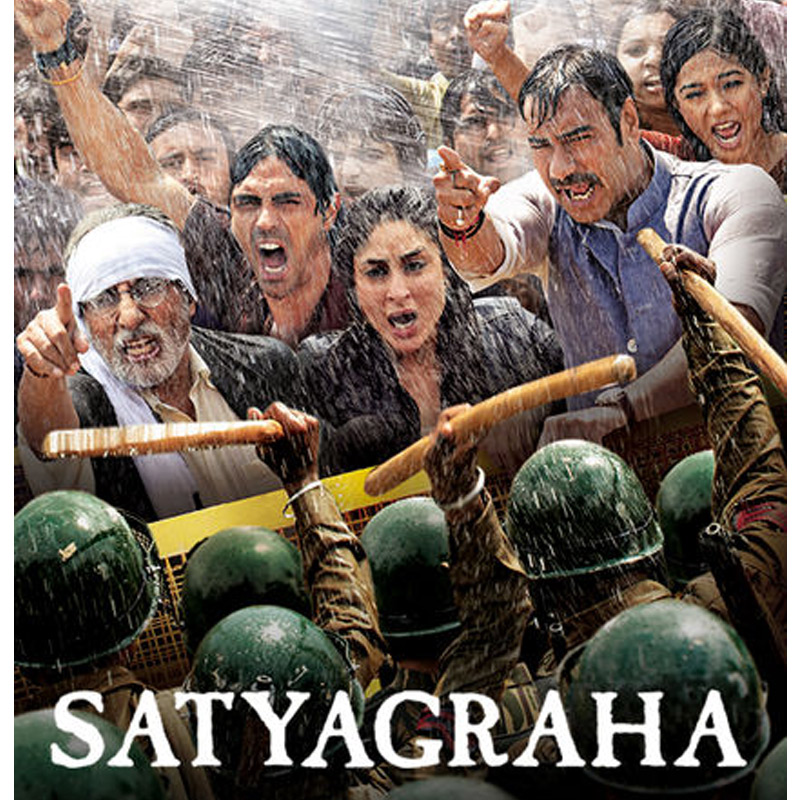
    MUMBAI: Not limiting his next venture Satyagraha just to film, Prakash Jha is mulling with the idea to turn it into a book too.

    He, along with his co-writer Anjum Rajabali, is working on the script again, to modify it into a book. The film that has been written very critically includes many underlying facts which might not be known to the masses. So the director has decided to compile the script into a full-fledged book.

    However, the original script written by Anjum Rajabali was heavily modified by Jha to make it appropriate for the film. According to the co-writer the script was modified numerous times to make it apt for the film.

    In the book, the writers would include required details from the original as well as the modified film script.
    Jointly produced by UTV Motion Pictures and Prakash Jha Productions, Satyagraha examines the current socio-political system in India. It stars Amitabh Bachchan, Ajay Devgn, Kareena Kapoor, Arjun Rampal, Manoj Bajpai and Amrita Rao.

    The film is slated to release on 15 August this year.

  • Indo-German film week opens in Berlin

    Indo-German film week opens in Berlin

    MUMBAI: To bring film communities of Germany and India closer, an Indo-German Film Week has been organised in Berlin. The week will see film screenings, workshops, interactions and master classes, all presenting the Indian film and media world to the German and international audiences.

    States the Indo-German Film Week website, “We want to show the German and international audience the whole variety of Indian Cinema, that there is much more than just”song and dance films”. But we will also show the vibrant Fiction Production in Germany which is internationally recognized for its high quality Movies Made for TV.”

    The highlight of the event is the Indo German Screenwriting Workshop from 5 to 7 February that will have lectures by screenwriter and head of screenwriting department at FTII, Anjum Rajabali, Keith Cunningham, a German screenwriter and consultant, author and head of the German Film and Television Academy, Berlin, Jochen Brunow who will talk about principles of storytelling and Indian and Greek mythology.

    Among 15 film screenings, Barfi!, English Vinglish, Shanghai and Inkaar will make their German premieres in the presence of their respective directors.

    While Gauri Shinde (English Vinglish) will speak on women‘s rights in India, Anurag Basu will share his knowledge and experience about the process of turning a screenplay into a movie like he did with Barfi!

    Organised by Life Entertainment and Babylon Berlin, the film week that began from yesterday (5 February) will run till the 11th of this month.

  • Indian director Sarthak Dasgupta wins Sundance-Mahindra filmmaking award

    Indian director Sarthak Dasgupta wins Sundance-Mahindra filmmaking award

    MUMBAI: Indian filmmakers are going places. Sarthak Dasgupta from India and three other directors have won the 2013 Sundance-Mahindra Global filmmaking award that supports the emerging independent talent from around the world.

    Dasgupta, who has previously written and directed award-winning film The Great Indian Butterfly, won the award this time for The Music Teacher. The other winners include Jonas Carpignano from Italy-US for A Chjana, Brazilian director Aly Muritiba for The Man Who Killed My Beloved Dead and Vendela Vida and Eva Weber for Let the Northern Lights Erase Your Name, a UK-Germany-US co-production.

    Each of the four winning filmmakers will receive a cash award of $10,000, attendance at the Sundance Film Festival and creative and strategic support.

    This is the second year that one of the four award recipients is an Indian. Last year‘s winner was Shonali Bose for her project Margarita, With A Straw.

    The awards were presented at a private ceremony at the 2013 Sundance Film Festival in Park City, Utah (US) by Rohit Khattar, Chairman, Mumbai Mantra, Michelle Satter, Founding Director, Feature Film Programme, Sundance Institute and Paul Federbush, International Director, Feature Film Programme, Sundance Institute.

    “At a time when there is no dearth of issues around the world that are crying out to be heard, the Global Filmmaking award recognises independent filmmakers who give expression to those voices,” said the Mahindra Group chairman and managing director Anand Mahindra in a statement.

    “The Mahindra Group is proud to assist the Sundance Institute in this endeavour, which, in line with the Group‘s ‘Rise‘ philosophy, aims to drive a positive change in communities across the world,” he added.

    The nomination committee for the Indian Award winner included prominent names from Indian cinema like Sharmila Tagore, Anil Kapoor, Rajkumar Hirani, Ramesh Sippy, Shabana Azmi, Shyam Benegal, Anjum Rajabali, K Hariharan and Ira Bhaskar.

    The Sundance Institute-Mahindra Global Filmmaking Award is part of a multifaceted collaboration that exemplifies a commitment to and support of world cinema by the Mahindra Group, one of the largest industrial conglomerates in India, and the non-profit Sundance Institute, one of the world‘s leading cultural organisations.

    This is the third and the last of the three-year collaboration between the two organisations.

    The Sundance-Mahindra Group‘s collaboration also includes the Mumbai Mantra Sundance Institute Screenwriters Lab in India, which provides an annual opportunity for eight screenwriters from India to develop their works under the guidance of accomplished international screenwriters.