Tag: Anil Malhotra

  • Orange Alert as Media Chiefs Call Time on Sour Regulation

    Orange Alert as Media Chiefs Call Time on Sour Regulation

    MUMBAI: When your brightest industry minds start comparing creativity to citrus fruit, you know the discussion’s got some zest. At FICCI FRAMES 2025, the session titled “Regulating the Orange Economy: Past, Present, and Future” turned into a spirited masterclass on what’s holding back India’s most vibrant export creativity itself.

    Moderated by Koan Advisory’s Vivan Sharan, the panel brought together some of the sharpest voices in Indian broadcasting Avinash Pandey (CEO, Indian Broadcasting and Digital Foundation), Krishnan Kutty, head of cluster, Entertainment (South) – JioStar, Anil Malhotra (COO, Zee Media), and Yatin Gupta (COO, GTPL Hathway). Together, they dissected the bitter-sweet evolution of India’s media and entertainment (M&E) industry from its liberalisation glory days to today’s tangled web of red tape and regulation.

    Avinash Pandey kicked things off with a nostalgic rewind. “We were declared an industry in 1996, and for a brief while, we were actually treated like one,” he said dryly, drawing laughter from the crowd. He recounted how the early 2000s saw broadcasting boom as a sunrise sector driven by investment, private innovation, and minimal interference.

    “Then came a time when the government helped us grow,” he continued. “But today, every little aspect from pricing to packaging is regulated. We are living under a 2005 framework in a 2025 economy.”

    Pandey’s lament set the tone. The orange economy shorthand for industries fuelled by creativity and culture has turned ripe, but over-regulation, panelists warned, risks turning it sour.

    Krishnan Kutty of JioStar took the baton, calling for “a lighter hand and a smarter head” in policymaking. He drew a sharp comparison between legacy broadcasters and digital-first platforms. “Television is capped, controlled, and scrutinised. OTT platforms, meanwhile, stream what they want with almost no oversight,” he said.

    Kutty argued that the answer isn’t to regulate the new, but to liberate the old. “Over-prescription kills innovation. Consumers don’t need protection from choice they need access to more of it.” His words echoed across an audience that included broadcasters, policymakers, and streaming executives all trying to decode the new power balance between screens.

    Anil Malhotra from Zee Media added historical perspective and a dose of irony. “Cable TV arrived in India in 1985. It was regulated only in 1995. Broadcasting began in 2005, got regulated much later,” he said. “Regulation always comes late to the party and then overstays its welcome.”

    Malhotra argued that in a digital-first world, it makes no sense to hold traditional media hostage to older rulebooks. “If the government doesn’t regulate new tech like OTT and AI, it must deregulate the old. Otherwise, you’re penalising the legacy systems that built India’s media strength in the first place.”

    He also called for a “policy audit,” a comprehensive review of old broadcasting rules to identify those that have outlived their relevance. “We need regulation that enables, not restricts,” he stressed.

    GTPL Hathway’s Yatin Gupta brought the discussion closer to ground reality and homes still running on coaxial cables. “We’re the most regulated part of the media chain,” he said bluntly. “Every rate, every fee, every package is dictated. Yet, we’re expected to compete with digital platforms that face no such limits.”

    Gupta pointed out that India’s cable homes have dropped from 150 million a few years ago to around 100 million today, a staggering 30 per cent loss in a market still hungry for affordable entertainment. “We can’t evolve if we’re boxed in,” he added. “If the aim is to take India fully digital, we must support the legacy infrastructure that connects Bharat to the world.”

    He called for skill development, broadband integration, and hybrid models that let cable operators transform into full-fledged digital service providers. “If we don’t, we’ll end up with an uneven playing field and an excluded audience.”

    By the time Avinash Pandey took the mic again, his tone had sharpened. “Regulators talk about ‘orderly growth’,” he said with a knowing smile. “That’s a Soviet-era phrase. You can’t dictate how creativity grows, it defeats the very nature of innovation.”

    He urged policymakers to think of the media sector as a living organism, one that thrives on unpredictability. “Creativity doesn’t follow command-and-control models. It needs chaos, experimentation, and freedom to fail.”

    The audience broke into applause when he declared, “If you want free markets, let the market breathe.”

    Despite the fiery debate, the panel didn’t write television off. Far from it. “TV still delivers high-quality entertainment at the lowest cost per viewer,” Pandey noted. “There are over 100 million Indians yet to own a television. Growth is far from over but it will stall if innovation is strangled.”

    The panellists agreed that the future of India’s media sector lies in convergence television and digital not competing, but coexisting. With global streamers investing heavily in Indian stories and regional content booming across states, the creative economy stands at a crossroads.

    As the discussion wound down, what emerged was less of a gripe and more of a roadmap: deregulate the old, modernise the law, empower talent, and let creativity not bureaucracy set the tone.

    In a nation bursting with storytellers, artists, and innovators, the message was clear: the Orange Economy shouldn’t be juiced dry by rules made for an analogue age.

    If India truly wants to be a global creative powerhouse exporting not just IT services but imagination, it must give its creators the same freedom its coders enjoy. Or as one delegate quipped while leaving the hall, “You can’t make lemonade with red tape.”


  • Tata Play unveils Marathi Classics

    Tata Play unveils Marathi Classics

    Mumbai: Tata Play introduced Marathi Classics, a new platform service dedicated to iconic movies and shows from the golden era of Marathi entertainment. Recognising its audience’s content preferences, this service will also feature a rich catalogue of kirtans, to cater to spiritually inclined viewers. Powered by ZEE Talkies, this latest addition aims to curate the finest Marathi titles and classic movie offerings that have a strong connect with the viewers.  

    This ad-free service contains a captivating lineup of Classic Marathi blockbusters which released post 1950’s, along with an impressive lineup of popular serials and kirtan recitals. Cult classics like Zapatlela, GupChup GupChup, Palva Palvi, Maherchi Sadi, Dev Manus are a part of the content lineup. Subscribers will get to enjoy movies featuring legendary actors like Ashok Saraf, Sachin Pilgaonkar, Laxmikant Berde, Dada Kondke, Varsha Usgaonkar, Jayshree Gadkar, Nilu Phule and many more. Daily soaps like Avantika, Vadalvaat, Abhalmaya, etc will also be brought back as part of the offering.

    Tata Play’s chief commercial and content officer, Pallavi Puri, said, “Yesteryear’s Marathi content is known for its beautiful portrayal of rich Maharashtrian culture. There is a dedicated fan base for such content and we, in partnership with ZEE Talkies, wanted to revive these timeless shows and films that are celebrated today as classics. We believe this eclectic curation will resonate deeply with our viewers, rekindling their nostalgia.”

    ZEEL head public & regulatory affairs and CRO-Affiliate sales Anil Malhotra further added, “We’re thrilled to partner with Tata Play to bring back the golden age of Marathi cinema. Marathi Classics is a testament to the enduring appeal of timeless storytelling. With this curated platform, we aim to reconnect audiences with iconic films and shows that have shaped Marathi entertainment.”

    The service is free for the first five days from the date of subscription; INR 1.5 per day will be charged thereafter. On-the-go viewing can be availed through the Tata Play Mobile App.

    Tata Play Marathi Classics joins Tata Play’s range of over 50 entertainment and infotainment Platform Services suitable across age groups and providing content across genres like Entertainment, Kids, Learn, Regional, Devotion and much more. For more information, log onto Tata Play Specials.

  • Siti Networks posts Rs 509 million operating EBITDA in Q2 FY22

    Siti Networks posts Rs 509 million operating EBITDA in Q2 FY22

    Mumbai: Multi-system operator (MSO) Siti Networks has released its consolidated audited financial results for Q2 FY22 ended on 30 September. The company has maintained operating EBITDA at Rs 509 million and its operating EBITDA margin expanded to 13.9 per cent.

    The company announced the launch of Siti Mitra mobile app for its 25000+ local cable operator partners. The app has a fully functional ‘Own Your Customer’ subscriber management system, allowing partners to have control of their business on their palms. The app is available on the Google Play store.

    Total revenue (excluding activation) increased to Rs 3672 million from Rs 3615 million in the previous quarter. The company’s subscription revenue remained essentially flat at Rs 2350 million. Siti Broadband, too, observed a base jump of 20 per cent year on year and seven per cent quarter on quarter to 2.19 lakh. Siti Broadband’s revenue increased 4.1 per cent over the previous quarter and 11 per cent YoY to Rs 288 million.

    “Siti’s continued focus on operational efficiencies and strict control over expenses has ensured that our operating EBITDA is Rs.509 million with 13.9 per cent operating EBITDA margins. Our total revenue also increased to Rs.3,672 million. Our push for SITI Broadband has ensured that our customer base and revenues are up 20 per cent and 11 per cent y-o-y, respectively,” said Siti Networks chief executive officer Anil Malhotra.

    He added, “We have always had our ears to the ground, and the launch of the Siti Mitra mobile app for our 25,000+ partners is a testament to that. The app has our fully functional ‘Own Your Customers’ subscriber management system, and now our partners will be able to manage their business from their mobile phones. The app is available on the Google Play Store.”

  • In hybrid push, Siti Networks launches Siti PlayTop Android TV set top box

    In hybrid push, Siti Networks launches Siti PlayTop Android TV set top box

    New DELHI: In a bid to cement its place in the hybrid set-top box space, multi-system operator (MSO) Siti Networks has launched Siti PlayTop Magic, a 4K HDR STB which offers Android TV features along with linear TV. For a superior next-generation entertainment experience, the STB uses NAGRA’s card-less content security solution. This represents NAGRA’s first Android TV project in India based on the Google MediaCAS framework for Android TV deployments.

    Through its partnership with NAGRA, Siti Networks hopes to rapidly deploy both secure and market-leading Android TV services across its three-million strong subscriber base in India including a comprehensive content offering and access to a large library of applications.

    Additionally, Siti PlayTop Magic's mobile app, available on both iOS and Android platforms, brings a single subscription for multiple OTT apps like Hungama Play, Shemaroo Me and Adda Times in customers’ palms.

    The roll-out of Siti PlayTop STB and iOS/Android apps is a crucial part of the MSO’s expansion strategy in India, remarked Indian Cable Net Company Ltd (JV partner of Siti) director Suresh Sethiya.

    "We are delighted to partner with Nagra, who provides comprehensive support for Android TV through an end-to-end content protection ecosystem. This box will make any TV Smart while bringing Siti HD+ digital cable television's ultimate viewing experience with a DVR facility,” shared Siti Networks CEO Anil Malhotra.

    The NAGRA solution provides comprehensive support for Android TV through an end-to-end content protection ecosystem that can be extended at a time of an operator’s choosing through additional options such as forensic watermarking and/or anti-piracy services.

    Deployed “as a service,” it enables operators to take advantage of reduced total cost of ownership and regular modular and cloud-driven updates and frameworks for both CAS and DRM integration, while ensuring the ecosystem remains protected from pirates.

    “We’re proud to partner with Siti Networks on its continued expansion within the Indian market,” said NAGRA SVP – sales APAC Stephane Le Dreau. “The strength, level of innovation and unique features of NAGRA’s content and service protection services for Android TV provides operators around the world with the tools they need to protect their content and rapidly deploy and protect their next-generation services against piracy.”

  • Siti Networks reports improved numbers for FY 2020

    Siti Networks reports improved numbers for FY 2020

    BENGALURU: The Essel group’s MSO major Siti Networks Limited reported 5.3 percent higher consolidated simple EBIDTA for the year ended 31 March 2020 (FY 2020, year or period under review) as compared to the previous year FY 2019. The company reported a 12.2 percent increase in operating revenue for the period under review as compared to the previous year. All numbers mentioned in this report are consolidated unless stated otherwise.

    The company has managed to reduce its major expenses, but for Pay Channel, Carriage Sharing & Related Costs (pay channel costs) in FY 2020 which increased 29 percent as compared to the previous year. Overall expenses increased 7.7 percent on account of these pay channel costs. In a note to the financial statements, Siti has explained that its operating revenue includes broadcaster share of subscription revenue, hence it has shown the broadcasters share in its pay channel costs as an expense.

    In its earnings release, Siti says that Subscription Revenue for Q4 2020 grew 25.3 percent y-o-y to Rs. 2,842 million. For FY 2020, Subscription Revenue surged 21.3 percent to Rs.11,567 million.

    The consolidated operating revenue figures reported by Siti are Rs 1,618.59 crore and Rs 1,442.13 crore for FY 2020 and FY 2019 respectively, hence a growth of 12.2 percent as mentioned above. Simple EBIDTA as calculated by the author for FY 2020 was Rs 340.64 crore (21 percent of operating revenue) and for FY 2019 it was Rs 323.61 crore (22.4 percent of operating revenue). Loss for the year under review reduced to Rs 188 crore from Rs 264 crore in the previous year.

    For Q4 2020, Siti’s consolidated operating revenue was Rs 27.8 percent higher y-o-y at Rs 408.29 crore as compared to Rs 415.06 crore in Q4 2019. Simple EBIDTA for Q4 2020 as calculated by the author increased 22.1 percent to Rs 81.58 crore (20 percent of operating revenue) from Rs 66.78 crore (20.9 percent of operating revenue). Loss for the quarter was lower at Rs 70.30 crore as compared to a loss of Rs 123.93 for Q4 2019.

    CEO of Siti CEO Anil Malhotra mentioned: “SITI Networks continued its consistent growth focus while maintaining a strict control on operational efficiencies during FY 2020. Our subscription revenue for Q4 2020 grew by 25.3 percent y-o-y, while our total revenue grew by approximately 23 percent y-o-y. Even for FY 2020, our total revenue jumped by 15.3 percent to Rs. 16,354 million. Our constant mantra of improving operational efficiencies while improving monetization helped us to deliver strong operating EBITDA at INR 3,538 million, in FY 2020, a surge of 1.2 times. Our response to COVID-19 pandemic has been widely appreciated. Our teams and partners have left no stone unturned to ensure that our customers get the best services."

    Let us look at the other numbers reported by Siti

    Total expense in FY 2020 increased 7.7 percent to Rs 1,781,33 crore from Rs 1,654,21 crore in the previous year. Amongst the major expense heads, Pay Channel, Carriage Share & Related Costs increased 29 percent in FY 2020 to Rs 843.96 crore from Rs 654.14 crore in FY 2019. Finance costs in FY 2020 declined 7.6 percent to Rs 157.68 crore from Rs 170.72 crore in FY 2019. Employee benefits expense in FY 2020 declined 8 percent to Rs 74.78 crore from Rs 81.32 crore in the previous year. Other expenses in FY 2020 declined 5.6 percent to Rs 357.70 crore from Rs 378.79 crore in FY 2019.

    Total expense in Q4 2020 increased 16.7 percent to Rs 451.03 crore from Rs 386.39 crore in Q4 2019. Amongst the major expense heads, Pay Channel, Carriage Share & Related Costs increased 47.9 percent in Q4 2020 to Rs 212.82 crore from Rs 143.94 crore. Finance costs in Q4 2020 declined 20.5 percent to Rs 35.52 crore from Rs 44,66 crore in the corresponding year ago quarter. Employee benefits expense in Q4 2020 declined 9.4 percent to Rs 16.95 crore from Rs 18.71 crore in the corresponding quarter of the previous year. Other expenses in Q4 2020 increased 9.1 percent to Rs 96.53 crore from Rs 88.44 crore in Q4 2019.

  • SITI Networks’ FY20 Operating EBITDA surges 1.2X Y-o-Y to Rs.3,538 Mn

    SITI Networks’ FY20 Operating EBITDA surges 1.2X Y-o-Y to Rs.3,538 Mn

    New Delhi: SITI Networks Limited (BSE: 532795, NSE: SITINET), an Essel Group Company, one of India’s largest Multi-System Operators (MSO), has released its Consolidated Audited Financial Results for Q4 and full year FY20, ending March 31, 2020. On the back of sustained efforts in FY20, SITI reported continuous growth through operational efficiencies and strict control on expenses across all metrics.  

    SITI’s Operating EBITDA for FY20 surged by 1.2x to Rs.3,538 Mn by efficiently leveraging existing operating resources. SITI’s Operating EBITDA for Q4FY20 also jumped 2.5% to Rs. 861 Mn year on year. Q4FY20 also saw further consolidation in SITI’s Operating EBITDA Margins which grew 1.02X to 21.6% on y-o-y basis. 

    Subscription Revenue for Q4FY20 grew 25.3% y-o-y to Rs. 2,842 Mn. For FY20 too, Subscription Revenue surged 21.3% to Rs.11,567 Mn. Total Revenue (excluding activation) for Q4FY20 surged ~23% y-o-y to Rs. 4,128 Mn. FY20 Total Revenue (excluding activation) also jumped 15.3% over FY19 to Rs.16,354 Mn. 

    SITI Broadband continued its focus on providing the best technology to its customers by launching a composite FTTX based network architecture which would make enable customer premises with the best of online and linear content. Implementation of this composite model will benefit both SITI Networks and SITI Broadband, while providing IOT based services to customers.  

    In the fight against COVID-19 pandemic, SITI’s team and 24,000+ strong distribution network is playing a significant role. During lockdown, SITI’s field staff, Contact Centre and Distribution Partners worked diligently on the ground to ensure that customers stayed indoors and provided best in class infotainment and keep the world connected to them. To cope with the lockdown and the need to protect its staff, SITI also ensured remote work from home for all its staff while maintaining strict quality control and monitoring of services.   
     
    While commenting on the results, Mr. Anil Malhotra, CEO of SITI Networks Limited mentioned:  
     
    “SITI Networks continued its consistent growth focus while maintaining a strict control on operational efficiencies during FY20. Our subscription revenue for Q4FY20 grew by 25.3% YoY, while our total revenue grew by ~23% YoY. Even for FY20, our total revenue jumped by 15.3% to Rs. 16,354 Mn. Our constant mantra of improving operational efficiencies while improving monetization helped us to deliver strong operating EBITDA at INR3,538 mn, in FY20, a surge of 1.2 times. Our response to COVID-19 pandemic has been widely appreciated. Our teams and partners have left no stone unturned to ensure that our customers get the best services."

  • Siti numbers improve on optimisation of major matrices

    Siti numbers improve on optimisation of major matrices

    BENGALURU: Indian leading multi-system operator (MSO) Siti Networks Limited (Siti) reported 7.8 percent increase in revenue from operations at Rs 1,210.29 crore for the nine month period ended 30 December 2019 (9M 2020, YTD 2020) as compared to the Rs 1,122.71 crore for the corresponding nine month period of the previous year (9M 2019, previous nine month period).  The company’s total expense for 9M 2020 increased 4.9 percent to Rs 1,330.30 crore (108.8 percent of Total Income) from Rs 1,267.81 crore (111,6 percent of Total Income) in the previous nine month period. Siti’s total expense across all major heads decreased 7.7 percent in 9M 2020, as compared to 9M 2019, but for pay channel, carriage share and related costs which increased by Rs 120.94 crore or 23.7 percent.

    Sit reported a lower loss of Rs 117.87 crore in 9M 2020 as compared to a loss of Rs 140.36 crore in 9M 2020.

    Siti claims in its earnings release that 9M 2020 operating EBITDA surged 1.24 times over similar duration of last fiscal, to Rs. 267.6 crore. The company attributes this jump to strict control over expenses and operating efficiencies. Siti says that its operating EBITDA Margin for 9M 2020 also expanded by 1.1 times y-o-y to 22 percent.

    Siti says its subscription revenue for 9M 2020 grew 19.5 percent y-o-y to Rs. 868.7 crore, aided by the strong growth. Subscription ARPU  leapt 1.8 times to Rs.128 per month. Total Revenue (excluding activation) also surged 12.7 percent y-o-y to Rs. 1218.9 crore for the same period.

    Siti CEO Mr Anil Malhotra said: “We are focused on working closely with

    our distribution partners for increased sweating of ground assets further through introduction of allied value-added services for our customers Siti Broadband with Zee 5, India’s fastest growing OTT app, gives both partners an opportunity to scale up our business ambitions, creating value for all our stakeholders with a focused and strategic approach."

    Let us look at the other numbers reported by the company

    Total Income for 9M 2020 increased 7.6 percent y-o-y to Rs 1,222,26 crore from Rs 1,135.11 crore in 9M 2019. Pay channel, carriage sharing and related costs in 9M 2020 increased 23.7 percent y-o-y to Rs 631.14 crore from Rs 510.20 crore. Employee benefits expense in 9M 2020 declined 7.6 percent y-o-y to Rs 57.83 crore from Rs 62.61 crore.  Finance costs in 9M 2020 reduced 3.1 percent y-o-y to Rs 122.16 crore from Rs 126.05 crore. Other expense in 9M 2020 reduced 10 percent y-o-y to Rs 261.17 crore from Rs 290.35 crore.

    Numbers for Q3 2020 as compared to Q3 2019

    For the quarter ended 31 December 2019 (Q3 2020, quarter under review), revenue from operations increased 4.3 percent y-o-y to Rs 402.60 crore from Rs 385.92 crore in Q3 2019. Total Income increased 4.6 percent in the quarter under review to Rs 407.94 crore from Rs 390.11 crore. Loss for Q3 2020 at Rs 33.56 crore was lower than loss of Rs 35.41 crore in Q3 2019.

    Total expense in Q3 2020 increased 4.9 percent to Rs 442.17 crore from Rs 421.70 crore, Excluding pay channel, carriage sharing and related costs, expenses in Q3 2020 declined 10.6 percent to Rs 227.75 crore from Rs 254.72 crore in Q3 2019. Employee benefits expense in Q3 2020 declined 9.5 percent to Rs 18.75 crore from Rs 20.71 crore in Q3 2019. Finance costs in Q3 2020 reduced 7.5 percent to Rs 38.06 crore from Rs 41.13 crore. Other expense in Q3 2020 decreased 13.4 percent to Rs 84.28 crore from Rs 97.33 crore.

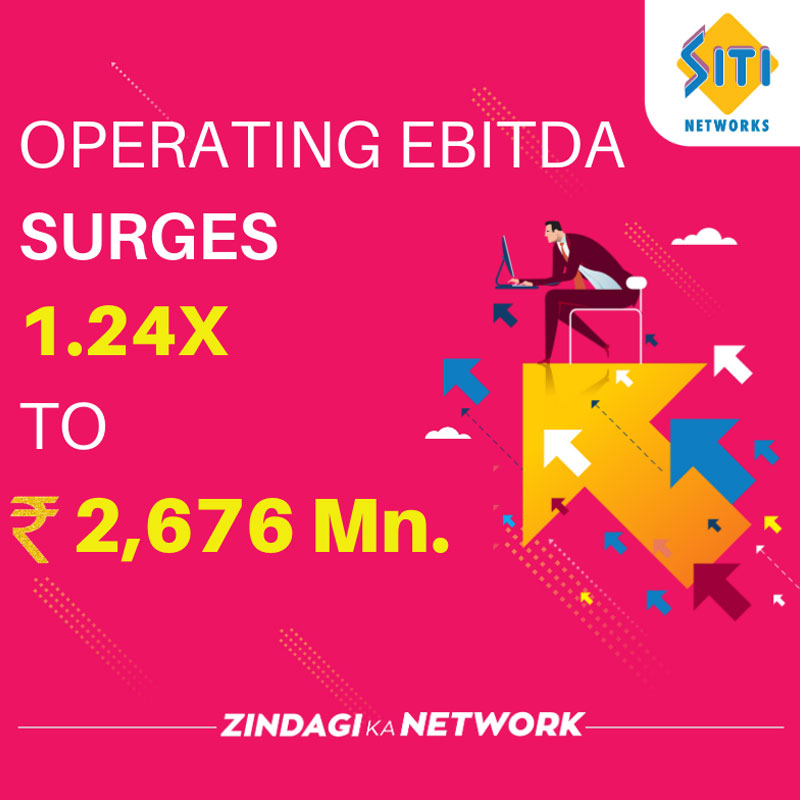
  • SITI Networks’ 9MFY20 Operating EBITDA surges 1.24X Y-o-Y to Rs.2,676 Mn

    SITI Networks’ 9MFY20 Operating EBITDA surges 1.24X Y-o-Y to Rs.2,676 Mn

    MUMBAI: SITI Networks Limited (BSE: 532795, NSE: SITINET), an Essel Group Company, one of India’s largest Multi-System Operators (MSO), has released its Consolidated Audited Financial Results for Q3 FY20, ending December 31, 2019, showcasing continuous growth through strict control on expenses and operational efficiencies across all metrics.

    SITI’s 9MFY20 Operating EBITDA surged 1.24 times over similar duration of last fiscal, to Rs. 2,676 Mn. This jump has been due to strict control over expenses and operating efficiencies. SITI’s Operating EBITDA Margin for 9MFY20 also expanded significantly by 1.1 times y-o-y to 22%.

    Subscription revenue for 9MFY20 grew 19.5% y-o-y to Rs. 8,687 Mn, aided by the strong growth Subscription ARPU, which leapt 1.8 times to Rs.128 per month. Total Revenue (excluding activation) also surged 12.7% y-o-y to Rs. 12,189 Mn for the same period.

    SITI Broadband and Zee 5, India’s fastest growing OTT platform joined hands to promote premium content to SITI’s high speed broadband customers. SITI Broadband also expanded its presence through a mix of smart customer management and innovative offerings. A new SITI Broadband web and mobile interface has been introduced to enhance customer experience.

    SITI’s continuous efforts on improving operational efficiencies through improvement of its systems, processes and personnel has been yielding results. This has resulted in a better and intimate ground connect with its 24,000+ strong distribution network and increased focus on being fully compliant to the Tariff regime.

    While commenting on the results, Mr. Anil Malhotra, CEO of SITI Networks Limited mentioned:

    “SITI’s continued focus on operational efficiencies and strict control over expenses has driven growth in Operating EBITDA by 1.24 times y-o-y to Rs.2,676 Mn and expanding Operating EBITDA margins by 1.1 times y-o-y to 22% in 9MFY20. Our Total Revenue (excluding Activation) also surged 12.7% y-o-y to Rs.12,189 Mn in the same period. Our Subscription Revenue also jumped 19.5% to Rs.8,687 Mn. We are focused on working closely with our distribution partners for increased sweating of ground assets further through introduction of allied value-added services for our customers SITI Broadband with Zee 5, India’s fastest growing OTT app, gives both partners an opportunity to scale up our business ambitions, creating value for all our stakeholders with a focused and strategic approach."
     

  • Hathway’s Panesar succeeds Wadhwa as AIDCF head

    Hathway’s Panesar succeeds Wadhwa as AIDCF head

    MUMBAI/NEW DELHI: Hathway Cable & Datacom’s Video Business CEO T S Panesar has taken over as the new president of the All-India Digital Cable Federation (AIDCF), the apex body of digital cable television players.

    Panesar was unanimously elected at AIDCF’s 11th governing council meeting held in New Delhi. He succeeds SITI Networks ED and CEO V D Wadhwa who completed his two-year term as the founder-president of the Federation.

    Panesar has over 20 years of experience in media and entertainment industry, both on the broadcasting and distribution side.
    The governing council also appointed SITI Networks COO Anil Malhotra as he vice-president and Fastway Transmissions Private Ltd CEO Peeush Mahajan as the treasurer of the Federation.

    AIDCF placed on record its appreciation for the immense contribution made by Wadhwa as the founder and first president of the Federation over two years ago. Under his aegis, the federation earned its stripes with MIB, TRAI, DoT, Ministry of Finance and all the other industry bodies i.e. IBF, DTH Federation, CII, FICCI, ASSOCHAM etc in the media & entertainment Sector.

    The Federation has played key role in bringing all the major players of the industry controlling over 70 per cent of the business under one umbrella and have taken up the issues concerning the cable industry by liaising with the concerned government department/ministry as well as with the other industry bodies of the broadcasters and DTH operators besides playing key role in resolving the deadlock in implementation of phase III of digitization.

    On giving over the baton to Panesar, Wadhwa said, “A solid foundation has been laid for addressing all the concerns of the industry and I am confident that under the leadership of Panesar and active participation by all the members, the federation would further gain strength and shall be able to create an environment for the profitable growth of the cable industry.”

    Commenting on his appointment as the AIDCF president, Panesar said, “I am deeply honored and privileged to be appointed to lead the federation. It’s a big challenge and responsibility entrusted upon me and I look forward to working closely with all members to bring further changes in the environment. Having seen the evolution of the cable & broadcasting industry from the analogue to the digital regime, we are now at the cusp of a another major shift in light of the new regulation which is aimed at improving transparency, empowering customers to exercise choice and ensuring orderly growth of all stakeholders in the eco-system. We strongly believe that technology should be leveraged to address the changing needs of the industry. Together, we will strive towards strengthening our bond with all stakeholders to deliver a world class service to the consumers and improve customer satisfaction levels.”

    AIDCF secretary -general Saharsh Damani said, “With digitisation entering into last phase and focus on wired broadband gaining traction for all the members, I am sure that, under Panesar’s leadership, the digital cable industry will enter into the next orbit of momentum and growth.”

  • Hathway’s Panesar succeeds Wadhwa as AIDCF head

    Hathway’s Panesar succeeds Wadhwa as AIDCF head

    MUMBAI/NEW DELHI: Hathway Cable & Datacom’s Video Business CEO T S Panesar has taken over as the new president of the All-India Digital Cable Federation (AIDCF), the apex body of digital cable television players.

    Panesar was unanimously elected at AIDCF’s 11th governing council meeting held in New Delhi. He succeeds SITI Networks ED and CEO V D Wadhwa who completed his two-year term as the founder-president of the Federation.

    Panesar has over 20 years of experience in media and entertainment industry, both on the broadcasting and distribution side.
    The governing council also appointed SITI Networks COO Anil Malhotra as he vice-president and Fastway Transmissions Private Ltd CEO Peeush Mahajan as the treasurer of the Federation.

    AIDCF placed on record its appreciation for the immense contribution made by Wadhwa as the founder and first president of the Federation over two years ago. Under his aegis, the federation earned its stripes with MIB, TRAI, DoT, Ministry of Finance and all the other industry bodies i.e. IBF, DTH Federation, CII, FICCI, ASSOCHAM etc in the media & entertainment Sector.

    The Federation has played key role in bringing all the major players of the industry controlling over 70 per cent of the business under one umbrella and have taken up the issues concerning the cable industry by liaising with the concerned government department/ministry as well as with the other industry bodies of the broadcasters and DTH operators besides playing key role in resolving the deadlock in implementation of phase III of digitization.

    On giving over the baton to Panesar, Wadhwa said, “A solid foundation has been laid for addressing all the concerns of the industry and I am confident that under the leadership of Panesar and active participation by all the members, the federation would further gain strength and shall be able to create an environment for the profitable growth of the cable industry.”

    Commenting on his appointment as the AIDCF president, Panesar said, “I am deeply honored and privileged to be appointed to lead the federation. It’s a big challenge and responsibility entrusted upon me and I look forward to working closely with all members to bring further changes in the environment. Having seen the evolution of the cable & broadcasting industry from the analogue to the digital regime, we are now at the cusp of a another major shift in light of the new regulation which is aimed at improving transparency, empowering customers to exercise choice and ensuring orderly growth of all stakeholders in the eco-system. We strongly believe that technology should be leveraged to address the changing needs of the industry. Together, we will strive towards strengthening our bond with all stakeholders to deliver a world class service to the consumers and improve customer satisfaction levels.”

    AIDCF secretary -general Saharsh Damani said, “With digitisation entering into last phase and focus on wired broadband gaining traction for all the members, I am sure that, under Panesar’s leadership, the digital cable industry will enter into the next orbit of momentum and growth.”