Tag: Anil Kakar

  • Hathway launches campaign for new channel packages

    Hathway launches campaign for new channel packages

    MUMBAI: Multi system operator (MSO) Hathway Cable & Datacom is out on a mission: to educate cable TV subscribers about their new power – ‘The power to choose.’ And to spread this message the MSO has come out with three TVCs, print ads and radio jingles. 


    The campaign will use multiple media to inform and educate consumers about the different packages that the MSO has created. The move comes in the wake of broadcaster Star India’s decision to enter into only Reference Interconnect Offer (RIO) deals with MSOs. 


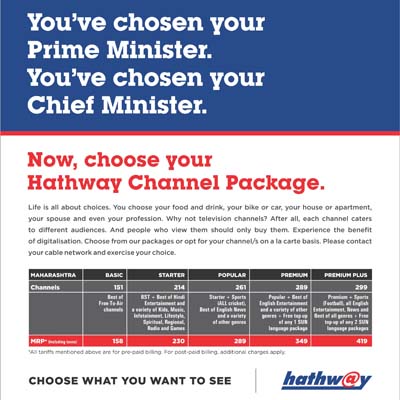
    The five packages for Maharashtra that have been rolled out by Hathway include: 


    · Basic Pack priced at Rs 158: This will have the best of all the free to air channels.


    · Starter priced at Rs 230: This will have best of Hindi entertainment and a variety of kids, music, infotainment, lifestyle, spiritual, regional, radio and games. 


    · Popular priced at Rs 289: This will have channels from Starter pack + sports (all cricket, best of English news and a variety of other genres).


    · Premium priced at Rs 349: This will have channels from Popular pack + bets of English entertainment and a variety of other genres + free top up of any one Sun language package.


    · Premium Plus priced at Rs 419: This will have channels from Premium pack + sports (football, all English Entertainment, news, best of all genres + free top up of any two Sun language package. 


    Conceptualised and created by Gasoline, while one of the TVCs has life reference, the other two are animated. Speaking to Indiantelevision.com, Gasoline founder and chief creative officer Anil Kakar says, “The brief given to us was that the MSO wanted the power of choice to be in the hands of consumers.” 


    The campaign highlights the five different packages as well as the a la carte prices being offered by Hathway. 


    Incidentally, the work on the campaign started in October, which is the same time when Star announced its plan to enter into RIO deals. “While the client wanted life reference, we wanted to bring in animated characters. The reason being that while the message is hard selling, animation makes it light,” informs Kakar. 


    The ad film draws an analogy from contexts wherein a consumer makes a choice. For instance, the first film opens on a lady buying a soap in a soap store. The salesman is seen pushing various soap brands on offer. The lady quips, ‘You aren’t trying to sell the whole store, are you?’ and smiles. Cut to a CG section wherein we see a host of channel logos and a voiceover, which says, ‘We choose everything in life, why not television channels?’  


    The strategy is to communicate the cost-effectiveness of a Hathway package subscription. The campaign extends with a couple of animation films, which demonstrate how a subscription is reasonably priced vis-a-vis other things in life. In the first film, we see a young character in a cafe going through his mobile bills, only to find his café bill more expensive, thus communicating the fact that a monthly subscription to a Hathway channel package is still cheaper than two cups of coffee and a sandwich.


    The radio spot extends the idea further with a groom who is choosing a bride and in another, a waiter rattling off the menu in a rapid-fire sequence. The radio jingles have been co-produced by 94.3 Radio One. 


    The print ad is topical and captivating. It reads: ‘You have chosen your Prime Minister. You have chosen your Chief Minister. Now choose your Hathway channel package.’


    While the TVC will be aired on the Hathway channels, radio ads will be played in Kolkata, South Indian states (except Chennai), Mumbai and Delhi and the print ad will also be published all over India in the mainline newspapers. 


    “The campaign has been designed to ease the life of cable operators, who are facing issues in informing consumers about the packages and its pricing,” concludes Kakar.

  • World TV Day: Industry barons go down the memory lane

    World TV Day: Industry barons go down the memory lane

    It was on 15 September 1959 when India officially experimented her tryst with the box that has been loved, loathed and equally criticized over the years.  But today, in its current avatar, the television set has seen a paramount shift, right from colour television being introduced in 1982 as India geared up for the Asian games to today’s 4K technology.

    Production values of various shows as well as the viewership experience have changed phenomenally.  As the world today celebrates World Television Day which was declared by the U.N in December 1996, indiantelevision.com speaks to some of India’s most notable names from the TV industry recalling some of their fondest memories of viewing television programmes.


    Prasar Bharati CEO Jawhar Sircar

    Television needs to look beyond its traditional ecosystem to embrace the opportunities offered by digital technology. The medium will die if it continues to grow in a linear fashion. TV began over electro-magnetic waves in 1959 and has grown through satellite to cover the entire country.

    While terrestrial TV has its own relevance, it will be quickly overtaken by new technologies including satellite and digital addressable systems.


    India Today Group consulting editor Rajdeep Sardesai

    For me my fondest memory was the coverage of the live elections in the years of 1995-1996. At that time, everyone would watch the national broadcaster Doordarshan as there were no private news channels. Covering the elections as a reporter along with journalist like Vinod Dua and Dr Pranoy Roy is a big part of those memories for me.


    NDTV executive vice chairperson KVL Narayan Rao

    Television today is more contemporary. Society has changed a little and what you have on air is reflective of that. The world has become a smaller place. There is more access now as compared to 25 years ago when the only window to international news was The Week That Was, produced by NDTV as one of the earliest private players. I remember serials like Buniyad, Humlog, Mahabharat and Ramayan. Some of the old ones were core of the heart serials and dealt with issues that were the reality of so many people of the country at that time such as post partition. The serials now have different production values.


    Sony Six business head Prasana Krishnan  

    Sports on television is growing rapidly and the Indian sports fan today has more access to viewing multiple properties than any other fan in the world and that too at an affordable cost. My fondest memory has to be this year’s FIFA World Cup Brazil as not only was it personally satisfying for me as a football fan but  a matter of pride to be carried on the channel. Every minute of the game on TV was engaging.


    Ten Sports CEO Rajesh Sethi

    Viewing television programmes is an enriching experience and is all about entertainment, entertainment and entertainment! Watching television especially sports is a great stress buster and allows me to relax. In fact watching sports on TV for me is all about celebration.


    Gasoline, founder and chief creative officer Anil Kakar

    From just two Doordarshan channels to over 800 channels today, television has come a long way. The good thing is, content continues to get more defined to suit niche audiences.  With the recent changes announced by the Star Network, viewers now have the choice of subscribing to specific channels on an a la carte basis. It will be interesting to see how this will go on to alter viewing patterns. In the long run, this might even lead to a shift of focus, largely from GECs to more diversified, niche content, as television gets more fragmented. Ultimately, as audiences, we will have even greater choice than we have today. Even with so many channels today, I would say the finest moments in television belong to the 90s. MTV and Channel V brought in a cultural change and attitudinal shift of sorts. Programmes such as Different Strokes, The Wonder Years, Mind Your Language and Star Trek were had to miss and are still hard to forget.

  • Viral on your mind?

    Viral on your mind?

    A‘Kolaveri Di’ kind of video with the capacity to go viral doesn’t happen every day, and that’s something marketers and the junta might do well to remember.

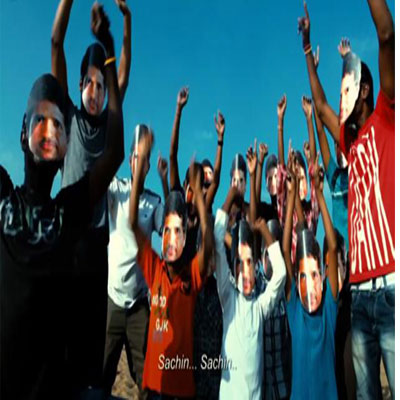
    There have been enough and more cases of online campaigns that fell flat on their face just as there have been instances of campaigns that fared considerably well in recent times (Dove’s real beauty, Flipkart’s Nation wants to know, Dhanush’s Sachin anthem).

    Content is king

    So what are the ingredients that make for success? First up, it’s the content. GroupM ESP national director (sports and live events) Vinit Karnik opines that videos like ‘Kolaveri Di’ and ‘It’s your fault’ are an engaging and entertaining way to disseminate a social message and build awareness.

    Watch the video: Boost pays tribute to Sachin’s 23 years of stamina!

    Gasoline founder and chief creative officer Anil Kakar says the first rule of creating online content is that it needs to be worth sharing. “The potential reach shareable content can offer is enormous and brands are currently only scratching the surface,” he says.

    Referring to two recent viral videos ‘It’s your fault’ and ‘I quit’, Draftfcb Ulka Interactive (digital arm of Draftfcb Ulka) creative head Sudarshan Sudevan says: “These two videos share different lights in the context of one’s feeling, one is targeted at the mass and the second, targeted at a single person….her boss. But the common platform that they share is – being vocal about it. That’s the lesson you can learn from it. Exercise your freedom of expression to the maximum… without fear. You can be a total stranger but your voice is surely heard if it has a message. That’s the power of this digital medium.”

    Not to do list

    Successful online content is often disruptive, based on a powerful insight and more importantly, follows a set of rules in social media that are way different from other forms of media.
    Experts believe the most common mistake that someone/some brand can make while launching a digital campaign is to create it to go viral. According to Infosys global head (digital marketing) Ashok Lalla, that is the biggest fallacy. “Virals happen. Of course, one can help them happen through content which is very high quality and well produced, and also through extensively promoting the content. For example, Idea’s Honey Bunny was promoted across media and that drove the viral-ness of the video online,” he points out.

    Similarly, Everest Brand Solutions president Dhunji Wadia says if one tries to create a campaign to go viral, there are a million ways to go wrong as there is no fixed formula or template for these videos. “You just have to click with the consumers, literally! Firstly, if it doesn’t impress me, how will it impress the world? One can get carried away with an idea, which does not make as much sense after production as much as it made on paper. Don’t hesitate to start fresh in such a case. Secondly, is the product/service forced into the communication? Sometimes there is a ‘disconnect’ between the product/service and the ad concept. If the two are not inter-twined, the product will be left hanging after a great concept.  It will hardly be noticed. Try to find a common ground between the two.”

    Highlighting mistakes marketers/advertisers tend to make, Sudevan adds: “Low budget for a promotion to be launched ‘asap’ plus maximum output demanded (for example say 1 million likes) and hence resorting to social media leads to bad ideas and bad execution, considering the time the agency gets to churn this out in that shoe-string budget. Also, no research of the ecosphere of social media or what or how much a campaign should cost or the time it should get competed within leads to selection of bad ideas presented by some smart agency.”

    With or without social media

    All said, the social media universe is swelling and no advertiser or marketer can afford to ignore it. Besides, with the dipping rupee and dwindling economy, conventional Indian media is facing the heat, rendering social media the smartest option in the current scenario. 

       
    Says Kakar: “What makes social media unique is the fact that brands can, for the first time, have a conversation directly with consumers. This is a huge paradigm shift of sorts, which is already testing our collective skills as an industry. Also, for the first time, we can gauge accurate responses through analytics and tools, engage with a select audience, should the need arise, and alter content according to responses. Social media is also a great platform to engage opinion leaders or ‘feeders’, who help promote content onto blogs, twitter, facebook and other platforms for a multiplier effect, generating free PR, which would have otherwise cost an arm and a leg for an advertiser.”

    Watch the video: AIB seeks an answer to whose fault is it anyway?

    FoxyMoron co-founder and director – new business and innovations Pratik Gupta seconds Kakar saying: “A lot of brands want to reach out to their audience and it might be as simple as uploading a TVC on YouTube. One must remember that a TVC is watched by the entire family, out of which, not all could be the target audience wherein the people who will click on social media are the correct viewers.”

    Gupta gives the example of the campaign Baby Lips Kiss Song featuring Alia Bhatt that FoxyMoron recently did for Maybelline. He says there are many brands that are utilizing the platform to the fullest to reach their TG.  He also talks about the YouTube channel Q-tiyapa by TheViralFeverVideos saying they are doing everything right to strike a chord with the youth.

    And what do advertisers have to say about digital platforms? “Advertising is a 360-degree experience. That’s when a user feels the brand in totality and since every medium has its own plus points, it’s best to design any campaign keeping in mind the purpose of the campaign,” say advertisers.

    Then again, there are the naysayers who feel digital media and by extension, social media is still not a mass channel of outreach in India. Statistics for internet usage vary between 70-140 million and those for social media are a subset of this. So, it’s unlikely to be the medium of choice for all brands for all seasons. At best, digital/social media may be the medium of choice for a younger, urban-centric demographic concentrated in major metros and towns across the country.

    Whatever be the case, one thing is clear that with the medium encouraging conversations on various social platforms, the movement of content from ‘airing’ to ‘sharing’ can catalyze the internet audience to great effect.