Tag: Android

  • Mobile Video Monetization: The Way Forward

    Mobile Video Monetization: The Way Forward

    Players in the delivery ecosystem must start collaborating to increase the size of the market; Simplified regulatory framework that facilitates content-sharing needed.


    Digivive’ flagship, award-winning application nexGTv offers users entertainment across multi-screen devices, be it mobile, tablets or laptop/PCs. The choice of entertainment is a suite of movies, Live TV, TV shows and videos. Besides ranking among the top 10 entertainment applications in App Stores, nexGTv has also won ‘The Best Digital Experience’ award at the prestigious World Communication Awards 2014, at London. It runs seamlessly across 2G/EDGE/3G/4G and Wi-Fi networks across platforms such as Android, iOS, BlackBerry and Tizen, enabling consumers to remain entertained irrespective of bandwidth limitations and operating platform. Digivive’s General Manager of Marketing Gaurav Sahni shares his perspective about monetizing one of the most exciting mediums  today – mobile video.


    Rise of OTT and Mobile Video


    Wikipedia defines ‘entertainment’ as ‘a form of activity that holds the attention and interest of an audience, or gives pleasure and delight’.That definition is so very apt, but nowadays, another keyword is rapidly becoming part of this definition – i.e. mobile. It’s increasingly becoming the new mass media for information, supplanting traditional media channels, even the internet, which is starting to bring about an inevitable transformation into our social, demographic, and psychological work environment, impacting usage and consumption in varied ways.


    Going forward, mobiles and more especially smartphones are expected to become the main drivers or carriers of all kinds of information including entertainment. Like in the rest of the world, the ongoing digital transformations in India including access to mobile internet are progressively catalysing the move towards rapid penetration of mobile entertainment including audio and video (includes Live TV, Video on Demand, TV Shows, Movies, etc.). However, growth in mobile video is expected to far outstrip the growth in mobile audio. In fact, reports indicate that mobile video is expected to form nearly three quarters of all mobile data traffic by 2019. A recent Ericsson Mobility report highlighted that India showed the fastest growth in net additions to mobile subscriber base followed by China. Current IAMAI and KPMG reports indicate that India will have around 236 million mobile internet users by 2016, and 314 million by 2017 which echoes reports from other sources.


    The explosive growth of smartphones in India over the past couple of years indicates the keenness of Indian audience to stay abreast and embrace the latest digital trends. Social media,  content sharing, e-shopping and permeation of 3G networks together with steps undertaken by  telcos to launch 4G have created an undisputable case for mobile entertainment, fuelling enthusiasm of content players and consumers alike. In fact, a lot of industry experts expect 4G to be an inflection point for mobile video in the coming years. Rising incomes, including a proportionately higher spend on entertainment is expected to be supplemented by an increase in internet-enabled devices, cheaper handsets and availability of affordable data plans.


    According to industry reports, mobile video traffic exceeded 50 percent of traffic for the first time in 2012 globally. With data consumption outstripping voice traffic on networks and growing in an unprecedented manner, demand for content availability over multiple platforms such as mobile, tablets and laptops, is creating new opportunities for content owners, providers, publishers, communication service providers as well as technology providers, all of which are now working to not only understand, but also leverage these radical changes for business growth and consumer benefit.


    With service provider owned data pipelines stabilizing, internet access has revolutionized the entire Over-the-Top (OTT) business ecosystem, not only creating new businesses but also newer ways of working that have opened  up innovative revenue streams even for existing ventures. OTT video – a prime example is growing in leaps and bounds, aided by a growing consumers push to consume video anywhere, at any time and on any device.


    These developments are not just affecting existing industry dynamics and setups but throwing up new challenges that have the power to format entire media, mobile, entertainment, regulatory and content ecosystems. While the Indian OTT market is comparatively nascent, it nevertheless holds substantial promise for both free (ad-supported) and paid (subscription-led) services, given the rising smartphone penetration in most cities, citizen and subscriber mobility, complimented by enhanced data usage on the networks.


    Monetizing Mobile Video: The Way Forward


    Industry participants including providers of services, content, publishers and broadcasters alike have started to realize the potential of mobile TV and video. For content owners and broadcasters, OTT means new distribution opportunities, opening avenues to expand viewership and revenue both via paid and advertising models. For service providers, OTT creates a new revenue generation opportunity by ensuring delivery of entertainment at the last mile, using their data pipes.


    With mobile emerging as one of the most effective and truly personal advertising platforms, companies are devising ever newer strategies to target and engage audiences via innovative and programmatic formats which are increasingly becoming self-learning or intuitive. Aside from social networking, mobile are the ‘media of choice’ for online bookings, financial transactions, shopping, essential services, entertainment and even employee communications. Tech companies are increasingly using such platforms for targeted communication while promoting their apps.


    However, like all industries, the rapidly evolving mobile video domain in India is also facing its own set of emerging challenges. As competition over viewers, advertisers, eyeballs, content, pipelines, hits, and subscriber lifecycles intensifies, lack of consensus over reporting metrics, pricing, formats, network quality of service (QoS) and likely revenue share serve to dampen an otherwise spirited and expanding market. There is also uncertainty over choosing mobile web or in-app channels for meeting advertisement targets.


    In spite of the above concerns, mobile video has proven to be highly successful in several markets, delivering higher user engagement on mobile devices. Of late, advertisers have also started to embrace video advertisements on the mobile as part of their cross-channel strategy.


    The question about having an ideal monetization framework that splits available revenue evenly between all players however, remains. In order to monetize the opportunity, content owners, broadcasters, aggregators, publishers and service providers need to start collaborating to first define and increase the size of the addressable market. With television and cable transmission going digital, there exists tremendous scope of expansion under the framework of the Government’s digital inclusion program especially in Tier 2 and 3 cities and beyond for an entertainment-starved populace.


    Much like the Cable and TV industry, creation of a progressive and simplified regulatory framework that facilitates content-sharing, boosts access to mobile entertainment, and ensures a level playing field for all is also a critical need of the hour. While ‘content’ is increasingly regarded as King, the industry is rapidly realising the role and importance of every other player including aggregators, advertisers as well as bandwidth owners or service providers to ensure the creation, curation and delivery of a complete and immersive mobile entertainment experience.


    Additionally, while advertising has been and remains a proven mechanism to earn revenue or recover cost, players in the digital and mobile ecosystem as well as end-consumers, are increasingly realizing that creation and distribution of quality content is costly. ‘Subscription’ therefore, appears to be a viable mechanism being slowly embraced by industry players.


    To each his own seems to be the short-term mantra and while one can see the entire category being rife with innovative business models, an ideal or near perfect monetization structure seems to be sometime away, given the proliferation and abundance of not just content, but also mobile TV apps, together with a consumer base that is highly fragmented and keen on ‘digital snacking’.


    The information shared, views and opinions expressed in this article are those of the author and do not necessarily reflect the scope of knowledge and views of The Indian Television Group, its affiliates, or its employees.



  • YouTube adds two new virtual reality features on Android

    YouTube adds two new virtual reality features on Android

    MUMBAI: YouTube has trained its eyes on the next big thing in the digital video space – Virtual Reality (VR). The video network has added two new VR features to YouTube’s Android app.


    “If we’ve learned anything in the past 10+ years at YouTube it’s that capturing and sharing videos is a great way to bring people there with you—whether “there” is an Icelandic glacier, a special performance by violinist Tim Fain, or just a friend’s birthday party,” YouTube VR senior product manager Kurt Wilms, YouTube product manager Sanjeev Verma and Jump product manager Husain Bengali collectively said in a post. 


    “Virtual reality makes the experience of being there even more awesome and immersive, so today we’re bringing two new VR features to YouTube’s Android app. All you need is your current phone, and a Google Cardboard viewer,” they added.


    YouTube now supports VR video – a brand new kind of video that makes you feel like you’re actually there. Using the same tricks that we humans use to see the world, VR video gives you a sense of depth as you look around in every direction. Near things look near, far things look far. “So if you were excited about 360° videos, this is pretty freakin’ cool,” they added.


    To give it a try, find a VR video on YouTube – like the Hunger Games Experience or TOMS Shoes Giving Trip – tap the new Cardboard icon, drop your phone into your Cardboard viewer, and you’re off! 


    Creators can also check out technologies like Jump to capture and share their own VR videos.


    “Our second bit of news is for the universe of existing YouTube content. And that’s the fact that you can now watch any video using Google Cardboard, and experience a kind of virtual movie theater. Just select the new “Cardboard” option from the watch page menu, drop your phone into your viewer, and you’re done. You’ll now have the largest VR content library right at your fingertips,” they said.

  • Times Internet launches Samayam in South India

    Times Internet launches Samayam in South India

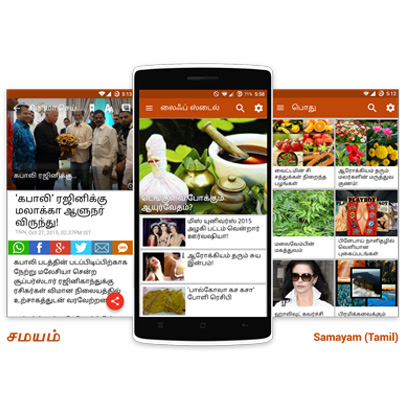
    MUMBAI: Times of India Group’s digital products company Times Internet (TIL) has launched Samayam – a news, entertainment and lifestyle content destination in Tamil, Telugu and Malayalam languages.


    Samayam aims to bridge the gap between users looking for quality content in their language and trustworthy platforms providing them.


    Times Internet head of news business Puneet Gupt said, “We are really excited to launch Samayam. Mobile led media landscape is evolving rapidly in India and we hope to become the destination of choice for millions of Indians and Indian diaspora users across languages and platforms.”


    Samayam is available as an Android app, on mobile web and also on desktop. With the launch of Samayam, Times Internet’s language offerings are now available across eight Indian languages namely Hindi, Tamil, Telugu, Malayalam, Kannada, Gujarati, Marathi and Bangla – in addition to English.

  • Modi convinces Silicon Valley about Digital India, lauds Facebook & Google

    Modi convinces Silicon Valley about Digital India, lauds Facebook & Google

    NEW DELHI: As he entered the extensive office of Facebook in California, he was greeted with the song ‘Chak de India’ and when he left, Prime Narendra Modi left a huge impression about India’s seriousness ongoing digital.


    The euphoria was the same when he visited Google, or addressed a meeting of persons from LinkedIn or start-ups.


    In various speeches during his visit, Modi said Facebook, Twitter and Instagram were the new neighbourhood.


    “If Facebook were a country, it would be the third most populous one and the most connected,” he said. 


    Similarly, he said Google “has made teachers less awe-inspiring and grandparents more idle. Twitter has turned everyone into a reporter. The traffic lights that need to work the best are on CISCO routers.” 


    The status that now matters, he said, “is not whether you are awake or asleep but whether you are online or offline. The most fundamental debate for our youth is the choice between Android, iOS or Windows.”


    From computing to communication, entertainment to education, from printing documents to printing products, and, now to Internet of Things, it’s been a long journey in a short time. 


    Referring to digital networks, he said, “We have attacked poverty by using the power of networks and mobile phones to launch a new era of empowerment and inclusion: 180 million new bank accounts in a few months; direct transfer of benefits to the poor; funds for the unbanked; insurance within the reach of the poorest; and, pension for the sunset years for all.”


    By using Space technology and internet, the country had been able to identify in the last few months 170 applications that will make governance better and development faster. 


    “The pace at which people are taking to digital technology defies our stereotypes of age, education, language and income,” he added.


    “Customers, more than creators, are defining the use of a product. The world may be driven by the same ancient impulses. We will continue to see human struggles and successes. We will witness human glory and tragedies,” Modi said. 


    He added that in this digital age, there was an opportunity to transform lives of people in ways that was hard to imagine just a couple of decades ago. 


    “Today, technology is advancing citizen empowerment and democracy that once drew their strength from Constitutions. Technology is forcing governments to deal with massive volume of data and generate responses, not in 24 hours but in 24 minutes. When you think of the exponential speed and scale of expansion of social media or a service, you have to believe that it is equally possible to rapidly transform the lives of those who have long stood on the margins of hope. So out of this conviction was born the vision of Digital India,” he said. 


    “It is an enterprise for India’s transformation on a scale that is, perhaps, unmatched in human history. Not just to touch the lives of the weakest, farthest and the poorest citizen of India, but change the way our nation will live and work,” he said. “We will transform governance, making it more transparent, accountable, accessible and participative. I spoke of E-Governance as a foundation of better governance – efficient, economical and effective.” 


    After MyGov.in, Modi said he had just launched the Narendra Modi Mobile App.


    Information, education, skills, healthcare, livelihood, financial inclusion, small and village enterprises, opportunities for women, conservation of natural resources, distributed clean energy – entirely new possibilities have emerged to change the development model. 


    “We want our 1.25 billion citizens to be digitally connected. We already have broadband usage across India go up by 63 per cent last year. We need to accelerate this further,” he further said. 


    An aggressive expansion of the National Optical Fibre Network had been launched that will take broadband to our 600,000 villages. “We are expanding our public Wi-Fi hotspots. For example, we want to ensure that free Wi-Fi is not only there in airport lounges, but also on our railway platforms. Teaming up with Google, we will cover 500 railway stations in a short time. We are also setting up Common Service Centres in villages and towns. We will also use information technology to build smart cities,” Modi informed. 


    “We are also setting up an Electronics Development Fund to support design, development and launch of new products,” he added. 


    Indians account for 15 per cent of startups in the United States. “Hundreds of thousands of Indian professionals here and in India are contributing to the global success of US enterprises. Many are leading them today. This is the possibility of the digital bridge – to connect distant lives and change fortunes and future,” he said.


    Modi said he was delighted that Qualcomm announced a fund of $150 million for startups in India.

  • Spuul inks deal with UTV; to stream ‘PK’

    Spuul inks deal with UTV; to stream ‘PK’

    MUMBAI: Online streaming service for Indian cinema and television content, Spuul has added the highest grossing Hindi movie of all time PK in its catalogue. Along with PK, subscribers can also watch other UTV titles like Rang De Basanti, Jodhaa Akbar, Kai Po Che, Barfi, Dev D and Chennai Express amongst others.


    All movies will be available across platforms like web, mobile (iOS, Android), Smart TV (Samsung, Panasonic, LG) Airplay on iOS, and Chromecast on Android. Spuul will be offering these movies to subscribers in India, UK, Middle East and other major territories around the world.


    Spuul global CEO Subin Subaiah said, “As one of the leading providers of Bollywood content to viewers across India, Pakistan, UK, US and Middle East, we are constantly investing in growing our library by adding new, popular and in many cases, offbeat titles to our list. PK’s addition to our rich UTV catalogue is yet another step in this direction.”

  • Virat Kohli’s Sport Convo aims to be star-backed platform; eyes more partnerships

    Virat Kohli’s Sport Convo aims to be star-backed platform; eyes more partnerships

    MUMBAI: Whether it’s a professional sport or a business venture, the competitive spirit is one thing that’s common to both. The breed of sportspersons turning entrepreneurs is growing formidably and one such player who is becoming a force to reckon with is Virat Kohli – because for this dapper current Indian test captain, scoring centuries at a brisk rate is just not enough!

    Kohli’s Sport Convo, a multiplatform sports social media hub where fans can connect and “convo” about sport, has gathered momentum amongst fans. Kohli stepped into the venture early when it was still in its concept stage and today he couldn’t be happier.

    In an exclusive interaction with Indiantelevision.com, Kohli, who dons the dual hats of a player and an entrepreneur, says, “I am looking forward to the launch in the next month. The guys have been really hard at work to create a product that we can all be proud of. I am looking forward to supporting this business and see it grow.”

    With a vision to make Sport Convo the premier place where sport fans consume sports, Sport Convo managing director and founder Vishal Patel is upbeat about the venture and its progress so far.

    What’s more, the company is also in advanced talks with a few sports stars to invest in the venture. Patel says, “We have been approached by a number of major sports stars across the sport to potentially join Virat Kohli in investing in Sport Convo. We are in advanced discussions with a couple of stars and will make a formal announcement once things are finalised. We believe we will attract a minimum of three other major global personalities to back Sport Convo in the way Virat has. We look forward to making some major announcements soon.” 

    The layout of the site indicates that Sport Convo will not be limited to cricket and hence there is a wide possibility of more stars from across the sports fraternity wearing Sport Convo merchandises and promoting the venture. When queried as to whether the company was planning to rope in more stars, Patel says, “We are a multiple sport platform. We are a star backed platform rather than a star led platform. We want our functionality, content and unique ways of creating content to be at the fore of the product. However, should sport stars want to the join the platform they would be welcomed.”

    Speaking of Kohli’s role in the business, Patel says, “We have worked with him and his team from the early stages of product development. He is a shareholder of the business and an ambassador of the brand. His presence has played a vital role in giving us real exposure and it has been brilliant for us so far.”

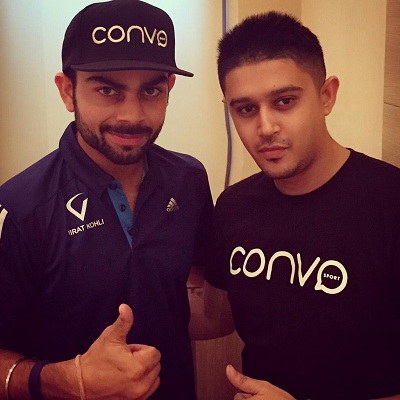
    Kholi has been spotted sporting Sport Convo caps and T-shirts on his various public appearances, which helps in the brand’s publicity and exposure.

    “He even wore our T-shirt in Dwayne Bravo’s music video Chalo Chalo, which was a great surprise to us. So to have someone like Virat enthused and motivated to see his investment succeed is excellent for a startup business like us,” Patel says.

    Additionally, Gareth Bale and Alex Hales have also been seen wearing our snapbacks, which are now available to buy at www.convostore.com.

    It was the growth of technology and the spurt of multiple online platforms that triggered Patel to come up with a venture like Sport Convo, where fans can have conversation on various sporting moments. “I have always been passionate about the tech industry and I also am a huge fan of sports. I wanted to combine both my passions to create a hub for sport where fans like me can consume sport in a unique way, and that’s how Sport Convo came into existence,” Patel informs. 

    The yet to launch platform has already roped in 24.7K followers on Twitter and has 5000+ likes on Facebook. “Considering the fact that we have not yet formally launched our platform, we are truly humbled with the kind of social media following that we have received. As of now, we have a more than 30K social media followers, which also includes some sports stars. Some notable sports stars, who have started following us organically are Real Madrid’s most expensive soccer star Gareth Bale as well as England and Essex cricketer Ravi Bopara,” Patel informs.

    Sport Convo’s Beta version, which was launched sometime back, now has more than 15K pre-registered users. Expressing delight, Patel says, “We are glad to say that we had over 15K pre-registrants and another 6K evincing interest in our merchandise.”

    Sport Convo’s Android and iOS apps are slated to launch by end September. “At that point the network will be open to everybody where they can register on the site or download the app. From September to the end of October, we will have a number of updates of functionality that we hope will excite users,” adds Patel.

    At the outset, majority of the marketing strategies will reverberate around social media. “We are in discussions with a number of third party companies including major broadcasters and telecom companies for partnerships. Since our global headquarters are in London, we will be setting up a office in India to handle marketing efforts for the region. We have not hired a marketing agency in India,” informs Patel. 

    Sport Convo will have multiple revenue generating features within the app. Additionally, the venture will also be open to traditional means of advertisement. “Unlike many tech companies, we are endeavoring to build a brand and eventually launch a lifestyle fashion brand backed by social network. This would prove to be a highly unique revenue model for a tech business like us,” says Patel.

    While merchandising will be a major source of revenue, it will not be the only source. Patel says, “Merchandising will be one of the revenue sources but we will not be fully dependent on it. We are implementing some highly unique features, which we believe will provide a strong revenue stream.”

  • News In Short raises Rs 127 crore in Series B funding

    News In Short raises Rs 127 crore in Series B funding


    MUMBAI: News In Shorts, a startup that launched the India based mobile news app has raised Rs 127 crore from its existing venture capital investor Tiger Global in Series B funding. With this, the company, according to the Economic Times, is now valued at about Rs 570-Rs 635 crore.  


    Founded by IIT dropouts Azhar Iqubal, Deepit Purkayastha and Anunay Arunav, News In Shorts is a news publishing app that curates the top 60 news story of the day and crunches them into 60 word shorts for the readers. Its launch was actively backed by funding from Times Internet, mentors Ankush Nijhawan, Gaurav Bhatnagar and Manish Dhingra.


    The app had crossed over 100,000 downloads for iOS and Android by February. “It is these increases, which directly led to this new funding round from Tiger Global,” News In Shorts co-founder Purkayastha informed techcrunch.com.


    The co-founder further stated that this round of Series B capital will be primarily used to enhance their Android app, since the Google-owned platform accounts for around 80 per cent of mobile devices in India.


    The report also highlights the editorial team’s plans on working on a number of new additions, including a personalization engine that predicts user’s interests, and a feature to allow users to express and share opinions on news via the service.


    “The only focus that we have right now is to make sure that the app runs smoothly on lower-end smartphones as well,” News In Shorts co-founder and CEO Azhar Iqubal told The Economic Times.


    The startup hit the headlines earlier this year after it received Series A funding of Rs 25 crore from Tiger Global, with participation from Japan’s Rebright Partners and Flipkart’s Bansals.

  • LINE launches group call app globally on Android

    LINE launches group call app globally on Android

    MUMBAI: LINE has launched a free group call app called Popcorn Buzz that allows up to 200 participants to simultaneously converse on Android.


    Popcorn Buzz offers group call functionality, which is being touted as a replacement for existing paid business-grade conference call services. For users that need to talk to multiple people at once, Popcorn Buzz accommodates both personal and business usage, all for free.


    Anyone can get started with Popcorn Buzz by choosing a username and uploading a profile picture. By sending out each group call’s unique URL via email, text message, or another communication method of the user’s choice, they can start making group calls with friends without any delay. Additionally, existing LINE users can log in to Popcorn Buzz with their LINE account to immediately synchronize their friends list data and get started making group calls with their LINE friends right away.


    During group calls, users can see all the other call members’ icons, and tell who is talking via the green dots that light up in the lower right-hand corner of current talking users’ icons.


    An iPhone release is also planned, along with implementation of additional features like group video chat, interconnectivity with LINE groups, and more in the future.


    The app supports multiple languages like Arabic, Brazilian Portuguese, Chinese, English, French, German, Indonesian, Italian, Japanese, Korean, Malay, Portuguese, Russian, Spanish, Thai, Turkish, and Vietnamese.

  • Inox ups digital strategy with new mobile app & website revamp

    Inox ups digital strategy with new mobile app & website revamp

    MUMBAI: Multiplex chain Inox Leisure has upped its digital strategy with the launch of an app for Android based phones, iPhone, iPad and tablet users. Additionally, Inox has also revamped its website to make it faster and effective for its guests.


    The new mobile app allows users to check show timings of movies, select seats and book tickets on the go. Nearest theatres can also be located through the app. The app will also provide real time information on movies and special offers.


    Inox, in association with Brenzy, has introduced an app that provides movie goers with real time information on films, special offers and discounts that one can avail at the multiplex through a one-time download of the application Brenzy.


    On its revamped website, Inox has initiated a new concept for its consumers. Moviegoers can take part in contests that are run regularly along with real time updates. The website also serves the purpose of providing information on all Inox properties as well as its investors, shareholders and the media.

  • Myntra app ranks number one in fashion shopping category

    Myntra app ranks number one in fashion shopping category

    MUMBAI: Riding on exponential growth in e-commerce, online fashion platform Myntra on 6 March shared that 90 per cent of its traffic is being generated through mobile devices.


    The online platform further stated that close to 85 per cent of this traffic is driven by Android, iOS and Windows platforms. Moreover, over 50 per cent of the mobile traffic is coming from Tier II and III cities.


    According to a recent study, India ranks second in consumers accessing the internet for online shopping through mobile devices, after China. With over 150 million smartphone users as of 2014, and penetration of mobile phones expected to reach 45 per cent with whopping 520 million users by 2020, mobile is radically transforming consumer’s shopping behaviour.


    Myntra e-commerce platform head Prasad Kompalli said that mobile for them is more than just another channel. He believed that its value proposition is best delivered and experienced through the mobile app. 


    This medium allows us to redefine fashion shopping by offering deep personalised experiences in discovery, content consumption and transactions. In India, mobile is fast becoming the default device for accessing internet across geographies and demographies. This is why, in a short span, we are witnessing such a surge in business from mobile platform,” Kompalli said.


    Myntra launched its mobile app in May 2014 and within a span of nine months, it has become one of the fastest growing shopping apps with over six million installs. With high quality fashionable imagery, simplistic and clutter free layout, the Myntra apps are designed to make browsing convenient enabling shoppers to maneuver through the 1,60,000 products from over 1,000 brands with ease.