Tag: Anand Mahindra

  • Pro Kabaddi League season 2 pushed to July

    Pro Kabaddi League season 2 pushed to July

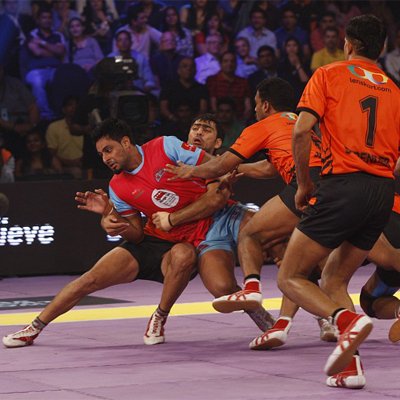
    MUMBAI: The Pro Kabaddi League was a surprise package last year wherein the sport managed to grab eyeballs on television and heavy presence of audience at the stadiums too.


    While the first edition of the league was held from 26 July to 31 August 2014, League promoter Anand Mahindra had said on the day of the finale, “We are very happy with the response for the League and Kabaddi and so will be back as early as March 2015.”


    However, now official sources have confirmed to Indiantelevision.com that the second edition of the League will not be kicked off in March but during the same window period as last year, i.e July to August 2015.


    The reason for the shift in schedule is being attributed to the evident clash with this year’s biggest sporting spectacle, the ICC Cricket World Cup 2015.


    Official broadcaster of the World Cup, Star Sports is also the broadcast partner for the Pro Kabaddi League. With Star Sports having its hands completely tied up with the Cricket World Cup, the League’s second season will now only kick off in the July to August 2015 period.


    Pro Kabaddi League was conceptualised by Mahindra and commentator Charu Sharma through their venture Mashal Sports. Sharma, known for his knowledge of the game, will also be seen playing the role of a cricket commentator during this edition of the World Cup.


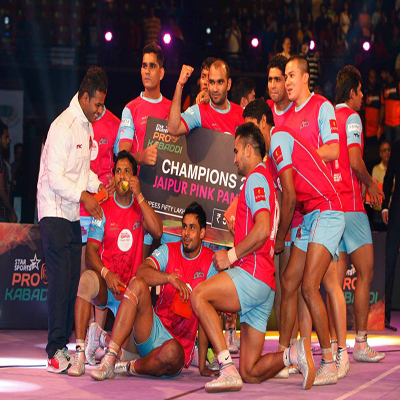
    The last maiden season of the league was won by Abhishek Bachchan owned Jaipur Pink Panthers, which defeated Ronnie Screwvala owned U Mumba. Sources also confirmed that the second edition will not see any additional franchises taking part.

  • “We know we have to work on awareness level,” says Epic’s Mahesh Samat

    “We know we have to work on awareness level,” says Epic’s Mahesh Samat

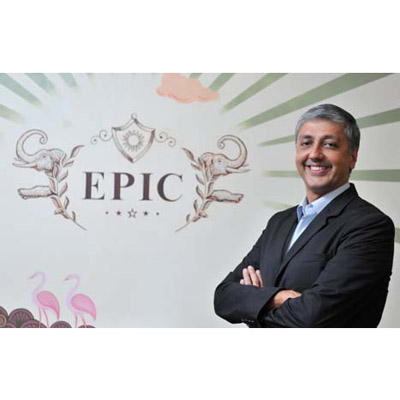
    One of the newest entrant in the Hindi general entertainment channel (GEC) space, Mahesh Samat’s Epic, which was launched on 19 November, 2014 has been gaining momentum on the rating chart ever since.

    “I would want my kid to watch Epic,” says a media planner when contacted to know how the channel has been performing.

    The news of the former Disney executive launching Epic Television Network had first broken in 2012. Labeled as India’s first genre-specific Hindi entertainment channel, it was supposed  to be launched by August 2013. However, due to the delay in getting the licence from the Ministry of Information and Broadcasting, the venture backed by Anand Mahindra, Mukesh Ambani and Rohit Khattar, focusing on Indian history, folklore and mythology, had to wait a long time to entertain the audiences.

    Nonetheless, Samat is happy with the progress and the pace in which the channel is moving. “Ratings wise we are somewhat on track. And there is market for segmented content,” he says.

    The channel, which shows finite weeklies, aims to change the way “entertainment” is categorised today. Samat believes that there are enough people in urban India who want to watch mythology and know about the historical aspects of the country. The channel, though slightly male skewed, while conventional GECs are heavily female skewed, aims to entertain the whole family.

    With an array of fiction and non-fiction shows, all enlightening the viewer of the history gone by, the channel has got on board a new breed of producers and changed the way a story is told. Face Entertainment’s Monia Pinto, who has worked on numerous lifestyle shows, is producing non-fiction shows like Sanrachna and Lost Recipes for the channel.

    Unlike the other shows she has worked on, the series on Epic intellectually stimulates her and her team, thanks to the research which goes into creating them. “We invest a lot of time in research so basically we have to study the subject thoroughly. The team at Epic also does its homework well on a subject so when we go back to them, we merge the ideas and studies to come up with a brilliant piece of work,” she says.

    Speaking on Ekaant, which takes one through abandoned roads, alleys of some of India’s historic locations, Pinto highlights that two researchers work on a project and visit the place, speak to historians to get the facts and story right. “Sometimes it takes us even a month to just study about 2 or 3 monuments,” she says while adding that things have fasten as they are more adjusted with the work as compared to when the production house started off work for the channel. The most difficult part is to get the right people to talk about on the subject as everything has to be very authentic.

    Happy with most production houses working with the channel, Samat believes the work which has been produced is better than what is already out there. Considering the shows are finite, Samat believes it is very difficult to tell a tale in limited episodes as the genre is vast. “There has to be passion for the work and the story else we won’t be able to differentiate from the rest,” he opines.

    Shot on sets as well as on locations, the channel is not worried about the cost which has gone in producing the shows. “Both fiction and non-fiction have worked for us and for us the channel is a long term project as we have invested anything from six months to two years on the programmes,” states Samat.

    Siyaasat which is based on Indu Sundaresan’s novel, ‘The Twentieth Wife,’ is the story of a pawn that charted Mehrunissa’s way to power to become Nur Jahan, the Mallikaa of Hindustan and was shot in Bikaner as well as sets in Mumbai. “Adoptions need research too; but for us the main approach lies in telling the story without being melodramatic,” says Green Light Productions Rishabh Sheth on what differentiates historical shows on Epic from the rest of the channels.

    “Unlike other dailies, we are weekly which gives us enough time to work on pre and post production of an episode,” states Sheth who believes sometimes in a historical show liberties can be taken to make a character glossy to become more liked by the audience.

    At the launch of Chakravartin Ashoka Samrat, Colors CEO Raj Nayak had said that historical and mythology as a genre has great potential. “One can tell a story from various perspectives and still not lose the essence of it if treated well,” he had said on the growth in the genre. For instance, Dharmakshetra, a courtroom drama, unearths the buried questions and allows the legendary characters of Mahabharata to justify their actions for the very first time.

    Though all the blocks are fitting well for the channel, there is still a few missing links. “The content is good, but how many know of it is the question,” points out a media planner and adds, “The channel is not for family viewing as they prefer to watch dramas. It caters to a niche audience, which is interested in the content.”

    Samat too agrees with the fact and says, “Yes, for us the fundamental issue is awareness as it is lower than what we would expect it to be.” With new shows coming up, the channel will start a massive second phase of marketing.

    “Content is conventional and has created a lot of buzz for the channel on the social media, hence, again the focus of marketing will be digital,” says Samat and adds that unconventional route will also be taken. It is planning to launch school programmes across the country soon.

    As for the inventory, the channel is still taking it slow. “The industry has given us positive response but we still want to give them a little more time. Another six months and I guess we should be able to talk on the subject,” answers Samat when asked about the response from the advertisers. The channel currently has Aquaguard, HP, Tata Motors and Foodpanda on board.

    He, just like the others, is waiting for Broadcast Audience Research Council India (BARC) to start releasing data. “Things will change once BARC comes into play,” he opines.
    Nonetheless, it will follow the two minute ad-cap. On Information and Broadcast Minister Arun Jailtey comment of not being in favour of ad cap, Samat says that which way the regulations go, the channel will follow them. However, for him, the audience will be the judge as he doesn’t want to spoil the television viewing for them.

    Monetising through digital is also on Samat’s plan of action. “Our content is for the future and whenever we are ready for it, we will opt for digital subscription model,” says Samat, who is optimistic about the growth of the medium in the country with 4G coming in soon. That’s not all; he also believes that the content will be so rich and unique that it can be sold to the world.

    With a reach of 35 million+ homes, the HD pay channel, also available in down-scaled SD version comes with a subscription rate of Rs 55 while SD is available at Rs 10.5. For planners, the cost is too much especially when audience is used to getting a number of channels at a very minimal rate. “In a country where one TV home still outdoes homes where there are more screens and popular GECs available on nominal cost, why would one pay that much?” asks a media analyst.

    The analyst isn’t convinced that the channel will be able to monetise well on the digital platform.  

    Listening to all the suggestions and working on the same, Samat believes that the channel has a long way to go and things will alter depending on the future.  The channel with the primetime slot of 8:30 pm to 11 pm, currently is focusing on the awareness of it in the Hindi speaking market (HSM).
  • Viewers to decide CNBC-TV18’s top business icons

    Viewers to decide CNBC-TV18’s top business icons

    MUMBAI: Choosing an icon is never an easy task especially in a country like India where many have strived and done their bit to make the country proud.


    Economic growth being utmost importance; over the last decades, India has witnessed a flurry of business thinkers turn into history makers, reinventing its economic growth. To salute them, CNBC-TV18, which is celebrating its 15 years, has launched an initiative called Indian Business Icons.


    The endeavour is to form a league of the most powerful business icons that the people of the country think have had a monumental impact, not only on their lives, but also on the Indian economy.


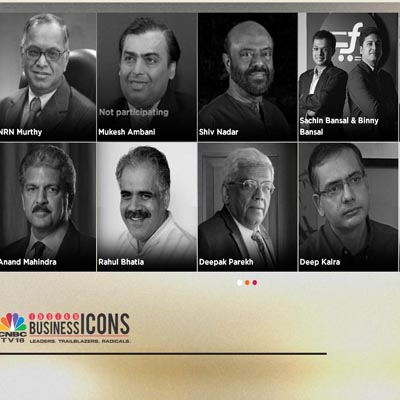
    The channel has unveiled the list of the top 30 business icons, arrived at by a robust editorial process. The list includes leaders such as Ratan Tata, Anand Mahindra, Kishore Biyani, Deep Kalra and Kiran Majumdar Shaw amongst others.


    Asked upon how were the icons shortlisted, a channel spokesperson highlighted, “These names were shortlisted after an extensive process of going through leaders who have impacted Indian economy in the past 15 years. An eminent jury was drawn up that consisted of the top editorial faces at CNBC-TV18 such as Shereen Bhan (managing editor) and Senthil Chengalvarayan (editor in chief) amongst others.”


    The initiative will let people have the power to vote for their own business icon, someone who has significantly changed lives, in the past decade and a half via missed calls, Facebook, Twitter and website voting.


    The final list of the chosen 15 business icons will be selected on the basis of public voting, which will be audited by independent auditor Grant Thornton.


    “We wanted the final list of 15 to be as close to the real truth as possible and decided that the final decision should lie with those who matter – the people of India. Each of these great men have not only impacted the economy at large but have also touched the lives of Indians in many ways. CNBC-TV18, for the first time in India, provided a platform for the public to decide, which leader according to them deserved to make the cut,” added the spokesperson.


    To highlight these icons, the channel has created especially packaged short films (two to three minutes) on each of the nominations. These short films have been running on the channel for some time now. Each film looks at the key high points of the nominee’s contribution to the Indian economy in the past 15 years, hence, the reason for their nomination. “It allows our viewers to make a rational decision while voting. Apart from this, our top anchors discuss the dynamic voting results almost on a daily basis as it throws up interesting rankings,” added the spokesperson.


    Additionally, an extensive on-air as well as off-air (digital, radio, print and social media) promotional campaign has been designed for the same.

  • Our content will cross borders, says Mahesh Samat

    Our content will cross borders, says Mahesh Samat

    MUMBAI: After a wait for almost an year, Mahesh Samat’s Epic will finally see the light of day on 19 November.

    The news of the former Disney executive launching Epic Television Network first broke in 2012 and was supposed to launch the channel by August 2013. However, due to the delay in getting the licence from the Ministry of Information and Broadcasting, the venture backed by Anand Mahindra , Mukesh Ambani and Rohit Khattar, focusing on Indian history, folklore and mythology, had to wait a long time to entertain the audiences.

    As per media reports, Mahindra and Ambani each have a 25.8 per cent stake in the company and together have financial control. Also, there is an initial commitment of Rs 100 crore from the group of ‘angel investors’. Samat has a 48.5 per cent stake in the venture, as per the company’s filing with the Registrar of Companies (RoC).

    The HD pay channel, also available in down-scaled SD version, aims to change the way entertainment is being categorised today. “We are not what people think and call ‘general entertainment’. We are a brand that stands for something which Indian television industry doesn’t have,” says Samat while adding that Indian history has numerous stories to tell and that’s what the channel will do.

    Someone who has keen interest in history, Samat believes there are enough people in urban India who want to watch mythology and know about the historical aspects of the country. The channel, though slightly male skewed, while conventional GECs are heavily female skewed, wants to entertain the whole family.

    With months of research gone into creating the fictional shows like DharamaKshetra, Dariba Diaries as well as non-fictional shows like Adrishya, Raja, Rasoi aur anya Kahaniyaan have been shot in HD and sound recording is on 5.1 Dolby. “Technology is changing the way we tell stories today,” says Samat and highlights how it has also collaborated with Mumbai University and other institutions to help with the facts.

    The channel is working with a new-breed of producers like Bolt Media, Green Light Production, Pride Rock Television among many others, who are willing to take a contemporary take on age-old stories. The research was done by the production houses with the channel’s help. “We got enough creative freedom from the channel,” says a producer of a show soon to be aired on the channel and adds, “The cost of production is higher than that of a show on other channels, but one needs to know how to utilise and make the best of the resources available.” As per industry sources, the cost of production of a show could range from anything between Rs 12 lakh to Rs 20 lakh per episode.

    The shows are finite with most of the shows comprising 20+ episodes and will also see filmmakers like Pankaj Prashar creating content for the channel. “Today a lot of filmmakers want to enter the big world of the small screen. However, most of them don’t have time for infinite shows. Here we are giving them an opportunity to tell stories in a short period of time,” says Samat.

    “And depending on the response and love we get from the audiences we will look at bringing back the show through various seasons,” he adds. Samat believes in changing the way industry works today. “We don’t want to stretch story lines. Everywhere else in the world, seasons work. It’s time we did too.”

    That’s not all; he believes that the content will be so rich and unique that it can be sold to the world. “International syndication is important to me and I want to take our stories to the world,” says Samat. The channel has already got a good response from buyers at MipCom where it showcased the content and Samat believes that before the next edition, the content will have enough takers. “We will not just focus on conventional markets but non-conventional markets as well,” he adds while highlighting that as a pioneer he and his team of 40 have to take risks and go an extra mile to stand out of the crowd. YRF TV’s former head Ravina Kohli is the development head and Aparna Pandey is the business head who also takes marketing decisions.

    The channel will go on air with 13 to 15 shows which will be weekly with the primetime being from 8:30 pm to 11 pm. The morning and afternoon slot currently will show repeats. The channel plans to acquire historic films and programmes as well, which will be aired mostly on the weekends. “As our library grows, the FPC will change too,” he pin points.

    So far, the channel has got no advertiser on board; however, talks are on. “We want to give a week or two for brands to see the content and how they can relate with our philosophy,” says a confident Samat, who feels many will come on board soon. “We are not an AFP driven channel,” he says.

    Media planners too believe that brands will want to watch the content. “No one wants to take a risk,” says a media planner. He adds, “Lifestyle brands will hop on board. However, Reliance and Mahindra brands are always there.” However, several feel that the channel will take time to create a niche of its own as viewers still want to see daily soap operas.

    With a pan-India approach, the channel will be distributed and syndicated by IndiaCast. “Talks are on with all the major DTH players as well as cable operators in DAS area,” says IndiaCast group COO Gaurav Gandhi.

    Subscription rate for the HD channel is Rs 55 while SD will be available at Rs 10.5.

    Beamed off Intelsat 20, the channel will soon start the marketing regime. General entertainment channels (GECs), news as well as other genres will be targeted along with major dailies in the metros. Major hoarding sights will be targeted as well with a lot of focus on digital. Currently, on Youtube, the channel has 1530 subscribers and the first look of the channel has got more than 1.2 million views.

    “Our content will be available online, but will come at a cost,” informs Samat.

    Madison is the media agency while Jack in the Box is the digital agency. Dynamite is the creative agency, though a lot of creatives are done in-house as well.


    The channel has entrusted revenue monetisation to Helios Media which has emabrked on seeding the channel in advertiser market. “Everything about Epic is unique. And those with futuristic view will be on board soon,” says the agency’s MD Divya Radhakrishnan.


  • Epic channel set to roll out by end 2014

    Epic channel set to roll out by end 2014

    NEW DELHI: India’s first genre specific Hindi entertainment channel, Epic is all set go on air by the end of the year  and will showcase content based on Indian history, folklore and mythology in a contemporary format. It is the first segmented channel in Indian television.


    Mukesh Ambani, Anand Mahindra and Rohit Khattar are the three promoters of the company. Mahindra & Mahindra chairman and managing director Anand Mahindra speaking on the occasion said that the landscape of Hindi entertainment is undergoing a dramatic transformation and in order to appeal to an evolved audience, and to sustain their engagement, there was a need for a revolution in the broadcast space.


    “We have all been entertained with the history and mythology of India through books and grandparents’ stories. These stories will now come to life on television in a contemporary manner,” he added


    The channel identified fragmentation of audiences as a huge opportunity for differentiated and genre specific content. By integrating India’s rich heritage with the current consumption patterns, the channel is creating original content within the Indian history, folklore and mythology genre and will be using a contemporary story telling format.


    Epic Television network founder and managing director Mahesh Samat commented, “The ‘segmented’ content will allow viewers to choose and consume genre-specific content of their liking. Our vision is to create a brand in television that will translate our vibrant past into entertainment with the objective of creating new IPs, strong characters and new heroes that strike a chord with audiences.”


    The channel will have action, drama, comedy, supernatural and narrative non-fiction content, set against Indian history and mythology. The stories will be innovative with high production quality and a distinct look that will appeal to both men and women. Most of the content will be shot at real locations with HD cameras. The programming line-up has a mix of fiction shows, narrative non-fiction shows, short form content as well as films at launch.

  • A sigh of relief for Epic

    A sigh of relief for Epic

    MUMBAI: The channel which plans to create a history finally breathed a sigh of relief when after almost a year’s wait has got a licence approval from the Ministry of Information and Broadcasting (MIB).


    Mid-last year, Mahesh Samat, a former Disney MD, had announced his plan of his own venture Epic TV channel. Mahindra & Mahindra chairman Anand Mahindra had come on board as a major investor. And then, soon came the news that billionaire industrialist Mukesh Ambani too had joined the venture as the second investor venture capitalist to fund Samat’s Epic Television Networks.


    The channel offering segmented content to viewers specifically related to history, folklore and mythology was supposed to debut by August 2013.


    Samat had brought in former YRF TV head Ravina Kohli as programming head, apart from business head Aparna Pandey who was earlier associated with Big CBS channels as business head. “Our shows will be different from what India has been watching,” Samat had quoted then.


    Amongst the shows being developed is one based on a novel by Indu Sundaresan called The Twentieth Wife which tracks a young widow named Mehrunissa, daughter of Persian refugees and wife of an Afghan commander, who goes on to become the empress of the Mughal Empire under the name of Nur Jahan by getting married to emperor Jehangir.


    However, things didn’t progress as planned. The tedious and long procedure to get approvals from the MIB delayed its launch.


    “Yes, it comes as a big relief that finally we have got the licence from the MIB. However, we still have to get a nod from Wireless Planning & Coordination wing of the Ministry of Communications and Information Technology. So keeping the fingers crossed,” says Samat.


    The channel hopes to get the nod soon and hopes to launch by end of the year.


    There will be a few more announcements as well because the channel will make changes to the agencies representing it. Earlier, IContract, a part of Contract Advertising and the WPP Group, was appointed to manage the creative and brand building duties for the channel; while Madison Media was assigned the media buying and planning mandate. Similarly, MSLGroup, a specialty communications and engagement network, has been handling the channel’s Public Relations, while Jack in the Box Worldwide, the content-for-brands arm of Bang Bang Films, had been selected to manage all digital communication for EPIC.


    “MSLGroup no longer represents us and there might be a few more changes,” says Samat without revealing much.

  • Star India’s bet with Pro Kabaddi League gets a thumbs up

    Star India’s bet with Pro Kabaddi League gets a thumbs up

    MUMBAI: Fans and advertisers who until now were most familiar with boundaries and record breaking centuries scored by cricketers in India are learning how to tackle a new game-Kabaddi which slowly yet steadily is raiding the hearts of many.


    During the 37 day Pro Kabaddi League (PKL), a massive 435 million viewers tuned in to catch the action which is almost triple the number of people who watched FIFA World Cup 2014 in India.  When compared to the glitzy Indian Premiere League (IPL) which garnered 552 million viewers, Kabaddi undoubtedly has become India’s second most favourite sport after cricket for now. (Source: CS4+; Extrapolated from TAM panel).


    A record 86.4 million people tuned in during the finale between Jaipur Pink Panthers and U-Mumba or three fourth of an average Indian Premier League match where the Abhishek Bachchan owned Jaipur Pink Panthers were crowned winners of the first season. Star has compared this number to global events like the FIFA World Cup, WWE Wrestlemania and Hockey World Cup and the Wimbledon Men’s final which recorded 24.6 million, 32.2 million, 10.4 million and 6.1 million respectively.


    When asked what contributed to the contact sports success, Star India president sports Nitin Kukreja says, “To bring viewers closer to the game, we aired the action on prime time. We also invested a lot for building an entire facility for the matches in most cities where the league travelled, simply because of the lack of infrastructure for the game in India.”


    According to Star India, one out of every four Indian TV viewers was watching the finale coverage between 8 pm and 10:30 pm on 31 August (All numbers are based on TAM panel reach using standard extrapolation estimates). Star says the ratings of 3.7 TVR in male 15+ABC TG is higher than most movie premiers and equivalent to top sporting events like IPL.


    While women came in full gear to the stadiums to watch the matches, they also accounted for over 39 per cent of all viewership and children 22 per cent which has also broken the stereotype that this was only a male dominated sport.


    On social media the league recorded a whopping 2.3 billion plus impressions during its successful run. Over 90 per cent comments and reactions noted on social media with regards to the league had a positive tone. Both 29 August and 31 August (series culmination day) generated the most ever daily conversations for the Star Sports Twitter handle with more than 25,000 tweets coming in each day. Kukreja informs that approximately 25 per cent of the total conversations happening on social media were initiated by women. “Never before has the Indian woman been so receptive to any other full contact sport,” he says.


    In terms of production values, the global best-in-class production teams were put together from other full contact sports with the aim of offering an unadulterated viewing experience to the sports fans through live coverage of the games. This effort was supported by International Management Group (IMG), Prometheus and Alston Elliot. Along with using as many as 15 cameras to cover every piece of action during the league, the sport was analysed in terms of statistics to boost the perception of the game being a serious sport and make it more engaging for the viewers.


    Kukreja informs that their marketing efforts were focused on creating a shift in perception to make Kabaddi relevant and aspirational to the urban youth. In order to create awareness and a sense of excitement around the league, they planned the promotion through an aggressive marketing campaign with the backing of the Star India network.


    “Our strategy was to indulge in a 360 degree marketing plan and also promote PKL through outdoors, on-ground activities and radio. The TV campaigns portrayed Kabaddi like never before and were conceptualised to achieve a perception shift from Kabaddi being a poor man’s game to it being a cool sport,” he says. 


    The on-air effort was complemented by a strong on-ground activation which got consumers across the eight franchise cities to experience the sport. These eight cities were Jaipur, Mumbai, Bengaluru, Delhi, Pune, Vizag, Kolkata, and Patna. Bollywood celebrities like Salman Khan, Abhishek Bachchan, Priyanka Chopra, Ajay Devgn and Anupam Kher added the glamour quotient to the league.


    In November 2013, Star had committed an investment of Rs 20,000 crore to help grow a multi sports culture in India. And for Star India CEO Uday Shankar, PKL is a signal of their commitment to foster the same.


    Indian businessman Anand G.Mahindra who set the vision for the game and is a co promoter of Mashal Sports along with popular commentator Charu Sharma said, “Charu and I feel humbled that our conviction in the potential and the popularity of the game has been vindicated.” In fact, looking at the success of the game, Mahindra also announced the second edition of the league that will kick off in March 2015.


    While advertisers played a wait and watch game during this maiden season, Kukreja says that the interest from advertisers kept building up as the tournament’s reach and popularity exponentially increased week after week.  He says, “While we continue working towards building Pro Kabaddi as a premium property, we’re confident that there will be a rush from the advertisers in the next season.”


    According to Group M ESP national director- entertainment sports and live events Vinit Karnik, while the industry was unsure initially, the league has performed above expectations and broken the perception that Kabaddi is a rural game. “Advertiser interest in the league has definitely increased, thanks to the surprise packaging of the game. The property should combine the on ground and on air packages together for the next season,” he opines.

  • 95% of the world’s online public conversation about TV is on Twitter: Rishi Jaitly

    95% of the world’s online public conversation about TV is on Twitter: Rishi Jaitly

    MUMBAI: The new trend that is creating waves in India these days is the usage of social media while watching television and specifically writing about television content on the platforms. Speaking about this growing trend was Twitter India market director Rishi Jaitly at the TV.Nxt conference in Mumbai.


    Jaitly said that Twitter believes that it is a realisation of the dream of the inventor of the printing press, Johan Guttenberg and today it has become a platform that has truly frictionless content consumption capability and frictionless content expression and publishing. This has led to it producing nearly 500 million tweets a day with 76 per cent users from mobile phones.


    He stresses that Twitter encourages people to think of it not as a website but as a mobile microphone which has led to 40 per cent people only consuming content but 60 per cent users consuming as well as contributing. “When you go on YouTube or Wikipedia, you don’t feel ‘oh I must upload a video’ or ‘oh I must edit this page’ but on Twitter people feel this need to tweet, which is fantastic!” says Jaitly.


    Recently, Twitter launched its analytics for everyone to track. This, because it has become important to know not just the reach but the ‘live reach’ of tweets as well. Jaitly highlights that 75 per cent of impressions are created within an hour of publishing a tweet.


    Talking about the relationship between television and Twitter he shared some statistics that during the Indian Premiere League, 75 per cent of tweets had been sent during the match. In the UK, 40 per cent of Twitter traffic in the evening is about TV and globally 95 per cent of the world’s online public conversation about TV is happening on Twitter.


    Research agency Nielsen found that shows that rate high, drive conversation on Twitter but a third of the time, buzz on Twitter can drive ratings. Two years ago, Nielsen came to the social media company saying that advertisers wanted to know how alive its audience was. So, Twitter offered its data set to create Nielsen Twitter TV ratings for shows in real time, every night.


    An added bonus to advertisers is that when viewers are engaged on Twitter while watching content, they are less likely to tune away during ads and more likely to recall them. Jaitly points out that the non-fiction entertainment genre is most conducive to public buzz due to its high engagement tactics such as voting or reaction to eliminations, led by sports and news and increasingly by drama and fiction.


    Jaitly compares his platform to a sofa, where everyone is watching TV together including the talent, anchor, brand and friends. “This 3D holistic experience is where we think the world is moving and when you optimise on that experience, you optimise for the success of your business,” he says. However, success on Twitter is about personifying oneself by having executives, talent, mascot and machines on the platform. This is why businessman Anand Mahindra is so popular and so is Homer Simpson, the character from the popular series The Simpsons, who tweets during off season and extends the life of the show. Says he, “You win on Twitter when you bring a collection of voices together and when you get your viewer to tweet, you convert him into a marketer.”


    According to him, even brands today are engaged in telling stories. “We believe media is moving to where audiences crave content that is personal, mobile and interactive,” he says.


    In India, its top priority is to drive growth. This is supported by advertisers and brands who want to be a part of Twitter conversations through its product ‘promoted tweets’. But it ensures that it doesn’t interfere in a user’s newsfeed. Meanwhile, adapting to the multiple languages of the country, it allows tweets in all Indian languages including translation.

  • When Kabaddi turned Pink!

    When Kabaddi turned Pink!

    Pink is the new colour of Kabaddi. The colour, associated with sensitivity, tenderness and femininity is definitely in stark contrast to the indigenous game which has its origins dating to the pre historic times. On 31 August,  when Jaipur Pink Panthers clawed U-Mumba during a nail biting finale of the Star Sports Pro Kabaddi League, the highly agile and contact sport was covered in Pink and announced its presence on the world stage.


    The Star Sports Pro Kabaddi League (PKL) which spanned 37 days and 60 matches, finally culminated at the National Sports Complex of India, Mumbai, the very same venue where the seeds of the game were first sown. While the Abhishek Bachchan-owned Jaipur Pink Panthers lifted the coveted trophy, the Ronnie Screwvala-owned U-Mumba team had to be content with the second spot.


    While many, including advertisers were skeptical whether the league would be able to generate audience’s interest both at the stadiums and on TV, the results are all out for the world to see. Not just male audiences, but women and children lapped up the game as they came in full gear supporting their respective teams with flags and merchandise. Families from Patna to Vizag, filled the stadiums with not just their presence but also their loud chants, enthusiasm, glee and even disappointment when their teams had to bid farewell. People connected to every raid taken by the 24 year old Jaipur Pink Panthers’ captain Maninder Singh. Players like him and U-Mumba captain Anup Kumar have a new-found fan base now. The last time when such enthusiasm was showcased was probably at the Wankhede stadium for India’s first love-Cricket.


    During the opening night 66 million Indians tuned in to watch the games on Star Sports and Star Gold claims the channel. On the micro blogging site Twitter, Star said it had generated conversations that were trending for nearly two days.


    No one but Star India, businessman Anand Mahindra and promoter Charu Sharma could have augured the path that Kabaddi has taken today. When Star India COO Sanjay Gupta earlier said that the sport would fit their objective of transforming the sports landscape in India, he was right. India seems to have found its second sport.


    The league proves that with a balanced mix of corporate backing, government support, telecast backing combined with international quality production values and celebrity endorsement, a lost game can draw renewed crowds to the stadium or tune in their TV sets. Therefore, it’s hardly a surprise that restaurants, bars and lounges had their customers asking for Kabaddi to witness the performance of 96 of the world’s best Kabaddi players. A few parents who complained that their kids were turning into couch potatoes are smiling, since their kids are now in the open playing the game.


    This has been driven by celebrities/owners of teams including Aamir Khan, Amitabh Bachchan, Shahrukh Khan, Sachin Tendulkar and Aishwarya Rai Bachchan who pledged their support to the games by being present at the venue.


    All in all, we eagerly wait to wear our favourite T-shirts at the next edition of the league beginning in March 2015 (hope the advertisers are listening!).

  • Cinestaan Film Company to produce three films

    Cinestaan Film Company to produce three films

    MUMBAI: Cinestaan Entertainment has unveiled its plans to produce films and shall soon foray into television and internet services as well. Rohit Khattar is the founder and chairman of Cinestaan, while Anand Mahindra is a major investor.


    Cinestaan’s first subsidiary, the Cinestaan Film Company has announced its foray into film production with a three film agreement with Rakeysh Omprakash Mehra’s ROMP Pictures. 


    Rohit Khattar said, “I am delighted to announce the launch of Cinestaan Entertainment in partnership with Anand Mahindra. We share a common vision and similar tastes in story telling which shall, we hope, manifest in some good films. Cinestaan is committed to preserving the rich legacy of our cinema heritage for which we are working on several initiatives including an oral histories television project that shall celebrate the memories and contributions of our screen legends.” 


    He added, “To begin our film slate with a prodigal talent like Rakeysh Mehra is an incredible high and we are excited about developing these films with him.  Cinestaan shall announce some more projects soon.”


    Cinestaan Film Company’s first film as a co-production with ROMP Pictures will be the Rakeysh Mehra directed ‘Mirziya’. The second film ‘FanneyKhan’ is an official remake of an Oscar nominated film to be directed by Nitin Kakkar, the National Award Winner for Best Film “Filmistan” in 2013. The third film (yet untitled) shall again be directed by Rakeysh Mehra.