Tag: Analog

  • TRAI suggests auction of 200 khz band for digital radio broadcast

    TRAI suggests auction of 200 khz band for digital radio broadcast

    NEW DELHI: While recommending financial incentives by government, the Telecom Regulatory Authority of India (TRAI) today recommended auctioning of 200 KHz bandwidth spectrum in VHF-II band for providing digital radio broadcasting services.

    “Auction should be carried out in phases, starting with cities of category A+ and A, and subsequently in cities of other categories,” TRAI said while releasing a series of recommendations for ushering in digital radio broadcasting services in India.

    TRAI further added: “Immediately after the successful auction of spectrum for digital radio broadcasting, an offer should be made to the existing FM radio broadcasters to get their existing frequency bandwidth of +100 KHz, already allocated through auction in Phase-III of FM radio, liberalised and provide digital radio broadcasting services in simulcast mode with analog FM radio services.”

    Suggesting further liberalisation of existing spectrum, already allocated to the FM radio broadcasters in Phase-III of FM radio, according to TRAI, the existing FM players will have to pay an amount equal to the difference of auction determined price of equivalent spectrum for digital radio broadcasting in a city and amount paid for allocation of FM radio frequency.

    At present, analog terrestrial radio broadcast in India is carried out in medium wave (MW) short wave (SW) and VHF-II (FM band) spectrum bands. AIR, the public service broadcaster, has established 467 radio stations encompassing 662 radio transmitters, which include 140 MW, 48 SW and 474 FM transmitters. Private sector radio broadcasters are licensed to transmit programs in FM frequency band (88-108 MHz) only and presently operate through 322 radio stations in 86 cities. Presently, radio signals are largely transmitted in analog mode in the country.

    Analog terrestrial radio broadcasting, when compared with digital mode, is inefficient and suffers from operational restrictions. With the advancement in technologies, digital radio technologies around the globe have been developed and adopted by a number of countries in order to offer more choice to listeners along with efficient use of spectrum. Digital Radio broadcasting provides a number of advantages over analog radio broadcasting. The biggest advantage of digital radio is that it is possible to broadcast three to four channels on a single frequency carrier, while ensuring excellent quality of audio for all the channels whereas analog mode broadcasts only one channel on a frequency carrier.

    The TRAI said it hopes the recommendations would enable a smooth transition from analog to digital radio broadcasting services, without disruption of the existing FM Radio services.

    The salient features of the recommendations are as follows:

    — Government should notify the policy framework for digital radio broadcasting in India in time bound manner with clear roadmap for rollout of digital radio broadcasting services.

    — The WPC wing of telecoms Ministry should carry out necessary amendments in NFAP- 2011 for permitting digital radio broadcasting in MW, SW, and VHF-II frequency bands.

    — Private sector should .be permitted to provide digital radio broadcasting services within the existing frequency band of 88 -108 MHz used for FM radio broadcasting.

    — Frequency and geographical area coverage planning for digital radio broadcasting using the vacant 600 KHz spectrum in VHF-II (88 -108 MHz) and VHF-III (174-230 MHz) bands should be completed by BECIL, AIR, and WPC together in phased manner.

    — 200 KHz bandwidth spectrum in VHF-II band should be auctioned for providing digital radio broadcasting services.

    — In case market determined price of 200 KHz for digital radio broadcasting is less than or equal to the price paid by FM radio broadcasters then FM radio broadcasters will not be required to pay any additional amount and it will be permitted to provide digital radio broadcasting services also for the remaining period of permission.

    — The broadcasters should be allowed to make use of any available digital technology, recognised by ITU, within the allocated/liberalised spectrum for providing digital radio broadcasting services subject to adaptation, if any, recommended by MIB/TRAI from time to time.

    — No date for digital switch over of radio broadcasting services should be declared at this stage.

    — Existing analog FM radio channels should be allowed to remain operational for the remaining period of their Phase-III permissions.

     — The continuance of operation of existing analog FM radio channels that do not migrate to digital radio broadcasting should be reviewed after the expiry of their existing Phase-III permissions.

    — The auction of remaining channels of Phase-III should be done by delinking them from technology. Broadcasters should be permitted to use any technology (analog or digital or both) for radio broadcasting on the frequency allocated to them through auction in future.

    — For initial three years after declaration of digital radio broadcasting policy, the government should grant fiscal incentives in the form of lower tax rates to manufacturers of digital radio receivers.

    Also Read:
    TRAI seeks to regulate online streaming platforms

    Trai paper seeks to streamline uplinking, downlinking norms

  • Broadcasters, DPOs to crack down on piracy, analogue transmission

    Broadcasters, DPOs to crack down on piracy, analogue transmission

    NEW DELHI: There is general agreement among broadcasters and delivery platform operators including direct to home (DTH) as well as digital cable operators that a joint industry task force should be set up to check and report cases of piracy in the third and fourth phases of digital addressable system (DAS).

    There was general consensus that certain states – particularly Andhra Pradesh and Telengana – had high levels of pirated material on local television channels.

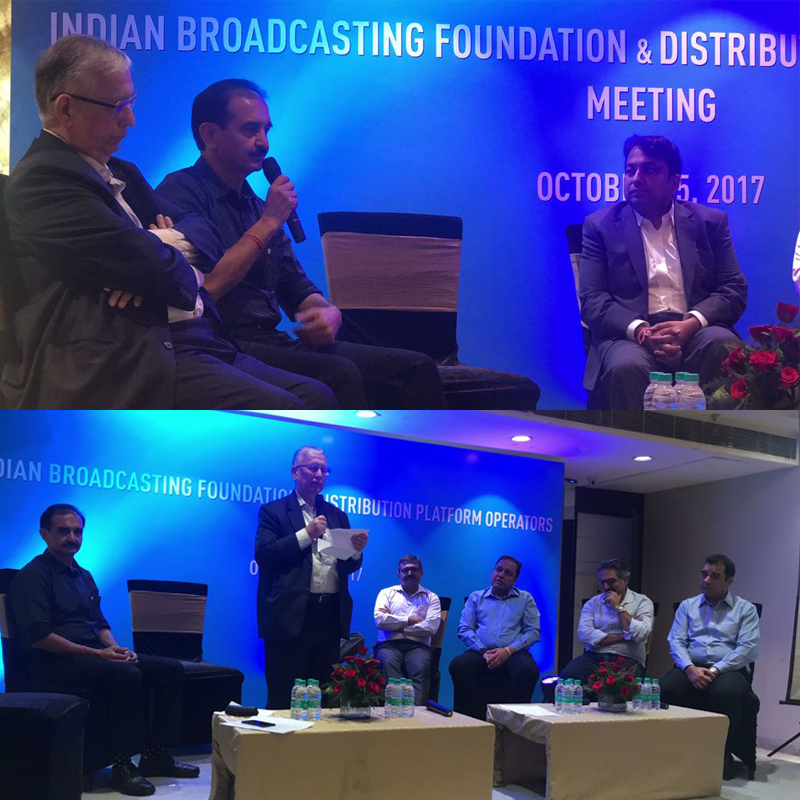
    Such were the thorny issues being discussed in a meeting held between the All India Digital Cable Operators Federation and the DTH Operators with the Indian Broadcasting Foundation (IBF) on Wednesday.

    As senior AIDCF member Ashok Mansukhani said that it was more appropriate for the stakeholders to meet in this manner than in courts of law.

    Among others, the meeting was addressed by IBF President Punit Goenka, Jawahar Goel of Dish TV, AIDCF President Rajan Gupta and senior office-bearer S N Sharma.

    Goel said there was an attempt by Punjab and other states to bring back what he termed as the ‘inspector raj’ by imposition of local taxes. Furthermore, he said broadcasters were free to give content to OTT or YouTube, but this should not be live as it would directly hit the DPOs like the DTH players and digital cable operators.

    The larger multi-system operators (MSO) said the inefficient handling of piracy by broadcasters was the cause of their suffering. Broadcasters neglect to take actiom against operators carrying analogue signal. There are small MSOs who do not have CAS & SMS system and do not follow TRAI QoS guidelines so broadcasters should refrain from giving content to them. Hence a joint industry task force should be made to raid such operators / MSOs and initiate legal action against those operators. The News Broadcasters Association should also be made part of this.

    Issues were also raised relating to OTT, Doordarshan’s FreeDish, and Reliance Jio and the DPOs alleged that providing signals to these entities led to huge losses to the digital cable and DPOs.

    Answering various question in a presentation, Goenka said OTT rights and digital cable rights were two different issues and should not be confused. OTT was an interactive and on-demand platform and in any case was never free being part of a subscription bandwidth. Thus this should not be compared with other platforms.

    YouTube content are only the ones that have already been broadcast and therefore, there was no conflict of interest. He denied any concessions to Reliance Jio and said it was in fact paying more than digital cable.

    He expressed concern by the Jio announcement that its mobile phone could receive the signals of not only new LCD/LED television sets but also the old sets. AIDCF said that this would bring Jio under TRAI’s regulations.

    Goenka said he will advise IBF members to take up the issue with OTT providers, especially Reliance Jio. In any case, he said the present contracts forbid such activity.

    He said broadcasters are not offering OTT content on television screen by connecting Reliance Jio phone through a cable and they prohibit such an activity. But agreeing with the concern of the AIDCF, he said this would be rigorously monitored and action will be taken in case there is any violation.

    Referring to the AIDCF charge that pay channels were being given as Free to Air (FTA) to Doordarshan’s FreeDish after paying huge carriage fees, Goenka said that broadcasters like Star and Sony are offering paid live content free on Freedish but with a time lag of one year. He agreed that this should be implemented across all genres and it should be completely free to all platforms.

    He said that in any case digital cable had more channels than FreeDish which primarily comprised FTA channels and so it was unreasonable to compare the two especially as the content was also being provided to digital cable operators.

    The speakers from AIDCF said MSOs have invested around Rs 200 billion in digitisation and are yet to get the return on their investment. This is primarily on account of the growth in rates that the broadcasters demand every year. Hence it was now the question of viability and survival of the MSOs that broadcasters should come out with their MRP based pricing.


  • Arasu to formally launch DAS in Chennai on Sept. 1

    Arasu to formally launch DAS in Chennai on Sept. 1

    NEW DELHI: The Tamil Nadu Arasu Cable TV Corporation, which is still to get a permanent digital licence necessary for an MSO, is formally launching its digital system on 1 September 2017. Tamil Nadu Chief Minister Edappadi K. Palaniswami is expected to grace the occasion.

    Ministry of Information and Broadcasting (MIB) had in April this year given a provisional MSO licence to Arasu on the condition that it adopts DAS within three months, a condition that has been extended from time to time.

    Taking the ground that it had failed to get an adequate number of digital set top boxes, TACTV or Arasu had sought extension for three months beyond mid-July, but the centre had only agreed to one month till 17 August 2017. Consequently, TACTV has been asked to complete the digitisation process by 17 August failing which the provisional the “registration may be suspended/revoked.”

    A TACTV official, who did not want to be named, had then told indiantelevision.com that the state government-controlled MSO already put up most of the digital head-ends and would be ready to transmit signals by mid-August.

    According to an Arasu official, the real problem lay in the availability and seeding of seven million digital set top boxes, which may take more time. It had floated tenders in this connection to get India-made STBs, the official had said.

    Arasu is aiming at six million standard definition (SD) set-top boxes and one million high definition (HD) set top boxes.

    The proposed TV services (300 channels to start with that would be expanded to 500) will be in MPEG 4 standard definition. About 30 TV channels would be beamed in HD, while there would be also provision for 20 FM audio services.

    Though the regional party in Tamil Nadu AIADMK, which regained hold over Tamil Nadu few years back, had promised to give free STBs to subscribers as part of its election campaign, Arasu sources said a final call on that will be taken by the chief minister.

    AIADMK, a political ally of the ruling BJP-led coalition in New Delhi, is presently in turmoil and witnessing intra-party churning.

    Few days back, local cable operators had held a protest rally against Arasu alleging that it was being handed favourable treatment by MIB and that distribution of free STBs would upset the business model other players in the state.

    Meanwhile, the government is still to take a final decision on repeated reports by the Telecom Regulatory Authority of India that states, political parties, and religious groups should not be permitted in broadcasting or distribution sectors.

    ALSO READ:

    Arasu gets a month’s extension to go digital

    Arasu seeks more time to go digital as it waits for STBs

    Arasu ‘monopolistic practices’ decried by LCOs, TN body seeks GST exemption

    Godfather, Kal, Digi Cable & Intermedia licence cancellation stayed, 50 ‘pan-India’ MSOs’ op area changed

  • MIB show-causes MSOs on incomplete digitisation info

    MIB show-causes MSOs on incomplete digitisation info

    NEW DELHI: Ministry of Information and Broadcasting (MIB) has issued show-cause notices to those MSOs who have failed to provide digitization details to the government, including the number of boxes seeded in their areas of operation.

    Quoting earlier government directives, MIB told the errant MSOs today in an official note that they had not submitted details of their headends, subscriber management system, number of mandatory TV channels being carried on their networks, apart from the total number of boxes seeded in the market. This information was to have been uploaded by MSOs at a designated place earmarked by MIB.

    “Whereas you have failed to furnish the said details to the Ministry within the stipulated time frame…why not your MSO registration be terminated/canceled?” the government has asked, directing the MSOs to provide the details within 15 days from 31 August 2017.

    Officially, the whole country was deemed digital on 1 April 2017, but in private both the government and industry stakeholders opine that pockets of analog TV distribution still persist and boxes are still being seeded in phase IV areas comprising small towns and villages primarily in rural areas and India’s hinterland.

    ALSO READ:

    DAS: MSOs, LCOs give low figure of STB seeding, official sources admit it’s under 80%

    Arasu DAS licence: Stakeholders fear flurry of similar requests & permissions

  • TRAI gives more time on responses to Paper on internet telephony which can affect mobile TV, IPTV

    TRAI gives more time on responses to Paper on internet telephony which can affect mobile TV, IPTV

    NEW DELHI: The Telecom Regulatory Authority of India today decided to give more time to stakeholders to respond to its consultation paper on internet telephony (VoIP).

    The paper had noted that unified IP based backbone and the benefits associated with the converged telecom access scenario has enabled service providers to launch more and more converged services such as Internet Telephony, IPTV, Mobile TV etc.

    TRAI has now asked stakeholders to respond by 22 August 2016 (which is exactly two months after the paper was issued on 22 June 2016) and give countercomments by 5 September 2016.

    The paper has sought to know the format of voice over internet telephony (VoIP) in India.

    The authority has pointed out that use of Internet Protocol (IP)-based networks, including the Internet, continues to grow around the world due to the multitude of applications it supports and particularly due to Voice Over IP (VoIP). IP-based networks are capable of providing real-time services such as voice and video telephony as well as non real-time services such as email and are driven by faster Internet connections, widespread take-up in broadband and the emergence of new technologies.

    The terms “IP Telephony”, “VoIP”, Internet Telephony and other variants often generates confusion as there are many different definitions used by various organizations. Some use them interchangeably while others give them distinct definitions. Further confusion is caused by using the terms to refer to both the IP-based technologies and the services that are enabled by these technologies.

    Convergence is primarily driven by increasing processing power, high capacity memory storage devices, reduced price, lesser power requirement and miniaturization of the devices. High-speed data transfer is now possible which is necessary for delivering innovative and advanced multimedia applications.

    Recent trends indicate that Telecom operators are adopting converged platforms to deliver multimedia rich applications containing voice, video and data.

    The separation of service provisioning and its management from the underlying network infrastructure in packet based networks is further increasing the acceptability of IP based Networks. It is now possible to separate provision of service contents, configuration and modification of service attributes regardless of the network catering such service. There has been enough evidence to suggest that in future IP networks will play much important role and may ultimately encourage migration of conventional networks towards Next Generation Networks or an All IP Network.

    The regulator wants to know what should the additional entry fee, Performance Bank Guarantee (PBG) and Financial Bank Guarantee (FBG) for Internet Service providers be if they are also allowed to provide unrestricted Internet Telephony.

    It says the point of Interconnection for Circuit switched Network for various types of calls is well defined, and should the same be continued for Internet Telephony calls or there is need to change Point of Interconnection for Internet Telephony calls.

    Trai has asked whether accessing of telecom services of the TSP by the subscriber through public Internet (internet access of any other TSP) can be construed as extension of fixed line or mobile services of the TSP.

    It wants to know whether the present ceiling of transit charge needs to be reviewed or it can be continued at the same level.

    The regulation has asked what the termination charge should be when call is terminating into Internet telephony network and whether an Internet telephony subscriber be able to initiate or receive calls from outside the SDCA, or service area, or the country through the public Internet thus providing limited or full mobility to such subscriber.

    Should the last mile for an Internet telephony subscriber be the public Internet irrespective of where the subscriber is currently located as long as the PSTN leg abides by all the interconnection rules and regulations concerning NLDO and ILDO, asks Trai.

    It wants to understand the framework if Number portability is allowed for Internet Telephony numbers.

    In case it is not possible to provide Emergency services through Internet Telephony, will it be enough to inform limitation of Internet Telephony calls in advance to the consumers, asks Trai.
    Since the 1960’s when digital voice communication first emerged, the Public Switched Telephone Network (PSTN) has been supported worldwide as the primary means of voice communication. The PSTN is a connection-oriented, circuit-switched network in which a dedicated channel (or circuit) is established for the duration of a communication. Originally transmitting only analog signals, the PSTN ultimately switched to digital communication, which offered solutions to the attenuation, noise and interference problems inherent in the analog system. The modern PSTN uses Pulse Code Modulation (PCM) to convert all analog signals into digital transmissions at the originating network and reverses the processes in the receiving network.

  • TRAI gives more time on responses to Paper on internet telephony which can affect mobile TV, IPTV

    TRAI gives more time on responses to Paper on internet telephony which can affect mobile TV, IPTV

    NEW DELHI: The Telecom Regulatory Authority of India today decided to give more time to stakeholders to respond to its consultation paper on internet telephony (VoIP).

    The paper had noted that unified IP based backbone and the benefits associated with the converged telecom access scenario has enabled service providers to launch more and more converged services such as Internet Telephony, IPTV, Mobile TV etc.

    TRAI has now asked stakeholders to respond by 22 August 2016 (which is exactly two months after the paper was issued on 22 June 2016) and give countercomments by 5 September 2016.

    The paper has sought to know the format of voice over internet telephony (VoIP) in India.

    The authority has pointed out that use of Internet Protocol (IP)-based networks, including the Internet, continues to grow around the world due to the multitude of applications it supports and particularly due to Voice Over IP (VoIP). IP-based networks are capable of providing real-time services such as voice and video telephony as well as non real-time services such as email and are driven by faster Internet connections, widespread take-up in broadband and the emergence of new technologies.

    The terms “IP Telephony”, “VoIP”, Internet Telephony and other variants often generates confusion as there are many different definitions used by various organizations. Some use them interchangeably while others give them distinct definitions. Further confusion is caused by using the terms to refer to both the IP-based technologies and the services that are enabled by these technologies.

    Convergence is primarily driven by increasing processing power, high capacity memory storage devices, reduced price, lesser power requirement and miniaturization of the devices. High-speed data transfer is now possible which is necessary for delivering innovative and advanced multimedia applications.

    Recent trends indicate that Telecom operators are adopting converged platforms to deliver multimedia rich applications containing voice, video and data.

    The separation of service provisioning and its management from the underlying network infrastructure in packet based networks is further increasing the acceptability of IP based Networks. It is now possible to separate provision of service contents, configuration and modification of service attributes regardless of the network catering such service. There has been enough evidence to suggest that in future IP networks will play much important role and may ultimately encourage migration of conventional networks towards Next Generation Networks or an All IP Network.

    The regulator wants to know what should the additional entry fee, Performance Bank Guarantee (PBG) and Financial Bank Guarantee (FBG) for Internet Service providers be if they are also allowed to provide unrestricted Internet Telephony.

    It says the point of Interconnection for Circuit switched Network for various types of calls is well defined, and should the same be continued for Internet Telephony calls or there is need to change Point of Interconnection for Internet Telephony calls.

    Trai has asked whether accessing of telecom services of the TSP by the subscriber through public Internet (internet access of any other TSP) can be construed as extension of fixed line or mobile services of the TSP.

    It wants to know whether the present ceiling of transit charge needs to be reviewed or it can be continued at the same level.

    The regulation has asked what the termination charge should be when call is terminating into Internet telephony network and whether an Internet telephony subscriber be able to initiate or receive calls from outside the SDCA, or service area, or the country through the public Internet thus providing limited or full mobility to such subscriber.

    Should the last mile for an Internet telephony subscriber be the public Internet irrespective of where the subscriber is currently located as long as the PSTN leg abides by all the interconnection rules and regulations concerning NLDO and ILDO, asks Trai.

    It wants to understand the framework if Number portability is allowed for Internet Telephony numbers.

    In case it is not possible to provide Emergency services through Internet Telephony, will it be enough to inform limitation of Internet Telephony calls in advance to the consumers, asks Trai.
    Since the 1960’s when digital voice communication first emerged, the Public Switched Telephone Network (PSTN) has been supported worldwide as the primary means of voice communication. The PSTN is a connection-oriented, circuit-switched network in which a dedicated channel (or circuit) is established for the duration of a communication. Originally transmitting only analog signals, the PSTN ultimately switched to digital communication, which offered solutions to the attenuation, noise and interference problems inherent in the analog system. The modern PSTN uses Pulse Code Modulation (PCM) to convert all analog signals into digital transmissions at the originating network and reverses the processes in the receiving network.

  • Bibhash Jha quits Star Sports, joins Siti Cable

    Bibhash Jha quits Star Sports, joins Siti Cable

    MUMBAI: Multi system operator (MSO) Siti Cable has roped in Bibhash Jha as its head-content & carriage. Jha in his capacity will provide a fillip to the growth momentum of Siti Cable. The MSO is taking giant strides in this exciting phase of digitisation and Jha will play an instrumental role in this leap from analog to absolute digitisation.


    Jha has over 20 years of distribution work experience with 15 years at Star Sports India, where he played an instrumental role in the transition of ESPN channel to Star Sports India. In 2007, he played a key role in the launch of new sports channel Star Cricket. Under his ambit, a separate vertical of MSO business was created which was profitable in its very first year of operation. He was also responsible for the distribution of sports channel for Star on pan India basis.


    Siti Cable executive director and CEO VD Wadhwa said, “We are delighted to have Bibhash Jha on board. With his rich experience of broadcasting & distribution business, he brings to us a competitive edge in strategizing business and accomplishing organisational goals.”


    Jha will be based at the Corporate Office of Siti Cable, Noida.


  • Analog Terrestrial TV Homes to decline 24 per cent by 2008

    Analog Terrestrial TV Homes to decline 24 per cent by 2008

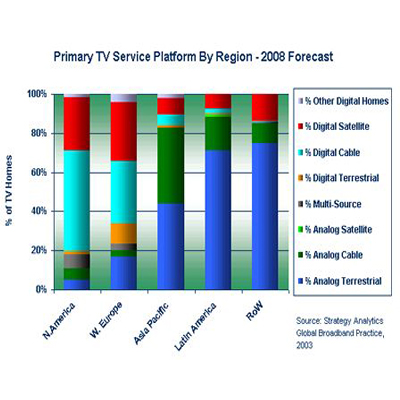
    LONDON : New research from Strategy Analytics, the global analyst and consulting firm, quantifies the steady decline of analog television broadcasting and the progress towards so-called ‘Analog Switch-Off’.
     

    The report, published to subscribers to the Broadband Entertainment Strategies service, shows that 597 million homes worldwide used analog terrestrial broadcasting as their primary TV service in 2002. With the growth of digital television services offered by satellite, cable and terrestrial operators, this number is forecast to decline by 24 per cent to 455 million by 2008.

    North America and Europe will be the most advanced markets in the digital TV transition by 2008, but the majority of homes in the rest of the world will still use analog terrestrial TV as their primary service. Even in the most advanced markets, however, a realistic analog switch-off strategy will have to account for the additional costs of converting hundreds of millions of secondary TV sets and VCRs.

    Analog switch-off is seen as a key policy goal by most governments. Releasing this valuable spectrum could ultimately lead to major new commercial and public revenue opportunities. The report suggests that few, if any, countries will be 100 per cent digital until well into the next decade. Some countries, such as Germany, will instead seek to use analog platforms such as cable as an alternative to terrestrial broadcasting. The report recommends that broadcasters relying strongly or wholly on analog terrestrial broadcasting for access to viewers must consider implementing alternative strategies and distribution partnerships in order to safeguard their long term position.