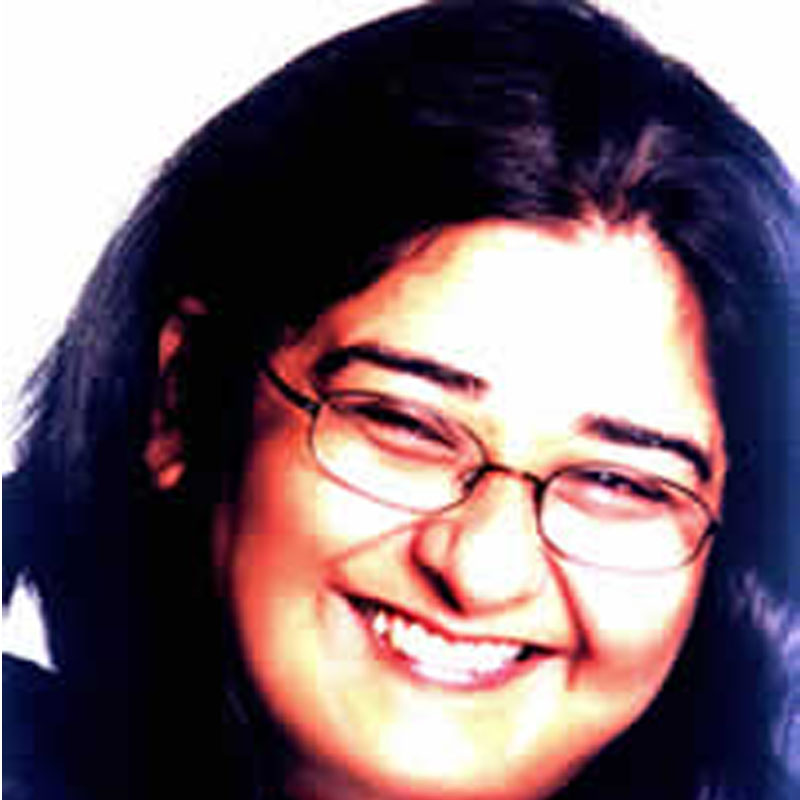
The fact that Vinta Nanda is a brilliantly creative writer, producer, director is undeniable. Every story that she has attempted explores fresh creative techniques, transcending boundaries. Vinta takes up new challenges and enjoys open-mind crossover experimentation in new genres and has always managed to find a committed audience for her work.
Born in Jammu and raised in Amritsar, Jallandhar, Kota, Ajmer, Indore and Chandigarh as her father’s transferable job in the LIC took the family to different places, Vinta’s tryst with writing began very early as she used reams and reams of paper on writing long letters to the friends who would so often be left behind when they moved to a new place.
Vinta is third in line amongst four siblings. Her holidays were spent with her paternal and maternal grandparents in Kashmir and Mumbai respectively. Academics failed to interest her except for political science in college. But, reading literary works, poetry, fiction, drama, essays, sketches, and writing have always appealed to her. Bachelor in Arts from Chandigarh, Vinta’s disinterest in pursuing further studies was a source of worry for her parents, but her two older sisters who were in Mumbai assured their father that his dreams for Vinta to be an achiever would be fulfilled.
 Just talking to her is an education, a little prodding brings forth a well-told vignette of what happened to her at different stages in her life. Vinta’s first job as an account’s executive was with Frank Simoes Advertising, which did not last more than six months. She aspired to be a journalist, but failed the interview for the Times of India journalists training programme as well as the Sophia College entrance test.
Through a family friend’s recommendation, she got a job as a production assistant with Shobha Doctor, who was then producing Idhar Udhar and Titliyan. That’s where she met Nadira Babbar, who was the director of Titliyan, and was inspired by her amazing passion for theatre, writing and music. She quit her job and joined Babbar’s theatre company Ekjute, and tasted blood. Vinta says, “I became obsessed with art, music, dance, literature and the sheer magic of the acceptance of the audience.”
But, following her passion did not help pay bills and with her sisters insisting she get a job to survive, she got lucky to land a job of an assistant director with Shekhar Kapur and Raman Kumar. She began getting regular work from Raman’s contemporaries and FTII batch mates. From 1983 to 1988 she worked as an assistant director and associate writer for the various TV serials and feature films like Rahee, Parbat Ke Us Paar, Tera Nam Mera Naam, Shabnam and Kasam Teri Kasam.
 She says, “I earned enough to pay my bills and do theatre until my father, who was the world to me, passed away suddenly and a sense of fear of the unknown gripped me and for some strange reason made me responsible. I floated my production company Tracinema in 1989 with Raman and began to produce, direct or write documentaries, ad films, short films, corporate films, telefilms and TV serials.”
Tracinema produced Umeed, Shatranj, V3plus, Raahat, Agnichakra, Raahein, Sansaar, Hero Uncle, 10 Civil Lines, Deewar, Sheila, Kasbah, Aur Phir Ek Din and many other one offs for TV.
Commenting on her work profile and achievements, Vinta says, “The fun times came with satellite television when I got the opportunity to co-produce and write the long running series Tara and its success till date illuminates and blesses our lives. The serial drove a new era and penetrated cable and satellite demographics because of which I got to do some of the best shows in the most progressive times of television in India.”
Her talents are combined with a demeanour and commitment that lifts the bar, personally and professionally, for everyone she has come in contact with, and that is a lot of people. Vinta’s portrayal of characters in her serials and films strike a chord with the viewers for being realistic and true to life. In an age where unreal family drama serials have managed to woo viewers, it is remarkable that her characters are a breath of fresh air and years later they have a high recall value among audiences.

In the 90’s Vinta ruled with Tara and by 1997 she had eight programmes on different TV channels when suddenly in just three days, all her programmes were pulled off air due to a change in management. A company of roughly 300 employees was reduced to nothing. Vinta recalls an incident that involved then Zee programming head Chandraprakash Dwivedi who told her, “Women like you are not allowed to enter my office or deserve an appointment.” She says that after being so successful, in one stroke she went on to being a nobody.
But talent gets its due recognition. Mahesh Bhatt got her to write for Kabhi Kabhi on Plus Channel. And, there was no looking back after that. Then came Rahen, Agnichakra, Aur Phir Ek Din and Sansar. “In 2004, I produced, wrote and directed my first feature film in English, White Noise, starring Rahul Bose and Koel Purie,” says Vinta on her projects. In a profession dominated by male writers, Vinta has made a mark from scratch. She has not left any genre untouched having tested drama, documentary drama, comedy, talk shows, interviews and feature films.
If that was not enough, on being asked if she would explore any other mediums after this, Vinta says, “I am promoting artistic excellence now. I am planning and creating infrastructures to support all performing and non performing arts of entertainment and doing my best to create a culture in my organization that nurtures talent. I want to help my employees to feel free from all external struggles so that they are free to deliver their best. Teaching is probably the only medium I haven’t explored and I intend pursuing it after a few years.”
|
Vinta’s unflinching enthusiasm is infectious as she speaks on trivial personal queries…
|
| Stress buster: An afternoon spent with my niece and nephew, Devki and Shiv |
| Formula for success: Work diligently and give your absolute to each moment |
| Best trait: I keep smiling, all the time |
| Dream gizmo: My new laptop |
| Favourite holiday spot: Goa |
| Worst nightmare: A bad DVD print of a good film |
| Two guests you would love to dine with: Amitabh Bachchan and Rabbi |
| What makes her laugh: ‘The Great Indian Laughter Challenge’ and Javed Jaffrey |
When asked if she fights male dominance in this industry and is it a challenge being a woman, Vinta says, “It is a challenge to survive this industry. Gender does not matter to me and therefore male dominance does not bother me. I do not fight male dominance, I do my job and do not get fazed about it being a man’s world while I work. If anybody forces me to see a different viewpoint, then I make sure he/she sees it my way too.”
Funding is perhaps the biggest obstacle for women filmmakers. Vinta says, “I do see big budget opportunities reaching out mostly to men but that could be, perhaps, because there are a larger number of men in our industry than women, especially in decision making areas.”
Adding, “A friend did point out to me, at the recently concluded Ficci convention that there were hardly any women up on the dais. Now that is a challenge for women to face collectively. We must get there and be there in equal numbers,”
On how the television industry is going to shape up in these times of more viewer choices and greater audience fragmentation, Vinta sounds positive that this is the best time for the television industry. She adds, “Viewer choices and fragmentation of audiences have been driven by technology. Content creators have all the opportunity in the world to explore new ideas. Finally that time has come when everything that once worked will not necessarily work the next time too. So, experimenting with genres will peak and every creative mind will find space.”
She is a resolute advocate of not succumbing to big bucks by writing inane rubbish. One can see why she enjoys her work and believes it to be her true calling, “There will be no monopolies and television will not remain television alone because content will flow like gushing waters of rivers through all available mediums. The more there is, will be less. I strongly believe that this era hails true democracy and freedom of speech. Whoever has something to say will not only have a platform, but also an audience.”
If one assumes that her work is her only priority, then read on to see the current issues on top of her agenda. “The gap between the haves and the have nots, poverty, illiteracy and human rights is disturbing. The incorrect portrayal of life and values and the lopsided and illogical definition of our morality.”
Another issue that ticks her off is hypocrisy and double standards of Indians and feudal behaviour of the rich that translate themselves into the caste system amongst the poor. “The lack of faith in systems and governance, politics slanting to religion and what worries me the most these days is the blurred lines between advertising and reporting,” says Vinta.
Her work reflects her thoughts. The Distant Thunder, Yeh Sadak Ke Bacche and Vaastav are some of the documentaries made by Vinta covering issues ranging from maternal and child health, women in development, Aids, rural development to the political and legal aspects of human rights issues. These were shown at many international forums and has received critical acclaim and appreciation for highlighting topical socially relevant issues.
 Vinta’s latest documentary Gender Bender discusses the achievements of women who have made their mark in traditionally male-dominated professions. It was launched last month in Delhi by finance minister P Chidambaram.
Among her weaknesses she lists being lazy and often overstaying her vacations, apart from hibernating for months, losing touch with the world and starting afresh when she returns. She regrets not being able to spend much time with her family and expects all of them to leave everything aside for her when she needs them. She adds that insomnia, her friends, Goa and her dog Charlie would also count as her weaknesses.
In the same breath she says that most of her weaknesses are also her strengths. Being a workaholic and craze for all arts and forms of entertainment, plus her knowledge of India, and the itch to travel are her positive strengths. “My mother who started working at the age of 50 and still works at the age of 70, travelling by bus from the suburbs to town three times a week, my daughter Ritchelle, my sisters and my brother,” are the people in her life who keep her going.
Yet it is not only her achievements that make her so special. She remains just as committed to many philanthropic activities. She founded an NGO called Project Smita Society in 1989, which made films for Unicef, Voluntary Health Association of India and other organizations. It was started with the objective to harness popular media so that its outreach could be the perfect vehicle for social change. “This Trust is my life. I am its working president and am in the process of broadening its base so as to be able to include all the talent that desires to contribute towards a better future.”
Among the many people who have helped her find a footing in life are Mahesh Bhatt, Raman, Anil Bahuguna, Gaurav Saxena and Moses. Vinta has just finished scripting Kali, a story of a child widow, and will produce/direct it next year. Meanwhile, she is currently working on a feature film Magic that is inspired from the life of Mahesh Bhatt.
Vinta’s honesty exudes confidence which reveals her down to earth nature. The pride with which she talks of job is unmistakable. She is without pretension or false modesty. And, touching base with her roots in everything she does is important to her. The story of her current show Millie on Star Plus is an example of how she translates simplicity in vision and thought to success.