Tag: Ampere Analysis

  • Covid2109: Entertainment industry to lose $160 billion over five years

    Covid2109: Entertainment industry to lose $160 billion over five years

    MUMBAI: The global entertainment sector will lose $160 billion of growth due to the Covid2109 pandemic in the coming five years, according to research by Ampere Analysis.

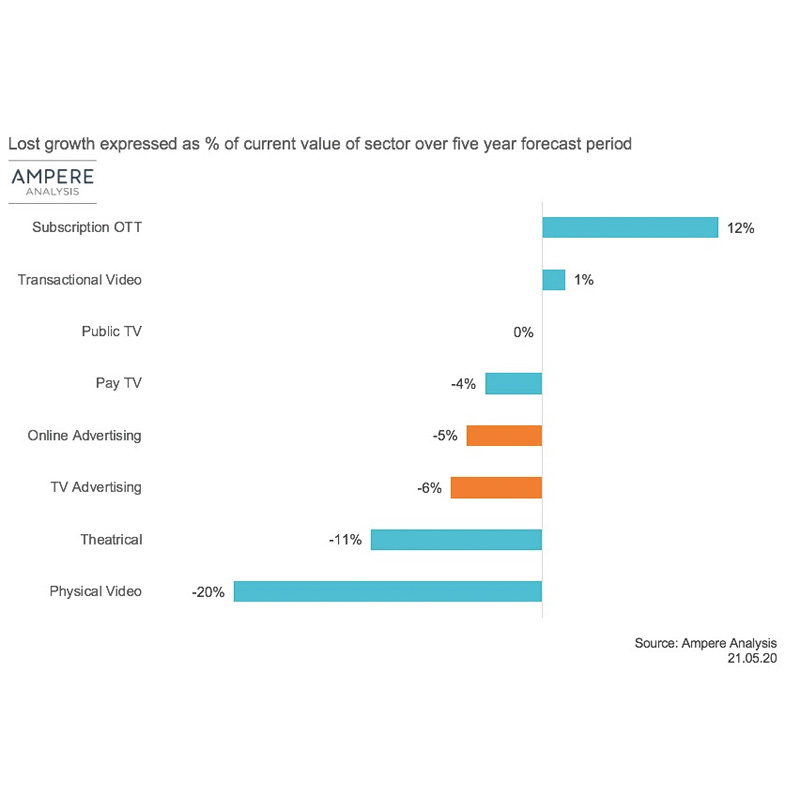
    "While the biggest impact will be felt in 2020 and throughout 2021, growth will be reduced each year for the duration of the five-year forecast period. While gross loss (the total amount of lost growth in dollar terms) will be greatest for the advertising sector, it’s also important to look at the relative impact pegged to the size of the sector. On that basis, theatrical will be hardest hit, set to lose $24.4 billion over the next five years, with its revenue growth down more than 11 percent over Ampere’s previous forecasts," says Ampere Analysis.

    The TV and online advertising market will lose almost $40 billion of revenue growth and $43 billion next year. Though a recovery can be expected in the year 2022, the figures will not come near the previous forecasts made by Ampere Analysis.

    Ampere Analysis research director Guy Bisson said that advertising has been hit the hardest. "The interconnected nature of the entertainment value chain means that will have a number of effects in other areas of the value chain. Some of which will not be fully felt for several years to come," he said.

    Shut theatres will have a direct bearing on theatrical revenues. However, the long-term effects “mean a glut of movies vying for release windows next year could ultimately lead to a slowdown in film production that impacts content acquisition and distribution further down the line," said the report.

    Streaming winner  

    Streaming, however, will remain the big winner with viewers relying on such platforms heavily. Streaming will achieve 12 per cent more revenue growth in the next five years, says the research firm. Lockdown across the world have led to an exponential increase in “streaming consumption and new subscriptions, benefiting subscription video-on-demand, broadcaster video-on-demand and other catch-up services."

    Pay TV, which has already gone through huge losses due to the lack of live sports, will be losing “significant value in what was already a challenging market structurally, representing around four per cent of its previously forecast value," says the research firm.

    Scripted TV to suffer

    The firm predicts disruption in the supply and release of new content for a year due to delays in production caused by Covid2019.

    While the unscripted market will likely to easily withstand the pandemic, the scripted TV sector will be affected, and its effects remaining so for the rest of the year and even into 2021. This will remain so even if production resumes by June.

    “There is one certainty among the current uncertainty – that the Covid2019 pandemic will change the TV production industry far beyond the end of the lockdown. Initially, we expect delays to cause gaps in scripted TV release schedules, which broadcasters and streaming players will have to fill with other content. However, as delayed productions begin to fill out content gaps in later months, these gaps will begin to close. But this has further ramifications. The knock-on effect of delayed releases is a likely depression of the number of new commissions for some time after the shutdown ends, as commissioners look to fill schedules with delayed projects they have already invested in before signing off new ones,” says Ampere Analysis senior analyst Fred Black. 

    Follow Tellychakkar for the consumer facing news & entertainment
  • SVod outpacing pay TV in W. Europe’s consumption trends: Report

    SVod outpacing pay TV in W. Europe’s consumption trends: Report

    MUMBAI: Subscription video on-demand (SVoD) content is increasing more and more as compared to Pay TV.

    Several discussions have taken place in India with the growing number of digital platforms. Broadcasters such as Star India, Viacom18, Zee Media and Sony Television, etc have entered this space with their own OTT/VOD platforms. Debates not just confined to the emergence of VOD platforms but also the entry of various global players have been raging since.

    The fact that digitisation is at a nascent phase in India only paved the way for the players to experiment various models. This also raised a few eyebrows on the existence of cable and satellite television.

    While most follow an advertising-led model or a ‘freemium model’, the countable ones have taken the challenge of following a subscription-based model. As print has survived after the entry of broadcast, analog and digital cable network will also co-exist with the emergence of various digital platforms. With the robust penetration of internet in the US, Pay TV has remained powerful.

    But is it the same everywhere else? Certainly not. The scenario is completely different in Western Europe. SVoD subscription has been outstripping Pay TV since 2012. The subscription net addition of Pay TV in 2016 is 2 million which is estimated to see a downfall by 2021 to 1 million.

    On the other hand, SVoD in 2016 is 9 million only and evaluated to come down to 3 million by 2021. Both the services are currently at its peak but are substantially going to see some disruption. This clearly shows that currently the viewers are ready to pay for good quality content.

    These were some of the findings presented in a report at IBC by Ampere Analysis, a London based analyst firm, at Amsterdam yesterday.

    According to the Ampere report, SVoD is growing as a significant segment not just in the USA but also in other countries such as Poland, France, the Netherlands, Spain, Italy, Germany, the UK, Sweden and Denmark. The average SVoD-only homes in the second quarter of 2015 has been 5 per cent while, in the current scenario, it has grown by 2 per cent for the first quarter.

    US specifically has seen a growth from 9 per cent to 13 per cent whereas the UK has seen an increase of 2 per cent from 8 per cent to 10 per cent in just a year.
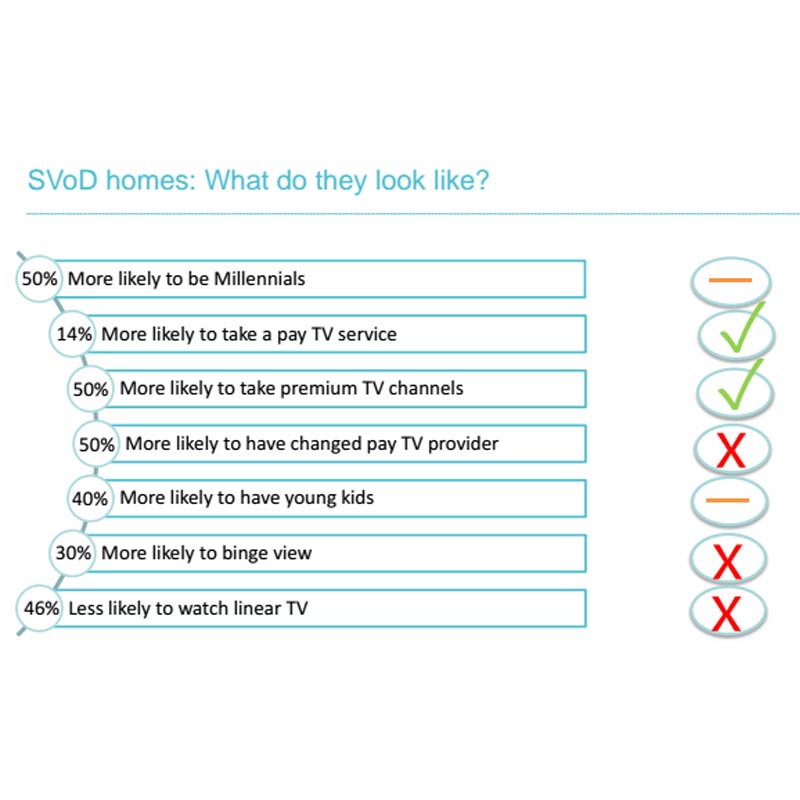
    So, what exactly do the SVoD homes constitute of? The three most relevant observations about who is consuming such massive content on digital platforms are — a big percentage comprise millennials, and the remainder people are more likely to take premium TV channels and some pertcentage have most likely changed their Pay TV provider.

    In all, 46 per cent are less likely to pay for linear TV, while 40 per cent of homes have kids. 30 per cent of the homes have shown an inclination to binge watching. Only 14 per cent of people have opted for a Pay TV service, according to Ampere.

    Business-wise, the concept of platform and channel is evolving though the producer and distributor remain unhampered. Earlier, content was distributed on platforms like Sky, Moviestar and Canalsat, etc which is now replaced by Facebook, Twitter, Snapchat, YouTube, etc. On the other hand, the channel from which content was ideally consumed has converted from Discovery, Fox, HBO, etc to digital platforms like Netflix, SeeSo, CuriosityStream, etc.

    Pay TV and new media products are segmenting, the report states.

    People with lower income are on-demand led whereas people with higher income are linear-led. Young millennials and teenagers can be appealed via services such as Whistle Sports, Soccer, Snapchat, Facebook,etc. Higher income traditional broadcast get pushed through Sky Q to protect high-end broadcast viewers. Direct To Consumers (DTC) cost to get a channel on air are considerably lower. So with a satellite you are going to take your yearly transponder, but with an OTT service you do not have that significant upfront cost. But, what you do have is a scaling cost, CDN delivery, that grows with your customer base.

    Ampere accepts that the latter factor makes OTT uneconomic for reaching very large audiences, estimating that for a single channel or service offering video in any definition from SD to UHD, a satellite feed works out cheaper beyond 10m viewers’ even if they watch on average just one minute of content per day. For a daily viewer base below 20,000, OTT always works out cheaper, even if all viewers watched five hours of content a day and all content was transmitted inUHD, Ampere found.

    With changing economics, channel groups are increasingly looking to Direct To Consumers (DTC) SVOD service. Viewers/advertising spends have shifted to online, operators are pushing back on channel carriage fee, content owners’ margins have squeezed and the DTC, SVoD launch have led to recoup margin. The millennials are already approaching two SVOD services per home. In the US, millennials have crossed the more than 2 number than the average. They are approaching to the number in Germany, Denmark, Poland and UK. Out of the 1002 sample survey, 255 are Netflix customers in UK which only means that the country is most likely to have more Netflix customers.

    It is not all about broadband penetration, because size is also important. And actually if we look at the size of the addressable market, emerging markets like Mexico, Brazil, Russia, China, Taiwan, Thailand, etc all have started to become interesting [DTC] markets when we talk about the total addressable size.

    Ampere’s research found that in the UK a Netflix customer is 1.5 times more likely than average to also take Sky’s Now TV OTT service; 1.8 times more likely to also take Amazon; 2.5 times more likely also to take Spotify’s streaming music services; and 1.5 times more likely to use the catch-up TV apps of the major broadcasters.

    To date, Netflix’s growth strategy has relied on geographic expansion. But, its set to run out of road by 2017. Central, South and Western Europe saw 6 customer additions on an average in 2015 which has reduced to 4 or 5 in 2017 further reducing in 2021. But in Asia Pacific region, the customer addition has gone up from 1 to 5 and is estimated to be 3. Even after this, the fact that Netflix has invested a huge amount of money on content cannot be ignored. Netflix is spending like a broadcast or premium channel group. It spends 60 per cent revenue on program followed by premium platforms contributing 40-70 per cent revenue. Pay multichannels are putting 30-40 per cent revenue on programs.

    Pay TV is still growing but OTT is growing faster – much faster. And that fact sums up both the threat and the opportunity that OTT video presents to platform operators. The survival of service providers depends on their ability to launch new services ahead of the competition.

  • SVod outpacing pay TV in W. Europe’s consumption trends: Report

    SVod outpacing pay TV in W. Europe’s consumption trends: Report

    MUMBAI: Subscription video on-demand (SVoD) content is increasing more and more as compared to Pay TV.

    Several discussions have taken place in India with the growing number of digital platforms. Broadcasters such as Star India, Viacom18, Zee Media and Sony Television, etc have entered this space with their own OTT/VOD platforms. Debates not just confined to the emergence of VOD platforms but also the entry of various global players have been raging since.

    The fact that digitisation is at a nascent phase in India only paved the way for the players to experiment various models. This also raised a few eyebrows on the existence of cable and satellite television.

    While most follow an advertising-led model or a ‘freemium model’, the countable ones have taken the challenge of following a subscription-based model. As print has survived after the entry of broadcast, analog and digital cable network will also co-exist with the emergence of various digital platforms. With the robust penetration of internet in the US, Pay TV has remained powerful.

    But is it the same everywhere else? Certainly not. The scenario is completely different in Western Europe. SVoD subscription has been outstripping Pay TV since 2012. The subscription net addition of Pay TV in 2016 is 2 million which is estimated to see a downfall by 2021 to 1 million.

    On the other hand, SVoD in 2016 is 9 million only and evaluated to come down to 3 million by 2021. Both the services are currently at its peak but are substantially going to see some disruption. This clearly shows that currently the viewers are ready to pay for good quality content.

    These were some of the findings presented in a report at IBC by Ampere Analysis, a London based analyst firm, at Amsterdam yesterday.

    According to the Ampere report, SVoD is growing as a significant segment not just in the USA but also in other countries such as Poland, France, the Netherlands, Spain, Italy, Germany, the UK, Sweden and Denmark. The average SVoD-only homes in the second quarter of 2015 has been 5 per cent while, in the current scenario, it has grown by 2 per cent for the first quarter.

    US specifically has seen a growth from 9 per cent to 13 per cent whereas the UK has seen an increase of 2 per cent from 8 per cent to 10 per cent in just a year.
    So, what exactly do the SVoD homes constitute of? The three most relevant observations about who is consuming such massive content on digital platforms are — a big percentage comprise millennials, and the remainder people are more likely to take premium TV channels and some pertcentage have most likely changed their Pay TV provider.

    In all, 46 per cent are less likely to pay for linear TV, while 40 per cent of homes have kids. 30 per cent of the homes have shown an inclination to binge watching. Only 14 per cent of people have opted for a Pay TV service, according to Ampere.

    Business-wise, the concept of platform and channel is evolving though the producer and distributor remain unhampered. Earlier, content was distributed on platforms like Sky, Moviestar and Canalsat, etc which is now replaced by Facebook, Twitter, Snapchat, YouTube, etc. On the other hand, the channel from which content was ideally consumed has converted from Discovery, Fox, HBO, etc to digital platforms like Netflix, SeeSo, CuriosityStream, etc.

    Pay TV and new media products are segmenting, the report states.

    People with lower income are on-demand led whereas people with higher income are linear-led. Young millennials and teenagers can be appealed via services such as Whistle Sports, Soccer, Snapchat, Facebook,etc. Higher income traditional broadcast get pushed through Sky Q to protect high-end broadcast viewers. Direct To Consumers (DTC) cost to get a channel on air are considerably lower. So with a satellite you are going to take your yearly transponder, but with an OTT service you do not have that significant upfront cost. But, what you do have is a scaling cost, CDN delivery, that grows with your customer base.

    Ampere accepts that the latter factor makes OTT uneconomic for reaching very large audiences, estimating that for a single channel or service offering video in any definition from SD to UHD, a satellite feed works out cheaper beyond 10m viewers’ even if they watch on average just one minute of content per day. For a daily viewer base below 20,000, OTT always works out cheaper, even if all viewers watched five hours of content a day and all content was transmitted inUHD, Ampere found.

    With changing economics, channel groups are increasingly looking to Direct To Consumers (DTC) SVOD service. Viewers/advertising spends have shifted to online, operators are pushing back on channel carriage fee, content owners’ margins have squeezed and the DTC, SVoD launch have led to recoup margin. The millennials are already approaching two SVOD services per home. In the US, millennials have crossed the more than 2 number than the average. They are approaching to the number in Germany, Denmark, Poland and UK. Out of the 1002 sample survey, 255 are Netflix customers in UK which only means that the country is most likely to have more Netflix customers.

    It is not all about broadband penetration, because size is also important. And actually if we look at the size of the addressable market, emerging markets like Mexico, Brazil, Russia, China, Taiwan, Thailand, etc all have started to become interesting [DTC] markets when we talk about the total addressable size.

    Ampere’s research found that in the UK a Netflix customer is 1.5 times more likely than average to also take Sky’s Now TV OTT service; 1.8 times more likely to also take Amazon; 2.5 times more likely also to take Spotify’s streaming music services; and 1.5 times more likely to use the catch-up TV apps of the major broadcasters.

    To date, Netflix’s growth strategy has relied on geographic expansion. But, its set to run out of road by 2017. Central, South and Western Europe saw 6 customer additions on an average in 2015 which has reduced to 4 or 5 in 2017 further reducing in 2021. But in Asia Pacific region, the customer addition has gone up from 1 to 5 and is estimated to be 3. Even after this, the fact that Netflix has invested a huge amount of money on content cannot be ignored. Netflix is spending like a broadcast or premium channel group. It spends 60 per cent revenue on program followed by premium platforms contributing 40-70 per cent revenue. Pay multichannels are putting 30-40 per cent revenue on programs.

    Pay TV is still growing but OTT is growing faster – much faster. And that fact sums up both the threat and the opportunity that OTT video presents to platform operators. The survival of service providers depends on their ability to launch new services ahead of the competition.