Tag: Amitt Sharma

  • JBL, VDO.AI and Havas Media tune into festive storytelling on CTV

    JBL, VDO.AI and Havas Media tune into festive storytelling on CTV

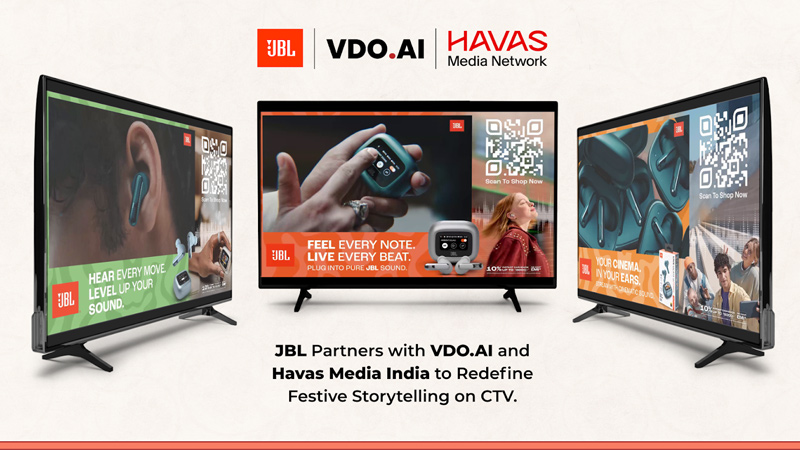
    MUMBAI: This Diwali, JBL is giving festive advertising a new sound. The premium audio brand has joined hands with advertising technology leader VDO.AI and Havas Media India to launch an interactive connected TV campaign for its latest wireless earbuds, JBL live beam 3.

    Timed to the Diwali shopping rush, the campaign blends discovery with purchase in a single screen experience. At its heart is VDO.AI’s ad suite, featuring a scannable QR Code wrapper that let’s viewers shift seamlessly from watching to buying. A quick scan unlocks the JBL live beam 3 product page, turning the television into both showcase and store. The campaign will reach households in Delhi, Mumbai, Bengaluru, Hyderabad, Chennai, Kolkata, Pune, Ahmedabad, Cochin and other fast-growing cities.VDO.AI

    “At JBL, innovation has always been at the core of our brand. With the JBL live beam 3 earbuds, we’re turning sound into a truly immersive experience,” said Harman India consumer audio, head of digital marketing, Akhil Sethi. “This festive season we’re reimagining how product campaigns come alive on CTV. Partnering with Havas Media India and VDO.AI we are transforming awareness into interaction and curiosity into action.”

    VDO.AI, ceo and co-founder, Amitt Sharma added, “With JBL, we saw an opportunity to take a premium brand and give it an equally premium advertising journey. Our CTV technology makes video interactive, ensuring viewers don’t just watch JBL’s product but engage with it. This is the future of advertising.”

    Havas Media India, chief digital officer, Rohan Chincholi said, “CTV is fast emerging as the new prime time. With JBL and VDO.AI, we have created a festive campaign that brings creativity, technology and storytelling together for maximum impact.”

    The campaign is now live across premium CTV environments, creating a festive push in the run-up to Diwali and setting a new benchmark for connected brand experiences.

  • Vdo.ai lights up festive ads with formats that click, swipe and convert

    Vdo.ai lights up festive ads with formats that click, swipe and convert

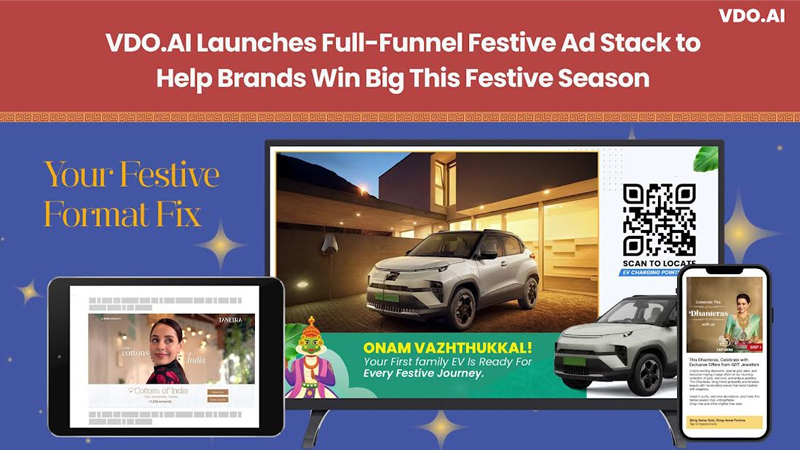
    MUMBAI: ‘Tis the season to click smarter and Vdo.ai is making sure brands do just that. As India’s festive fervour kicks off, the global adtech platform has unwrapped a brand-new suite of high-impact ad formats designed to cut through the Diwali din and deliver measurable marketing sparkle.

    Timed to catch the big spending wave from now through the end of the year, the new solutions span Connected TV (CTV), online video, and mobile rich media. But these aren’t just pretty packages, they’re powered by some serious tech. Expect Remote-Based Integrations that let users shop using their TV remotes, Countdown-Based creatives to drive FOMO, and Dynamic Creative Optimisation that adjusts ads based on everything from AQI to your current location.

    In short, it’s personalisation at scale and precision with performance.

    “Our festive ad suite is engineered to go beyond just visibility,” said Vdo.ai co-founder and CEO Amitt Sharma. “Whether it’s hitting ~95 per cent video completion rates on CTV or outperforming click-through benchmarks across display and video, the aim is simple: help brands convert high-intent festive shoppers into loyal customers.”

    For brands braving a landscape where attention spans are shorter and budgets tighter, these formats also bring engaging flair think Parallax scrolls, 3D Cube animations, Expandable Carousels, Motion Sensor-triggered ads, and even Trivia Quizzes. All powered by Gen AI, Weather APIs, Geo-Location and real-time data.

    Vdo.ai co-founder and CTO Arjit Sachdeva added: “The festive season is a peak moment for consumer interaction. With our full-stack tech, brands can now connect with users at the perfect time with the perfect message and track it all.”

    India’s ad spending traditionally spikes during the October–December festive stretch. According to industry estimates, digital advertising alone sees a 30–35 per cent increase during this period. Vdo.ai’s festive suite is built for brands looking to ride that surge and do more than just show up.

    With global reach and local tech muscle, the company’s pitch is clear: Let others light diyas. You light up dashboards.

  • Fashion sizzles on CTV with 97 per cent ad completion rate: VDO.AI report

    Fashion sizzles on CTV with 97 per cent ad completion rate: VDO.AI report

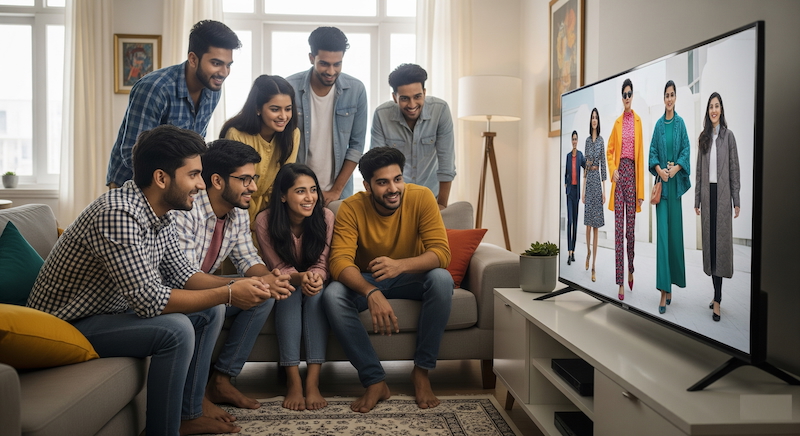
    MUMBAI;  Viewers in India are tuning in and staying glued to fashion ads on connected TV, with a staggering ~97 per cent video completion rate, according to a new report from adtech player VDO.AI. The study, released on 4 July, reveals that fashion brands are reaping the benefits of immersive, distraction-free CTV formats, with advanced formats like DCO and API-triggered ads powering 67 per cent of top-performing campaigns.

    Fashion storytelling is thriving in CTV’s premium environments, particularly in southern cities. Bengaluru, Chennai, Hyderabad and Goa are leading the charge, posting an 87 per cent higher engagement rate compared to their northern counterparts, including Delhi and Jaipur.

    Fashion Ads on CTVVDO.AI co-founder & chief executive Amitt Sharma said: “CTV represents the convergence of cinematic storytelling capability with precision target ing that fashion brands require. Such a heightened completion rate validates our thesis that when content quality meets the right viewing environment, consumer engagement follows naturally. We are sure these insights will help fashion marketers make the right decision to move beyond traditional impression-based campaigns toward more sophisticated storytelling approaches that build emotional connections with consumers.”

    What's powering Top fashion campaigns on CTVCo-founder & chief technology officer Arjit Sachdeva pointed to the visual appeal of CTV for fashion campaigns. “CTV provides a high-quality, distraction-free, full-screen experience, especially powerful for a visually driven category like fashion.,” he explained. “As a result, fashion brands are increasingly leveraging advanced CTV advertising formats to create shopping-like experiences. Interactive elements such as CTV carousel ads and store discovery units are enabling viewers to explore collections and brand offerings without leaving their screens, mimicking the intuitive browsing behaviour familiar from social media and e-commerce 
    platforms.”

    As fashion advertisers chase performance over reach, VDO.AI’s latest data signals a fundamental shift—CTV is no longer just for awareness; it’s driving real engagement, brand recall and intent.

  • Ad-scrollers welcome VDO.AI’s new format puts static in motion

    Ad-scrollers welcome VDO.AI’s new format puts static in motion

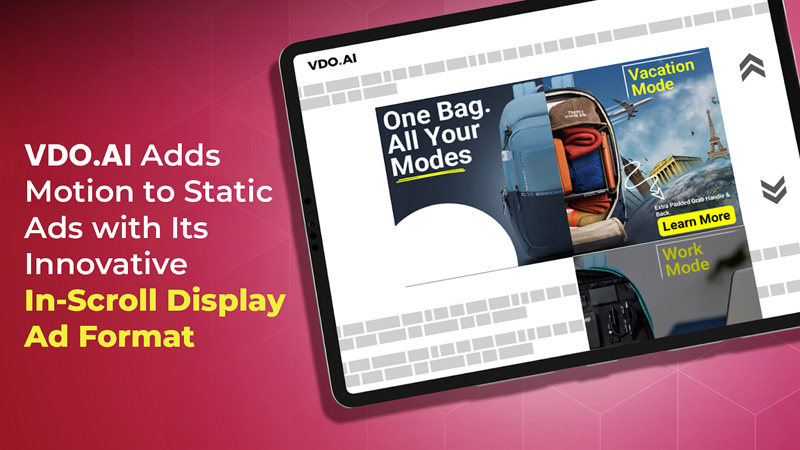
    MUMBAI: Scrolling just got a serious glow-up. In a bid to rewire how static ads grab attention, advertising tech innovator VDO.AI has unveiled a first-of-its-kind In-Scroll Display Ad Format, breathing 3D motion and interactivity into the previously one-dimensional world of banner ads. This dynamic new format features a slick 50-50 split-screen design half static brand imagery, half immersive product storytelling. But the real twist? As users scroll through content, the ad responds with subtle 3D transitions and interactivity, making viewers stop mid-scroll and engage.

    The result? A 25 per cent uplift in engagement rates, proving that the future of display isn’t just visible, it’s scroll-activated.

    VDO.AI co-founder and CEO Amitt Sharma said, “This format infuses static creatives with vitality and dimension. As consumers grow more selective in their digital interactions, ads must not only be seen they must be felt. This format helps brands do both.”

    Designed to work across desktop and mobile, the ad unit marks a step-change for marketers aiming to break the banner-blindness curse. The format brings storytelling to the scroll, letting users explore USPs, features, and even animations within the ad frame without clicking away.

    VDO.AI, CTO Co-founder Arjit Sachdeva, added, “This is more than just a format, it’s a reimagination of what static ads can be in a performance-first world. We’re constantly evolving our ad tech stack to keep brands a step ahead in crowded digital spaces.”

    As attention spans shrink and scroll speeds soar, VDO.AI’s latest innovation gives brands a tactile edge proof that in today’s digital game, motion may just be the new emotion.
     

  • Howzzat for Ads VDO.AI bowls over brands with cricket-themed formats

    Howzzat for Ads VDO.AI bowls over brands with cricket-themed formats

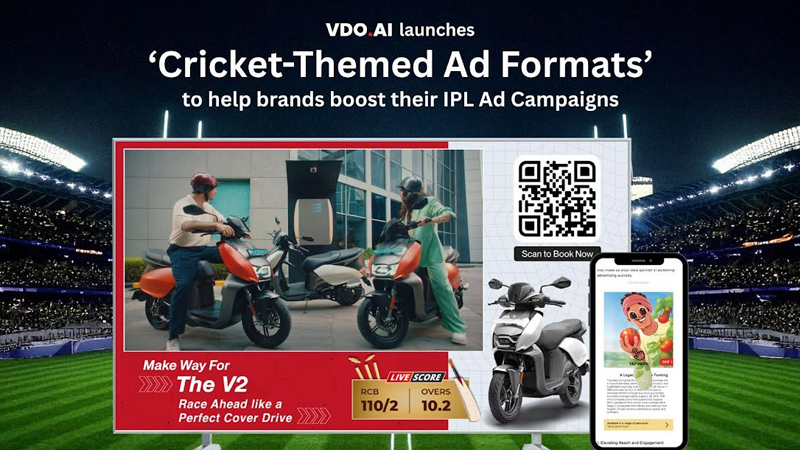
    MUMBAI: As cricket fever grips the nation, VDO.AI is padding up to help brands hit advertising for six with the launch of its new cricket-themed ad formats for Connected TV (CTV) and display. Just in time for the IPL frenzy, the global advertising tech player has introduced QuickFrame, Interactive Storytelling, and InMotion, a trio of formats engineered to turn ad breaks into applause-worthy moments.

    Designed to capitalise on cricket’s real-time thrill, these formats offer more than just flashy visuals. They come loaded with dynamic features like live match score integration, event-triggered messages for boundaries, sixes, and wickets, and animated creative assets reflecting team colours. It’s not just advertising, it’s a second-screen experience.

    VDO.AI, founder and CEO Amitt Sharma said, “At VDO.AI, we operate at the dynamic intersection of brands and advertising platforms, serving as the bridge that empowers both to elevate their advertising strategies through our innovative ad solutions. With our newly launched cricket-themed ad formats, we are not only reimagining the way brands advertise during sporting events but also setting a new benchmark to drive engagement and return on investment (ROI). By moving beyond passive, run-of-the-mill ads to dynamic, interactive experiences, our vision is to supercharge advertising, empowering brands with innovative tools that drive deeper audience engagement and lasting brand recall”.

    VDO.AI, co-founder and CTO Arjit Sachdeva stated, “As cricket viewership, especially IPL, in the country has scaled to unprecedented heights, brands are vying for consumer attention and want to leave no stone unturned to maximise the ROI of their advertising campaigns. At VDO.AI, technology is at the core of everything we do. From real-time scorecard integrations to dynamic, moment-driven creatives and interactive QR codes, VDO. AI’s cricket-themed ad formats have the potential to help brands cut through the noise and transform such cricketing events into a hub for digital engagement.”

    The formats also go interactive with QR code integration and carousel galleries, nudging viewers toward immediate action whether it’s redeeming a promo, booking a ride, or diving deeper into the brand. No more passive scrolling, this is real-time call-to-action at its finest.

    Backed by an AI-powered contextual engine, VDO.AI’s innovation allows advertisers to make their content as thrilling as the match itself. And as the IPL season continues to keep millions glued to their screens, VDO.AI’s cricket-infused formats are giving brands a whole new way to play ball.

    In a season where every over counts, VDO.AI is making sure no opportunity goes un-hit blending cricket’s excitement with ad-tech smarts to deliver campaigns that truly score.
     

  • VDO.AI achieves Google Certified Publishing Partner status

    VDO.AI achieves Google Certified Publishing Partner status

    Mumbai: VDO.AI, the foremost global advertising technology innovator, proudly announces its recent certification as a Google Certified Publishing Partner (GCPP) marking a significant milestone in the company’s commitment to delivering cutting-edge solutions for advertisers and publishers. This achievement not only underscores VDO.AI’s dedication to excellence but also heralds a new era of lucrative revenue monetization, unwavering commitment to quality, and transparency opportunities for publishers globally.

    VDO.AI secured its prestigious Google Certified Publishing Partner status through a comprehensive evaluation process, highlighting the company’s profound expertise and demonstrated success in delivering outstanding outcomes for clients. This thorough assessment considered diverse elements, such as generating revenue for publishers, maintaining publisher relationships, ensuring customer satisfaction, and more.

    VDO.AI’s Google Certified Publishing Partner status delivers a comprehensive array of benefits to publishers, solidifying its role as a strategic ally. Equipped with advanced tools for revenue monetization aligned with industry best practices, VDO.AI ensures a seamless commitment to quality, evident in the assurance of optimal Google health scores. Addressing industry challenges such as ad spending slowdowns, VDO.AI’s certified solutions empower publishers with unmatched agility and flexibility. Moreover, VDO.AI’s specialized expertise successfully mitigates spoiler challenges, fortifying a secure and fraud-resistant advertising environment for publishers.

    “Our Google Certified Publishing Partner status is not just a certification; it’s a demonstration of our unwavering dedication to providing solutions that empower publishers to thrive. We are excited about the potential for revenue monetization and user engagement that this certification brings, reinforcing our mission to redefine the possibilities of digital advertising,” commented VDO.AI CEO Amitt Sharma.

    “We are thrilled to achieve the prestigious Google Certified Publishing Partner status. This certification not only validates our commitment to providing top-notch solutions but also reinforces our dedication to the success of our partners. As we continue to push the boundaries of advertising technology, this recognition positions us as a key player in shaping the future of digital advertising,” added VDO.AI CTO Arjit Sachdeva.

  • VDO.AI reinvents brand engagement with Dexter

    VDO.AI reinvents brand engagement with Dexter

    Mumbai: VDO.AI, a leader in the advertising technology industry, unveils Dexter, a game-changing creative feature poised to redefine brand engagement by harnessing the power of innovative Gen AI algorithms. In today’s fast-paced digital arena, brand engagement isn’t just crucial; it’s the lifeblood of success. Recognising the ever-evolving landscape of consumer expectations, VDO.AI introduces Dexter, a groundbreaking tool that will revolutionise how brands connect with their audiences.

    Dexter is a testament to the fusion of creativity and technology. It leverages the capabilities of Gen AI algorithms to empower brands with the ability to craft deeply personalised, contextually relevant, and visually stunning content. By understanding individual user preferences, Dexter ensures that brands can deliver messages that resonate deeply, fostering authentic connections. Moreover, this avant-garde technology streamlines content creation, enabling brands to deliver the right message at precisely the right moment.

    Key Features of Dexter:

    •    Personalisation perfected: Dexter analyses user data to create bespoke content that speaks directly to individual preferences, thereby boosting user engagement and retention.
    •    Contextual brilliance: Understanding the context of user interactions, Dexter ensures that brands provide timely and relatable content, forging more profound connections.
    •    Visual mastery: Dexter elevates visual elements, creating attention-grabbing and memorable content that lingers in the minds of the audience.
    •    User-friendly integration: Dexter effortlessly integrates into existing marketing strategies, making it accessible and adaptable for brands of all sizes.

    The launch of Dexter represents a significant milestone in VDO.AI’s relentless pursuit of innovation in the digital advertising arena. Brands that embrace Dexter can anticipate heightened user engagement, increased conversion rates, and strengthened brand loyalty.

    VDO.AI CEO and founder Amitt Sharma shared his excitement about Dexter: “We find ourselves on the verge of a groundbreaking era in brand-consumer interaction. Dexter empowers us to establish dynamic connections with our audiences, converting passive observers into engaged participants. This achievement signifies a pivotal milestone in amplifying customer engagement and loyalty, as it allows us to harness the interactive potential that AI offers—a facet that brands have yet to fully explore.”

    “We are thrilled to introduce Dexter to the market. In a landscape where user engagement is king, Dexter empowers brands to create authentic, impactful connections. This innovation is set to reshape the very foundations of digital advertising.” added VDO.AI co-founder Arjit Sachdeva.

    Dexter is now available, offering forward-thinking brands an opportunity to elevate their brand engagement strategies. It unlocks endless avenues for brands to explore novel approaches, fostering innovation that resonates on multiple levels of engagement.

  • GUEST COLUMN: How conversational AI is helping adtech brands maximize advertising ROI

    GUEST COLUMN: How conversational AI is helping adtech brands maximize advertising ROI

    Mumbai: The role of Artificial Intelligence (AI) in adtech has become pivotal over the years. It started with simple bots that helped customers with basic queries and requests through voice or text & now has evolved into sophisticated conversational AI. It is capable of Automatic Speech Recognition (ASR) for taking voice inputs and formulating a context-specific response in real-time. After all, understanding natural language and providing a meaningful response is the key to creating a seamless experience for customers, and this is where conversational AI comes into play.

    Traditional online advertising was not successful in engaging customers

    As digitization has exponentially increased in the past years, it has become difficult to cater to customer demands manually, and automation has been widely experimented with in the adtech sector. The drawbacks of conventional chatbots ranged from being disengaged and irrelevant to frustratingly non-conversational. The seemingly robotic nature of digital advertisements led to a lot of digital campaigns going to dust.

    The result often used to be a loss in customers rather than a hike due to an uncontrolled and unthoughtful message being conveyed via the use of ineffective chatbots. A general lack of understanding of the customer’s intent and providing them with a specific solution were the topmost issues in the area of customer support. A lot of brands are now trying to implement conversational AI into their existing AdTech stack with varying levels of success. Some are doing it right, while others still have a long way to go.

    The modern-day consumer demands more than being sold a product

    Personalisation can be boosted from the very inception of a customer journey through predictive analysis. This innovation helps companies in customer personification, giving them access to a lot of structured data throughout the customer journey. The AI can analyse all the data available on a particular customer and predict what they want based on past behaviour. This enhances the prospects of call-to-action, directly impacting the revenues by 21 percent organically.

    The customer’s AI-generated avatar helps build a personalised experience in an omnichannel ecosystem for advertisements. The analysis is effective across these channels, and the consistent brand voice communicated to the customer imparts a sense of connection that aligns with the customer’s mindset. This plays a critical role in keeping them engaged as building upon previous impressions becomes easier and cost-effective due to reduced cost per acquisition (CPA). Customers are no longer just numbers on a spreadsheet; they are individuals with unique goals and needs. This is why conversational AI is such an essential technology for advertisers today.

    Conversational AI uses intuitive technologies to interact with their customers

    Conversational AI is a game-changer for the adtech industry. It is creating new opportunities for brands to maximise their advertising ROI. It offers in-depth customer insights that help adtech companies understand, adapt and respond to customer needs, thereby improving engagement and sales.

    It helps businesses create targeted audiences based on data analysis around various factors, including age, gender, location, and more. This helps deliver specific content to different groups of people, boosting engagement and sales. Predictive analysis by AI significantly reduces turnaround time, making it easier for companies to meet deadlines without sacrificing quality or spending more money on additional resources like hiring full-time employees for each department (like marketing).

    Conversational AI can analyse conversations between consumers and brands, which allows businesses to predict what their customers want next. This data can then be used to personify a consumer’s identity as part of their journey through the sales funnel so that they feel more connected than ever before.

    Summing up

    As the industry moves towards conversational commerce, it has become clear that conversational AI will play a fundamental role in driving this change. And because it’s built into an existing CRM system, the existing infrastructure can be used without having to make significant changes or upgrades. AI-powered chatbots are, therefore, the future of customer service, with the industry poised to reach a whopping $14 billion by 2025.

    The author is Amitt Sharma, Founder and CEO, VDO.AI

  • GUEST COLUMN: Relevance of conversational AI in adtech sector

    GUEST COLUMN: Relevance of conversational AI in adtech sector

    Mumbai: Conversational AI, which allows contextual dialogue through advanced algorithms that enable superior, result-oriented, human-like conversations, emerged due to the shortcomings of traditional chatbots. Individuals were often fraught with the challenge of searching for a specific product or customised financial services online and being disappointed since all the results displayed were irrelevant due to certain mismatched algorithms. Likewise, a bot interaction cannot yield the desired outcome if the keywords do not match with the pre-programmed list. This can trigger the user to the extent that they may altogether discontinue the existing services or shift their business to another organization. Needless to say, bot responses can be predictive, repetitive, disengaged, impersonalised, and more often than not, far placed from the real solution.

    Owing to its advantages, adtech industry has been one of the fastest to leverage the benefits of Conversation AI since it has the potential to catapult the ecosystem to the next realm. These advertisements are the most effective ways of instilling a sense of personalisation that drives a long-lasting, meaningful connection between the brand and its target audience. Conversational advertising allows customers to exchange information with brands, providing the latter with unprecedented levels of insight into customer impressions.

    Conversational AI becoming critical

    Conversational AI experiences have been found to drive multiple minutes of engagement, increase conversion rates, and provide a transparent and opt-in way for consumers to share insight about their preferences by brands in categories as diverse as retail, automotive, financial services, and lifestyle, among others. Conversational advertising uses AI bots, to create natural, automated interactions that assist in accelerating purchase intent, brand recognition, and conversions when compared to static ads.

    The emerging AI tech enables virtual assistants to comprehend questions, deduce consumer intent, and answer appropriately. Customers are kept engaged throughout the conversation with customer-focused and relevant information. As conversational AI assistants can now respond to both text and speech commands, they are providing users with more convenient interaction possibilities.

    Conversational Advertising uses existing display and OLV advertising channels to build two-way connections between businesses and customers. When compared to modern digital advertising or one-way mass media, it’s no surprise that customers like the ability to respond. New age consumers are increasingly shifting from visiting stores and websites, reading reviews, and getting recommendations from social media influencers, to technology-guided mechanisms that provide the best fit within the least turnaround time.

    Evolution of adtech through conversational AI

    1) Sophisticated audience targeting

    Personalisation is one of the reasons why digital advertising is superior to traditional advertising. Finding the correct target demographic for an advertisement used to be like shooting in the dark. But now, owing to consumer data, Conversational AI sifts through terabytes of data in a matter of seconds and analyses it to pinpoint the target audience for a marketing campaign. These advertisements have the power to listen, understand and offer customised solutions.

    2) User engagement through personalised interactions

    By utilising data to drive customised interactions, conversational AI increases user engagement. When a consumer is indecisive about making a purchase, they are likely to go online and search for the products, leading to conversions only if they find the relevant information. In its absence, they will switch to another brand without batting an eyelid. This is where a Conversational AI can assist in converting the lead. By leveraging the customers’ data, it can create responses that improve user experience through deep engagement, thereby prompting an increase in conversion rates.

    3) Conversational AI-based intent analysis

    Understanding the target audience’s intent is crucial for marketing and advertisement. A conversational AI chatbot provides a broader perspective to the customer’s intent analysis by building a detailed consumer persona through its multichannel presence. It provides the quickest way to sift through large amounts of data and take action.

    4) Predictive analysis adaptation model

    Predictive advertising is built on predictive analytics that creates ads based on what consumers are likely to do in the future. What if businesses already knew what consumers were going to look for? This would save companies millions of dollars in advertising if they understood what to advertise for? That is why AI and predictive analytics are at the forefront of advertising technology.

    Bottom line

    Conversational AI can help with various issues that arise during a customer’s interaction with the company. By leveraging ASR to translate, NLP to interpret, and NLG for dialogue generation, ML lies at the core of creating personaliaed conversations at scale. Not only does this method generate leads and accelerate the conversion rate, but it also enables seamless integration into pre-existing CRM tools for an engaging experience. With its self-learning capabilities, conversational AI is expected to reimagine adtech and customer engagement in the future.

    (About Author: Amitt Sharma is the founder and CEO of VDO.AI)

  • Guest column: Holiday spirit to spur demand for advertising

    Guest column: Holiday spirit to spur demand for advertising

    NEW DELHI: The pandemic seems to be behind us. Though it hasn’t really disappeared, a slight ray of hope and safety has emerged from the talks of a vaccine soon becoming available. The effect of the prolonged lockdown has impacted economies across the globe, with India being no exception to it. In fact, for an economy which was already reeling under fiscal pressures, the pandemic and resultant lockdown only exacerbated things further. 

    To put things in perspective, look at the dismal performance of the economy in Q1. GDP contracted by a whopping 23 per cent in the June quarter of FY21 after having expanded by a not so impressive 3.3 per cent in the last quarter of FY20. With the first two quarters being wiped out, the third quarter numbers are only expected to be marginally good compared to the ones preceding it. In fact, the GDP in Q3 had expanded by slightly more than 5 per cent in FY19 and 4.6 per cent in FY20. The prolonged lockdown which completely shut down economic activity will have a paralysing effect on the Q3 GDP growth too.  

    A depressed economic growth has an all-pervasive impact on sectors, whether primary or tertiary. The advertising sector too has taken its fair share of hits. Most of the festive season this year has been under the shadows of the pandemic. Bigger festivities have been a complete washout until Diwali. But from here on there seems to be a light of hope. 

    With the world slowly opening, advertisers are likely to spend the remainder of the festive season trying to cover up for what was lost during the lockdown period. A paradigm shift in the overall marketing scenarios following the pandemic will obviously need a change in advertising strategies, creatives and mediums. This is likely to bode well for the advertising world. 

    What will drive advertising going forward?

    With Diwali witnessing a slight uptick in activity, a lower spread rate of Covid2019 will help in maintaining the momentum from here on out. The focus now shifts to year-end festivities starting with Thanksgiving towards the end of November and moving towards Christmas and New Year. 

    One factor that will drive demand from consumers is the very fact that across the board they have been weary of spending big and focusing on saving in a scenario where job losses and pay cuts have been bothering them. Targeted advertising towards the consuming class will hence drive the fortunes of the industry over the next couple of months until New Year.

    The large swathe of middle and upper middle-class consumers are key in the Indian context. This is exactly the layer of society which has been able to weather the economic storm of the pandemic to some extent. With salary structures crawling back to normal, spending habits too can be expected to return to pre-Covid levels. 

    In the changed mindset that we are presently living, fine tuning advertising to the temperaments of consumers will become essential. While products suited to the changed environment, where safety takes precedence over all else will be in demand, pricing will be the next crucial element to target consumers. 

    Though a bumper season is not what it looks like, a rejuvenated spirit among advertisers will surely buoy spirits keeping them high enough to be prepared for a better festive season next year. After all hope is the only reality!

    (The writer is founder & CEO of VDO.AI. Indiantelevision.com may not subscribe to his views.)