Tag: Ambika Sharma

  • Tupperware agency Pulp Strategy milks AIB post

    Tupperware agency Pulp Strategy milks AIB post

    MUMBAI: In today’s age of cutthroat competition, it is beyond a shadow of doubt that opportunities have become very scarce. However, if you keep your eyes on your target and ear on the ground, you can make wonders happen, and that’s precisely what Pulp Strategy a multi-award winning full-service marketing agency did.

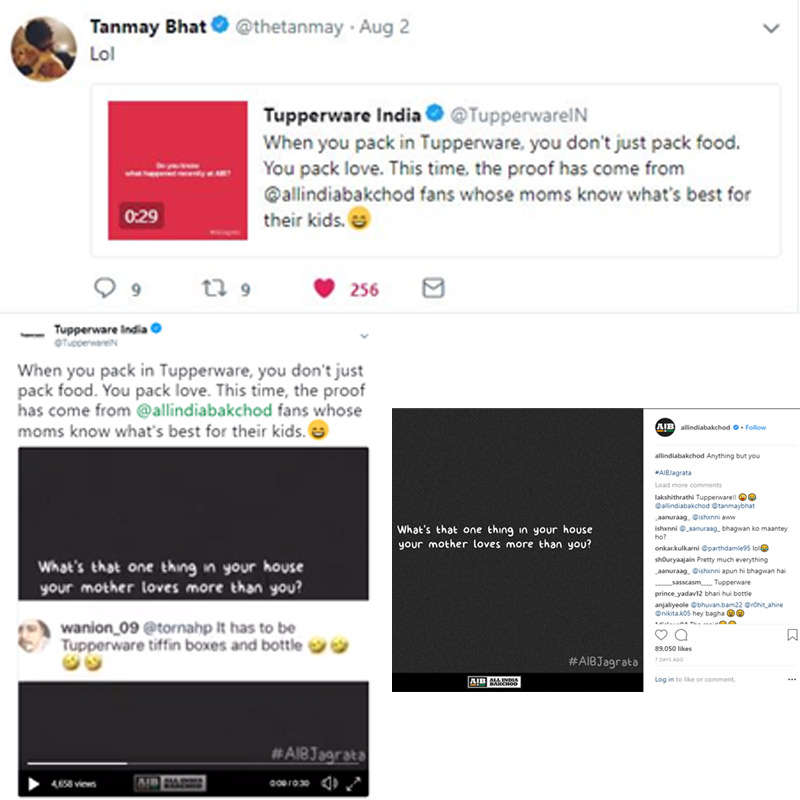
    Recently content creator All India Bakchod (AIB) had a post on Instagram which created a buzz. AIB asks its followers a random question under #AIBJagraata. This time, the question was “What’s that one thing in your house that your mother loves more than you?”

    The replies naturally included Tupperware given the strong market positioning of the kitchen accessory brand. But, Tupperware India (with its end-to-end marketing managed by Pulp Strategy) left no stone unturned to tap into this now-prevailing opportunity. The agency’s social media listening team proactively participated in the ongoing discussion and further amplified the overall engagement by taking it off to its own Facebook, Twitter, and Instagram handles.

    Pulp Strategy founder and managing director Ambika Sharma said, “At Pulp Strategy, we do not merely create opportunities, but also ensure that we tap into every single one that surfaces anytime, anywhere. This all-embracive approach is what has helped us in staying ahead of the curve always. I’m proud that the team at Pulp Strategy has yet again upheld that culture.”

    Within 24 hours, Tupperware India reached out to more than 25,000 people on Facebook and 1,686 people on Instagram, and all of that, without spending a single penny. The whole activity also caught the attention of Tanmay Bhat, the co-founder of AIB, who retweeted the Tupperware India post.

    This year, the marketing agency had also conceptualised and executed the #PressForConfidence campaign for Tupperware around International Women’s Day. The innovative campaign effectively used Facebook’s newly-released ‘press and hold’ feature to create an interactive content series and received massive participation on the social media platform.

  • Founder and MD Ambika Sharma becomes the sole equity stakeholder of Pulp Strategy

    Founder and MD Ambika Sharma becomes the sole equity stakeholder of Pulp Strategy

    MUMBAI: In a massive top-tier overhaul, the reins of Pulp Strategy have been taken over by its Founder and Managing Director Ambika Sharma. Ambika Sharma the Majority stake holder acquired an the balance equity stake of 22% for an undisclosed amount from the brand’s exiting minority shareholder and Director CFO Raj Vikram Singh, to become the sole equity owner of the multi-award winning full-service marketing agency.

    The restructuring has helped Pulp Strategy tide over vision mismatch and improve its agility to consolidate its domain leadership position as a leading independent Digital creative agency in India redefining the brand-consumer interaction in today’s dynamic business landscape.

    With the management overhaul that was finalised in Q3 of the Fiscal Pulp Strategy has experienced accelerated growth in H2, as it gears up for large-scale business expansion, with a singular focus on innovation driven by an in-depth understanding of the industry.

    With new client acquisitions including brands like Tupperware, Barco, Hero Electric, Proburst and Philips Avent, The agency is now looking to increase its focus on content marketing, digital engagement, while simultaneously leveraging interactive new-age technologies for its expanding client portfolio.

    On the development, Pulp Strategy, Founder and Managing Director, Ambika Sharma said, “As a young business it was important for us to maintain our agility as well ensure that our talent contributes towards the improvement of our offerings as well as our commitment to our clients. This decision to re-haul management has been taken with an aim to augment the growth trajectory of Pulp Strategy and to consolidate the agency’s market position. It will enable us to further our aggressive growth plans while strictly maintaining an industry-focused and innovation-driven approach.”

    Incorporated in 2011, Pulp Strategy at present drives revenue worth Rs. 443 million and is eyeing forward-thinking product and service offerings to support its market ascension and client base expansion. Its current and previous clientele includes the likes of Google, Philips, Microsoft, Michelin, Canon, Rolls Royce and Yahoo!, amongst others.

  • Pulp Strategy conceptualizes Tupperware’s #PressForConfidence campaign for International Women’s Day!

    Pulp Strategy conceptualizes Tupperware’s #PressForConfidence campaign for International Women’s Day!

    MUMBAI: Hardships and roadblocks are part and parcel of life. While everyone experiences them on a day-to-day basis, they are often more gruelling for women juggling multiple roles – that too without a single holiday! In order to honour the women and their hard work, Tupperware India launched its innovative International Women’s Day campaign, #PressForConfidence, on social media.

    As part of the campaign, Tupperware asked its audience several important questions on its tipping point, putting in more efforts than required, dealing with hope and despair, etc. The brand then, put forth these questions to their support system, i.e. women who support and motivate them on a daily basis. The participants shared their stories and personal experiences to celebrate the women in their life and #PressForConfidence.

    Tupperware India’s Managing Director, Shilpa Ajwani said, “When we invest in women, we invest in our community. Tupperware empowers them to grow professionally and personally, and seeks ways to enhance their livelihood by providing continued business and learning opportunities. This has been a binding ideology for us.”

    The campaign has been conceptualized and executed by Tupperware India’s digital agency, Pulp Strategy, which leveraged interactive content for higher engagement. The brand launched three teasers for the campaign inspired by International Women’s Day #PressForProgress as confidence is the foundation of progress and Tupperware believes in cultivating confidence.

    The flagship content pieces utilized Facebook’s new ‘Press and Hold’ feature. The engagement levels are at an all time high and social platforms are buzzing with participation.

    Pulp Strategy’s Founder, Ambika Sharma said, “Tupperware is a brand highly engaged with its audiences and community. It believes in creating delight with the small things and it was natural that we created the campaign #PressForConfidence with interactive content as the flagship.”

    This International Women’s Day, why not celebrate the people who make an impact in your life with Tupperware’s insightful campaign? Share your story of how you #PressforConfidence and how has it transformed your life!

  • Pulp designs Philips Avent’s breastfeeding awareness campaign

    MUMBAI: Royal Philips, a leader in healthcare technology, recently rolled out an awareness campaign aimed to empower mothers, expecting mothers, and their families in India. Launched under the Philips Avent brand, the campaign promotes the importance of breastfeeding, address societal barriers, while also introducing solutions to prolong breastfeeding as much as possible.

    Philips Avent has rolled out a digital film that focuses on the bond between a mother and child and how mothers can empower themselves to ensure that their babies get the best nutrition.

    It highlights how new mothers can strike a balance between their personal and commitments without comprising on the nutrition of their young ones through modern healthcare solutions for assisted breastfeeding.

    Philips India director – health & wellness – personal health Dipanjan Chakraborty said: “We believe that a healthy start is a healthy future.”

    Pulp Strategy MD Ambika Sharma said, “The healthcare solution brings out the nuances of a little spoken about subject to start conversations across the country.”

    According to World Health Organisation, a child must be breastfed for six months, with continued breastfeeding supplemented by the desired complementary food for up to two years of age.

  • Budget ’17: Encourage digital economy to make tax system globally competitive

    Budget ’17: Encourage digital economy to make tax system globally competitive

    MUMBAI: Various industry sectors are of course expecting the budget to ease stress in the business environment with tax rebates, restructuring of slabs or incentives. The advertising and communication industry is seeking some incentive announcements to further popularise the digital initiatives of the government. In the backdrop of demonetisation, every addressable transaction may be charged which may ideally move in the direction of becoming a zero-tax nation.

    Pulp Strategy Communications Founder & MD Ambika Sharma says, “The upcoming budget announcement I hope will focus on providing incentives such as better tax slabs to ‘Make in India’ companies in the technology space. A relaxation in the corporate tax rate will give a great boost to the startups in the tech sector in India, and will encourage tech companies to contribute more actively to the vision of ‘Digital India’.”

    She recommends that “Provisions must also be made for carry forwarding losses to be set off against any future income.”

    Sharma feels, “The growth in smartphone penetration and better internet connectivity means that more consumers are now leveraging the online channels of media consumption. However, players in the segment currently have to deal with different taxation slabs, leading to multi-layered problems such as effective tax rates, dual tax levies, and multiplicity of indirect taxes. This calls for a standardisation of tax and implementation on online media in the latest budget. Implementation of the tax should be standardized and made simpler with all players following a standard structure with no ambiguity.”

    Vertoz Media CEO and founder Ashish Shah says, “There is hope that there will be some incentive announcements to further popularise the digital initiatives of the government. Being a pure AdTech firm, we are very optimistic on the government’s vision of ‘Digital India’. We expect to see a growth oriented budget.”

    “The government has been encouraging entrepreneurship among the younger generation with its flagship initiative – ‘Startup India’ and keep up the momentum this time as well. More entrepreneurs in the ecosystem will drive sustainable economic growth and generate more job opportunities,” Shah added.

    Dentsu Aegis Network chairman & CEO – South Asia said, “A Union Budget that is growth oriented and puts more money in the pocket of the common man will benefit the advertising industry. Research has shown that, as a rule of thumb, every percentage point added to the GDP growth adds 1.5 – 2 per cent points to the advertising Industry growth. So, I hope that there is a growth oriented budget, which in turn spurs economic growth all around in India, particularly in the rural areas.”

    He is forthcoming on the fact that “the advertising industry doesn’t really mind paying legitimate taxes. It is actually the on-ground implementation and the complexities of the taxation system that causes huge amounts of productive time to be wasted in unproductive red-tape. In that context, any simplification of the taxation processes, both in the direct and in the indirect tax areas will be welcome. Even GST, which was supposed to simplify indirect taxation, is likely to inadvertently make it much more tedious for the services sector. The Government needs to address this urgently. Service tax on advertising is already very high at 15 per cent, including surcharges. I hope, particularly given the slowdown caused due to demonetisation, the finance minister will consider not taking it up any further and reducing it if possible.”

    Chrome Data Analytics & Media MD Pankaj Krishna says, “Post-demonetisation, the government would be looking at increasing demand, hence we can expect people-friendly measures being introduced in this budget. There will also be a focus on more spends on infra, utilizing the gains from demonetisation. The prime minister’s laudable schemes, including smart cities and digital India should stand to gain more fund allocation. Rural connectivity too will be in focus, given the govt.’s push towards cashless transactions.”

    Krishna feels, “This is an ideal time to see a cut in corporate tax, given the unprecedented collections for banks, to the tune of Rs 14 lakh crore. Personal taxes too should see a cut and a more simplified structure. The exchequer would generate it from charging a percentage per transaction, since these will be addressable transactions. Ideally, this will be a move in the direction of becoming a zero-tax nation.”

    moneycontrol editor Santosh Nairbelieves, “Due to the buoyant tax collections — both direct and indirect, the numbers for the current fiscal are likely to be healthy. Most economists expect the fiscal deficit target of 3.5 per cent to be maintained.”

    He feels, “The big challenge for the FM is going forward is to forecast revenues and spending without a clear handle on the impact of demonetisation.”

    “To help create more jobs without adding to its own wage bill,” he opines, “the government is likely to announce incentives for start-ups by way of friendly tax structures and fewer approvals to set up a business.”

    Viacom18 group CEO & CII media and entertainment committee chairman Sudhanshu Vats is expectant of a high-impact budget, as he says, “This budget will be a ‘transformational’ budget. The government has already showcased its commitment to alter the status quo by changing the classification of expenditure, subsuming the rail budget and advancing the date of the announcement.”

    He says, “I have always maintained that as an industry, we have a lot to gain from an economy that is buoyant in the aggregate sense. This year’s budget will enable just that – a revitalized economy that’s raring to go. Demonetisation is sure to expand the tax base in the medium term. I am certain that the government will use this added fire-power in a prudent manner. Hopefully, we’ll get to hear policy measures that encourage the digital economy, make India’s tax system globally competitive and put more money in the hands of Indians. As the saying goes, ‘the best is yet to come’.”

    SABGROUP CEO Manav Dhanda says, “From a media industry perspective, I feel that a change in the definition of industrial undertaking for the services industry as well as a push to define the GST roadmap would be sector-positive. There is a landmark attempt in the budget to simplify the tax administration, which should herald a friendlier tax regime.”

    “Not increasing the service tax,” he said, “is a positive, particularly for the advertising and media sector.” “The general expectation will be that service tax may go up in anticipation of higher GST rates. Controlling the fiscal deficit and several steps to invigorate the rural economy and rural consumption are positive signals. A rural consumption revival will help the economy and the advertising and media sector tremendously,” he feels.

    There will an expectation based on what the finance minister said in the past, that the corporate tax rate would come down, Dhanda said.

    In balance, there seems an expectation of a mixed bag budget with a positive bias.

    “Digitisation, in my opinion,” he said, “is the most important factor for the broadcast sector — change in excise duty changes proposed for set-top-boxes might help in the last mile infrastructure of Digital Addressable System (DAS).”

    “The proposal for a more conducive excise duty regime for STBs and other ‘entertainment-access devices’ would be welcome,” he said.

    Jack in the Box Worldwide president Kaizad Pardiwalla says,”I hope this budget is a growth-oriented budget, one that incentivises consumption. If GST comes in that will also aid India Inc. and will hopefully see an upswing in media spends. Digitalisation is and should remain a priority for the government as it is leading to an opening up of the economy and driving profitable growth.”

    Contiloe COO Anup Vijai says, “I think there will a reduction in the overall tax rate. And also, GST was supposed to be implemented come 1 April, but now they are talking about 1 July. So we are expecting a road map around that. Right now, the GST slab rates have come up.”

    “Going forward,” he said, “we are expecting the rates of movie tickets to go down say by 15 to 20 per cent in the state of Maharashtra where we have a very high entertainment tax. Moreover, high rates of entertainment tax and lack of uniformity in tax rates across different states, is adding on. A uniform taxation across product categories will benefit the entertainment sector on the whole,” he added.

  • Budget ’17: Encourage digital economy to make tax system globally competitive

    Budget ’17: Encourage digital economy to make tax system globally competitive

    MUMBAI: Various industry sectors are of course expecting the budget to ease stress in the business environment with tax rebates, restructuring of slabs or incentives. The advertising and communication industry is seeking some incentive announcements to further popularise the digital initiatives of the government. In the backdrop of demonetisation, every addressable transaction may be charged which may ideally move in the direction of becoming a zero-tax nation.

    Pulp Strategy Communications Founder & MD Ambika Sharma says, “The upcoming budget announcement I hope will focus on providing incentives such as better tax slabs to ‘Make in India’ companies in the technology space. A relaxation in the corporate tax rate will give a great boost to the startups in the tech sector in India, and will encourage tech companies to contribute more actively to the vision of ‘Digital India’.”

    She recommends that “Provisions must also be made for carry forwarding losses to be set off against any future income.”

    Sharma feels, “The growth in smartphone penetration and better internet connectivity means that more consumers are now leveraging the online channels of media consumption. However, players in the segment currently have to deal with different taxation slabs, leading to multi-layered problems such as effective tax rates, dual tax levies, and multiplicity of indirect taxes. This calls for a standardisation of tax and implementation on online media in the latest budget. Implementation of the tax should be standardized and made simpler with all players following a standard structure with no ambiguity.”

    Vertoz Media CEO and founder Ashish Shah says, “There is hope that there will be some incentive announcements to further popularise the digital initiatives of the government. Being a pure AdTech firm, we are very optimistic on the government’s vision of ‘Digital India’. We expect to see a growth oriented budget.”

    “The government has been encouraging entrepreneurship among the younger generation with its flagship initiative – ‘Startup India’ and keep up the momentum this time as well. More entrepreneurs in the ecosystem will drive sustainable economic growth and generate more job opportunities,” Shah added.

    Dentsu Aegis Network chairman & CEO – South Asia said, “A Union Budget that is growth oriented and puts more money in the pocket of the common man will benefit the advertising industry. Research has shown that, as a rule of thumb, every percentage point added to the GDP growth adds 1.5 – 2 per cent points to the advertising Industry growth. So, I hope that there is a growth oriented budget, which in turn spurs economic growth all around in India, particularly in the rural areas.”

    He is forthcoming on the fact that “the advertising industry doesn’t really mind paying legitimate taxes. It is actually the on-ground implementation and the complexities of the taxation system that causes huge amounts of productive time to be wasted in unproductive red-tape. In that context, any simplification of the taxation processes, both in the direct and in the indirect tax areas will be welcome. Even GST, which was supposed to simplify indirect taxation, is likely to inadvertently make it much more tedious for the services sector. The Government needs to address this urgently. Service tax on advertising is already very high at 15 per cent, including surcharges. I hope, particularly given the slowdown caused due to demonetisation, the finance minister will consider not taking it up any further and reducing it if possible.”

    Chrome Data Analytics & Media MD Pankaj Krishna says, “Post-demonetisation, the government would be looking at increasing demand, hence we can expect people-friendly measures being introduced in this budget. There will also be a focus on more spends on infra, utilizing the gains from demonetisation. The prime minister’s laudable schemes, including smart cities and digital India should stand to gain more fund allocation. Rural connectivity too will be in focus, given the govt.’s push towards cashless transactions.”

    Krishna feels, “This is an ideal time to see a cut in corporate tax, given the unprecedented collections for banks, to the tune of Rs 14 lakh crore. Personal taxes too should see a cut and a more simplified structure. The exchequer would generate it from charging a percentage per transaction, since these will be addressable transactions. Ideally, this will be a move in the direction of becoming a zero-tax nation.”

    moneycontrol editor Santosh Nairbelieves, “Due to the buoyant tax collections — both direct and indirect, the numbers for the current fiscal are likely to be healthy. Most economists expect the fiscal deficit target of 3.5 per cent to be maintained.”

    He feels, “The big challenge for the FM is going forward is to forecast revenues and spending without a clear handle on the impact of demonetisation.”

    “To help create more jobs without adding to its own wage bill,” he opines, “the government is likely to announce incentives for start-ups by way of friendly tax structures and fewer approvals to set up a business.”

    Viacom18 group CEO & CII media and entertainment committee chairman Sudhanshu Vats is expectant of a high-impact budget, as he says, “This budget will be a ‘transformational’ budget. The government has already showcased its commitment to alter the status quo by changing the classification of expenditure, subsuming the rail budget and advancing the date of the announcement.”

    He says, “I have always maintained that as an industry, we have a lot to gain from an economy that is buoyant in the aggregate sense. This year’s budget will enable just that – a revitalized economy that’s raring to go. Demonetisation is sure to expand the tax base in the medium term. I am certain that the government will use this added fire-power in a prudent manner. Hopefully, we’ll get to hear policy measures that encourage the digital economy, make India’s tax system globally competitive and put more money in the hands of Indians. As the saying goes, ‘the best is yet to come’.”

    SABGROUP CEO Manav Dhanda says, “From a media industry perspective, I feel that a change in the definition of industrial undertaking for the services industry as well as a push to define the GST roadmap would be sector-positive. There is a landmark attempt in the budget to simplify the tax administration, which should herald a friendlier tax regime.”

    “Not increasing the service tax,” he said, “is a positive, particularly for the advertising and media sector.” “The general expectation will be that service tax may go up in anticipation of higher GST rates. Controlling the fiscal deficit and several steps to invigorate the rural economy and rural consumption are positive signals. A rural consumption revival will help the economy and the advertising and media sector tremendously,” he feels.

    There will an expectation based on what the finance minister said in the past, that the corporate tax rate would come down, Dhanda said.

    In balance, there seems an expectation of a mixed bag budget with a positive bias.

    “Digitisation, in my opinion,” he said, “is the most important factor for the broadcast sector — change in excise duty changes proposed for set-top-boxes might help in the last mile infrastructure of Digital Addressable System (DAS).”

    “The proposal for a more conducive excise duty regime for STBs and other ‘entertainment-access devices’ would be welcome,” he said.

    Jack in the Box Worldwide president Kaizad Pardiwalla says,”I hope this budget is a growth-oriented budget, one that incentivises consumption. If GST comes in that will also aid India Inc. and will hopefully see an upswing in media spends. Digitalisation is and should remain a priority for the government as it is leading to an opening up of the economy and driving profitable growth.”

    Contiloe COO Anup Vijai says, “I think there will a reduction in the overall tax rate. And also, GST was supposed to be implemented come 1 April, but now they are talking about 1 July. So we are expecting a road map around that. Right now, the GST slab rates have come up.”

    “Going forward,” he said, “we are expecting the rates of movie tickets to go down say by 15 to 20 per cent in the state of Maharashtra where we have a very high entertainment tax. Moreover, high rates of entertainment tax and lack of uniformity in tax rates across different states, is adding on. A uniform taxation across product categories will benefit the entertainment sector on the whole,” he added.

  • Pulp Strategy Communications bags three Youth Marketing Awards 2015

    Pulp Strategy Communications bags three Youth Marketing Awards 2015

    MUMBAI: Pulp Strategy Communications, a full service agency in the realm of experiential, digital and interactive marketing, won three awards at the Youth Marketing Awards 2015 by Global Youth Marketing Forum.


    The event was held at Taj Land’s End, Mumbai. The Global Youth Marketing Forum is the largest rendezvous of youth experts, marketing professionals and brand specialists. The agency won the awards for ‘Best Social Media Integrated Campaign’, ‘Social Media Campaign of the Year’ and ‘Best Integrated Campaign’.


    Pulp Strategy Communications founder and managing director Ambika Sharma said, “We are a young agency and recognition of work is a powerful motivator, which strengthens our resolve to work harder and smarter for our clients.”


    The Global Youth Marketing Forum is a platform for several youth obsessed brands coming from across the globe. Fashion, music, technology, sports and lifestyle brands are present at this event and offer a chance to get into the heads of today’s increasingly hyperactive and complex youth and have brands resonate with today’s youth culture and psyche.


    The metals at the Global Youth marketing forum come close on the heels of the win at the 29th MAA Worldwide Globe Awards in which Pulp Strategy bagged a Gold, in the category of Best Long Term Loyalty and Relationship, and was the only agency in India to have won a Metal this year.

  • Pulp Strategy wins NEC India’s biz

    MUMBAI: Pulp Strategy, a full service experiential marketing and communications agency, has been appointed as NEC India‘s activation and OOH partner.

    Pulp‘s role will essentially comprise creative responsibilities, OOH, activation and events.

    The account was won after a multi-agency pitch and will be handled out of agency‘s Delhi office.

    Pulp Strategy is now slated to handle OOH campaign as NEC India heralds the Indian Grand Prix 2012, in active collaboration with the Sauber F1 Team. NEC India is the premier partner of Sauber F1 Team.

    NEC India national marketing manager Vijayant Khatri said, “We are confident that our partner agency will play a critical role in achieving our marketing goals. Their energy and proactive approach has inspired confidence.”

    Pulp Strategy Communications managing director and CEO Ambika Sharma added, “NEC is a great brand, and we are proud to be a part of the NEC Sauber F1 Team campaign. We are a carefully constructed robust team that brings on board a strong and holistic approach to branding and activation. We look forward to partnering with NEC India.”

    NEC India is a wholly-owned subsidiary of NEC Asia Pacific (HQ: Singapore) and NEC Corporation (HQ: Japan), and works with its customers to develop solutions and services for a “ubiquitous” networking society. Leveraging on NEC‘s capabilities in integrating IT and networking technologies for a diverse customer base across governments, businesses, individuals and societies worldwide, NEC India customises solutions to construct large-scale, highly reliable, scalable and flexible IT and network systems.

  • Pulp Strategy Communications bags Barista Lavazza’s digital biz

    Pulp Strategy Communications bags Barista Lavazza’s digital biz

    MUMBAI: Pulp Strategy Communications has won the digital account of Barista Lavazza following a multi-agency pitch that started in December 2011.

    The account will be handled by agency‘s Delhi office.

    Confirming the development, Pulp Strategy Communications MD and CEO Ambika Sharma said, “Lavazza India has big plans towards quality and leadership position in the café business in India and we are excited to partner them in fulfilling that goal. Our biggest strength is a talented team and a holistic integrated approach, which understands the sensibilities of the brand as well as the nuances of retail and social media”.

    The agency has commenced working on the account in February. The agency‘s mandate includes overseeing the brand‘s digital and social media strategy, media buying, and planning across all digital and interactive channels. In addition to this strategic planning for activation at retail is also a part of the AoR.

    Law & Kenneth is strategic and creative solutions agency for Lavazza in India.