Tag: Amazon

  • Amazon saw most ever Prime subscriptions in Q4 2018

    Amazon saw most ever Prime subscriptions in Q4 2018

    MUMBAI: E-commerce giant Amazon beat analysts' expectation for the fourth quarter of 2018 after falling short of revenue expectations for the last two quarters. The company posted revenue of $72.4 billion and a record net profit of $3 billion. Despite the strong result, Amazon’s weak guidance for quarter 1 in 2019 dragged the stock down in after-hours trading.

    While the revenue was of $72.4 billion against consensus expectation of $71.89 billion, earnings per share(EPS) came at $6.04 compared to $5.65. Though the result represents 20 per cent increase in revenue, the pace was slowest till the first quarter of 2015. Moreover, Amazon finished the year with $232.9 billion in annual revenue, passing the $200 billion milestone for the first time.

    In the earnings release, the company claimed that tens of millions of customers worldwide started Prime free trials or began paid memberships during the Holiday season. It also added that more customers signed up for Prime worldwide in 2018 than ever before but did not reveal exact number.

    The success of Alexa has been especially mentioned in the release. “Alexa was very busy during her holiday season. Echo Dot was the best-selling item across all products on Amazon globally, and customers purchased millions more devices from the Echo family compared to last year,” Amazon founder and CEO Jeff Bezos said.

    Amazon Web Service’s growth has again shown unbeatable revenue growth of 45 per cent reaching to $7.43 billion in the quarter. The company’s “other” category which primarily comprises advertising services jumped 95 percent to $3.4 billion in revenue.

    Jeff Bezos led company called out the introduction of localised Hindi, Tamil, and Telugu language user interfaces in Amazon Prime Video India. It also mentioned the nomination of Inside Edge as the first Indian show from a video streaming service for the International Emmy Awards.

    “Amazon partnered with ICICI Bank to launch the Amazon ICICI Bank credit card to preselected customers in India. This is the first card in the country to offer Prime members 5 per cent in reward points for their purchases on Amazon.in and reward points for all other payments where Visa is accepted,” the release read further.

    However, the new FDI e-commerce rules in India, which include an e-commerce company with a marketplace model will not exercise control or ownership over the inventory that will be sold, is highly concerning the investors of Amazon. E-commerce restrictions can hit Amazon badly as it prevents to drive down prices in the country also. Moreover, it comes at a time when the company’s international sales growth also slowed to 15 percent compared to the previous year's 29 percent growth rate.

  • Hotstar adds offline watching feature for premium content

    Hotstar adds offline watching feature for premium content

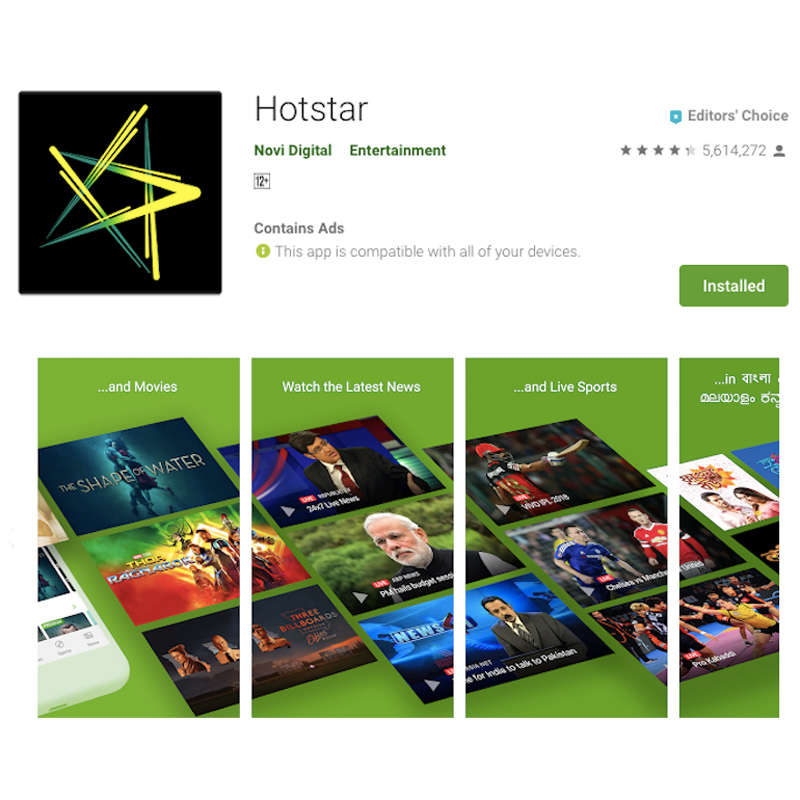
    MUMBAI: Hotstar, the leading streaming platform of India has now made the option of offline viewing available for its premium content. While the in-app download feature on rival platforms like Amazon, Netflix has been well received, Star India’s digital arm restricted the download feature to only non-premium and old content.

    The facility is available now for both Android and iOS users. It has also enabled support for watching videos in 18:9 aspect ratio, which most of the modern full-screen phones offer. However, it is not clear if the support is also available for premium users.

    “Now you can download and watch offline most of your favourite premium shows like Game of Thrones, Friends, Big Bang Theory and many more,” Hotstar Android app changelog noted on Google Play.

    Hotstar users will have the option to choose between low, medium, high and full-HD quality to download. However, downloaded premium content on the app will expire within 7 days of the download or 48 hours since the user starts watching it.

    Among the number of OTT platforms in India, Hotstar is way ahead in the race. Even streaming giant Netflix admitted that YouTube and Hotstar are till now leaders in the Indian market.

  • OTT platforms may soon adopt self-censorship

    OTT platforms may soon adopt self-censorship

    MUMBAI:  Leading OTT players clearly don’t want the government interfering with their content or creating rules like broadcast. So, Netflix, Hotstar, Reliance Jio and some other streaming services may soon adopt a voluntary censorship code.

    As part of the code, the platforms will remove content that has been banned by the courts and that disrespects the national flag, emblem, hurts religious sentiments or promotes violence or terrorism against the country, or even shows children in sexual acts. These are codes that even the broadcast industry follows.

    Economic Times citing sources reported on the self-censorship initiative. However, tech companies including Amazon, Facebook and Google are unlikely to sign up for the code as this move of could set an example of how to regulate internet and meddle with creative freedom.

    The code is likely to include a “redressal mechanism” allowing the users of the streaming platform to issue complain in case they think that the over-the-top (OTT) services have violated the code. Eventually, this mechanism may transform in an “adjudicatory body” that will resolve the complaints filed by the customers.

    According to the report, ZEE5, Times Internet, Eros Now and AltBalaji are in favour of the code and the Internet and Mobile Association of India (IAMAI) is facilitating the process. It also added that the players who don’t think it as a very wise step opine it would lead to an unnecessarily nervous environment and validates the government’s point of view that the internet needs regulation.

    Allegedly, the whole process has been opaque and closed-door while content creators have not been included in the discussions. The opposition group to the court also believes the process has been swayed by companies that want OTT companies to be at a more level playing field with broadcasters.

  • Product selling norms tightened for e-commerce sites

    Product selling norms tightened for e-commerce sites

    MUMBAI: The government of India, in its new set of orders, has listed out new rules for e-commerce services like Amazon, Flipkart, Grofers, and BigBasket to make consumer-experience more satisfactory and secure.

    As per the new directives released by Commerce and Industry Ministry, shopping sites are now barred them from selling products of companies in which they have a stake while FSSAI has stepping up scrutiny of food companies, stating that there can be no compromise on last-mile delivery and safety of food products.

    “An entity having equity participation by e-commerce marketplace entity or its group companies, or having control on its inventory by e-commerce marketplace entity or its group companies, will not be permitted to sell its products on the platform run by such marketplace entity,” the Ministry mandated in a statement. It has also prohibited e-commerce companies from entering into an agreement for exclusive sale of products.  

    As per the directives, the e-commerce sites cannot exercise ownership or control over the inventory and can enter into transactions with sellers only on B2B basis.

    On the other hand, FSSAI has announced that food products supplied by online portals are now liable to be sampled at any point in the supply chain. Companies will also need to provide an indicative image of the food on their platforms so that consumers can recognise the product. All mandatory information mentioned in the Food Safety and Standards (FSS) Act will also have to be provided to consumers before purchase and only fresh food should be delivered to consumers. Food should have a remaining shelf life of 30 per cent or 45 days before expiry at the time of delivery, the guidelines said.

  • Amazon qualifies Mybox’s AVS provider with set-top-box solution

    Amazon qualifies Mybox’s AVS provider with set-top-box solution

    MUMBAI: MyBox Technologies, a Hero Electronix venture, specializing in the research and development and manufacturing of set-top boxes, has announced that it is now an Alexa Voice Service (AVS) solution provider and has collaborated with Amazon.

    The company enables cable and DTH operators to bring Alexa to compatible, pre-existing set-top boxes. Paired with MyBox’s hub and microphone-equipped remote control, customers will have access to Alexa and the ability to control smart home devices, play music, shop for household goods, and more – hands-free.  

    MyBox Technologies MD Amit Kharbanda said, “Becoming one of the first Indian solution providers for the Alexa Voice Service is a matter of great pride and honor for MyBox. Collaborating with Amazon, MyBox’s world-class R&D team has created a set-top box with rich voice functionality. With Alexa now part of the TV environment, MyBox is committed to bringing new voice-forward video experiences to TV viewers.”

  • Hulu Japan says hello to Indian content

    Hulu Japan says hello to Indian content

    MUMBAI: The world has been amazed with Japan's anime and now it's time for role reversal. While international over the top (OTT) giants like Netflix and Amazon are already playing an active game in India, Hulu Japan has also arrived in search of content.

    A fireside chat with Hulu Japan CCO Kazufumi Nagasawa was conducted at Vidnet 2018 hosted by Indiantelevision.com powered by Verizon which had ZEE5 as title partner. The session was moderated by Indiantelevision.com founder and CEO Anil Wanvari.

    Nagasawa said that the Japanese market is crowded with OTT platforms, majority focusing on SVOD service and a few on AVOD model. He claimed Hulu Japan stands with 1.8 million paying subscribers with more than 50,000 hours of content. Talking about the company making room for Indian content in the Japanese market, Nagasawa said that the plan is to offer Swastik Productions' Porus in its content line-up with Japanese subtitles.

    He added, “We prefer period drama and are usually not excited for miniseries. Moreover, I got a chance to look at the Porus trailer at Mipcom and I was fascinated by it.” Baahubali was also another option that the company had offered to the Japanese viewers which worked well with them.

    Apart from this, Hulu acquired Turkish and Russian shows and its performance did better than their expectations. “The reason for acquiring Indian content is because it is affordable as compared to Turkish content. Because of the given resources that we have, we need to be very choosy. In the next two years, we might acquire Indian shows including Tamil, Telugu and Kannada among others but with subtitles as we cannot afford to dub them.” He also said that in 2019, its plan is to focus on developing original content and to be less dependent on studio content (American).

    Hulu Japan was initially launched in the US in 2011. Then it got acquired by Nippon TV in 2014. Nagasawa said that Hulu is a pure SVOD service and that is its primary focus. “We have 50,000 hours of content and out of that, 3000 are films and the rest are series. As far as content from domestic and international markets is concerned, 60 to 65 per cent are from domestic and the rest is from international, which is mostly from US. We actually launched our service with pure US content initially because we couldn’t get local content, especially from broadcasters.”

    He further said that now most of the content the company gets is from its parent Nippon TV and the content that it provides is catch-up, exclusive content, drama series, extra footage etc.

    When it comes to age diversification, Nagasawa said that initially, men were majority users. Right now it is 50:50 and especially the audience from Nippon TV has a big skew to women. "This happened because we started US drama series. Half of the consumption comes from living room set and majority of the users are watching on mobile that means many users are using multiple devices to watch content. In terms of hours, living room is most important but that doesn’t mean people doesn’t use mobile,” he concluded.

  • Big B launches campaign for Lux Inferno ahead of winter

    Big B launches campaign for Lux Inferno ahead of winter

    MUMBAI: LUX Industries manufactures more than 300 products across 14 brands under its belt, such as Lux Venus, GenX, Lux Cozi, ONN, Lyra, Cott’swool, Inferno etc.  

    Now the company has announced its new range of Lux Inferno thermal wear collection. With winter just around the corner, keeping in mind the seasonal demand, Lux has reintroduced the brand Lux Inferno, endorsed by Bollywood legend, Amitabh Bachchan, in an all new avatar in the advertisement, where he takes selfies with the Eskimos.

    Lux Industries is offering its customers with the entire range of Lux Inferno, crafted with double layer knit and warmth retaining fabric which soothes one’s body. The range is available for men, women and kids at an attractive price point. The body warmer comes in dark grey shade in long round neck top, as well as soft thermal trousers. Lux Inferno comes prepared with the body warmer designed as an undershirt and under pant. Lux Inferno provides an amazing and soft experience without any itching or irritation and as well as coming in various sizes from 75 – 100 for the customers.

    Lux Industries senior vice president Udit Todi says, “Lux Inferno has earned the trust of the consumers over the years. Besides providing comfort from the chilly winters in North, West and Eastern India, it has a definite style factor which has been liked by all. We have worked on the material and made it more soft and light which makes it easy to wear undershirt or trousers. The thermal wear range from Lux Industries contributed 10 per cent last year to our overall sales and we foresee a lot of potential in this market segment this year as well.”

    Lux Industries senior vice president Saket Todi adds, “Continuing the brand promise of comfort, style, quality and affordability we are confident that the entire winter wear range of Lux Inferno will strike a chord with our target audience and satisfy the consumers on these parameters. We are proud that a legendary actor and personality like Mr. Amitabh Bachchan has agreed to endorse our products. This association will help us make further inroads in tier II and tier III towns which are a part of our strategy to maintain steady growth.”

    The price range of men uppers and lowers starts from Rs 273, the range for women starts from Rs 255 and that for kids Rs 90 onwards. Besides retailers, the new range of Lux Inferno will be available on e-commerce platforms such as amazon.in and flipkart.com

  • Netflix has no plans to introduce cheaper offerings in India

    Netflix has no plans to introduce cheaper offerings in India

    MUMBAI: Denying market buzz about Netflix’s plan to introduce cheaper subscription plans in India, the streaming video giant’s CEO Reed Hastings said that an executive’s comments suggesting otherwise had been “misunderstood.”

    Hastings in an interview with Reuters noted that the OTT platform had three price tiers in India: Rs 500 ($6.90) for a basic plan, Rs 650 ($9.00) for a standard plan and Rs 800 ($11) for premium. Compared to the amount Netflix charges in the US, these prices are only modestly lower.

    “We see the typical mix across these three plans (in India) that we see in many other countries like the US, which would indicate that we don’t have a pricing issue. Because if it was, everyone would be on the lower price plan,” he said.

    After posting Q3 result in October, chief product officer Greg Peters said in an earnings call, “We’ll experiment with other pricing models, not only for India, but around the world that will allow us to broaden access by providing a pricing tier that sits below our current lowest tier.” This comment was widely perceived as an indication of the company’s plan to introduce lower pricing.

    “It got misunderstood as a decision that we are going to have lower prices in India, which is not something we are particularly contemplating,” Hastings said against this backdrop.

    However, Netflix boss did not deny that it’s not easy to penetrate a billion household with this subscription rate in Indian economy. Rather focusing on English-language, English-entertainment households will help to have a higher income. According to him, the high-end focus is “a practical, realistic” place to start and eventually targeting a broader audience.

    Hastings said Netflix could still thrive although Netflix has competitors in India including YouTube, Hotstar, Amazon who offer cheaper options for the audience. As YouTube is free, and Amazon is cheaper and cable is extremely inexpensive, that creates a consumer expectation. But Netflix boss added that the cost of Netflix in India was “like going to the movie theatre 2-3 tickets a month, but you get to watch a lot more.”

    While Netflix currently has more than 130 million subscribers worldwide, Hastings has said the India market could deliver the next 100 million subscribers.

  • Amazon eyes another 100 mn users in India

    Amazon eyes another 100 mn users in India

    MUMBAI: E-commerce has not even scratched the surface of its growth potential in the country – this according to Amazon India head Amit Agarwal. The giant will not shy away from another round of aggressive investments in this market. 

    As per the reports, Agarwal said that the company is looking to add another 100 million users to its platform in India. He added that the company would transform the landscape of domestic e-commerce and take its prime subscription base in the country to 100 million. Earlier this year, the company said it has more than 100 million Prime users globally. Prime drives a significant part of its overall sales in India. 

    Repeating the words used by CEO Jeff Bezos, on the occasion of the US company’s fifth anniversary in India, Agarwal said that Amazon is not even in ‘Day1’ of e-commerce in India.

    As per the reports, Bezos had committed $5 billion investment for India since Amazon’s entry and  much of this has already been invested. The current numbers for Prime and the overall user base in India were not disclosed by Agarwal. He also didn’t reveal about the size of possible future investments. As per Kantar IMRB’s study of 32,000 online shoppers, 50 per cent of online shoppers chose to shop on Amazon India during the festive season sale this year. Moreover, Flipkart had claimed leadership over Amazon during the sale. 

  • Amazon set to acquire 9.5% stake in Future Retail

    Amazon set to acquire 9.5% stake in Future Retail

    MUMBAI: Ecommerce giant Amazon is all set to acquire a minority stake in Future Retail next week according to an Economic Times report. This deal will allow Amazon to reach the country’s food and grocery market through supermarket chains like Big Bazaar and Nilgiris. Future Retail has more than 1,100 physical stores across India.

    The deal is said to be around Rs 2,500 crore. Speaking to Economic Times, sources said, “Amazon, through the foreign portfolio investor (FPI) route, will buy about 9.5 per cent stake in Future Retail and has already signed a term sheet. The deal will be announced after board approval on 14 November.”

    Wazir Advisors founder Harminder Sahni said, “It essentially means Amazon is taking a position in offline retail. But it can’t just be a financial investment and they will surely leverage Future Group's network and backend facilities for supply chain and other operations."