Tag: Amazon

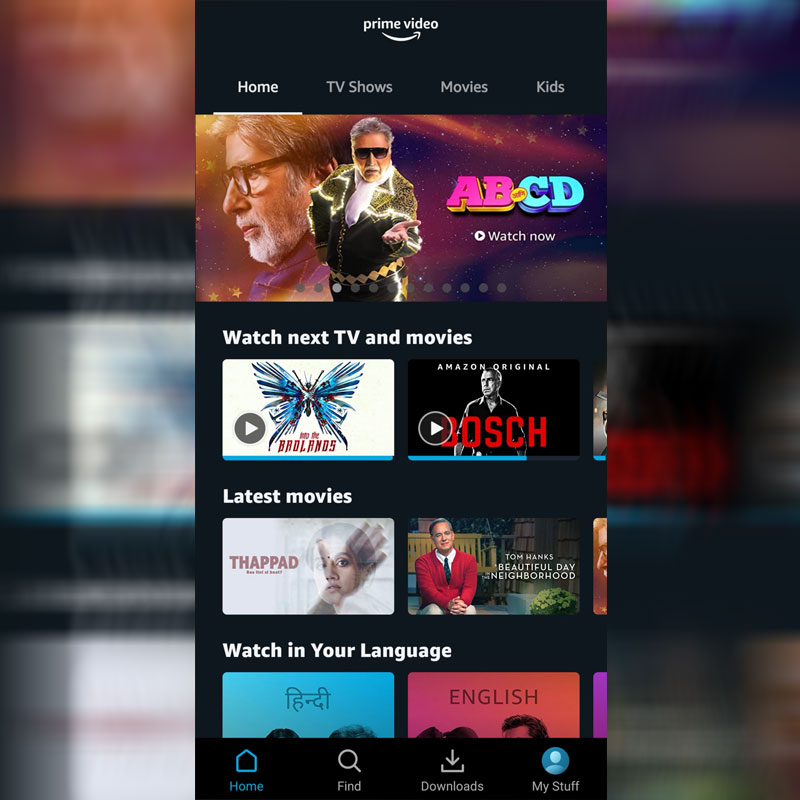
  • OnePlus TV launches dedicated Amazon Prime Video section on Oxygen Play

    OnePlus TV launches dedicated Amazon Prime Video section on Oxygen Play

    MUMBAI: OnePlus, the global technology brand, announced their latest update for OnePlus TVs, with the launch of a new dedicated Amazon Prime Video section on the Oxygen Play platform.

    The launch of this new, deeply integrated feature on OnePlus TV’s Oxygen Play further enhances the overall seamless user experience provided by OnePlus TVs, on both OnePlus TV 55 Q1 and OnePlus TV 55 Q1 Pro. With this exciting feature, new and existing OnePlus TV users will now be able to directly view popular movies and series exclusively from Amazon Prime Video Library through an integrated channel on Oxygen Play. As an added benefit, OnePlus users can easily access a variety of carefully curated content from Prime Video’s extensive library without having to scroll through at length.

    OnePlus’ Oxygen Play serves as the content discovery platform of OnePlus TV where users can access a plethora of content from several partners.

    The Prime Video catalogue features thousands of TV shows and movies from Hollywood and Bollywood, and Indian-produced popular Amazon Original series like Four More Shots Please!, Paatal lok, The Family Man, Mirzapur, among many others. Prime Video includes titles available in Hindi, Marathi, Gujarati, Tamil, Telugu, Kannada, Malayalam, Punjabi and Bengali, thereby providing a diverse range of content to OnePlus TV users.

  • Amazon in talks with Airtel to acquire stake

    Amazon in talks with Airtel to acquire stake

    MUMBAI: The Indian telecom industry may become a hotbed of deep-pocket foreign investors as  Amazon is reportedly in early-stage talks to buy a stake worth at least $2 billion in Bharti Airtel.

    According to a Reuters' report, if talks go well, Amazon will be acquiring a roughly five per cent stake based on the current market value of Airtel. Recently, Facebook invested Rs 43,574 crore in Jio Platforms. In addition to that, Google is also considering to buy a five per cent  stake in Indian telecommunications provider Vodafone Idea.

    According to the report, the talks between Bharti and Amazon are at an early stage and the deal terms could change. There are even chances that the talks will not come to fruition.

    "We routinely work with all digital and OTT players and have deep engagement with them to bring their products, content and services for our wide customer base. Beyond that there is no other activity to report," Airtel said in a statement.
     

  • We are in the race to build a niche product, not to increase user numbers: Aditya Pittie

    We are in the race to build a niche product, not to increase user numbers: Aditya Pittie

    “We are not in the race of having x million DAUS or MAUS or active users. We are in the race of building a niche product.” IN10 Media Network managing director Aditya Pittie is pretty much clear about where he wants to position the network’s OTT business in an ever-growing market. Anand Mahindra- and Aditya Pittie-promoted IN10 Media has a bouquet of varied media offerings such as television (Epic TV), OTT platforms (Epic On and Docubay), and production house (Juggernaut).

    During a virtual fireside chat with Indiantelevision Group founder, CEO and editor-in-chief Anil Wanvari, Pittie asserts that Epic On and Docubay are not driven by number of users. They are rather driven by time spent, organic tractions, etc. Instead of increasing the number of users, the aim is to build a niche product as a vertical player. That is the OTT strategy the company is following. He is also bullish about Juggernaut, which is going to be one of the company’s key businesses going forward. He says that having an asset like Juggernaut will definitely be a big value addition. “We have the probably largest order book in the industry right now with more than 11 shows confirmed for production,” he states.

    Here he dwells at length on the network’s OTT business, strategy, etc.

    Excerpts:

    After the successful entry into the broadcast business, you launched Docubay. Tell us about it.

    Docubay came about because of our love for factual entertainment. We were very interested in documentaries and we believed that as a genre it is the most popular in the world. Prominent OTTs like Amazon have a good library of documentaries. A lot of people across the world enjoy watching them. Then we thought: why don’t we look at a dedicated platform for documentaries. Then we thought of going global, instead of making India-centric. Today, Docubay is a very powerful product; the experience of watching documentaries on Docubay is far superior than any other platform. And we don’t call our subscribers. We call them members, because the idea is to build a community. That’s why it has the tagline of ‘one tribe, many stories.’ The message is that there are many things to explore in this planet, but we are all one tribe. That is the message of Docubay. We just went live on Roku in North America.  And we are one of the very few companies – in the smaller media networks segment – in India that has its own OTT technology in-house. We spent almost a year and a half in building that technology. As an organisation we are really proud of both our OTT products.

    How are Epic On and Docubay faring in terms of pricing and number of subscribers?

    As regards the KPIs and metrics, Epic On and Docubay are not driven by number of users. They are driven by time spent, how many organic tractions, etc. We are not in the race of having x million DAUS or MAUS or active users. We are in the race of building a niche product.  The pricing of Epic On or Docubay is far higher than any of the horizontal or generic OTT. We are very clearly a vertical player. We have very specific offering and then charge a premium for that offering. That is the model we are working on. By no way we try to fret about how many users we have or how faster our user base is growing. We are not hungry just to drive traffic. We wanted quality traffic. Some of the conversion rates that we have in terms of install vs number of people who are subscribing is probably one of the best in the industry. Those are the kind of models we try to work on. Stickiness, higher paying members who are looking for a specific service as opposed to getting everybody to come on the platform and give what they like. That is not our strategy.  

    Since you are not looking at metrics, what is your business game plan to monetise?

    Profitability in the media business is about how much content you want to put out. We have a business plan in place. We believe in a direction we want to take. Going forward, 15 to 20 years from now, when OTTs become mainstream, there will be a big market for vertical OTTs where people will subscribe and pay you a premium for the kind of content you create and curate for them, which is dedicated to the genre they prefer focusing on. So the differentiation is that in horizontal you have all kind of content under one umbrella, whereas vertical is slightly more focused on niche. That is the base model behind our OTT strategy. There are various other vertical OTT players all over the world. They have less number of users, but very viable business model.

    But here you have entered a global space. So are you competing with Curiosity Stream?

    Curiosity Stream has a lot of short-form content and docu-series. Docubay is a feature platform. We only do films. We carry content that has minimum duration of 20-25 minutes. The product offering thus is very different. Theirs is a very knowledge-based, and about science, research, etc. On the other, we give perspective for you to form your own opinion. That is how the documentary genre should be. If you look at the content at Docubay you will realise that they give perspective but let you form your own opinion about the topic. While they are in some degree competition to us, we believe that we are a completely different platform than Curiosity Stream. And we don’t necessarily consider them to be a competition.  

    What is the thinking behind having own production company and forging partnership with Applause?

    I think we need to separate the Applause Entertainment deal from us being in production. While they are connected they are two separate business models. We were able to foresee last year that the demand for content for OTT platforms is going to skyrocket. Unfortunately, good content creators who understand what kind of content works for OTTs are limited in our industry. There are only a handful of players that are able to create good quality content. As an organisation we have created so many hours of content for our broadcasting business. We felt that we could leverage that knowledge and expertise to build successful production business for other platforms. In terms of scale, we felt that the business can be large enough to justify our resources, time, and energy. That’s why we hired Samar Khan to lead our production business for OTT. And Code M was a super-hit (which came on ZEE5 and Balaji).

    And we have the probably largest order book in the industry right now. We have more than 11 shows confirmed for production, with an order book of over Rs 100 crore for the next one year. Juggernaut is going to be one of our key businesses going forward. We are really excited about the ability to create content at scale. Samar and his team have really worked hard to build our good talent of writers and convince OTT platforms that we have the ability to deliver solid products. I am really excited about the Juggernaut business. Having an asset like Juggernaut in our portfolio will definitely be a big value addition.

    You work for local OTTs or big international ones like Amazon, Netflix, etc.?

    I won’t be able to divulge specific contract details because that will be breach of confidentiality with them. We have one or two shows with every Indian platform. We are obviously in conversation with international OTT players. While Samar has a very big pedigree of content creation, Juggernaut as a company is new. So we are building some traction. Our aim is to deliver some hits this year and then start working with OTTs like Netflix, Amazon, Hulu, HBO Max, etc. at some point as well.

    What genre is Juggernaut positioned in?

    We have seen the success of Code M and Samar as a content creator has been very good at certain shows, but we don’t want ourselves to be restricted to that. Content creation is a collective effort. Success in content creation happens by bringing the right people together for the right type of project. So we are not focussed on just doing thriller shows, fiction or non-fiction. The idea is to create good content that is in demand by platforms. OTT is such a fast-feedback medium. It is not like television. You come to know the feedback – whether it works or not – the same day of launching the show. And there is so much data. The platforms specifically know what they want, what kind of content works, and in which region. So rather than focusing on a particular genre like thriller or non-fiction, etc., we want to focus on knowing what works with audiences, learning from experiences in creating good content, working closely with the platforms, leveraging our relationships to pre-empt what kind of concepts and stories are going to work down the lane and prepare our content bank to cater to that need. That’s the broad strategy we are looking at. You can see that we are creating shows across genres.  

  • Foxtel to launch streaming service on 25 May

    Foxtel to launch streaming service on 25 May

    MUMBAI: Australian pay TV company Foxtel will launch a new entertainment streaming service on 25 May, entering the crowded streaming market.

    The official announcement has ended all speculations regarding the launch that have been doing the rounds.

    The next-generation streaming service, which will offer more than 10,000 hours of content including movies and dramas, will be competing with giants like Netflix, Amazon and Disney+.

    Though there has not been any official announcement of the name, Foxtel had recently registered ‘Binge’ brand name and logo trademarks.

    It is still not known the kind of subscription model the new streaming service will adopt. Media reports say it could be similar to that of Kayo, Foxtel’s sports streaming platform, which works on a monthly subscription free model.

    The platform will be hosting content from Sony, BBC Warner Bros, and HBO Max. Over the last one-and-half years, Foxtel has been renegotiating content deals with studios to get SVOD rights for the new streaming service.

    “There has been a lot of speculation about our new streaming service and its name, and we are pleased to finally be ready for the big reveal to Australia next week,” says Foxtel Group CEO Patrick Delany.

    He termed the streaming service as Foxtel’s ‘growth engine’. The purpose of the new OTT, he said, will be to target consumers who seek to consume the premium content offered by the company.

    “We have been beta-testing the service for a few weeks and we are sure Australians will love everything about it. It brings an exciting new brand to younger streaming audiences with a very different and compelling product experience, and a distinctly curated mix of the best drama and movies from the world’s best entertainment brands,” he added.

    He said that the launch will be another milestone in the Foxtel Group’s strategy to transform itself and bring its unparalleled catalogue of entertainment and sports to even more viewers in Australia. “Our goal is to consolidate our position as Australia’s preeminent subscription television and streaming provider,” he said.

    Foxtel’s subscription television service has 2.5 million customers, providing premium experience – the best of television and on-demand services.

  • Endemol Shine Group partners with Plex for extensive catalogue deal

    Endemol Shine Group partners with Plex for extensive catalogue deal

    MUMBAI: Global content creator, producer and distributor Endemol Shine Group today announced a multi-territory content partnership with Plex, the global streaming media company that brings your favourite content together in the highest-rated OTT video app.

    The agreement includes a raft of programming from Endemol Shine Group’s extensive library, which will be available for Plex users across the US, UK, Canada, Australia, Germany, France, Italy and Spain.

    Popular titles, spanning a broad range of genres, include Anthony Bourdain: Parts Unknown, Bananas in Pyjamas, City Homicide, Deal or No Deal, MasterChef, McLeod’s Daughters, Mr Bean and Peaky Blinders*.

    Kasia Jablonska, head of digital distribution and monetisation, Endemol Shine Group, said: “We are very pleased to launch another partnership, which demonstrates the enormous popularity of Endemol Shine’s catalogue. Plex is a unique platform, combining more types of content in one solution than any other streaming service in the industry, including a media storage solution and an original media player experience with a vast media library. We are looking forward to working and growing our business together.”

    “Plex has always served a global audience and growing our library of content available around the world has been a top priority,” said Shawn Eldridge, vice president, strategic alliances and content, at Plex. “The quality of the Endemol Shine library is sure to appeal to a wide range of audiences and these titles are welcome additions to the Plex platform.”

    Offering all types of content together in one app, Plex is the world’s most comprehensive streaming platform. Through Plex, consumers have access to free, on-demand movies and TV shows, podcasts, web shows, news, music, over-the-air live and recorded television, as well as personal media collections. By offering access to this diverse range of content mediums, Plex provides cross-content discovery options, helping identify movies, TV, news, podcasts, and web shows consumers might enjoy based on what they’ve already watched or listened to. This advanced technology reduces decision fatigue about what to watch, making the entertainment experience actually entertaining instead of overwhelming.

    Endemol Shine Group showcase their catalogue of content beyond linear through licensing and self-publishing content and curated channels across a variety of digital platforms. From YouTube to Facebook, TikTok, Amazon, Roku, Samsung TV Plus and Tubi to name a few, Endemol Shine Group maximises opportunities across their deep content library which contains 68,000 hours of programming.

  • Amazon Prime Video users nearly doubled in March 2020

    Amazon Prime Video users nearly doubled in March 2020

    MUMBAI: It's a trend worldwide that over-the-top (OTT) platforms have seen huge uptake in consumption under shelter-in-place directives due to the Covid2019 crisis. Amazon Prime Video is no exception. The streaming service segment of the e-commerce giant is also experiencing a lot more usage from prime subscribers. Moreover, it's the first time that users also nearly doubled in March. 

    “In March, the first time, viewers nearly doubled, which is I think a good thing for people when they are looking to stay entertained and see our video collection. It's also beyond just Prime Video, our channels and video rentals also went up as I'm sure others in the entertainment business saw that as well,” Amazon senior vice president and chief financial officer Brian T Olsavsky said in an earnings call.

    Olsavsky also mentioned that in the US, the UK and Germany movies are going direct to pay-per-view because of the lack of theatres and that was a good move by the team. It has been very well received and they have also made a lot of kids and family content available free to watch on Prime Video. He said that people are getting a better look at what's available with their Prime memberships other than shopping. 

    Additionally, users are finding more benefit from Alexa as they stay at home. They are listening to more music and asking many questions related to issues around Covid2019. Alexa is also being used for educational purposes for children. Moreover, it is being used a lot more on the communication side as people are using Alexa calling and drop in.

    “So I think the Prime story is that shopping is really important for people now, especially when those people can't leave their houses. I think the digital benefits are scaling well. I think they are handling the additional demand and it gives people a good time and reason to use all of their Prime benefits that maybe they hadn't used as much in the past,” he added. 

  • Amazon’s net income down to $2.5 billion in Q1

    Amazon’s net income down to $2.5 billion in Q1

    MUMBAI: Amazon.com, Inc. today announced financial results for its first quarter ending March 31, 2020. The result is a measure of how the Covid2019 pandemic is affecting the overall online shopping experience.

    Net income decreased to $2.5 billion in the first quarter, or $5.01 per diluted share, compared with net income of $3.6 billion, or $7.09 per diluted share, in first quarter 2019.

    Operating cash flow increased 16 per cent to $39.7 billion for the trailing twelve months, compared with $34.4 billion for the trailing twelve months ended March 31, 2019.

    Free cash flow increased to $24.3 billion for the trailing twelve months, compared with $23.0 billion for the trailing twelve months ended March 31, 2019.

    Net sales increased 26 per cent to $75.5 billion in the first quarter, compared with $59.7 billion in first quarter 2019. Excluding the $387 million unfavourable impact from year-over-year changes in foreign exchange rates throughout the quarter, net sales increased 27 per cent compared with first quarter 2019.

    Operating income decreased to $4.0 billion in the first quarter, compared with operating income of $4.4 billion in first quarter 2019.

    “From online shopping to AWS to Prime Video and Fire TV, the current crisis is demonstrating the adaptability and durability of Amazon’s business as never before, but it’s also the hardest time we’ve ever faced,” said Jeff Bezos, Amazon founder-CEO.

    He further added: “Under normal circumstances, in this coming Q2, we’d expect to make some $4 billion or more in operating profit. But these aren’t normal circumstances. Instead, we expect to spend the entirety of that $4 billion, and perhaps a bit more, on Covid-related expenses getting products to customers and keeping employees safe. This includes investments in personal protective equipment, enhanced cleaning of our facilities, less efficient process paths that better allow for effective social distancing, higher wages for hourly teams, and hundreds of millions to develop our own COVID-19 testing capabilities.”

    “There is a lot of uncertainty in the world right now, and the best investment we can make is in the safety and well-being of our hundreds of thousands of employees. I’m confident that our long-term oriented shareowners will understand and embrace our approach, and that in fact they would expect no less,” he added.

    Covid2019 and employees

    Amazon made over 150 significant process changes in its operations network and Whole Foods Market stores to help teams stay healthy — and it conducts daily audits of the measures we’ve put into place.

    “A team of Amazonians — from research scientists and program managers to procurement specialists and software engineers — has moved from their normal day jobs to a dedicated team working to build incremental testing capacity. The team is building its first lab and has begun a pilot to test front-line employees. We’re not sure how far we will get in the relevant timeframe, but we think it’s worth trying, and we stand ready to share anything we learn. In March and April, we announced plans to and have now hired 175,000 people in our fulfillment and delivery network in response to increased customer demand and to assist existing employees. We are happy to welcome these new hires to our team and are continuing to hire,” said the company.

    Alexa is helping customers stay informed and connected, and can now answer tens of thousands of questions related to Covid2019.

    “We’re working to provide accurate and timely information from official government and news sources, globally. Alexa also provides an experience that helps customers in Brazil, Canada, India, Japan, Mexico, and the U.S. check their risk level for COVID-19. Customers can ask, “Alexa, what do I do if I think I have COVID-19?” or “Alexa, what do I do if I think I have coronavirus?” Alexa then asks a series of questions about the person’s symptoms and possible exposure and provides guidance sourced from local health authorities.”

    Amazon is supporting small businesses by partnering with American Express and its Stand for Small initiative, providing free use of business tools that help with virtual communication and collaboration, such as Amazon Chime, Amazon WorkDocs, and Amazon WorkSpaces, as well as enabling small businesses to use the cloud at no charge for 12 months with AWS Free Tier.

    Shopping and entertainment

    Amazon ranked #1 in the 2019 American Customer Satisfaction Index Internet Retail Category and has been ranked in the top 10 for the past 11 years. In the UK, the Institute of Customer Service named Amazon as the company with the best customer service score for the past decade.

    Prime Video launched Prime Video Cinema in the US, the UK, and Germany. Prime Video Cinema is a premium movie rental offering that allows customers to stream in-theatre movies at home, including titles such as Birds of Prey, Emma, The Invisible Man, Onward,andTrolls World Tour.

    Customers in the US, the UK, and Germany can now rent or buy hundreds of thousands of video titles directly from the Prime Video app on Apple iOS 12 devices and the Apple TV Gen 4+, including new release movies, award-winning TV shows, and Oscar-nominated movies.

    Prime Video premiered several new Amazon Original series including the reality competition Making the Cut, hosted and executive produced by Heidi Klum and Tim Gunn; The Forgotten Army in India; Love Island in France; Celebrity Hunted in Italy; and the docuseries The Test: A New Era for Australia’s Team in Australia.

    Prime Video and the National Football League (NFL) announced a multi-year agreement to renew their partnership to deliver a live digital stream of 11 Thursday Night Football games as well as exclusive global streaming rights to one additional regular season game. All NFL games on Prime Video are available at no extra cost to Prime members.

    Amazon launched Amazon.nl and a new Prime program for the Netherlands marketplace. Amazon Prime includes unlimited free shipping, Prime Video, Twitch Prime, and Amazon Photos.

    Devices and Alexa

    Alexa is available on even more devices including TV, mobile, and auto and is now available on select LG and Samsung Smart TV 2020 models and the new OnePlus 8 mobile phone. Additionally, BMW customers in the U.S., and MINI customers in the U.S., France, Italy, Spain, and Austria can now access Alexa on select models.

    Amazon introduced a new speaking style for Alexa skills, enabling U.S. developers to build more natural long-form content experiences by adding conversational pauses to Alexa’s speech when reading articles or blogs.

    Fire TV’s content catalog continues to grow internationally with new apps, including Disney+, available on Fire TV and Fire Tablet devices in the UK, France, Germany, Italy, and Spain.

    Amazon Web Services

    AWS announced the opening of the AWS Europe (Milan) and AWS Africa (Cape Town) Regions. AWS now spans 76 Availability Zones within 24 geographic regions, with announced plans for nine more Availability Zones and three more AWS Regions in Indonesia, Japan, and Spain.

    AWS announced the general availability of Amazon Detective, a security service that makes it easy for customers to conduct faster and more efficient investigations into security issues across their AWS workloads. Amazon Detective automatically collects log data from a customer’s resources and uses machine learning, statistical analysis, and graph theory to build interactive visualizations that help customers analyze, investigate, and quickly identify the root cause of potential security issues or suspicious activities.

    AWS announced the general availability of Amazon Keyspaces (for Apache Cassandra), a scalable, highly available, and fully managed database service for Cassandra workloads. Amazon Keyspaces supports the same application code, Apache 2.0 licensed drivers, and developer tools that customers running Cassandra workloads use today. With Amazon Keyspaces, customers can easily migrate on-premises Cassandra workloads to the cloud, without having to provision, configure, and operate servers or large Cassandra clusters, or needing to manually add or remove nodes or rebalance partitions as traffic scales up or down.

    AWS announced the general availability of Amazon Augmented Artificial Intelligence (Amazon A2I), a fully managed service that makes it easy to add human review to machine learning predictions to enhance model and application accuracy by continuously identifying and improving low confidence predictions. Human review for model predictions can be added to new or existing applications using reviewers from Mechanical Turk, third party vendors, or a customer’s own employees.

    AWS is helping schools around the world quickly deploy and transition to online learning through its EdTech customers and partners. In Egypt, the Ministry of Education and CDSM Thinqi are standing up instant access to online learning content, where 22 million K-12 students are able to continue their education in the midst of COVID-19; and in India, EdTech startup Impartus is launching virtual classrooms for more than 530,000 students — the online equivalent of 13,000 physical classrooms. AWS is also working with Blackboard, the largest education technology and services company in the world, enabling them to scale to 50x their usual capacity within a 24-hour timeframe to meet the global surge in demand of daily users for their virtual teaching and learning platform.

    Second quarter 2020 guidance

    Net sales are expected to be between $75.0 billion and $81.0 billion, or to grow between 18 per cent and 28 per cent compared with second quarter 2019. This guidance anticipates an unfavorable impact of approximately 70 basis points from foreign exchange rates.

    Operating income (loss) is expected to be between $(1.5) billion and $1.5 billion, compared with $3.1 billion in second quarter 2019. This guidance assumes approximately $4.0 billion of costs related to COVID-19.

    This guidance assumes, among other things, that no additional business acquisitions, investments, restructurings, or legal settlements are concluded.

    Follow Tellychakkar for the consumer facing news & entertainment

  • Where’s Quibi headed for in the OTT world?

    Where’s Quibi headed for in the OTT world?

    MUMBAI: The streaming video landscape continues to fragment in 2020, as a growing number of streaming services join the fight for subscribers and users within an already competitive space. As a result, the global number of SVoD subscriptions is estimated to exceed 1 billion by mid-2020. Other streaming video services across social media players, esports and AVoD are also expected to show impressive growth.

    The subscription streaming market has been further amplified by the stay-at-home lockdown period, which is not only encouraging a rise in TV viewing but also a change in behaviour, as gaps in live TV scheduling, particularly sports, encourage consumers to look elsewhere for entertainment alternatives. Beyond SVoD, this is also expected to fuel uptake of premium AVoD services such as Pluto TV. According to Futuresource’s Living with Digital consumer research, at the end of 2019, one in seven American households were active monthly users of Pluto TV, with Tubi just a little lower.

    Quibi is a platform that sees a potentially rich corner for targeting millennial audiences with mobile-specific content. As the name indicates, ‘quick bite’ entertainment will consist of scripted and non-scripted content across a range of genres, including comedy, drama, reality and news updates. A-list creators, including Steven Speilberg, Ridley Scott and Catherine Hardwicke, are on board to produce and direct shows exclusively for the service, with Quibi’s new film-making technology ensuring a seamless experience, whether viewing in portrait or landscape.

    Its launch during lockdown presents itself as a double-edged sword. As mentioned, consumers now have more time to experiment with new services, but equally, solo mobile-viewing is based to fit around people’s lifestyles and “normal” routines: when arriving early to meet your friends at the bar, commuting to work or school, exercising at the gym – all of those activities that are now on hold for the foreseeable future. The marked increase in SVoD viewing on TV sets over the recent weeks ultimately comes at the expense of content viewing on mobile devices.

    Another key point here is: who are Quibi’s rivals? Its unique proposition addressing mobile viewing at a monthly price means that it is not only competing with major SVoD players like Netflix, Hulu, Amazon, and beyond, but other free services that also focus on mobile viewing. This includes the likes of Facebook Watch, Snap Originals, IGTV, Tik-Tok and of course, YouTube. Although YouTube is the market leader for short form content worldwide, people do not only watch its content on smartphones or tablets. In fact, Futuresource’s consumer research shows that just 42 per cent of YouTube watchers in the top five Western European countries and USA use a tablet or smartphone as their main viewing device to view the service. As the quality and professionalism of content on YouTube increases, consumers are finding additional value in watching on a larger screen. This means that Quibi faces potential competition from all sides, as it looks to exploit what it has identified as a gap in the market. However, Quibi has recently announced that it will enable casting to compatible TVs in May.

    Quibi launches with a free 90-day trial, a longer period than currently offered by Netflix, Amazon Prime, Apple TV or Disney+. This is highly unusual for such a service launch, and its major challenge will be converting these to paying subscribers. While the trial provides a valuable period to garner user behaviour and shape the future direction of the service, will most users have exhausted the content that interests them by the time the trial expires?

    Quibi will be judged on both the quality and originality of the content it provides, benchmarked against the key SVoD and AVoD players as mentioned above. Whether the service can command the attention it needs in a considerably fragmented market remains to be seen.

    The author is principal analyst at Futuresource Consulting
     

  • Synamedia joins Alliance for Open Media

    Synamedia joins Alliance for Open Media

    MUMBAI: The Alliance for Open Media (AOMedia) has announced that Synamedia, the world's largest independent video software provider, has joined at the promoter level.

    As a member of the Alliance, Synamedia will collaborate with AOMedia members, which include fellow leading internet and media technology companies, to advance open standards for media compression and delivery over the web. Synamedia's video network portfolio features video distribution, processing, and delivery services, and solutions to power premium quality broadcast and broadband video, create compelling live multi-screen experiences, enable software-defined video processing and unify operations.

    AOMedia members include industry leaders like Amazon, ARM, Cisco, Facebook, Google, Intel, Microsoft, Mozilla, Netflix, NVIDIA, Samsung Electronics, and Tencent.

    The availability of AOMedia Video Codec 1.0 (AV1), AOMedia's open-source, royalty-free video coding format is a significant milestone in the journey to deliver a next-generation video format. AV1 is interoperable, open, optimized for internet delivery and scalable to any modern device at any bandwidth. AV1 enables more screens to display the vivid images, deeper colours, brighter highlights, darker shadows, and other enhanced UHD imaging features that consumers and businesses have come to expect – all while using less data.

    "We're thrilled to join AOMedia. As customers make more intelligent use of virtualization and cloud, we see the adoption of AV1 as a way to further our own goals of enhancing online video streaming experiences for OTT at scale. We look forward to working alongside AOMedia members to open up new possibilities to use AV1 for royalty-free, cross-platform online video across a wide range of applications," said Julien Signes, senior vice president and general manager, video network at Synamedia.

    "We're excited to have Synamedia as our newest member, reflecting our joint commitment to increase the openness and interoperability of internet video," said Matt Frost, AOMedia vice president of communications and membership, and director at Google. "Synamedia brings to AOMedia a long history of live encoding and OTT delivery for major content distributors. We look forward to collaborating to improve the quality and availability of streaming video with AV1."

    Designed at the outset for hardware optimization, the AV1 specification, reference code, and bindings are available for toolmakers and developers to download here to begin designing AV1 into products. Specifically, the release of AV1 includes:

    Ø  Bitstream specification to enable the next generation of silicon

    Ø  Unoptimized, experimental software decoder and encoder to create and consume the bitstream

    Ø  Reference streams for product validation

    Ø  Binding specifications to allow content creation and streaming tools for user-generated and commercial video.

    Alliance for Open Media

    Launched in 2015, the Alliance for Open Media (AOMedia) was formed to define and develop media technologies to address marketplace demand for an open standard for video compression and delivery over the web. Board-level, Founding Members include Amazon, Apple, Arm, Cisco, Facebook, Google, Intel, Microsoft, Mozilla, Netflix, NVIDIA, Samsung Electronics, and Tencent. AOMedia's open-source, royalty-free, video codec AV1 is a significant milestone in the ability to deliver a next-generation video format that is interoperable, open, optimized for internet delivery and scalable to any modern device at any bandwidth.

  • Neestream bets big on Malayali diaspora

    Neestream bets big on Malayali diaspora

    MUMBAI: Neestream, a streaming platform targeted at the Malayalam-speaking population across the globe, was launched earlier this month. The premium service is limited to the US and Canada, with a basic version available in Kerala. But it will soon be available across the world. The OTT platform seeks to reach the Malayali diaspora across the world. It hopes to accomplish that by the end of 2021, says Neestream Chairman Dr Javad K Hassan during an interaction with Indiantelevision.com.

    Neestream, owned by Virginia-based conglomerate JKH Holding Co, bets big on the Malayalam-speaking diaspora spread all over the world. According to the chairman, as much as 20 per cent of the Malayali population lives outside of Kerala, which is a captive market that can be tapped. “Apart from an occasional movie based on an NRI in the United States or Gulf, there is not enough content on this important demography. We want to address that,” he says.

    Going forward, it plans to launch more regional OTT platforms. Asked when the full version will be made available, Javad said, “We hope to make that call in the near future. Right now, because of Covid-19, our expansion plans are on hold. Our basic package is available in Kerala and other parts of the world.”

    In a market flooded with OTT platforms of various kinds, what prompted it to launch a Malayalam streaming service? “A lot of factors were instrumental in us focusing on Malayalam,” he says. “The Indian OTT market is very crowded, with the presence of major international players such as Netflix and Amazon, and Indian heavyweights such as Hotstar. Many of these companies already have presence in the Malayalam market, but only in a limited way. While all these streaming services have solid Malayalam content, their primary focus is elsewhere.”

    “Kerala has a huge diaspora, which, our studies have shown, consumes a lot of Malayalam news and entertainment content on a regular basis. It’s also a market very familiar to us, with most of our leadership having close ties to Kerala. In fact, our technology base is in Kochi, the commercial capital of Kerala,” he adds.

    The company has ambitious future plans in the streaming segment. They include plans to launch similar streaming services in other regional languages.

    “We do have long-term plans to enter other regional languages, but not at this point. Right now, our focus is to grow Neestream in the North American market and then globally,” he informed.

    The future plans include platforms focused on current affairs. In the second half of the year, it will be launching a companion current affairs platform in English, targeting the Indian diaspora in North America. Another platform for the global Indian diaspora is also in the pipeline. Both will be more current affairs-heavy than news and entertainment.

    With regard to the sourcing of content, Neestream has a multipronged approach for sourcing content. “We have acquired a lot of third-party content and are still doing it. We have also launched a modest production setup, which we plan to grow gradually. In the long run, we will also focus on unearthing talent and creators in Kerala and from within the global Malayalee diaspora.”

    Neestream has a number of shows in the pipeline, including a lot of content on and from the diaspora.

    Neestream follows a mixed content strategy, comprising a mixed bag of original and the old evergreen content. “It is a mix of originals and existing content. The experiences of all OTT players show that while originals are the key to the kingdom, evergreen content from the past is also very popular among viewers. We will be acquiring a fair deal of existing content. At the moment, we are in talks with a number of producers and content creators in Malayalam,” he explains.

    The streaming platform has adopted a robust marketing plan, combining both offline and online campaigns. “We are also planning a number of events, including concerts and entertainment events, as part of our marketing campaign. At the moment, most of the offline campaigns are halted as a result of the Covid-19 lockdown. But we are continuing online campaigns, which are delivering great results,” he says.