Tag: Amazon

  • So what’s streaming this Christmas

    So what’s streaming this Christmas

    Mumbai: Christmas is here, and so are the streaming platforms with their new content line-ups curated especially for the Xmas season. OTT platforms like Netflix, Prime Video, Disney+Hotstar, and Lionsgate Play have put together a list of handpicked Christmas Classics for their viewers.

    Streaming on Netflix are ‘A Boy called Christmas’, ‘Waffles and Mochi’, ‘The Princess Switch 3’, and ‘Murali’. Amazon Prime Video’s line-up includes ’10 hours for Christmas’, ‘Christmas Break-in’, and ‘The Kacey Musgraves Christmas Show’.

    Amazon’s audiobook service Audible joins the party with ‘The Christmas Pig’ (written by J.K. Rowling; narrated by Amaka Okafor, Rocco Padden, Gerran Howell, Tom Alexander, Rachel Atkins, Annette Badland, Karen Bartke, Nicholas Boulton, and more), ‘Home For Christmas’ (written by Jessika Devert, Annika Devert, Anna Gilham; narrated by Natalie Pela), ‘All I Want For Christmas’ (written by Michelle Stimpson; narrated by Eboni Flowers, Reginald James), ‘A Christmas Carol’ unabridged (written by Charles Dickens; narrated by Jon Baum) and ‘The First Christmas’ (written and narrated by Stephen Mitchell).

    Disney+ Hotstar is celebrating the season with ‘Hawkeye’ (2021), ‘Encanto’ (2021), ‘Home Sweet Home Alone’ (2021), ‘Once Upon a Snowman’ (2020), ‘The Disney Holiday Singalong’ (2020), ‘LEGO Star Wars Holiday Special’ (2020), ‘Noelle’ (2019), ‘Toy Story: That Time Forgot’ (2014), ‘Frozen 2’ (2019), and ‘Frozen’ (2013).

    Lionsgate Play’s Christmas playlist includes ‘Sharing Christmas’, ‘Wonder’, ‘All about Christmas Eve’, ‘A Bad Moms Christmas’, and ‘Long Shot’.

  • E-commerce in India sees uptick of 77% between 2020 and 2021: Report

    E-commerce in India sees uptick of 77% between 2020 and 2021: Report

    Mumbai: E-commerce in India has witnessed an uptick of 77 per cent between 2020 and 2021 with tier-2, tier-3 cities leading maximum transactions according to a report by conversation media platform Bobble AI.

    While the tier-1 cities dominate the fashion festival figures, transactions in tier-2 cities like Jaipur, Guwahati, Lucknow, Kochi, Mysore, and Bhubaneswar are at an all-time high – up 82 per cent over the previous year, found the report based on over 50 million smartphone users’ (in 640+ Indian cities) data.

    The findings also show that majority of consumers are between the ages of 26 and 35 accounting for 37 per cent, and between the ages of 18 and 25, accounting for 26 per cent with 72 per cent males and 28 per cent females.

    Beauty and fashion lead e-ecom in India

    Beauty e-commerce apps usage grew by 64 per cent, whereas fashion e-commerce grew by 368 per cent over the past year. The festive period has only led the two e-commerce domains to skyrocket, with at least two transactions completed by shopaholics during the fashion festivals.

    Competition heating up with new players

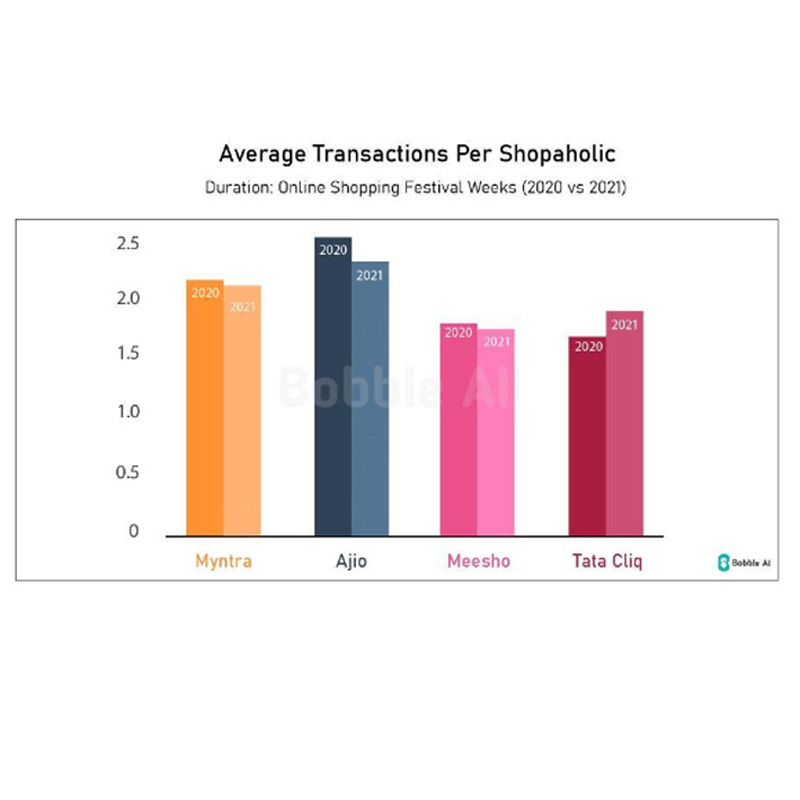
    As per the report, India’s fashion e-commerce industry has transformed from ‘Monopoly’ to ‘Ludo.’ Fashion giant Myntra faced tough competition from its competitive counterparts, Meesho, Ajio, and TataCliq. While almost 46 per cent of all transactions belonged to Myntra during the 2020 festive period, Ajio bagged around 69 per cent of all transactions in 2021. The share of Myntra’s active users, also using Meesho, Ajio, and TataCliq has also increased significantly, indicating how users are exploring multiple options this year.

    The battle of the e-commerce legends, Amazon, and Flipkart is also worth noting, with Flipkart’s active user base rising 83 per cent in 2021 online shopping festival compared to Amazon’s 72 per cent. Despite the fact that Flipkart is dominating in terms of engagement metrics like search frequency and active sessions, Amazon is winning in terms of transactions, significantly less average session times.

    Apart from fashion e-commerce, interesting insights have also emerged from the beauty e-commerce segment.

    Leading players Nykaa and Purplle locked horns this festive season – and Purplle took a piece from Nykaa’s pie. In light of Nykaa’s IPO, let’s look at their market share against Purplle, Nykaa’s pure-play fashion e-commerce competitor. Purplle had a 70 per cent growth in active users in the 2021 shopping festival, compared to a 50 per cent increase for Nykaa. With 15 per cent common user base in 2020, Purplle is now standing at 17 per cent in 2021, as per the report.

    Hypergrowth on the horizon

    The festive season trends point towards healthy and fast-evolving competition in the e-commerce market, which bodes well for customers who are looking for high-quality products at affordable prices.

    With the festive season coming to a close, it is exciting to anticipate how the competition will pan out in 2022. With India’s e-commerce market set to reach $120 billion by 2025, the future seems promising. Hypergrowth is definitely on the horizon for the segment, and according to Bobble AI’s findings, brands are poised to capture growth opportunities.

  • WPP acquires Cloud Commerce Group to strengthen its commerce offering

    WPP acquires Cloud Commerce Group to strengthen its commerce offering

    Mumbai: International advertising group WPP has acquired Cloud Commerce Group (CCG), a UK-based technology company that helps brands to market, sell and deliver their products across e-commerce platforms and marketplaces globally, such as Amazon, eBay, Etsy, and Wayfair.

    CCG will merge with Wunderman Thompson’s global network offering, Wunderman Thompson Commerce, a platform that aims to support brands across the e-commerce journey including the connection of customer acquisition and multi-platform commerce with inventory, warehousing, and partnerships.

    CCG helps brands market, sell and deliver to customers working with some of the most widely-used online marketplaces, while also supporting European retailers and wholesalers through its software integration. It also works with brands such as Ford, IBM, Mars, and Mondelez. The multi-channel e-commerce software platform employs over 100 people across Europe.

    This acquisition reflects WPP’s ongoing investment into strengthening its commerce offer for clients and is aligned with the group’s accelerated growth strategy and focused M&A approach, building on existing capabilities in the areas of experience, commerce and technology, stated the company.

    “Clients look to WPP to help them market, sell and fulfil across multiple e-commerce channels and marketplaces,” stated WPP CEO Mark Read. “With over £1 billion in revenue transacting through its platform, Cloud Commerce Group already has demonstrable scale and success in managing the complex omnichannel commerce needs of global brands. I am excited about how CCG’s expertise will further strengthen the breadth and depth of our commerce offering to deliver growth for our clients.”

    Founded by Mark Hallam and Stuart Forrest in 2015, the e-commerce solutions company is headquartered in Lancaster, England and will see its 100-plus employees across Europe join WPP as a result of the merger.

    “The team at WPP are excited by our existing roadmap for developing the Cloud Commerce Pro platform and expanding our marketing services through Cloud Seller Pro and, with the investment and experience WPP bring in growing businesses, we will be able to achieve those goals faster and take on new integrations and markets,” said the statement.

    “This acquisition by WPP is the next step of the journey for CCG and we are excited about the opportunities this will present to our hard-working team and growing customer base,” it added.

  • Amazon, Asian Paints & Tata Tea emerge as ‘Most Purposeful Brands’: Kantar report

    Amazon, Asian Paints & Tata Tea emerge as ‘Most Purposeful Brands’: Kantar report

    Mumbai: Data insights and consulting company Kantar has released the 2021 edition of its annual BrandZ India report that unveils the year’s ‘Most Purposeful Brands’ in India. Amazon, Asian Paints, and Tata Tea emerged as the most purposeful leaders in India across technology, non-FMCG, and FMCG categories respectively, according to the report.

    The technology ranking has Amazon followed by Zomato, YouTube, Google, and Swiggy jointly in fourth place, followed by Flipkart. The non-FMCG ranking is dominated by telecom brands, with Samsung and Jio jointly second, followed by MRF, Tata Housing, and Airtel. The FMCG category ranks some of India’s biggest names: Tata Tea followed by Surf Excel, Taj Mahal, Parachute, and Maggi both in fourth position, and Britannia completing the list, as per the report.

    According to Kantar BrandZ data, consumers believe that these brands lead with a clear sense of purpose to make their everyday lives better. It also exhibits those that have taken a bolder social stance, as Covid-19 magnified the need for brands to do more than focus on profits alone. The findings tie in with longer-term trends in India and abroad to value brands on ESG criteria (environmental, social and governance) alongside traditional factors, such as valuations and earnings growth.

    While the fundamentals of brand-building remain the same as before namely – Meaningfulness, Difference and Salience, what has changed this time is the expectation that the brand will stand for something more. Kantar conducted an analysis of 418 brands across 30 categories from a total of over 12,000 respondents and found that in India especially, perceptions of a brand’s purpose, its ability to ‘make people’s lives better,’ is crucial to establishing a brand’s meaningful quotient and thus, boosting prospects for growth.

    The Indian consumer, as per the report, is on par with many of their Asian counterparts in actively engaging with sustainability. 77 per cent are prepared to invest time and money in companies that try to do good, the report stated.

    The 2021 Kantar BrandZ data for India, in conjunction with other Kantar consumer sentiment tracking, has also revealed several patterns in what Indian consumers deemed ‘Purposeful’ in 2021.

    Some of the key highlights are that it is critical to amplify or communicate the brand purpose, even as tech brands showed how everyday convenience contributes to brand purpose. These brands have been able to scale up and showcase a wide range of products plus enter new categories at a time when consumers were desperate for at-home & delivery solutions.

    For FMCG brands, taking a social stance by focusing on reducing their carbon footprint scored high, showing that purpose and profit can go hand-in-hand. The key is to do more than just meet consumers’ immediate needs, like non-FMCG brands that adopt marketing strategies that promote the brand in ways that look beyond the function of product or service.

    “Brand Purpose provides an anchor amidst constant uncertainty, both as a North Star for brands, but also as reassurance to consumers. Purpose as a contributor to brand equity is 10 times more important in India, in comparison to globally. This shows that a larger societal purpose is even more critical to success for brands in India,” said Kantar executive managing director for South Asia Insights Division Deepender Rana.

    “Of course, vague slogans and one-off ‘corporate charity’ events do not work, and it is not about jumping on the bandwagon of the latest fashionable cause either. Instead, real Purpose flows from and builds on, a brand’s existing core values and DNA. This reinforces the need to understand and measure if a brand’s Purpose is perceived as adding real meaning to consumers’ lives,” he added.

    Speaking about Kantar BrandZ’s report in India, Kantar managing director- client and quantitative Insights Division Soumya Mohanty stated, “Purpose can work as a strategy for brands, when it’s based on the right consumer insights, and executed effectively. In India, Kantar BrandZ data suggest that a brand’s Purpose ranking has a direct impact on its Meaningfulness score – which in turn is one of the cores, proven building blocks of brand value growth.”

    Methodology

    The Kantar BrandZ database was analysed from 2020-21 covering 418 brand cases for this project, with brand perception and brand equity metrics for brands across 30 categories from a total of over 12,000 respondents. The database includes 28 consistent attributes. A two-stage analysis process was used to arrive at the decision to centre Purpose in this year’s report.

  • Amazon Pay’s new campaign #AbHarDinHuaAasan showcases power of digital payments

    Amazon Pay’s new campaign #AbHarDinHuaAasan showcases power of digital payments

    Mumbai: Amazon Pay has launched a digital-led campaign called #AbHarDinHuaAasan that highlights the convenience and safety of digital payments on the platform and its positive impact on millions of customers across India. Amazon Pay offers a large set of use-cases ranging from paying utility bills and restaurant bills to booking travel tickets, transferring money, and much more.

    The campaign unfolds with a digital film that celebrates the evolution of money and various business activities, from cash to digital, across generations. It further showcases how Amazon Pay can be used to pay anyone, anywhere, effortlessly, and instantly.

    “Over the last few years, digital payments have become an integral part of our lives. Amazon Pay constantly works to provide a trusted, convenient, and rewarding payments experience to millions of customers and small businesses,” stated Amazon Pay India CEO and VP Mahendra Nerurkar. “#AbHarDinHuaAasan is our endeavor to demonstrate how digital payments simplify daily lives for these stakeholders. Through this campaign, we have captured various perspectives and stories that further strengthen the sense of trust around digital payments and drive adoption.”

    The campaign film captures an array of use cases, such as, shopping in a marketplace or online, recharges and utility bills, payment to delivery personnel, and more to showcase the convenience of payments through Amazon Pay. It also narrates how Amazon Pay has enabled small business owners such as street vendors to seamlessly start accepting digital payments.

  • ‘Hyperlocal’ is the latest buzzword for E-commerce sites

    ‘Hyperlocal’ is the latest buzzword for E-commerce sites

    MUMBAI: The Great Indian Festive sales have gotten underway with every e-commerce platform launching its biggest annual blockbuster sale campaign. The growth in internet users, reduction in data prices, and changing consumer behaviour fuelled by the pandemic have spurred the evolution of online retail to go beyond the metros and tier-1 towns. The rapid growth of Bharat online is re-shaping India’s e-commerce landscape like never before with ‘hyperlocal’ being the new buzzword.

    India’s e-commerce market is estimated to record sales worth $ 55 billion during 2021 with the addition of 40 million new online shoppers, as per a recent Indian Retail Industry Report. The number of online shoppers for 2021 is estimated to reach 190 million compared to 150 million in 2020. India is poised to become the third-largest online retail market by 2030 after the US and China with an annual Gross Merchandise Value (GMV) of S$ 350 billion. This changing e-comm landscape is largely driven by hitherto underpenetrated regions in the country, alongside the emergence and growth of multiple e-commerce platforms and D2C (direct-to-consumer) start-ups catering to these lesser explored segments.

    The growing popularity of online shopping has led the e-commerce players to further expand their consumer base into the country’s villages and towns, in time for the busy festive season. Online marketplaces have been localising various offerings in the areas of regional language, Voice, and Video in a bid to break the language barrier and make e-commerce more accessible and convenient for customers pan India.

    E-commerce giant, Amazon India announced that its website will now be available in Marathi and Bengali in addition to Hindi, English, Kannada, Malayalam, Tamil, and Telugu. The e-tailer plans to expand its regional language offering further with the launch of a voice shopping experience in Hindi. “Our aim is to make e-commerce accessible, relevant and convenient for customers. Every month, tens of millions of customers visit Amazon.in in regional languages and 90 per cent of the customers are from tier-2 and below cities,” said Amazon India director- customer experience & marketing Kishore Thota.

    Snapdeal too announced the expansion of its call center capabilities to speak to users in eight Indian languages, making customer support services available in additional local languages. “The pandemic has accelerated the adoption of digital channels, and today people in smaller cities are now purchasing items such as everyday fashion, home decor, kitchenware, and other items online. And as more and more people gravitate towards e-commerce, they will increasingly expect customer services to be in their languages,” said a Snapdeal spokesperson.

    Marketplaces like Amazon and Flipkart are leading the hyperlocal agenda by increasing Bharat’s presence into newer as well as niche markets, said WATConsult managing partner Sahil Shah. “E-tailers who are into mass-market products have shifted gears since the pandemic. There is a clear plan to capture the new India that comes from various parts of the country, using the most localised form of experiences that one can create,” he noted.

    While events like Big Billion Days and special sales on Independence Day and Republic Day offering were organised earlier too, it is only now that India’s e-tailers have sensed an opportunity in regional festivals like Ganesh Chaturthi or Onam to propel sales in different states.

    “E-commerce players are shifting focus to regional activations and are offering region-specific deals as people tend to shop more ahead of their own festivals. To achieve maximum penetration, e-tailers are using vernacular communication channels and deploying social media influencers popular in specific states or regions to promote such events,” said ClanConnect CEO and co-founder Sagar Pushp.

    The changes have become more pronounced since the outbreak of the COVID-19. There has been a three-fold rise in the number of influencers being engaged by e-tailers to promote their sale events through personalised messaging.

    With the Pujo and Navratri celebration underway, and Dusshera and Diwali just around the corner, lifestyle and fashion e-tailers like Myntra, Ajio, Meesho, Purplle have launched campaigns with distinctive regional flavour and feel in multiple vernacular languages. These shopping marts are trying to outdo one another in grabbing eyeballs and finger clicks onto their platforms with special offers & Pujo Makeup Guides and, exclusive launches, and cash-back schemes for their customers. E-tailers are leaving no stone unturned to increase their brand awareness through creative ad spend. After a brief lull in the April-June quarter, they are going all out to redefine KPIs and cater to the newly emerging consumer segments.

    “In terms of marketing spends, we have seen a shift of 20-30 per cent budget being allocated to regional campaigns compared to last year. Focus has moved from generic creatives to specific ones in various vernacular languages to garner more sign-ups,” said cashback and coupons app, CashKaro co-founder Swati Bhargava. Celebrities and brand ambassadors are also picked carefully, with a heightened focus on regional audiences. There also has been a 3x rise in influencer-led digital promotions.

    CashKaro has implemented measures like device-level and language-based targeting after studying the data from Tier-2 to Tier-6 cities, from where 45-50 per cent sale is expected. “At CashKaro, for instance, the activation rates for Tier-2 and beyond have shot up by 40 per cent because of integrating regionally popular creators into the pipeline. The organic impact has been massive as we’ve seen an 8x jump in our traffic during this sale time compared to last year,” shared Bhargava.

    The rise of micro and macro influencers from small towns has come into the spotlight over the last year, as people looked for somebody they could relate to. To leverage this want, many e-tailers have implemented activation of regional celebrities and influencers to acquire more users.

    Myntra’s celeb-heavy campaign features brand ambassadors with a massive regional following like Vijay Deverakonda, Dulquer Salmaan, Mallika Dua, Konkona Sen Sharma and Samantha Akkineni, in addition to those with a national following like Hrithik Roshan, Disha Patani and Kiara Advani. These stars will be seen in region-specific engagements through various content formats such as reels, videos, and stories. Apart from this, over 100 high-impact celebrities and influencers with heavy local presence from the worlds of Bollywood, OTT, reality TV, and digital will drive awareness through pre-buzz and event days for the e-tailer. Other Fashion e-sites like Ajio too have launched campaigns featuring a plethora of celebrities with each of the films voiced in a different regional language, targeting a particular zone across the country.

    Meesho released its latest TVCs which will be aired on major regional TV networks, such as SunTV, VijayTV, Gemini TV, AsiaNet, UdayaTV, TV9, and ETV, in addition to YouTube, and OTT platforms in Hindi, Tamil, Telugu, Kannada, and Malayalam, in order to reach deeper into the Tier 2+ markets. The etailer also plans to leverage regional content creators on multiple alternate channels like – Sharechat, Moj, MX TakaTak, and other favoured content channels for the target group.

    Purplle has also rolled out a 360-degree campaign across Television, Print, Digital, and Social Media channels which will see over 3000 regional influencers participating in a bid to reach out beyond metros to the tier 2, 3 towns.

    “From onboarding regional influencers who create content in local languages to adaptations of the videos and even static content in local languages, we have personalised offers to drive traffic from these locations,” said digital-first agency Lyxel&Flamingo co-founder and COO Shreyansh Bhandari, adding that the agency also maps traffic and revenue from these new towns. “Across campaigns, we have seen the View through rates, CTRs (click-through rates) have been much better when we have localised content for the TG.”

    Brands that were only focused on Tier-1 cities are now seeing exponential growth from smaller towns. What digital has been able to do so well is to provide them access to great content in their language. The confidence of creators, publishers, and OTT platforms is only increasing to keep investing and producing content for them.

    “Digital and e-commerce in the last decade were about India– its urban, English-speaking audience. However, this decade is all about Bharat– it’s rural, small-town audiences who prefer to consume content in a language that is native to them,” added Bhandari.

  • Amazon launches Prime Video Channels in India; names Chaitanya Divan as head

    Amazon launches Prime Video Channels in India; names Chaitanya Divan as head

    Mumbai: Amazon has taken a giant leap transforming into a super app aggregator as it announced the launch of Prime Video Channels in India. Starting 24 September, Prime members will have the option to watch global and local binge-worthy content including shows, movies, reality TV, and documentaries from eight video-streaming services including discovery+, Lionsgate Play, Docubay, Eros Now, MUBI, hoichoi, Manorama Max, and Shorts TV – each accessible with respective add-on subscriptions.

    Media and entertainment veteran, Chaitanya Divan who joined Amazon in 2019 as part of the company’s leadership team will lead Amazon Prime Video Channels India as head. Prior to this, he was head of business for premium sports in his long stint with Star India. In his career spanning two decades, Divan has worked with HUL, Marico, Star India, and NDTV Imagine.

    Prime Video Channels aim to address customers’ need for a hassle-free entertainment experience, simplified discovery, and frictionless payments. It does so, by acting as an intermediary that allows members to stream content from popular OTT services on the Amazon Prime Video app and website in India through an add-on subscription. Customers therefore will need to pay only for the service they choose. At launch, Prime members can enjoy a special introductory annual subscription offer made available by the OTT channel partners.

    Commenting on the development, Amazon Prime Video, India country manager, Gaurav Gandhi said, “With the launch of Prime Video Channels, we now take the next big step in our journey to entertain India by creating a video entertainment marketplace – first of its kind in India – which will not only delight our customers by giving them even more entertainment choices but also benefit the OTT Channel partners who collaborate with us to leverage Prime Video’s distribution, reach and tech infrastructure.”

    “As content choices explode, a single interface for discovery, streaming, and payments, is a key need for customers and we aim to solve for this with the launch of Prime Video Channels,” added Amazon Prime Video, Head-Prime Video Channels, Chaitanya Divan “Prime Video Channels arrives in India after having successfully launched in 11 countries. Our choice of OTT partners for Prime Video Channels is reflective of our diverse and discerning customers’ entertainment needs and interest areas. The launch marks our effort to collaboratively grow the video streaming segment in the country. We look forward to increasing the selection of entertainment even further, with additional channel partners joining in the next few months.”

    Prime members will be able to watch subscribed Prime Video Channels on the Prime Video app for smart TVs, mobile devices, Fire TV, Fire TV stick, Fire tablets, and Apple TV among other connected devices. Episodes can be downloaded for offline viewing at no additional cost.

    Other than the introductory offers and ease of discovery and payments, customers will also get the benefit of using Prime Video features to view content on Prime Video Channels.

    Elaborating on the same, Divan said, “We define the convenience that Prime Video Channels is offering as a layered benefit covering different aspects such as discovery, payments, etc., and making the overall viewing experience easier for customers. Additionally, all Prime Video features such as X-ray, downloads, and watchlists that are hugely popular among our viewers are available across Prime Video Channels content as well. The partner channels will be accessible on our service with these user-friendly features from the very start.”

  • Online retail market in India to rise 3X in next 4-5 years: MMA & GroupM study

    Online retail market in India to rise 3X in next 4-5 years: MMA & GroupM study

    Mumbai: The online retail market in India is set to rise three folds in the next four to five years, majorly driven by under-penetrated categories like grocery, education, and health, as per a new study conducted by MMA India and GroupM.

    Online video spends have seen the highest growth rate of 46 per cent in 2020, as compared to other media channels. Online content consumption grew 35 per cent post Covid, with a total growth of 13 per cent in time spent on OTT from January 2020 to January 2021.

    The industry playbook titled ‘Modern Marketers Guide to Connected Consumer Journeys’ launched by MMA India on Tuesday, along with the AMMP Council and GroupM India is a compilation of learnings and insights by multiple industry experts and an analysis of the e-commerce landscape in India. In the context of the accelerated adoption of online channels, the playbook provides marketers with insights into the changing e-commerce landscape and the factors driving this shift. It also delves into the evolving customer buying journey and purchase patterns, sales-driving technologies such as Voice, AR/VR driving sales and effective channel strategy for improved business ROI.

    According to the playbook, ‘Voice’ is at a nascent stage Indians are leapfrogging on Voice adoption and the market is expected to grow by 40 per cent by 2022. Not just on Google Assistant, voice is rapidly growing as a preferred medium of input across Search and YouTube, driven by vernacular internet users’ preference of voice, who find it to be a more natural way of interacting with technology, helping reduces friction, found the study. Hindi on voice assistants is second biggest globally; 72 per cent Indians prefer non-English language.

    Urban internet users are relying on online platforms for product research. At least 62 per cent of urban users are researching products online before making any purchase either online or offline, as per the guide. As many as 50 per cent of offline shopping across categories involves online product research.

    The biggest retail trend is the increasing popularity of the direct-to-consumer or DTC model, according to the handbook. D2C brands are witnessing a high number of subsequent funding rounds and strategic sales to incumbents. Brands with a DTC model can leverage direct relationships through loyalty programs, special discounting and promotions, and unique and category-specific shopping experiences, says the study.

    The study also highlights that online retail is shifting from electronics to grocery and 73 per cent of customers have purchased through online shopping platforms in the past 12 months. The deciding factors, as per the guide are – product quality ( 63 per cent), price (55 per cent ) and product information (55 per cent), return and cancellation policy, and product warranty.

    There has been an interesting purchase pattern in the consumer journey in the last three months where Amazon, Flipkart, and Myntra were the top three online shopping destinations, notes the study. Groceries, fashion and health, beauty, and personal care were the most searched product categories.

    India today has 622 million internet users (8 per cent growth over 2019) and is expected to touch 900 million users by 2025. With affordable data prices, consumers are increasingly becoming more “digital Conversational Commerce, Voice Search, Video Streaming and Augmented Reality will also help brands drive their e-commerce strategies, says the guide.

    MMA India board member; country head – India, MMA Moneka Khurana said, the playbook outlines how organisations and digital business leaders can improve their understanding of the shift in consumer behavior and solutions that will drive the next phase of growth. “Consistent digital exposure, combined with the presence of available omnichannel touchpoints has resulted in the development of a new consumer purchasing process. MMA through its e-Commerce Council aims to build an overall understanding of the ecosystem and address cluster-specific issues improving capability in omnichannel marketing. We hope this playbook will assist marketers and brands to effectively re-strategise their market approach – from the customers they target to the channels they sell-through,” said Khurana.

    GroupM South Asia president – growth and transformation, Tushar Vyas said the growth in internet users, reduction in data prices, and changing consumer behavior are the key growth drivers for the evolution of eCommerce in India. “We understand the changing online retail market and how it is set to grow 3x in the next 4-5 years mainly driven by underpenetrated categories like grocery, education, health. Considering the emergence and growth of eCommerce platforms, this handbook provides A-Z solutions on how marketers can use eCommerce as a platform to enhance a brand’s reach in these rapidly evolving times,” said Vyas.

    According to Tata Industries Ltd. executive director, KRS Jamwal, going forward, platforms and brands will need to differentiate by providing customers with a better, preferably personalised, yet holistic buying experience that enhances the browse and purchase journeys, and even attempt to bring aspects of the in-store experience online, leveraging tech. “The MMA report provides an overarching view on consumer behavior shifts as well as identifies challenges those organisations may face as a result of those shifts, with best practices and possible solutions”, he added.

  • Amazon to hire 8,000 direct workforce in India this year

    Amazon to hire 8,000 direct workforce in India this year

    Mumbai: Amazon has announced its plans to hire more than 8,000 direct workforce across 35 cities in India this year, across corporate, technology, customer service and operations roles. 

    The global e-commerce giant has embarked on a hiring spree recently and this latest announcement comes on the back of its plans to hire 55,000 people worldwide, announced earlier.

    “We have more than 8,000 direct job openings across 35 cities in the country, including cities like Bengaluru, Hyderabad, Chennai, Gurgaon, Mumbai, Kolkata, Noida, Amritsar, Ahmedabad, Bhopal, Coimbatore, Jaipur, Kanpur, Ludhiana, Pune, Surat. These job opportunities are spread across corporate, technology, customer service, and operations roles,” Amazon HR leader – corporate, APAC, and MENA Deepti Varma told PTI.

    Varma added that the company is also hiring for machine learning applied sciences and roles in support functions like HR, finance, legal, among others.

    She said the e-tailer aims for 20 lakh job openings, both direct and indirect, by 2025, and has already created 10 lakh direct and indirect jobs in India. “Even during the pandemic, Amazon gave jobs to three lakh people, both direct and indirect, and made the entire hiring process virtual,” she stated.

    Meanwhile, as Amazon is growing in India and has plans to hire in big numbers, the company plans to showcase itself as an exciting place to work through its first-ever Career Day in India on 16 September.

    This virtual and interactive event will bring together Amazon leadership and employees to share what makes the company an exciting workplace, what it is like to work here and how the company is steadfast in its commitment to help India unleash its true potential in the 21st century, Varma said.

    Besides, she said, the multiple global and India-focused sessions in the event, 140 Amazon recruiters will conduct 2,000 free, one-on-one career coaching sessions with job seekers across the country.

    The recruiters will offer advice on how to approach the job search process effectively, resume-building skills, and interview tips that will help candidates in their search for the right jobs, she said.

    Currently, Amazon employs over one lakh professionals across diverse areas like engineering, applied sciences, business management, supply chain, operations, finance, HR to analytics, content creation and acquisition, marketing, real estate, corporate security, video, music and many more, Varma said.

    India is the second-largest technology hub for Amazon with Indian talent innovating for not just India, but also globally, noted Varma, while adding, “We are just getting started, and we are seeking passionate builders out there to join us in this once-in-a-lifetime opportunity to digitally transform India.

    “This Career Day, we look forward to sharing our long-term commitment to tapping into India’s potential in the 21st century, and career opportunities to empower and enable this legacy,” said Amazon India, global senior vice president and country head, Amit Agarwal in a statement.  

  • Amazon miniTV & boAt set to bring ‘Kaali Peeli Tales’ on 20 August

    Amazon miniTV & boAt set to bring ‘Kaali Peeli Tales’ on 20 August

    Mumbai: Amazon’s free video entertainment service, miniTV, in collaboration with boAt, announced the exclusive premiere of its first anthology series, “Kaali Peeli Tales” through an intriguing trailer. The show will be available to watch within the Amazon app on 20 August.

    Directed by Adeeb Rais of Madmidaas Films, “Kaali Peeli Tales” consists of six entertaining short stories capturing the essence of love, relationships, and complexities of life in the city of Mumbai. These unique stories, featuring popular actors – Vinay Pathak, Gauahar Khan, Sayani, Gupta, Maanvi Gagroo, Soni Razdan, Hussain Dalal, Sharib Hashmi, Priyanshu Painyuli, Tanmay Dhanania, Sadiya Siddiqui and Adeeb Rais, revolve around young, urban characters on the crossroads of change and acceptance.

    Centered around the themes of romance, marriage, infidelity, homosexuality, forgiveness and divorce, each story offers a unique perspective on modern-day relationships taking into account the uncertainties of today’s cosmopolitan and digital era. The symbol of Mumbai, the iconic Kaali Peeli taxi, is the common thread across all six stories titled ‘Single Jhumka’, ‘Love in Tadoba’, ‘Marriage 2.0’, ‘Fish Fry aur Coffee’, ‘Harra Bharra’, and ‘Loose Ends’, according to the press statement.

    “At Amazon miniTV, we are always harnessing opportunities to provide our customers a diverse selection of content,” said Amazon miniTV and Prime Video India, director and head of content, Vijay Subramaniam. “With such a talented ensemble cast coming on board and giving our viewers six immersive short stories to cherish, we are certain that our Amazon customers will enjoy this visual treat along with a host of exclusive content available on miniTV.”

    “We are delighted to announce our maiden collaboration with Madmidaas Films for a one-of-a-kind anthology on miniTV,” stated director and head of Amazon Advertising, Harsh Goyal. “These heartwarming and progressive stories will surely leave audiences spellbound. It is interesting to see how these six stories are perfectly weaved in to curate an anthology which will resonate well with our hundreds and millions of customers on the Amazon shopping app.”

    “Each of the six stories in the anthology presents a different shade of love and relationships. From new love to rekindling a marriage, from infidelity to divorce, each story will take viewers on an entertainment journey replete with multiple emotions. Along with the stellar cast, the city of Mumbai adds an interesting dimension to every story,” added director Adeeb Rais.