Tag: aMap

  • Jio impacts Vodafone India H1-17 results

    Jio impacts Vodafone India H1-17 results

    BENGALURU: Vodafone Group Plc (Vodafone group) reported Group organic service revenue up 2.3 per cent for the half year ended 30 September 2016 (H1-17).  H1-17 Group revenue declined 3.9 per cent to €27,054 million as compared to € 28,151 million for H1-6 (corresponding period of the previous year). H1-17 Vodafone Group reported organic EBITDA growth of 4.3 per cent to €7,906 million, supported by strong cost control. In real terms, EBIDTA declined 1.7 per cent from $8,039 million reported for H1-16.

    India numbers

    Vodafone India contributed about 11.1 per cent to Vodafone Group revenues and adds about 43.7 per cent to Vodafone group mobile subscriber base in the quarter ended 30 September 2016 or Q2-17. About 51.4 per cent of the group’s voice usage was from India in Q2-17 at 183,555 million minutes (Total group 357,034 million minutes).

    Vodafone India Service revenue grew by 5.9 per cent (quarter ended 30 June 2016 or Q1-17: 6.4 per cent, Q2-17: 5.4 per cent) in H1-17 to Rs 22,579 crore from Rs 21,321 crore in H1-16. Excluding regulatory drags including MTR cuts, roaming price caps and an increase in service tax, the quarterly rate of growth slowed from 7.7 per cent in Q1-17 to 6.3 per cent in Q2-17. This underlying slowdown was mainly driven by lower data revenue growth resulting from increased competitive pressure says the company.

    Data revenue growth slowed from 22 per cent in Q1-17 to 16 per cent in Q2-17. This was driven by a flattening of unique data user growth quarter-on-quarter, reflecting the impact of ‘free’ promotional offers from a new entrant, viz., Reliance Jio. 

    Vodafone group’s active data customer base at the period end was 69.6 million or 6.96 crore (Q1-17- 69.7 million or 6.97 crore). Overall data pricing declined 14 per cent year-on-year, while data usage per customer continued to grow strongly to 504MB (+28 per cent). Vodafone group 3G / 4G customer base continued to grow to 36 million (3.6 crore), up 51 per cent, and smartphone penetration was now 34.5 per cent says the company. Vodafone India reported revenue from data of Rs 4,617 crore. Data ARPU (for users more than 1MB) was at Rs 164 in Q2-17 versus Rs 158 in Q2-16.

    Voice revenue growth increased to 2.7 per cent in Q2-17 (Q1-17: 2.2 per cent) supported by a growing customer base. This was despite seasonally lower average minutes of use per customer. Total mobile customers increased 2.8 million (28 lakh) over the period, giving a closing customer base of over 200 million for the first time (Q2: 200.7 million or 20.07 crore).
    During the period Vodafone India added 4,100 new 3G sites, taking the total to 63,000. It also has 13,000 4G sites. In the Indian spectrum auction during October Vodafone India increased its total spectrum holding by 62 per cent. 

    Overall Vodafone paid Rs 20,300 crore (€2.7 billion), of which 92 per cent was on spectrum for the 12 circles in which it claims to be a market leader. Vodafone India plans to extend its 4G footprint from 9 to 17 circles by the end of the current financial year. These circles cover around 91 per cent of Vodafone India’s service revenues and 94 per cent of its data revenues.

    EBITDA grew by 2.6 per cent in H1-17 to Rs 6,704 crore from Rs 6,534 crore, with the EBITDA margin declining by 0.1 percentage points to 29.6 per cent due to higher network and customer acquisition costs, which were largely offset by significant operating cost savings says the company.

    The Vodafone Group intends to proceed with an IPO of Vodafone India as soon as market conditions allow. It does not expect this to take place during the current financial year.

    Company speak

    Vodafone group chief executive Vittorio Colao said, ‘We have further improved our performance during the first half of the financial year with Europe modestly ahead of our expectations – led by Germany and Italy – and good execution in AMAP. Our substantial network investments and ‘more-for-more’ propositions have allowed us to capture opportunities from strong data demand, supporting European mobile contract ARPU and continued growth in emerging markets. As Europe’s fastest-growing broadband operator, we are driving rapid uptake of our consumer fixed and TV services while our wholly converged Enterprise business continues to outperform its peers. We are now translating faster revenue growth into margin expansion, supported by our focus on cost efficiency.

    Competition in India has increased in the year, reducing revenue growth and profitability. We have responded to this changing competitive environment by strengthening our data and voice commercial offers and by focusing our participation in the recent spectrum auction on acquiring frequencies in the more successful and profitable areas of the country.

    Overall, we expect to sustain our underlying performance in the second half of the year and remain on track to meet our full-year objectives despite macroeconomic uncertainties. This performance allows for improved returns to our shareholders, as reflected by the growth in the interim dividend.

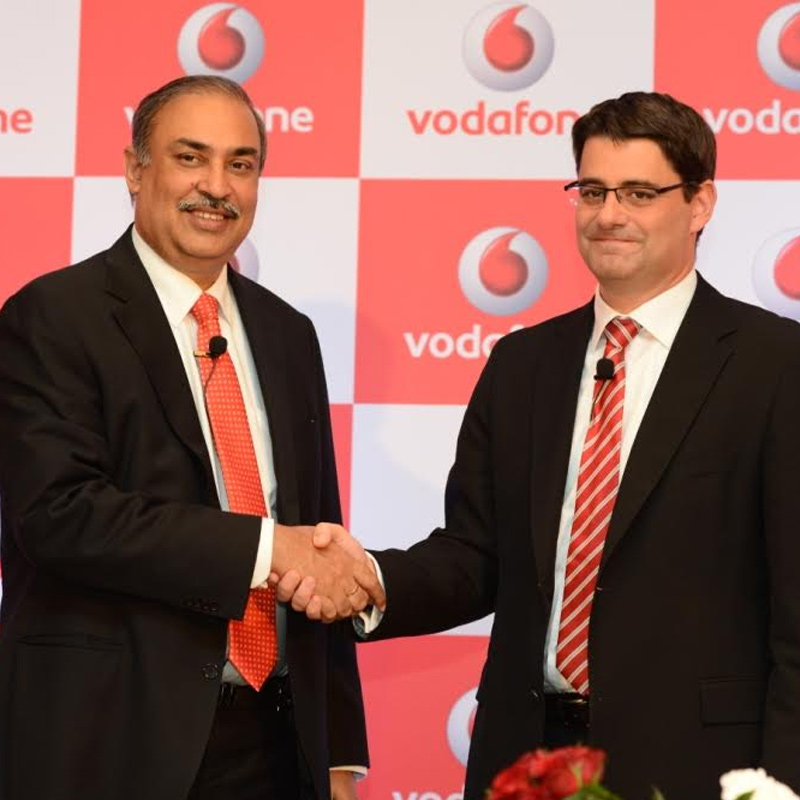
    Vodafone India managing director and CEO Sunil Sood commented: “Amidst a dynamic environment, we delivered a solid performance. We are well prepared for the increased level of competitive intensity that we are experiencing. We have strengthened our customer value propositions making Vodafone Play, your one window to the world of entertainment, launched exciting 4G offers – 9GB free on purchase of 1GB pack for new 4G handsets and revamped Vodafone RED for high end voice and data users. Further, we pioneered lifestyle propositions such as Vodafone U for young customers and Vodafone Flex, which allows customers to make a single recharge for voice, sms and data. We expanded our 4G footprint to 9 circles by launching services in 4 new circles. With the spectrum bought recently, we will roll out the Vodafone SuperNet 4G experience rapidly to 2,400 towns and in 8 additional circles by March. We continue to invest to expand our modern and scalable network with a strong backhaul, to support the increasing volumes and need for speed from both retail and enterprise customers. We remain committed to fulfill the evolving needs of our customers and leverage our global experience plus rich understanding of India to play a meaningful role in enabling Digital India.”

  • Jio impacts Vodafone India H1-17 results

    Jio impacts Vodafone India H1-17 results

    BENGALURU: Vodafone Group Plc (Vodafone group) reported Group organic service revenue up 2.3 per cent for the half year ended 30 September 2016 (H1-17).  H1-17 Group revenue declined 3.9 per cent to €27,054 million as compared to € 28,151 million for H1-6 (corresponding period of the previous year). H1-17 Vodafone Group reported organic EBITDA growth of 4.3 per cent to €7,906 million, supported by strong cost control. In real terms, EBIDTA declined 1.7 per cent from $8,039 million reported for H1-16.

    India numbers

    Vodafone India contributed about 11.1 per cent to Vodafone Group revenues and adds about 43.7 per cent to Vodafone group mobile subscriber base in the quarter ended 30 September 2016 or Q2-17. About 51.4 per cent of the group’s voice usage was from India in Q2-17 at 183,555 million minutes (Total group 357,034 million minutes).

    Vodafone India Service revenue grew by 5.9 per cent (quarter ended 30 June 2016 or Q1-17: 6.4 per cent, Q2-17: 5.4 per cent) in H1-17 to Rs 22,579 crore from Rs 21,321 crore in H1-16. Excluding regulatory drags including MTR cuts, roaming price caps and an increase in service tax, the quarterly rate of growth slowed from 7.7 per cent in Q1-17 to 6.3 per cent in Q2-17. This underlying slowdown was mainly driven by lower data revenue growth resulting from increased competitive pressure says the company.

    Data revenue growth slowed from 22 per cent in Q1-17 to 16 per cent in Q2-17. This was driven by a flattening of unique data user growth quarter-on-quarter, reflecting the impact of ‘free’ promotional offers from a new entrant, viz., Reliance Jio. 

    Vodafone group’s active data customer base at the period end was 69.6 million or 6.96 crore (Q1-17- 69.7 million or 6.97 crore). Overall data pricing declined 14 per cent year-on-year, while data usage per customer continued to grow strongly to 504MB (+28 per cent). Vodafone group 3G / 4G customer base continued to grow to 36 million (3.6 crore), up 51 per cent, and smartphone penetration was now 34.5 per cent says the company. Vodafone India reported revenue from data of Rs 4,617 crore. Data ARPU (for users more than 1MB) was at Rs 164 in Q2-17 versus Rs 158 in Q2-16.

    Voice revenue growth increased to 2.7 per cent in Q2-17 (Q1-17: 2.2 per cent) supported by a growing customer base. This was despite seasonally lower average minutes of use per customer. Total mobile customers increased 2.8 million (28 lakh) over the period, giving a closing customer base of over 200 million for the first time (Q2: 200.7 million or 20.07 crore).
    During the period Vodafone India added 4,100 new 3G sites, taking the total to 63,000. It also has 13,000 4G sites. In the Indian spectrum auction during October Vodafone India increased its total spectrum holding by 62 per cent. 

    Overall Vodafone paid Rs 20,300 crore (€2.7 billion), of which 92 per cent was on spectrum for the 12 circles in which it claims to be a market leader. Vodafone India plans to extend its 4G footprint from 9 to 17 circles by the end of the current financial year. These circles cover around 91 per cent of Vodafone India’s service revenues and 94 per cent of its data revenues.

    EBITDA grew by 2.6 per cent in H1-17 to Rs 6,704 crore from Rs 6,534 crore, with the EBITDA margin declining by 0.1 percentage points to 29.6 per cent due to higher network and customer acquisition costs, which were largely offset by significant operating cost savings says the company.

    The Vodafone Group intends to proceed with an IPO of Vodafone India as soon as market conditions allow. It does not expect this to take place during the current financial year.

    Company speak

    Vodafone group chief executive Vittorio Colao said, ‘We have further improved our performance during the first half of the financial year with Europe modestly ahead of our expectations – led by Germany and Italy – and good execution in AMAP. Our substantial network investments and ‘more-for-more’ propositions have allowed us to capture opportunities from strong data demand, supporting European mobile contract ARPU and continued growth in emerging markets. As Europe’s fastest-growing broadband operator, we are driving rapid uptake of our consumer fixed and TV services while our wholly converged Enterprise business continues to outperform its peers. We are now translating faster revenue growth into margin expansion, supported by our focus on cost efficiency.

    Competition in India has increased in the year, reducing revenue growth and profitability. We have responded to this changing competitive environment by strengthening our data and voice commercial offers and by focusing our participation in the recent spectrum auction on acquiring frequencies in the more successful and profitable areas of the country.

    Overall, we expect to sustain our underlying performance in the second half of the year and remain on track to meet our full-year objectives despite macroeconomic uncertainties. This performance allows for improved returns to our shareholders, as reflected by the growth in the interim dividend.

    Vodafone India managing director and CEO Sunil Sood commented: “Amidst a dynamic environment, we delivered a solid performance. We are well prepared for the increased level of competitive intensity that we are experiencing. We have strengthened our customer value propositions making Vodafone Play, your one window to the world of entertainment, launched exciting 4G offers – 9GB free on purchase of 1GB pack for new 4G handsets and revamped Vodafone RED for high end voice and data users. Further, we pioneered lifestyle propositions such as Vodafone U for young customers and Vodafone Flex, which allows customers to make a single recharge for voice, sms and data. We expanded our 4G footprint to 9 circles by launching services in 4 new circles. With the spectrum bought recently, we will roll out the Vodafone SuperNet 4G experience rapidly to 2,400 towns and in 8 additional circles by March. We continue to invest to expand our modern and scalable network with a strong backhaul, to support the increasing volumes and need for speed from both retail and enterprise customers. We remain committed to fulfill the evolving needs of our customers and leverage our global experience plus rich understanding of India to play a meaningful role in enabling Digital India.”

  • TAM expanding peoplemeter size: Kantar’s Eric Salama

    TAM expanding peoplemeter size: Kantar’s Eric Salama

    MUMBAI: For the past three months, the focus of the entire TV industry has been on the new industry-backed Broadcast Audience Research Council (BARC). It was almost a given that the decade-old viewership ratings agency TAM Media Research would slip away into the night as the newbie had got the government’s and industry’s support.


    But TAM is not disappearing. It got some relief last week as the Delhi High Court adjourned to 26 August the hearing on its parent Kantar Media Research’s  suit against the government-declared regulation on cross holding patterns of TV ratings agencies.


    And unknown to many, TAM is working to comply with the other requirements of TV ratings agency guidelines to continue to exist. A long standing demand of industry and a crucial criterion requiring compliance is the minimum number of peoplemeters. And TAM apparently is coming up to speed on this.


    “We are continuing to increase the size of the panel but haven’t announced exact numbers and timings around it,” Kantar CEO Eric Salama told indiantelevision.com last week.


    According to the ‘policy guidelines for TV rating agencies,’ the minimum peoplemeter sample size has to be 20,000 homes. So Salama’s response to indiantelevision.com seems to imply that TAM will likely aim for that figure.


    TV rating agencies also have to apply for a licence before they can operate in India and there cannot be any cross holding between agencies and TV ratings agencies. The latter regulation is something that Kantar has challenged in the Delhi High Court and TAM can continue to be operational until the court pronounces its verdict.  But it has applied for a TV ratings agency licence to  the ministry of information & broadcasting. There is no word from the ministry on the same, as the guidelines don’t prescribe a deadline for the approval or disapproval of the licence.


    We reached out to but TAM, but none of its officials were available for comment at the time of filing this report.


    Industry however isn’t too concerned whether or not TAM increases it  people meter sample as it is BARC they are banking on and awaiting patiently. Says a senior executive from a news channel, “Who cares whether or not TAM is expanding its meters. Government is backing BARC.”


    Another broadcast CEO stated: “We don’t know what TAM is trying to achieve by increasing its sample size,” he said. “Are they trying to confuse the stakeholders or are they grandstanding?”


    Now the question is if TAM does scale up, and is not shut down by some quirk of fate: can the industry support two ratings agencies? In the past it has not been able to.  Intam was the first TV viewership monitoring service which was set up in 1994 by ORG-Marg. TAM, followed in 1998. But former was merged into TAM in 2001.  aMAP was set up in 2004; commenced operations in 2007, folded up in 2011.  TAM continued to hold ground, despite carping from industry.


    And now we are in a time where another rival has reared its head – BARC, which is set to roll out its ratings by end-2014. Will history be repeated or a new chapter be written?

  • Prasun Basu is Millward Brown South Asia MD

    MUMBAI: Brand, media and communications research company Millward Brown has appointed Prasun Basu to the post of managing director for the South Asia Region.

    Basu will report in to Africa, Middle East and Asia Pacific (AMAP) CEO Travyn Rhall and will join the AMAP executive board. He will be based in Mumbai.

    Basu replaces Shishir Varma who served as Indian operations MD for five years. He will be taking on the role of chief client officer for the AMAP region and will be based out of Dubai.

    Basu‘s responsibilities in the new post involve leading Millward Brown‘s operations across India and also expanding operations in South Asia. Millward Brown currently has offices in Mumbai, Gurgaon and Bangalore.

    Basu said, “I am delighted to have been appointed to lead Millward Brown across South Asia at such an exciting time for both the region and our company‘s development. From its set-up in 2008, the organization has grown significantly under Shishir‘s leadership. As relationships with our clients mature, it becomes more important than ever that we continue to provide our clients with the very best consumer-based advice on managing their marketing investments, as branding and the role of media increases in importance across the rapidly-changing but incredibly diverse region”.

    Basu joined Millward Brown in May 2011 as managing director of the East Africa operations, before he went on to lead the newly-formed Middle East and North Africa business units. Prior to Millward Brown, he was at Nielsen for five years in a number of positions, the latest being head of consumer research for the India Region as well as head of BASES for Africa, Middle East and India.

    Rhall said, “Prasun is a hugely experienced researcher with a proven track record who will lead the business to best serve our clients in this increasingly important region. His rare management talent and passion for the business of brands make him an invaluable addition to both the India and regional management teams.”

  • Cas effect: net reach of TV genres down in Mumbai, Delhi, Kolkata

    Cas effect: net reach of TV genres down in Mumbai, Delhi, Kolkata

    MUMBAI: With conditional access (Cas) coming into effect in certain areas of Mumbai, Kolkata and Delhi, the net reach as well as market share of all key genres has come down with the exception of Hindi News and cable channels.

    This is not surprising as Hindi news channels are free to air.

    Audience Measurement and Analytics has done a study on how Cas has afected television viewing. Total usage (Usage per viewer) of television shows a drop of 14 minutes in the first week of January 2007 versus the last week of December 2006.

    In Delhi the drop at the peak of prime time (for cable homes) is close to 12 per cent in the first week of the Cas rollout. Similarly Hindi movie channels too lost viewership all across the day. Mass channels and the mass genre retained reach but lost out on market share and time spent. Cable channels were the biggest gainers in this situation notes aMap.
    Mumbai presented a picture similar to Delhi with mass genre (Cable Homes) losing in terms of viewership in evening prime time and movie channels losing viewership in afternoon and evening prime time. Hindi News and Cable channels gained in market share as well asusage per viewer.

    In Kolkata the drop in ratings of mass genre across various day parts is the most. The drop is as steep as 25 per cent and 39 per cent during the afternoon prime time and the evening prime time respectively. There is a similar drop in ratings of Hindi movies and the drop during the peak day parts both in the morning and evening prime time is to the tune of 23 per cent. Cable and Hindi News channels gained market shares as well as registered an increase in the usage per viewer.

  • TV measurement service aMap announces all India coverage with 6,000 Peoplemeters

    TV measurement service aMap announces all India coverage with 6,000 Peoplemeters

    MUMBAI: Two years after launching its television ratings service in the country, Audience Measurement and Analytics (AMA) has announced that aMap, which provides data on overnight viewing, has installed 6,000 meters in India.

    In addition to the 28 markets already being measured, aMap is now present in three more markets Jammu, Guwahati and Bihar and Jharkhand.

    aMap CEO Tapan Pal says, “Currently, ten (broadcast) clients buy our product. We have also launched a fastrack service for our clients. This reports on viewership patterns during a significant event. For instance around 27 million people across India watched the Semi-Finals of the ICC Champions Trophy.

    “While these numbers are lesser than what the India matches got, they are considerably higher than the number of people that previously saw neutral matches. I would say that while our price might be higher than the competition (Tam) it is a question of the value one offers. One can slice and dice information in many ways. For instance one can check out what students watch and if o0ne wants to slice further one can see what an a student who speaks English watches versus what a student who speaks Marathi watches. We thus go beyond basic demographics

    “Also our service allows broadcasters and advertisers to constantly stay in touch with the consumer. The resistance from certain quarters to another ratings product will I am sure come down. Already there are another 50 channels who are keen on using us.”

    Pal notes that often there are differences in the ratings that aMap throws up versus what Tam shows. For instance the time spent on the niche channels like HBO, Star Movies is higher in aMap’s analysis than what Tam data shows.

    One show that delivered hugely divergent ratings on aMap and Tam was the Sa Re Ga Ma Pa L’il Champs finale live event which aired on 28 October. Tam data indicates that L’il Champs delivered for Subhash Chandra’s flagship channel Zee TV a whopping 11.1 TVR, rocketing it to the top of the charts for that week. On the other hand, the aMap rating for the show was just 4.7 without the ad break and 4.1 with the ad break included. The data was generated for C&S 4+ for north, west and east. “We are confident about our numbers,” asserts Pal.

    Confident he may be, but such disparities only make the already increasingly complicated job of media consumption analysis that much more difficult.

    aMap director Francis Howard said, “We are committed to the Industry in continuing with the most robust and sophisticated system that addresses the needs of the changing mediascape. We are now present all over India. Introduction of the three new markets of Jammu, Guwahati and Bihar and Jharkhand will give path-breaking insights into hitherto unreported markets. aMap ensures that it is large enough to capture the smallest nuances of the market.”

    “We proceeded in a deliberate manner in adding peoplemeters given the fact that the distribution landscape is changing. Ideally one would want 20,000 meters in three years. We also have plans in radio which we hope to surprise the industry with,” he asserts.

    Of course there is the question of how agencies related to WPP, which co-owns AGB Nielsen Media Research, the parent company of Tam Media, will respond to aMap’s product. aMap MD Raviratan Arora says that while it faces an uphill task in this area, he is confident that firms will accept a product that offers more targeted results. The idea that a monopoly is good in the ratings services industry is a fallacy, Arora argues. After all innovation will not happen unless there is competition, he points out.

    He still has to convince the industry on that score though.

  • Headbanger’s Ball

    Headbanger’s Ball

    Usually my Sunday afternoon siestas are broken by Barking Boxer. He lives in the building behind ours and his weekly treat is playing cricket with his human friends on the street. He cheers loudly and unreservedly. Last Sunday, he went ballistic. The size of the ball in the narrowness of the playing area confused him and drove him ecstatic at the same time – that’s right, the kids next door had switched to footer.

    As had the whole country. Not just Kerala and Goa and West Bengal. Finally, cricket fever is abating. Forgive this terrible indiscretion, but I never could understand what millions saw in twenty two men in long pants chasing a tiny ball around a wide open field, every thirty excruciating seconds, and could keep at it for hours, even days, together.

    By now, the evidence that football fever has overtaken cricket is all over the place – the viewership figures of 5.2 million speak for themselves. In a couple of weeks, Intellect will tell us how much out of home television viewing occurred as well, and I would not be surprised if that added a good 50 per cent to the overall.

    Last Sunday gave us the unusual and perhaps unlikely occurrence of two awesome live telecast finals almost back to back. Not middle of the road pop music cricket, but the intense mastery of stroke making jazz music tennis at primetime, and the ultimate headbanger’s ball later that night. From the classy Federer sporting a pristine white jacket bearing his family insignia, to the crassness of a skirmish that a hero will regret all his life, the evening kept audiences glued to their sets.

    In sheer numbers, the total home viewing audience on July 9th in the top six cities went up by 33 per cent over the average Sunday (the average Sunday itself including a live telecast ODI cricket match between home team India and the West Indies at prime time on May 28). One and a half million more viewers were added, with the audience post 11 pm alone shooting up from 2.1 million to 4.1 million viewers. Average viewing minutes post 11 pm nearly doubled from 56 to 92 minutes.

    By now, the evidence that football fever has overtaken cricket is all over the place – the viewership figures of 5.2 million speak for themselves
    _____****_____

    The maximum increase percentage wise was observed among male children aged 4 to 14 years – at 43 per cent. Boxer’s friends sure had a well filled day that day. While the maximum increase in volumes was observed among the 35 plus. 3.75 lakh more men tuned in to watch television on Awesome Twosome Sunday, up from 9 lakh men over 35 in these six cities on an average Sunday in summer. Plus a whole lot more in pubs, clubs and friend’s places.

    And hold your breath – 3.34 lakh more women over 35 too! (One of them being me.)

    All in all it was a sports lover’s treat, of course, but not just limited to the sports lover. And that’s what makes this story all that more interesting. It holds out promise for all the other deserving but so far unsupported sport in this country. Add plenty of eye candy to the promotion of the sport, speed things up a bit, pour in millions of dollars, globalize the players keeping up with the worldly new definition of ‘home’, and who knows – twenty years down the line, Barking Boxer – or his progeny – could well be keeping time to hu-tu-tu.

    (With grateful thanks to aMap for the data and Deepa Menon of Intellect – LMG for the analysis).

    (The author is Lintas India Director of Media Services)

    (The views expressed here are those of the author and Indiantelevision.com need not necessarily subscribe to the same)