Tag: Alphabet

  • WARC ad forecast: Digital giants to gorge on global bonanza in 2025

    WARC ad forecast: Digital giants to gorge on global bonanza in 2025

    MUMBAI: Global advertising expenditure is set to surge by 7.4 per cent this year to $1.17trn, according to WARC’s latest forecast—the first upward revision in more than a year. The research firm has boosted its projection by 1.2 percentage points since June, driven by what it calls a “social media windfall” and frenetic pre-tariff spending.

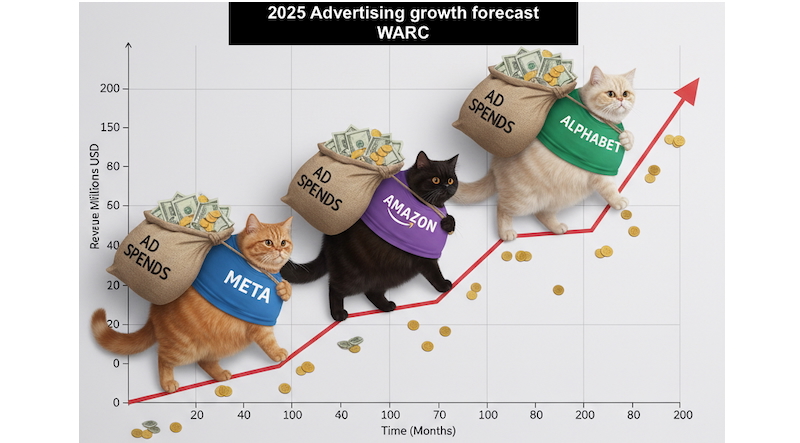
    The bonanza is heavily skewed towards a handful of technology titans. Meta, Alphabet and Amazon are forecast to hoover up nearly two-thirds of all advertising growth in 2025, cementing their stranglehold on the global marketing purse strings. Outside China, the trio already commands 55.8 per cent of all advertising spend—a share set to exceed 60 per cent by 2030.

    Digital platforms are cannibalising traditional media with ruthless efficiency. Nine in every ten new advertising dollars are flowing to online-only platforms, leaving legacy media owners—even those with digital arms—to scrap over what WARC likens to “the equivalent of Facebook’s monthly revenue.”

    Social media has emerged as the single largest advertising medium globally, gobbling up 40.6 per cent of new marketing dollars. Spending on the channel is projected to rocket by 14.9 per cent to $306.4bn this year, representing more than a quarter of total global advertising expenditure. Meta remains the chief beneficiary, capturing 60 per cent of all social media advertising spend.

    The spending spree was particularly pronounced in the second quarter, when social media expenditure jumped 20.2 per cent year-on-year—well above WARC’s initial projection of 12.4 per cent growth. The surge was driven by retailers rushing to stockpile inventory and promote value ahead of expected price hikes, with retail now the largest category on both Instagram and TikTok.

    Search advertising is attracting around 22 per cent of new dollars, while retail media platforms are capturing another 21.5 per cent. Amazon is poised to claim over a third of the retail media pie, which is forecast to grow 13.7 per cent to $175bn in 2025.

    The momentum is expected to accelerate further, with global advertising spend projected to rise 8.1 per cent to $1.27trn in 2026 and 7.1 per cent to $1.36trn in 2027. The market is on track to nearly double in value since the pandemic, underscoring advertising’s remarkable resilience despite economic headwinds.

    “This includes disruption to global trade and reduced purchasing power among consumers, brands are doubling down on Meta, Alphabet and Amazon,” said WARC director of data, intelligence and forecasting James Mcdonald. “The global market is set to nearly double in value since the pandemic, underscoring the resilience of advertising in a tougher economic climate.”

    The rosy outlook contrasts sharply with some other industry forecasts. eMarketer recently slashed its projections for American digital advertising spending, citing the impact of trade wars on automotive and retail sectors. But WARC’s global perspective suggests the digital advertising juggernaut shows no signs of slowing.

  • Global ad market to be hit by trade wars, tariffs, and turmoil, says Warc

    Global ad market to be hit by trade wars, tariffs, and turmoil, says Warc

    MUMBAI: The global advertising industry is set for a bumpier ride than expected thanks to Donald Trump’s recent trade pronouncements and the retaliatory measures by the countries  affected and the continuing conflicts in certain parts of the world. 

    With this background in mind, Warc has slashed its ad spend growth forecast for 2025 by almost a percentage point to 6.7 per cent. The revised estimate pegs global ad spend at $1.15 trillion, down $20 billion over the next two years, thanks to economic stagnation, trade tariffs, and regulatory upheaval. The outlook for 2026 has also taken a hit, with growth now expected at 6.3 per cent.

    Warc director of data, intelligence & forecasting James Mcdonald put it bluntly: “The ad market is feeling the squeeze from tariffs, economic stagnation, and regulatory crackdowns, prompting brands to rein in budgets. Despite the volatility, digital ad spend remains robust, with Alphabet, Amazon and Meta set to control over half the market by 2029.”

    Automakers are slamming the brakes on ad budgets, cutting spend by 7.4 per cent as manufacturing stalls and supply chain woes deepen. Key players like General Motors and Ford have already slashed marketing budgets, focusing more on digital and social channels over traditional TV spots. Meanwhile, tariffs on Mexican, Canadian, and Chinese car imports threaten to worsen the crunch, with 40.7 per cent of the industry at risk, per the European Automobile Manufacturers Association.

    Retailers, too, are tightening belts. The sector, the biggest spender in global advertising, is set to cut ad budgets by 5.3 per cent this year, as rising costs and trade barriers squeeze margins. Chinese disruptors like Temu and Shein, which fuelled a retail ad boom in 2024, are expected to dial back their spending due to new trade restrictions.

    Tech brands, once the ad market’s golden child, are now facing a slowdown. The sector’s projected growth has been halved, down to 6.2 per cent, as new tariffs on semiconductors hit supply chains. Warc had previously forecast a 13.9 per cent jump in tech ad spend—now it’s looking at a much cooler landscape.

    Despite the broader slowdown, digital advertising remains a money-spinner. Search advertising will grab 21.7 per cent of global ad spend this year, rising eight per cent to $250 billion. Social media, the biggest single advertising channel, will rake in $286.2 billion—almost a quarter of all ad spend—powered by TikTok (+23.6 per cent), Instagram (+17 per cent) and Facebook (+8.6 per cent).

    Retail media, the rising star, is set to be one of the fastest-growing advertising formats, with a 15.4 per cent surge this year. However, trade barriers could dent ad receipts from consumer goods brands that rely on global supply chains. 

    Yet, there are storm clouds ahead. The EU has slapped Apple and Google with Digital Markets Act violations, putting billions in ad revenues at risk. UK courts could soon allow consumers to opt out of personalised ads, threatening the backbone of search and social media advertising.

    The US remains a bright spot, with ad spend expected to rise 5.7 per cent to $451.9 billion. But that’s a far cry from the 13.1 per cent growth seen in 2024. Warc predicts a stronger 2026, with a 6.5 per cent uptick, thanks to the FIFA World Cup and US midterms.

    China’s ad market, however, is losing steam. Growth is slowing to 5.3 per cent this year to $205.5 billion – compared to growth of 7.1 per cent recorded in 2024 – as weak domestic demand takes its toll. This year’s growth rate equates to a 3.5 per cent rise in real terms.

    Europe’s major economies, meanwhile, are teetering. The UK’s ad market is still growing—up 7.1 per cent to $52.6 billion—but inflation-adjusted figures tell a less rosy story, with real growth at just 5 per cent. Germany, bogged down by economic sluggishness, is heading for a 2.1 per cent decline in ad spend, while Japan is bracing for a 2 per cent drop. Japan’s market is set to grow 3.3 per cent this year when measured in local currency, demonstrating the current strength of the greenback against the yen.

    Trade wars, tariffs, and economic turmoil are reshaping global ad spend, forcing brands to rethink strategies. The digital giants remain dominant, but regulatory pressures are mounting. In a market full of uncertainty, one thing’s clear—advertisers will need to stay agile to keep ahead of the curve.

  • Sundar Pichai talks Google and Alphabet financial performance with analysts for Q4 meet

    Sundar Pichai talks Google and Alphabet financial performance with analysts for Q4 meet

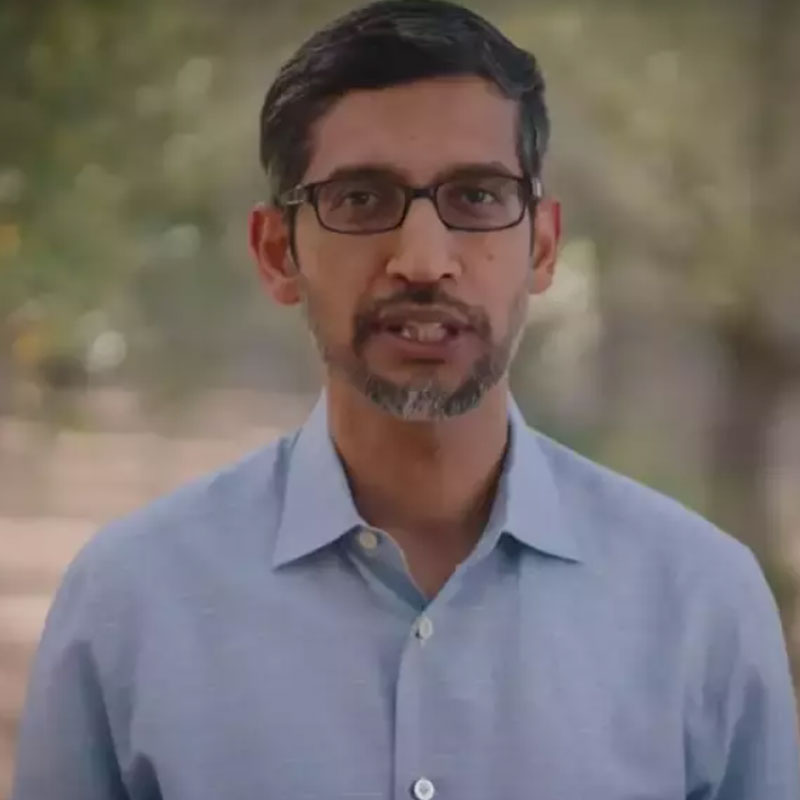
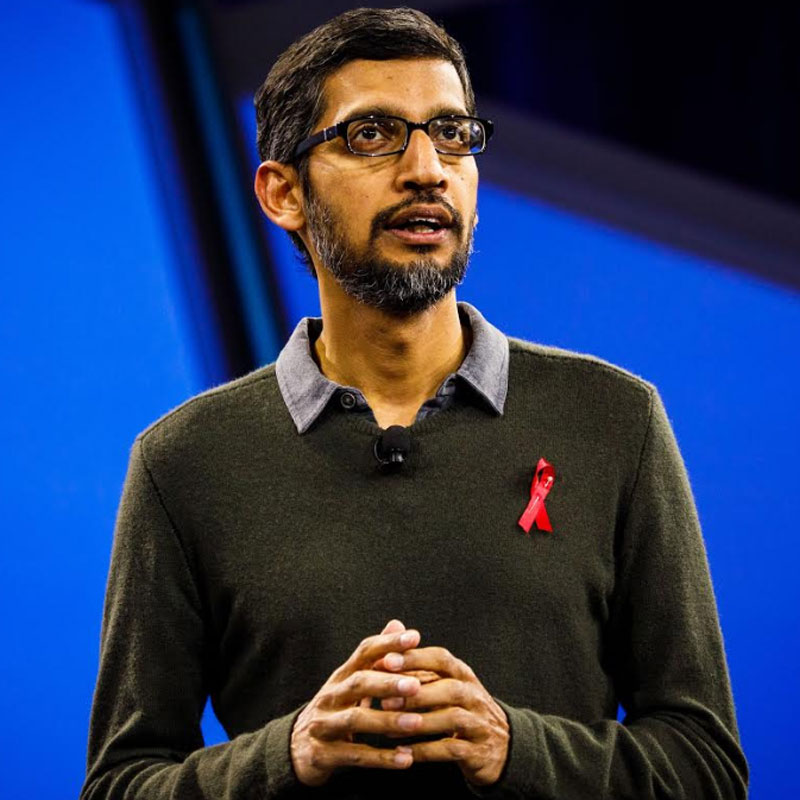
    MUMBAI: Alphabet & Google CEO  Sundar Pichai addressed investors and analysts, highlighting a strong performance in Q4, largely attributed to the company’s advancements in artificial intelligence (AI) and a unique full-stack approach.

    “Q4 showcased our rapid progress in computing capabilities and efficiencies,” Pichai said. He noted significant improvements in product utilisation, consumer engagement, and revenue growth as a result of innovations in AI, including the launch of AI Overviews in over 100 countries and Circle to Search on more than 200 million android devices.

    Notably, Pichai announced that Google cloud and YouTube reached a combined annual revenue run rate of $110 billion at the close of 2024, exceeding their target of $100 billion.

    Focusing on AI, Pichai outlined three key areas of innovation: leading AI infrastructure, world-class research, and product integration. The company has invested in eleven new cloud regions and seven subsea cable projects aimed at enhancing global connectivity. Pichai revealed the launch of the Gemini 2.0 AI model, designed to improve user interactions and drive a more multifaceted search experience.

    In addition, YouTube continues to thrive, maintaining its position as the leading platform for streaming watchtime in the US with over 45 million viewers engaging with election-related content on a single day. The recent integration of podcasts has proved successful, further solidifying its dominant market position.

    Moving to financials, Alphabet’s revenue surged to $350 billion in 2024, a 14 per cent increase year-on-year. Expenditures increased, primarily due to content acquisition costs associated with YouTube and depreciation related to technical investments. Despite rising costs, operating income rose 31 per cent to $31 billion.

    With an optimistic outlook, Pichai stated, “We are well-positioned for continued growth in 2025,” as plans to enhance AI capabilities and expand cloud services take shape. 

    Following Pichai, Philipp Schindler, SVP  and CBO, highlighted the strong performance across Google services, with revenues reaching $84 billion, driven by a significant increase in advertising revenue. 

    Anat Ashkenazi, SVP and CFO, reaffirmed the positive momentum, indicating that the company is prepared for ongoing growth amid anticipated challenges. 

    The market did not believe their posturing totally as Alphabet shares crashed by seven per cent on Wednesday. Investors reacted badly to Pichai’s  plans to spend $75 billion on capital expenditures over  2025 and $16-18 billion in the first quarter  as it builds out its AI offerings and races against megacap rivals to build out data centers and new infrastructure. 

  • Warc revises ad revenue growth estimates upwards for 2024

    Warc revises ad revenue growth estimates upwards for 2024

    MUMBAI: Bullish is the mood at marketing effectiveness specialist Warc. The  firm had forecast in August 2024 that global advertising spend is on course to grow 10.5 per cent this year to a total of $1.07 trillion. Now, it has revised that growth upwards by 0.2 percentage points; its latest projection is that ad spends globally will grow by 10.7 per cent to touch  $1.08 trillion – the strongest growth rate in six years and the largest absolute rise on record if the post-Covid recovery of 2021 (+27.9 per cent year-on-year) is disregarded. 

    Warc’s latest global projections are based on data aggregated from 100 markets worldwide. Online media is on course to drive the growth,  a good year for TV has also made a notable contribution. The good news is that spends on linear TV are rising and are expected to end the year higher by 1.9 per cent, at $153.6 billion, following two years of slippage. Political TV adverts (especially in the US), the Paris Olympics and Euro football in Q3 have buoyed the spends on TV. However, before you start apart applauding please note that  linear TV’s hold today stands at just 14.3 per cent of global advertising spend, much, much lower than the heady days of a 41.3 per cent share in 2013. 

    We have all heard it before: Alphabet, Amazon and Meta are Pacmen increasingly swallowing up ad dollars in large chunks of billions every year. Warc data supports that. It stated that pure play online internet businesses like that of the three big tech firms, will see ad revenue growths of 14.1 per cent reaching $741.4 billion – accounting for a total of 68.8 per cent of all spends. Gadzillions!

    Social media ad spends are expected to leap upwards by 19.3 per cent reaching $252.7 billion -equalling 23.5 per cent of the total ad market. This is mostly because the sales folks at Facebook, Instagram and TikTok have been selling hard leading to better than expected results at the three firms during the first nine months of this year. 

    Overall ad spend growth is also expected to be buoyant next year at 7.6 per cent in 2025, and seven per cent in 2026 taking the global ad market to $1.24 trillion. For all those who have been doomsayers predicting the slamming of brakes on advertising here’s some facts: global ad investments have more than doubled over  the past 10 years and have grown 2.8 times faster than global economic output since 2014.

    Warc director of data, intelligence and forecasting and author of the research James McDonald said: “Our latest forecast anticipates $104bn in incremental advertising spend worldwide this year, the largest rise in history if the post-pandemic recovery year of 2021 were discounted. Whether this boom will sustain remains unclear, however, as 2025 presents a sliding doors moment due to heightened regulatory pressures on Google and TikTok – together a quarter of the ad market outside of China. This, alongside an increasingly challenging geopolitical climate, may spell uncertain times ahead for the businesses that rely on advertising trade.”

    (The image for this report was created using OpenArt AI. No copyright infringement is intended)
     

  • Competition Commission clears Alphabet’s investment in Flipkart

    Competition Commission clears Alphabet’s investment in Flipkart

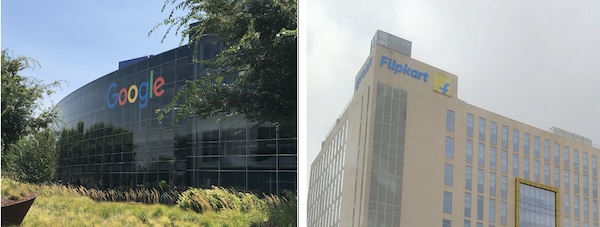
    MUMBAI: Indian ecommerce giant  Flipkart  -owned by  US retail major Walmart – has a new minority shareholder. India’s monopolies  and fair trade watchdog, the Competition Commission of India, on 26 November, gave the green signal to Alphabet’s subsidiary Shoreline International Holdings LLC to acquire a stake in it. Shoreline International Holdings is a wholly-owned offshoot  of Alphabet,  Google’s parent company. It is a holding firm and does not own or operate any Google products or services.

    “The proposed transaction comprises an investment through subscription of shares of Flipkart Pvt Ltd (Target) by Shoreline International Holdings LLC (acquirer) and an arrangement between an affiliate of the acquirer and the target’s subsidiary for the provision of certain services,” the regulator said in a release.

    Flipkart mainly  offers wholesale cash and carry operations and runs marketplace-based e-commerce platforms to facilitate trade between customers and sellers in India. 

    In 2023, Flipkart had started a funding round of close to a billion  Us dollars which included $350 million from Google and around $600 million from Walmart. The agreement with Google also included, according to reports, access to its cloud services which would allow it expand its digtal infrastructure further. With that its valuation had risen to $36 billion and it said it would use the money to expand into quick commerce and other fintech ventures.

    85 per cent owned by Walmart, Flipkart will probably move towards an IPO in the not-too-distant future, as it is something which the Binny Bansal and Sachin Bansal-founded firm has been thinking about for sometime. 

  • Godrej redefines ABCD on Children’s Day

    Godrej redefines ABCD on Children’s Day

    Mumbai: Godrej Group has launched a new campaign for Children’s Day that redefines all 26 letters of English. The new-age ABC song was released on the group’s social media pages.

    Sung in the same tune as the traditional ABC, it makes the learning process easy and catchy. The song aims to help little ones grow and live better, thereby promoting a society and nation that thrive. The song aspires to help raise the children to be genuine, well-aware, and streetwise individuals who learned facts and values early in their lives.

    With a vision of replacing the traditional ABC with the new-age ABC, Godrej Group has tied up with Teach For India for an on-ground partnership. They will be posting the video on their social media handles as well as sharing it with their fellows, who will make videos/reels of them reciting this new ABCD song. Going forward, we will be approaching more schools and the Educational Board of India to include ABC in the pre-school curriculum.

    Speaking on the launch of the new ABC song, Godrej Group executive director and chief brand officer Tanya Dubash said, “It is imperative that children learn and inculcate the right attitudes and habits at a tender age. Since Children’s Day is extra special for us at Godrej, we thought of gifting our kids with a song that will help them become better individuals tomorrow, even as they learn the basics of the alphabet. The new ABC song will therefore be an appropriate introduction to learning for the children of today.”

    Speaking about the partnership, Teach For India CEO and founder trustee Shaheen Mistri added, “At Teach For India, we keep children at the centre of everything that we do. We want every child to reach their truest potential by giving them access to an excellent, reimagined education. With the new-age ABCDs, we can start to sow the seeds of what children can truly imagine for themselves, for others, and for India.”

    Creativeland Asia co-founder and creative vice chairman Anu Joseph said, “With so many things changing around us over the last couple of years, we thought kids should have a new set of things to remember and learn. Therefore, this new-age ABC song.

  • Facebook parent Meta posts its first-ever revenue decline in Q2

    Facebook parent Meta posts its first-ever revenue decline in Q2

    Mumbai: Facebook parent company, Meta, on Thursday announced a decline in the company’s revenues in its second quarter earnings 2022 for the first time since it went public in 2012. The tech major reported a drop in revenues from $29.08 billion to $28.82 billion, down one per cent over last year.

    Meta also announced that its chief finance officer (CFO) David Wehner would now take over the role of chief strategy officer (CSO) and oversee the company’s strategy and corporate development.

    The company announced that Susan Li, currently vice president of finance, will replace him as CFO. The transitions will be effective from 1 November.  

    The social media network’s net income saw a decline of 36 per cent in April-June, falling from $10.39 billion ($3.61 per share) to $6.69 billion ($2.46 per share) year-on-year (YoY).

    “We seem to have entered an economic downturn that will have a broad impact on the digital advertising business,” said Meta founder and CEO Mark Zuckerberg in an earnings call on Wednesday. “It’s always hard to predict how deep or how long these cycles will be, but I’d say that the situation seems worse than it did a quarter ago.”

    The social media giant also issued a bleak third-quarter forecast. “This outlook reflects a continuation of the weak advertising demand environment we experienced throughout the second quarter, which we believe is being driven by broader macroeconomic uncertainty,” chief finance officer David Wehner said in a statement.

    “We have reduced our hiring and overall expense growth plans this year to account for the more challenging operating environment while continuing to direct resources toward our company priorities,” he added.

    The company expects its 2022 total expenses to be in the range of $85-88 billion, lowered from its prior outlook of $87-92 billion, Wehner further stated.

    Meta’s worrying results follow a pattern reflected in the results of other major tech companies and its rivals, Snap and Twitter – both of whom reported disappointing second-quarter numbers last week, during an unprecedented stressful period across the industry. The results also follow a broader decline in the digital advertising market.

    Advertising revenue growth slowed throughout the second quarter as advertiser demand softened, Wehner stated. “The deceleration has been broad-based across verticals, and we believe businesses are lowering their advertising spend in response to the increased economic uncertainty.”

    Earlier on Wednesday, another tech major and Google parent company- Alphabet posted a 13 per cent growth in consolidated revenue at $69.7 billion for the second quarter – its slowest quarterly growth in two years.

    Meta also faces its own unique challenges of competing with TikTok, while focusing on its next phase of building the immersive metaverse.

    In this environment, we’re focused on making the long-term investments that will position us to be stronger coming out of this downturn — including our work on our discovery engine and Reels, our new ads infrastructure, and the metaverse, stated Zuckerberg. The company is also focused on being rigorous about measuring returns and sizing these investments correctly, he added.

  • Alphabet, Meta & Amazon accounted for 46.1% of all advertising spend in 2021: WARC report

    Alphabet, Meta & Amazon accounted for 46.1% of all advertising spend in 2021: WARC report

    Mumbai: Alphabet, Meta and Amazon receive almost half of all advertising spend globally at 46.1 per cent, according to the latest data released by WARC. While the three companies accounted for 33.8 per cent of all advertising investment in 2019 before the pandemic, the digital acceleration from consumers and brands in 2020 and 2021 has pushed this share even higher.

    Alphabet tops the list, accounting for 27.2 per cent of adspend, up from one-fifth in 2019. Meta has risen to 14.9 per cent while Amazon has doubled its share to 4.0 per cent, according to WARC’s analysis of the company reports.

    The three tech giants have also managed to grow their share of online advertising, despite their dominant size. Altogether, Alphabet, Meta and Amazon accounted for 71.2 per cent of all online adspend in 2021, up from 67.8 per cent in 2019, as per the data from WARC.

    WARC Data’s latest forecast puts total advertising growth at 12.5 per cent in 2022, with e-commerce set to be the quickest-growing medium. Social media is also expected to overtake search advertising in value this year.

    The three companies that are leaders in their respective media – Alphabet in search (Google) and online video (YouTube), Meta in social media (Facebook and Instagram), and Amazon in e-commerce – have steadily grown their share of the advertising market. If their current rate of growth continues, they’re set to account for more than half of all advertising investment in 2022, says WARC Data’s forecast.

  • YouTube reports $6 billon ad revenue in Q1, up 49% from year earlier

    YouTube reports $6 billon ad revenue in Q1, up 49% from year earlier

    KOLKATA: YouTube’s advertising revenue rose dramatically in the first quarter of 2021 , up 49 per cent from the same quarter in the last year. As the parent company Google/Alphabet reported its first quarter earnings, YouTube ad revenue amounting to $6 billion has trumped all expectations.

    Google and Alphabet chief financial officer Ruth Porat has credited “exceptional performance in direct response and ongoing strength in brand advertising” for the jump in ad revenue. The direct response business is now a large and fast-growing business for the segment, Google chief business officer Philipp Schindler added.

    The platform is also working on shopping capabilities of viewers on the platform. “I think we’re still scratching the surface on what’s possible really with commercial intent on YouTube,” Schindler said. He emphasised that advertisers are using YouTube to reach audience that they can’t find anywhere else. The video viewing platform is starting to see an advertiser mix of awareness and more action-oriented formats who are driving reach and results across the funnel.

    The video giant currently boasts of over two billion monthly logged users and over one billion hours of daily video consumption. Interestingly, its short video platform has also seen exponential growth. “YouTube Shorts continues to gain popularity with over 6.5 billion daily views as of March, up from 3.5 billion at the end of 2020,” Google and Alphabet CEO Sundar Pichai said.

    Overall, Alphabet reported $55.3 billion in Q1 revenue, up 34 per cent year-over-year. “Over the last year, people have turned to Google Search and many online services to stay informed, connected and entertained. We’ve continued our focus on delivering trusted services to help people around the world. Our Cloud services are helping businesses, big and small, accelerate their digital transformations,” Pichai said in a letter to the shareholders.

  • YouTube’s ad revenue growth slows down in Q2, subscription revenue sees good growth

    YouTube’s ad revenue growth slows down in Q2, subscription revenue sees good growth

    KOLKATA: In the pandemic-hit period, Google-owned YouTube’s advertising revenue declined in the Q2 of 2020 compared to the previous quarter. It has raked $3.81 billion for the quarter up from $3.60 billion in the year-ago period but lower than $4.04 billion in Q1. 

    “For YouTube, we ended March with a year-on-year growth rate in the high single digits, and that's reflecting a substantial headwind from brand. The headwind from brand moderated modestly at the end of the second quarter, and then we saw a further improvement in July. Direct response has been consistently strong,” Google and Alphabet CFO Ruth Porat said.

    Google and Alphabet CEO Sundar Pichai also mentioned strong growth in non-ads revenues particularly from Cloud, Google Play and YouTube subscriptions. Nevertheless, content acquisition costs of the company were primarily driven by content costs for YouTube TV and paid YouTube Music and premium subscription services. 

    He also added that YouTube Premium Music and TV subscriptions performed well during the quarter. “This, in turn, is helping our partners, developers and creators earn revenue and deliver valuable services to people. We are focused on the steps to build long-term value with these opportunities,” Pichai said.

    However, while the ad market saw a bump since March, the headwind from brand moderated modestly at the end of the second quarter seeing further improvement in July. Moreover, the company added features in the quarter to make video ads more easily shoppable and browsable on YouTube as more businesses are shifting to online to offset physical store closures.