Tag: Alice Rohrwacher

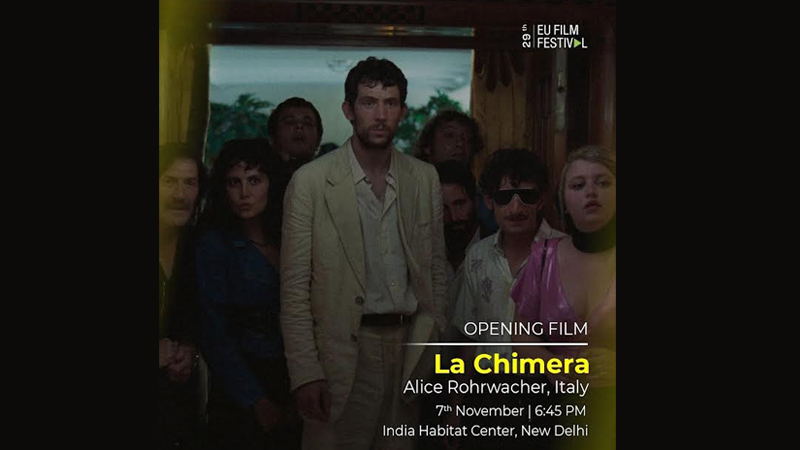
  • La Chimera to open the 29th European Union Film Festival

    La Chimera to open the 29th European Union Film Festival

    Mumbai: The 29th European Union Film Festival (EUFF) will open with La Chimera, screening on 7 November 2024 in New Delhi. Written and directed by Alice Rohrwacher, the film follows an Englishman exploring Italy’s historical treasures with an eccentric group. La Chimera touches on themes of lost love, relationships, life, and death. Yile Yara Vianello, the film’s lead actress, will attend the opening night in India.

    Writer-director Alice Rohrwacher said, “The proximity of sacred and profane, of death and life, that characterised the years in which I was growing up has always fascinated me and given a measure to my way of seeing. This is why I decided at last to make a film that tells this layered story, this relationship between two worlds, the last part in a triptych about a local area whose attention is focused on one central question: what should it do with its past? As some grave-robbers say, down our way it’s the dead that give life.”

    The European Union Film Festival (EUFF) will run in New Delhi from 7 to 16 November 2024, showcasing 26 European films in 31 languages, providing insights into European society, culture, and people. Organised by the European Union in partnership with EU Member States and regional partners, the festival strengthens EU-India cultural ties and fosters cross-cultural understanding.


    The festival will take place at three venues in New Delhi: India Habitat Centre, Instituto Cervantes, and Goethe-Institut / Max Mueller Bhavan. It features films exploring diverse themes, including relationships, gender identity, sisterhood, and self-discovery. The lineup includes several India premieres, such as What A Feeling, Because I Love Bad Weather, Stairway To Heaven, Death is a Problem for the Living, Jim’s Story, Without Air, Black Velvet, The Last Ashes, Blood on the Crown, Baan, Horia, and The Man Without Guilt.

    All films will have English subtitles and are available on a first-come, first-serve basis. Some films are rated 18-plus; please check ratings before attending.

    EUFF 2024 film line-up by country:

    ●    Austria: What a Feeling 
    ●    Belgium: Employee of the Month (L’employée Du Mois) 
    ●    Bulgaria: Because I Love Bad Weather (Защото обичам лошото време) 
    ●    Cyprus: Embryo Larva Butterfly 
    ●    Czech Republic: Restore Point (Bod Obnovy) 
    ●    Denmark: Sons (Vogter) 
    ●    Estonia: Stairway To Heaven (Taevatrepp) 
    ●    Finland: Death is a Problem for the Living (Peluri- Kuolema on Elävien Ongelma) 
    ●    France: Jim’s Story (Le roman de Jim) 
    ●    Germany: Afire (Roter Himmel) 
    ●    Greece: Animal 
    ●    Hungary: Without Air 
    ●    Ireland: An Irish Goodbye 
    ●    Italy: La Chimera 
    ●    Latvia: Black Velvet (Melnais Samts) 
    ●    Lithuania: Five And A Half Love Stories In An Apartment In Vilnius (Penkios su puse meilės istorijos, nutikusios viename Vilniaus bute) 
    ●    Luxembourg: The Last Ashes (Läif a Séil) 
    ●    Malta: Blood on the Crown 
    ●    Netherlands: Como el Viento 
    ●    Poland: Dangerous Men (Niebezpieczni dżentelmeni) 
    ●    Portugal: Baan 
    ●    Romania: Horia 
    ●    Slovenia: The Man Without Guilt (L’uomo senza colpa) 
    ●    Spain: The Teacher Who Promised The Sea (El maestro que prometió el mar) 
    ●    Sweden: UFO Sweden 
    ●    Ukraine: How is Katia? (Yak Tam Katia?)

  • Cannes Palme d’Or goes to Turkey’s Nuri Bilge Ceylan for feature and to Simón Mesa Soto for shorts

    Cannes Palme d’Or goes to Turkey’s Nuri Bilge Ceylan for feature and to Simón Mesa Soto for shorts

    NEW DELHI: Renowned Turkish filmmaker Nuri Bilge Ceylan has won the Palme d’or for his film Winter Sleep on the conclusion of the 67th Cannes Film Festival.


    The award – to the best of the 18 in competition – was presented to him by the American actress Uma Thurman and the American director Quentin Tarantino. The Jury was presided over by Jane Campion.


    Nuri Bilge Ceylan said: “This is a huge surprise for me, I wasn’t expecting it. I don’t know what to say. This year marks the 100th anniversary of Turkish cinema, which is a happy coincidence. I would like to thank the Festival de Cannes for supporting this long project. Thank you to the Jury, to Thierry Frémaux and Gilles Jacob. I would like to dedicate this Palme d’or to the young people of Turkey and to those who lost their lives during the year. Thank you very much”. 


    The film also won the top award given by The FIPRESCI (International Association of film critics) jury headed by Esin Kücüktepepinar of Turkey.


    While Titli by Kanu Bahl from India was highly lauded, the film that was selected for Un Certain Regard and Gitanjali Rao’s 19-minute animated romance True Love Story in the Critics’ Week failed to make any mark. Behl was also a contender for the Camera d’Or, the award for feature directing debut.


    Sergio Leone’s Per un pugno di dollari (A Fistful of Dollars) presented by Quentin Tarantino, was screened at the end of the ceremony.


    Le Meraviglie (The Wonders) by Alice Rohrwacher received the Grand Prix award while the best Director Award went to Bennett Miller for Foxcatcher.


    The Jury Prize ex-aequo went to Mommy by Xavier Dolan (the youngest winner at 25) and Adieu Au Langage (Goodbye to language) by the renowned Jean-Luc Godard.


    The best acting awards went to actress Julianne Moore in Maps to the Stars by David Cronenberg and actor Timothy Spall in Mr Turner by Mike Leigh. Mr Turner also won the award of the Vulcan Award for Technical Artist of the Jury of the CST to Dick Pope, director of photography, for bringing to light the works of Turner.


    The Best Screenplay Award was awarded to Andrey Zvyagintsev and Oleg Negin for Leviathan.


    The Palme d’Or for Short Films went to Leidi by Simon Mesa Soto.


    A Special Mention – Ex-aequo – was made of A?ssa by Clément Trehin-Lalanne and Ja Vi Elsker (Yes we love) by Hallvar Witzo.


    The Un Certain Regard Prize went to Fehér Isten by Kornél Mundruczó. FIPRESCI gave the Un Certain Regard award to Jauja by Lisandro Alonso.


    The Jury Prize went to Turist by Ruben Östlund while the Un Certain Regard Special Prize was awarded to The Salt of the Earth by the lauded Wim Wenders and Juliano Ribeiro Salgado.


    The Ensemble Prize was given to Party Girl by Marie Amachoukeli, Claire Burger and Samuel Theis, and the film also received the Camera d’Or award in the Un Certain Regard, while the Best Actor Award went to David Gulpilil in Charlie’s Country by Rolf de Heer.


    In the Cinefondation category for student films, the first prize went to Skunk by Annie Silverstein from the Texas University at Austin in the United States, while the second prize went to Oh Lucy!  by Atsuko Hirayanagi of the NYU Tisch School of the Arts Asia, Singapore and the third prize was given jointly to Lievito Madre by Fulvio Risuleo of Centro Sperimentale di Cinematografia, Italy and The Bigger Picture by Daisy Jacobs of the National Film and Television School in the United Kingdom.


    The Nespresso Grand Prize in the Critics’ Award category went to The Tribe by Myroslav Slaboshpytskiy, which also received the France 4 Visionary Award. It additionally got the Gan Foundation Support for Distribution.


    The SACD Award went to Hope by Boris Lojkine.


    A Ciambra by Jonas Carpignano received the Sony CineAlta Discovery Prize for short film and the Canal+ Award for short film went to Crocodile by Gaëlle Denis.


    In the Directors’ Fortnight section, the Europa Cinema Label, the SACD Prize and the Art Cinema Award went to Love At First Fight (Les Combattants) by Thomas Cailley. The film also received the FIPRESCI award.


    The Illy prize for short film was given to Heartless (Sem Coraç?o) by Nara Normande and Ti?o.


    A special mention was made of It Can Pass through the Wall (Trece si Prin Perete) by Radu Jude.


    Ceylan’s film is a 210 minute morality tale about a former actor who runs a hotel in remote Anatolia. As winter approaches, he is alone with his young wife and her sister going through a divorce. The cold weather makes the hotel not only a shelter but a site where the three must confront their growing feelings of animosity.


    Mommy, like the films of Jean Luc Godard, has broken ground, and ironically Dolan shared the jury prize with the French New Wave director with the daring hand held camera and jump cuts. Godard’s film Adieu au Langage (Goodbye to Language) in the official competition uses colorized scenes and fragmentation in a rather well shaped non-linear narrative. Dolan’s “Mommy” represents a paradigm shift for cinematic language. Defying established aspect ratios, Dolan and his director of photography André Turpin used a perfectly square 1.1 instead of today’s widescreen formats. Mommy shot on 35mm explores futuristic Canada with new mental-health laws in this film about a mother with a violent son.