Tag: Alcatel

  • Alcatel joins Flipkart to launch stylish Make in India smartphones

    Alcatel joins Flipkart to launch stylish Make in India smartphones

    MUMBAI: Alcatel has announced a strategic tie-up with Flipkart, bringing its latest range of ‘Make in India’ smartphones to Indian consumers via both Flipkart’s main platform and its rapid delivery arm, FK Minutes.

    This collaboration marks a bold step in Alcatel’s push to blend global innovation with local manufacturing, targeting digitally savvy youth across metros and smaller towns with feature-rich devices wrapped in sleek French design.

    With Flipkart’s massive e-commerce reach and real-time fulfilment capabilities, the partnership sets the stage for Alcatel to tap into the aspirations of India’s booming smartphone market—especially among the urban and semi-urban youth segment.

    Alcatel chief business officer Atul Vivek said, “As we chart our path forward, our vision is to build a complete ecosystem of products that deliver a truly connected and unified experience for Indian consumers. We are enthusiastic about our upcoming launches and the steady expansion of our footprint in the Indian market. This strategic partnership with Flipkart is instrumental in bringing that vision to life. Leveraging Flipkart’s expansive reach and deep market insights, we aim to offer high-quality products backed by a reliable, seamless after-sales service, ensuring an elevated consumer experience across the country.”

    Alcatel chief operating officer Ansh Rathi added, “We are proud to join hands with Flipkart to bring world-class quality and service to Indian consumers. This collaboration marks a significant step in elevating the smartphone experience by introducing feature-rich, premium devices at compelling price points. At Alcatel, our commitment lies in creating a seamless, connected ecosystem across devices and platforms. Guided by our core philosophy of delivering exceptional product experiences, we believe Flipkart’s vast network will help us build strong, meaningful connections with the youth across both urban and emerging markets in India.”

    Alcatel is also scaling up its nationwide service infrastructure to ensure smooth, dependable after-sales support.

  • Fintech powerhouse Angel One snaps up Walmart tech guru in C-suite shuffle

    Fintech powerhouse Angel One snaps up Walmart tech guru in C-suite shuffle

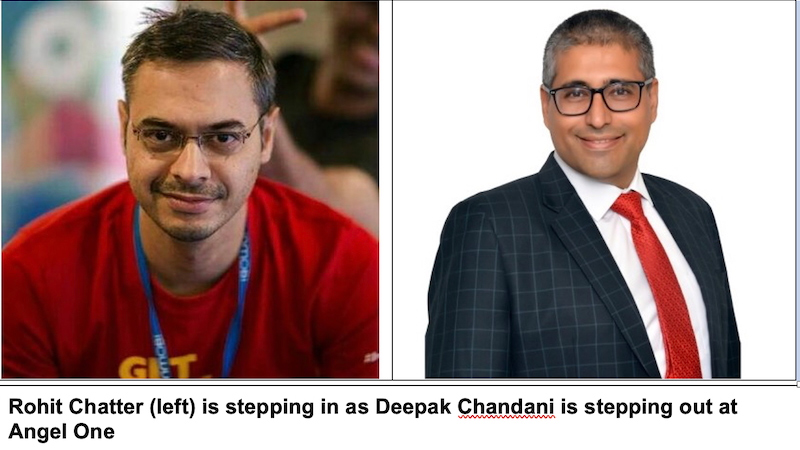
    MUMBAI: Angel One Ltd has poached tech heavyweight Rohit Chatter as its new chief data officer, while bidding farewell to outgoing data chief Deepak Chandani.

    Chatter, fresh from his gig as chief software architect at Walmart Global Tech, will take the reins with immediate effect, as Chandani prepares to clear his desk by April  end.

    The well-timed appointment sees Angel One doubling down on its AI ambitions, with chairman Dinesh Thakkar making no bones about the company’s lofty aspirations. 

    “We’re not just embracing the future of finTech—we’re building it,” he declared with characteristic swagger. “Data is the foundation of this revolution and Rohit’s unparalleled expertise in AI, cloud platforms and data science will be a game-changer in redefining digital investing. With his leadership, we will push the boundaries of innovation, deliver hyper-personalized experiences and empower millions with smarter financial solutions.”

    Chatter brings nearly three decades of tech wizardry to the table, having cut his teeth at Silicon Valley giants and masterminded large-scale data operations. At Walmart, he was the brains behind their generative AI revolution, while his stint as CTO at InMobi saw him transform their remarketing platform into a cash cow across major markets.

    The data boffin’s CV also boasts impressive turns at Yahoo India, where he spearheaded big data initiatives, and various leadership roles at Talisma, IPSoft, TiVo and Alcatel in the US. His tech toolkit includes everything from Oracle databases to Unix systems, alongside programming chops in Perl, Python and Java.

    Chatter, who holds a BE in electronics & telecom and an MBA from NMIMS, seems positively gung-ho about his new role. 

    “Angel One is revolutionizing the financial services industry with its AI-first approach and I am excited to be part of this dynamic team. AI and data science are shaping the future of investing and my focus will be on enhancing Angel One’s platforms with automation, predictive analytics and intelligent insights that empower investors across India. The potential to innovate and scale AI-led financial solutions at Angel One is immense and I look forward to thisjourney,” he enthused, barely containing his excitement at the prospect of unleashing predictive analytics upon India’s investing masses.

    For the uninitiated, Angel One stands tall as India’s largest listed retail stock broking house by active NSE clients. The tech-savvy outfit serves over 30 million investors through its digital platforms, including the Angel One Mobile App, the rather clever ‘ARQ Prime’ recommendation engine, and the ‘Smart Money’ educational platform designed to turn investing novices into market maestros.

  • TO THE NEW Digital appoints Dave Maan as EVP

    TO THE NEW Digital appoints Dave Maan as EVP

    MUMBAI: TO THE NEW Digital has appointed Dave Maan as executive vice oresident for its video solutions.


    With an experience of 20 years in software engineering, Maan has worked with companies like Altran, Ericsson, Hewlett Packard, Alcatel, Schlumberger and Sapient.


    Maan is an established industry expert in digital video, OTT and multi-screen convergence space supplemented by his digital experience in mobile ad platforms, digital marketing technologies, CDN-Cloud and predictive mobile data analytics.


    At TO THE NEW Digital, Maan will be responsible for contributing to the overall strategy and managing the delivery quality of products and services to the clients. He would primarily work towards increasing service offerings for Video Streaming Solutions and VideoReady (an end-to-end OTT Video solution).


    “We are excited to have Dave in our leadership team. His global experience will be an asset as we continue to grow our services breadth. I welcome him aboard,” said TO THE NEW Digital CEO Deepak Mittal.


    Maan added, “I am excited to join TO THE NEW Digital and work with the exceptional team. I look forward to utilise my experience for creating exciting new experiences for clients and contributing to the growth of the company.”

  • Zee Media Corporation CEO & executive director Ashish Kripal Pandit resigns

    Zee Media Corporation CEO & executive director Ashish Kripal Pandit resigns

    MUMBAI: Zee Media Corporation executive director and CEO Ashish Kirpal Pandit has resigned from the company with effect from 12 October.


    He handled senior management roles for more than 27 years in industries from ranges from telecom to retail. He has been associated with brands like Alcatel, Efirst Technologies, Fortis Healthcare Limited,  Reliance Webstore and Tata Teleservices. 


    Pandit joined Zee Media Corporation in October 2014 and looked after senior management team. Pandit was with Digicall Global for three years before joining Zee.

  • Telecom sector ‘biggest success story’; Cisco, Alcatel for R&D investment: Economic Survey

    Telecom sector ‘biggest success story’; Cisco, Alcatel for R&D investment: Economic Survey

    NEW DELHI: Hailing the country’s telecom sector as “one of the biggest success stories of market oriented reforms”, the Economic Survey of India, tabled in the Parliament today, has said that by the end of 2012, a total of 650 million telephone connections (including 66 million wired and 584 million wireless connections) are expected to be achieved.

    Interestingly, the report informs that a large number of foreign companies like Alcatel, Cisco etc. have also shown interest in setting up their research & development (R&D) centres in India.

    A proposal for setting up a Telecom Equipment and Services Export Promotion Council and Telecom Testing and Security Certification Centre (TETC) is in the pipeline. With the above initiatives, India is expected to become a manufacturing hub for telecom equipment, the report holds.

    It says that broadband connectivity would be made available on demand, without limiting the speed.

    “Each village would have at least one broadband enabled kiosk. Broadband connection would be provided to schools, health centres and panchayat offices,” it has envisaged.

    It is also been envisaged that internet and broadband subscribers will increase to 40 million and 20 million, respectively, by 2010.

    “India is now amongst the fastest growing telecom markets in the world. Supportive government policies coupled with private sector participation have fuelled the unprecedented expansion of this sector,” the report asserted citing data.

    Looking back, it has said also that the announcement of the New Telecom Policy, 1999, was a watershed event for telecommunications in India. Other policy milestones include the opening of the long-distance market in 2002, the termination of VSNL’s monopoly over international traffic in the same year, and the resolution of the wireless in local loop issue.

    “As a result, telecom tariffs which were among the highest in the world less than four years ago have now dipped to being among the lowest. Tele- density has also increased from 12.7 per cent in March 2006 to 16.8 per cent in December, 2006.

    The data given by the Survey shows that the number of CDMA were 0.61 million in 2003 and in 2006 stand at 44.17; similarly, for the same period, the users of GSM sprang from 12.69 mn to 105.43 mn, and the figures for wireless (CDMA and GSM) rose from 13.30 mn to 149.60 mn.

    The Survey has put the annual growth rate in 2006 stands at 45 per cent, as compared to 2003, when it was 40 per cent.

    The Survey has note that the total number of telephones has increased from 54.63 million on March 31, 2003 to 142.09 million on March 31, 2006 and 189.92 million on December 31, 2006.

    “While 43.72 million telephones were added during the 12 months of 2005-06, during the current year, about five million subscribers are being added every month.
    “With this growth, the number of telephones is expected to reach 250 million by the end of 2007,” says the report

    “The growth of wireless services has been phenomenal, with wireless subscribers growing at a compound annual growth rate (CAGR) of above 90 per cent per annum since 2003.

    “Today the wireless subscribers are not only much more than the fixed subscribers in the country, but also increasing at a much faster pace.

    “The share of wireless phones has increased from 24.3 per cent in March 2003 to 78.77 per cent in December, 2006. Improved affordability of wireless phone has made universal access objective more feasible,” says the report.

    “The number of internet subscribers grew at 25 per cent, while broadband subscribers grew from a meagre 0.18 million to 1.32 million, during 2005-06. It is necessary to increase the broadband connectivity for the knowledge-based society to grow quickly and for reaping the consequent economic opportunities.

    Foreign direct investment (FDI) is one of the important sources to meet the huge funds that are required for rapid network expansion, the report has noted, adding that the FDI policy provides an investor-friendly environment for the growth of the telecom sector.

    “The total FDI approved and the actual inflow up to July, 2006 were Rs 389.2 billion and Rs 11,801.46 billion, respectively,” says the report.

    It says also that of the more than 235.4 million public call offices (PCOs) functioning in the country, 200,000 are in the rural areas.

    “Apart from this, 560,000 village public telephones (VPTs) are also providing access to telecom facilities in the rural areas. The Mobile Grameen Sanchar Sewak Scheme providing telephone at the doorstep of villagers in about 12,000 villages is also in place.

    On the issue of manufacture of telecom equipment, the report notes that the Indian telecom industry manufactures a complete range of telecom equipment, using state of the art technologies designed specifically to match the diverse terrain and climate conditions.

    Production of telecom equipment has increased from Rs 160.9 billion in 2004-05 to Rs 178.33 billion in 2005-06, it has noted, adding that “Rising demand for a wide range of telecom equipment, particularly in the area of mobile telecommunication, has provided excellent opportunities to domestic and foreign investors in the manufacturing sector.”
     

  • Alcatel, Samsung to develop mobile TV handsets in the S-Band

    Alcatel, Samsung to develop mobile TV handsets in the S-Band

    MUMBAI: France based comunications services provider Alcatel and Samsung Electronics have signed an agreement to develop mobile handsets compatible with the evolution of the DVB-H standard in the S-Band. This is part of Alcatel’s Unlimited Mobile TV solution.

    The two parties will collaborate on interoperability testing in order to deliver a seamless end-to-end solution to operators and a high quality Mobile TV service to end-users. Both companies will support the standardization process of this solution in the DVB Forum undertaken in the DVB-SSP (Satellite Services for Portable devices) Ad-Hoc Group, and join forces to market their combined solution. In a first step, this agreement covers Europe, where the S-band spectrum is available today.

    The solution in the S-Band allows complete territory coverage for Mobile TV at the scale of a country or even a continent, including inside buildings. Besides, this solution is compatible with DVB-H in UHF, which also enables the development of dual-mode UHF/ S-Band Mobile TV terminals.

    Samsung senior VP Kwang Suk Hyun says, “Samsung values its new cooperation with Alcatel for handsets in the S-Band, as it opens the door to a significant new business opportunity for Samsung in Europe. S-Band is a solution of choice in Europe for Mobile TV deployment and Samsung intends to be a major player in this business.”

    Alcatel’s mobile broadcast activities president Olivier Coste says, “We welcome Samsung as a new key stakeholder in the S-Band ecosystem for broadcast Mobile TV, as they enjoy a track record in fast Mobile TV handset development and go-to-market capability. Samsung’s endorsement of our hybrid mobile TV solution in the S-Band also demonstrates the attractiveness of this option for the Mobile TV industry at large.”

    The goal of Alcatel’s “Unlimited Mobile TV” solution is to make television available on mobile phones throughout rural and urban areas, including indoors, with a wide range of programming options and excellent image quality, regardless of the number of viewers simultaneously watching the same programme.

    This universal broadcast coverage is possible thanks to the unique combination of a high-power geo-stationary satellite for cost-effective nationwide coverage and a network of low power repeaters, co-located with mobile base stations, to provide urban and indoor coverage. This innovative solution uses an evolution of the DVB-H standard in the 2 GHz band (S-Band), a telecom frequency band between 2.17 and 2.2 GHz associated with satellite usage, which is adjacent to the 3G/UMTS band. This 30MHz band is currently available all across Europe.

  • Global sports TV forum Sportel Monaco sells 85 per cent of exhibition space

    Global sports TV forum Sportel Monaco sells 85 per cent of exhibition space

    MUMBAI: With two months to go before the opening of the sports television forum Sportel Monaco 2006, exhibitors have committed to more than 85 per cent of the expanded floor space in the Grimaldi Forum. The event takes place from 16-19 October 2006.

    Exhibitors include Total Sports Asia, A1GP World Cup Of Motorsport, AGFIS, Alcatel, BBC Worldwide, EBU, PGA Tour, HBO, the NBA and World Wrestling Entertainment (WWE).

    Sportel CEO David Tomatis says, ” We have opened up every corner of the exhibition floor to add more stands and it is virtually certain that we will sell all existing space in the coming weeks.

    “We are continuing to focus on exciting new technologies involving the reception of sports content on mobile receivers, along with our traditional base of international TV sports. Sportel Monaco 2006 may very well be our largest market ever.”

  • Orange, Alcatel testing new mobile broadcasting concept

    Orange, Alcatel testing new mobile broadcasting concept

    MUMBAI: French space agency Cnes, telecom firm Orange France, and communications solutions provider Alcatel have announced the selection of Toulouse and the Midi-Pyrenees Region in France for the first trial of a system that is central to Alcatel’s “Unlimited Mobile TV” solution.

    This trail was outside the laboratories of the main technical characteristics of the new mobile broadcasting solution over a hybrid satellite and terrestrial transmission system using S-band. It is preliminary to the research and development efforts for the terrestrial aspects of the project, made possible with support from the French Industrial Innovation Agency.

    The Cnes financed and oversaw the design and deployment of the demonstrator, set the trial schedule, and is leading the trial; Orange, the leader in mobile broadcasting, is providing terrestrial repeater sites and contributing its expertise for analyzing results; Alcatel is conducting all trial measurements and preparing the result analysis; in addition, Eutelsat and SES Astra are supplying the satellite resources needed for feeding terrestrial repeaters.

    The trial was initially scheduled to continue through September 2006. Based on initial results, it has been decided to extend the technical trial through the end of 2006. As part of this extended trial period, Eutelsat will partner with Cnes, Orange France, and Alcatel in order to pursue the validation of the technical choices of the hybrid satellite and terrestrial broadcasting system to provide S-band services.

    Mobile Television Forum president Janine Langlois-Glandier says, “The Mobile Television Forum recently declared its support for the adoption of standards which are widely approved in Europe and which guarantee interoperability, such as the DVB-H standard and its evolution in the S-band. We are pleased that a trial using the S-band solution will be conducted in Toulouse by Cnes with Orange France and Alcatel, because we believe that this solution will assure consistency that will be beneficial for France and Europe as a whole.”

    The trial is part of permanent ongoing projects being conducted by Cnes on space applications for the consumer market, and part of continuing preparatory work being conducted jointly by Cnes and Alcatel on architectural concepts and the feasibility of a variety of technical alternatives for a hybrid satellite and terrestrial system for mobile broadcasting.

    The purpose of this trial is to provide a technical assessment, to supplement ongoing laboratory work, of certain key parameters of hybrid satellite and terrestrial S-band broadcasting, such as the impact of wave form on transmission quality, link budget, antenna diversity, error-correcting codes, and frequency sharing for satellite and terrestrial elements of the solution.

    The demonstrator includes all elements of the proposed solution. The satellite is simulated using an S-band transmitter on board a helicopter at high altitude. The system is completed by terrestrial repeaters installed in ten or so locations belonging to Orange France, the mobile telecommunications operator, alongside its GSM and UMTS service transmitters. Lastly, a test terminal and instruments on board a vehicle are used to measure and record the signal in real time.

    The demonstrator covers southeastern Toulouse and the suburbs, from downtown to Castanet Tolosan and St Orens, including the Canal Technology Park and Rangueil. The tests will also be conducted outside of Toulouse and its suburbs, in order to evaluate reception conditions in population centers of variable size, simulating complete coverage within mainland France.

  • Alcatel, IBM and Microsoft Collaborate to deliver Integrated Server Solutions for IPTV

    Alcatel, IBM and Microsoft Collaborate to deliver Integrated Server Solutions for IPTV

    MUMBAI: Alcatel and Microsoft Corp. announced they will harness IBM’s server systems technology to deliver solutions for carrier-class triple play/Internet Protocol Television (IPTV) deployments. This announcement, combined with the existing OEM agreement between IBM and Alcatel, solidifies IBM as a key member of the joint Alcatel-Microsoft IPTV ecosystem.

    As a result, IBM, Alcatel and Microsoft will work together to deliver these advanced systems to carriers deploying triple play service offerings.

    The optimization of IBM’s server and storage solutions will include the ability to provide superior support for the Microsoft TV IPTV Edition software platform within Alcatel’s overall Triple Play Service Delivery Architecture (TPSDA). The companies will also cooperate on global go-to- market efforts that will include joint selling and marketing activities, states an official release.

    The combination of Alcatel’s network access experience, IBM’s proven server solutions and Microsoft’s software expertise and comprehensive IPTV Edition software platform is expected to speed time to market for IPTV services while improving system performance and architecture scalability for telecommunications service providers. In addition, with the pre-investment in performance testing and integration, the cooperation also has the potential to improve performance and lower CAPEX for service providers, the release adds.

    “As the key services integrator and partner to many of the world’s largest service providers seeking to deliver triple play offerings, our customers rely on us for guidance across all areas of their projects,” says president for Alcatel’s fixed solutions activities Monika Maurer. “By working with established leaders like IBM and Microsoft we maintain tremendous confidence in the capabilities of the ecosystem, while providing our customers with the flexibility and reliability necessary for their next-generation network deployments.”

    “IBM is pleased to be a key server platform and storage provider in delivering integrated IPTV solutions to Alcatel and Microsoft customers,” says IBM’s Systems and Technology GroupVP Jim Pertzborn. “Leveraging the breadth of IBM’s System x ™ and BladeCenter ™ technologies will enable Alcatel and Microsoft to deliver reliable, scalable and cost-effective IPTV solutions to their customers.”

    “Our joint collaboration with Alcatel and IBM is a significant validation of the growing IPTV industry,” adds Microsoft TV Division GM Marketing Christine Heckart. “By working with these industry-leading companies we can continue to strengthen the Microsoft IPTV Edition platform while enabling service providers to cost-effectively deliver exciting new TV experiences for consumers.”

  • Alcatel buys Lucent Technologies for $13.4 billion

    Alcatel buys Lucent Technologies for $13.4 billion

    MUMBAI: Global telecom players Alcatel and Lucent Technologies have announced that they have entered into a definitive merger agreement.
    The combined company, which will be named at a later date, will have an aggregate market capitalization of approximately Euro 30 billion (USD 36 billion), based upon the closing prices on Friday, March 31. Based on calendar 2005 sales, the combined company will have revenues of approximately Euro 21 billion (USD 25 billion), divided almost evenly among North America, Europe and the rest of the world. As of December 31, 2005, the combined companies had about 88,000 employees.

    Under the terms of the agreement, Lucent shareowners will receive 0.1952 of an ADS (American Depositary Share) representing ordinary shares of Alcatel (as the combined company) for every common share of Lucent that they currently hold. Upon completion of the merger, Alcatel shareholders will own approximately 60 per cent of the combined company and Lucent shareholders will own approximately 40 per cent of the combined company.

    The combined company’s ordinary shares will continue to be traded on the Euronext Paris and the ADSs representing ordinary shares will continue to be traded on the New York Stock Exchange.
    This Management Committee of the combined company will be headed by Patricia Russo, CEO, will also consist of Mike Quigley, COO; Frank D’Amelio, Senior EVP, who will oversee the integration and the operations ; Jean-Pascal Beaufret, CFO; Etienne Fouques, EVP, who will supervise the emerging countries strategy; and Claire Pedini, Senior VP, Human Resources. Additional organization and management team announcements will be made at a future date.

    The primary driver of the combination is to generate significant growth in revenues and earnings based on the market opportunities for next-generation networks, services and applications, while yielding significant synergies, Alcatel said in an official release.

    The transaction, which was approved by the boards of directors of both companies, will build upon the complementary strengths of each company to create a global leader in the transformation of next-generation wireless, wireline and converged networks, the release adds.

    “This combination is about a strategic fit between two experienced and well-respected global communications leaders who together will become the global leader in convergence,” said chairman and CEO of Alcatel Serge Tchuruk, who will become non-executive chairman of the combined company. “A combined Alcatel and Lucent will be global in scale, have clear leadership in the areas that will define next-generation networks, boast one of the largest research and development capabilities focused on communications, and employ the largest and most experienced global services team in the industry. It will create enhanced value for shareholders of both companies who will benefit from owning the most dynamic, global player in the communications industry.”

    Lucent chairman and CEO Patricia Russo, who will become CEO of the combined company said, “The strategic logic driving this transaction is compelling. The communications industry is at the beginning of a significant transformation of network technologies, applications and services — one that is projected to enable converged services across service-provider networks, enterprise networks and an array of personal devices. This presents extraordinary opportunities for our combined company to accelerate its growth. The combination creates a new industry competitor with the most comprehensive portfolio that will be poised to deliver significant benefits to customers, shareowners and employees.”

    The cost synergies are expected to be achieved within three years of closing and will come from several areas, including consolidating support functions, optimizing the supply chain and procurement structure, leveraging R&D and services across a larger base, and reducing the combined worldwide workforce by approximately 10 percent.

    The merger also will result in approximately Euro 1.4 billion (USD 1.7 billion) in new cash restructuring charges, with the charges to be recorded primarily in the first year. A substantial majority of the restructuring is expected to be completed within 24 months after closing. The transaction is expected to be accretive to earnings per share in the first year post closing with synergies, excluding restructuring charges and amortization of intangible assets, states an official release.

    Between signing and closing, Serge Tchuruk and Patricia Russo will supervise an integration team to be nominated shortly, which will seek to ensure that synergies will start to be realized as soon as closing takes place.

    The combined company created by this merger of equals is incorporated in France, with executive offices located in Paris. The North American operations will be based in New Jersey, U.S.A., where global Bell Labs will remain headquartered. The board of directors of the combined company will be composed of 14 members and will have equal representation from each company, including Tchuruk and Russo, five of Alcatel’s current directors and five of Lucent’s current directors. The board will also include two new independent European directors to be mutually agreed upon.

    The combined company intends to form a separate, independent U.S. subsidiary holding certain contracts with U.S. government agencies. This subsidiary would be separately managed by a board, to be composed of three independent U.S. citizens acceptable to the U.S. government. This type of structure is routinely used to protect certain government programs in the course of mergers involving a non-U.S. party, the release adds.

    The combined company will remain the industrial partner of Thales and a key shareholder alongside the French state. Directors to the Thales board who are nominated by the combined company would be European Union citizens. Serge Tchuruk, or a French director or a French corporate executive of the combined company would be the principal liaison with Thales. Furthermore, the board of Alcatel has approved the continuation of negotiations with Thales with a view to reinforce the partnership through the contribution of certain assets and an increased shareholding position in Thales.

    The merger is subject to customary regulatory and governmental reviews in the United States, Europe and elsewhere, as well as the approval by shareholders of both companies and other customary conditions. The transaction is expected to be completed in six to twelve months. Until the merger is completed, both companies will continue to operate their businesses independently.