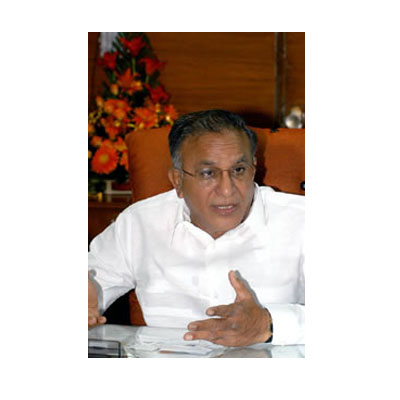
|
“Till the time Prasar Bharati is dependent for this money on the government, autonomy cannot be there practically”
|
BBC Q – Mr. Reddy, you are talking about revolutions and financial autonomy of Prasar Bharati. But the real situation is that all governments have made political appointments in the Prasar Bharati Board, and the word autonomy exists on paper only. Isn’t this a sad state of affairs, what are the plans to reverse this?
JR – I do feel sad about political appointments. But the practical reality is that such appointments are bound to be there in the existing political system and the only way out of this is providing financial autonomy to Prasar Bharati and this is what this government is working at.
BBC Q – Mr. Reddy from where would the resources be generated for the financial autonomy?
JR – See I am giving the example of Britain for financial resources, where the licence fee is the source. In India, there used to be a licence fee earlier, which was abolished. It could be there again, a small cess could be levied, and there are a few other ideas like this. But no final decision has been taken so far.
BBC listener from Japan – Sir, ever since the idea of Prasar Bharati was mooted back in 1989, even after 15 years, this institution’s autonomy leaves a lot be desired. The tradition of political appointments is continuing without any break. And appointees are those who dance to the tune of their mentors. What would do you do for a real autonomy?
JR – Legally, Prasar Bharati is autonomous, as I said earlier, but financially it is not. I am not thinking about changes in these appointments. There is no culture of autonomy in our country. We would have to encourage this culture. The officers appointed in India work as subordinates.
BBC Q – But, Mr. Reddy, the new government has made a good beginning in the Human Resources Department by appointing a committee of the experts to select the NCERT chairman. Would this be the case for all appointments so that this menace of political appointments is brought to an end and nobody should be able to point a finger and accuse the governments?
JR – I am working to put an end to such accusations.
BBC Q – Would you elaborate, Mr. Reddy?
JR – I would not like to bring any changes to the Prasar Bharati Board. But the culture which has been there to speak only in the favour of the government should be changed, I am working in this direction.
BBC listener from Raipur – Sir, why do the governments in India ignore radio? There are more than 100 TV cable channels in India, whereas the poor man, who can only afford radio, has to be content with Akashwani. Why can’t radio listeners listen to world class news? The previous government inaugurated FM for Vividhbharti in 2001, but that is not fully operational so far.
JR – I agree that radio in India has been ignored to a large extent. I am going to give particular attention to the future of radio. As far as the local problem is concerned, it has been brought to my notice, and I will look into it and take steps.
BBC Q – Mr. Reddy, the TV revolution has changed the face of TV in India, but haven’t the radio and print media been left behind?
JR – I feel the newspapers of India are doing well even when considered at the world level. I think the Indian papers do compete well at the international level. There is no need for a revolution for the newspapers. For the radio, yes there is definitely a scope for improvement in radio, we are working on it.
BBC Q – Mr. Reddy, why has the radio in India been in so much tighter governmental control and what is the plan for future?
JR – See, the utility of radio has to be understood, till now the governments have not realised the potential of radio, which has to be done now. We are encouraging private FM radio stations, and the potential of radio in Prasar Bharati would be encouraged further.
BBC Q – But, Mr. Reddy, even private stations on FM are for music programmes, and the governments in India have been reluctant to open radio for news and current affairs – why?
JR – We have not thought about this issue so far. It is
not easy to bring a revolution overnight. At the moment we are dealing with some fresh issues arising out of FM opening, let us solve that first.
BBC Q – But, Mr. Reddy, news and current affairs of entire world is available on TV, all views are available on the Internet. Why should radio listeners suffer? Why not allow them to listen to world programmes?
JR – As an individual, I have my views, but now, being a minister, I would not like to comment at this moment.
BBC listener from UAE – Sir, I feel that if autonomy were given to Prasar Bharati, corrupt officials would be exposed. Look at the Tehelka case, so much pressure was exerted on Tarun Tejpal that the case was lost somewhere, as independence of media was undermined. You are back in the ministry, so what would you do now?
JR – Tehelka was a private company and Prasar Bharati is a public broadcasting corporation. The CBI has the right to check corruption, CAG is there for accounting and auditing accuracy. My view is that being independent would eliminate grounds for corruption – and such questions.
BBC Q – But, Mr. Reddy, isn’t Tehelka an example of how ruling parties in India can undermine the independence of media by witch-hunting against the organisations which expose inconvenient stories?
JR – Such tendencies and such culture would have to be brought to an end. The way in which the previous government tried to suppress the Tehelka case has not been liked by the Indian public and that is why the people voted against the BJP-led alliance.
|