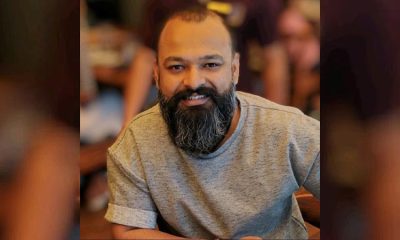
Tag: Ajay Gupte

  • Mathemedia: Shripad Kulkarni launches podcast for media’s next era

    Mathemedia: Shripad Kulkarni launches podcast for media’s next era

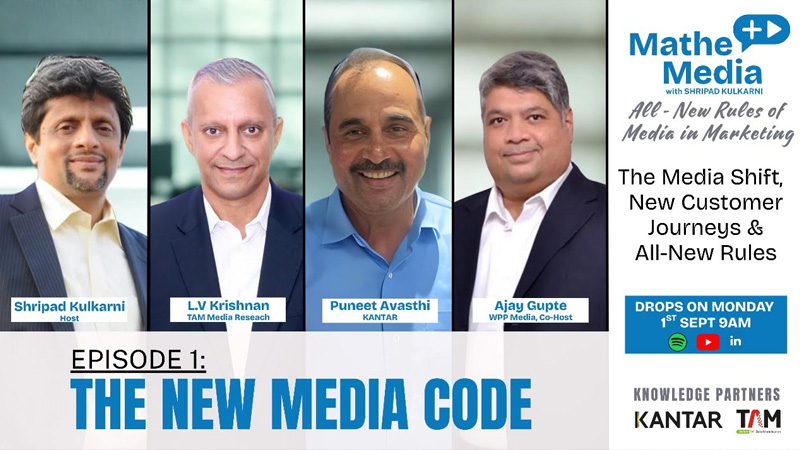
    MUMBAI:  Shripad Kulkarni, veteran media maven and former ceo of Vizeum, is launching MatheMedia, a first-of-its-kind podcast that promises to crack the code of India’s fast-changing media landscape.

    Streaming from 1 September 2025, the long-format series blends a CMO briefing with a masterclass, featuring over 25 industry heavyweights from advertising, tech, publishing, and brand leadership. The opening episode, aptly titled ‘The New Media Code’, will bring together voices such as L.V. Krishnan (TAM Media Research), Puneet Avasthi (Kantar), and Ajay Gupte (WPP Media) to decode the seismic shifts shaking the industry.

    “We live in a world of channel chaos, with more platforms and fragmented audiences than ever before,” said MatheMedia, founder, Shripad Kulkarni. “Gone are the days when we could think & work linear & measure with a linear mindset. Today’s marketer faces multiple challenges. With more category entry points, brand assets & personalised messaging needs, brand strategy is being redefined. Brand custodians face growing pressure from a crowded network of channels and partners. It’s time for new rules in strategy, media, measurement, and collaborations.”

    The podcast’s 12-episode debut season will tackle hot-button issues: the rise of AI in advertising, quick commerce, evolving consumer journeys, and the urgent need for unified, privacy-compliant measurement systems. Expect candid debates, sharp insights, and a dash of storytelling to simplify complex industry jargons.

    Guests lined up include Schbang’s Akshay Gurnani, Google India’s Priya Choudhary, Dentsu Creative Isobar’s Sahil Shah, and India Today’s Vivek Malhotra, to name just a few. Think of it as a roundtable where India’s top media minds redraw the playbook for marketers navigating chaos.

    Kulkarni, who has advised marquee brands from Fevicol and BMW to Airbnb and Yes Bank, brings his three-decade expertise and signature wit to the mic. His goal is to help professionals not just adapt to disruption, but shape it.

    Episodes will drop every Monday across Spotify, YouTube, LinkedIn and Instagram. So, whether you’re a CMO, a curious marketer, or just wondering why your ads keep following you around the internet, MatheMedia might just be the formula you need.


  • WPP Media South Asia hits reset with new leadership councils and client-first gameplan

    WPP Media South Asia hits reset with new leadership councils and client-first gameplan

    MUMBAI: WPP Media South Asia has officially turned the page on its GroupM chapter with a sweeping leadership overhaul, as it embraces a sharper, integrated model under WPP’s global media reset.

    The network’s new direction was internally announced this week, marking a bold step toward unified media, measurable outcomes, and future-ready innovation across India and South Asia.

    At the core of the transformation is a newly minted Executive Committee (ExCo), led by four presidents of client solutions — Priti Murthy, Ajay Gupte, Amin Lakhani, and Navin Khemka — who will jointly shape strategy, execution, and client delight across verticals.

    Supporting them is Vishandas Hardasani, continuing as chief finance officer, ensuring compliance and commercial rigour.

    In new, focused roles:

    ●    Upali Nag steps in as president – strategy, tasked with steering high-impact client programmes.

    ●    Vishal Jacob takes charge of Choreograph as president, scaling data and tech capabilities.

    ●    Ashwin Padmanabhan, now chief operating officer, will turbocharge execution across media buying, commerce, content, and sports.

    ●    Praseed Prasad, as president, growth & marketing, will focus on emerging categories, SMBs, startups and lead mOutcome initiatives.

    In tandem with the ExCo, WPP Media South Asia also launched the WPP Media Leadership Council (WLC), featuring a high-powered bench including Ajey Mehta, Atique Kazi, Ruchi Mathur, Shekhar Banerjee, Snehi Jha, Vinit Karnik, Manini Chakraborty, Namrata Mehra, Muralidhar T, Parveen Sheikh, and Rohit Sule.

    This cohort will focus on cohesion, culture, and capability-building to ensure WPP Media’s new architecture translates to real business wins.

    Prasanth Kumar continues to lead operations in India and Sri Lanka, anchoring both ExCo and WLC as they execute WPP’s new-age blueprint. A chief people officer appointment is also said to be in the works, hinting at a stronger push towards people-first transformation, learning, and leadership.

    With this structural shake-up, WPP Media South Asia isn’t just repositioning for the AI era — it’s building a battle-ready blueprint for the future of media.

    (If you are an Anime fan and love Anime like Demon Slayer, Spy X Family, Hunter X Hunter, Tokyo Revengers, Dan Da Dan and Slime, Buy your favourite Anime merchandise on AnimeOriginals.com.)

  • Centerfruit gets tongues wagging with AI challenge

    Centerfruit gets tongues wagging with AI challenge

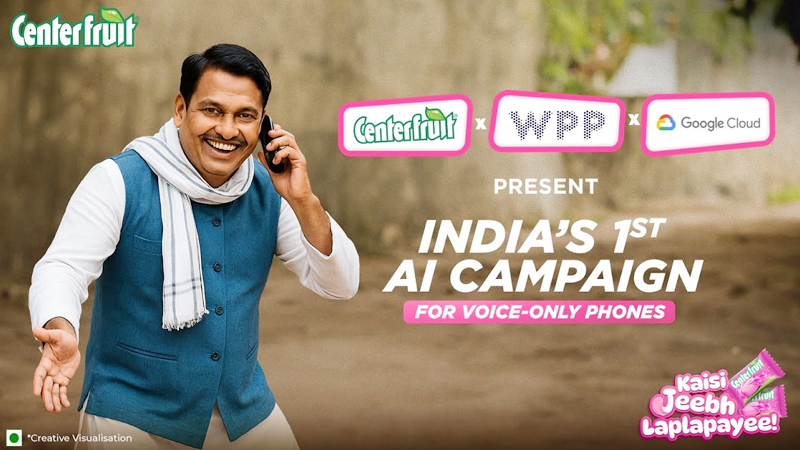
    MUMBAI: What do you get when you mix flavour, fun, and futuristic tech with zero internet? A rural marketing masterstroke. Centerfruit, from the house of Perfetti Van Melle India, has launched an industry-first voice-based AI campaign that’s got rural tongues wagging – quite literally.

    In a bold move to bridge the digital divide, Centerfruit rolled out the Tongue Twister Challenge in partnership with WPP, BharatGPT.ai, and Google Cloud. Targeted at audiences in rural Uttar Pradesh – where smartphone penetration is patchy and data access even patchier – this initiative lets users engage with the brand using nothing more than a basic feature phone.

    Sharing his thoughts on the campaign, Perfetti Van Melle India marketing director Gunjan Khetan said, “Rural Bharat is an important market for Centerfruit, and while we have been able to reach millions through Television, there are still pockets where narrating our brand story has been a challenge. However, the latest Voice AI tech activation is a game-changer, it allows us to not just reach but have conversations with people outside of the traditional digital ecosystem. By using AI and creative storytelling, we bring the Kaisi Jeebh Laplapayee spirit to life in a way that feels local, effortless, and deeply inclusive. We believe this is a powerful step toward ensuring that no consumer is left out of the conversation, no matter where they are or what technology they have access to.”

    As part of its ongoing ‘Kaisi Jeebh Laplapayee’ campaign, the brand deployed a hyperlocal Voice AI that dialled users directly. All they had to do was give a missed call, and they were in – chatting away in local dialects, tackling tongue twisters, and laughing through a gamified, fully voice-led experience.

    The backend was as sophisticated as the frontend was simple. Deployed on Google Cloud, the experience leveraged BharatGPT and CoRover’s desi LLM optimised for Indian languages and dialects. Users’ voices were streamed and converted in real-time, analysed by Gemini (Google’s AI model), and scored on clarity, pronunciation, and speed. No screens, no apps, just good ol’ vocal cords.

    But the experience didn’t stop at tongue twisters. Users could also ask questions in their native dialects via BharatGPT.ai’s ‘Ask Engine’ and receive instant responses, turning every call into a conversation.

    Google Cloud India VP and country MD, Bikram Singh Bedi added, “Google Cloud’s scalable cloud infrastructure will enable brands like Center Fruit to reach consumers in their native language and Gemini’s capabilities will enable real time scoring which will make the whole user journey exciting while creating more brand recognition. This is a testament to how technology can truly empower businesses and consumers around the globe.”

    Wavemaker CEO – South Asia, Ajay Gupte said, “We believe technology should be an equalizer, not a barrier. Our collaboration on the campaign along with BharatGPT.ai and Google Cloud is a powerful example of how voice-based GenAI can bridge the digital divide and bring playful, immersive brand experiences to audiences often overlooked by mainstream media. By combining creativity with scalable tech infrastructure, we’re proud to help create a campaign that’s as inclusive as it is innovative—one that speaks directly to people, in their language, on the devices they already use. This initiative is a step forward in redefining how brands connect with rural India—not just by reaching them, but by truly engaging them in ways that are local, personal, and deeply human.”

    Hogarth India CEO Karthik Nagarajan said, “This partnership between Perfetti Van Melle, WPP, Google Cloud, and BharatGPT wasn’t about tech deployment – it was about cultural engineering. We built AI not just to answer questions, but to reflect the wit, rhythm, and warmth of everyday Bharat. When creativity meets technology, you don’t just reach people – you resonate. As a content experience company, we specialize in delivering engaging, enriching brand experiences irrespective of the medium. In this case, we are very grateful to Perfetti Van Melle for providing a platform that enabled us to create such an experience at scale for its audience.”

    With this move, Centerfruit hasn’t just taken the road less travelled – it’s made it multilingual, hyperlocal, and powered by next-gen tech. Who said you need 5G to have fun?

  • Ajay Gupte’s Wavemaker tops Warc’s agency effectiveness list

    Ajay Gupte’s Wavemaker tops Warc’s agency effectiveness list

    MUMBAI: Wavemaker India is riding high, clinching the top spot in the WARC 100 Most Effective Global Ranking 2025—pulling off a victory with the swagger of a Madison Avenue maverick.

    As the advertising industry scrambles under the Competition Commission of India’s (CCI) watchful eye over alleged price-fixing allegations, Wavemaker has flipped a potential headwind into a jet stream of success.

    Ajay Gupte, chief executive for south Asia, isn’t just celebrating—he’s making a statement. “Creativity powered by insight and innovation.” That’s not just a corporate tagline—it’s a battle cry.

    The numbers tell a cracking story. Wavemaker Mumbai stormed to 115.3 points, blowing past global giants. More remarkably, it stands as the only Indian agency in the top 10—a statistical unicorn in a rankings table usually ruled by North American and European behemoths.

    The global podium: 

    1) Wavemaker Mumbai, India (115.3 points)
    2) Starcom Chicago, US (107.7 points)
    3) Mindhare New York, US (78.4 points)

    Even as the CCI probes alleged anti-competitive practices in the advertising world, Wavemaker has flipped the script—turning scrutiny into strategy. While some players glance nervously over their shoulders, Wavemaker is already sprinting ahead.

    Chief client officer and office head, west, north & east Shekhar Banerjee, calls it a journey of “consistency, evolution and relentless focus. No 1 in 2023 #2 in 2024. Back to #1 in 2025.”

    The WARC 100 isn’t just a list. It’s the Everest of media effectiveness rankings—stacked with the most impactful campaigns on the planet.

    A massive shoutout to GroupM and Wavemaker India’s leadership for pushing boundaries on tech, measurement, full-funnel strategies and creativity.

    While the industry introspects, Wavemaker accelerates.

  • Wavemaker India elevates Sairam Ranganathan to chief digital officer

    Wavemaker India elevates Sairam Ranganathan to chief digital officer

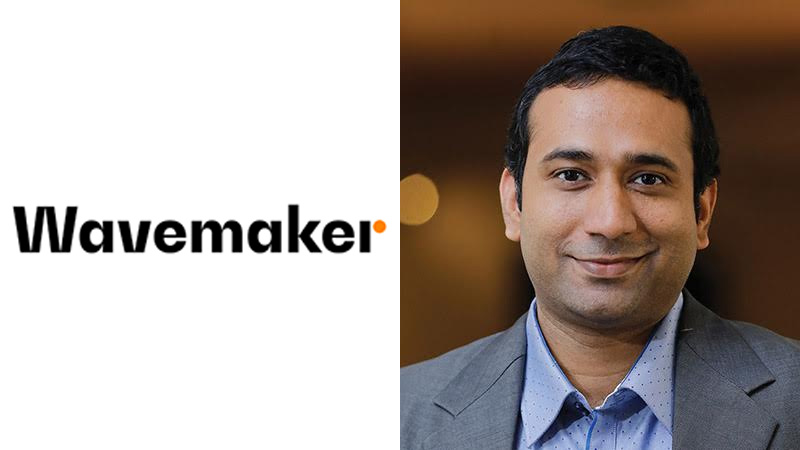
    Mumbai: Wavemaker India, the most awarded agency of GroupM, today announced the appointment of Sairam Ranganathan as Chief Digital Officer. In his new role, Sairam or Sai as he is fondly called, will strengthen digital capabilities and lead the newly formed team Wavemaker NorthStar. In his new role, Sai will continue to report to Vishal Jacob (chief transformation officer at Wavemaker India).

    As the head of Wavemaker NorthStar, Sai will work with clients to drive business outcomes. Team Wavemaker NorthStar will bring in the right experts across platforms, commerce, analytics & tech to orchestrate data-led solutions that yield business results. In addition, he will also be responsible for accelerating growth in digital services, integrating and aligning digital initiatives across business units for clients.  

    Sai has been an integral part of GroupM India since 2004. He has worked across multiple categories which include Telecom, FMCG, Consumer durables, Ecommerce, Retail, Lifestyle, Jewellery, Tourism, Technology, BFSI, Media & Entertainment. In the last few years, Sai has played a national role working with multiple teams to build and strengthen digital capabilities for Wavemaker.

    Commenting on Sai’s elevation, Ajay Gupte, CEO  of South Asia said, “At Wavemaker we are constantly evolving and adapting to help our clients grow by enabling better business solutions, build robust data-led experiences and positively provoke growth for them and for us. Sai brings in wealth of expertise and knowledge to deliver innovative customer initiatives across business domains, with a perfect balance of people management skills. I am confident that Sai is best placed to drive the digital-first agenda for us and our partners”.  

    “At Wavemaker our emphasis has always been to push the boundaries on our capabilities and provide our clients with an unmatched advantage through our services. In his new role, Sai will consolidate and grow capabilities on digital media and lead a team called Wavemaker NorthStar that will help clients deliver business outcomes through data-driven solutions. Given Sai’s passion, resilience, and commitment there could be no better person to lead this team and take our solutions to the next level”, expressed Wavemaker India’s chief transformation officer Vishal Jacob.  

    A big Star Wars fan, Sai has also co-authored two books on digital marketing in India – The Curious Digital Marketer and The Curious Digital Marketer 2.0.

    Talking about his new role, Sairam Ranganathan shared, “My journey at GroupM has been incredibly thrilling and enriching. In these last 20 years, I have grown significantly in my professional as well as personal life. I am grateful to Wavemaker for this exciting opportunity and I look forward to leading Wavemaker NorthStar as I start a new chapter in my growth journey to make Wavemaker an even more desirable partner for our clients.”

  • Seagram’s Royal Stag Packaged Drinking Water unveils ‘A Billion Films for A Billion Fans’ campaign

    Seagram’s Royal Stag Packaged Drinking Water unveils ‘A Billion Films for A Billion Fans’ campaign

    Mumbai: Strengthening its long-standing association with cricket at the global level, Seagram’s Royal Stag is thrilled to announce the launch of an innovative and immersive AI-led fan experience ‘A Billion Films for A Billion Fans’. The campaign features three of India’s most talismanic cricketers, team captain Rohit Sharma, Jasprit Bumrah, and Surya Kumar Yadav. Fueling the larger-than-life emotions associated with cricket, the brand aims to ignite a whole new generation of young cricket fans, many of whom are witnessing their first World Cup in India as adults.

    This World Cup is happening in India and is already slated to be the “Greatest World Cup Ever.” Syncing with the brand’s ‘Live it Large’ philosophy, the AI-integrated campaign gives each fan an opportunity to become part of a personalized film featuring the cricketers. Conceptualized in association with creative agency partners FCB India, Digital Agency partners Dentsu India, Technology Partner Artizens Events, and Experiential solutions & media partners Wavemaker; the campaign is groundbreaking where every fan is able to not merely live their dream, but also, live large.

    The whole fan experience has been curated keeping today’s youth, aka, the digital natives, in mind by offering them a simplified user journey. A selfie and a voice sample coupled with the power of regenerative AI creates an ultimate fan experience. With these tools, the campaign uses the power of generative AI technology and machine learning, to create a platform that enables each fan to feature themselves as part of the Royal Stag Live It Large star cast. With the aid of this innovation, each fan can create a personalized edit of the film. Face-mirroring algorithms precisely map the unique facial features of fans onto the characters in the main film. In addition, with just a brief voice sample it also emulated the tone, pitch, and nuances of the fan’s voice. In essence, this campaign will transform the consumer journey into an extraordinary yet personal experience. The consumer experience also gives the fans a chance to go beyond boundaries and get close to their favorite players and World Cup trophy.

    The campaign will be amplified through a high-decibel 360-degree plan spread across digital, print, radio and OOH to offer an immersive, unforgettable experience.

    Pernod Ricard India chief marketing officer Kartik Mohindra stated, “Royal Stag aims to share the electric atmosphere in the stadium with cricket fans across the world. As a partner of ICC, AI allows us to deliver a truly “Live it large” experience to die-hard cricket fans everywhere. This year, we are giving each fan the power to craft their own Live It Large Story through this unique AI platform that integrates with the brand’s commitment to relishing every moment in their journey to success. While on one hand we celebrate cricket’s heritage, on the other we have embraced cutting-edge technology to broaden brand engagement and inspire cricket fans to immerse themselves in their favorite sport like never before.”

    FCB India president Abhinav Kaushik added, “In an age where experience is the only currency amongst the digital natives, how can a cultural icon like Royal Stag do something that epitomizes ‘large’ during the biggest sporting spectacle of the year. This was the starting point of the brief, and we are excited that this idea truly allows every cricket fan to create their own unique ‘Live it Large’ experience. I am confident that this power of creativity fuelled by technology, will not only deliver brand engagement but enhance the love for the brand multi-fold.”

    Wavemaker CEO – South Asia Ajay Gupte said, “Cricket World Cup is undoubtedly one of the most celebrated sports properties and this World Cup 2023 is touted to be the greatest ever. Through this collaboration, we aim to extend brand synergies and offer a unique, memorable, and thrilling ‘Live it Large’ experience to each and every cricket fan”.

    Dentsu Creative India CEO Amit Wadhwa said, “This campaign provided us a big platform where we could showcase how modern creativity can be infused into the Indian Cricket fandom. It’s a great example of how technology can be used to enhance and enrich our connection to sports and entertainment. This multi-faceted campaign has the potential to inspire fans to become more deeply involved in their favorite sport, creating memorable moments and experiences that will stay with them for a long time.”

    Artizens Events & Experiential Solutions founding partner Aditya Joshi said, “As technology partners to this innovative campaign, we are trying to harness the connection with the Generation Large who crave for social currency and vicarious thrills by bringing together AI and Machine learning and creating a never seen before immersive experience.”

    The ICC Men’s World Cup is scheduled to take place in India from 5 October to 19 November. Royal Stag is an associate partner for all ICC events.

  • #Throwback2020: How the pandemic reshaped agency culture

    #Throwback2020: How the pandemic reshaped agency culture

    NEW DELHI: There were a lot many seemingly impossible things that 2020 managed to turn into reality. One such thing was advertising and marketing agencies locking their gates and their employees working remotely for a good chunk of the year. For a business that thrives on human contact and face-to-face interactions, where beer pe charcha has been a trend for the longest time, and where teamwork defines the core strength of the company, it seemed like a herculean task to undertake. However, the year made everyone used to it. In fact, for the industry, it has paved the way for a more relaxed, geo-agnostic, hybrid working model, which will possibly be its future. And not just the technology, but the human connections that have developed this year will help sustain this model. 

    Relationships across the screen 

    The first task for the agencies in the lockdown was to create a system for its teams while working from home to ensure that the output does not drops and their commitment to the clients continues in the same way as before. This was a humungous task as none was prepared for it. They adapted the new techniques of sharing the status of work, deliberating ideas, seeking feedback, team meetings and briefing sessions. Agency folks across the hierarchies took time to adapt but they did and the work went back at the same pace. 

    Earlier in the year, Indiantelevision.com had also reported that the Covid2019 crisis made agencies and clients bond well than ever before. 

    Publicis Worldwide MD Srija Chatterjee had this to say about improved client-agency relationships during one of our virtual roundtables: “We have started understanding each other more. There is much more transparency now. As an agency, we know what the issues are that they face with cash flows and we are trying our best to help them out.”

    Also, Kinnect CEO Rohan Rohan Mehta and COO Chandni Shah in a live virtual chat corroborated that clients, in fact, became very comfortable with presentations and pitches over video calls. And it might be a trend that will continue to stay in the industry for a good long while, though they personally would prefer it to be otherwise. 

    Be it crunching numbers or deliberating on that one great creative idea, all the teams adopted the new normal and started bonding on the screens. They collaborated more and engaged with each other beyond work making work-from-home feel like not a very tough task. 

    Wavemaker South Asia CEO Ajay Gupte told us in a previous interaction, “On the team-level, we have gotten much more closer and understanding of each other. Earlier, our teams in various states could manage to meet once or twice a year, but now we are having at least two meetings every week.” 

    During the lockdown, the agency execs took up participated in team games and sessions like learning cooking, singing. They celebrated festivals online, shared new learnings and developments to create a light atmosphere.

    Embracing a hybrid model

    Advertising is a people's business and at the end of the day, one needs to have boots on the ground to ensure the execution of the ideas at the last mile. This includes production, post-production, art-work, shoots and several other things.  

    While the lockdown restrictions eased, it was not possible for everyone to immediately go back to the office. Havas Media Group MD India Mohit Joshi mentioned in a tete-a-tete with Indiantelevesion.com founder, CEO and editor-in-chief Anil Wanvari a few months back, “Yes, the offices are open but we are not forcing anyone to join. Additionally, we have done extensive joining assessments for the people on grounds like who all are living alone versus who all are living with old parents or young children, who have morbidities associated, etc. So, only those people are being called to the office for whom it is absolutely safe. We are not allowing anyone who travels via public transport to come to the office.” 

    Wunderman Thompson South Asia group CEO and chairman Tarun Rai, while speaking at a Bangalore Advertising Club webinar, insisted that it is high time that agencies embrace the hybrid working model. 

    “I have been passionate about the fact that people should be allowed flexibility at workplaces. We need to be more output-focussed and not input. We can work remotely and deliver the same results,” he said. Rai added that this will help in vapourising the gender bias at the workplace. 

    But more than everything, it will allow agencies to rope in skilled people with hyper-local and targeted capabilities to deliver better solutions to clients. Several industry leaders pointed out that having great talent on-board will not be a function of geography anymore. 

    Several big agencies have reopened the offices. Leadership teams are meeting once or twice every week. Mid-level execs are allowed to come office but are needed to inform in advance. Its HR teams are ensuring that the office does not have over 30 per cent staff at once.  

    What the future looks like

    The industry is positive that hybrid is the way ahead. Freshly appointed PHD India CEO Monaz Todywalla said, “In terms of working models, hybrid working is going to stay. Agencies will collaborate with skilled professionals more. There is also going to be a big focus on in-house skill development.”

    Case in point being most of the young agencies that launched this year – like Syed Amjad Ali’s Catalysts, Saurabh Varma’s WondrLab – are going to be geo-agnostic enterprises. Although nearly all agencies are regularly working with freelance professionals across different geographies to execute projects but this trend will further grow.

    In Rai’s view, traditional agencies also will be moving towards a more free working environment where going to the office would not necessarily mean sitting in a cubicle. It could also mean meeting for a coffee or sitting at a co-working space.

    However, he added that for this to turn into a reality, legacy agencies will have to do a rejig of their entire culture, HR policies, and appraisal systems. He argued that to make all of this function in the real world, people will have to give up the control they are used to exercising on their teams and will have to turn more trusting towards people.

    “In addition to that, we also need to work on our HR policies and appraisal schemes. To this date, we have to punch in our office timings as the system remains input-based. Even with consultants, we are used to asking how many days they will be coming to the office. All this needs to change,” he remarked. 

    For Mehta and Shah, this pandemic has paved the way to a flourishing gig economy in India. Mehta noted that more agencies will be open to outsourcing specialised skills to freelancers and consultants. However, there is a long way to go for standardising the prices and work culture for those who are not on company payrolls.

    He added, “LinkedIn has been a part of the media mix for most advertisers for the past three years now and it has constantly been bringing in new formats to advertise also. The place where LinkedIn lacks a little bit is its expensive pricing. Also, the number of people on the platform is quite limited and you can’t reach a wide audience. I have been waiting for LinkedIn to become more India-centric and viable in terms of pricing. As soon as that happens, a ton of advertisers will flock the place and will be using it way more aggressively.”

  • Marketers want news channel viewership data to be more frequent

    Marketers want news channel viewership data to be more frequent

    NEW DELHI: The Broadcast Audience Research Council (BARC) and the representatives of the news genre have often been at loggerheads; the latter having several complaints regarding how the measurements work. From sample size to data points, everything has been a cause of concern for most of the channel owners and editors. Now, several marketers have raised another important point in the narrative, expressing how they would like the industry ratings, including the IRS ratings, to be more frequent. 

    At a recent webinar on brand safety hosted by Indiantelevision.com, presented by BBC World News and BBC.com, Future Group CMO – FBB Prachi Mohapatra pointed out that ratings remain at the basis of all the math they do to create their marketing strategies and decide their marketing pies and it would really help the cause if they are more regular. 

    “I really want to have data that I can rely on completely and not have to act on my gut feeling basis the data of the past week or the past few months,” she said. 

    PolicyBazaar head of marketing Samir Sethi also insisted that the data should be as real-time as possible so one doesn’t have to wait for the completion of a campaign to gauge its success.

    “I think all advertisers and agencies would want the data to be as frequent as possible because that will aid in instant decision making. If I know about the ratings six months later or two months later, it gets less valuable,” explained Wavemaker CEO – South Asia Ajay Gupte.

    He went on to add that TV channels could potentially lose out to digital modes of marketing, where the data can be tracked and measured practically instantaneously. “It's about having data which is relevant and which is robust and which is to the day because the channels today are also competing with Google, Facebook, YouTube, and Twitter, where the data is almost real-time.” 

    Parle Products senior category head – marketing Krishnarao S Buddha agreed that there is a dire need of a frequent matrix but he highlighted that content should also be taken into consideration to create a differentiation when it comes to picking channels to put ads on. 

    Initiative CEO Vaishali Verma, while acknowledging that there are certain brands that prefer buying news as a commodity and plan their spends basis TRP, said there are some that also see the content and its authenticity. 

    Mohapatra added that along with the individual content of the channel, another factor contributing to their marketing decisions are the fellow brands that are present on the channel. “Looking into the adjacent space helps us create a multiplier effect for the sales. Therefore, it is very important to put your brand in a space that is relevant for you and your category.” 

    However, when it comes to picking content to put ads on, Sethi emphasises that brands should be non-partisan. “If somebody believes in a certain media outlet, he is still a potential customer. Toxicity is a different thing, but when it comes to the leaning of a channel, I think businesses should not pick a side. The world has always been divided and it will continue to be. Our aim should be to be present where the customer is.” 

    The panel also discussed other hot-button issues like the need for 24-hour news channels, and how advertisers are seeing the current news media.