Tag: Airtel Digital TV

  • DTH subscriber growth muted in CY-2017

    DTH subscriber growth muted in CY-2017

    BENGALURU: DAS, especially phases 3 and 4, was supposed to be a great growth opportunity for television direct-to-home (DTH) service providers. Has that been the case? Not if one were to go by data released by the Telecom Regulatory of India (TRAI) and three of the six private DTH players in India.

    The status quo
         
    At present, there are six private pay-TV players (five active in the true sense of the word) and one government free-TV player DD FreeDish. The five players are: Airtel Digital TV or Airtel DTH, Dish TV, Sun Direct, TataSkyand Videocon DTH–the sixth player being Reliance Digital TV or Big TV.

    Reliance Big TV has been acquired by Pantel Technologies and Veecon Media. Normal operations have to recommence as yet. A number of Big TV customers were acquired by other players and the true status of its operations and current subscriber numbers are still unclear at the time of writing.

    Please refer to the figure below for subscriber share of the six private players at the end of 30 September 2017 (Q2-18 or Q2-2108).

    public://11_0.jpg

    DTH subscriber acquisition seems to have petered down in calendar year 2017 (CY2017, 1 January 2017 to 31 December 2017) as compared with CY 2016. Please refer to the chart below for active subscribers addedas per TRAI data until 30 September 2017 (Q2-2018) and data reported by the three private players – Airtel DTH, Dish TV and Videocon d2h until 31 December 2017. It may be noted that these three players had almost 63 percent share of subscribers according to the above-mentioned Dish TV investor presentation.

    The continuous blue curved line in the chart below represents the total number of net active subscribersaddedfor each quarter – this number has been obtained by deducting the number of active subscribers in a quarter from the number of subscribers in the previous quarter. The combined total number of the three subscribers has been obtained by addition of net subscribers added by each of the three players – Airtel DTH, Dish TV and Videocon d2h – as declared by them in their financial/other releases and presentations. Thesecombined subscriber additions are represented by the continuous maroon line in the figure. The broken grey line represents the percentage of the combined net subscriber additions by the three players of the total subscriber additions as per TRAI data.

    public://2_6.jpg

    The chart below indicates the subscriber base of the three players and all private DTH players as per quarterly data released by TRAI. TRAI data for the October-December 2017 quarter has not been released at the time of writing. Subscriber data for each of the three players mentioned below has been obtained from their respective financial releases and presentations. The numbers have been rounded off to the nearest lakh by the author.

    As is obvious, Dish TV is the biggest player in the country in terms of subscribers followed by Airtel DTH and Videocon d2h in that order. It may be noted that Tata Sky subscriber base could be higher than Airtel’s subscriber base. Tata Sky data is not available in the public domain, and hence this cannot be verified.

    public://3_2.jpg

    Overall, the players are faced with declining monthly average revenue per user (ARPU). In absence of complete ARPU data, the author has taken the liberty to calculate ARPUs of each of the three players by using quarterly operating revenue/subscription revenue of the players and dividing it by the subscriber base at the end of that quarter and then calculating the ARPU per month. Similarly, the quarterly operating/subscription revenues of the three players have been added and then divided by the combined subscriber base of the three players at the end of that quarter and then the average monthly average ARPU has been arrived at. In each case calculated ARPU numbers have been rounded off to the nearest rupee.

    The combined four quarter average monthly ARPU of the three players across four quarters of 2017 has declined by Rs 9 to Rs 183 from Rs 192 in CY-2016. Airtel DTH is the premium player – its four quarter average monthly ARPU in 2017 increased by Rs 2 to Rs 230 from Rs 228 in 2017. Dish TV is a value player, its average declined by Rs 18 in 2017 to Rs 143 from Rs 161 in 2016. Videocon d2h four quarter average monthly ARPU in 2017 declined by Rs 9 to Rs 186 from Rs 195 in 2017. It must be reiterated here that the ARPU numbers mentioned in this paper have been calculated by the author and may vary from the actual numbers. The numbers in the graph below are just indicative numbers.

    public://4_1.jpg

    Besides the six private pay DTH players, FreeDish is a major player in terms of subscribers with an estimated 2.2 crore as per the numbers available in the public domain. It must however be noted that an exact number for registered or active subscribers is not available even with DD, since this is a free DTH service. If and when the announced Dish TV Videocon d2h merger happens, the merged entity will probably be one of the largest DTH players in the world in terms of subscriber numbers.

    According to an E&Y report titled ‘India’s Free TV’ released in July 2017, among the DTH operators in India, FreeDish has grown to become the largest with its estimated 2.2 crore subscribers which E&Y predicted could cross 4 crore over the next two to three years.

    A number of reasons can be attributed to this dismal performance–two of the chief ones that have been touted over the recent past by most players in media and entertainment industry are demonetisation in November 2016 and the implementation of the new GST regime. Given that most of India faced a cash crunch for a few months post demonetisation, money spends for entertainment took the least priority for the common man.Subscriber acquisition seems to have picked up in the April-June 2017 quarter, only to be dampened in the July-September 2017 – the quarter in which the new GST regime was implemented. The glitches of the new GST are slowly being ironed out. In the absence of TRAI data for the October-December 2017 quarter, numbers reported by the three players seem to indicate that DTH subscriber acquisition should have improved. Despite this, it seems unlikely that the industry was able to surpass or even match subscriber growth of CY-2016.

    Another important reason could be that DTH is considered a premium service – by all the stakeholders in carriage ecosystem with the resulting perception that procurement as well as monthly subscription will be premium and hence a deterrent for the consumer. While some players such as Dish TV have been making attempts to come up with packages that it perceives should attract the masses, but, results as per TRAI data seem to indicate otherwise. Yes, Dish TV is the largest private player in the country that has come up with different pricing models under different brands, whether unwittingly or not, most of the other players present themselves as premium players and seem to have done little in that direction.

    Also Read :

    DTH’s year of consolidation

    Recalibrating India’s DTH sector after Airtel DTH-Warburg Pincus deal
    Veecon Media acquires Reliance Big TV

  • Airtel Digital TV revenue, PAT and EBITDA up in Q3 2018

    Airtel Digital TV revenue, PAT and EBITDA up in Q3 2018

    MUMBAI: Bharti Airtel’s DTH arm Airtel Digital TV has seen a 10.4 per cent revenue growth in the quarter ending 31 December 2017 (Q3-2018) compared with Q3 2017 (y-o-y). Earnings before interest, taxes, depreciation and amortisation (EBITDA) grew by 22 per cent y-o-y in Q3 2018. Airtel DTH’s contribution to the overall Airtel revenue and EBITDA has stayed the same at 6 per cent.

    Airtel Digital TV’s revenue for Q3 2018 saw revenue rise to Rs 964.2 core from Rs 936.9 crore in Q2 2018 and higher than the Rs 873.5 crore y-o-y. EBITDA rose to Rs 370.8 crore from Rs 351.7 crore in Q2 and Rs 302.6 crore y-o-y.

    Earnings before interest and taxes (EBIT) saw a huge jump from Rs 123 crore in Q2 2018 to Rs 150 crore this quarter, a 22 per cent rise. This was 2.2 times than Rs 68.4 crore reported in the year ago quarter.

    The DTH segment assets were Rs 2,659.1 crore, up from Rs 2,590.7 crore in the previous quarter and Rs 2,399.3 crore in Q3 2017. The segment’s liabilities increased to Rs 33,19.3 crore from Rs 3,279.8 crore in the previous quarter and Rs 3,030.8 in Q3 2017.

    Airtel Digital TV’s capex during the quarter under review was Rs 236 crore, 11 per cent lower y-o-y from as against Rs 265 crore spent in the corresponding year ago quarter. Cumulative investments increased by 8 per cent y-o-y to Rs 7,799.3 crore from Rs 7,212.7

    Subscribers grew by 3.1 per cent to 1.3937 crore, up from 1.3521 crore in the previous quarter and a 10.7 per cent increase y-o-y from 1.2588 crore. A total of 416,000 subscribers were added in the corresponding quarter. Average revenue per user (ARPU) remained flat at Rs 233 (just 0.4 per cent growth from the corresponding quarter a year ago). Monthly churn reported for Q3 2018 stood at 1.2 per cent (1.4 per cent reported in the previous quarter; 1.3 per cent in Q2 2017).

    The DTH business saw no additions of districts this quarter and the number remained at 639 numbers.

    Airtel’s overall revenue dropped by 12.9 per cent y-o-y to Rs 20,319 crore from Rs 23,336 crore. Its revenue dropped to Rs 15,294 crore, 11.3 per cent y-o-y and down from the Rs 16818.3 crore in the previous quarter. This was mainly due to mobile drop of 17.6 per cent. Mobile broadband customers increased by 64.9 per cent to 6.21 crore from 3.77 crore in the corresponding quarter last year. Mobile data traffic grew by more than 6 times to 110,600 crore MBs in the quarter as compared with 172,000 crore MBs in the corresponding quarter last year. Total India mobile subscribers increased by 2.9 per cent from the previous quarter to 29.0 crore, which is also 9.1 per cent growth y-o-y.

    Airtel’s profit before tax stood at Rs 838.1 crore, lower than the Rs 1298.8 crore reported in the previous quarter. Net income also dropped to Rs 305.8 crore from Rs 343 crore.

    Airtel India and South Asia MD and CEO Gopal Vittal said. “Regulatory fiat in the form of a cut in domestic IUC rates has exacerbated the industry ARPU decline in Q3 18. The recent announcement of reduction in international termination rates will further accentuate this decline and benefit foreign operators with no commensurate benefit to customers. Continued investments in data capacities, strategic partnerships with content and handset providers and focus on customer friendly innovations like data rollover has led to healthy customer additions of 0.81 crore during the quarter. Q3 2018 has also seen the highest ever broadband site deployment of 32K in any quarter, complementing the robust data and voice traffic growth of 544 per cent and 50 per cent respectively on a y-o-y basis. We are committed to remaining the operator of choice for all customers in this rapidly consolidating industry.”

    Also Read :

    Airtel Digital TV revenues, op profits rise in Q2 FY 2018

    Airtel Digital TV sub base expands, even as ARPUs dip

  • DTH’s year of consolidation

    DTH’s year of consolidation

    MUMBAI: It would be safe to say that this was the year of the big DTH challenge. India’s cable TV multi system operators (MSOs) could not go into many phase IV areas and DTH stepped in wherever analogue broadcast signals were switched off following the crossing of the digital addressable system (DAS) deadline. Whether it was Tata Sky, FreeDish, Videocon d2h, Airtel Digital TV, Sun Direct or Dish TV, they all played a part.

    The going, however, was not as smooth as it could have been. High capex and opex and low ARPUs continued to dog the video distribution vertical making it an extremely low or no-margin business. While in the early days customer acquisition was the driver for most distribution platform operators, currently their eye has been on cost-efficiencies. This was evident from the ongoing overtures three of the players were making to others. Dish TV and Videocon d2h were already going through the throes of merging, the Anil Ambani-owned Reliance Big DTH was shopping around having conversations with almost every player, and there were talks of Airtel and Tata Sky possibly getting into bed with each other.

    The first nearly came to pass in 2017 with the two companies getting clearances from all quarters—government, courts and company law board—but getting stuck over the year end because of a technical difficulty. Reliance Big TV was sold to an IT and electronics company Veecon that sells security scanners and tablets–the wealth of its promoters is rumoured to be from selling religious lockets. Veecon said it would renew the Big TV licence by giving the requisite bank guarantees and ensure TV continuity for its approximately 1.2 million customers and jobs for nearly 500 people. It also announced that it would take Reliance Big DTH free to air (FTA) and announced a partnership with Sri Adhikari Brothers to launch a clutch of channels that would prove to be drivers of the platform. How Veecon will pay off Big TV’s payments to broadcasters was not clear at the time of writing and will decide whether the platform will ever take off.

    However, its announcement came at a time when the government had shut the door for private broadcasters and DD FreeDish, which had shown gee whiz growth rates, had come up as a powerful DTH player. New Ministry of Information and Broadcasting (MIB) minister Smriti Irani refused to make channel renewals for which several broadcasters took it to the Telecom Disputes Settlement Appellate Tribunal (TDSAT). An interim order gave the channels, whose licence was soon to expire, relief that they could continue by paying similar prices till Prasar Bharat came up with an alternative proposal and a convincing explanation to throw out private TV channels off DD Free Dish. It is expected that Prasar Bharati will formulate its new policy akin to the FM radio auction wherein 50 per cent of revenue is shared, apart from the bid amount, in e-auctions. Talk internally is that none of this would happen and DD Free Dish is most likely going to be used solely to relay government channels.

    Media reports also said sometime in the second half of the year that there could be more synergies between the Tatas and News Corp-promoted Tata Sky and Airtel Digital TV with possible merger talks taking place. That hasn’t happened as of now but the Airtel group did end up buying out certain telecoms asset of the Tatas.

    Also, private equity firm Warburg Pincus announced its decision to own 20 per cent stake in Airtel Digital TV for $350 million, leaving 80 per cent with Airtel’s promoters. That valued the Mittal-owned DTH service at a whopping $1.7 billion, which was mouthwatering news for the DTH pioneers. By September, Airtel claimed ownership to 14 million subscribers with revenue of $550 million.

    The year was significant for the fact that the DTH operators led by Tata Sky and Airtel Digital decided they had to take a tour of the court. The Harit Nagpal-led operator challenged the Telecom Regulatory Authority of India’s (TRAI) order on tariff and the reference interconnect regulations. The order stated that all stakeholders must abide by rates fixed by broadcasters. Joining Tata Sky in court was Airtel.

    Dish TV, the oldest DTH player in the country, appointed Anil Dua as its new CEO even as the company’s integration with Videocon d2h was on the anvil. Dish TV’s CMD Jawahar Goel raised an alarm over Star India’s monopoly in cricket events that, after its acquisition of the rights for the Indian Premier League (IPL), would force DTH players to include Star Sports channels and result in the broadcaster pricing the sports channels exorbitantly. No government reaction was forthcoming on this issue. Dish TV also took Star channel Life Ok to the TDSAT claiming that it could not rebrand itself as an FTA from a pay channel without sufficient intimation. Life Ok is today Star Bharat and a leading channel in BARC viewership ratings, riding on the expanded viewership courtesy Doordarshan’s FTA KU-band platform called DD FreeDish.

    For the quarter ended 31 March 2017, not only did subscriber additions dip drastically, but were also the lowest for a quarter in the financial year 2016-17. Airtel, Dish TV and Videocon saw total addition of just 8.33 per cent to 41.13 million for the concerned financial year. By 30 September 2017, there were just 2.47 million additions to the DTH industry as per TRAI, which was way below the 3.37 million it gained in the same six months in 2016. Moreover, active subscribers added in the July-September quarter were just 0.78 million, half of the figure from the corresponding quarter a year ago. Dish TV, Airtel DTH and Videocon d2h make up 63-65 per cent of the total active subscribers while Tata Sky holds about 21 per cent and Sun Direct 11 per cent. DD Free Dish is estimated to have 22 million subscribers and is expected to touch 40 million in two to three years.

    The second half of the year saw the introduction of the goods and services tax (GST) that gave a breather to those consuming cable and DTH services. Whereas customers once paid anything between 10-30 per cent as entertainment tax as well as a 15 per cent service tax, it was now fixed at 18 per cent. The Punjab government also announced that it would be adding a new entertainment tax to cable and DTH connections with the latter having to bear Rs 5 a month.

    Sun Direct is a major DTH player in the south holding about 40 per cent of the area. It also makes up 97 per cent of its total subscribers. Sun Direct took up an HEVC media solution from Harmonic to increase its HD channel number to 80.

    Profit after tax (PAT) for Videocon stood at Rs 168 million for the quarter ended 30 September 2017, which was just Rs 12 million for the previous quarter and Rs 148 million for the corresponding quarter a year ago. Dish TV, however, was in the red with net loss of Rs 178.7 million for the quarter as against PAT of Rs 689.6 million for the same quarter a year ago. During the quarter ended 30 September 2017, Airtel reported PAT of Rs 12,990 million down from Rs 27,350 million from a year ago.

    Videocon d2h and Airtel showed good average revenue per user (ARPU) numbers in 2017. The former raked in Rs 212 for the quarter ended 30 September 2017 from 13.25 million subscribers (a 0.21 million increase from the previous quarter). The ARPU for the previous quarter was Rs 198 while a year ago quarter was Rs 209. Dish TV’s ARPU for the same quarter was Rs 149, a rupee higher than the trailing quarter. It had a total of 15.1 million subscribers. ARPU for Airtel Digital TV stood at Rs 233 in the respective quarter, up from Rs 228 in the previous quarter and Rs 232 in the year ago quarter. Tata Sky does not release its financial numbers but analysts pinpoint its ARPU to be close to Rs 300.

    Dish TV introduced numerous value-added services (VAS) to encourage more viewers such as the Dance Active and Disney Active series, cardless STBs, 32 educational channels under Swayam Prabha. Early on in the year, it cut the rate of its base pack to Rs 33 a month to counter the free services by DD Free Dish. It even went to the extent of allowing people to curate their own packs by picking individual channels. Dish TV added 23 channels, which included nine HD ones.

    Tata Sky came up with a Make My HD pack for as low as Rs 30 per month and a regional HD Access pack at Rs 50 per month for users subscribed to regional SD channels. The channel targeted the south market with a South special pack at Rs 290. Dish TV campaigned for HD in all homes by removing the access fee on it and advertising a cost as low as Rs 169 per month (excluding taxes). Countering DD Free Dish, the oldest DTH player also introduced an FTA pack with a price translating to Rs 32 a month.

    On the technology front, Airtel’s hybrid STB was officially the first to launch in the market, bringing to consumers the best of both worlds–satellite channels and content available on the internet. The STB also came preloaded with Netflix and YouTube allowing even a regular TV to turn ‘smart’ courtesy an inbuilt wi-fi feature and Google voice search. Dish TV launched its new card-less security feature with Verimatrix as well as an artificial intelligence-enabled chatbot called ADI.

    For the coming year, the industry will likely see the outcome and growth of the first merger between Dish TV and Videocon and the synergies they bring to the industry. FreeDish is expected to be a big player in the remote parts of the country, especially with FTA broadcasters dancing to their tune. DTH operators have to still work hard to increase ARPU and maintain profitability.


  • DTH subscriber growth down in second quarter

    DTH subscriber growth down in second quarter

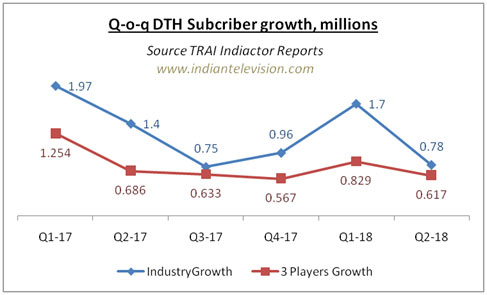
    BENGALURU: The carriage industry and more specifically the direct to home or DTH industry had a disappointing fiscal year 2017 (FY-17, year ended 31 March 2017) in terms of subscriber growth. Going by the subscriber numbers data of the six private DTH players in India provided by the Telecom Regulatory Authority of India (TRAI) in its Indicator Reports of the Indian Telecom Sector. This dismal performance seems to have spilled over to the second quarter of financial year 2017 (FY-18, year commenced on 1 April 2017 until 31 March 2018) as per TRAI data for the quarter ended 30 September 2017 (Q2-18, quarter under consideration). The industry could add just 2.47 million subscribers during the first six months (first 2 quarters, 1 April 2017 to 30 September 2017) as compared to the 3.37 million subscribers it added during the corresponding year six-month period the year before. Active DTH subscribers added in Q2-18 were just 0.78 million as compared to 1.4 million in Q2-17.

    Further, as reported by us earlier, despite the sunset date for DAS IV having passed, the DTH industry had not been able to leverage the opportunity that it was presented with. Earlier, TRAI numbers for the six private players in the DTH industry showed a very poor growth rate of just 0.96 million and 5.08 million during the quarter and year ended 31 March 2017 (Q4-17, FY-17) respectively. This figure is far lower – less than one-third of the 17.38 million active DTH subscribers that were added in fiscal 2016 by the six.

    Please refer to the figure below – The three players whose numbers are available in the public domain and whose combined q-o-q subscriber growth has been represented in the figure are Dish TV, Airtel DTH and Videocon d2h

    public://1_6.jpg

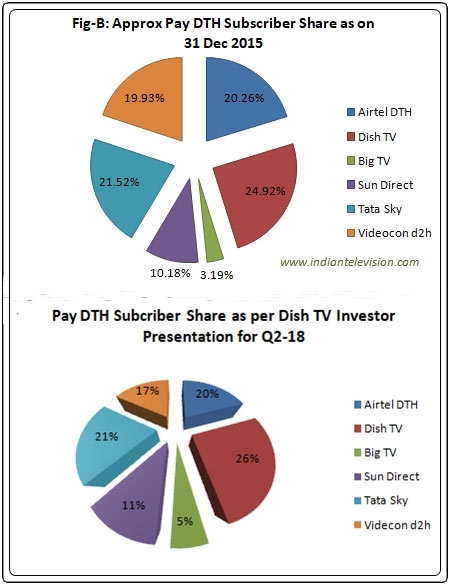
    Let us understand the status of the DTH industry at the end of September 2017. The six private DTH players are – Dish TV, Tata Sky, Airtel Digital Services (Airtel DTH), Videocon DTH, Sun Direct, and the Anil Ambani-led Reliance Big TV (Big TV). It may be noted that Big TV announced closure of its operations since November 2017. The three players – Dish TV, Airtel DTH and Videocon d2h represented approximately 63 to 65 percent of the active pay-TV DTH subscribers at the end of September 2017. Please refer to figure below for subscriber share of the private DTH players as per data in the public domain:

    public://2_1.jpg

    Besides the six private pay DTH players, Doordarshan’s (DD) Free Dish DTH service is a major player in terms of subscribers with an estimated 22 million as per the numbers available in the public domain. It must however be noted that an exact number for registered or active subscribers is not available even with DD, since this is a free DTH service. When the announced Dish TV Videocon d2h merger happens, the merged entity will probably be one of the largest DTH players in the world in terms of subscriber numbers.

    According to an E&Y report titled ‘India’s Free TV’ released in July 2017, among the DTH operators in India, DD Free Dish has grown to become the largest with its estimated 22 million subscribers which E&Y predicted could cross 40 million over the next two to three years.

    A number of reasons can be attributed to this dismal performance – two of the chief ones that are touted over the recent past by most players in media and entertainment industry – demonetisation in November 2016 and the implementation of GST. Another important reason could be that DTH is considered a premium service – by all the stakeholders in the carriage ecosystem with the resulting perception that procurement as well as monthly subscription will be premium and hence a deterrent for the consumer. While some players such as Dish TV have been making attempts to come up with packages that it perceives should attract the masses, but, results as per TRAI data seem to indicate otherwise. Yes, Dish TV is the largest private player in the country that has come up with different pricing models under different brands. Whether unwittingly or not, most of the other players present themselves as premium players and seem to have done little in that direction.


  • DTH subscriber growth on upswing in first quarter?

    DTH subscriber growth on upswing in first quarter?

    BENGALURU: Is the DTH subscriber growth in the first quarter of fiscal 2017 (Q1-18, quarter ended 30 June 2017, current quarter) on an upswing?  Of the six private players in the Indian DTH ecosystem, three are publically listed and their numbers are available in the public domain. Two players, Airtel DTH and Dish TV, have indicated a quarter-on-quarter growth in number of subscriber additions. Telecom Regulatory Authority of India (TRAI) has yet to release subscription numbers for Q1-18.

    Airtel has indicated subscriber additions of 0.499 million for Q1-18 as compared to 0.228 million for the previous quarter (quarter ended 31 March 2017, Q4-17, previous quarter). Dish TV reported adding 0.186 million subscribers as compared to an estimated 0.165 million additions for the previous quarter.

    The third player – Videocon d2h reported adding 0.13 million subscribers in Q1-18 as compared to the slightly higher 0.14 million for Q4-17. It may be noted that subscriber numbers are generally rounded off by the players in their reports, in some case to an extent of 10,000. Also, the sum of the net subscriber additions per quarter may not be equal to the overall subscribers reported as added in a fiscal by the companies because of subscriber churn and rounding off.

    Please refer to the figure below:

    public://F1_18.jpg

    As reported by us earlier, despite the sunset date for DAS IV having passed, the DTH industry had not been able to leverage the opportunity that it presented. Financial results of  Airtel Digital TV (Airtel DTH), Dish TV, and Videocon DTH show poor subscriber adds in the quarter ended 31 March 2017 (fourth quarter, Q4-17). As a matter of fact, subscriber additions in Q4-17 was the lowest that the three Indian major operators reported in a quarter for the financial year ended 31 March 2017 (FY-17). The combined subscribers for all the three players grew 8.33 percent to 41.23 million in FY-17 from 38.06 million in FY-16. In FY-16, the three players had added about 65 percent more subscribers in absolute numbers at 4.93 million as compared to the 3.81 million added in FY-17.

    The DTH industry witnessed a slowdown in subscriber growth even in fiscal 2016. Combined subscriber additions of the three pay-direct to home operators in India for the annual period ended 31 March 2016 (FY-16) vis-à-vis the previous year (FY-15) grew by 14.8 percent.  This subscriber growth rate was however was much lower than the growth that these entities had in FY-15 at 24.7 percent as compared to FY-14.

    The current DTH scenario in India

    Dish TV is at present the largest private DTH player in the country in terms of number of subscribers. The three players – Airtel DTH, Dish TV and Videocon d2h represent about 60 to 65 percent marketshare of the pay-TV DTH industry subscribers. The other three players are Tata Sky, Sun Direct and Big TV. Please refer to the figure below for the estimated subscriber marketshare of the private pay-TV players.

    public://F2_9.jpg

    The government’s FreeDish DTH service is the largest DTH player by far in terms of subscribers with an estimated 22million or 2.2 crore subscribers in 2016 as per the KPMG-FICCI Indian Media and Entertainment Industry Report 2017 (KPMG-FICCI M&E Report 2017) titled Media for the Masse: The Future Unfolds. It must however be noted that an exact number for registered or active subscribers is not available since this is a free DTH service. Also, the proposed merger of Videocon d2h with Dish TV will create the largest private television carriage player in India and quite likely the second largest in the world, be it cable, internet television or DTH or any other.


  • Airtel Digital TV sub base expands, even as ARPUs dip

    MUMBAI: Q1 2018 ended 30 June 2017 has been a bit of a mixed bag for the Sunil Mittal headed Bharati Airtel’s DTH biz – Airtel Digital TV. Its subscriber base expanded by nine per cent to 13.3 million as compared to 12.14 million in Q1 FY 2017 ended 30 June 2016. Net customer additions were hence around 499,000. The average revenue for the quarter however dropped to Rs 228 as compared to Rs 233 in the corresponding quarter last year.

    Revenues from the DTH segment grew at a slower pace of seven per cent in Q1 FY 2018 to touch Rs 897.4 crore (Rs 836.9 crore in Q1 FY 2017). EBIDTA in the latest quarter grew 10 per cent over the previous corresponding period to Rs 330 crore, even as its capex went up 31 per cent to Rs 266.1 crore (Rs 203 crore). Its operating free cash flow was down 35 per cent from Rs 98.1 crore to Rs 63.9 crore.

    Bharati Airtel’s cumulative investment to date in Airtel Digital TV has spurted to Rs 7225.3 crore as compared to Rs 6693.6 crore in the previous corresponding quarter.

    Cumulatively, the DTH service is contributing five per cent revenues to the telecom behemoth’s top line even as investments in the segment are at three per cent.

    Says an industry observer: “Airtel Digital TV is among the three to four players who are offering a world class service at very reasonable prices to consumers. The quality of customers who may have signed on in the last quarter could be coming in from Phase III and phase IV areas of cable TV digitization (where customers have a lower propensity to pay for the premium services) or it could be that the competition is forcing it to cut its prices. But overall it has done reasonably well in a difficult year. “

    Airtel Digital TV offers both standard and high definition (HD) digital TV services with 3D capabilities and Dolby surround sound. It offers a total of 590 channels including 67 HD channels, five international channels and four interactive services.

  • DTH subscriber growth slows down even further

    BENGALURU: Despite the information and broadcasting (I&B) ministry extending the deadline for phase IV of cable television digitisation by three months to 31 March 2017, owing to the “unsatisfactory progress of installation of set top boxes (STBs) in phase IV areas”, reports submitted by the carriage industry indicate that subscriber additions in the extended period have been low.

    Financial results of companies or entities from the carriage industry whose financial and limited operational data is available in the public domain – Airtel Digital TV (Airtel DTH), Dish TV, and Videocon DTH show poor subscriber adds in the quarter ended 31 March 2017 (fourth quarter, Q4-17). As a matter of fact, subscriber adds in Q4-17 was the lowest that the three Indian major operators reported in a quarter for the financial year ended 31 March 2017 (FY-17). The combined subscribers for all the three players grew 8.33 percent to 41.23 million in FY-17 from 38.06 million in FY-16. It maybe noted that subscriber numbers are generally rounded off by the players in their reports, in some case to an extent of 10,000. In FY-16, the three players had added about 65 percent more subscribers in absolute numbers at 4.93 million as compared to the 3.81 million added in FY-17.

    Please refer to the figure below:

    public://dth-1.jpg

    The DTH industry witnessed a slowdown in subscriber growth even in the previous year.Combined subscriber additions for the annual period ended 31 March 2016 (FY-16) vis-à-vis the previous year (FY-15) grew by 14.8percent of the three pay-direct to home operators in India.  This subscriber growth rate was however a little less than half that these entities had in FY-15 at 24.7 percent as compared to FY-14.

    Let us see where the three pay DTH players considered in this paper stand in the Indian DTH eco-system

    Airtel DTH, Dish TV and Videocon d2h have about two thirds (65 percent) of market share of the DTH universe by private players in India. Of the other three players, according to a TRAI report Tata Sky has a market share of 23 percent, while Sun Direct and Reliance have a market share or 10 percent and 2 percent respectively. It may be noted that at present probably the largest DTH player in India could be the government’s FreeDish, but since it is a free service, no subscriber data is available even with Prasar Bharati. Please refer to the chart below:

    public://dth2_0.jpg

  • With 350 astro experts & 500 hrs of programming, Dominiche SVoD launches on Airtel Digital TV

    MUMBAI: Airtel Digital TV, the DTH arm of India’s largest telecommunications provider, and Dominiche, India’s first MCN catering to the DTH & OTT ecosystem, has announced the launch of Astrovaani, a 24X7 ad-free, subscription-based video on demand (SVOD) astrology channel. This is the first time that Indian viewers will have access to on-demand, round the clock, cable content focused on astrology.

    The service is available to Airtel DTH users at an introductory price of Re 1 for first 15 days. After which subscribers can access the channel for a nominal Rs. 39 month. To activate the service, Airtel DTH subscribers can give a missed call to 9109121114.

    Astrovaani will showcase a variety of astrology techniques and practices including Tarot, Vastu, Feng Shui, Palmistry, Numerology, Healing, Face reading, Aura reading as well as Runes. Also, the programming will cover astrological accessories such as gems & precious stones, rudraksh, yantra, and lal kitaab, among other things. Predictions on Astrovaani will be made by prominent names in the field of astrology including the likes of Munisha Khatwani, Bejan Daruwala, Roop Lakhani, Neel Choksi, Swami Jaganath, Eeishaa Nisha, Ssanket Jayant Popat, Bhavesh Dave, Payal Agarwal, Pooja Shirasi, Amit Lamba, Shiv Prakash, Sharmila Mohanan, Smita Mehta, Hittesh Morjaria, Kashmira Elavia, Kirti Seth, Rasesh Shah, Smriti Panchal, Tamana C Bhatia, Biindu Khuraana, Dimple Luniya, Dr. Jyoti Jhangiani, Sarmistha, Neeta Singhal, Naqqiya Jarwalla, Dr. Prem Gupta, Sangeeta Jhangiani, Jyotsna Kapoor & many more.

    Airtel Digital TV CMO Sriram Sundresan said, “Indians have shown an appetite for content related to astrology and this service will offer them easy access to the latest related in the genre and will go a long way in answering their questions on the subject.”

    Dominiche MD Utpal Vaishnav said, “As part of our endeavor to constantly make unique and compelling content available to the DTH ecosystem, we have curated and produced the Astrovaani channel. The genre has the capability to drive a lot of viewership in India. The Astro genre also fills a significant void. Astrovaani features the best Indian astro experts, Dominiche has covered this genre most comprehensively by exclusively signing up over 350 top experts and creating over 500 hours of program content.”

  • Dish TV expects significant growth from DAS P III & IV markets

    MUMBAI: Even as India’s consolidating MSOs race ahead to digitise India’s cable TV infrastructure — albeit in fits and starts — in smaller towns and villages, direct to home platform (DTH) owners expect to capture a slice of the action there. Amongst those who have been pushing in the heartlands include state-owned pubcaster’s DD FreeDish. And, it has registered some gains there. Dish TV — which is slated to complete its merger with Videocon d2h later this year — is also hoping to partake the TV subscriber harvest in heartland India.

    “We are anticipating that 70 per cent of the new connections over the next two years would come from those living in small towns and rural markets,” Dish TV CEO Arun Kapoor told PTI, adding that, “it would be primarily because of implementation of Digital Addressable System (DAS) in Phase III and IV.” Of Dish TV’s 15.5 million subscriber base at present, around 35 per cent are from top 100 cities, and the remainder from small towns and rural markets.

    Dish TV is expecting the Average Revenue Per User (ARPU) of the DTH industry to grow over two-fold in the next five years to Rs. 450-500. ARPU would increase from the current industry average of Rs. 150-160. This would be primarily driven by growth in number of HD channels, Value Added Services on DTH platform and implementation of DAS,” Kapoor added.

    Dish TV, the Zee group DTH service arm, is hoping to formally complete the merger with Videocon Group’s DTH arm Videocon d2h by October 2017 after receiving the required regulatory approvals. The merged company would have a subscriber base of 27.2 million, making it the largest DTH service provider in the industry. The merged entity will be renamed as Dish TV Videocon Ltd., the total revenue of Dish TV and Videocon d2h together was Rs. 5,915.8 crore on a pro-forma basis for the fiscal ended 31 March, 2016.

    Dish TV has an active subscriber base of 15.5 million, while that of Videocon d2h stands at around 12.2 million. The DTH industry has around 62 million active subscribers.

    Kapoor said it was soon expecting approvals from regulatory bodies such as National Company Law Tribunal, the Competition Commission of India, and stock exchanges.

    According to Kapoor, the DTH industry, which has players such as Sun Direct, TataSky, Airtel digital TV, Reliance Digital, has a current growth rate of 10 to 12 per cent.

    Also Read  :

    Migrate registration to GST regime, DishTV persuades distributors & trade partners

    DishTV expands its portfolio by 23 channels

    Active DTH subscriber growth subdued in Oct-Dec’16 quarter

  • DTH subscriber growth retards in Q1-16 as per TRAI data

    DTH subscriber growth retards in Q1-16 as per TRAI data

    BENGALURU: We at www.indiantelevision.com had noted and said thatContrary to expectations that the sunset date of 31 December 31, 2015 (Q3-16 in financial terms in India) would rake in good numbers for the DTH industry for Q4-16 the subscriber base growth just did not happen.At that time, results declared by three of India’s seven DTH players whose results are available un public domain did notshow much of a change.Further, at that time, though Airtel Digital TV and Videocon d2h had both shown a small spike in subscriber additions between Q2-2016 and Q3-2016, overall taking the combined addition in subscription numbers by all the three, the change was just 3.59per cent. In the case of the third player-Dish TV, it witnessed the lowest growth over a five quarter period starting Q3-2015 until Q3-16 at 2.19 per cent.

    Results for Q4-16 (quarter ended 31 March 2016) showed a reversal of sorts in that trend. Dish TV announced that it had added 5 lakh subscribers – the highest additions in fiscal 2016. Airtel DTH and Videocon d2h added 6.19 lakh and 5.9 lakh subscribers respectively and each reported approximately 11 percent quarter-over-quarter (q-o-q) growth in operating profits in that quarter.It may be noted that TRAI (Telecom Regulatory Authority Regulatorreports for Q3-16 (quarter ended 31 December 2015) of the net active subscriber base included temporarily suspended subscribers that have been inactive for not more than 120 days – hence reflecting a huge 36 percent growth in active subscribers for that quarter.

    Besides Airtel DTH, Dish TV and Videocon d2h, there are three other private DTH players in India – Reliance, Sun Direct and Tata Sky, and the government’s FreeDish. Airtel DTH, Dish TV and Videocon d2h (the three players in this report) represent about 65 percent of the private DTH active subscriber universe in India. Please refer to Fig A below:

    public://image1.jpg

    FreeDish DTH service – the largest DTH player by far in terms of subscribers with an estimated 15 million or 1.5 crore subscribers in 2015 as per the KPMG-FICCI Indian Media and Entertainment Industry Report 2016 (KPMG-FICCI M&E Report 2016) titled The Future: Now streaming. It must however be noted that an exact number for registered or active subscribers is not available since this is a free DTH service. The proposed merger of Videocon d2h with Dish TV will create the largest private television carriage player in India and the second largest in the world, be it cable, internet television or DTH or any other.

    As per numbers released by TRAI for Q4-16 and the quarter ended 30 June 2016 (Q1-17), the growth of registered and active DTH subscribers has reduced from 4.5 percent and 4.6 percent in Q4-16 to 3.3 percent and 3.4 percent respectively in Q1-17. Overall, DTH active subscribers grew by 19.7 lakh or 8.06 percent q-o-q in Q1-17 to 605 lakh active subscribers (66 percent of registered subscribers) from 585.3 lakh (also 66 percent of registered subscribers) in Q4-16. The three players in this report contributed a combined 12.95 lakh or 65.74 percent in subscriber growth. Registered subscriber numbers were 915.3 lakh and 886.4 lakh in Q1-17 and Q4-16 respectively. In Q3-16, registered subscribers were 848 lakh.

    In Q1-17, 4.65 lakh (3.97 percent growth), 4 lakh (2.76 percent growth) and 4.3 lakh (3.6 percent growth) were added q-o-q by Airtel DTH, Dish TV and Videocon d2h respectively.

    Among the three, Airtel DTH added more net subscribers in absolute numbers in FY-16 than in FY-15, Dish TV added approximately the same number of net subscribers in both FY-15 and FY-16, while Videocon d2h saw slightly lower absolute net subscribers increment in FY-16 as compared to FY-15. Airtel DTH added 55.6 percent more subscribers in FY-16 – 16.52 lakh to reach net subscriber base of 117.52 lakh as compared to 10.62 lakh in FY-15; Dish TV added 15 lakh subscribers in FY-16 as well as in the previous year; Dish TV’s subscriber base was 145 lakh in FY-16; Videocon d2h added 16.8 lakh subscribers in FY-16 to reach a subscriber base of 118.6 lakh as compared to 17.4 lakh subscriber additions in FY-15. The above numbers are based on the financial results/investor presentations reported by the three DTH entities.

    Please refer to Fig B below.

    public://image2.jpg

    ARPU has been steadily increasing in the case of Airtel DTH and Videocon d2h, while it has was constant in the case of Dish TV at Rs 174 in Q4-16 as well as Q1-17. In Q2-17, however, Dish TV’s ARPU has dipped q-o-q by a huge Rs 12 to Rs 162.

    For the first time in Q1-17, despite having the largest subscriber base amongst the top three, Dish TV’s revenues have been the lowest. In Q2-17, Airtel DTH reported the highest revenue amongst the three followed by Dish TV, with Videocon d2h’s revenue lower by just a few crore rupees. This could be mainly because Dish TV is more of a value player, whilst the other two are premium players.  It may be noted Videocon d2h’s ARPU in Q2-17 has also dipped q-o-q by Rs 10 to Rs 209. Please refer to Fig C below for revenue and ARPU trends (Revenue numbers have been rounded off to the nearest Rs crore, ARPU numbers are in Indian Rupees, Rs)

    public://IMAGE3.jpg

    Let us see how the three have performed in Q1-17

    Airtel DTH

    Revenue from Airtel’s DTH segment in Q1-17 increased 22.2 per cent to Rs 836.9 crore as compared to Rs 684.8 crore in the corresponding quarter of the previous year. Airtel’s DTH segment reported EBIT (Earnings before interest and tax) of Rs 121.9 crore (14.6 per cent operating margin) in Q1-17 as compared to EBIT of Rs 41.5 crore (6.1 percent operating margin) in Q1-16.

    Airtel DTH added 4.24 lakh net subscribers in Q1-17 to bring its subscriber base to 121.9 lakh from 117.25 lakh in the previous quarter. Average revenue per user (ARPU) increased to Rs 233 from Rs 229 in the immediate trailing quarter. Airtel DTH reported a monthly subscriber churn of 0.8 percent in Q1-17, same as the churn in Q1-16 and Q4-16.

    Dish TV

    Dish TV reported 6.7 percent higher y-o-y subscription revenue of Rs 728.2 crore for Q1-17, as compared to Rs 682.8 crore. Operating revenue in Q1-17 increased 5.7 percent y-o-y to Rs 778.6 crore from Rs 736.7 crore in the corresponding quarter of the previous year.

    Dish TV says that:
    (1.1) For Q1-17, subscription revenue, on a like-to-like basis, was Rs 766.9 crore, a growth of 12.3 percent y-o-y.
    (1.2) For Q1-17 operating revenue, on a like-to-like basis, was Rs 817.2 crore, a growth of 10.9 percent y-o-y.

    Dish TV reported PAT of Rs. 40.9 crore in Q1-17, down 24.5 percent as compared to Rs 54.2 crore in Q1-16.

    EBIDTA in the Q1-17 increased 12.2 percent to Rs 264.6 crore from Rs 235.7 crore in Q1-16.

    The company reported addition of 4.02 lakh net subscribers for Q1-17. It closed the quarter with 149 lakh subscribers. Average revenue per user (ARPU) for Q1-17 remained the same year-over-year (y-o-y) and quarter-over-quarter (q-o-q) at Rs 174.

    Videocon d2h

    Videocon d2h is the second listed Indian DTH player to report a profit after tax (PAT), after the Essel group’s Dish TV that turned the numbers black last year. Videocon d2h reported PAT of Rs 2.7 crore for Q1-17. For the corresponding year ago quarter (Q1-17), the company had reported a loss of Rs 24.4 crore and for the immediate trailing quarter (Q4-16) reported loss was Rs 21.2 crore.

    Videocon d2h subscription and activation revenue in Q1-17 increased 23.9 percent y-o-y to Rs 752.3 crore from Rs 607.3 crore and increased 6.6 percent q-o-q from Rs 705.6 crore.

    The DTH major also reported 15.5 percent year-over-year (y-o-y) growth in net subscriber number growth at 122.9 lakh for Q1-17 as compared to 106.4 lakh and a 3.6 percent quarter-over-quarter (q-o-q) growth from118.6 lakh. Average revenue per user (ARPU) in Q1-17 increased to Rs 219 from Rs 205 in Q1-16 and from Rs 214 in the immediate trailing quarter.

    Subscriber monthly churn in the current quarter was 0.49 percent; in Q1-16 it was slightly lower at 0.46 percent, while in the immediate trailing quarter it was much higher at 0.58 percent.

    Comments

    There is not much of a change in the comments and conclusions drawn by us for FY-16 numbers. Overall, the pay DTH industry is turning profitable as is obvious from the results.

    DAS III and IV were/are sunshine periods for the television carriage industry. Activation revenues have been adding to the top lines and bottom lines of most of the players. Have they been able to optimise the opportunity that DAS has offered? Not fully! At present the focus of a majority of the players is more investor oriented, not viewer oriented. This has to change. DTH has the potential to grow even more than the predictions of the industry pundits, provided they get their act together in coming out with packaging – as has Dish TV to a limited extent. India is a price sensitive market, offer the viewers what they want at a reasonable price and the sheer volumes will bring in more and more moolah.And what happens to profits once the activation fee component goes down?