Tag: AIR

  • Decision on Arasu DAS licence will depend on Govt. view on Trai report

    Decision on Arasu DAS licence will depend on Govt. view on Trai report

    NEW DELHI: The Government has said the application by the Tamil Nadu Arasu Cable Television Corporation Ltd. for issuance of a digital addressable system licence is under consideration.

    However, Information and Broadcasting Ministry sources said that the application was being examined in the light of the report of the Telecom Regulatory Authority of India (Trai) which is opposed to granting licences for television channels or distribution networks owned or supported by state governments or political parties.

    The sources also said that no time frame could be given for a final decision on the application for registration as multi-system operator received on 5 July last year to operate in notified areas of Chennai.

    A newly constituted Inter-Ministerial Committee was currently examining the recommendations of Trai in its report in mid-December reiterating its stand taken in 2008, and so a decision on Arasu would be taken only after this process is finalised.

    Chaired by the Additional Secretary of the I&B Ministry, the IMC has representatives of the Departments of Information Technology, Telecommunications, Economic Affairs, and Industrial Policy and Promotion apart from some experts. The representatives of these Ministries should be of a rank not lower than Joint Secretary.

    The two Joint Secretaries (Broadcasting) in the I&B Ministry serve as member secretaries depending on the subject and section concerned.

    The experts are: Chairman and Managing Director of the Broadcasting Engineering Consultants India Ltd., the Director-Generals of Doordarshan and All India Radio, and the Engineers-in-Chief of DD and AIR.

    The Committee may co-opt any number considered necessary from time to time.

    Recommendations of the IMC would be communicated to the I&B Ministry Secretary and ‘thereafter to the Minister for instructions on matters relating to the recommendations of Trai.

  • IRS Q3 2012: Malayalam magazine Vanitha continues to be most read magazine

    MUMBAI: Malayalam fortnightly magazine Vanitha continues to be the most read magazine in the country despite fall in numbers, according to the latest Indian Readership Survey (IRS) for the third quarter of 2012 conducted by the MRUC.

    Vanitha saw a decrease in its all India readership (AIR) to 2.271 million in the third quarter of 2012 from 2.353 million in the preceding quarter.

    Hindi monthly Pratiyogita Darpan continues to be the second most read magazine with a readership of 1.894 million, down from 1.918 million in Q2.

    Another Hindi monthly magazine Samanya Gyan Darshan was the third most read. Its readership actually increased to 1.733 million in the third quarter of 2012 from 1.644 million a quarter earlier.

    The fourth most read was India Today, which saw an increase in readership to 1.526 million in the third quarter from 1.554 million a quarter earlier.

    The pecking order of Hindi magazines remained unchanged with Patiyogita Darpan at the top followed by Samanya Darpan. Fortnightly publication Saras Salil was at number three, but saw a drop in AIR to 1.351 million in the third quarter from 1.548 million a quarter earlier. Seven out of the 10 Hindi magazines saw a drop in AIR for the third quarter of 2012.

    Amongst the English magazines, India Today retained its top position though its readership decreased from 1.554 million in the second quarter to 1.526 million in the third quarter. Second spot holder General Knowledge Today too saw a drop in readership to 1.047 million in Q3 from 1.087 million a quarter earlier. Seven out of the 10 English magazines saw a drop in AIR for the third quarter of 2012.

    In the Indian language magazines too Vanitha leads. Bengali weekly Karmakshetra takes the second spot with its readership increasing from 1.168 million in Q2 2012 to 1.183 million in Q3 2012. The readership of Malayala Manorama too rose from 1.113 million in Q2 2012 to 1.053 million. Occupying the fourth spot is Karmasangsthaan with .996 million readership in Q3 as compared to .964 million in Q2.

  • Govt wakes up to the power of social media, begins monitoring

    Govt wakes up to the power of social media, begins monitoring

    NEW DELHI: Stung by the campaigns on the social media both in the Delhi gang rape case as well as on the India-Pakistan exchange of fire on the Line of Control, the Information and Broadcasting (I&B) Ministry has set up a group to monitor the various social media channels on the internet.

    While the anti-corruption campaign and gang rape messages on the social media showed how people could be mobilised to come onto the streets, the campaign relating to the killing of two Indian soldiers also exposed the fragility of this medium to creating tensions between nations.

    It is learnt that the group has been instructed to give a weekly report to I&B Minister Manish Tewari on what the social media is saying on crucial issues. The team is tracking all social media including Twitter, Facebook and blogs.

    The ministry has not just begun monitoring the social media channels, but also increased its own presence on the internet. Even as it had earlier launched a page on Facebook on digitisation, the ministry as well as All India Radio (AIR) and Doordarshan (DD) have created separate accounts on Twitter.

    The ministry also launched itself on YouTube late last year and publicised this at the International Film Festival of India (IFFI) in November. This can be downloaded on android phones and will soon be made available on other smart phones through a special download application.

    India has over 120 million Internet users – Twitter has about 16 million subscribers and Facebook over 60 million from India. The penetration of 3G will mean more exchange of data. Mobile sales may soon touch the 250 million mark in India.

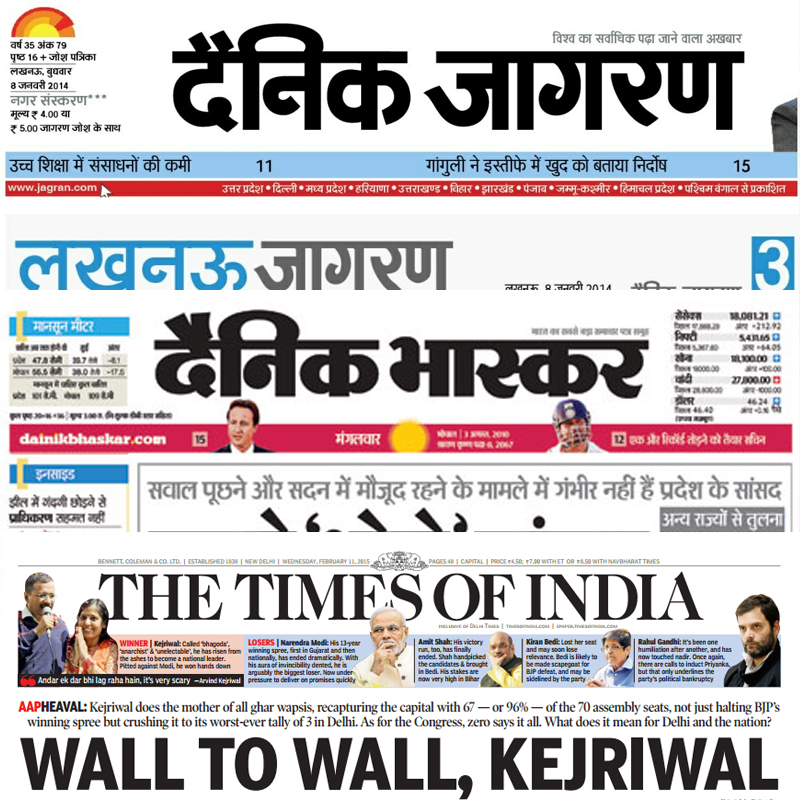
  • IRS Q4: Dainik Jagran, TOI continue to dominate

    IRS Q4: Dainik Jagran, TOI continue to dominate

    MUMBAI: Dainik Jagran and The Times of India continue to be the most read Hindi and English dailies, according to the Indian Readership Survey (IRS) Q4 report, released by the Media Research Users Council (MRUC) and Hansa Research.

    However, breaking the trend from Q3, Dainik Jagran recorded a decrease in its average issue readership (AIR) from 16.46 million in Q3 to 16.41 million in Q4. It saw a negative of 0.3 per cent.

    Dainik Bhaskar, meanwhile, continued to be second and recorded an AIR of 14.60 million, down 1.84 per cent, compared to 14.88 million in Q3.

    While the top five places did not see any major changes, the top two recorded decrease in AIR while Hindustan, Malayala Manorama and Amar Ujala (third, fourth and fifth position respectively) gained readership.

    Maharashtrian daily Lokmat and Tamil publication Daily Thanthi swapped places to land up at No. 7 and 8 respectively. The Tamil daily’s AIR was recorded at 7.5 million while the Marathi publication’s AIR was 7.5 million

    Among the English dailies, The Times of India leads with a readership of 7.62 million, an increase of 2 per cent over previous quarter’s AIR of 7.47 million.

    While the top six dailies maintain the pecking order from the last quarter, the last four positions have seen some shuffle with The Economic times (AIR 790,000) slipping to No. 8 and Mumbai Mirror (AIR 803,000) climbing to No. 7.

    The ninth and tenth positions also saw a change as The Tribune (AIR 585,000) slipped to No. 10 while The New Indian Express (AIR 637,000) settled at No. 9.

    The regional dailies also experienced changes in the top ten order. While Lokmat went up a notch to No. 2 with AIR of 7.56 million, Daily Thanthi replaced it at the No. 3 spot with a readership of 7.5 million. Eenadu slipped down the ladder to sixth position with AIR of 5.99 million, propelling Anand Bazar Patrika to fifth spot with a readership of 6.05 million. Tamil daily Dinakaran dropped down to No. 8 at an AIR of 5.22 million while Telugu daily Sakshi bumped up to No. 7 with AIR of 5.3 million.

  • IRS Q3: Vanitha retains top spot among magazines

    IRS Q3: Vanitha retains top spot among magazines

    MUMBAI: The Indian Readership Survey (IRS) 2011 for the third quarter carried out and released by Media Research Users Council (MRUC) and Hansa Research revealed that there isn’t much change in the readership base of the top five magazines in the country.

    Retaining its numero uno position, Malayalam fortnightly Vanitha recorded an average issue readership (AIR) of 2.59 million. Pratiyogita Darpan also maintained its position at number two with an AIR of 2.02 million.

    Last quarter‘s number nine and ten, Kumudam (Tamil) and Grehlakshmi (hindi) respectively lost their positions to English magazine General Knowledge Today (with an AIR of 1.09 million at number nine) and Bengali magazine Karmakshetra (AIR 1.05 million at number 10).

    Among the Hindi magazines Pratiyogita Darpan‘s AIR stood at 2.02 million topping the list while Saras Salil followed second with an AIR of 1.94 million.

    Slipping down to seventh position, Grehlakshmi recorded an AIR of 983,000 while Grih Shobha, which took its place at number six, clocked in an AIR of 990,000.

    Among the English magazines, India Today continues to lead with 1.64 million AIR. Reader‘s Digest (AIR 998,000) made way for General Knowledge Today (AIR 1.09 million) at number two while it slipped down to number three.

    Further down the list Stardust climbed up to number seven with AIR of 385,000 and while Business Today moved up to number eight (from number 10 last quarter) with an AIR of 345,000. Recording the deep plunge in the ranking, Filmfare fell to number 10 from previous quarter’s number seven with an AIR of 327,000.

    In the regional languages sector, the Malayala Manorama continued to be second with an AIR of 1.31 million while Kumudam slipped down to number four with an AIR of 1.03 million. Taking its place, Bengali weekly magazine Karmakshetra recorded a readership of 1.05 million.

    Tamil weekly Ananda Vikatan fell from number six in the last quarter to number nine in Q3 with a readership of 781,000 while Bengali weekly Karmasangsthaan climbed three spots to reach number six with a readership of 855,000.

  • 2010 a year of wait for FM radio

    2010 a year of wait for FM radio

    For the private FM radio broadcasters, 2010 was more of a wait for positive government policies that would fuel the sector’s growth that has been somewhat stunted.

    But the year ended on a positive note that things would move in 2011 – at least as far as permitting news and launching Phase III of FM radio was concerned. And some steps were also taken towards taking a decision on increasing foreign direct investment in the radio sector.

    Besides, some positive steps were taken towards revenue sharing on copyright of radio and other music, though this still needs to be ironed out with the music industry not too happy with the outcome so far.

    With the Group of Ministers (GoM) on FM radio Phase III finalising the e-auction model, the radio sector is poised for an exponential growth in India. The e-auction will also pave the path for a transparent process much along the lines of the 3G auctions held last year.
     
    There is a proposal for allowing 806 private FM Radio stations in Phase III in addition to the 245 channels at present. In addition, All India Radio (AIR) is getting ready to launch a total of 320 FM radio stations.

    The GoM headed by Finance Minister Pranab Mukherjee decided against the conventional open auction model and instead chose the e-auction method.

    A total of 216 cities and towns are to get private FM radio for the first time in Phase III, out of the 302 identified by the Government and split into four categories. Of the 86 cities and towns which have private FM radio channels, 67 are to get additional channels.

    Among the four main metros (which fall in first category), Mumbai will get two more channels while Delhi and Chennai will get one each. Kolkata has filled its quota of nine private FM channels.

    The GoM also extended the licence period for the radio stations to 15 years from the existing 10 years. Some decisions were also taken with regard to Prasar Bharati rentals and music royalty by the GoM.

    The GoM accepted the Government proposal to permit relay of All India Radio news (unaltered) by private FM channels on terms and conditions worked out with Prasar Bharati, thus rejecting the view of the Telecom Regulatory Authority of India and the industry-led Federation of Indian Chambers of Commerce and Industry (FICCI). The regulator had recommended that news should be allowed to be accessed from AIR, Doordarshan, Press Trust of India, United News of India, and any other authorised news agency or television news channel.

    In the absence of a regulatory authority with a localised presence and absence of monitoring arrangements for private channels and in view of the sensitivities involved, the Government feels it is not possible to allow complete freedom to broadcast news even though the news may be sourced from authorised sources. There was a possibility of sensationalising news by the private channels in their presentation.

    However, it is clear that the issue has not ended since some private FM operators are contemplating taking up the issue with the government.

    However, no final decision has been taken so far on lifting the foreign direct investment (FDI) cap on the sector to 26 per cent from the current 20 per cent. Trai had initially proposed to raise the FDI limit to 49 per cent but cut it down to 26 per cent in its June recommendations last year. A meeting of the Committee of Secretaries headed by the Cabinet Secretary had towards 2010-end decided the note prepared by the Information and Broadcasting Ministry should be referred to the Union Cabinet. The current foreign investment limit in FM radio stands at 20 per cent.

    With FM Phase III expanding to smaller tier ‘D‘ cities, it is likely to provide greater freedom and multiple ownership, promotion of local content, talent and culture. Formats like talk shows, dramas, classic and folk music concerts, programming specifically for children, short stories and plays with a social message too are likely to be incorporated.

    Currently, the radio sector generates annual revenues worth $49.5 million and is growing at around 20 per cent annually,

    according to the joint report by KPMG and Ficci. The radio advertising industry is projected to grow at a CAGR of 12.2 per cent over 2010-14, reaching $ 342.7 million in 2014 from the present $192.8 million in 2009, as per PriceWaterhouseCoopers.

    Meanwhile not too happy with the growth of community radio, the government is organising consultation workshops in different parts of the country to increase awareness of the advantages of local radio stations.

    The country at present has a total of just over 100 community radio stations (71 with Educational Institutions, 24 with non-Governmental Organizations, and eight with Krishak Vigyan Kendras and agricultural

    science universities though the scheme was announced in April 2005.

    The Ministry says it encourages setting up of the Community Radio Stations as CRS promises to provide opportunities to the local communities to express themselves, and empower women. The main aim of starting the CRS in educational institutions is to provide different and useful information to the people in nearby villages.

    Although community radios were allowed since April 2005, the Central Government in December 2006 had liberalised the Policy on Community Radio by bringing in the civil society and voluntary organisations, agricultural universities, ICAR institutions, Krishi Vigyan Kendras etc, under its ambit. The policy was liberalised to allow greater participation by the civil society on issues of development and social change. Earlier, only educational institutions were permitted to launch community radio channels. Under the new guidelines, limited advertising and announcements relating to local events, local businesses and services and employment opportunities has been allowed up to a maximum duration of five minutes per hour of broadcast.

    A total of 48 Community Radio Stations are presently functioning in 16 states and union territories which included 42 from educational institutions and six from non-governmental organisations. Twenty letters of Intent have been issued in 2009, taking the total to 189 LoI so far.

    A total of 584 applications, including 240 applications from educational institutions, have been received from various organisations for setting up CRSs. While 79 had been rejected, a total of 316 applications were under process.

    Tamil Nadu has the largest number of CRS – 26 (up from ten at the end of 2009), followed by Uttar Pradesh with 13, Maharashtra with ten, Karnataka with nine, and Delhi with six. The number of stations in other states – Andhra Pradesh, Bihar, Chandigarh, Gujarat, Haryana, Kerala, Madhya Pradesh, Orissa, Puducherry, Punjab, Rajasthan, Uttarakhand, and West Bengal – varied between one and five.
    Clearly waiting for Phase III, no new FM channel has been launched in the country over the past 18 months. There are just over 245 private FM radio channels in the country, and the government earned revenue of Rs 1.33 billion between 2006 and September 2009 from private FM radio stations.

    FM Radio broadcasting was first launched in the country in 1999.

    Maharashtra has the largest number of private FM stations – 31 – followed by Uttar Pradesh and Tamil Nadu with 21 each and Rajasthan with 19.

    Kerala has 17 stations, while Gujarat and Madhya Pradesh have 16 each. West Bengal has 15 channels, Karnataka has 14, Andhra Pradesh has 13, Punjab has 12 and Delhi has ten stations.

    Permission given to 20 FM channels has been revoked by the Information and Broadcasting Ministry for various reasons. Of the channels that were revoked, nine belonged to Century Communications, eight to Pan India Network Infravest, two to Kushal Global, and one to Singla Properties.

    While the majority of these were refused because the channels were not operationalised within the prescribed time, the others commenced but after some time remained non-operational for a period of more than six months.

    While the Government gave permission to 266 channels including the 20 revoked later, one could not be operationalized in Aizawl in Mizoram as the Common Transmission Infrastructure is not yet ready. Under the Grant of Permission Agreement, the channels are expected to commence operations within one year of such agreement.

    Meanwhile, the Copyright Board sought to resolve the friction between the music companies and the FM radio, laying out a revenue share model for the industry that was earlier working on a fixed cost structure. FM radio companies will have to share two per cent of their net advertising revenues (total ad income minus agency commission and government taxes) with the music companies as royalty, according to the Copyright Board directive.

    The new revenue share model will work in favour of the FM radio broadcasters, while upsetting the music companies who are already weighing legal options as they see their earnings from the sector shrink.

    The FM radio broadcasters coughed out Rs 1.2 billion, or 18 per cent of their net ad revenues, as music royalty in FY‘10, according to industry estimates. A two per cent share, as the Copyright Board has directed now, would mean the music companies would have taken away just Rs 140 million in FY‘10.

    In May 2008, the Supreme Court authorised the Copyright Board to decide on the royalty rates for the industry. The Copyright Board had asked the radio and music companies to file evidence supporting their stand on the royalty issue earlier this year.

    The year 2010 ended with the music industry serving notices to various hotels and pubs in many cities and towns to pay requisite music licence fee to play music, events at these venues to mark the end of the year. Following intervention by the Phonographic Performance Ltd. (PPL), legal notices were issued to venues that have not paid the requisite music licence fee to play music at their year-end events. PPL plans to initiate strict legal action against defaulters in case the licence fee does not get paid ahead of their planned events.

    Under the statutory sanction of section 35 in the Indian Copyright Act, playing commercial music in public without paying the requisite licence fee is an offence liable to contempt of court. Section 35 grants exclusivity to PPL to issue licences to hotels/pubs for playing music during the events in their respective premises. The tariff is calculated on the basis of the number of hours the music is to be played and the number of people expected to attend the event. The penalty can be imprisonment for three years and a fine of up to Rs 200,000.

    For the sector that is under severe revenue crunch, 2011 could be the turning point as the government opens up new geographies under Phase III.

  • Snow White & the Seven Dwarfs, the Best Loved Musical of All Time to Air on Disney Channel

    Snow White & the Seven Dwarfs, the Best Loved Musical of All Time to Air on Disney Channel

    Mumbai, June 21, 2006: Oscar Nominee for Best Music Score and winner of numerous awards, Snow White and Seven Dwarfs (1937) will air on Disney Channel on Saturday, June 25th, 2006 at 6:00 p.m. This is the first ever full-length animated feature in color and with sound, which is also one of Disney’s greatest films, and a pioneering classic tale in film history.


    The most revered of all Disney films, Snow White and the Seven Dwarfs is alive with fairy tale magic, heart pounding suspense and rousing adventure. Once Snow White’s vain stepmother, the wicked Queen, consults her Magic Mirror to learn that her stepdaughter’s beauty surpasses her own, the lovely young girl must flee into the forest.

    There she meets seven lovable dwarfs: Dopey, Sleepy, Sneezy, Bashful, Happy, Doc and the rough edged, Grumpy. Despite their devotion, the dwarfs cannot save Snow White from the Queen’s evil spell – the spell that can only be broken by Love’s First Kiss!


    Will the evil Queen succeed in getting rid of her stepdaughter in her quest for the title “fairest of them all”? Find out on Snow White and the Seven Dwarfs on June 25th at 6:00 p.m. on Disney Channel.


    About Disney Channel:

    Disney Channel offers an unparalleled blend of quality Disney entertainment and distinctive, originally produced programs that kids love and families trust and enjoy. This includes Disney’s movies and series, sitcoms, family dramas and live action adventure stories. The channel’s multi-genre programming is designed to meet hitherto under-served needs of India’s preschool, kids and family audiences, by addressing specific entertainment genre gaps.

  • Radio industry in 2007 – an overview

    Radio industry in 2007 – an overview

    over the past two years the radio industry has moved beyond AIR with private FM stations lapping up the airwaves. The three policy initiatives from the Government — migration to a revenue-sharing regime, allowing foreign direct investment upto 20 per cent and opening up the sector to 91 more cities by issuing 338 licenses’ to private players — have aided this growth tremendously. FM Phase II saw as many as 245 more stations bagging licenses’, most of which went up this year. Phase II has provided a fresh lease of life to the radio industry and has really taken the medium to the next level. Things only look better from here, given the way this has helped new stations to come in, the existing and serious players to organise more and convert radio into a revenue making option.

    Year 2007 for the radio industry was the year of expansion. The radio industry is growing immensely and also doing very well, the number of people listening to radio each day has also increased, hence acknowledging this as the local medium of communication. The recent RAM results that were out recently proved how well the industry is doing. Spends on radio have definitely gone up and radio today, is the most cost-effective medium. Radio is becoming an important part of the advertisers advertising mix. The future will see more advertisers coming on board…

    RAM (radio audience measurement)
    Radio listenership measurement is a critical aspect to the industry, the emphasis being on ‘timely’ measurement and not just dated results that come in over three to six months. The radio category needs to grow to where it deserves and with the RAM coming in, it is a move in the right direction. What is measured is what is bought and RAM has worked extremely well for the radio industry.

    BIG 92.7 FM in 2007
    The year 2007 has been excellent for BIG 92.7 FM; the stations for phase II were rolled out, as we stand as a 42 station strong network today, spread across the length and the breadth of the country. The fastest rollout of stations among all players and making us the biggest radio network in the country. As per figures released BIG 92.7 FM is the No. 1 choice of listeners in Bangalore across all parameters – including reach, share and TARP. In Mumbai, it is the highest reached station, while in Delhi; it is the No. 2 station among 12-34 year old, SEC ABC listeners. BIG 92.7 FM will see expansion of our network in 2008; more stations will be added to our network as Govt. opens up more licenses.

    The numbers are looking very good especially given that BIG 92.7 FM is just about a year old. It reaffirms our positioning and content strategy which has helped the brand stand out in the cluttered environment. With competition heating up among brands, ‘differentiation’ is the key and we have managed to stand out with our ‘listener focused’ positioning of Life Banao as well as our distinct music.

    Next on BIG’s radar –
    ” The goal is to increase the size of radio’s share of the advertising pie from 3 per centto 7 per cent over the next three years.
    ” Consolidate post our launches and ensure sustained leadership in all our stations
    ” Digital integration with radio – more emphasis on our web portal, podcasting, internet driven interactivity etc

    Key landmarks / events:
    Year 2007 has been an eventful year for BIG 92.7 FM, and has certainly lived upto to its brand line of ‘Suno Sunao, Life Banao’.

    A combination of large national properties and hyperlocal content helped us grow rapidly in a sort span of time. BIG 92.7 FM has always believed in innovation in content and marketing. We launched a unique challenge & contest done for the first time ever on radio in association with Hyundai i10 called ‘Chipak Ke Jeeto’ which is the biggest endurance test to be held across key metros wherein the person who touches the car for the longest time walks away with a brand new Hyundai i10 car! The ‘Sabse BIG Diwali’ campaign with ICICI bank credit cards was launched with much fanfare- offered discounts from 9.27 per cent to 92.7 per cent on various products. Tied up various NGOs’ across the country and hosted the ‘Sabse BIG Diwali’ party with the senior citizens.

    The year 2007 also saw BIG 92.7 FM radio partnering for some of the biggest banner movies and TV shows like Ta Ra Rum Pum, Jhoom Baraabar Jhoom, Cash, Saawariya, Nach Baliye 3, Sa Re Ga Ma Pa, Jhoom India, while also entering into a strategic partnership with the Indian Television academy for the ‘ITA 7th Annual Indian Television Academy Awards’. BIG 92.7 FM also roped in the iconic Raju Shrivastav and escalated the humor quotient of the station – BIG RJ Raju Shrivastav provided listeners their daily dose of Raju Shrivastav jokes every morning on the breakfast show across the country.

    We pioneered the coverage of sporting events on radio with the award winning coverage of the PHL, ICC tournament and the T-20 World Cup. For the first time ever, BIG FM brought on radio, eminent personalities like Harsha Bhogle and Shekhar Suman, Kris Srikkanth and Mandira Bedi, which created a new and exciting experience for listeners across the country.

    Speculations for the year 2008
    The Indian radio sector is poised to become a Rs 1,200-crore industry by 2010, according to a study conducted by the Federation of Indian Chambers of Commerce & Industry and PricewaterhouseCoopers.

    With the majority of licenses in Phase II going operational by the end of this year, 2008 is going to be a very good year for Radio; the industry will experience dramatic expansion in its listener base leading to significant growth in business. 2008 will be the Tipping Point for the radio industry.

    We hope that news and current affairs will be opened for private radio broadcasters. In the event this does happen, this will lead to a new wave of growth for radio in 2008.

    For BIG 92.7 FM, listeners are going to be witnessing far more exciting and interesting radio activity. Our initiatives will focus on creating more relevant and innovative content for our listeners, tapping into new trends and insights we observe among the youth.

    So stay tuned and Suno Sunao, Life Banao!

  • FM radio – Abuzz with activity

    The floodgates opened in 2007.

    The year gone by was a time when years of hard work and patience finally paid off for the radio industry in India. It was a year of intense competition, aggressive marketing and marginal creativity as private FM finally flowered in metros as well as tiny towns throughout the nation.

    Even though advertising crept up only slowly, and the government continued to pussyfoot around the issue of allowing news and current affairs on private radio, the mood stayed upbeat throughout the radio industry.
    With phase II of FM opening up the industry for private players, there was no holding back.

    Consider these figures. In 2006, 26 private FM stations were operationalised. In contrast, AIR saw ten FM stations operationalised in 2004 and an equal number in 2005, with just two in 2006.

    By October 2007, a total of 281 FM channels include 161 of All India Radio and 120 privately owned channels were operational.

    By the year end, there was a scramble among operators to put up stations in the 91 cities for which licenses had been doled out – held up in many places by the government’s delay in activating the transmission towers. It was no mean task. Entities like Big FM and Sun’s SFM have a quota of 45 stations each to put up, Mirchi has 32 and Bhaskar, the late entrant hurried to put up 17 stations on air. Most have reached their targets, some like BAG Films’ Dhamaal is yet to launch in four cities, and India Today’s Meow has five more cities in its kitty.

    But more than these numbers, it was programming and marketing of stations that were put up in a hurry that hogged the limelight. A trove of radio jockeys was unearthed from various corners of the country (some poached, a lot honed) to give that much needed edge to the programming, while contests and on ground events (particularly in the small towns) jostled for listener attention.

    The core content, despite the operators’ insistence to the contrary, stayed what the listener apparently wanted the most – Bollywood music.

    Music all the way
    They gave it their own tags – superhit music, hot adult contemporary music, latest hits – but the fact remained that recent Bollywood music played on most stations throughout the day, with experiments like western music and ‘old’ tracks relegated to the very early mornings or the very late nights.

    Very few, like Radio Indigo and Fever played differential western music and could attract only niche audiences, and fewer like Meow FM decided to take the ‘talk’ format and address the female audience directly. While Meow claimed that it had managed to hook the feminine ears in both Delhi and Kolkata, the other stations played safe and stuck to the ‘less talk, more music’ formula.

    The innovations came in other forms – Big FM devised a 100 chartbuster formula, to keep playing the ‘most wanted’ music all the time, while Radio One went for the 20 20 format to keep the elusive listener hooked to a show. “The 20 minute format works on the principle that if a listener is listening to an average time of 20 minutes, the programming mix is designed to achieve that,” officials averred, when the format launched in June.

    Radio City amplified its outlook with the Whatte Fun concept, that started with a music video and spun across programming to become a microsite of its own, which will probably have a larger life of its own in 2008. Big FM’s new digital division will be another entity to watch out for in 2008; launched in the last part of ’07, it began small with a podcast of its Bangalore station but promises a lot in the digital space.

    It was the myriad contests that remained the nectar to attract the bees, however. In the absence of a regular audience tracking methodology till October end, when TAM’s Radio Audience Measurement came into being, contests and big prizes stayed the carrots with which stations enticed listeners, who in the absence of differential programming, exhibited no real station loyalty.

    CSR also remained a strong buzz word on radio – from distributing raincoats to traffic police paying tribute to Kargil martyrs , aiding the flood hit in Rajkot to spreading AIDS awareness among truck drivers, the initiative also became a good on ground activity to popularise the stations.

    ‘Ad’ding up the revenues
    Overall radio advertising revenue, that was at Rs 3180 million in 2005, was expected to touch around Rs 6800 million this year, a figure that would still be around six per cent of the total ad pie.

    Advertisers are slowly but steadily beginning to view radio as a medium that can reach out to people, and need no more be a supporting medium. As industry veterans had predicted, the presence of more stations, drove listenership which fetched more ads too.

    Players like Big FM introduced uniform rate cards for advertisers in all its stations across India, to bring in rate transparency. Elsewhere, companies like MBPL offer sales support to Gwalior’s ‘Suno Lemon’, while a Radio Mirchi managed Radio Ghupshup’s national ad sales.

    Radio itself used other media aggressively to advertise itself, with radio stations’ advertising on TV tripling in one year.

    A measure of success
    After a long stint of the lone Indian Listenership Track of the MRUC that would release data in phases through the year, TAM finally brought out its data in the form of the Radio Audience Measurement by the end of October. While a majority of the stations contributed to the service, the initial findings released by RAM (operational only in Delhi, Mumbai and Bangalore with Kolkata on the cards) created a tizzy of sorts in the industry with stations staking claim to numero uno positions in either reach, listenership or in respective TGs. A few months down the line, the RAM data should help the industry find its feet, and tailor programming and marketing to suit the market it addresses.

    All India Radio
    The reign of the unchallenged state sponsored monarch was challenged in a big way in 2007, but some of the RAM figures indicate that AIR’s own FM, operational even in border areas where terrrestrial reach is a problem, continues to hold its own. AIR also continues to enjoy a monopoly on news and current affairs aes well as live cricket commentary, an area that gives it a huge edge over private FM competitors. The other player in the satellite space, Worldspace Radio, did not fare much better, despite innovations like a tie up with MSN India for streaming its content online.

    Community radio, 26 stations of which became operational this year, should become a force to reckon with this year. The government is also considering the proposed 5,000 licenses it plans to issue to be divided into sectors, such as farming community, fishing community, women and children and others, and issue the licenses accordingly.

    At present 26 stations, all by educational institutions are using community radio.

    Code of conduct
    While the I and B ministry said there would no separate regulatory authority for FM stations other than the Broadcast Regulatory Authority of India conceived in the proposed Broadcast Regulatory Services Bill, the Association of Radio Operators of India (AROI) formed an advisory committee for the creation of a self-regulatory Content Code for private FM radio broadcasting.

    The year wasn’t without its share of controversy. Uninhibited chatter by radio jockeys turned into a crisis of sorts when the north east erupted over a wayward comment on the Indian Idol winner. The case still hangs fire.

    Upward swing
    Needless to say, the sudden spurt of FM brought with it a fresh wave of young listeners, a wave aided in no small measure by the increasing reach of the mobile phone, which came loaded with the FM features. Over 85 per cent of radio listenership in metros by the end of the year happened on the move. The figures will only go up this year. Whether the curve is matched by an increased burst of creativity now remains to be seen.

  • Big FM brings Cricketainment to radio

    Big FM brings Cricketainment to radio

    MUMBAI: With cricket fever gripping the nation, radio has decided to jump onto the bandwagon as well. Big FM today announced two new shows based on cricket in the run up to the World Cup.

    The FM has on board cricket commentator Harsha Bhogle and actor Shekhar Suman hosting two news shows on cricket.

    ‘Big Googly’ hosted by Shekhar Suman is a funny take on everything to do with cricket- the sponsors, the locker room brawls, the hits and near misses. The show to be aired during drive time in the evenings will keep listeners entertained with all the gossip around cricket and World Cup.

    Says Shekhar Suman, “Cricket has always been about entertainment and this show is about viewing the game in a lighter vein.” For good measure he also adds, “Thank God for radio, or it would have been someone in noodle straps who would be doing the show.”

    Cricket commentator Harsha Bhogle is not new to the medium. He started his career on AIR, Hyderabad before moving to television.

    On what Big Cricket expert would feature Bhogle pointed out that, “The whole question of cricketainment being debated today is quite strange. Cricket has always been all about entertainment. Until such time as we can have ball by ball commentary on private FM, radio will do a great job of providing analysis and updates on the matches.”

    Big Cricket Expert hosted by Bhogle will include a pre match show on the days of the match. He will also present a ‘Breakfast Show’ with post match analysis the following day.

    Big FM also plans to get in celebrities to give their take on the World Cup and its players.

    Speaking on this celebrity mix for ‘cricketainment’, Big FM national programming head Manav Dhanda said, “Cricket is believed to be a purists game for a lot of people in our country and therefore we have the best in the business to talk about the serious side of cricket- the matches et al. Shekhar Suman clearly brings in the fun element with his own brand of humour.”

    Big Googly and Big Cricket Expert are both national properties and will be aired across all the 12 Big FM stations operating across the country. The FM has also planned a series of a contests and interactive features around the two shows.